
Quick Answer
The cheapest septic system to install is a conventional gravity-fed system, typically running $3,000–$7,000 fully installed. It uses no pumps, no electrical components, and no moving parts — just gravity doing the work. Whether that system is an option for your property depends entirely on your soil, slope, and local code.
Key Takeaways
- A conventional gravity system is the least expensive option at $3,000–$7,000 installed
- Holding tanks cost less upfront ($1,500–$5,000) but carry significant ongoing pump-out expenses
- Soil quality, lot size, and local regulations determine which system types are even available to you
- The national average for septic installation runs $7,000–$9,000 across all system types
- Cheap upfront doesn't always mean cheap long-term — aerobic systems cost more to install but serve problem soils where gravity systems simply won't work
About 1 in 5 U.S. homes — roughly 21 million households, according to the EPA — rely on a private septic system. If you're building on raw land, replacing a failed system, or putting in a septic for a cabin or small house, the price spread between system types is enormous. We're talking anywhere from $3,000 to $25,000 for the same basic function.
This guide ranks every major system type by total installed cost, breaks down what's driving those numbers, and tells you exactly where you can cut costs — and where cutting costs will cost you more later. Some homeowners even consider a DIY septic system build to trim labor costs, an option we touch on further down.
Septic System Cost Ranking: Cheapest to Most Expensive
Here's the complete ranking by installed cost. These are total project figures — tank, drain field, excavation, labor, and permits — not just the tank purchase price.
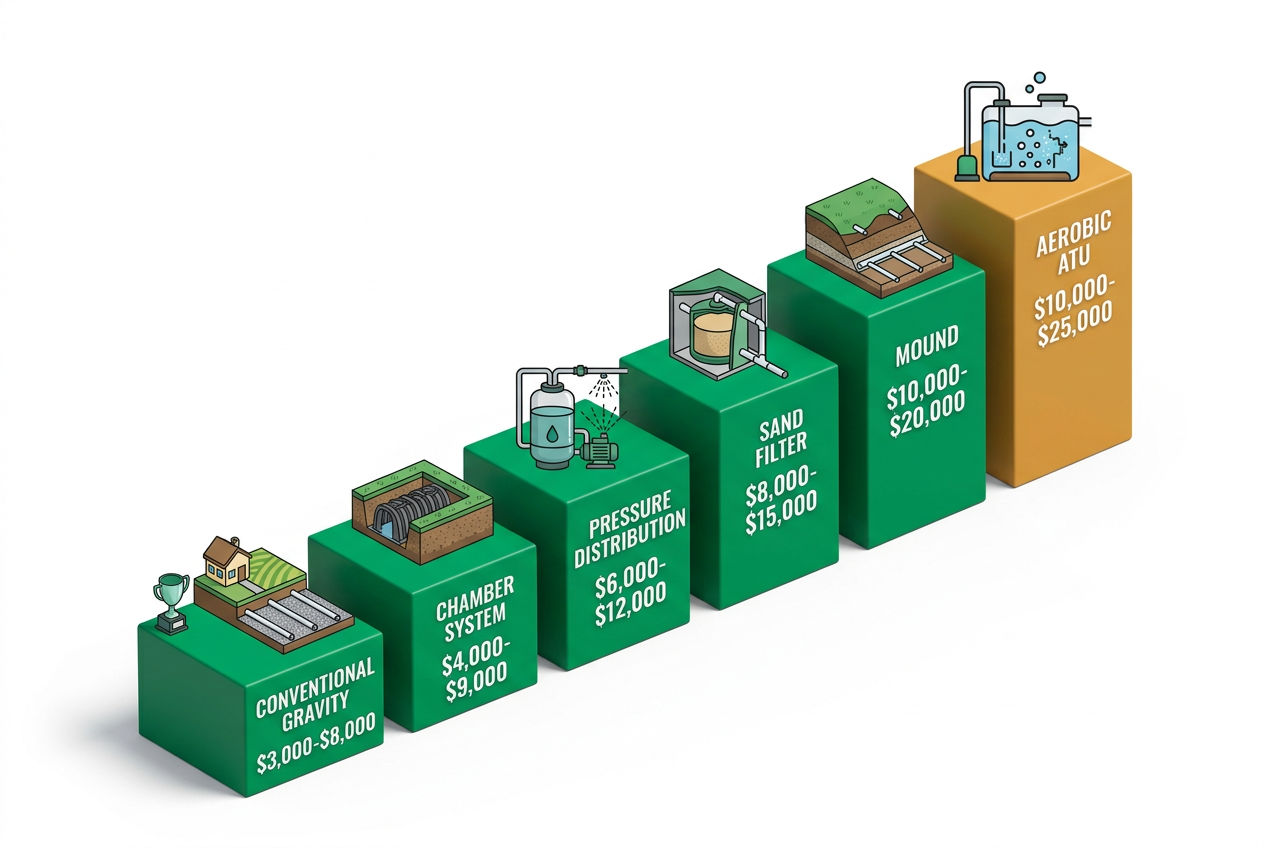
| System Type | Installed Cost Range | Best For |
|---|---|---|
| Conventional Gravity | $3,000 – $7,000 | Good soil, gentle slope |
| Chamber System | $3,500 – $8,000 | Variable soil, sandy areas |
| Pressure Distribution | $5,000 – $9,000 | Uneven terrain, moderate soil |
| Sand Filter System | $7,000 – $18,000 | Poor soil percolation |
| Drip Distribution | $8,000 – $18,000 | Tight lots, slow-perc soil |
| Aerobic Treatment Unit | $10,000 – $20,000 | Poor soil, strict regulations |
| Mound System | $10,000 – $25,000 | High water table, clay soils |
Source: National cost averages compiled from EPA guidance, NOWRA installer data, and regional contractor pricing (2025–2026).
A holding tank ($1,500–$5,000) technically costs less upfront but isn't a true septic system — it requires pump-outs every 1–3 months at $150–$400 per visit, making it one of the most expensive options over time.
What Type of Septic System Is the Least Expensive?
A conventional gravity septic system is the least expensive system type, with total installed costs ranging from $3,000 to $7,000. It moves wastewater from your home to the tank, then out to the drain field using gravity alone — no pump chamber, no float switches, no aerator compressor. Fewer components means lower installation cost and lower long-term maintenance cost.
The system works like this: wastewater flows into a 1,000-gallon (or appropriately sized) concrete or poly tank, where solids settle and partially decompose. Clarified effluent flows out through a baffle wall into a distribution box, then travels by gravity through perforated leach laterals buried in a gravel-and-pipe or chamber-style drain field.
The catch? Your soil has to pass a percolation test. If water moves through your soil too slowly (clay) or too quickly (coarse gravel), a gravity system won't meet code. That's when costs jump — because you're suddenly looking at a mound system or an aerobic treatment unit.
A real scenario: A 3-bedroom home in rural Georgia with sandy loam soil and a 1.5% lot slope is a perfect gravity system candidate. Same house on a flat Florida lot with a 24-inch water table? Florida's high groundwater often mandates a mound or ATU, pushing costs to $12,000–$20,000 before you've bought a single piece of pipe.
How Much Does a Basic Septic System Cost in 2026?
A basic conventional septic system — tank, drain field, and all installation costs — runs $3,000–$7,000 for most straightforward residential installations in 2026. The national average across all system types is approximately $7,000–$9,000, which reflects the reality that many properties can't use the cheapest option and require upgraded systems.
Here's how the cost breaks down for a conventional gravity system serving a 3-bedroom home:
- 1,000-gallon concrete septic tank (materials): $800–$2,000
- Drain field / leach field installation: $2,000–$5,000
- Excavation and labor: $1,500–$3,500
- Permit and perc test fees: $300–$1,500
- Total: $4,600–$13,000, with most 3-bedroom installs landing in the $5,000–$8,000 range
The full septic installation cost breakdown goes deeper on what drives each line item, but the three biggest variables are your tank size, your drain field size, and what your soil requires.
Tank size matters. Your county health department dictates minimum tank capacity based on bedroom count. General guidelines (which vary by state):
- 2-bedroom home: 750-gallon minimum
- 3-bedroom home: 1,000-gallon minimum
- 4-bedroom home: 1,250-gallon minimum
A 750-gallon poly tank runs $600–$900. A 1,250-gallon concrete tank runs $1,200–$2,500. That's a meaningful difference before excavation equipment even arrives.

DIY Septic Blueprint
Thinking about building it yourself?
The complete, plain-English plan to size, permit and install your own septic system — designed for homeowners, not contractors. Skip the $15,000–$25,000 quotes and do it right the first time.
Get the DIY Blueprint — $67 →Instant download · 8 modules + 3 bonus guides · 60-day money-back guaranteeAre Plastic Septic Tanks Cheaper Than Concrete?
Yes — plastic (polyethylene) septic tanks are cheaper than concrete tanks by $200–$800 for comparable sizes. A 1,000-gallon poly tank costs $700–$1,200, while a 1,000-gallon concrete tank runs $800–$2,000. Fiberglass sits between them at $1,200–$3,000.
The concrete vs. plastic septic tank comparison covers durability trade-offs in detail, but here's the practical summary:
Plastic tanks:
- Lighter — easier to transport and lower crane/delivery costs
- Resistant to cracking in freeze-thaw cycles
- Can flex and deform under heavy soil load or vehicle traffic
Concrete tanks:
- More durable under load and long-term soil pressure
- Standard choice in most regions — contractors are comfortable with them
- Heavier delivery costs, but often a longer service life
For pure budget purposes, a poly tank saves you money upfront. Whether it's allowed depends on your county. Some jurisdictions require concrete. Check with your local health department before pricing materials.
What Is the Cheapest Septic System for a Small House or Cabin?
For a small house, cabin, or tiny home with 1–2 bedrooms and low water usage, a conventional gravity system with a 500- or 750-gallon poly tank is the most affordable option, typically running $3,000–$5,500 fully installed in areas with cooperative soil conditions.
A few things work in your favor with a small structure:
- Smaller tank requirement (a 500-gallon tank is $400–$800 vs. $800+ for a 1,000-gallon unit)
- Smaller drain field — fewer bedroom equivalents means fewer linear feet of leach laterals
- Lower permit fees in some jurisdictions for seasonal or limited-use structures
If the cabin is off-grid or used seasonally, a composting toilet combined with a greywater system is worth considering. Total setup costs run $1,500–$4,000, and some rural counties permit them with fewer regulatory hurdles than a full septic system. The limitation: composting toilets require maintenance, regular emptying of solid waste bins, and aren't permitted everywhere for full-time residential use.
For seasonal use on land that fails perc testing, a holding tank ($1,500–$3,500 for a 500-gallon fiberglass unit) handles waste until you can pump it. That's a temporary solution, not a long-term one. A 500-gallon holding tank serving two people fills in roughly 2–4 weeks of use, and pump-out costs of $150–$300 per trip add up fast.
Check out our guide to small septic tank options for specific sizing recommendations by use case.
What Are the Cheapest Alternatives to a Traditional Septic System?
The cheapest alternatives to a conventional septic system — when that system isn't an option — include chamber systems, composting toilet setups, and (as a last resort) holding tanks. Each carries trade-offs in cost, permitting, and long-term practicality.
Chamber systems ($3,500–$8,000 installed) are often the next-cheapest option after conventional gravity. Instead of gravel-and-pipe drain field construction, chamber systems use plastic arch chambers (Infiltrator Water Technologies makes the most widely used units) that allow effluent to seep into native soil. They require less aggregate material, can be installed in tighter spaces, and work well in sandy soils. Labor costs are often lower because there's less gravel to haul. Learn more about Infiltrator septic chambers and how they compare.
Pressure distribution systems ($5,000–$9,000) add a pump chamber and distribution manifold to spread effluent more evenly across the drain field. They cost more than gravity systems but significantly less than aerobic treatment units — and they're sometimes required where a slope or uneven terrain makes pure gravity flow impractical.
Aerobic treatment units (ATUs) cost $10,000–$20,000 installed, making them far from "cheap." But in areas with poor soil, high water tables, or tight lot setbacks, they're the only code-compliant option. An ATU injects air into the treatment tank (using an aerator compressor like a Hiblow HP-80) to accelerate bacterial breakdown, producing cleaner effluent that meets stricter standards. Ongoing costs are higher too — expect $200–$800/year in maintenance plus electricity.
For a full comparison of every system type and how they work, see our types of septic systems guide.
How Much Does It Cost to Put In a Septic System on Raw Land?
Installing a septic system on raw land in 2026 typically costs $5,000–$12,000 for a conventional gravity system on a property with workable soil. The higher end accounts for site prep, longer utility trenching, and properties where the installer is working without existing infrastructure.
Raw land installations often require:
- Perc test / soil evaluation: $300–$1,000, sometimes more for full engineering reports. Without passing percolation results, you can't get a permit. See our perc test guide for what to expect.
- System design / engineering: $500–$2,000 if your soil conditions require a custom engineered septic system rather than a standard code-compliant layout
- Site clearing and grading: Variable, but plan for $500–$2,500 if heavy equipment needs to clear vegetation before excavation begins
- Increased excavation costs if you're in rocky terrain — Mountain West states like Colorado, Montana, and Wyoming often add $2,000–$5,000 to excavation budgets for rocky soil removal
The permit process on raw land can also take longer. In Massachusetts or New York, plan for a multi-month process with Title 5 compliance requirements and engineer-stamped drawings. In Alabama, Mississippi, or rural Missouri, the same system might be approved in weeks.
Can I Install My Own Septic System to Save Money?
DIY septic installation is legal in some states but prohibited in most, and the potential savings rarely outweigh the risks for a full conventional system. In states like Texas (where county-level regulation varies widely) and parts of the rural Midwest, homeowners can pull owner-builder permits and do their own installation work. In most other states, licensed contractors are required by law.
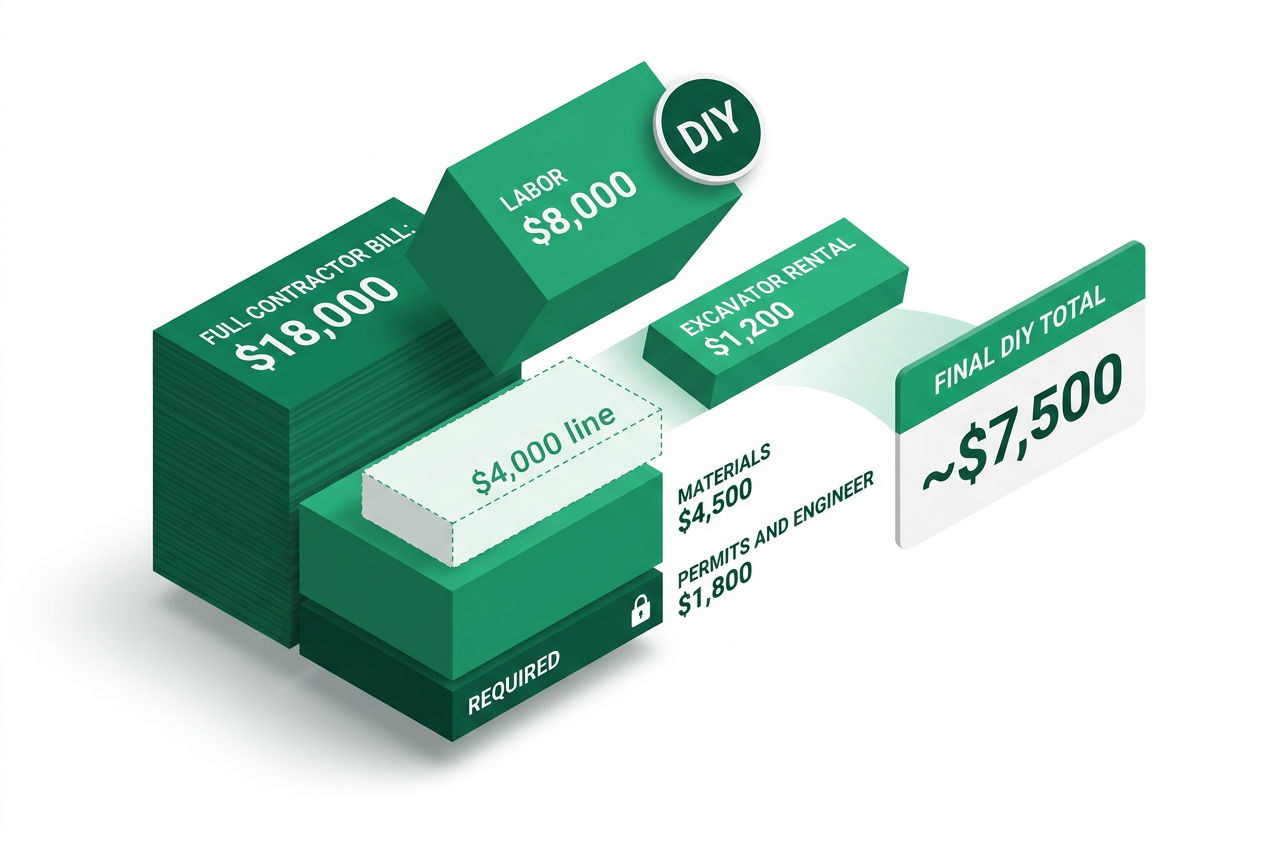
Even where it's legal, the DIY septic system installation route has real limitations:
- You still need a perc test, permit, and final inspection — those costs don't disappear
- Excavation equipment rental runs $300–$600/day; most installs require 2–4 days minimum
- Incorrect drain field depth, improper slope (leach laterals need roughly 1/8" per foot), or a missed baffle installation can cause system failure within years
- A failed or improperly installed system can contaminate groundwater, trigger county enforcement, and cost more to fix than a professional install would have cost in the first place
If you want to reduce labor costs legitimately, some contractors will allow homeowners to handle specific tasks — clearing the site, backfilling after inspection, or installing risers — while the licensed contractor handles regulated components. That hybrid approach can shave $500–$1,500 off labor without creating legal or liability exposure.
Where You Live Changes Everything
Regional cost variation for septic installation is significant — not just because labor rates differ, but because soil, regulation, and climate dictate which systems are even permitted.
Lowest costs nationally: Southeast states like Alabama, Mississippi, Georgia, and South Carolina benefit from sandy soils that perc well, lower labor rates, and less regulatory complexity. A conventional gravity system here routinely lands under $5,000.
Highest costs: The Northeast — Massachusetts, Connecticut, New York, Vermont, New Hampshire — runs 25–50% above national averages. Massachusetts Title 5 regulations require detailed soil testing, engineer-stamped designs, and licensed septic system installers. Rocky soil increases excavation costs. Frost depth requirements (sometimes 48+ inches) mean deeper tank burial.
Florida's hidden problem: Despite being southern (and cheap-seeming), Florida's high water table in many counties eliminates gravity and chamber systems as options. Mound systems and ATUs become the default, pushing costs to $10,000–$20,000+. That's before accounting for state contractor licensing requirements through the Florida Department of Health.
Texas: Highly variable by county. Some rural counties allow significant owner-involvement with simpler permits. Urban counties near major metros have stricter requirements. Caliche soil in West Texas can dramatically increase excavation costs.
Scheduling matters too. Shoulder season installations — early spring before peak construction demand, or late fall before winter freezes — can yield 5–15% savings simply because installers have more availability and may negotiate more aggressively.
Don't Let Cheap Upfront Fool You: Total Cost of Ownership
A conventional gravity system at $5,000 installed sounds like the clear winner — and usually is. But factor in 25 years of ownership and the math gets more nuanced.
A properly maintained conventional gravity system costs $200–$500/year in maintenance, primarily from pumping every 3–5 years at $300–$600 per pump-out. (Septic pumping costs vary by tank size and region.) Over 25 years: $5,000–$12,500 in maintenance on top of installation.
An aerobic treatment unit at $15,000 installed costs more upfront but produces cleaner effluent that extends drain field life and may be required by regulation anyway. Annual maintenance runs $200–$800/year plus electricity for the aerator compressor — but in the right context, it protects a $10,000 drain field from premature failure.
The cheapest system that lasts 30 years beats the cheap system that needs a $10,000 drain field replacement in year 12. Regular pumping and proper maintenance are what actually determine long-term cost.
Get Quotes Before You Decide Anything
Every number in this guide is a national average. Your actual cost depends on your soil, your county, your system size, and who's doing the work. The only way to know your real number is to get multiple quotes from licensed local installers. The fastest way to do that is to compare local septic pros side by side.
Use SepticTankHub's directory to find septic installation companies near you and request free quotes. Prices between contractors on the same job routinely vary by $1,000–$3,000. Getting three quotes is the single easiest way to find the cheapest septic system for your specific situation.
Sources & Methodology
U.S. Environmental Protection Agency (EPA): Septic system statistics, household prevalence data, and general system guidance. epa.gov/septic
National Onsite Wastewater Recycling Association (NOWRA): Installer practices, system type prevalence, and professional cost data. nowra.org
State Health Department Regulations: Massachusetts Title 5, Florida Department of Health septic contractor licensing, Texas county-level regulatory structure — referenced for regional cost and compliance variation.
Infiltrator Water Technologies: Chamber system specifications and product data used for chamber system cost estimates.
Regional Contractor Pricing Data: Cost ranges reflect aggregated installer quotes and published pricing data from multiple U.S. regions, updated 2024–2025. Individual project costs vary significantly by location, soil conditions, and site-specific requirements.
Readers should obtain local quotes and verify permit requirements with their county health department before beginning any septic installation project.
Free download
Not ready for the Blueprint? Start free.
Grab the free DIY Septic Planning Kit — the permit-first checklist, perc-test cheat sheet, and sizing tables that keep your build from getting red-tagged.
Was this article helpful?
Frequently Asked Questions
Recommended Resources
📖 Related Articles
- Perc Test (Percolation Test): What It Is & How It Works
- Concrete vs Plastic Septic Tanks: Which Is Better?
- Septic System Permit Cost & State Requirements (2026 Guide)
- Off-Grid Septic Systems: Legal Options That Actually Work
- Small Septic Tanks: Options for Cabins, Tiny Homes & Guest Houses
- Infiltrator Septic Chambers: How They Work, Cost & Installation
- Types of Septic Systems: Complete Comparison Guide
- Can You Install a Septic System Yourself?
- The Complete Septic Tank Maintenance Guide
💰 Cost Guides
🔧 Services
Find Septic Professionals Near You
Compare licensed, verified septic companies by area — top county markets and cities below, or browse all 50 states.
County markets
Popular cities
