
Quick Answer
Homemade septic tank treatment refers to using household ingredients — yeast, baking soda, vinegar, or other pantry staples — to maintain or restore the bacterial activity inside a residential septic tank. In most cases, these remedies are harmless but ineffective. A healthy tank doesn't need them. A struggling tank needs a pump-out or professional inspection, not a kitchen experiment. The one action that actually protects your system is pumping every 3–5 years — everything else is maintenance around the margins.
Homemade septic tank treatment is one of the most searched DIY topics among the roughly 21 million U.S. homeowners who rely on a septic system. The appeal is obvious — a packet of active dry yeast costs under $1, while a professional pump-out runs $300–$600. So the question isn't unreasonable. It's practical.
But before you flush a box of Fleischmann's down the toilet and call it maintenance, you need an honest picture of what's actually happening inside your tank, what helps, what does nothing, and what can quietly destroy a system that costs $3,000–$15,000 to replace.
Key Takeaways
- Active dry yeast produces enzymes but is not a replacement for the anaerobic bacteria your tank depends on.
- Baking soda and vinegar in typical household quantities are unlikely to cause serious harm — but they don't treat your tank either.
- Bleach, antibacterial soaps, and drain cleaners are the real threats to bacterial colonies.
- The EPA's position: a properly functioning septic system does not need additives, DIY or commercial.
- Pumping every 3–5 years is the single most effective maintenance action you can take.
How Does a Septic Tank Actually Work?
A septic tank is a buried, watertight chamber — typically 1,000–1,500 gallons for a 3-bedroom home — that separates waste into three layers: a floating scum layer on top, a liquid effluent zone in the middle, and a settled sludge layer on the bottom. The liquid effluent drains into your drain field, where soil microbes finish the treatment process.
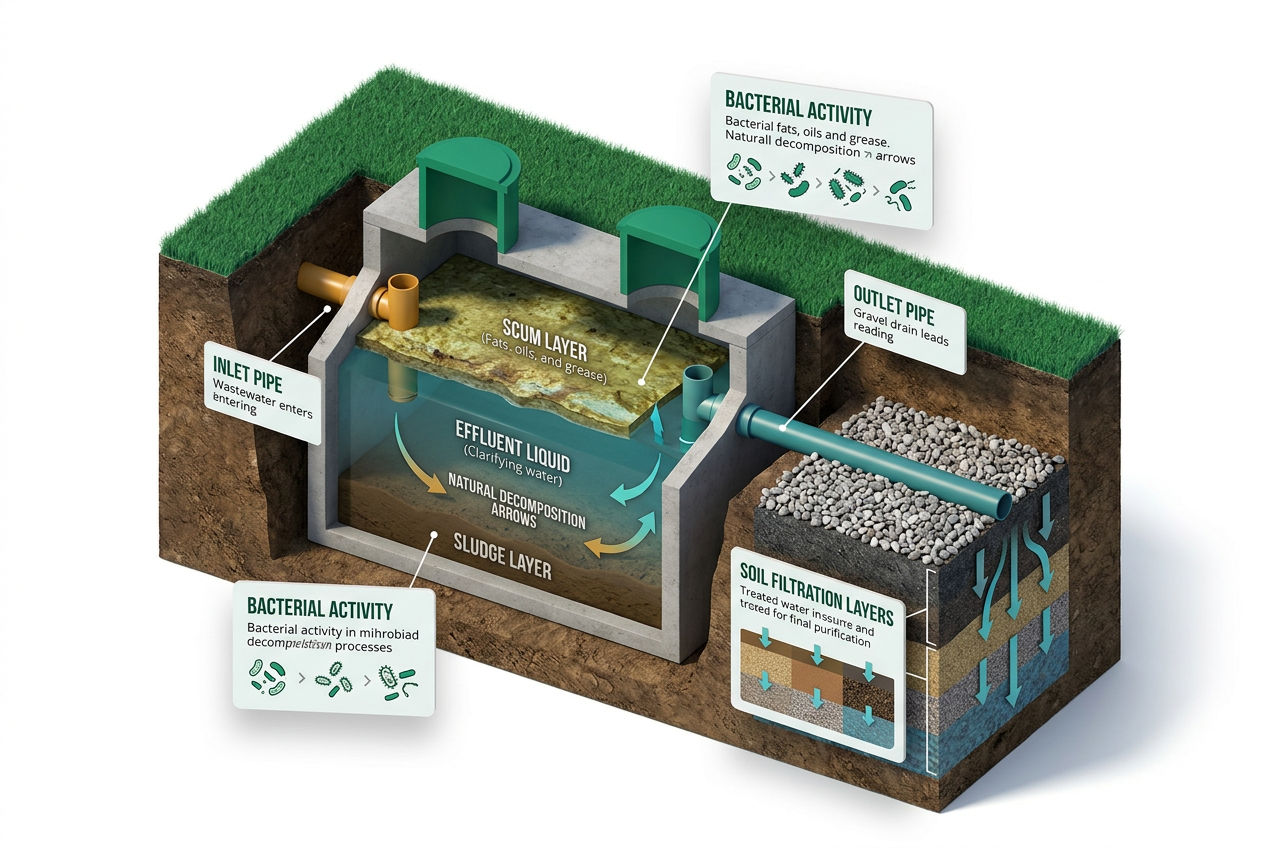
The engine driving all of this is biology. A healthy tank contains billions of anaerobic bacteria — microbes that thrive without oxygen. These bacteria break down organic solids in the sludge layer, reducing volume and producing gases like methane and carbon dioxide. Without them, solids accumulate faster, your tank fills sooner, and your drain field — the most expensive component in your yard — starts taking on partially treated waste.
You can learn more in our detailed breakdown of how septic tanks work.
Does Yeast Work as a Homemade Septic Tank Treatment?
Yeast can support enzyme activity in your tank, but it does not introduce the anaerobic bacteria your system actually depends on. Active dry yeast (Saccharomyces cerevisiae) is a fungus, not a bacterium. It produces amylase and other enzymes that help break down starches and sugars, but it cannot replicate the full biological process that anaerobic bacteria perform on fats, proteins, and complex solids.
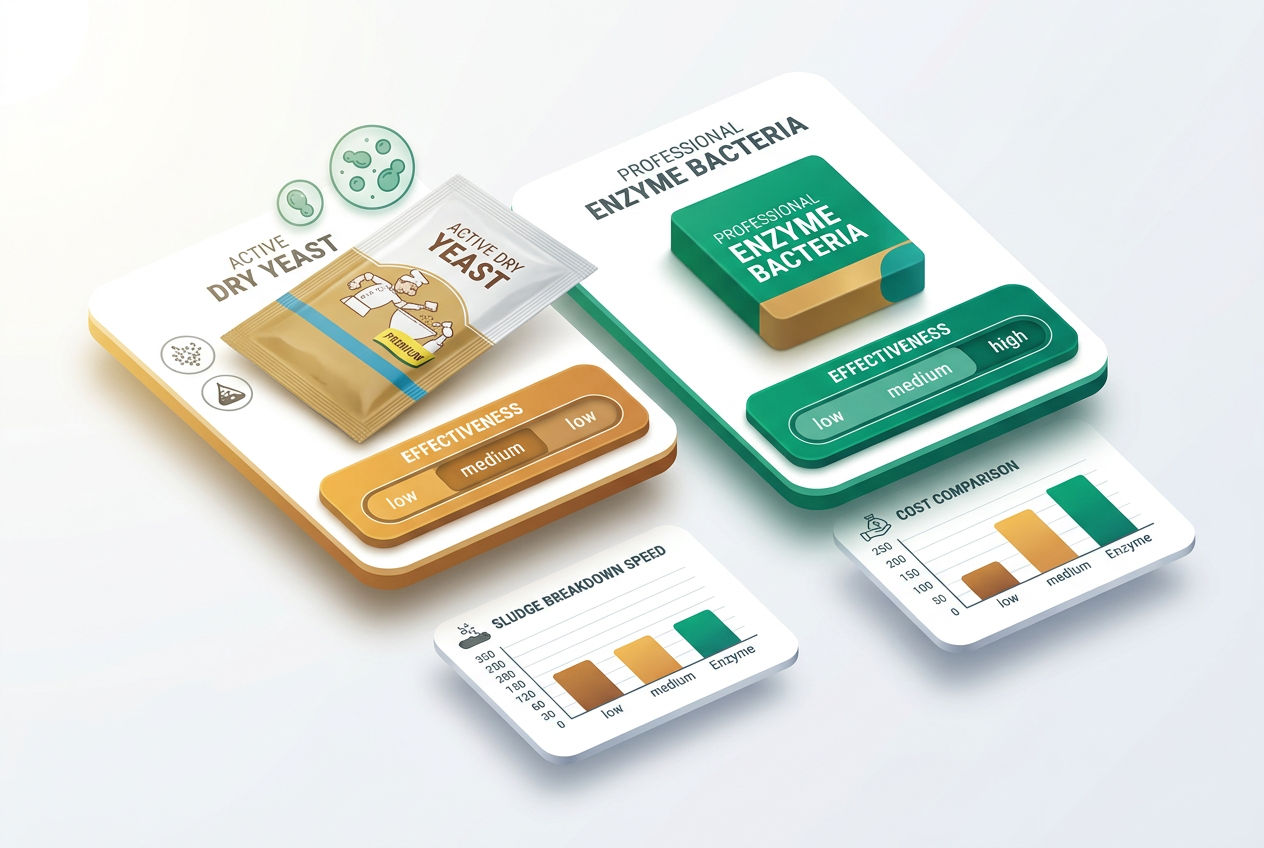
The common DIY septic tank treatment recipe — flush one packet of active dry yeast with warm water down the toilet — has circulated for decades. People swear by it. It probably doesn't hurt anything, and the enzyme boost may provide minor, short-term support. But calling it a treatment overstates what yeast can do.
A healthy 1,000-gallon tank serving a four-person household doesn't need a yeast boost. The bacteria naturally present in human waste reseed the tank continuously. After a disruption — say, a round of antibiotics or heavy use of antibacterial soap — bacterial colonies typically replenish within days to weeks on their own. If your system is functioning properly, yeast is solving a problem that doesn't exist.
Can Baking Soda Hurt Your Septic System?
Small amounts of baking soda — the kind you'd use cleaning a sink or deodorizing a drain — are unlikely to harm your septic tank. Sodium bicarbonate is a mild base. A tablespoon or two flushed down the drain barely registers in a 1,000-gallon liquid environment.
The concern that baking soda "neutralizes" your tank's pH and kills bacteria is largely overblown for normal household use. Septic bacteria operate best at a slightly acidic to neutral pH (around 6.0–7.5). A small baking soda application isn't going to swing that meaningfully.
That said, baking soda doesn't treat your tank either. It has no meaningful antibacterial effect on tank bacteria, and it doesn't accelerate solid breakdown. If you're using it to address septic smell, you're masking a symptom rather than addressing a cause. Persistent odors usually point to a full tank, a blocked inlet baffle, or a failing drain field — problems that need a pump-out or a professional inspection, not a box from the pantry.
Can Vinegar Be Used to Clean a Septic System?
Vinegar is safe for septic systems in modest quantities but doesn't function as a treatment. Acetic acid at household concentrations (5% in white distilled vinegar) is mildly acidic. Used occasionally as a surface cleaner — in amounts that get diluted through your plumbing before reaching the tank — it poses minimal risk to bacterial colonies.
The myth is that vinegar "cleans" the septic tank itself. It doesn't. Once diluted in hundreds of gallons of liquid, its antimicrobial effect is negligible. Conversely, if someone decides to dump a gallon of straight vinegar directly into their tank access as a "treatment," that's a different story — but the harm still pales compared to a single bleach application.
For more on which cleaning products are genuinely safe and which ones you should never let near your system, see our guide on septic-safe cleaning products.
What Household Products Actually Harm Septic Bacteria?
Most DIY treatment attempts are harmless but ineffective. The more consequential category is household chemicals that can genuinely devastate your tank's bacterial population.
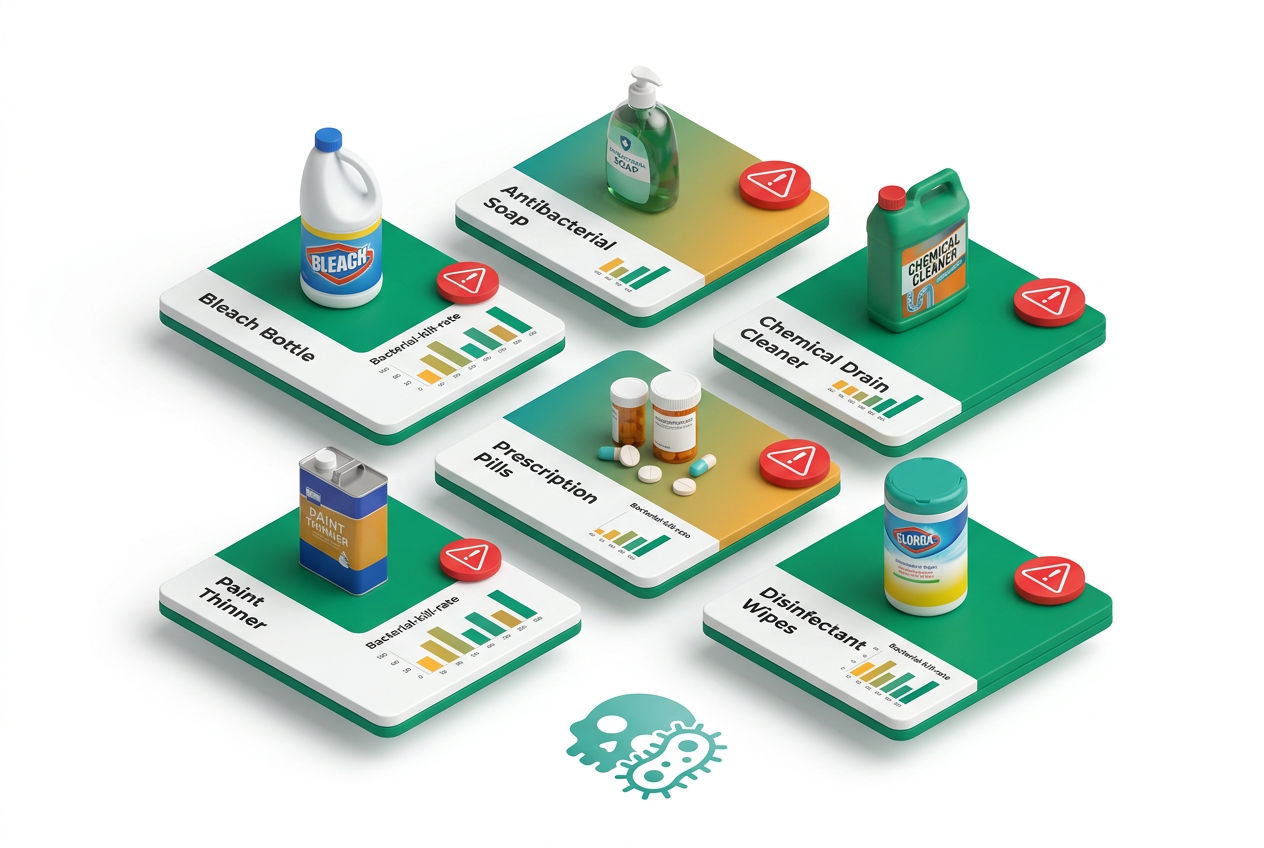
| Product | Risk Level | Threshold for Harm |
|---|---|---|
| Chlorine bleach | High | ~1 cup per wash cycle disrupts balance |
| Antibacterial soaps (>1% triclosan) | High | Regular daily use reduces colony counts |
| Chemical drain cleaners (lye-based) | Very High | Even occasional use kills anaerobic bacteria |
| Prescription antibiotics | Moderate | Courses of 7–14 days can reduce populations |
| Paint thinner / solvents | Very High | Even small amounts are toxic to bacteria |
Sources: EPA Septic Systems guidance (epa.gov/septic); University of Minnesota Extension septic program
One cup of bleach per washing machine cycle can measurably disrupt bacterial balance, according to EPA septic guidance. Products containing more than 1% antibacterial agents — some hand soaps, bathroom cleaners, and toilet bowl treatments — pose a cumulative risk with daily use.
Drain cleaners are arguably the worst offenders. A single application of a lye-based product like Drano can significantly reduce bacterial populations in a conventional septic tank. If you have a septic system, using Drano is something to think carefully about. Our dedicated article on what kills septic bacteria covers this topic in full detail.
What Is the Best Natural Septic Tank Treatment?
The most effective natural septic tank treatment isn't a product — it's behavior. Here's what actually moves the needle:
1. Pump on schedule. A 1,000-gallon tank serving four people needs pumping every 3–4 years. Add a garbage disposal, and that drops to every 2 years. The EPA recommends pumping every 3–5 years for most households. This single action does more for system longevity than any additive, homemade or commercial.
2. Manage water load. Flooding your tank with excessive water — from back-to-back laundry loads, long showers, or draining a hot tub into a drain connected to your septic — pushes solids into the drain field before they've been digested. Spread laundry loads across the week. Fix running toilets immediately.
3. Protect the drain field. Keep vehicles, heavy equipment, and deep-rooted trees away from the drain field area. Trees planted near septic systems can send roots into leach laterals and crush distribution lines.
4. Be thoughtful about what goes down the drain. This means knowing what you can safely flush and avoiding even "flushable" wipes, which don't break down in a septic environment.
If you want to explore commercial bacterial supplements as a supplement to (not replacement for) good habits, our review of whether septic additives actually work gives you an honest breakdown.
How Often Should You Treat Your Septic Tank?
For a properly functioning system, you probably don't need to treat it at all. The bacteria in a healthy tank are self-sustaining. Your daily waste provides all the feedstock they need.

If you've recently had a major bacterial disruption — a prolonged antibiotic course, accidental bleach dumping, or a system that was pumped and is being restarted — a one-time bacterial inoculant can help the colony re-establish faster. This is where commercial products containing Bacillus species have some legitimate application, though the EPA's position remains that they're unnecessary for normally functioning systems.
The maintenance schedule you should actually follow:
- Every 1–3 years: Inspect the inlet and outlet baffles and any effluent filter (a Polylok PL-122 or similar filter should be cleaned annually)
- Every 3–5 years: Professional pump-out (adjust based on household size and tank volume — use our septic pumping frequency guide to calculate your specific interval)
- Immediately: Call a professional if you notice slow drains across multiple fixtures, sewage odors in the yard, or wet spots over the drain field
Learn to recognize the signs your septic tank needs pumping before a minor issue becomes a drain field replacement.
Does Season Affect How Well Septic Tank Treatments Work?
Picture this: it's spring, the ground just thawed after a Minnesota winter, and your tank has been sitting at 38°F for four months. You flush a yeast packet down the toilet expecting results. Here's the problem — anaerobic bacteria slow dramatically below 50°F and become nearly dormant approaching 40°F. Any homemade septic treatment or bacterial inoculant you add during a cold-soil period is working against biology, not with it.
For homeowners in Minnesota, northern Wisconsin, Maine, and the Upper Peninsula of Michigan, this seasonal biology matters practically. Cold-climate systems often show slower solid digestion rates from November through March. That doesn't mean you need to treat your tank — it means you should be especially conservative about water usage and flush frequency during those months, because the biological engine that normally handles fluctuations is running at reduced capacity.
In warm-climate states like Florida, Georgia, and South Carolina, the biological environment stays active year-round, but high water tables and saturated soils create a different challenge: drain fields in these regions have less vertical separation between the distribution laterals and the seasonal high water table, which reduces the soil's treatment capacity during wet seasons. No homemade septic tank remedy addresses this — it's a site condition that requires professional evaluation.
The practical takeaway: timing a yeast flush or baking soda application for warm-weather months isn't wrong, but it also doesn't meaningfully change what those products can and can't do. The season matters most for understanding when your system is under natural stress — and responding by reducing load, not adding products.
When Should You Call a Professional Instead of Treating Your Tank Yourself?
Any of the following symptoms means a DIY septic tank home remedy is the wrong response:
- Slow drains in multiple fixtures simultaneously — single slow drains are usually a localized clog; multiple slow drains point to the septic tank or drain field
- Sewage odors inside the home — indicates a blocked or failing inlet baffle, or a full tank backing up toward the house
- Sewage odors in the yard — especially over the drain field area, which may indicate a failing leach field
- Wet, spongy, or unusually green grass over the drain field — effluent surfacing on the ground is a public health issue, not a DIY situation
- Gurgling sounds from toilets or drains after flushing — pressurized air returning from an overfull tank
- It's been more than 5 years since your last pump-out — at this point you're past due regardless of symptoms
If you're in a rural area where pump trucks may be 40–60 miles away and scheduling lead times stretch to weeks during peak season, don't wait until you have an emergency. Book your pump-out before the symptoms appear. See what a professional septic pumping service involves and get a realistic cost estimate before you call.
The math on deferred maintenance is straightforward: a pump-out costs $300–$600. A drain field replacement costs $5,000–$20,000. There is no homemade septic treatment that changes that calculation.
Frequently Asked Questions
Is it safe to put yeast in a septic tank?
Yes, adding active dry yeast to your septic tank is generally safe and unlikely to cause harm. Yeast (Saccharomyces cerevisiae) produces enzymes — particularly amylase — that can help break down starches and sugars in the tank. The standard DIY approach is flushing one packet of active dry yeast dissolved in warm water down the toilet. However, safe doesn't mean effective. Yeast is a fungus, not the anaerobic bacteria your tank actually depends on for solid digestion. It cannot replicate what those bacteria do with fats, proteins, and complex organic solids. A healthy tank reseed its own bacterial colony continuously through normal daily waste. If your system is functioning properly, yeast is solving a problem that doesn't exist. If it isn't functioning properly — slow drains, odors, wet spots over the drain field — you need a professional inspection, not a yeast flush.
What homemade things can I put in a septic tank?
The short answer: very little actually helps, and a few things genuinely hurt. Among common household items, active dry yeast is the most frequently recommended homemade septic treatment. It adds some enzymatic activity but doesn't meaningfully boost bacterial populations. Baking soda in small quantities (a tablespoon or two) is neutral — it won't harm the tank's bacterial balance in normal use. Diluted white vinegar used as a surface cleaner is similarly harmless once it reaches the tank. What you should never put in a septic tank: chlorine bleach in quantity, lye-based drain cleaners like Drano, antibacterial products with triclosan above 1%, paint thinner, or any petroleum-based solvent. These kill the anaerobic bacteria that make your system function. The most effective homemade approach to septic health isn't a product at all — it's behavior: spreading laundry loads across the week, fixing running toilets, and pumping on schedule every 3–5 years.
Does a septic tank home remedy actually work?
Most septic tank home remedies don't produce measurable results, but the more important question is whether they cause harm — and for most pantry staples used in normal quantities, they don't. Yeast, baking soda, and diluted vinegar are effectively neutral. The appeal of a home remedy is understandable: pump-outs cost $300–$600, and a packet of yeast costs under a dollar. But a functioning septic tank is already doing its job without help. Its bacterial colony is fed continuously by daily household waste and doesn't need supplementation. The EPA's formal position is that a properly functioning septic system requires no additives of any kind — commercial or homemade. Where home remedies genuinely fail is when they give homeowners a false sense that the system is being maintained. If you're flushing yeast every few months as a substitute for professional pump-outs and inspections, you're substituting a placebo for the one action that actually extends system life.
What is a DIY septic tank treatment that actually makes a difference?
The DIY septic tank treatment that makes the most difference is behavioral, not chemical. Specifically: spreading laundry loads across multiple days instead of running five loads back-to-back on Saturday; fixing running toilets immediately (a running toilet can add 200 gallons per day to your tank load); avoiding garbage disposal use or significantly reducing it (garbage disposal use roughly halves your pump-out interval, from every 4 years to every 2); keeping vehicles and deep-rooted trees off the drain field; and never flushing "flushable" wipes, which don't break down in a septic environment. If you want to add a biological product after a documented disruption — a long antibiotic course, or a system restart after pumping — commercial products containing Bacillus species have modest evidence behind them. But for day-to-day maintenance, no additive substitutes for pumping every 3–5 years and protecting the drain field from physical damage.
How often should you add homemade septic treatment?
For a normally functioning system, you shouldn't need to add any homemade septic treatment at all — not once a month, not seasonally, not ever. The bacteria in a healthy tank are self-sustaining and continuously replenished by normal household waste. Flushing yeast or baking soda on a regular schedule doesn't accelerate solid breakdown or meaningfully extend pump-out intervals. Where a one-time application might have minor value is after a specific disruption: finishing a 10-day antibiotic course, discovering a family member has been regularly using antibacterial soap in high concentrations, or restarting a system that was fully pumped and is re-establishing its bacterial colony. In those narrow situations, a single yeast flush or a bacterial inoculant product can provide a short-term enzyme and microorganism boost while the natural colony re-establishes itself. But this is an exception, not a routine. The actual maintenance interval to track is your pump-out schedule: every 3–5 years for most households, adjusted by tank size and occupancy.
Can homemade septic treatment replace pumping?
No. There is no homemade septic treatment — or commercial additive, for that matter — that replaces professional pump-outs. Here's why: biological additives accelerate the digestion of organic solids, but they cannot eliminate the inorganic material (sand, grit, non-biodegradable solids) that accumulates in the sludge layer over time. Even in a biologically perfect tank with maximum bacterial activity, sludge still accumulates and must be physically removed. According to EPA guidelines, most residential tanks serving a four-person household require pumping every 3–5 years. Skipping pump-outs and substituting any home remedy — yeast, enzymes, baking soda — allows sludge to build until it displaces the liquid zone and forces partially treated waste into the drain field. Drain field restoration or replacement costs $5,000–$20,000, compared to $300–$600 for a routine pump-out. No pantry ingredient changes that calculation.
Sources & Methodology
This article was developed using primary guidance from the U.S. Environmental Protection Agency's septic systems program (epa.gov/septic), including the EPA's Homeowner's Guide to Septic Systems and the agency's formal position on septic additives. Additional technical references include:
- University of Minnesota Extension septic systems program, including cold-climate bacterial activity research
- Penn State Extension on-lot sewage disposal guidance
- National Onsite Wastewater Recycling Association (NOWRA) technical resources
- National Association of Wastewater Technicians (NAWT) inspection standards
- University of Florida IFAS Extension for high water table and warm-climate drain field considerations
Product-specific references (Polylok PL-122 effluent filter, Fleischmann's active dry yeast) are included for specificity and do not constitute endorsement. Triclosan threshold (>1%) cited per EPA antimicrobial pesticide registration standards. Cost ranges reflect national averages from pump-out provider data and are updated periodically to reflect regional variation.
Free download
Not ready for the Handbook? Start with the free Fridge Card.
The Do / Don’t card the whole family can see, plus the Survival Kit: emergency flowchart, warning-sign decoder and pump-schedule card. One printable PDF.
Was this article helpful?
Frequently Asked Questions
Recommended Resources
📖 Related Articles
- What Is a Drain Field? (And How Does It Work?)
- What Is a Septic System? How It Works (Visual Guide)
- Septic-Safe Cleaning Products: The Complete List (Safe vs. Avoid)
- Can You Use Drano with a Septic System?
- What Kills Septic Tank Bacteria? (14 Things to Avoid)
- Trees Near Septic Systems: Safe Distances & Worst Species (2026)
- What Can You Flush with a Septic System? (Tampons, Wipes & More)
- Do Septic Tank Additives Actually Work? (The Science)
- How Often Should You Pump Your Septic Tank?
- 8 Signs Your Septic Tank Needs to Be Pumped
💰 Cost Guides
🔧 Services
Find Septic Professionals Near You
Compare licensed, verified septic companies by area — top county markets and cities below, or browse all 50 states.
County markets
Popular cities
