
Quick Answer
Slow drains on a septic system can stem from a localized pipe clog or a system-wide problem—a full tank, clogged effluent filter, damaged baffle, or saturated drain field. One slow drain almost always points to plumbing. Multiple slow drains at once point to your septic system. The diagnostic steps below will tell you which one you're dealing with before you spend a dollar.
💡 Key Takeaways
- One slow drain = likely a plumbing clog. All drains slow at once = likely a septic issue.
- A 1,000-gallon tank serving four people needs pumping every 3–4 years. Let it go longer and slow drains are predictable.
- A clogged effluent filter (Polylok PL-122 or similar) costs $50–$150 to clean—it's often the cheapest fix people never try first.
- Slow drains after heavy rain usually mean a saturated drain field, not a full tank—a distinction that matters for how you respond.
- Chemical drain cleaners kill the beneficial bacteria your septic system depends on. Don't use them.
The First Question: Is One Drain Slow, or Are All Your Drains Slow?
This single observation cuts your diagnostic work in half. If your kitchen sink is the only drain moving slowly while every other fixture in the house drains normally, you almost certainly have a localized plumbing problem—a grease buildup, a partial clog in the branch line, or a blocked vent stack serving that fixture. The septic tank is probably fine.
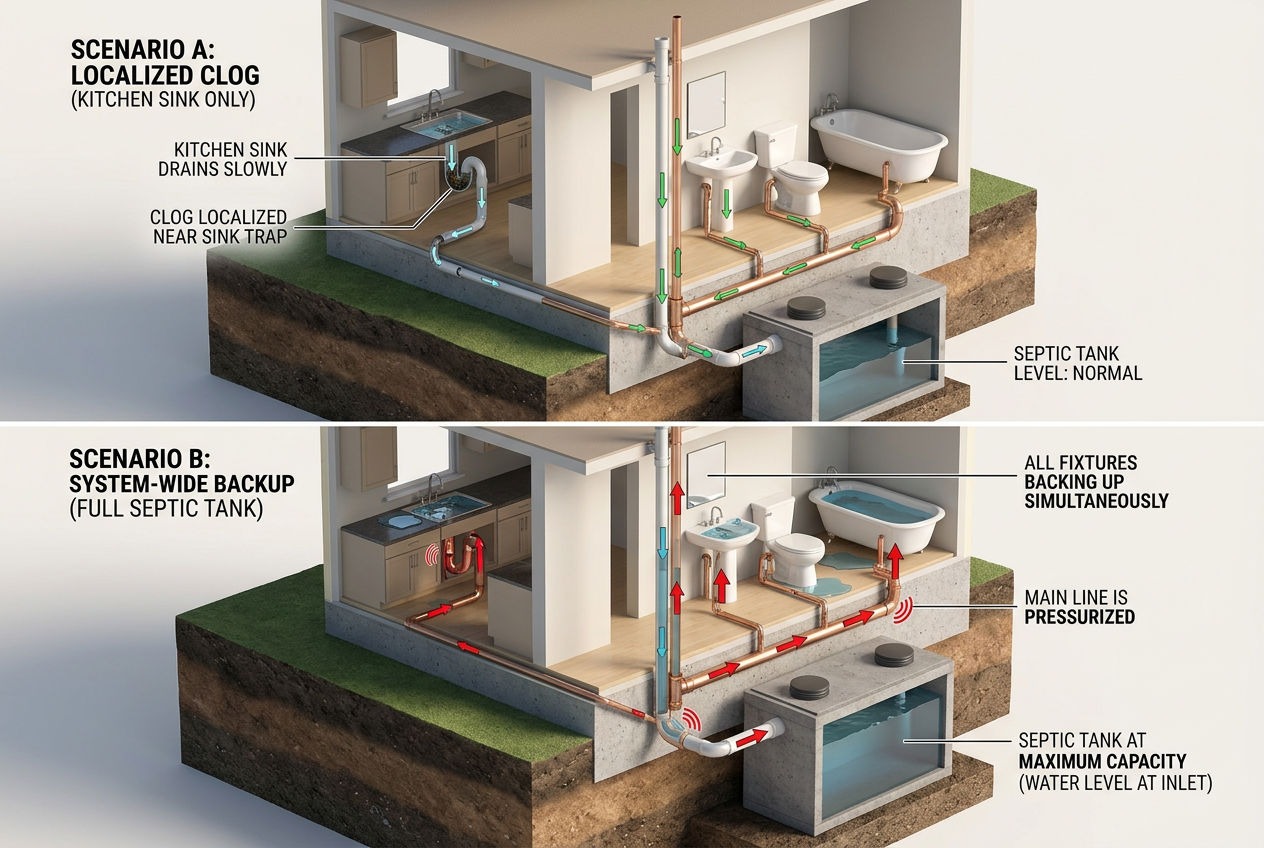
If two or more drains—say, the shower and the washing machine and the toilet—are all sluggish at the same time, the problem is downstream of your house. That means your septic system is the prime suspect.
📊 Quick Fact: A standard bathroom sink should drain completely in under 30 seconds. A bathtub should empty in 1–2 minutes. Anything slower than that consistently qualifies as a slow drain worth investigating.
Why One Slow Drain Points to Plumbing (Not Septic)
A single slow fixture tells you the restriction is upstream of the point where all your drain lines converge before heading to the septic tank. There are three common culprits:
Grease and Debris Buildup
Kitchen sinks are especially prone. Fats, oils, and food particles accumulate on pipe walls over months. If your kitchen sink is draining slow but other drains are fine, this is the most likely cause.
A Blocked Plumbing Vent
Every drain in your house has a corresponding vent pipe that exits through your roof. When a vent gets blocked—by a bird nest, leaves, or a dead animal—the affected drain loses its air supply and drains slowly or gurgles. A single gurgling drain with slow drainage almost always has a vent problem.
Tree Roots or a Partial Clog in a Branch Line
Tree roots near your septic system can infiltrate the lateral pipes connecting individual fixtures to the main drain line, causing one drain to slow while others stay normal.
✅ Pro Tip: For a single-fixture problem, a licensed plumber can snake the drain or clear the vent for $150–$350. That's the cheaper call to start with, assuming nothing else points to your septic system.
Can a Full Septic Tank Cause Slow Drains?
Yes—and it's one of the most common causes of slow drains throughout an entire house. When a tank fills beyond its working capacity, there's nowhere for incoming wastewater to go. The hydraulic pressure backs up through the outlet baffle and into your drain lines. Every fixture slows down simultaneously.
Pumping Schedule Guidelines
- 1,000-gallon tank, 4 people: Pump every 3–4 years (EPA SepticSmart guidelines)
- 1,000-gallon tank, 4 people + garbage disposal: Pump every 2 years
- 1,500-gallon tank, 2 people: Pump every 5–7 years
⚠️ Warning: Ground food solids from garbage disposals dramatically accelerate sludge accumulation.
The internal rule of thumb: your tank needs pumping when the combined sludge layer on the bottom and the scum layer floating on top occupy more than one-third of the tank's total liquid volume. A technician can check this with a sludge judge—a clear tube that samples layers at depth. You can't assess this yourself by looking at the lid.
Check how often to pump a septic tank to see where your household falls on that schedule.
Septic-Side Causes of Slow Drains (Beyond a Full Tank)
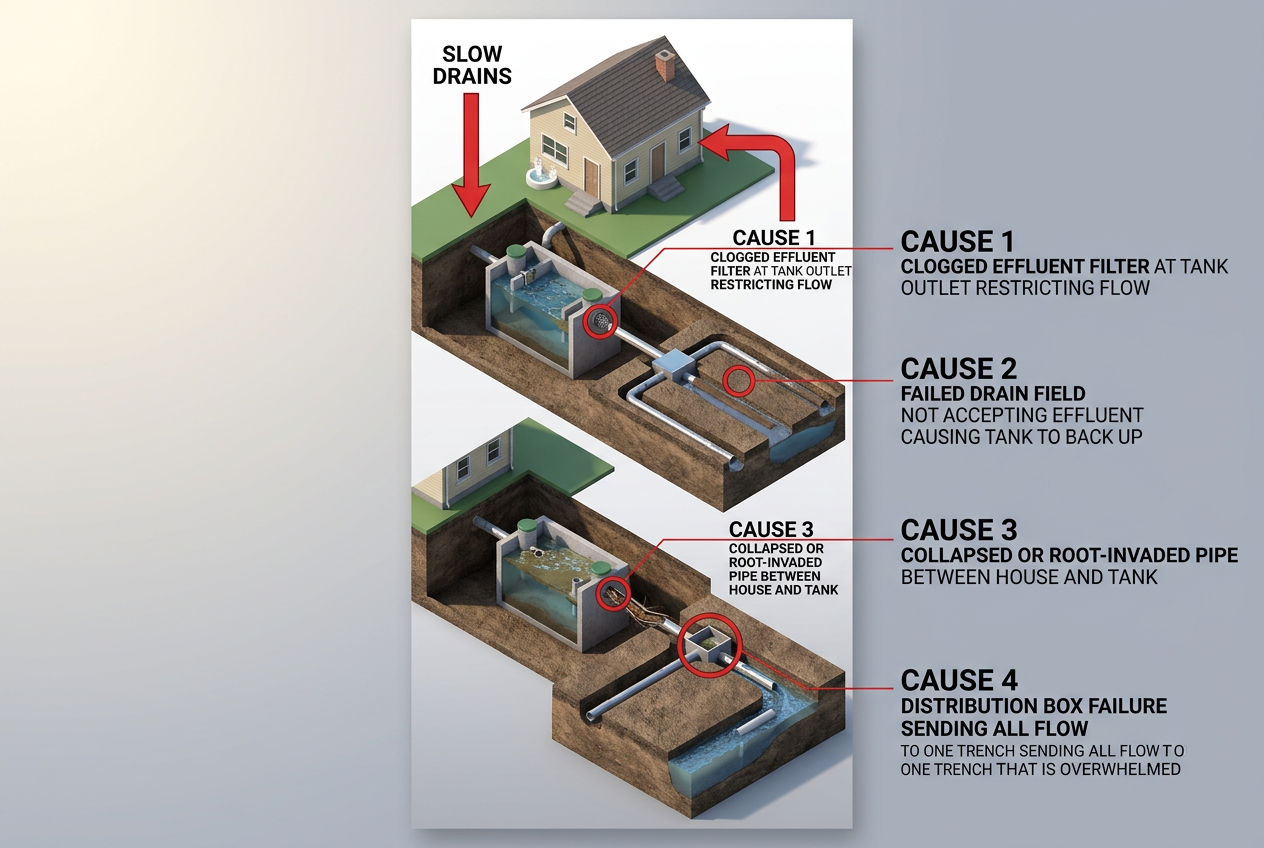
A full tank isn't the only septic-related cause. Three others are frequently overlooked—and one of them is a cheap fix most competing articles never mention.
The Clogged Effluent Filter
Most tanks installed after the mid-1990s have an effluent filter mounted on the outlet baffle—a Polylok PL-122, Zabel A1800, or similar cartridge filter. Its job is to screen solids before liquid effluent exits the tank toward the drain field. When it gets coated with biomat, it restricts flow and causes sluggish drains throughout the house.
💡 Key Takeaway: Cleaning or replacing an effluent filter costs $50–$150 and takes about 20 minutes for a technician. It's the most overlooked cheap fix in residential septic.
The septic effluent filter guide covers cleaning intervals in detail—most systems need it every 6–12 months.
Damaged or Clogged Inlet/Outlet Baffles
The inlet baffle slows incoming wastewater so solids can separate. The outlet baffle keeps floating scum from escaping into the drain field. When either one fails—cracked concrete, collapsed plastic tee, or blocked with accumulated debris—flow through the tank gets disrupted.
A septic baffle clogged or collapsed condition can cause slow drains that look identical to a full tank. A septic tank baffle repair typically runs $150–$500 depending on access and material.
Drain Field Failure
This is the diagnosis nobody wants to hear. If your drain field—the network of perforated pipes buried in gravel trenches—is failing, effluent can't absorb into the soil fast enough. The tank fills with treated effluent that has nowhere to go, and every drain in your house slows down or backs up.
Drain field failure develops gradually. You might notice slow drains for weeks or months before full backup occurs. Other warning signs include:
- A wet spot in your yard over the drain field
- Unusually green, lush grass over the septic area
- Sewage odors in the yard
⚠️ Warning: Repair or replacement of a drain field runs $3,000–$15,000+ depending on system size and soil conditions—which is exactly why early diagnosis matters.
Slow Drains After Heavy Rain: A Separate Scenario
Heavy rain causes a specific type of slow drain problem that gets misdiagnosed constantly. When the soil around your drain field becomes saturated—either from rainfall, snowmelt, or a seasonally high water table—effluent has nowhere to absorb. The drain field goes temporarily offline, and your drains slow down even if your tank is empty and your baffles are pristine.
Regional Rain Patterns to Watch
| Region | High-Risk Season | Common Cause |
|---|---|---|
| Pacific Northwest | October–April | Heavy rainfall saturation |
| New England | March–May | Spring thaw and snowmelt |
| Coastal Southeast (FL, GA, SC) | Year-round | High water table near surface |
💡 Key Takeaway: If your drains slow down every time it rains heavily, you almost certainly have a drain field saturation issue rather than a tank capacity problem. Pumping the tank won't solve it.
Learn more about how heavy rain affects your septic system and what options exist for fixing a saturated drain field.
Step-by-Step Diagnostic Walkthrough
Use this sequence before making any service calls:
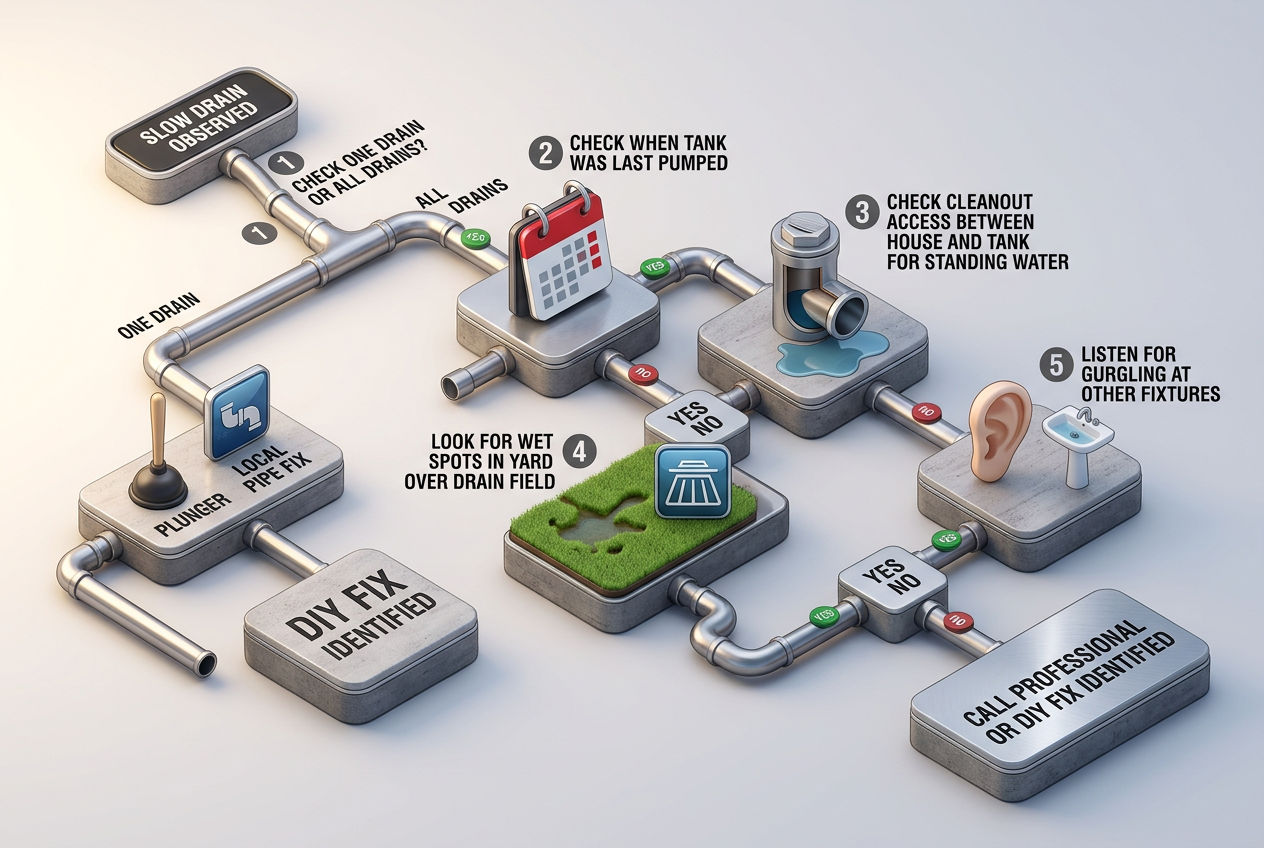
Step 1 — Count the Slow Drains
Run every fixture in the house one at a time. Is the slowness isolated to one drain, or does it appear in multiple locations? If it's one drain, stop here and call a plumber.
Step 2 — Check the Onset Pattern
Did the slowness develop gradually over weeks? Or did multiple drains slow down suddenly after a large gathering or heavy rain event?
- Gradual: Likely sludge buildup or effluent filter
- Sudden: Likely blockage, baffle failure, or rain saturation
Step 3 — Check Your Pump-Out History
When was your tank last serviced? If you can't remember, that's your answer. A 1,000-gallon tank and a 4-person household with no record in 5+ years almost certainly needs pumping.
Step 4 — Look for Companion Symptoms
These all confirm a septic-side problem rather than a localized pipe clog:
- Gurgling drains when you flush the toilet
- A sewage smell inside the house
- A toilet that won't flush properly
Step 5 — Check the Yard
Walk the area over your drain field. Spongy ground, standing water, or unusually dark-green grass are physical signs that effluent is surfacing—a serious problem requiring immediate professional attention.
Step 6 — Request a Septic Inspection
If Steps 3–5 point toward the septic system, a professional inspection ($100–$300) will pinpoint whether the issue is a full tank, a clogged effluent filter, baffle damage, or drain field failure.
✅ Pro Tip: That $200 inspection could save you from a misdiagnosed $500 pump-out that doesn't fix anything.
Use the tool above to trace your specific symptoms—single drain, multiple drains, rain correlation, gurgling, yard wetness—to the most likely cause before scheduling any service call.
What You Can Fix Yourself vs. What Requires a Pro
Not every slow drain situation requires an immediate service call. Some diagnostic steps and minor fixes are within reach for most homeowners. Others carry real risk if attempted without training or equipment.
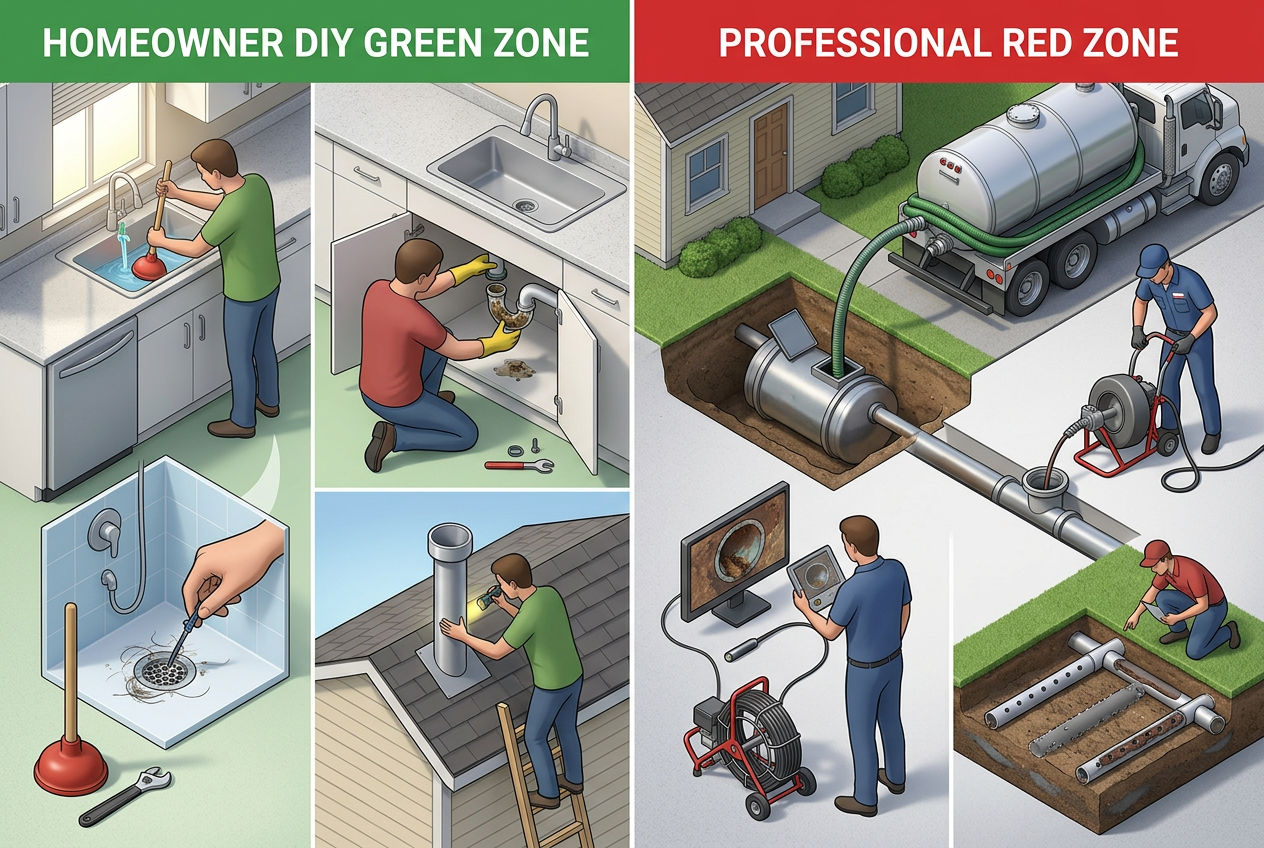
| Task | DIY Feasible? | Estimated Cost | Notes |
|---|---|---|---|
| Snake a single slow drain | Yes | $30–$80 (rental) | Effective for isolated clogs in branch lines |
| Clear a roof vent blockage | Yes (with caution) | $0–$50 | Requires roof access; clear debris with garden hose |
| Clean effluent filter | Possible | $0 if you own tools | Must locate tank first; filter is on outlet baffle |
| Check pump-out records | Yes | Free | Contact previous owners or county health department |
| Locate tank lid | Yes | $0–$25 (soil probe) | Use a septic tank lid finder method |
| Pump the tank | No | $300–$600 | Requires licensed vacuum truck operator |
| Replace/repair baffles | No | $150–$500 | Requires entering or accessing tank |
| Inspect drain field | Partial | $100–$300 | Visual inspection yourself; probe testing by pro |
| Repair drain field | No | $3,000–$15,000+ | Requires permits and licensed contractor |
Source: NAWT (National Association of Wastewater Technicians) technician certification guidelines; EPA SepticSmart homeowner guidance.
Septic Pumping Cost by Region: What to Expect
Rural vs. Urban Cost Differences
| Region | Typical Cost (1,000-gal tank) | Primary Cost Drivers |
|---|---|---|
| Rural Minnesota/Montana | $350–$500 | Higher travel costs, lower service density |
| Central Florida | $275–$375 | Competitive market, easier access |
| Northeast (MA, CT, NJ) | $400–$600 | Higher labor costs, stricter licensing |
⚠️ Warning: These figures are for routine pump-outs only. If a technician discovers a clogged effluent filter, damaged baffle, or a distribution box problem during the visit, expect add-on labor charges of $75–$200.
Always ask for an itemized quote, not a flat price, so additional findings are billed transparently.
See the full septic pumping cost guide for a breakdown by tank size, region, and access difficulty.
What Not to Put Down Your Drains on a Septic System
Slow drains are sometimes the first symptom of a bacterial imbalance inside the tank—one caused by household products that shouldn't enter a septic system at all.
Products That Kill Septic Bacteria
Chemical drain cleaners: Products like Drano contain sodium hydroxide (lye) and sodium hypochlorite (bleach). Both compounds kill the anaerobic bacteria that break down solids in your tank. A single heavy use can disrupt bacterial populations for weeks. Review why Drano and septic systems don't mix before reaching for that bottle.
Antibacterial soaps and cleaners: Regular use of antibacterial products—especially triclosan-containing soaps—gradually reduces bacterial activity in the tank. Switch to plain soap wherever possible.
Physical Clog Culprits
Grease and cooking fats: Poured down the kitchen sink, grease solidifies as it cools and creates a thick scum layer that accumulates faster than normal bacterial breakdown can handle. Use the trash or a sealed container instead.
"Flushable" wipes: These don't break down the way toilet paper does. They accumulate at the inlet baffle and can contribute to blockages that look exactly like a full tank.
Volume Overload
Excessive water volume: A washing machine running four loads back-to-back can hydraulically overload a tank, pushing solids into the effluent before they've had time to settle. Spread laundry across multiple days.
The septic safe products guide covers the complete list of what belongs—and what doesn't—in a septic-connected household.
When to Call a Pro Immediately
Most slow drain situations give you time to diagnose before calling anyone. A few don't.
Call a septic professional the same day if you observe any of the following:
-
Sewage backing up into a shower, tub, or floor drain. This is a full system backup—septic system backing up is an emergency, not a wait-and-see situation.
-
Standing sewage-smelling water over your drain field. Effluent surfacing above ground is a public health violation in most states and requires immediate attention.
-
Multiple drains suddenly going from normal to completely stopped. Gradual slow-down is diagnostic. Sudden complete stoppage usually means a blockage or a collapsed component.
-
The smell of hydrogen sulfide (rotten eggs) inside your home. This indicates gas is moving backward through your drain lines—a sign of serious pressure backup or baffle failure.
⚠️ Warning: Trying to wait out any of these situations almost always converts a $300–$600 repair into a multi-thousand-dollar emergency.
Sources & Methodology
-
U.S. Environmental Protection Agency — A Homeowner's Guide to Septic Systems. Referenced for diagnostic guidance on distinguishing septic-related drainage issues from plumbing problems.
-
University of Minnesota Extension — Research on common causes of slow drains in homes with septic systems, including effluent filter clogging and drain field saturation.
-
National Onsite Wastewater Recycling Association (NOWRA) — Industry guidance on diagnosing and resolving slow drain issues related to septic system performance.
-
National Environmental Services Center (NESC) — Technical publications on hydraulic overload, drain field failure diagnostics, and the relationship between household water use patterns and drain performance.
-
Minnesota Pollution Control Agency — State guidance on septic system troubleshooting, including the distinction between localized plumbing issues and system-wide septic problems.
Cost data reflects 2025–2026 national averages compiled from contractor pricing surveys across SepticTankHub.com's directory network.
Need help with your septic system? Find trusted septic professionals near you to get free quotes. Learn more about septic repair services. Browse local septic companies in Indiana or Alabama.
Free download
Not ready for the Handbook? Start with the free Fridge Card.
The Do / Don’t card the whole family can see, plus the Survival Kit: emergency flowchart, warning-sign decoder and pump-schedule card. One printable PDF.
Was this article helpful?
Frequently Asked Questions
Recommended Resources
📖 Related Articles
- Trees Near Septic Systems: Safe Distances & Worst Species (2026)
- How Often Should You Pump Your Septic Tank?
- Septic Effluent Filters: Do You Need One?
- Septic Tank Baffle Repair & Replacement: Costs, Signs of Failure, and DIY vs Pro
- Wet Spot in Yard Over Septic: What It Means & How to Fix It
- Green Grass Over Septic Tank: Normal or Warning Sign? (2026 Diagnostic Guide)
- Heavy Rain and Septic Systems: What Happens and What to Do
- How to Fix a Saturated Drain Field
- Septic Tank Gurgling Sounds: Causes and Fixes
- Why Does My Septic System Smell? Causes & Fixes
- Toilet Won't Flush With Septic: Troubleshooting Guide
- How to Find Your Septic Tank Lid (And What to Do If It's Buried)
- Can You Use Drano with a Septic System?
- Septic-Safe Products: What to Use (and What to Avoid)
- Septic System Backing Up? Causes & Emergency Steps
💰 Cost Guides
Find Septic Professionals Near You
Compare licensed, verified septic companies by area — top county markets and cities below, or browse all 50 states.
County markets
Popular cities
