
Quick Answer
Picture a farmhouse with three toilets, none flushing, and guests arriving in four hours. A common culprit in that situation: an inlet baffle that collapsed months earlier without anyone noticing. That single $300 repair had silently been building toward a $12,000 drain field replacement. If your toilet won't flush and you have a septic tank, here's how to figure out what's actually wrong before it reaches that point.
Before you call anyone or try anything, answer one question: is this a toilet problem or a septic problem? That single answer determines everything that comes next.
💡 Key Takeaways
- A single non-flushing toilet usually points to a local clog — not the septic tank
- If multiple drains are slow or backing up, the septic system is almost certainly involved
- A full tank, clogged baffle, blocked sewer line, or failing drain field are the four most common causes
- Most homeowners pay $300–$600 for a pump-out — far cheaper than ignoring it
- Septic problems get worse with delay; a drain field repair can run $3,000–$15,000+
Is It the Toilet or the Septic System? Start Here
The fastest diagnostic you can do takes about 60 seconds. Go check your other drains — the bathtub, the bathroom sink, the kitchen sink. Flush a different toilet if you have one.
One fixture slow or clogged? The problem is almost certainly between the toilet and the main sewer line — a clog in the toilet trap, the flange, or the drain pipe serving that fixture. The septic tank is probably fine.
Multiple drains slow, gurgling, or backing up? That's a system-wide signal. Your septic tank may be full, the inlet baffle may be blocked, the main line between your house and the tank may be clogged, or — worst case — your drain field is failing.
⚠️ Warning: Most homeowners skip this single vs. multiple fixture test entirely and go straight to plunging. That's the one diagnostic step that tells you whether you're dealing with a $10 plunger fix or a $500 pump-out call.
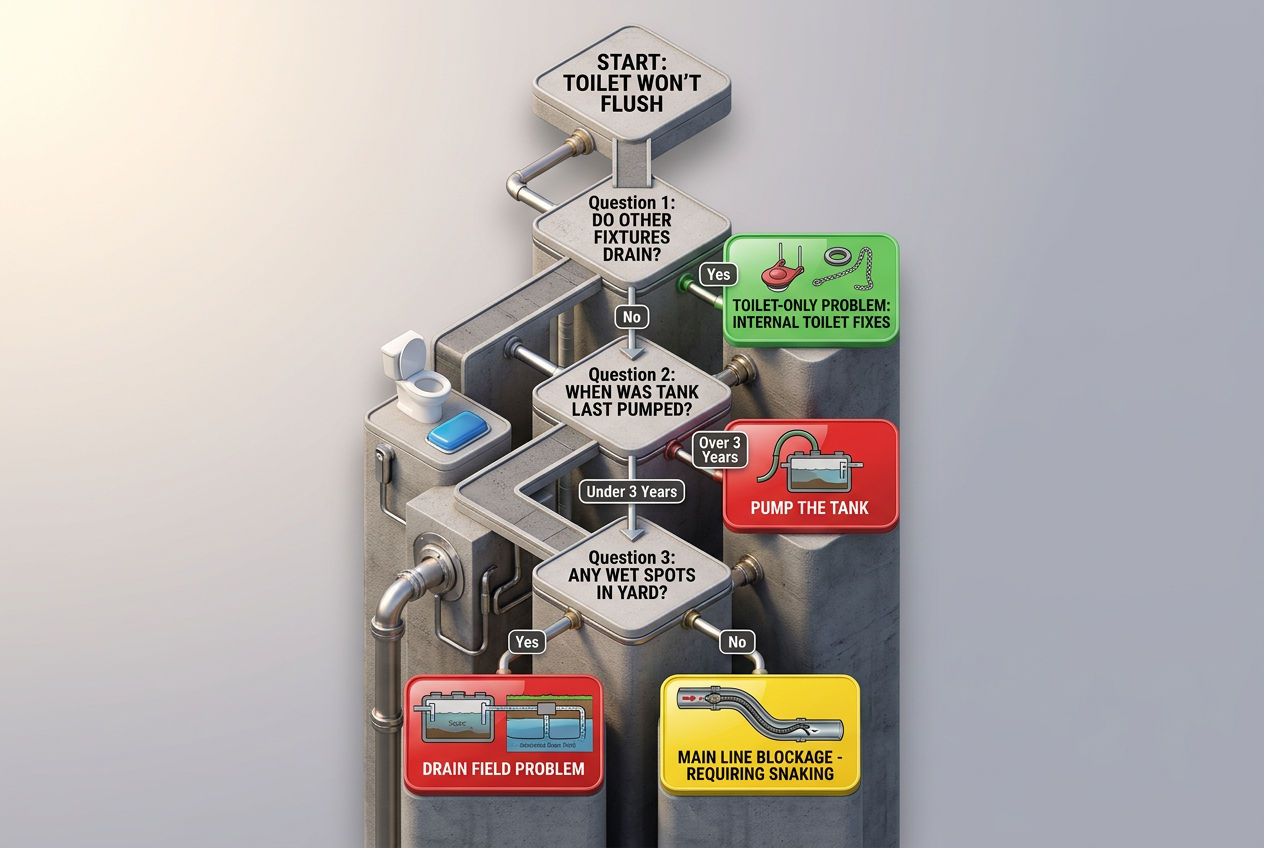
Quick Diagnostic Flowchart
Use this before you touch a plunger or call anyone:
-
Flush toilet → Does water rise and drain slowly, or not drain at all?
- Slow drain only → likely partial blockage
- No drain + water rising toward rim → likely full blockage or septic backup
-
Check other fixtures → Are they also slow or gurgling?
- Yes → septic system involvement likely; skip to Step 4
- No → toilet-level problem; start with Step 3
-
Plunge the toilet → Does it clear?
- Yes → done; monitor for recurrence
- No → check for foreign object; if clear, move to Step 4
-
Locate your septic tank lid and check for odors, wet ground, or visible overflow
- Wet soil above the tank or drain field → possible full tank or field failure
- Strong sewage smell indoors → septic system backing up
-
Call a licensed septic pumper or inspector if you reach Step 4
Why Is My Toilet Not Flushing With a Septic Tank?
Several specific causes explain why a toilet backs up or fails to flush in a septic-served home. Here are the most common, in order of likelihood.
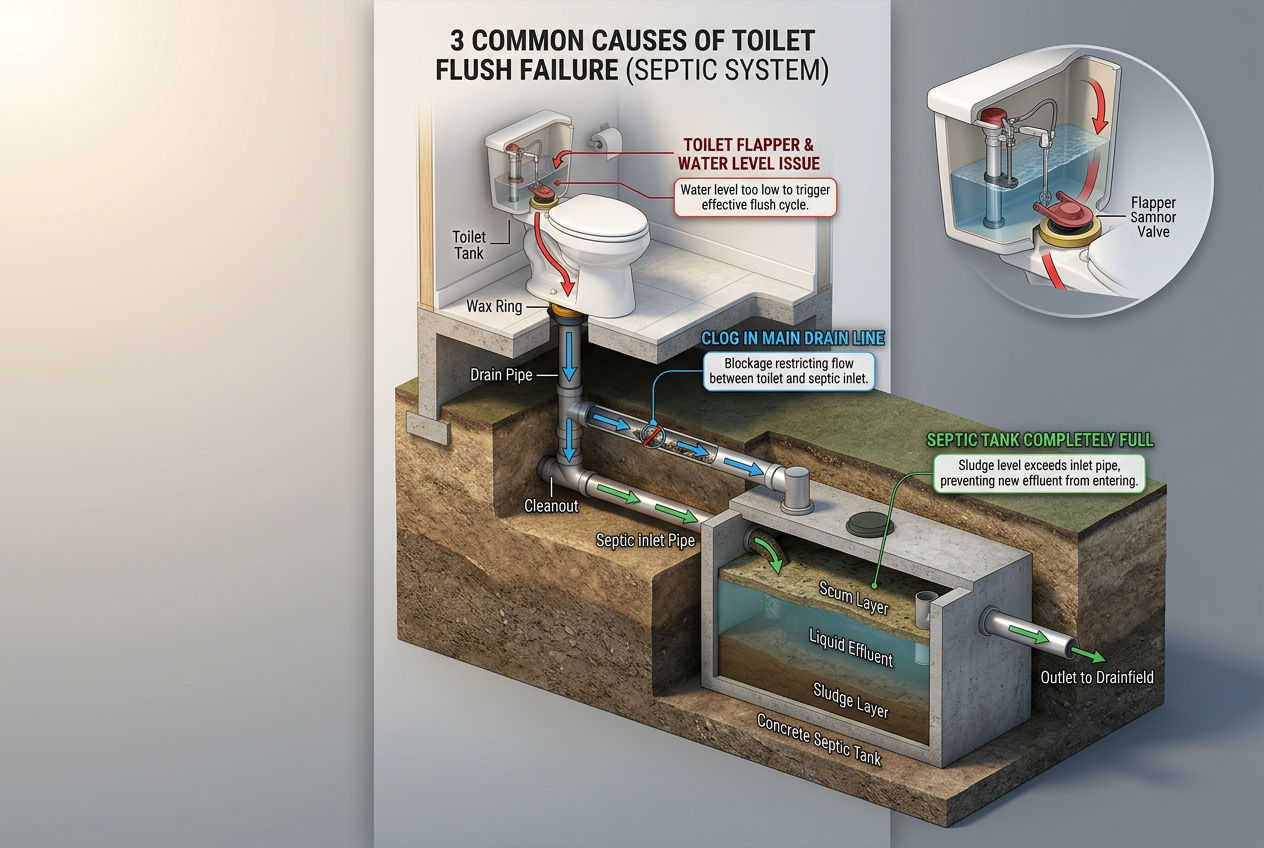
1. The Septic Tank Is Full
A full septic tank is the single most common cause of flushing problems. When solids and scum accumulate past the working capacity of the tank, there's nowhere for new wastewater to go. It backs up into the house.
A standard 1,000-gallon tank serving a 4-person household needs pumping every 3–4 years under normal use. The EPA recommends pumping every 3–5 years for most residential systems. Add a garbage disposal and that schedule shortens to every 2 years — the grease and food particles accelerate sludge buildup significantly.
Signs Your Tank Is Full:
- Toilets gurgle or drain sluggishly throughout the house
- Sewage smell near drains or in the yard
- Slow drains in multiple fixtures simultaneously
- Lush, unusually green grass directly above the drain field (here's what that means)
- Wet, spongy ground near the tank or drain field (wet spots in the yard are a serious warning sign)
✅ Pro Tip: If you can't remember the last time your tank was pumped — or you've never had it done since moving in — schedule a pump-out. See our guide to how often you should pump a septic tank for a full breakdown by household size.
2. Clogged Inlet Baffle
This is the cause most competing articles miss entirely. Inside your septic tank, near where the main sewer line enters, sits the inlet baffle — a concrete, plastic, or fiberglass divider that directs incoming sewage downward below the scum layer so solids separate properly.
When the inlet baffle cracks, collapses, or becomes coated with grease and buildup, it can create a partial or full blockage right at the tank's entry point. Wastewater hits the obstruction and backs up toward the house. The tank itself may not be full at all.
📊 Quick Fact: A technician with a sewer camera can diagnose this in minutes. Repairing or replacing a failed inlet baffle typically runs $150–$500, making it one of the cheaper septic repairs — if you catch it before it causes secondary damage.
Our septic tank baffle repair guide covers what to expect.
3. Blocked Main Sewer Line
The main line running from your house to the septic tank is typically 4-inch Schedule 40 PVC or cast iron pipe, buried anywhere from 10 to 100 feet between your foundation and the tank inlet. This line can block for several reasons:
| Cause | Description | Typical Fix |
|---|---|---|
| Tree root intrusion | Tree roots (especially willow, oak, silver maple) seek moisture and infiltrate joints. In the Pacific Northwest, Douglas fir and cedar roots are notorious. | Hydro-jet cleaning or mechanical snake ($150–$400); severe cases require pipe replacement |
| Non-flushable materials | Wipes (even "flushable"), feminine products, paper towels, cotton swabs don't break down. They accumulate at bends. | Line snaking or hydro-jetting ($150–$400) |
| Grease buildup | Cooking grease solidifies in cold pipe sections, narrowing interior diameter over time | Camera inspection ($100–$250) + hydro-jetting |
✅ Pro Tip: Check out what you can and can't flush in a septic system to prevent future blockages.
4. Drain Field Failure
If the tank is pumped and lines are clear but you're still having problems, the drain field becomes the primary suspect. The drain field — also called a leach field — is where clarified effluent from the tank disperses into the soil for final treatment. When the soil becomes saturated, biomat-clogged, or hydraulically overloaded, effluent has nowhere to go and backs up through the system toward the house.
Drain fields have a lifespan of 15–25 years on average.
Failure Warning Signs:
- Persistently slow drains even after tank pumping
- Sewage surfacing on the ground above the drain field
- Strong odors near the leach lines
- Gurgling sounds from multiple drains simultaneously — a classic gurgling drains sign that points to the septic system
⚠️ Warning: Drain field repair or replacement is the most expensive septic fix — typically $3,000–$15,000 depending on system size, soil conditions, and whether the entire field must be replaced or partially rehabilitated. See the full breakdown in our drain field replacement cost guide.
Can a Full Septic Tank Cause a Toilet to Not Flush?
Yes, absolutely. When a septic tank reaches capacity, the liquid level inside the tank rises to or above the outlet pipe elevation. New wastewater entering from the house has nowhere to go — it simply backs up through the inlet pipe and into your drain system.
You'll typically see the slowdown in all fixtures before a complete flush failure occurs. If your toilet bowl takes longer than 10–15 seconds to fully drain after a flush, you're likely looking at a downstream issue in the septic system, not just the toilet.
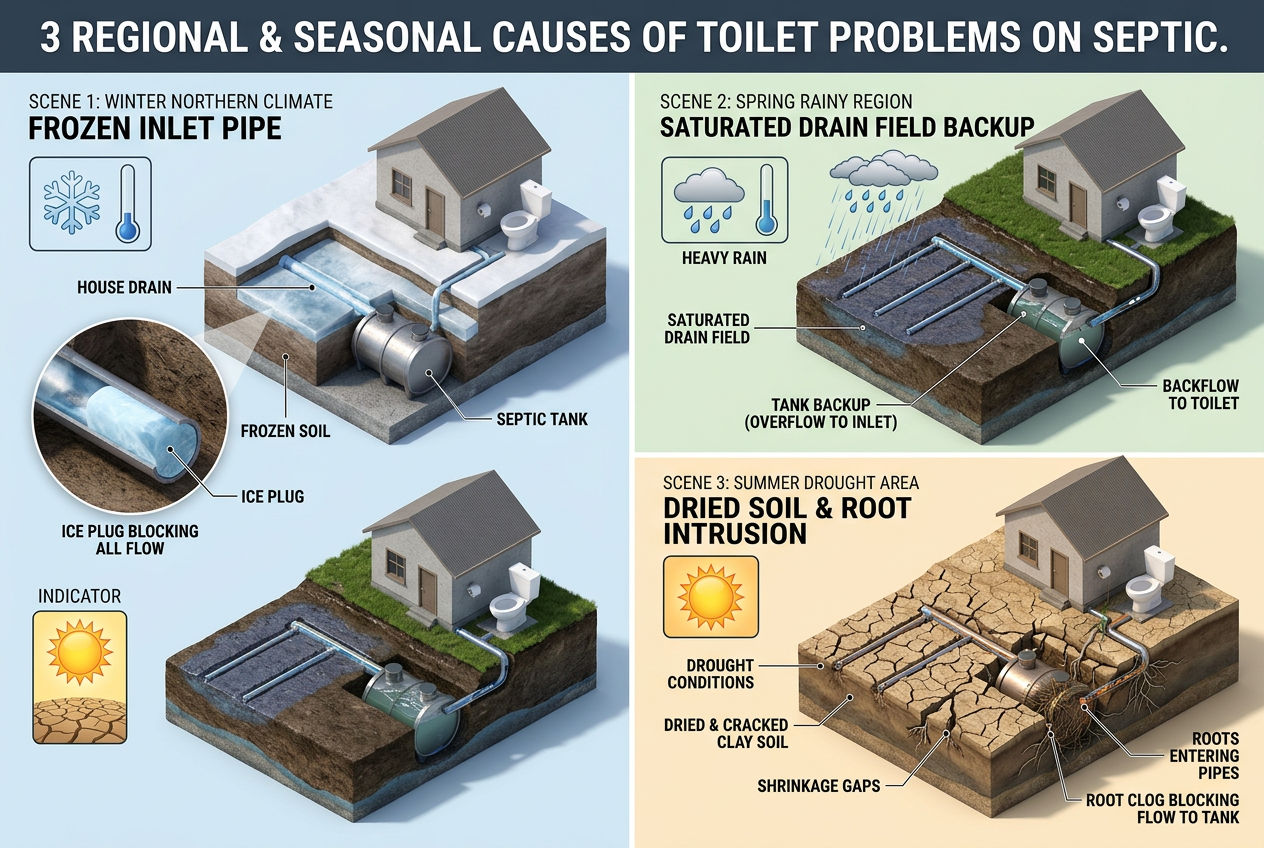
What About Seasonal and Regional Causes?
Where you live shapes the most likely cause. A toilet that won't flush in January in Minnesota points to something very different than the same problem in July in Florida.
| Season | Regional Risk | Common Cause | Prevention/Fix |
|---|---|---|---|
| Spring (March–May) | Northeast, Midwest, Pacific Northwest | Snowmelt and heavy rain saturate soil around drain fields, reducing soil's ability to accept effluent | Pump tank before spring; check saturated drain field from heavy rain |
| Winter | Northern states (frost lines 42–60 inches) | Frozen pipes between house and tank, especially if buried less than 18–24 inches | Insulate first 10 feet of pipe with foam wrap ($30); see preventing septic pipes from freezing |
| Summer | Southeast Florida, coastal Louisiana, South Carolina | High water table prevents drain field from dispersing effluent when water table is within 18–24 inches of leach lines | Monitor water table; see high water table effects on septic systems |
| Fall (October–November) | Nationwide | Wednesday before Thanksgiving = heaviest usage day of the year (laundry, showers, cooking, flushes) | Schedule pump-out before holiday weekend if tank is borderline full |
📊 Quick Fact: The septic industry calls the Wednesday before Thanksgiving the single heaviest usage day of the year — more loads of laundry, more showers, more cooking, more toilet flushes than almost any other day.
My Septic Tank Was Just Pumped — Why Won't the Toilet Flush?
This confuses a lot of homeowners. You just paid $300–$500 for a pump-out. The truck drove away. The toilet still won't flush. What happened?
A pump-out removes accumulated solids from the tank — it doesn't clear a blocked inlet baffle, doesn't snake the line between your house and the tank, and doesn't rehabilitate a failing drain field. If the obstruction is upstream of the tank (between your house and the tank inlet) or the drain field is saturated, pumping the tank itself won't solve the problem.
Three Things to Check When Flushing Problems Persist After Pump-Out:
-
Ask whether the technician inspected the baffles. A pump-out without baffle inspection misses the second most common failure point. The inlet baffle may be collapsed or heavily coated.
-
Check for infiltration. Heavy rain in the days before or after a pump-out can introduce groundwater into the tank through cracked lids or broken seams. A tank that fills back up within 24–48 hours of pumping almost certainly has groundwater infiltration — that's not normal wastewater volume.
-
Camera the main line. If baffles are intact and the tank isn't refilling abnormally fast, the obstruction is likely in the line between your house and the tank — tree roots, a grease plug, or a structural collapse.
How to Fix a Toilet That Won't Flush on a Septic System
Work through these steps in order — each one either solves the problem or rules out a cause before moving to the next.

Step 1: Confirm the Problem Is Isolated to One Toilet
Run water in every other fixture in the house for 30 seconds each. If everything else drains normally, the problem is in or immediately downstream of that toilet. If other fixtures are slow or gurgling, jump to Step 4.
Step 2: Plunge Correctly
Most homeowners own a cup plunger — the flat-bottomed red one designed for sinks. For toilets, you need a flange plunger with the rubber extension that fits down into the drain opening and creates a proper seal.
Technique matters: position the flange into the drain, push down slowly to expel air, then pull back sharply to create suction. Repeat 15–20 times with sustained pressure before concluding the plunger isn't working. Running hot (not boiling) water into the bowl before plunging can soften a partial grease or paper clog.
✅ Pro Tip: If the clog clears, flush twice to confirm proper drainage before considering the problem solved.
Sources
- EPA SepticSmart Program — Pumping frequency guidelines, septic system failure indicators, and homeowner maintenance recommendations. epa.gov/septic
- National Association of Wastewater Technicians (NAWT) — Baffle inspection standards, contractor training protocols, and residential septic troubleshooting procedures. nawt.org
- University of Minnesota Extension — Cold-climate septic system guidance including frost line depths, pipe insulation requirements, and seasonal failure patterns. extension.umn.edu
- International Association of Certified Home Inspectors (InterNACHI) — Camera inspection standards for sewer lines and septic system evaluation protocols during home inspections. nachi.org
Need help with your septic system? Find trusted septic professionals near you to get free quotes. Browse local septic companies in South Carolina or Missouri.
Free download
Not ready for the Handbook? Start with the free Fridge Card.
The Do / Don’t card the whole family can see, plus the Survival Kit: emergency flowchart, warning-sign decoder and pump-schedule card. One printable PDF.
Was this article helpful?
Frequently Asked Questions
Recommended Resources
📖 Related Articles
- Septic System Backing Up? Causes & Emergency Steps
- Green Grass Over Septic Tank: Normal or Warning Sign? (2026 Diagnostic Guide)
- Wet Spot in Yard Over Septic: What It Means & How to Fix It
- How Often Should You Pump Your Septic Tank?
- Septic Tank Baffle Repair & Replacement: Costs, Signs of Failure, and DIY vs Pro
- What Can You Flush with a Septic System? (Tampons, Wipes & More)
- Septic Tank Gurgling Sounds: Causes and Fixes
- Heavy Rain and Septic Systems: What Happens and What to Do
- Freezing Pipes and Septic: How to Prevent Winter Damage
- High Water Table and Septic Systems: What You Need to Know
💰 Cost Guides
🔧 Services
Find Septic Professionals Near You
Compare licensed, verified septic companies by area — top county markets and cities below, or browse all 50 states.
County markets
Popular cities
