
Quick Answer
---
title: "Rid-X for RV Black Tank: Does It Work and How Much to Use"
description: "Using Rid-X for RV black tank treatment is safe but off-label. Learn the correct dose by tank size, when it works, when it doesn't, and how it compares to dedicated RV treatments."
published: "June 12, 2025"
updated: "July 14, 2025"
---
Using Rid-X for RV black tank treatment is safe, but the product was designed for home septic systems — not holding tanks. It works when temperatures are right and you give it enough contact time, but a full household packet is massive overkill for a 40-gallon tank. This guide covers the correct dose, when it performs well, where it falls short, and what the alternatives actually cost.
Key Takeaways
- Rid-X is safe to use in an RV black tank but is not officially marketed for that purpose — use roughly 1–2 tablespoons per 40-gallon tank, not a full packet
- It contains four enzymes (cellulase, lipase, protease, amylase) that break down waste and can reduce odor, but it needs 12–24 hours of contact time to work
- Rid-X costs about $5–$8 per box, making it one of the cheapest options — but dedicated RV treatments like Happy Campers are formulated specifically for holding tanks
- Enzymes become significantly less effective below 50°F, which matters if you camp in cold weather
- Many state and national parks require formaldehyde-free tank treatments — Rid-X qualifies, which is a compliance win
Is Rid-X Safe to Use in an RV Black Tank?
Yes, Rid-X is safe for RV black tanks. It contains no formaldehyde, no harsh caustic chemicals, and nothing that will corrode your tank walls, damage your rubber seals, or harm the environment at a dump station. The four enzymes it carries — cellulase, lipase, protease, and amylase — are biological compounds that simply accelerate the breakdown of organic matter. They won't harm your tank.
That said, Rid-X's manufacturer, Reckitt, does not market this product for RV use. There's no RV-specific dosage on the label, no holding-tank-specific testing data published, and no official guidance for camper applications. You're using it off-label. That's not dangerous, but it does mean the dosage guidance below is based on community experience and enzyme science, not a manufacturer guarantee.
One thing worth flagging: Rid-X adds both enzymes and beneficial bacteria to the mix. In a home septic system, those bacteria colonize the tank over time and build up a thriving microbial community. In an RV black tank, which gets dumped every few days to weeks, that colony never has time to establish. The enzymes still do useful work, but you'll get less benefit from the bacterial side of the formula than you would in a stationary septic tank.
For a deeper look at how bacterial additives perform in general, see our guide on whether septic additives actually work.
How Does Rid-X Actually Work?
Rid-X relies on enzyme chemistry, not magic. Each of its four enzymes targets a specific type of waste material:
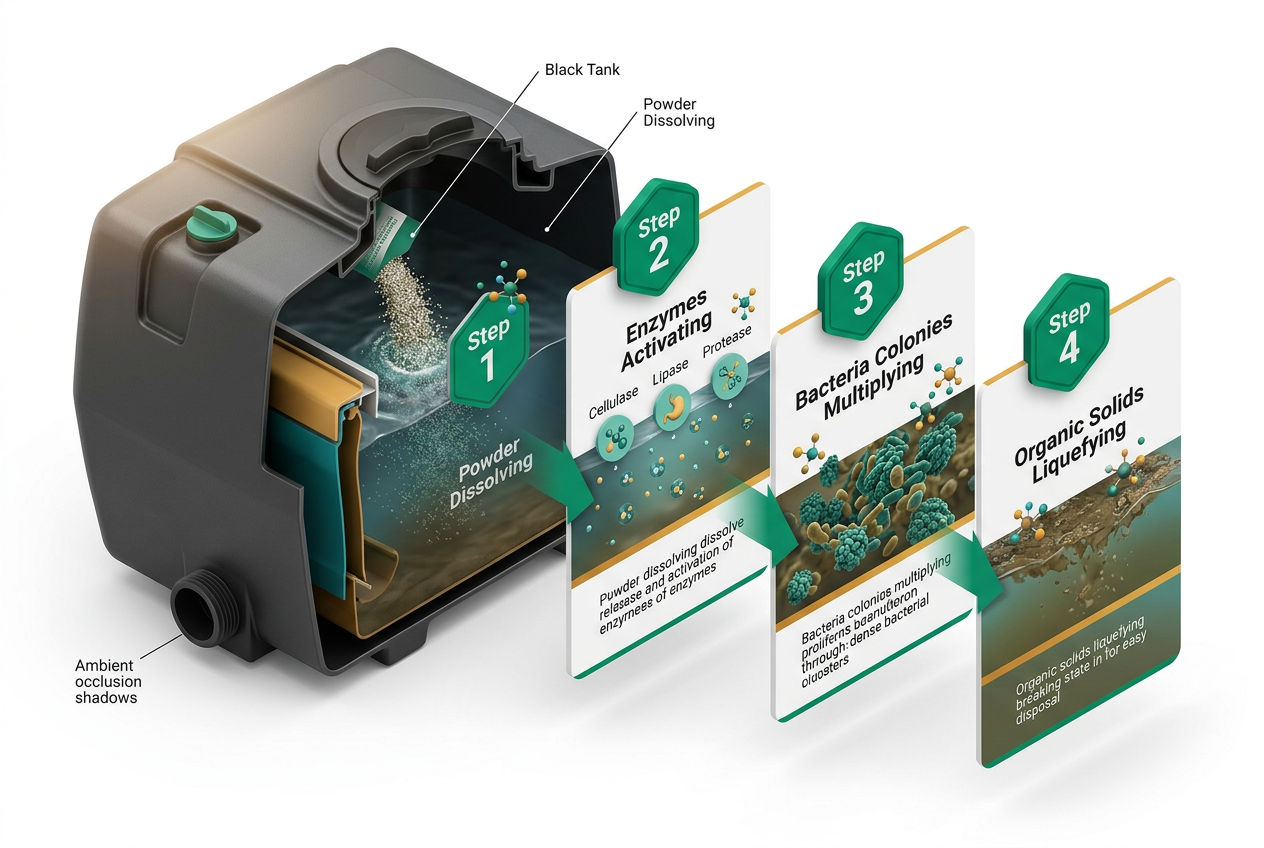
- Cellulase — breaks down toilet paper and plant-based organic material
- Lipase — targets fats and greases
- Protease — digests proteins (the primary component of human waste)
- Amylase — breaks down starches
Together, these enzymes convert solid waste into smaller particles that are easier to flush out at a dump station and less likely to build up into the crusty accumulation of dried waste that RV owners dread. They also reduce the hydrogen sulfide gas that causes that signature black tank smell.
For the enzymes to work, they need contact time. Enzyme treatments generally require 12–24 hours with waste at temperatures between 60°F and 100°F. That's an important constraint. If you dump your tank every day or drive 400 miles between campsites with a sloshing tank, the enzymes don't have a quiet window to do their job. They perform best when your rig is parked at a campground for a few days at a stretch.
The science behind septic tank enzymes follows the same principles whether you're treating a 1,500-gallon concrete tank or a 40-gallon polyethylene RV tank — contact time and temperature are everything.
How Much Rid-X Should You Use in an RV Black Tank?
A standard Rid-X household packet treats systems up to 1,500 gallons — one 9.8 oz packet per month. An RV black tank holds between 15 gallons (compact camper vans) and 50+ gallons (Class A motorhomes), with 30–45 gallons being the most common range.

Do the math: a full packet is massive overkill. The commonly recommended off-label dose for a typical 40-gallon RV black tank is approximately 1 to 2 tablespoons of Rid-X powder per tank fill. That's roughly one-quarter to one-third of a standard household packet.
Here's a practical breakdown:
- 15-gallon tank (small van conversion): ½ to 1 tablespoon
- 30-gallon tank (most travel trailers): 1 to 1.5 tablespoons
- 40-gallon tank (mid-size motorhomes): 1.5 to 2 tablespoons
- 50-gallon tank (Class A): 2 to 2.5 tablespoons
Add the powder directly into your toilet bowl with a few cups of water before your first use after dumping. This gets the enzymes into the tank immediately and gives them maximum contact time.
Rid-X is available in powder, liquid, and gel-pac forms — powder is most practical for RV black water tank use because it's easy to portion out precisely.
If you find the measuring and portioning inconvenient — or if odor control is your primary concern — the treatment we'd steer RV owners toward instead is Septifix. Each tablet releases oxygen directly into the tank alongside 14 strains of aerobic bacteria at roughly 10 billion CFU, and that oxygen is what actively works against odors and breaking down solids, rather than relying on enzymes alone. Dosing is simply one tablet flushed down the toilet — no tablespoon counts, no powder spills at a campsite. At $3–$4 per treatment it's comparable in cost to a measured Rid-X dose. Just be clear-eyed: no additive, Septifix included, is a substitute for regular dumping and periodic professional service.
Worked example: Say you own a 32-foot travel trailer with a 38-gallon black tank. You camp for five days at a state park, dumping once at the end of the trip. At arrival, you add 1.5 tablespoons of Rid-X powder through the toilet with two cups of water. Over five days at 75°F ambient temperature, the enzymes have roughly 120 hours of contact time — well above the 12–24 hour minimum. By dump day, solid waste is measurably softer and the outlet clears faster. Total cost: about $0.75 worth of product for the trip.
Rid-X vs. Dedicated RV Black Tank Treatments: A Cost Comparison
Here's where the numbers get genuinely interesting. Rid-X is cheap — but so are some of the purpose-built alternatives.

| Product | Price | Treatments | Cost Per Treatment | Formaldehyde-Free |
|---|---|---|---|---|
| Rid-X Powder (3-pack) | $5–$8 | ~9 RV doses | $0.55–$0.90 | Yes |
| Happy Campers | $18–$22 | 18 treatments | $1.00–$1.22 | Yes |
| Camco TST Drop-Ins | $14–$16 | 15 pods | $0.93–$1.07 | Yes |
| Aqua-Kem (Thetford) | $12–$15 | 8 treatments | $1.50–$1.88 | No (some formulas) |
Pricing based on national retail averages, July 2025. Formaldehyde content varies by product line — always verify label before use in parks requiring chemical-free treatments.
At roughly $0.55–$0.90 per treatment, Rid-X for RV toilet use is the cheapest option by a significant margin. If budget is your primary concern and you're camping in warm weather with moderate tank usage, it's a reasonable choice.
However, dedicated RV treatments like Happy Campers are specifically pH-balanced for the black tank environment — ideally between 6.5 and 7.5 — and their bacteria strains are selected for the anaerobic conditions of a sealed holding tank. Rid-X is engineered for aerobic-leaning septic conditions and doesn't fully replicate that. That's a real formulation difference worth knowing before you commit to a long season of camping. For a full side-by-side breakdown of pod-format treatments, see our septic treatment pods comparison.
If you want to know what professional black tank servicing runs when DIY options aren't enough, our septic pumping cost guide covers pricing by tank size and region.
Can Rid-X Unclog an RV Black Tank?
Partially — and only for specific types of clogs.
If you've got a partial blockage caused by accumulated waste and undissolved toilet paper, the cellulase and protease enzymes in Rid-X can soften that material over 24–48 hours and help it flush through. Some RV owners report success using a double dose left overnight to clear a sluggish sensor reading or a sticky valve.
But Rid-X cannot fix a mechanical clog. If something solid is wedged in your tank's outlet, your flush valve is stuck, or your macerator pump has failed, no enzyme treatment will help. Similarly, if your tank sensors are misreading — a widespread problem in older rigs — Rid-X may or may not clear the built-up residue causing the false reading. A dedicated tank rinser (like the Camco Tornado or a tank wand) combined with an enzyme treatment is a more reliable approach for that specific problem.
For serious clogs or mechanical failures, you're looking at a hands-on fix, not a chemical one. Our guide on how to empty an RV black tank covers the full process, including dealing with stuck valves.
Does Temperature Affect How Well Rid-X Works in an RV?
Yes — significantly. Enzyme activity is temperature-dependent. Rid-X's bacterial enzymes are most active between 60°F and 100°F. Below 50°F, effectiveness drops sharply. Below 40°F, the bacteria essentially go dormant and enzyme activity nearly stops.
This creates a real-world limitation that most product reviews skip entirely:
Summer camping (June–August): Ideal conditions. Heat keeps enzymes active, which also means odor-causing bacteria thrive faster — so treatment is more necessary and more effective. In Texas, Arizona, and Florida during summer, tank temperatures can exceed 90°F, which is still within the effective range.
Spring startup (March–May): Good conditions. If you're de-winterizing your rig and running the first fill through the tank, adding Rid-X as part of your spring startup routine makes sense. Temperatures are warming and enzyme activity will pick up within a few days.
Fall storage (September–November): Don't leave Rid-X in your tank over winter. Freezing temperatures kill the bacteria entirely. Dump, flush, and winterize your tank before temperatures drop. Enzyme treatments serve no purpose in a frozen, stored tank.
Cold-weather and full-timer use (December–February): If you're snowbirding in southern states, the Sun Belt climate keeps tank temperatures warm enough for Rid-X to function. If you're in the Mountain West or Northern states with outdoor temperatures below freezing, look into heated tank systems — and know that biological treatments won't do much for you.
Campers boondocking on BLM land in the Western U.S. often face dramatic overnight temperature swings. If your tank drops below 40°F at night and warms back up during the day, you're getting inconsistent enzyme performance at best. In those conditions, a chemical treatment rated for wider temperature ranges may be more reliable.
Is an RV Black Tank Treatment with Rid-X Compliant at Campgrounds?
Yes — Rid-X is formaldehyde-free, which makes it compliant with the chemical restrictions posted at most National Park Service campgrounds and many state park systems.
The compliance issue matters more than most RV owners realize. The National Park Service and many state park systems prohibit the use of formaldehyde-based holding tank treatments at dump stations on their grounds. Thetford's Aqua-Kem, in its traditional blue formula, contains formaldehyde — which is why you'll see "no blue chemicals" signs posted at NPS dump facilities. Rid-X contains none.
According to the National Park Service's waste management guidance, campgrounds within NPS jurisdiction are required to post chemical-use rules at dump stations, and rangers at high-traffic parks do enforce them. Using a prohibited chemical and being caught can result in a fine and dump station access being revoked for your rig.
Rid-X sidesteps that entirely. The product is enzyme-based with no dyes, no formaldehyde, and no quaternary ammonium compounds — all categories of chemicals restricted at sensitive campground locations.
One practical tip: keep a photo of the Rid-X ingredient label on your phone. At busy campgrounds where rangers ask what treatment you're using, a quick ingredient check takes five seconds and confirms compliance on the spot. It's a small thing that has gotten more than a few campers through the gate without friction.
What's the Difference Between Rid-X and RV-Specific Tank Treatments?
The core difference comes down to formulation environment. Rid-X was designed for aerobic-leaning home septic systems where bacteria have weeks to colonize a stationary tank. RV holding tanks are anaerobic, sealed, and dumped frequently — a very different environment.
That gap shows up in three practical ways:
1. Bacterial colony establishment: In a home septic system, Rid-X bacteria build up over months and develop a stable population that continuously processes waste. In an RV black water tank that gets dumped every 3–7 days, no colony ever establishes. You're getting one-time enzyme activity per dose, not a living system.
2. pH optimization: Products like Happy Campers are formulated to maintain the 6.5–7.5 pH range that favors enzyme activity in sealed holding tanks. Rid-X makes no such claim for holding tank environments.
3. Odor control additives: Dedicated RV treatments often include odor-masking compounds or surfactants designed for the specific smell profile of a sealed black tank in summer heat. Rid-X relies solely on enzymatic breakdown to reduce odor — which works, but more slowly and less completely in hot conditions.
None of this makes Rid-X a bad choice. It makes it a budget-appropriate, warm-weather, short-trip choice. For full-time RVers, cold-weather campers, or anyone with chronic odor problems, a product engineered for holding tank conditions will outperform it. See our Camco septic treatment review for how one of the most popular alternatives performs in real conditions.
When Should You Use Rid-X vs. a Dedicated RV Tank Treatment?
Use Rid-X for RV black tank treatment if:
- You're a seasonal camper doing 10–20 trips per year in warm weather
- Your tank holds 30–50 gallons and you dump every 4–7 days
- Budget is a priority and you camp at sites with reliable dump facilities
- You need a formaldehyde-free treatment that meets NPS campground rules

Choose Happy Campers if:
- You're a full-timer or extended-stay camper (4+ weeks continuous)
- You experience persistent odor problems that enzyme-only treatments haven't solved
- You camp in temperatures below 60°F regularly
- You want a treatment with a published RV-specific formulation
Choose Camco TST Drop-Ins if:
- You want the convenience of a pre-measured pod with no portioning
- You're sharing treatment duties with a partner who doesn't want to measure powder
- You camp at higher altitudes where temperature swings are common
The honest limitation: No holding tank treatment — Rid-X or otherwise — compensates for improper dumping technique, inadequate flushing water, or using non-RV-safe toilet paper. The biggest factor in black tank health is using at least 1 gallon of water per flush and rinsing the tank thoroughly at every dump. Chemistry is the assist, not the fix. Understanding how a septic system works provides useful context for why water volume matters so much in any waste-processing system.
Does Rid-X Work for Home Owners Who Also Use an RV?
If you maintain a home with a septic system and RV camp regularly, you can buy Rid-X in a single purchase and use it for both applications — just portion accordingly. One standard 9.8 oz packet treats one home septic system per month or provides approximately 9 RV black tank doses.
A few specifics to keep in mind: your home septic system benefits from the full bacterial colony effect of Rid-X — the long-term establishment that an RV tank can't replicate. According to the EPA's SepticSmart guidelines, biological additives used consistently in home systems can help maintain the microbial balance needed between pumping cycles. The same EPA guidance recommends professional pumping every 3–5 years regardless of additive use — a schedule that applies to the home system only, not your RV tank.
For your RV, you're getting the enzyme benefit without the colony benefit. That's still useful. Both applications are legitimate uses of the same product — just at very different scales and with different expectations for what the bacteria actually accomplish.
Our guide on RV and home septic system maintenance covers the overlap in more detail, including which additive types serve dual-use households best. For homeowners considering professional service options, SepticTankHub.com connects you with licensed providers in your area.
Sources & Methodology
- Reckitt (Rid-X manufacturer) — Product label, ingredient disclosure, and septic system usage guidance. Rid-X is not marketed for RV use; dosage recommendations in this article are based on enzyme concentration math, not manufacturer guidance.
- U.S. Environmental Protection Agency — SepticSmart Program — Guidelines on biological additive use in home septic systems. Available at epa.gov/septicsmart. Referenced for homeowner bacterial additive context.
- National Park Service — Waste Management at Campgrounds — NPS guidance on prohibited holding tank chemicals at dump stations. Formaldehyde restrictions are enforced at NPS-managed campgrounds. Available at nps.gov.
- National Onsite Wastewater Recycling Association (NOWRA) — Industry guidance on enzyme and bacterial additive performance in anaerobic vs. aerobic waste environments. Referenced for the septic vs. holding tank formulation distinction.
- Community data (iRV2 Forums, RV.net, Reddit r/GoRVing) — Dosage norms, temperature performance observations, and sensor-reading reports are drawn from aggregated RV owner experience. This data is directional, not peer-reviewed. Individual results vary by tank design, usage patterns, and regional climate.
Related Rid-X & Septic Treatment Guides
- Aerobic Septic System Diagram: How Each Part Works
- Are Septic Tank Treatments Necessary?
- Best Septic Tank Treatment for Slow Drains
- Bio-Clean Septic Treatment Review: Does It Work?
- Cabin Obsession Septic Tank Treatment Review
- Camco Septic Tank Treatment Review
- Green Gobbler Septic Treatment Review: Pods, Packets & Results
- How Often Should You Use Rid-X? Directions, Dosing & Timing
- How to Handle How Often to Use Septic Tank Treatment: Step by Step
- Is Rid-X Safe for Septic Tanks, Toilets & Pipes?
- Is Septic Tank Smell Dangerous? Gases, Risks & When to Worry
- The Best Rid-X Alternatives
- Does Rid-X Unclog Drains or Toilets?
- What's Actually in Rid-X? Ingredients Explained
- Rid-X vs. Green Gobbler: Which Septic Treatment Wins?
- Septic Tank Smell After Pumping? Causes & How to Fix It
- Septic Smell From Roof Vent? Causes & How to Fix It
- Septic Smell From Shower Drain? Causes & How to Fix It
- Septic Smell Coming From Toilet? Causes & How to Fix It
- Septic Smell When It Rains? Why It Happens & How to Fix It
- Septic System Diagram With a Pump
- Septic Tank Cross-Section Diagram: Every Part Labeled
- Septic Tank Diagram With Dimensions
- Yeast, Baking Soda & Milk in Your Septic Tank: Myths Tested
- Septic Tank Plumbing Diagram: From House to Drain Field
- The Best Septic Tank Smell Removers
- Septic Tank Treatments at Walmart vs. Home Depot vs. Online
- Septic Treatment Tablets vs. Powder vs. Liquid: Which Is Best?
- Where to Buy SeptiFix
- Rid-X Platinum Review: Is the Upgrade Worth It?
- Zep Septic Defense Review: Does It Beat Rid-X?
- The Best Septic Tank Sludge Dissolvers
- The Best Septic Treatment for Toilet Paper Breakdown
- Instant Power Septic Shock Review: Does It Work?
Frequently Asked Questions
How much Rid-X should I use in my RV black water tank?
For most RV black water tanks, use 1 to 2 tablespoons of Rid-X powder per tank — not a full household packet. A standard Rid-X packet is designed for septic systems up to 1,500 gallons, while most RV tanks hold between 15 and 50 gallons. For a 15-gallon van tank, use ½ to 1 tablespoon. For a 30-gallon travel trailer tank, use 1 to 1.5 tablespoons. For a 40-gallon mid-size motorhome tank, use 1.5 to 2 tablespoons. For a 50-gallon Class A tank, use 2 to 2.5 tablespoons. Add the powder through your toilet bowl with two to three cups of water before your first use after dumping. This gets enzymes into the tank immediately and maximizes contact time. Powder form is easiest to portion precisely — the liquid and gel-pac versions are harder to split into RV-appropriate doses without measuring equipment.
Can I use Rid-X instead of RV tank treatment products?
You can use Rid-X as an RV tank treatment, but it's not a direct substitute for purpose-built products. Rid-X is formulated for home septic systems, which are aerobic-leaning environments where bacteria colonize over months. An RV black tank is anaerobic and gets dumped every few days, so the bacterial colony benefit never develops — you're only getting the one-time enzyme action per dose. Dedicated RV treatments like Happy Campers are pH-balanced for sealed holding tanks and contain bacteria strains selected for anaerobic conditions. That's a meaningful formulation difference, especially for full-timers or anyone dealing with persistent odor. For seasonal campers doing warm-weather trips and dumping every 4–7 days, Rid-X performs adequately at a fraction of the cost — roughly $0.55 to $0.90 per treatment versus $1.00 to $1.22 for Happy Campers. Match the product to your actual use pattern rather than assuming one is universally better.
Will Rid-X hurt my RV black tank sensors?
Rid-X will not damage your RV black tank sensors, but it may or may not fix false sensor readings either. The sensors themselves are typically probe-type or resistive sensors mounted inside the tank wall. Rid-X contains no corrosive chemicals — no caustic compounds, no formaldehyde, no solvents — so sensor hardware is safe. The question is whether the enzyme activity helps clear the waste film that coats sensors and causes false "full" readings. Cellulase and protease enzymes can soften accumulated residue over 24 to 48 hours, which sometimes improves sensor accuracy. However, heavy built-up residue often requires mechanical cleaning. A tank wand or Camco Tornado rinser used in combination with an enzyme treatment is significantly more effective for sensor issues than enzyme alone. If your sensors have been misreading for multiple seasons, physical residue buildup is the likely culprit, and chemical treatment alone is rarely a complete fix.
Does Rid-X work in cold weather RV camping?
Rid-X works poorly in cold weather. Its bacterial enzymes are most active between 60°F and 100°F. Below 50°F, enzyme effectiveness drops sharply. Below 40°F, the bacteria go dormant and activity nearly stops. For winter camping in the Mountain West, Northern states, or high-altitude locations where overnight temperatures drop below freezing, Rid-X provides minimal benefit. If your tank temperature fluctuates dramatically — above 60°F during the day and below 40°F at night — you'll get inconsistent, unreliable enzyme performance. For cold-weather full-timing or snowbird camping in states where temperatures stay above 50°F (southern Texas, Arizona, Florida, coastal California), Rid-X remains effective. For true winter camping, consider a treatment rated for wider temperature ranges, or focus on mechanical flushing rather than biological treatment. Never leave Rid-X in a tank that will freeze — freezing kills the bacteria permanently and the product will be inert when thawed.
Is Rid-X safe to dump at campgrounds and RV dump stations?
Yes, Rid-X is safe to dump at virtually all campground dump stations, including those at National Park Service and state park facilities that restrict certain chemicals. Rid-X is formaldehyde-free, dye-free, and contains no quaternary ammonium compounds — the three categories most commonly prohibited at environmentally sensitive dump locations. Many campgrounds post signs prohibiting "blue chemicals," which refers to formaldehyde-based products like traditional Aqua-Kem. Rid-X uses none of those ingredients. According to NPS waste management guidance, campgrounds within NPS jurisdiction enforce chemical restrictions at dump stations, and prohibited products can result in fines. Rid-X sidesteps those restrictions entirely. As a practical tip, keep a photo of the Rid-X ingredient label on your phone — at campgrounds that ask what treatment you're using, showing the ingredient list takes seconds and confirms compliance immediately. No special disposal procedures are required beyond normal tank-dumping protocol.
Can I use Rid-X in my RV holding tank for gray water?
Rid-X can be used in a gray water holding tank, but it provides less benefit there than in a black tank. Gray water tanks collect sink and shower drainage — primarily soap residue, food particles, grease, and hair. Rid-X's lipase enzyme targets fats and grease, and protease handles proteins, so there is some applicable chemistry. However, gray water tanks rarely develop the odor or solid-accumulation problems that make black tank treatment necessary. If your gray water tank is producing noticeable odor — often caused by food-particle buildup near the drain valve — a small dose of Rid-X (½ to 1 tablespoon for most tank sizes) left overnight can help. For routine gray water management, regular flushing with clean water is more effective than chemical treatment. If gray water odor is persistent, the more likely culprit is a dirty tank drain valve or P-trap issue rather than a problem that enzyme treatment will resolve.
Free download
Not ready for the Handbook? Start with the free Fridge Card.
The Do / Don’t card the whole family can see, plus the Survival Kit: emergency flowchart, warning-sign decoder and pump-schedule card. One printable PDF.
Was this article helpful?
Frequently Asked Questions
Recommended Resources
📖 Related Articles
💰 Cost Guides
Find Septic Professionals Near You
Compare licensed, verified septic companies by area — top county markets and cities below, or browse all 50 states.
County markets
Popular cities
