
Quick Answer
Most Rid-X Platinum reviews focus on what the packaging claims. This one focuses on what the research actually shows. Rid-X Platinum is a premium septic tank enzyme treatment that contains higher concentrations of four core enzymes — cellulase, lipase, protease, and amylase — delivered in a dissolvable powder format sized for tanks up to 1,500 gallons. After comparing it against standard Rid-X, reviewing university extension research, and running the actual cost math, the short answer is: the upgrade is hard to justify for most households.
Key Takeaways
- Rid-X Platinum uses the same four enzyme types as standard Rid-X but claims higher concentrations, particularly of lipase for grease breakdown
- Platinum runs approximately $12–$15 per unit vs. $8–$10 for standard Rid-X — about $48–$60 per year more at monthly dosing
- Neither version eliminates the need for pumping; the EPA recommends pumping every 3–5 years regardless of additive use
- University extension research shows bacterial additives provide limited measurable benefit in healthy, functioning systems
- If you're committed to using a monthly treatment, our recommendation is Septifix — not Rid-X Platinum
What Is Rid-X Platinum, and How Does It Differ from Standard Rid-X?
Rid-X Platinum is the top tier of the Rid-X product lineup, positioned above the standard powder and liquid formulas as a "maximum strength" treatment. Both versions use the same four-enzyme approach, but Platinum markets itself on concentration and delivery.
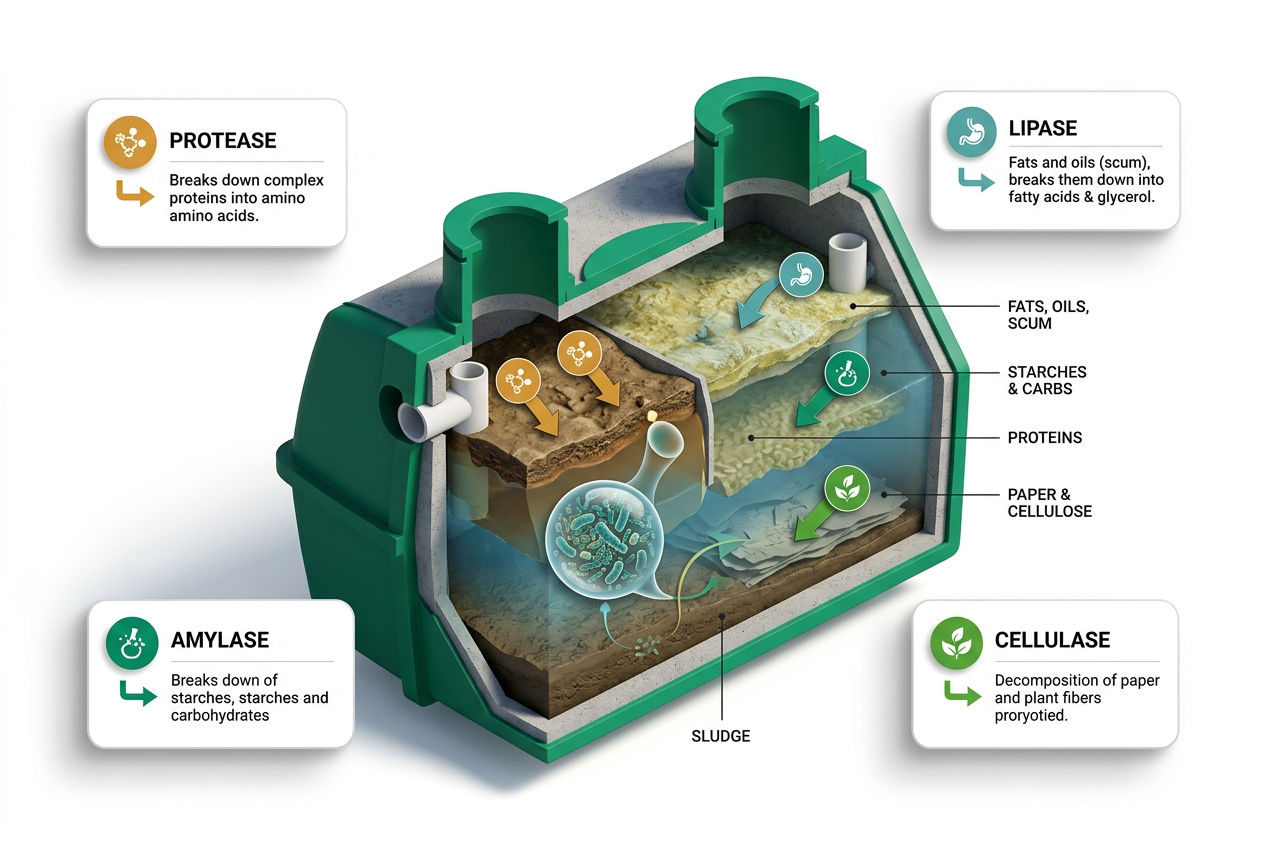
Here's the specific breakdown of what each formula targets:
- Cellulase — breaks down toilet paper, plant fibers, and cotton
- Lipase — targets fats, oils, and grease (FOG) in the scum layer
- Protease — digests proteins from food waste and human waste
- Amylase — breaks down starches and carbohydrates
Standard Rid-X has offered this same quartet for years. Rid-X Platinum's claim is that its lipase concentration is meaningfully higher, making it more effective at attacking the grease layer that accumulates at the top of your tank. Reckitt (Rid-X's parent company) doesn't publish exact CFU counts or enzyme concentration percentages publicly — a limitation worth noting before paying a premium based on marketing language alone.
The full Rid-X product lineup also includes a liquid formula and dissolvable gel pacs. Both are designed for the same monthly dosing schedule and the same 1,500-gallon tank coverage. If you're weighing powder versus liquid formats more broadly, that comparison is covered in our Rid-X liquid vs. powder guide.
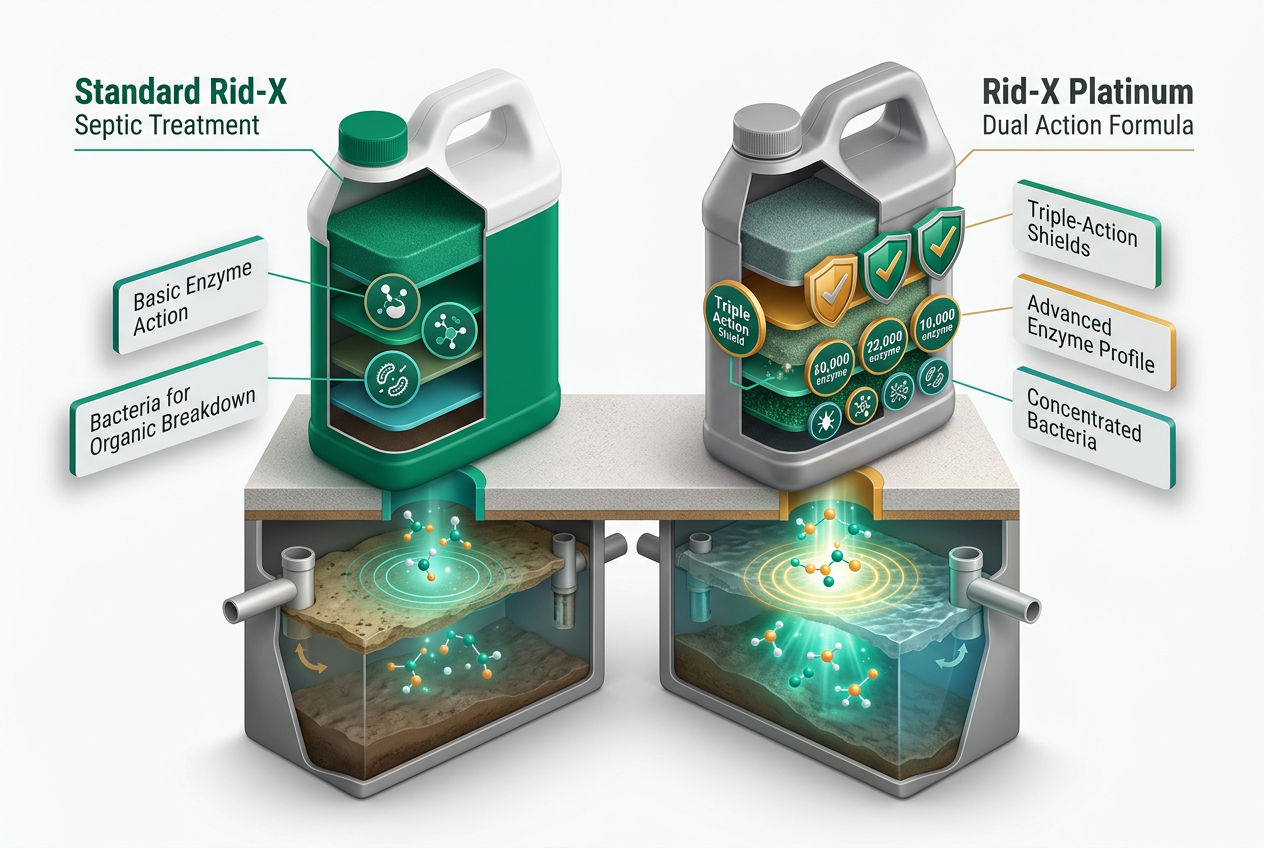
Rid-X Platinum vs. Regular Rid-X: Side-by-Side Comparison
| Feature | Rid-X Standard | Rid-X Platinum |
|---|---|---|
| Enzyme types | Cellulase, lipase, protease, amylase | Cellulase, lipase, protease, amylase |
| Concentration claim | Standard | Higher (lipase emphasis) |
| Tank coverage | Up to 1,500 gallons | Up to 1,500 gallons |
| Dosing frequency | Monthly | Monthly |
| Avg. price per unit | $8–$10 | $12–$15 |
| Annual cost (monthly use) | $96–$120 | $144–$180 |
| Available formats | Powder, liquid, gel pacs | Powder only |
Source: Reckitt manufacturer product listings; retail pricing from major national retailers as of 2026.
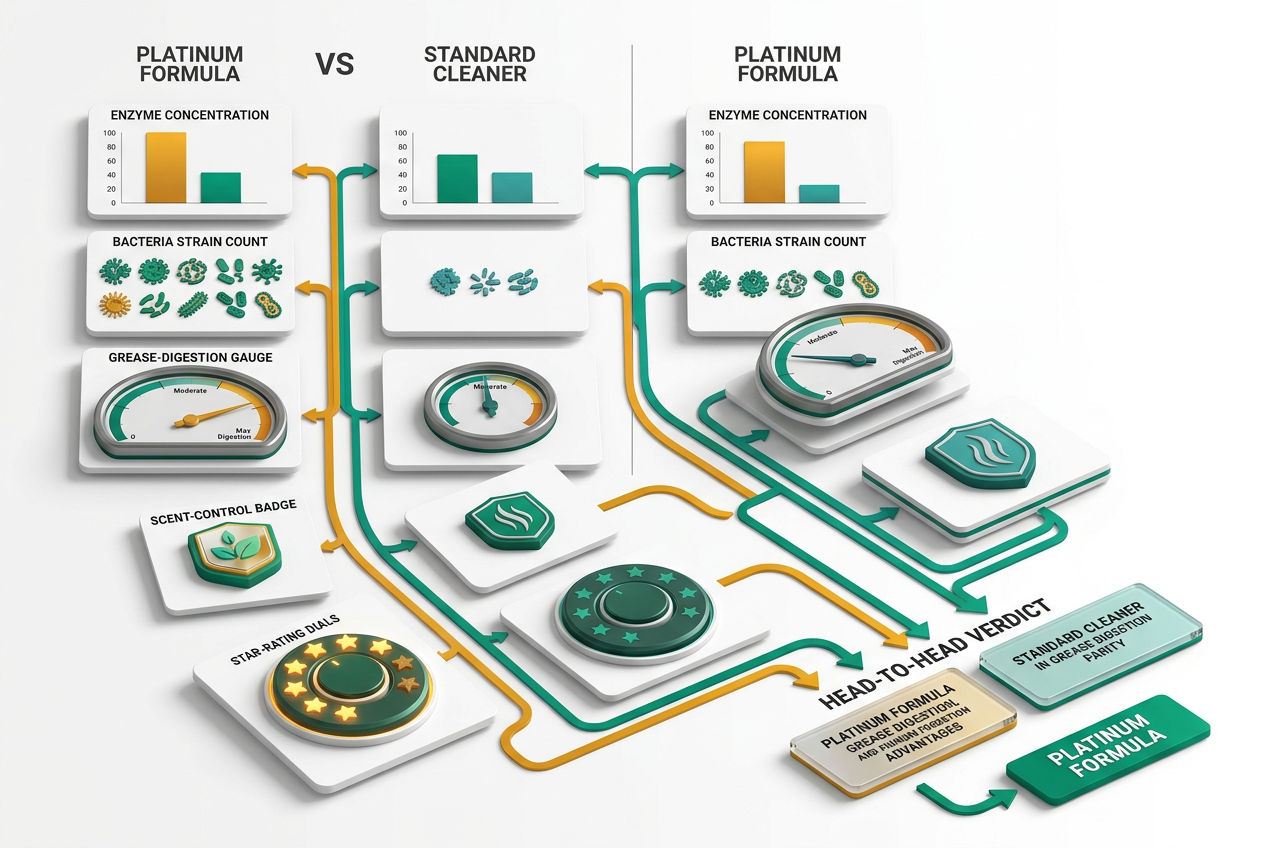
When homeowners search for "rid x platinum vs regular," they're usually asking whether the added cost produces a measurable difference. Based on the enzyme overlap above, it doesn't — at least not for a typical household.
Is Rid-X Platinum Worth It for Your Septic Tank?
Rid-X Platinum is marginally better on paper — but the real-world difference is difficult to measure and unlikely to matter for most septic systems.
The core enzymes are identical. The claimed concentration advantage targets grease, which matters most in households where cooking oils and fats enter the system frequently. That means Platinum is potentially worth considering if your household generates above-average FOG — think a large family cooking from scratch daily, or a household without a properly trapped kitchen line.
For a typical 4-person household with a 1,000-gallon or 1,500-gallon concrete tank, normal eating habits, and a system pumped every 3–4 years, the added lipase concentration in Platinum is unlikely to produce noticeable results. Your tank's existing anaerobic bacteria do most of the organic breakdown work already.
The bottom line: Platinum isn't worse. But the $48–$60 annual price difference gets you an unverified concentration claim, not a verified performance outcome. For a more thorough look at how all Rid-X formulas stack up, the Rid-X vs. Septifix comparison walks through the full breakdown.
What Do Septic Professionals Actually Think?
Septic pumpers are skeptical of all additives — Platinum or standard. The reasoning isn't that enzymes don't work in a lab. They do. The issue is whether a monthly dose into a 1,000- to 1,500-gallon tank meaningfully changes the microbial balance of a system that's already populated with billions of naturally occurring anaerobic bacteria.
According to the University of Minnesota Extension, healthy septic tanks contain sufficient naturally occurring bacteria to break down household waste without supplementation. Their guidance stops short of endorsing regular additive use as a maintenance strategy. North Carolina State University's extension program has published similar positions — acknowledging that enzyme products are not harmful to a functioning system, but questioning whether they provide meaningful benefit beyond what's already present.
According to the EPA's SepticSmart program (epa.gov/septic), septic systems do not require the addition of bacteria or enzymes to function properly. That's the federal baseline position.
Some pumpers report pulling lids on tanks where homeowners used Rid-X monthly for years and finding the same sludge accumulation rates as tanks where nothing was added. That's anecdotal — and it aligns with what the university extension data suggests. Our deep dive on whether septic additives work covers the research in full.
None of this means additives cause harm. But it does mean you shouldn't rely on Rid-X Platinum — or any enzyme product — as a substitute for your pump-out schedule. If your system is already showing symptoms like slow drains or soggy ground near the leach field, see our signs of drain field failure guide before reaching for a stronger product.
What Are the Rid-X Platinum Ingredients and How Do They Work?
Rid-X Platinum's active ingredients are four enzyme types: cellulase, lipase, protease, and amylase. Each targets a specific waste category inside a septic tank.
Cellulase breaks down cellulose-based materials — toilet paper primarily, but also cotton fibers from clothing washed through a connected laundry line. Lipase is the enzyme Reckitt emphasizes most in Platinum's marketing; it attacks the FOG (fats, oils, and grease) layer that floats at the top of the tank. Protease digests protein-based waste from food scraps and human waste. Amylase handles starches and complex carbohydrates.
These enzymes are suspended in a dry powder format and are inert until they dissolve in water. Once flushed, they travel into the tank and work on the scum layer rather than the sludge layer at the bottom — enzymes do not digest the inorganic solids that accumulate as sludge.
Reckitt does not publish the specific concentration ratios for Platinum versus standard Rid-X, which makes independent verification of the "maximum strength" claim impossible. That lack of transparency is a legitimate limitation when evaluating whether the Rid-X Platinum septic tank formula justifies its price point.
How Do You Use Rid-X Platinum Correctly?
Using Rid-X Platinum in a septic tank is straightforward: flush one pre-measured dose down the toilet each month for tanks up to 1,500 gallons. For tanks larger than 1,500 gallons — say, a 2,000-gallon system serving a 6-person household — a double dose is appropriate, though the packaging doesn't always spell that math out clearly.
A few practical notes on how to use Rid-X Platinum effectively:
- Timing: Flush the dose at night so it sits in the tank during low-use hours, giving enzymes more contact time with waste
- Consistency: Monthly use means 12 doses per year — skipping months reduces whatever marginal benefit the product offers
- Overuse: Flushing extra doses doesn't accelerate results and can temporarily disrupt natural bacterial populations, though this effect is short-lived
- What it won't do: Rid-X Platinum is a maintenance product, not a rescue treatment. It cannot reverse drain field failure, unblock clogged laterals, or reduce sludge in a tank that's overdue for pumping
The full guide on Rid-X safety covers the chemistry behind enzyme overuse and what happens when chemical additives — not enzyme products — enter a septic system.
How Much Does Rid-X Platinum Cost Over Time?
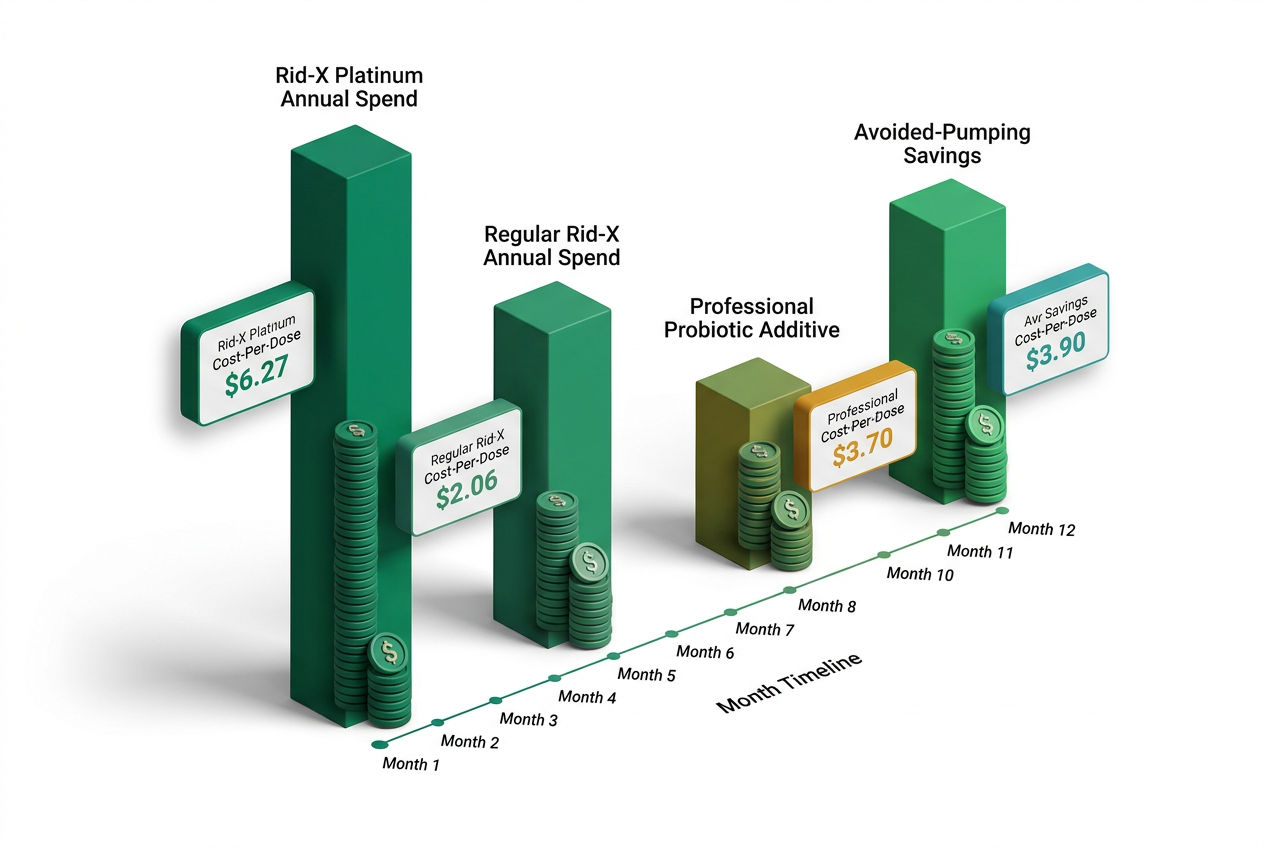
Here's a worked cost example. Say you have a 1,000-gallon concrete tank, a 4-person household in central Ohio, and you start using Rid-X Platinum monthly at $13 per unit. Over 5 years, that's $780 in product. Over 10 years, $1,560.
A pump-out in central Ohio runs $300–$450 for a 1,000-gallon tank. Pumping every 3 years over a decade means roughly 3 pump-outs: $900–$1,350 total.
The additive spend doesn't reduce how often you need to pump. Sludge accumulation in the bottom of the tank — that dense layer of inorganic solids and byproducts that enzymes simply cannot digest — still builds at roughly the same rate. When a pumper uses a sludge judge and finds sludge at 25–33% of tank depth, it's time to pump, regardless of what's been added monthly.
So over a decade: $780–$1,560 in Platinum product, plus the same $900–$1,350 in pump-outs you'd need anyway. The additive cost is entirely additive (no pun intended) — it doesn't offset any maintenance expense. See typical pump-out pricing for your region in our septic pumping cost guide.
What Should You Actually Use for Monthly Septic Maintenance?
If you're committed to a monthly septic treatment — and there are reasonable cases for supporting bacterial populations during periods of heavy antibiotic use, after bleach-heavy cleaning sessions, or following high-use events like holiday gatherings — our recommendation is Septifix, not Rid-X Platinum.
The Rid-X vs. Septifix comparison walks through the full breakdown, but here's the core difference. Septifix uses oxygen-releasing tablets carrying 14 strains of live aerobic bacteria at approximately 10 billion CFU per tablet. That's a fundamentally different mechanism from enzyme powder. The oxygen release actively targets odor and sludge accumulation in a way that passive enzyme powder sitting in an anaerobic environment cannot replicate.
Dosing is one tablet flushed down the toilet — no measuring, no powder clouds, no second-guessing whether you used the right amount for a 1,250-gallon tank. Septifix is made in the USA, non-toxic, and backed by a 60-day money-back guarantee. At roughly $3–$4 per treatment when purchased at volume, it costs $108–$144 less per year than Rid-X Platinum at monthly dosing.
That said, Rid-X Platinum's specific pitch is a three-in-one formulation targeting paper breakdown in addition to general waste. If accelerated paper digestion is your primary concern — say, a household that consistently uses thicker paper products — that's the one scenario where Platinum's enzyme blend might address something Septifix's aerobic approach handles more indirectly. It's a narrow use case, but worth naming honestly before you make the switch.
To be direct: Septifix doesn't eliminate the need for pumping either. No additive does. The EPA's position is clear on that. But if you want to support your system between pump-outs, particularly after events that kill off beneficial bacteria, Septifix gives you more biological activity per dollar than Rid-X Platinum does.
How to Get the Most Out of Any Septic Treatment
Whichever product you use, the maintenance fundamentals matter more than the formula.
- Pump on schedule: Every 3–4 years for a 4-person household without a garbage disposal; every 2–3 years with one. A septic inspection before your first pump-out establishes a baseline sludge depth so future intervals are based on actual accumulation, not guesswork
- Protect your drain field: Avoid parking vehicles or planting deep-rooted trees over leach lines. Compaction and root intrusion are more common causes of drain field failure than anything a treatment product would address — our drain field failure guide covers the early warning signs
- Use septic-safe products: Bleach-heavy cleaners and antibacterial soaps kill the beneficial bacteria your tank needs. Our septic-safe cleaning products guide lists specific brands and concentrations that won't disrupt the system
- Time your treatment doses: Flush any additive at low-use hours — typically late evening — so the product has maximum dwell time before the next flush cycle disturbs it
- Check your best septic tank treatment options if you're not sure Septifix or Rid-X is right for your system type — some aerobic systems and mound systems have different requirements
Related Rid-X & Septic Treatment Guides
- Aerobic Septic System Diagram: How Each Part Works
- Are Septic Tank Treatments Necessary?
- Best Septic Tank Treatment for Slow Drains
- Bio-Clean Septic Treatment Review: Does It Work?
- Cabin Obsession Septic Tank Treatment Review
- Camco Septic Tank Treatment Review
- Green Gobbler Septic Treatment Review: Pods, Packets & Results
- How Often Should You Use Rid-X? Directions, Dosing & Timing
- How to Handle How Often to Use Septic Tank Treatment: Step by Step
- Is Rid-X Safe for Septic Tanks, Toilets & Pipes?
- Is Septic Tank Smell Dangerous? Gases, Risks & When to Worry
- The Best Rid-X Alternatives
- Does Rid-X Unclog Drains or Toilets?
- Can You Use Rid-X in an RV Black Tank? What to Know First
- What's Actually in Rid-X? Ingredients Explained
- Rid-X vs. Green Gobbler: Which Septic Treatment Wins?
- Septic Tank Smell After Pumping? Causes & How to Fix It
- Septic Smell From Roof Vent? Causes & How to Fix It
- Septic Smell From Shower Drain? Causes & How to Fix It
- Septic Smell Coming From Toilet? Causes & How to Fix It
- Septic Smell When It Rains? Why It Happens & How to Fix It
- Septic System Diagram With a Pump
- Septic Tank Cross-Section Diagram: Every Part Labeled
- Septic Tank Diagram With Dimensions
- Yeast, Baking Soda & Milk in Your Septic Tank: Myths Tested
- Septic Tank Plumbing Diagram: From House to Drain Field
- The Best Septic Tank Smell Removers
- Septic Tank Treatments at Walmart vs. Home Depot vs. Online
- Septic Treatment Tablets vs. Powder vs. Liquid: Which Is Best?
- Where to Buy SeptiFix
- Zep Septic Defense Review: Does It Beat Rid-X?
- The Best Septic Tank Sludge Dissolvers
- The Best Septic Treatment for Toilet Paper Breakdown
- Instant Power Septic Shock Review: Does It Work?
Frequently Asked Questions About Rid-X Platinum
Is Rid-X Platinum worth it compared to regular Rid-X?
Rid-X Platinum is not worth the price premium for most households. Both Platinum and standard Rid-X use the same four enzymes — cellulase, lipase, protease, and amylase — and cover the same 1,500-gallon tank capacity at the same monthly dosing frequency. Platinum's only distinguishing claim is a higher lipase concentration for grease breakdown, but Reckitt does not publish actual concentration data, so that claim cannot be independently verified. At $12–$15 per unit versus $8–$10 for standard, the annual difference runs $48–$60. For a typical 4-person household with normal cooking habits and a concrete tank pumped every 3–4 years, that added cost is unlikely to produce a measurable difference in system performance. The one exception: households generating consistently high FOG loads — large families cooking heavily from scratch — might find the extra lipase marginally useful, but even then, the benefit remains unverified by third-party testing.
Does Rid-X Platinum actually work in a septic tank?
Rid-X Platinum's enzymes work in the sense that they dissolve and interact with organic waste inside the tank. Cellulase, lipase, protease, and amylase all perform their targeted functions under lab conditions. The real question is whether adding them to a tank already populated with billions of naturally occurring anaerobic bacteria produces a measurable improvement in system function. According to University of Minnesota Extension research, healthy septic tanks have sufficient native bacteria to break down household waste without supplementation. The EPA similarly states, through its SepticSmart program, that septic systems don't require added bacteria or enzymes to operate properly. Several licensed septic pumpers report no difference in sludge accumulation rates between tanks using monthly additives and tanks that use nothing. Rid-X Platinum won't damage a functioning system, but the evidence that it meaningfully improves one is limited. It should never substitute for a professional pump-out every 3–5 years.
What are the ingredients in Rid-X Platinum?
Rid-X Platinum contains four active enzyme types: cellulase, lipase, protease, and amylase. Cellulase targets cellulose-based materials like toilet paper and cotton fibers. Lipase — the enzyme Reckitt emphasizes most in Platinum's marketing — attacks fats, oils, and grease accumulated in the scum layer at the top of the tank. Protease digests protein waste from food scraps and human waste. Amylase handles starches and carbohydrates. These are the same four enzyme categories found in standard Rid-X; Platinum's distinction is a claimed higher concentration, particularly for lipase. However, Reckitt does not publish specific concentration data or CFU counts for either product, which makes it impossible to verify the "maximum strength" claim independently. The formula is delivered as a dry powder that activates upon contact with water. It contains no live bacteria — only enzymes — which is a key difference from products like Septifix that use live bacterial cultures.
How do you use Rid-X Platinum, and how often should you dose it?
Use Rid-X Platinum by flushing one pre-measured packet down the toilet once per month for tanks up to 1,500 gallons. For tanks larger than 1,500 gallons — such as a 2,000-gallon system in a 6-person household — use a double dose monthly. To maximize contact time, flush the product late at night when water usage is lowest, giving enzymes several hours to interact with the scum layer before the next flush cycle. Do not exceed monthly dosing thinking more product means faster results — overuse can temporarily disrupt natural bacterial populations without accelerating breakdown. Rid-X Platinum is a maintenance product and should be used consistently month to month, not intermittently. If your system is showing active symptoms — slow drains, sewage odors outdoors, gurgling pipes, or wet spots near the drain field — stop using the product and call a licensed septic professional. Those symptoms indicate a problem that no enzyme product can fix.
Is Rid-X Platinum safe for all septic systems?
Rid-X Platinum is generally safe for standard anaerobic septic systems — it will not damage the tank, the drain field, or the beneficial bacteria already present. However, it is not formulated for aerobic treatment units (ATUs), mound systems, or systems with specific biological media filters, which have different bacterial populations and operating conditions. The enzyme-only formula also has no harmful chemical components that would corrode tank walls or clog distribution lines. That said, "safe" is not the same as "beneficial." The EPA and multiple university extension programs confirm that healthy septic systems don't need enzyme supplementation, and pumpers who service tanks regularly report similar sludge levels regardless of additive use. If you're using Rid-X Platinum to try to extend the time between pump-outs, it won't work — sludge accumulates regardless of enzyme use, and the 25–33% tank depth threshold for pumping remains the same. For septic-safe cleaning product guidance, see our septic-safe cleaning products guide.
What is a better alternative to Rid-X Platinum?
Septifix is our recommended alternative to Rid-X Platinum. Where Rid-X Platinum delivers passive enzymes in a powder, Septifix uses oxygen-releasing tablets carrying 14 strains of live aerobic bacteria at approximately 10 billion CFU per tablet. The oxygen release mechanism actively targets odor compounds and sludge accumulation, which is a meaningfully different approach than enzyme-only products working in an already-anaerobic environment. Dosing is one tablet flushed down the toilet — no measuring, no powder clouds. Septifix is made in the USA, non-toxic, and comes with a 60-day money-back guarantee. At roughly $3–$4 per treatment at volume, it costs $108–$144 less per year than Rid-X Platinum on a monthly schedule. Like all additives, Septifix does not replace pumping — the EPA is clear that no product does. But for supporting bacterial populations during antibiotic courses, post-bleach recovery, or after heavy-use periods, it offers more biological activity per dollar than Rid-X Platinum does.
Sources and Methodology
- University of Minnesota Extension — "Septic System Additives" guidance document, recommending against routine additive use in functioning systems. extension.umn.edu
- North Carolina State University Extension — Published position on septic enzyme additives; acknowledges no harm in healthy systems but questions demonstrated benefit.
- U.S. Environmental Protection Agency, SepticSmart Program — Explicit statement that septic systems do not require bacteria or enzyme additives to function. epa.gov/septic
- Reckitt Benckiser — Manufacturer product listings for Rid-X Standard and Rid-X Platinum, including coverage specifications and dosing instructions. ridx.com
- Retail pricing survey — Pricing sourced from major national retailers (Amazon, Home Depot, Walmart) as of Q1 2026; ranges reflect multi-unit packaging variation.
Editorial note: This article was produced using publicly available manufacturer data, peer-reviewed extension research, and EPA guidance. The site recommends Septifix based on formulation comparison and cost analysis, not paid placement. No additive product on this site is represented as a replacement for professional septic maintenance.
Free download
Not ready for the Handbook? Start with the free Fridge Card.
The Do / Don’t card the whole family can see, plus the Survival Kit: emergency flowchart, warning-sign decoder and pump-schedule card. One printable PDF.
Was this article helpful?
Frequently Asked Questions
Recommended Resources
📖 Related Articles
- Rid-X for Septic Tanks: Does It Help or Hurt?
- Rid X Liquid: A Side-by-Side Comparison
- Do Septic Tank Additives Actually Work? (The Science)
- Signs Your Drain Field Is Failing (And What to Do)
- Is Rid-X Safe for Septic Tanks, Toilets & Pipes?
- Septic-Safe Cleaning Products: The Complete List (Safe vs. Avoid)
- Do Septic Tank Treatments Actually Work?
💰 Cost Guides
🔧 Services
Find Septic Professionals Near You
Compare licensed, verified septic companies by area — top county markets and cities below, or browse all 50 states.
County markets
Popular cities
