
Quick Answer
A septic smell from a roof vent is caused by hydrogen sulfide and methane gases venting normally from your septic tank—but when the pipe is clogged, too short, or atmospheric conditions push gases downward, that odor becomes a problem near windows, entryways, or inside the house. Most fixes cost $30–$300.
Key Takeaways
- Roof vent pipes are supposed to release septic gases—the problem is where those gases go, not that they exist
- A blocked plumbing vent stack is the most common fixable cause; clearing it costs $100–$300
- Pipes that don't extend at least 6–12 inches above the roofline push odors back toward your home
- Charcoal vent filters ($30–$80) reduce odor without blocking airflow and are a strong DIY option
- If your tank hasn't been pumped in 3–5 years, a full tank may be amplifying the gas output
Why Does Your Roof Vent Smell Like Sewage?
Your roof vent pipe—called the plumbing vent stack—is a built-in exhaust system for your septic system. Every time wastewater moves through your drains, anaerobic bacteria inside the tank break it down and produce gases as a byproduct: primarily hydrogen sulfide (H₂S), methane, ammonia, and carbon dioxide.
Those gases need somewhere to go. Without a vent, pressure would build and you'd get gurgling drains, slow toilets, and eventually sewer gas backing up inside the house. So the vent pipe isn't a defect—it's doing exactly what it's supposed to do.
The problem arises when those gases can't disperse properly above the roofline, or when something forces them back down toward windows, air intakes, or even into the home itself. To understand the full picture, understanding how your septic system works—from tank to drain field to vent stack—helps you diagnose the right cause quickly.
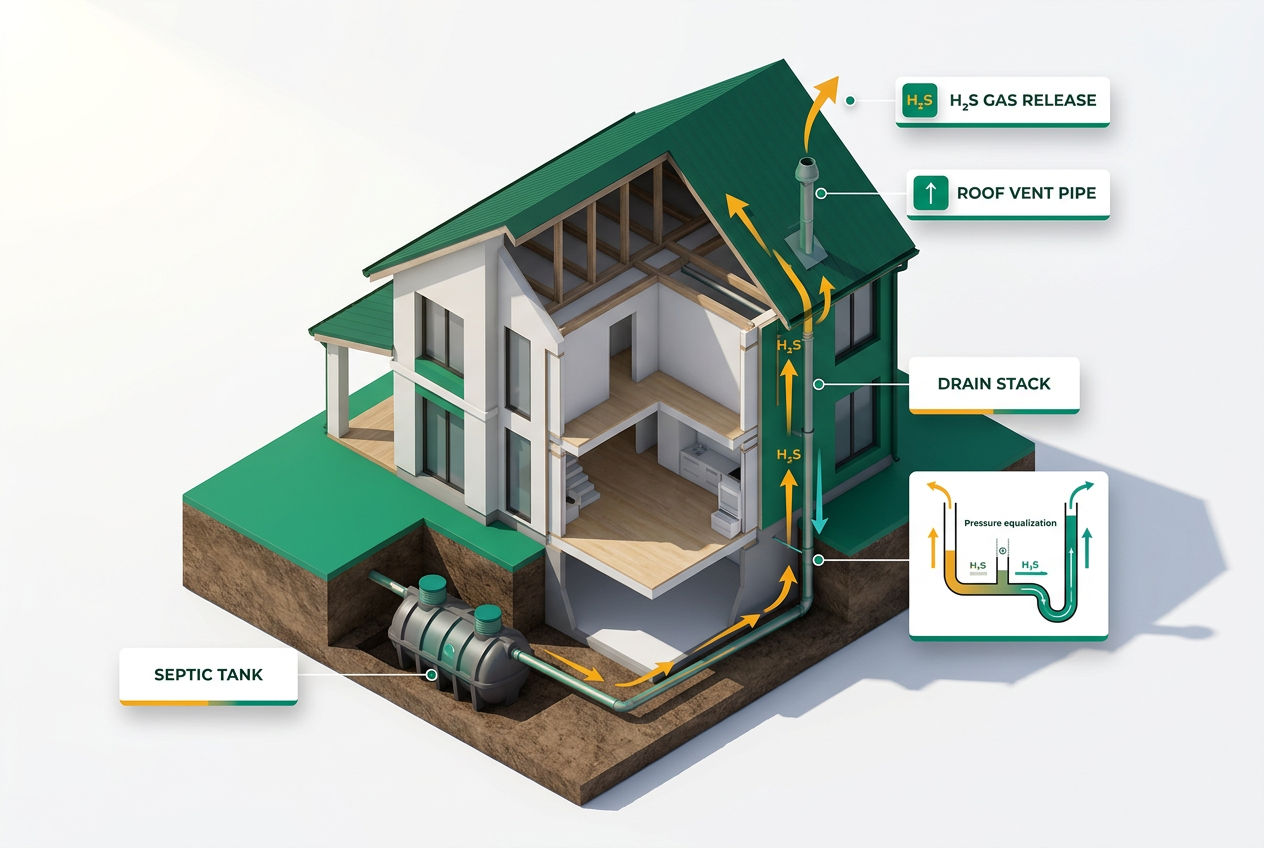
Is It Normal to Smell Septic Gas Near a Roof Vent?
A faint, occasional whiff near the vent pipe is technically normal. The vent is releasing gases on purpose. What's not normal is a persistent, strong rotten-egg odor that you notice from the ground, through windows, or inside the home.
Hydrogen sulfide is detectable by the human nose at concentrations as low as 0.5 parts per billion—which is an extraordinarily sensitive threshold. That means even trace amounts register as that distinctive rotten-egg smell. OSHA sets the permissible 8-hour exposure limit at 20 ppm, and the immediately dangerous to life and health (IDLH) threshold is 100 ppm. Outdoor venting from a residential system won't approach IDLH levels under normal conditions, but concentrated exposure in enclosed spaces is a different story.
Methane is also present and is flammable at concentrations between 5% and 15% in air—another reason not to ignore a badly configured or blocked vent.
What Causes a Septic Smell From Your Roof Vent Pipe? (Ranked by Likelihood)
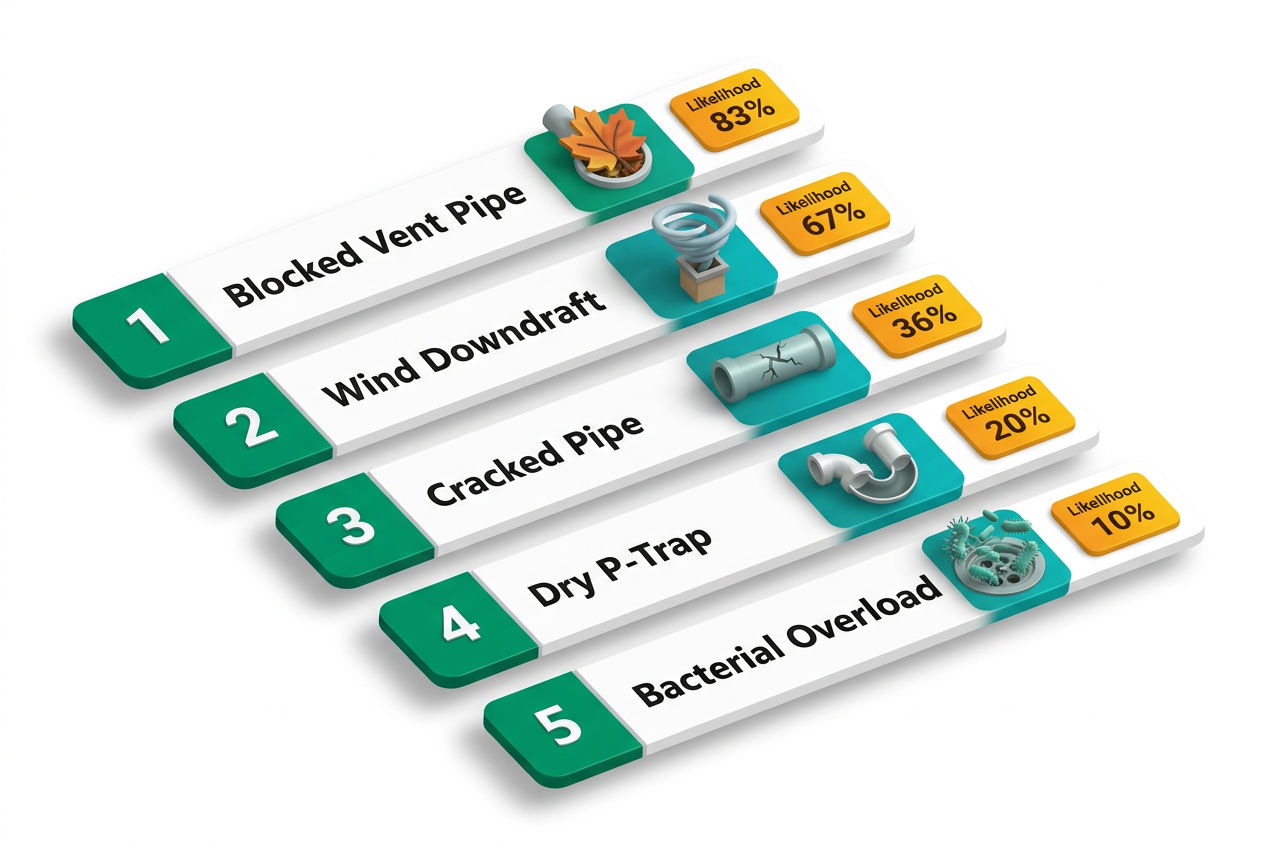
1. Blocked Plumbing Vent Stack
A clogged vent pipe is the single most common culprit. Leaves, bird nests, wasp nests, pine needles, and even dead squirrels can completely seal off a 3–4 inch main stack opening. When the vent is blocked, gases can't escape upward—so they find the next available path, which is often back down through your drain pipes and into the house.
You might notice slow drains, gurgling sounds when you flush, or septic tank gurgling sounds throughout the house alongside the odor. These are classic blocked-vent symptoms.
A plumber or septic technician can snake or pressure-flush a clogged vent for approximately $100–$300. If you're comfortable on a roof, you can often clear visible debris yourself with a flashlight, gloves, and a plumber's auger.
2. Vent Pipe Too Short
Most residential building codes require the vent stack to extend at least 6 inches above the roofline—some jurisdictions require 12 inches. Wind passing across a low vent creates a Venturi effect that actively pulls air downward, dragging gases with it.
If your vent terminates too close to the roof surface, gases that should disperse harmlessly into the atmosphere instead swirl back down, particularly near dormers, second-story windows, or HVAC intakes.
This is a code-compliance issue that a licensed plumber can fix by extending the pipe. Depending on your roof type and accessibility, expect to pay $150–$400 for the extension and labor.
3. Atmospheric Conditions and Temperature Inversions
Ever notice the sewer smell from your roof is worst on cold, calm mornings? That's not your imagination—it's physics. Normally, warm air rises and carries vent gases upward and away. During a temperature inversion (when a layer of cold, dense air traps warmer air near the ground), those gases can't rise and instead settle around your roofline.
This is especially common when outdoor temperatures drop below 32°F / 0°C. Wind patterns matter too. In open plains regions—think Kansas, Nebraska, the Dakotas—consistent wind can push vent gases horizontally toward the house rather than vertically away. You may notice this problem on windy days even when everything is functioning correctly.
The fix in these cases is usually a directional vent cap or an activated charcoal filter.
4. Frozen Vent Pipe Opening
In cold climates—Minnesota, Wisconsin, Michigan, New England, mountain states—the moisture in venting gases can freeze and form an ice cap over the pipe opening. A completely iced-over vent behaves exactly like a blocked one. Gases can't escape, pressure builds, and sewer odors back up into the house.
If you're smelling septic smell when it rains or during freeze-thaw cycles, a freezing vent is high on the suspect list. Some homeowners in northern climates use insulated vent pipe wraps or heated vent caps to prevent this. Extending the pipe height also reduces freeze-over risk because the opening sits above where frost collects at roof level.
5. Full or Overloaded Septic Tank
A tank that's reached capacity produces far more gas than normal. More solids, more bacterial activity, more hydrogen sulfide. That excess gas gets routed through the vent stack at higher volume, making outdoor odors noticeably worse—and increasing the chance that gas backs up into the house through P-traps or drain openings.
The EPA recommends pumping every 3–5 years for most households. A 1,000-gallon tank serving a 4-person home hits that mark reliably at 3–4 years. Add a garbage disposal to that household and you're looking at every 2–2.5 years.
If you can't remember your last pump-out, that's your first diagnostic clue. Signs your septic tank needs pumping include slow drains, greener-than-normal grass over the drain field, and, yes, intensified vent odors. See our guide to septic pumping costs—nationally, a standard pump-out runs $300–$600, depending on tank size and your location.
6. Dry P-Traps in Seldom-Used Fixtures
This one doesn't affect the vent itself, but it often gets confused with a vent problem. Every drain in your home has a P-trap—a curved pipe section that holds a small amount of water, which acts as a seal against sewer gases. If a sink, tub, or floor drain goes unused for 2–3 weeks, that water can evaporate, breaking the seal and allowing septic gases to flow freely into the room.
Run water in every fixture monthly, especially in guest bathrooms, basement floor drains, and utility sinks. Pour a cup of water into floor drains you never use.
7. Drain Field Saturation
When a drain field becomes saturated—either from heavy rain, high water tables, or a failing system—effluent backs up and increases gas production in the tank. That gas gets routed out the vent stack in higher concentrations.
If you notice septic smell outside near the yard and at the roofline, and you've had significant rainfall recently, a saturated field may be contributing. Learn more about drain field problems and what causes them.
Septic Vent Pipe Cause & Fix Reference
| Cause | DIY Fixable? | Typical Fix Cost | Time to Resolve |
|---|---|---|---|
| Blocked vent pipe (debris) | Often yes | $0–$300 | Hours to 1 day |
| Vent pipe too short | No (permit req'd) | $150–$400 | 1–2 days |
| Atmospheric/weather conditions | Partial | $30–$80 (filter/cap) | Same day |
| Frozen vent pipe opening | Often yes | $0–$150 | Hours |
| Full septic tank | No | $300–$600 (pump-out) | Same day service |
| Dry P-traps | Yes | $0 | Minutes |
| Drain field saturation | No | $500–$5,000+ | Days to weeks |
Cost estimates reflect 2025 national averages. Regional variation applies. Source: SepticTankHub.com research, EPA guidance.
How Do You Fix a Roof Vent Pipe Smell? Step-by-Step
The fix depends on the cause—but here's a practical sequence to work through:
Step 1: Inspect the vent pipe opening. Get on the roof safely (or use binoculars from the ground) and check for visible debris, bird nests, or ice. Clear any blockages you can reach. Note: a camera scope inspection is the only definitive way to confirm a partial blockage deeper in the stack—visual inspection from the opening can miss compacted debris 2–3 feet down.
Step 2: Check pipe height. Measure from the roofline to the top of the vent pipe. If it's less than 6 inches, you need an extension. Most jurisdictions follow IRC Section P3103.1, which requires a minimum 6-inch vent termination height above the roof surface; check your local code, as some municipalities require 12 inches.
Step 3: Add a charcoal vent filter. If atmospheric conditions or minor odor dispersion issues are the problem, a Studor carbon vent filter ($30–$80 at most plumbing supply retailers) fits standard 3–4 inch stacks and reduces H₂S output without blocking airflow. Replace every 1–5 years depending on usage.
Step 4: Address the tank. If you haven't pumped in 3+ years, schedule a pump-out. Septic inspection costs typically run $100–$250 and can confirm whether tank levels or drain field issues are driving excess gas production. See also our breakdown of septic repair costs if the inspection reveals a larger problem.
Step 5: Run fixtures and check P-traps. Walk through every seldom-used drain and run water for 30 seconds. Pour 1 cup of water into floor drains.

Do Septic Vent Pipes Need a Filter or Cap?
Standard vent pipes don't legally require a filter or cap—the open stack is code-compliant and intentional. But a carbon vent filter is a legitimate odor-reduction upgrade, particularly if your home sits in a low-wind area, near a valley, or in a neighborhood where vent gases don't disperse well.
A vent cap (without carbon filtration) mainly keeps out birds and debris. It does nothing for odor. If you're specifically dealing with a plumbing vent that smells like sewage near windows or HVAC intakes, a cap alone won't solve it—you need the activated charcoal element.
One practical worked example: a homeowner in a valley-sited property in Vermont installed a Studor carbon filter on a 3-inch stack. The vent pipe was correctly sized (10 inches above the roofline), so height wasn't the issue—cold air pooling in the valley was trapping H₂S near the foundation. The $45 filter resolved the odor within 48 hours. She replaces it every 18 months. No plumber required.
For a septic inspection to rule out mechanical causes before investing in filtration, especially if you're also seeing slow drains or gurgling, consult a licensed professional first.
What About Septic Treatments for Reducing Vent Odor?
No additive replaces pumping—the EPA is explicit on this point, and no bacterial treatment will reduce a full tank to safe operating levels. That said, if your tank is on a current pumping schedule and you're looking to reduce gas production between service intervals, a quality bacterial additive can make a measurable difference.
The treatment we recommend is Septifix. Here's why, specifically: it uses oxygen-releasing tablets that carry 14 strains of live aerobic bacteria at roughly 10 billion CFU per tablet. The oxygen component is what sets it apart from standard anaerobic bacterial additives like Rid-X—aerobic bacteria are significantly more effective at breaking down organic sludge and the sulfur compounds that produce hydrogen sulfide odor. Less sulfur compound breakdown in the tank means less H₂S routed out the vent stack.
Dosing is straightforward: flush one tablet down the toilet monthly. No measuring, no mixing. At roughly $3–$4 per treatment, it's a low-cost maintenance step for homeowners who want to reduce odor between pump-outs. It's made in the USA, non-toxic, and comes with a 60-day money-back guarantee.
Honest caveat: if your vent smells because the pipe is blocked, too short, or your tank is overdue for pumping, Septifix won't fix those problems. It's a maintenance tool, not a diagnostic solution. Fix the structural issue first. If you're comparing options, see our Rid-X vs. Septifix breakdown for a side-by-side on CFU counts, bacterial strains, and real-world odor reduction performance.
Is Sewer Gas From a Roof Vent Dangerous?
For most outdoor residential situations, the immediate health risk from a roof vent is low. According to OSHA, hydrogen sulfide at low concentrations (below 2 ppm) causes eye irritation and headaches in sensitive individuals; at 20 ppm (the 8-hour TWA limit), symptoms include nausea and respiratory irritation; at 100 ppm (IDLH), exposure is immediately dangerous.
Outdoor venting won't produce IDLH-level concentrations at ground level under normal circumstances. The risk escalates if:
- Gases are entering an enclosed space (basement, crawlspace, attached garage)
- A blocked vent is routing H₂S back through interior drains
- Multiple fixtures have dry P-traps simultaneously
Methane flammability (5–15% concentration range in air) is a separate concern. It's not a realistic ignition risk outdoors, but in an enclosed utility room with a failed P-trap and an ignition source, it becomes relevant. If you smell persistent sewer gas inside your home—not near the exterior vent—treat it as an indoor air quality emergency and ventilate immediately. Review the septic tank maintenance schedule to prevent conditions that lead to interior gas intrusion.

Preventing Roof Vent Odor Problems
The most cost-effective approach is prevention. Here's what that looks like in practice:
- Annual visual inspection of the vent opening — check for nests, debris, or ice damage each spring. A 5-minute roof inspection costs nothing.
- Pump on schedule — EPA guidance is every 3–5 years; adjust for household size, garbage disposal use, and tank capacity. See signs your septic tank needs pumping for real-world indicators.
- Run all fixtures monthly — prevents P-trap evaporation in guest bathrooms and utility drains.
- Use a bacterial additive between pump-outs — Septifix is our pick for reducing sludge accumulation and H₂S production between service intervals.
- Check pipe height after any roof work — reroofing projects sometimes inadvertently reduce vent stack height when new shingles raise the roofline reference point.
When Should You Call a Septic Professional?
Handle it yourself if:
- You can see and safely clear visible debris from the vent opening
- The smell is intermittent and weather-correlated
- Dry P-traps are the likely cause
Call a pro if:
- Sewer gas smell is present inside the home
- You have not had a pump-out in 3+ years
- Drains are slow or gurgling throughout the house
- The vent pipe is undersized or incorrectly pitched
- You suspect drain field saturation or failure
A licensed septic professional can camera-scope the vent stack to locate blockages invisible from the opening, confirm tank levels, and assess drain field health. Find a licensed septic professional near you through the SepticTankHub directory.
If your vent smell is mild, intermittent, and tied to a tank that is otherwise in good shape, a bacterial treatment can help manage odor between pump-outs. Septifix is the one we recommend: each tablet releases oxygen and 14 strains of live aerobic bacteria (roughly 10 billion CFU) directly into the tank, and the oxygen-driven process targets odor at the source rather than relying on enzymes alone. Dosing is straightforward — one tablet flushed down the toilet, about $3–$4 per treatment. That said, no additive replaces a scheduled pump-out, and the EPA is clear that a healthy system does not require additives. Use it as a supplement, not a substitute.
Related Rid-X & Septic Treatment Guides
- The Best Rid-X Alternatives
- The Best Septic Tank Smell Removers
- Septic Smell When It Rains? Why It Happens & How to Fix It
- Can You Use Rid-X in an RV Black Tank? What to Know First
- Is Rid-X Safe for Septic Tanks, Toilets & Pipes?
- How Often Should You Use Rid-X? Directions, Dosing & Timing
- What's Actually in Rid-X? Ingredients Explained
- Does Rid-X Unclog Drains or Toilets?
- Rid-X vs. Green Gobbler: Which Septic Treatment Wins?
- Green Gobbler Septic Treatment Review: Pods, Packets & Results
- Where to Buy SeptiFix
- Bio-Clean Septic Treatment Review: Does It Work?
- Cabin Obsession Septic Tank Treatment Review
- Camco Septic Tank Treatment Review
- Septic Tank Treatments at Walmart vs. Home Depot vs. Online
- Septic Smell Coming From Toilet? Causes & How to Fix It
- Septic Smell From Shower Drain? Causes & How to Fix It
- Septic Tank Smell After Pumping? Causes & How to Fix It
- Is Septic Tank Smell Dangerous? Gases, Risks & When to Worry
- Septic Tank Diagram With Dimensions
- Septic Tank Cross-Section Diagram: Every Part Labeled
- Septic System Diagram With a Pump
- Septic Tank Plumbing Diagram: From House to Drain Field
- Aerobic Septic System Diagram: How Each Part Works
- Are Septic Tank Treatments Necessary?
- How to Handle How Often to Use Septic Tank Treatment: Step by Step
- Septic Treatment Tablets vs. Powder vs. Liquid: Which Is Best?
- Best Septic Tank Treatment for Slow Drains
- Yeast, Baking Soda & Milk in Your Septic Tank: Myths Tested
Frequently Asked Questions
What causes a sewer smell from my roof vent pipe?
A sewer smell from a roof vent pipe is almost always caused by one of four things: a blocked vent stack (debris, nests, or ice sealing the opening), a vent pipe that's too short to disperse gases above the roofline, a full or overloaded septic tank producing excess hydrogen sulfide, or atmospheric conditions—like temperature inversions on cold mornings—that push gases back down toward the house instead of letting them rise. The Venturi effect from wind crossing a low-profile vent opening can actively drag sewer gas downward. Start your diagnosis at the roof: inspect the opening for blockages, measure the pipe height (minimum 6 inches above the roofline per most codes), then assess when you last pumped your tank. Most cases resolve with a $0–$300 fix. If the smell is present inside the home, not just near the exterior vent, that indicates gases are re-entering through dry P-traps or a blocked stack—call a licensed septic professional.
Why does my plumbing vent smell like sewage after rain?
When your plumbing vent smells like sewage after rain, the most likely cause is a saturated drain field pushing effluent back toward the tank and increasing gas production. Heavy rainfall raises the water table, which reduces the drain field's ability to absorb treated wastewater. That backs up liquid levels in the tank, accelerates bacterial activity, and produces more hydrogen sulfide than normal—all of which exits through the vent stack at higher concentration. A secondary cause is rain washing debris (leaves, dirt, organic matter) into the vent pipe opening, partially blocking it and forcing gas to back up into the house. If the smell after rain is accompanied by slow drains or wet ground over the drain field, a saturated or failing drain field is likely. A dry P-trap in a basement floor drain is also common after heavy rain events, since vibration and water movement can shift trap water. Run all fixtures and pour water into floor drains as a first step.
How do I stop the septic vent pipe odor near my windows?
Septic vent pipe odor reaching windows is usually a height or placement problem: the vent terminates too close to the roofline, and wind or negative air pressure near the house draws gases horizontally toward window openings and HVAC intakes rather than allowing them to disperse upward. The most effective fixes, in order of cost: (1) install an activated charcoal vent filter like the Studor carbon model ($30–$80) on the pipe opening—this reduces H₂S output without blocking airflow and doesn't require a plumber; (2) extend the vent pipe above the 6-inch minimum, which a licensed plumber can do for $150–$400 depending on roof type; (3) install a directional vent cap that angles gas output away from the home. If your windows are on an upper story adjacent to a dormer or roof valley, gases can concentrate in those low-pressure zones even with a properly sized vent. An extension plus a carbon filter addresses both the volume and dispersion issue simultaneously.
Is a roof vent smell dangerous to my family?
Under normal outdoor conditions, the hydrogen sulfide coming from a residential roof vent does not reach dangerous concentrations at ground level. OSHA's immediately dangerous to life and health (IDLH) threshold for H₂S is 100 ppm; residential roof venting disperses well below that threshold outdoors. The real danger is when gases stop venting properly and re-enter the home through dry P-traps, failed drain seals, or a blocked vent stack forcing gas back through interior drains. At that point, enclosed-space concentrations can rise to levels that cause headaches, nausea, and eye irritation (symptoms begin around 2–10 ppm). Methane, also present in septic gas, is flammable between 5% and 15% concentration—not a concern outdoors, but relevant if gas is accumulating in a basement or utility room near an ignition source. If you smell persistent sewer gas inside your home, ventilate immediately, identify the source, and contact a licensed septic professional rather than waiting.
Can a septic treatment reduce roof vent odors?
A bacterial septic treatment can reduce the volume of hydrogen sulfide gas your tank produces, which lowers the concentration of odor exiting through the vent stack. It won't fix a blocked pipe, a short vent, or a full tank—those are mechanical problems that require mechanical solutions. But if your system is on a current pumping schedule and you want to reduce odor between service intervals, Septifix is the treatment we recommend. It delivers 14 strains of live aerobic bacteria at roughly 10 billion CFU per tablet, plus an oxygen-release component that targets the sulfur compounds responsible for H₂S production. Aerobic bacteria are more effective at breaking down sludge and odor-causing compounds than the anaerobic strains used in standard additives. One tablet flushed monthly costs roughly $3–$4. The EPA is clear that no additive replaces pumping—but as a maintenance tool to reduce gas production and slow sludge accumulation, it's the most cost-effective option available. See the Rid-X vs. Septifix comparison for a detailed breakdown.
How much does it cost to fix a septic smell from a roof vent?
The cost to fix a septic smell from a roof vent ranges from $0 to $5,000+, depending entirely on the underlying cause. Clearing visible debris from the vent opening yourself costs nothing. A plumber snaking or pressure-flushing a blocked vent stack runs $100–$300. Installing an activated charcoal filter costs $30–$80 as a DIY project. Extending a vent pipe that's too short runs $150–$400 depending on roof access and labor rates in your area. A standard septic pump-out costs $300–$600 nationally, with variation based on tank size and location—see our septic pumping cost guide for regional breakdowns. If the cause is drain field saturation or failure, repair costs range from $500 for localized fixes to $5,000+ for full field replacement. Before spending money on repairs, spend 20 minutes on diagnosis: inspect the vent opening, measure pipe height, and check your pump-out history. Most roof vent odor problems fall into the $0–$300 category.
Sources & Methodology
- U.S. Environmental Protection Agency — Septic system guidance, pumping frequency recommendations, and additive efficacy position. epa.gov/septic
- Occupational Safety and Health Administration (OSHA) — Hydrogen sulfide permissible exposure limits (PEL: 20 ppm TWA), IDLH threshold (100 ppm), and H₂S odor detection data. osha.gov
- Minnesota Pollution Control Agency (MPCA) — Cold-climate septic system guidance, frozen vent pipe protocols, and northern-state system performance data. pca.state.mn.us
- National Onsite Wastewater Recycling Association (NOWRA) — Vent pipe sizing standards and residential septic system best practices. nowra.org
- International Residential Code (IRC), Section P3103 — Vent pipe termination height requirements (minimum 6 inches above roof surface). Published by the International Code Council. codes.iccsafe.org
SepticTankHub.com researches cost data from licensed contractor invoices, regional service providers, and publicly available permit data. Cost ranges reflect 2025 national averages. Individual costs vary significantly by region, tank size, and site conditions.
Free download
Not ready for the Handbook? Start with the free Fridge Card.
The Do / Don’t card the whole family can see, plus the Survival Kit: emergency flowchart, warning-sign decoder and pump-schedule card. One printable PDF.
Was this article helpful?
Frequently Asked Questions
Recommended Resources
📖 Related Articles
- What Is a Septic System? How It Works (Visual Guide)
- Septic Tank Gurgling Sounds: Causes and Fixes
- Septic Smell When It Rains? Why It Happens & How to Fix It
- 8 Signs Your Septic Tank Needs to Be Pumped
- Septic Smell Outside? Causes & How to Fix It
- What Is a Drain Field? (And How Does It Work?)
- Septic Tank Maintenance Schedule: The Complete Guide
💰 Cost Guides
🔧 Services
Find Septic Professionals Near You
Compare licensed, verified septic companies by area — top county markets and cities below, or browse all 50 states.
County markets
Popular cities
