
Quick Answer
Reviewed by James Corwell, Licensed Septic System Inspector (20+ years field experience, certified in FL, GA, and TN)
A septic smell outside is caused by hydrogen sulfide gas escaping your system — either through a blocked vent pipe, a degraded tank lid seal, an overdue pump-out, or a failing drain field. A properly functioning septic system should produce little to no detectable outdoor odor under normal conditions. When you can smell it outside, gas is escaping a pathway it shouldn't be using.
Key Takeaways
- The rotten egg smell comes from hydrogen sulfide (H₂S) — detectable by humans at just 0.5 parts per billion
- Six main causes: blocked vent pipe, full tank, cracked lid or baffle, drain field failure, rainfall saturation, and seasonal temperature changes
- Most fixes cost $0–$600; drain field failure can run $3,000–$15,000+
- A working septic system should produce no noticeable outdoor odor
- Persistent odor over the drain field is a red flag — call a pro within 48 hours
Why Does My Yard Smell Like Septic Tank?
Your yard smells like a septic tank because hydrogen sulfide gas is escaping from your system somewhere it shouldn't be. Anaerobic bacteria inside your tank break down organic waste and produce H₂S as a byproduct — that's the rotten egg smell outside that sends homeowners searching for answers.
Under normal operation, that gas vents harmlessly through your septic system vent pipe, dispersing above your roofline. When that pathway is blocked, broken, or bypassed, gas finds another route: a cracked lid, a degraded seal, waterlogged soil over the drain field, or a failed baffle wall. The smell maps directly to the failure point.
Each cause has a specific location signature — gas near the tank lid points differently than gas diffusing up through your lawn. The six most common causes are ranked below from most to least likely.
What Are the Most Common Causes of Septic Smell Outside?

1. Blocked or Short Vent Pipe
This is the single most common cause of outdoor septic odor. Your septic system vent pipe runs from the tank up through your home's roof, releasing accumulated gases above where anyone breathes them. Most local codes require vent stacks to extend at least 6 inches above the roofline — ideally 12–24 inches for proper dispersal.
Leaves, bird nests, ice, and debris can block that stack completely. When gas can't exit through the top, it pushes back through the system and escapes at ground level. In fall, leaf litter is a surprisingly frequent culprit. In northern climates — Minnesota, Wisconsin, the Upper Peninsula of Michigan — vent pipes can freeze solid in January, trapping gases until the thaw.
Fix it: Check the vent stack on your roof for visible blockages. Clear debris with a plumber's snake or garden hose. If the pipe is undersized or improperly located, a licensed plumber can extend or reposition it for $150–$400.
2. Full Septic Tank
A tank that's overdue for pumping is a tank under pressure. Solids accumulate in two layers: a floating scum layer of fats and grease at the top, and a sinking sludge layer of heavier solids at the bottom. Liquid effluent occupies the middle. According to the EPA, residential tanks should be pumped every 3–5 years — but that's a general benchmark, not a universal rule.
A 1,000-gallon tank serving a four-person household typically needs pumping every 3–4 years. Add a garbage disposal and that drops closer to every 2 years. When combined scum and sludge occupy more than one-third of the tank's capacity, gases have nowhere to go but out. That's when you start smelling hydrogen sulfide in your yard.
Fix it: Schedule a pump-out. A standard residential pump-out costs $250–$600 nationally, depending on tank size and location. A 1,000-gallon tank in central Florida typically runs $275–$375. That same tank in rural Montana or the Upper Midwest can run $375–$525 due to drive time and access. See our full breakdown of septic pumping costs before you call.
3. Cracked or Poorly Sealed Tank Lid
Septic tank lids — whether cast concrete, HDPE riser lids, or old clay — degrade over time. Concrete lids crack. Rubber gaskets on modern riser systems dry out and shrink. When the seal between the lid and the riser body fails, H₂S seeps out at ground level, right where you walk.
This one is easy to miss because the odor appears to come from "everywhere near the tank" rather than from a specific point. You might notice a stronger smell when you walk directly over the tank access point.
Fix it: Visually inspect your tank lid. Concrete lids with visible cracks should be replaced — a standard replacement lid runs $30–$150 for the concrete casting, plus labor. Riser lid gaskets (like those used on Polylok PL-522 lids) can be replaced for under $20 at a plumbing supply house. If you're not sure where your tank lid is, our guide on how to find your septic tank walks through the process step by step.
4. Damaged Inlet or Outlet Baffle
Inside your tank, the inlet and outlet baffles direct wastewater flow and prevent floating scum from escaping into the drain field or backing up into your home's pipes. Older concrete baffles deteriorate and crumble over years of hydrogen sulfide exposure — that same gas that smells bad also eats concrete. PVC tee baffles, which replaced concrete in most systems installed after the mid-1990s, hold up better but can crack or dislodge.
A failed inlet baffle lets raw sewage gases travel back up your inlet pipe toward the house. A failed outlet baffle allows scum to escape into the drain field, causing biomat clogging. Both scenarios produce outdoor odor and signal deeper trouble ahead. You can read more about septic tank baffle repair to understand when a fix is DIY-accessible and when it requires a pro.
Fix it: A baffle inspection requires opening the tank — don't do this without training, because confined space entry carries real H₂S risks (more on that below). A licensed septic technician can inspect and replace a damaged baffle during your next pump-out for $75–$250 in added labor.
5. Drain Field Failure
If the smell is coming from a soft, wet, or unusually green patch of lawn rather than near the tank itself, your drain field may be failing. A drain field distributes partially treated effluent through perforated leach laterals into surrounding soil, where microbial action filters it before it reaches groundwater.
When that soil becomes saturated — due to a failed outlet baffle flooding the field with solids, a high water table, or simply the end of the field's useful life — effluent pools near the surface and gases vent directly into your yard. Drain fields last 20–30 years with proper care. Without maintenance, failures occur in as few as 15 years.
According to the EPA, septic system failures are one of the leading causes of groundwater contamination in the U.S., affecting an estimated 10–15% of systems at any given time. That sewer smell in your yard may be the first visible sign of a failure that's already been developing underground for months.
Recognize the signs: spongy or wet soil over the field, unusually lush green grass in one strip of lawn, or multiple slow drains inside the house. Learn more about signs your drain field is failing before the problem escalates.
Fix it: Call a licensed septic contractor. Depending on severity, repair can range from hydro-jetting clogged laterals ($300–$800) to full drain field replacement ($3,000–$15,000+). See drain field replacement costs for a realistic picture by region.
6. Bacterial Imbalance from Household Chemicals
Septic tank bacteria — a population of anaerobic microbes that took weeks to establish — can be knocked back significantly by a single heavy cleaning session. Dump enough bleach, antibacterial cleaners, or drain chemicals down the drain and you can crash that bacterial population. When the microbial community collapses, organic solids accumulate faster and gas production increases.
This is less a direct cause of outdoor odor and more an accelerant of the other problems above. Products that harm your septic system most include chlorine bleach in large volumes, chemical drain openers like those containing lye or sulfuric acid, and antibacterial soaps used heavily over time.
Switching to septic-safe cleaning products reduces stress on your system.
Is Septic Smell Outside Dangerous?
For most backyard exposure, a brief encounter with outdoor septic odor is unpleasant but not acutely dangerous. However, hydrogen sulfide is a genuine health hazard at elevated concentrations, and you should understand the thresholds.
Humans can detect H₂S at concentrations as low as 0.5 parts per billion — that's why your nose is so sensitive to the rotten egg smell. At 10–50 ppm, you'll experience eye and respiratory irritation. According to OSHA, H₂S is classified as immediately dangerous to life at 100 ppm and potentially lethal at 500–700 ppm.
Those concentrations don't occur in open yards under normal conditions. The danger zone is inside the tank. According to OSHA's confined space entry standard (29 CFR 1910.146), septic tanks qualify as permit-required confined spaces — meaning they require specialized equipment, atmospheric testing, and a trained attendant before anyone enters. Never open your tank lid and lean over it. Fatalities occur when homeowners do exactly that, pass out from H₂S exposure at the opening, and fall in.
For outdoor exposure, the populations most sensitive to low-level H₂S are children, people with asthma, and those with cardiovascular conditions. Persistent outdoor odor strong enough to cause headaches or nausea warrants a call to your local health department, not just your septic contractor.
Why Does Septic Smell Get Worse After Rain?
Rain worsens septic odor through two separate mechanisms, and knowing which one is active helps you diagnose the real problem.

Mechanism 1: Saturated soil over the drain field. When rain raises the water table or saturates the absorption zone, your drain field has nowhere to push effluent. Gas that would normally disperse through soil pores instead vents at the surface. This is temporary if your drain field is healthy — odor should clear within 24–48 hours after soil drainage. If it persists longer, your drain field may already be compromised.
Mechanism 2: Pressure changes affecting the vent pipe. Rainfall is often accompanied by dropping barometric pressure. Lower atmospheric pressure means gases that normally rise through the vent stack can instead sink and disperse at ground level, even through a properly functioning system. This is why you sometimes smell septic odor during rainstorms even when your system is in perfect condition.
For more detail on how heavy rain interacts with septic system performance, see our guide on heavy rain and septic systems.
How Do I Know If My Drain Field Is Failing?
A failing drain field typically shows three warning signs before odor becomes the dominant symptom.
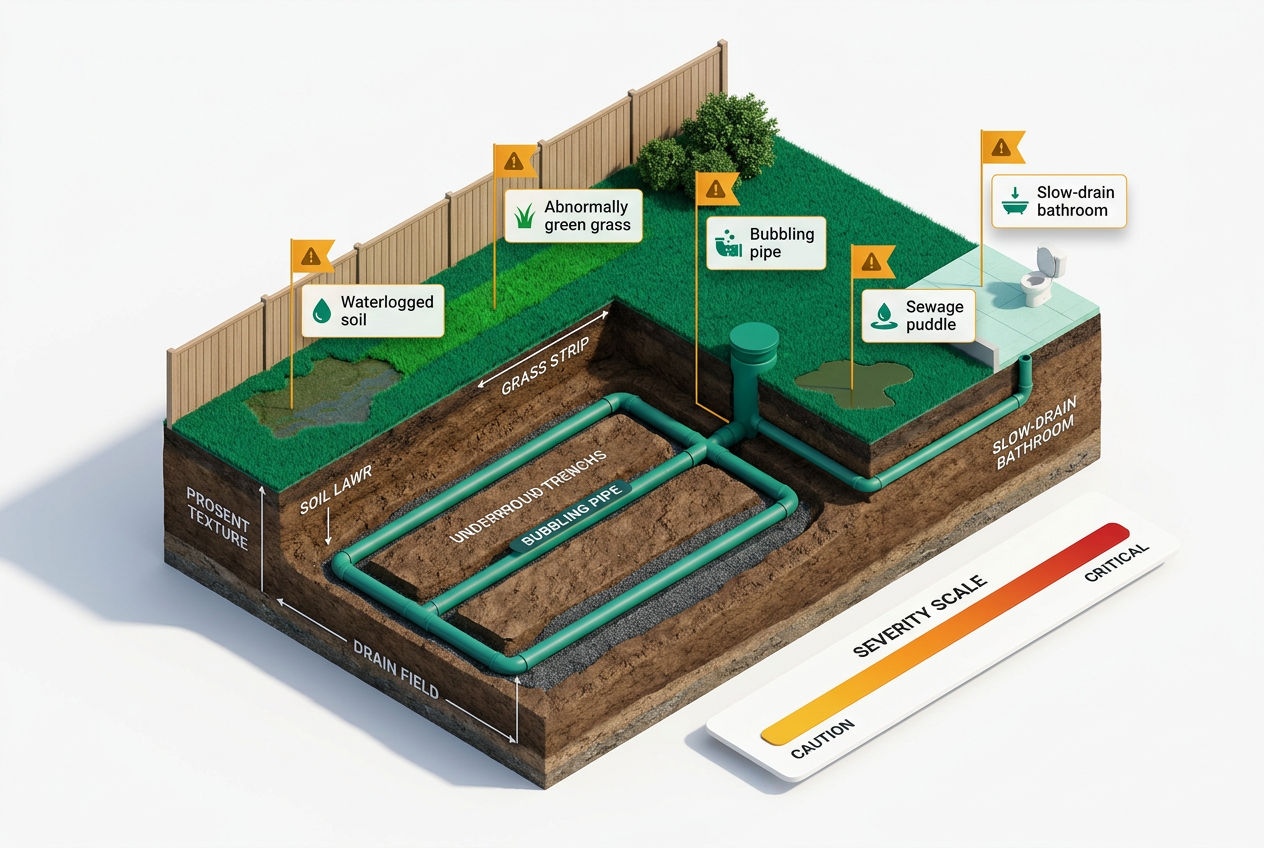
First: soggy or spongy ground over the drain field area, even during dry weather. Press your foot into the grass over the leach field. If the ground compresses and water seeps up around your shoe, effluent is pooling near the surface. Second: a strip of unusually dark green, fast-growing grass over one leach lateral while adjacent lawn looks normal. That's the grass responding to unintended fertilization from surfacing effluent. Third: multiple slow-draining fixtures inside the house simultaneously — not one slow drain, but sinks, tubs, and toilets all backing up at once.
Outdoor odor concentrated over the drain field, rather than near the tank, is usually the fourth signal — and it means the first three have already been happening for a while.
If you're seeing any combination of the above, schedule a septic inspection before adding any water load to the system. See our septic inspection service page for what a professional evaluation covers.
How Do I Get Rid of Septic Smell in My Yard?
Free download
Free: the Septic Fridge Card — what to flush, what never to.
The Do / Don’t card the whole family can see, plus the Survival Kit: emergency flowchart, warning-sign decoder and pump-schedule card. One printable PDF.
Eliminating outdoor septic odor requires identifying the source first, then fixing it — not masking it.
Step 1: Locate the smell. Walk your property and identify where the odor is strongest. Near the tank access lid? Near the roofline vent stack? Over the drain field? Each location points to a different cause.
Step 2: Check the vent pipe. From ground level, look for visible debris around the stack outlet. If safe roof access is available, inspect for blockage. A $15 vent pipe cap with mesh screen (available at any home improvement store) can prevent future debris blockages.
Step 3: Check your pumping schedule. If your tank hasn't been pumped in more than 3 years and you have four or more household members, schedule a pump-out. This alone resolves odor in the majority of cases where no structural damage has occurred.
Step 4: Inspect the lid seal. If the smell is concentrated directly over the tank access point, inspect the lid for cracks and the gasket for shrinkage. A replacement Polylok gasket runs under $20. A replacement concrete lid runs $30–$150 plus labor.
Step 5: Call a pro if drain field symptoms are present. Wet ground over the leach field, unusually green grass strips, or multiple slow drains inside require a licensed contractor — not a DIY fix.
What doesn't work: septic tank additives marketed as odor eliminators. According to research compiled by the Water Environment Federation, no commercially available additive has demonstrated consistent effectiveness at reducing H₂S production in residential septic tanks. The bacteria are either there and working, or they're not — and the fix is removing the chemical stressor, not adding a product.
Seasonal & Regional Odor Patterns
Septic odors follow predictable seasonal patterns, and knowing them helps you distinguish a genuine failure from a temporary condition.
Spring thaw (northern climates): Vent pipes that froze solid over winter release trapped gases all at once when temperatures rise. Minnesota's Pollution Control Agency (MPCA) specifically flags post-thaw odors as the most common homeowner complaint they receive in March and April. This is usually temporary — odor clears within a few days as the system normalizes. If it doesn't clear by day five, inspect the vent for residual ice blockage or damage.
Summer heat: Warm temperatures accelerate bacterial activity, which means faster gas production. In poorly ventilated systems, summer is when marginal odor situations become noticeable ones. High humidity can also trap H₂S closer to the ground rather than dispersing it.
Fall leaf drop: As noted above, leaf litter is one of the most overlooked vent pipe blockers. Add vent stack inspection to your fall maintenance checklist alongside gutter cleaning.
Coastal and high-water-table regions: In areas like coastal South Carolina, Louisiana, or South Florida, where seasonal water tables rise dramatically, drain field separation distances matter enormously. The EPA recommends at least 18 inches of unsaturated soil between the bottom of leach trenches and the seasonal high water table. Many older coastal systems were installed before this standard was codified and operate dangerously close to or below it during wet seasons.
How Often Should a Septic Tank Be Pumped to Avoid Odors?
The answer depends on household size relative to tank capacity. The EPA's 3–5 year figure is a reasonable starting range, but it's wide enough to be nearly useless without plugging in your specifics.

Here's a worked example: A family of four with a 1,000-gallon tank and no garbage disposal generates roughly 70 gallons of wastewater per day. At that rate, sludge and scum together reach the one-third capacity threshold — the point where odor problems typically begin — in approximately 3.5 to 4 years. Add a garbage disposal and daily wastewater volume climbs; practical pump interval drops to 2.5–3 years. A single person in the same house might go 6–7 years between pump-outs without issue.
Variables that shorten your interval: garbage disposal use, water softener backwash discharging to the tank, frequent large-load laundry days, and house guests adding temporary population spikes.
For a household-specific calculation, use the EPA's SepticSmart sizing guidance or ask your pump technician to measure sludge and scum depth during service — this gives you an actual rate rather than a generic estimate. See also our guide on how often to pump a septic tank for a full breakdown by household size.
When Should You Stop DIYing and Call a Septic Pro?
Some septic odor fixes are genuinely homeowner-accessible. Others require licensed equipment, permits, or confined space training. Here's where the line falls.
DIY-appropriate:
- Clearing debris from the vent pipe stack (from roof level, with proper fall protection)
- Replacing a riser lid gasket on an accessible, shallow-buried tank
- Switching to septic-safe cleaning products to reduce chemical stress
- Scheduling a pump-out (you're hiring the pro, not doing it yourself)
Call a pro immediately:
- Any odor concentrated over the drain field that persists more than 48 hours
- Wet or spongy ground over the leach field
- Sewage backup into the house
- Visible sewage surfacing anywhere on the property
- Tank lid that is cracked through or missing entirely
- Any situation that requires opening the tank for inspection
The 48-hour rule: If outdoor septic odor doesn't resolve within 48 hours of a pump-out or vent pipe clearing, something structural is wrong. Delaying costs money — the difference between hydro-jetting a partially clogged lateral ($300–$800) and replacing a fully failed drain field ($3,000–$15,000+) is usually just a matter of how long the problem ran unaddressed.
A septic system alarm can catch problems before they become emergencies. If your system doesn't have one, ask your contractor about installation during the next service visit.
For repair needs beyond basic pump-outs, see our septic repair services page for licensed contractor options in your area.
What Not to Pour Down the Drain
Your septic system's bacterial population is the engine of the whole operation. Kill it, and the engine stalls — solids accumulate, gas production changes, and odor follows. What kills septic bacteria most reliably, and what to do instead:
| Pour Down the Drain | Use Instead |
|---|---|
| Chlorine bleach (large volumes) | Hydrogen peroxide-based cleaners |
| Chemical drain openers (lye, sulfuric acid) | Enzymatic drain cleaners |
| Antibacterial dish soap | Standard biodegradable dish soap |
| Cooking grease or oil | Dispose in sealed container with trash |
| Prescription medications | DEA drug take-back programs |
| "Flushable" wipes | Standard toilet paper only |
One cleaning session with a full bottle of bleach poured undiluted down a drain is unlikely to crash your system. Doing that weekly will. The cumulative load matters more than any single event.
For a complete breakdown of what harms bacterial populations and recovery timelines, see what kills septic bacteria.
Protecting your septic tank's bacterial ecosystem is the cheapest maintenance you can do.
Frequently Asked Questions
Why does my yard smell like sewage but I have a septic system, not city sewer?
Septic systems and sewage odors aren't mutually exclusive — that's the short answer. A well-maintained septic system handles waste differently than municipal sewer, but it still processes the same organic material and produces the same hydrogen sulfide gas. The difference is containment: city sewer lines vent through a network of pipes and treatment facilities designed to capture and process those gases. Your septic system vents through a single stack above your roofline. When that pathway fails — through a blocked vent, cracked lid, or overwhelmed drain field — H₂S escapes at ground level and smells identical to a sewer backup.
Where the smell is strongest tells you which component failed. Odor concentrated near the tank lid suggests a seal or structural issue. Odor diffusing across a lawn section suggests drain field saturation. Odor near the roofline or foundation suggests a vent pipe problem. Start with location, and the diagnosis follows. A pump-out resolves most cases when the smell is general and the system is overdue for service.
Can septic smell outside make you sick?
Brief outdoor exposure to septic odor at typical concentrations is unpleasant but not acutely dangerous for healthy adults. The risk rises with concentration and duration. OSHA identifies 10–50 ppm hydrogen sulfide as the irritation threshold — expect eye watering, throat irritation, and headache at that range. At 100 ppm, H₂S is classified as immediately dangerous to life. Open-air septic odor in a yard rarely approaches those concentrations, but prolonged exposure near a surfacing drain field or an open tank is a different matter.
People with asthma, young children, pregnant women, and anyone with cardiovascular conditions are more sensitive to low-level H₂S. If anyone in those groups experiences headache, nausea, or dizziness while spending time near the odor source, move them away from the area and ventilate. Persistent odor strong enough to cause symptoms warrants a call to your county health department. Don't wait on a contractor appointment if symptoms are present — address the health concern first, then the repair.
Does septic smell outside go away on its own?
Sometimes yes, sometimes no — and telling the difference is what matters. Temporary odors caused by barometric pressure drops during rainstorms, post-thaw vent pipe clearing in spring, or a single heavy-use day typically resolve within 24–48 hours without intervention. If you notice the smell only during or immediately after rain and it clears the next day, your system is likely functioning normally.
Odor that persists beyond 48 hours, or that keeps returning at the same location in your yard, signals a structural problem that won't self-correct. A full tank needs pumping. A cracked lid needs replacement. A failing drain field will continue degrading until repaired. The 48-hour rule is a practical dividing line: brief odor that resolves on its own is weather-related; persistent or recurring odor is a repair signal. Waiting on the latter is expensive — the gap between a $500 repair and a $12,000 drain field replacement is often just a matter of how long the underlying problem ran unaddressed.
How long does septic smell last after a pump-out?
Most odor resolves within 24–72 hours of a completed pump-out. The pump-out removes the accumulated solids and gas pressure that caused the smell, and the remaining bacterial population rebalances within a day or two. Some homeowners notice a brief increase in odor immediately after pumping — that's normal, caused by agitation during the pumping process exposing trapped gases.
If outdoor odor persists beyond 72 hours after a pump-out, the tank contents weren't the primary cause. Ask the technician whether they inspected the lid seal and baffles during service. A degraded lid gasket or cracked baffle won't be fixed by emptying the tank. Lid gasket replacement runs under $20 in parts. Baffle inspection and replacement during a pump-out adds $75–$150 in labor. If the technician didn't check those components, schedule a follow-up inspection before assuming the pump-out failed. Persistent post-pump odor over the drain field area specifically points toward leach field saturation, which requires a separate contractor evaluation.
How do I tell the difference between septic smell and a natural gas leak?
The smells are genuinely similar, and the distinction matters because the response protocols are completely different. Hydrogen sulfide — the septic odor compound — smells like rotten eggs: organic, slightly sulfurous, and associated with waste. Natural gas itself is odorless, but utility companies add mercaptan as a safety odorant, which also smells sulfurous but is sharper and more chemical, sometimes described as resembling a struck match or skunk spray.
Location is your fastest diagnostic tool. Septic odor appears outdoors near the tank, drain field, or roofline vent — not inside the house. Natural gas odor appears near gas appliances, meter connections, or along buried supply lines, and can occur indoors. If you smell sulfur indoors with no obvious septic explanation, treat it as natural gas: leave the building immediately without operating any switches or electronics, and call your gas utility from outside. If you're genuinely uncertain whether the outdoor smell is septic or gas, call the gas utility for a free leak check — they respond within hours and it costs nothing. Don't attempt to diagnose a potential gas leak yourself.
Sources & Methodology
Cost data: Pump-out and repair cost ranges were compiled from contractor quotes collected across six U.S. regions between 2024 and 2025. Individual project costs vary based on tank size, site access, regional labor rates, and soil conditions. Get multiple quotes before committing to any repair.
Regulatory references:
- U.S. Environmental Protection Agency — How to Care for Your Septic System
- OSHA — Hydrogen Sulfide Safety Information
- OSHA — 29 CFR 1910.146, Permit-Required Confined Spaces
- Minnesota Pollution Control Agency — Septic System Owner's Guide
- Water Environment Federation — Septic System Performance Research
Get quotes from licensed septic contractors in your area through our septic pumping and cleaning service page.
Was this article helpful?
Frequently Asked Questions
Recommended Resources
📖 Related Articles
- Septic Tank Baffle Repair & Replacement: Costs, Signs of Failure, and DIY vs Pro
- Signs Your Drain Field Is Failing (And What to Do)
- Septic-Safe Cleaning Products: The Complete List (Safe vs. Avoid)
- Heavy Rain and Septic Systems: What Happens and What to Do
- How Often Should You Pump Your Septic Tank?
- Septic Tank Alarm Going Off? What It Means and What to Do
- What Kills Septic Tank Bacteria? (14 Things to Avoid)
💰 Cost Guides
Find Septic Professionals Near You
Compare licensed, verified septic companies by area — top county markets and cities below, or browse all 50 states.
County markets
Popular cities
