
Quick Answer
Camco septic tank treatment review summary: Camco TST does a solid job controlling black tank odors and breaking down waste — especially in RV holding tanks. It's formaldehyde-free, biodegradable, and available in liquid or drop-in pod formats. This Camco septic tank treatment review finds it effective for odor control and routine RV maintenance, but less ideal as a standalone treatment for residential septic systems.
Key Takeaways
- Camco TST products are enzyme-based and formaldehyde-free — safer than older RV treatments that used bronopol or formaldehyde
- The drop-in pods treat one standard RV holding tank per pod; liquid requires measuring at roughly 4 oz per 40 gallons
- Retail pricing runs $8–$22 depending on format and container size, putting cost per treatment at $0.75–$1.50
- For residential septic maintenance, Camco works as a supplement but lacks the bacterial diversity of dedicated home treatments
- No septic treatment — including Camco — replaces professional pumping every 3–5 years
Does This Camco Septic Tank Treatment Review Cover the Right Product?
Before getting into performance: Camco makes several septic-adjacent products, and it's easy to end up comparing the wrong one. This Camco TST review focuses specifically on the TST (Toilet & Septic Treatment) line — the drop-in pods, the ultra-concentrated liquid, and the enzyme holding tank variants — not Camco's gray tank treatments or general plumbing products.
If you've seen "Camco TST" or "Camco RV septic treatment" on a shelf at Camping World or Walmart and wondered whether it's worth buying, that's exactly what we're evaluating here.
Does Camco Septic Tank Treatment Actually Work?
Camco TST products are genuinely effective at what they're designed to do: reduce odors and accelerate waste breakdown in RV holding tanks. The enzyme formula attacks organic waste, toilet paper, and the sulfur compounds responsible for that unmistakable black tank smell.
Thousands of verified Amazon reviewers — the TST line averages 4.3 to 4.5 stars across more than 10,000 combined reviews — confirm real-world odor reduction within one to two tank cycles.
That said, "works" depends on your expectations. Camco is not a heavy-duty bacterial additive with billions of CFU per dose. It's an enzyme treatment that breaks down existing waste. Enzymes alone don't reproduce — they're catalysts that speed up decomposition, not living colonies that establish themselves in your tank. For how enzyme and bacterial treatments break down waste differently, that distinction matters.
For RV use: yes, Camco works well. For home septic systems, it can help with routine maintenance between pumpings, but it isn't the strongest option on the market.
What Products Are in the Camco TST Line?
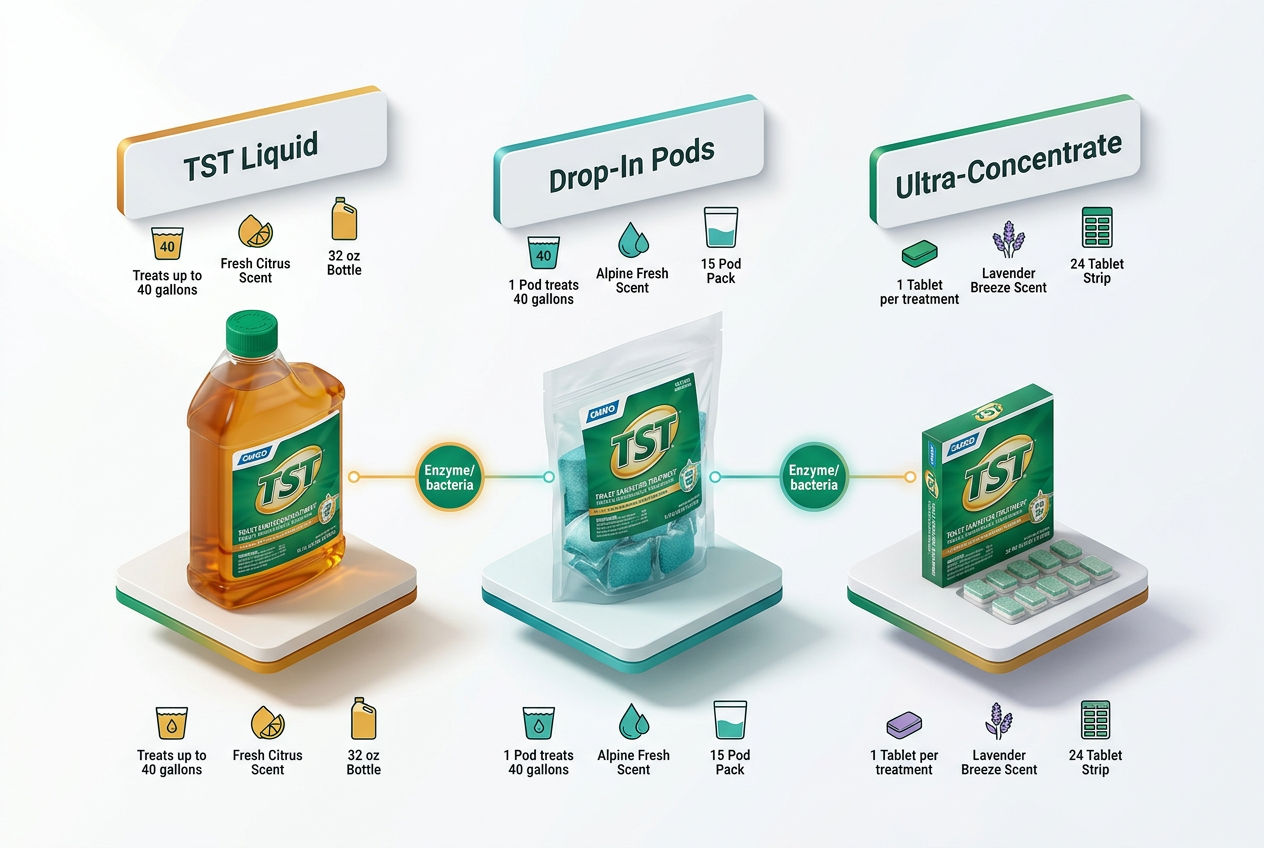
Camco markets several variants under the TST brand. Here's what you'll actually find on shelves and online:
Camco TST Ultra-Concentrated Liquid — The most common format. Available in 32 oz and 40 oz bottles. Dosage is approximately 4 oz per 40 gallons of holding tank capacity. A 32 oz bottle yields roughly 8 treatments. Retail price: $10–$14.
Camco TST DROP-INs — Pre-measured dissolvable pods. Each pod treats one standard RV holding tank (up to 40 gallons). Packs come in 15-count and 30-count. Price: $12–$22. These are the most convenient format — toss one pod in after dumping, no measuring required. See our comparison of septic tank treatment pods if you're weighing pod vs. liquid formats more broadly.
Camco TST Clean Scent — A scented version of the standard liquid formula, designed to layer fragrance over waste odors. The same enzyme base, with added fragrance.
Camco Enzyme RV Holding Tank Treatment — A slightly different formulation that emphasizes enzyme concentration. Targeted at users who want stronger waste digestion with less focus on odor masking.
All Camco TST products are labeled formaldehyde-free and septic-safe. The active mechanism in every variant is enzymatic digestion — primarily cellulase (breaks down toilet paper fibers), protease (proteins), and lipase (fats and grease).
Is the Camco TST Drop-In Review Different from the Liquid Review?
In practice, the formulas are nearly identical — same enzyme blend, same active ingredients. The difference is delivery format, not chemistry. A Camco TST Drop-In review and a Camco TST liquid review will reach the same conclusion on efficacy. Where they diverge is convenience and cost per treatment.
Drop-ins: No measuring, no spills, no risk of overdosing. You toss a pod into the tank after dumping. Each pod is pre-calibrated for a standard 40-gallon RV black tank. If your tank is 20 gallons, you're technically over-dosing — harmless, but slightly wasteful.
Liquid: More flexible dosing. Better for home septic systems where you're treating a 1,000+ gallon tank and need to scale up the dose. At $13 for 40 oz (about 10 treatments), the per-treatment cost runs $1.30. A 30-count pod pack at $22 runs $0.73 per treatment.
For a 4-person household running a 1,000-gallon residential tank: a single 4 oz liquid dose works out to roughly 1 oz per 250 gallons — a fairly dilute concentration for a full-size system. You'd want to scale up or consider a purpose-built residential treatment for meaningful bacterial support.
Camco TST vs. Liquid vs. Drop-In Pods: Which Format Should You Use?
The answer depends on your situation more than on any product difference.
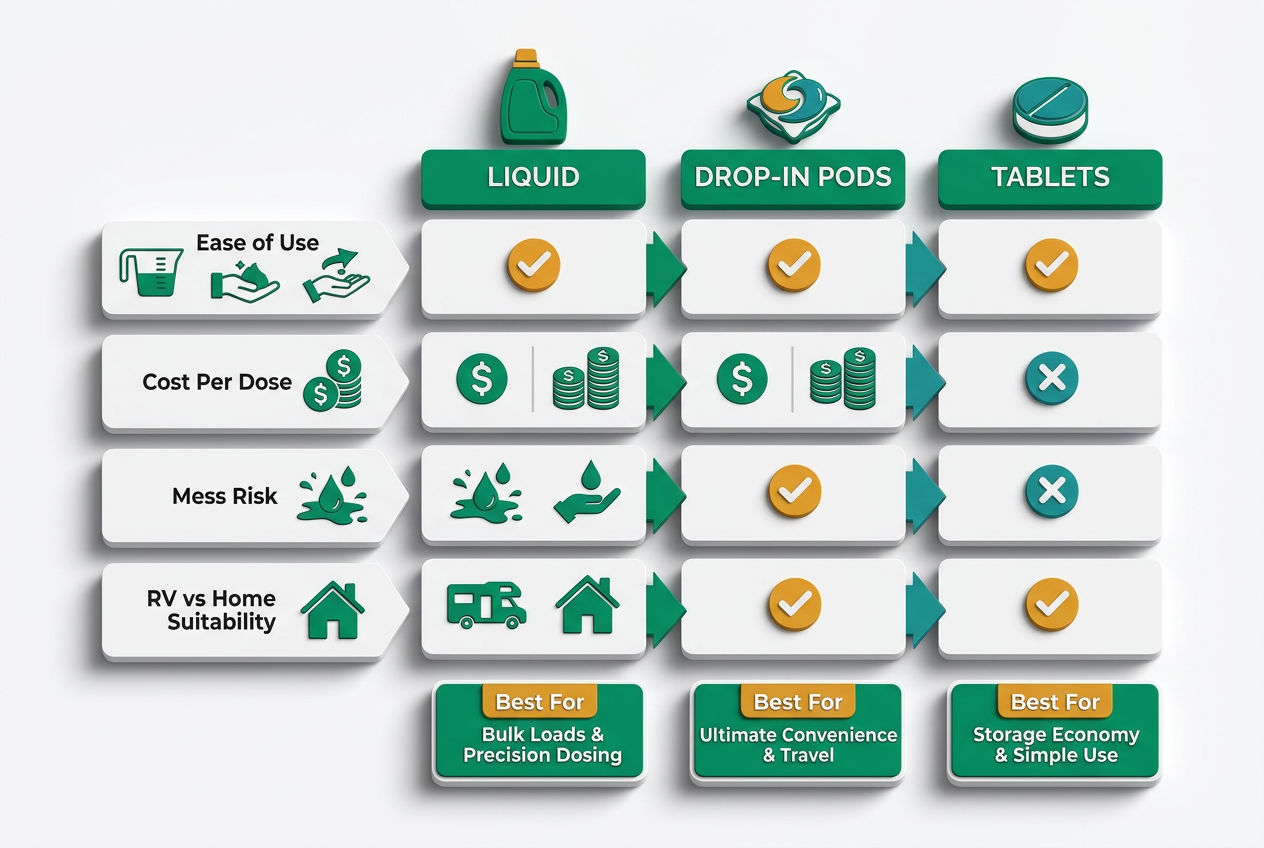
Drop-in pods win for convenience. One pod, one tank, done. No measuring, no spills, no risk of using the wrong dose. If you're camping out of your Class A or fifth wheel and dump at a campground station every few days, pods are the obvious choice.
Liquid beats pods on cost per treatment. A 40 oz bottle of TST Ultra-Concentrated at $13 yields about 10 treatments — roughly $1.30 each. A 15-count pod pack at $14 runs about $0.93 per pod, but the 30-count packs at $22 drop that to $0.73 per treatment. Do the math for your dumping frequency.
For home septic use, liquid is more flexible. You can dose based on your tank size — a 1,000-gallon concrete tank needs a different approach than a 40-gallon RV black tank.
If you have a permanent home septic system and you're already committed to using a treatment product, we recommend looking at Septifix as a stronger option for that application. Each tablet releases oxygen along with 14 strains of aerobic bacteria — roughly 10 billion CFU — directly into the tank, and dosing is as simple as flushing one tablet down the toilet at around $3–$4 per treatment. It's non-toxic, made in the USA, and backs up its claims with a 60-day money-back guarantee. That said, no additive — Camco, Septifix, or otherwise — replaces scheduled pumping; the EPA's position on that hasn't changed.
Is Camco TST Safe for Home Septic Systems?
Camco TST is labeled as septic-safe, and that label is accurate — it won't harm a residential septic system. Flushing it into a 1,000 to 1,500-gallon tank monthly poses no risk to your drain field or the beneficial anaerobic bacteria that do the real work in your system.
But "safe" and "effective for residential use" aren't the same thing.
Home septic systems are anaerobic environments. The bacteria that break down waste in a residential tank are predominantly anaerobic — they function without oxygen. Camco's enzyme formula is optimized for the faster turnover of RV holding tanks that get dumped every 3–7 days. A residential tank holds waste for months before pumping.
The enzyme concentrations and bacterial support you'd want for a 1,500-gallon tank serving a 4-person household are higher than what a product marketed primarily for 40-gallon RV tanks delivers at standard dosing. According to the EPA's guidance at epa.gov/septic, no additive has been shown to eliminate the need for professional pumping — and the agency recommends pumping residential tanks every 3–5 years regardless of additive use.
You can use Camco in your home system — it won't hurt anything. For meaningful residential maintenance, you'll want a product with a higher bacterial count and a formula specifically designed for anaerobic tank environments. For what actually works in a residential context, see our look at whether septic additives really work.
How Often Should You Use Camco Septic Treatment?
RV use: After every tank dump. Drop one pod or dose the liquid immediately after emptying the black tank and adding a couple gallons of fresh water. This pre-charges the tank with enzymes before waste accumulates.
Home septic use: Monthly. For a 1,000-gallon tank, use the full 4 oz dose monthly, flushed directly down the toilet. Some manufacturers suggest an initial double dose for tanks that haven't been treated before.
A worked example: Take a family of four in suburban Wisconsin with a 1,200-gallon concrete tank installed in 2008. At 4 oz of Camco liquid per treatment, monthly use costs about $1.30/month — $15.60/year. Over a standard 3-year interval between pumpings, that's $46.80 in additive costs on top of roughly $400–$600 in pumping costs (see our septic pumping cost guide for regional pricing). Whether that $46.80 delivers meaningful bacterial support in a 1,200-gallon tank — at concentrations that work out to under 0.4% of tank volume — is the honest question to ask. For that same $46.80, a higher-CFU bacterial product like Septifix would deliver approximately 12–15 monthly treatments at 10 billion CFU per tablet across 14 bacterial strains. The math matters.
Cold-weather limitation: Enzyme activity slows significantly below 50°F. If you're in Minnesota in February and your RV is sitting winterized, the treatment isn't doing much until temperatures rise. Northern RVers and homeowners in colder climates like Wisconsin or Montana should plan their treatment schedule around the warmer months and not expect the same breakdown speed they'd see in Texas in July. This is an honest limitation of enzyme-based products specifically — bacterial products with dormant-capable Bacillus strains handle cold better.

Camco vs. RID-X: Which Is Better?
This comparison comes up in almost every RV forum and septic maintenance discussion. Here's a fair breakdown:
| Feature | Camco TST | RID-X |
|---|---|---|
| Primary mechanism | Enzyme-based | Bacteria + enzymes |
| Best use case | RV holding tanks | Residential septic |
| Formaldehyde-free | Yes | Yes |
| Cost per treatment | $0.75–$1.50 | $1.00–$2.00 |
| Pod format available | Yes (DROP-INs) | Yes |
| Avg. Amazon rating | 4.3–4.5 stars | 4.4–4.6 stars |
Data sourced from Amazon product listings, manufacturer labels, and Camping World retail pricing, July 2025.
RID-X adds live bacterial cultures alongside enzymes — typically Bacillus strains that can establish themselves in your tank's anaerobic environment. That's a meaningful advantage for home septic systems. For RV black tanks, the faster turnover means bacterial colonization matters less; enzymes alone can do the job effectively.
Read our full RID-X review if you're comparing the two seriously for home use. And if you want to see how RID-X stacks up against our top residential pick, the RID-X vs. Septifix comparison breaks down the bacterial strain counts, CFU differences, and oxygen-release mechanism side by side.
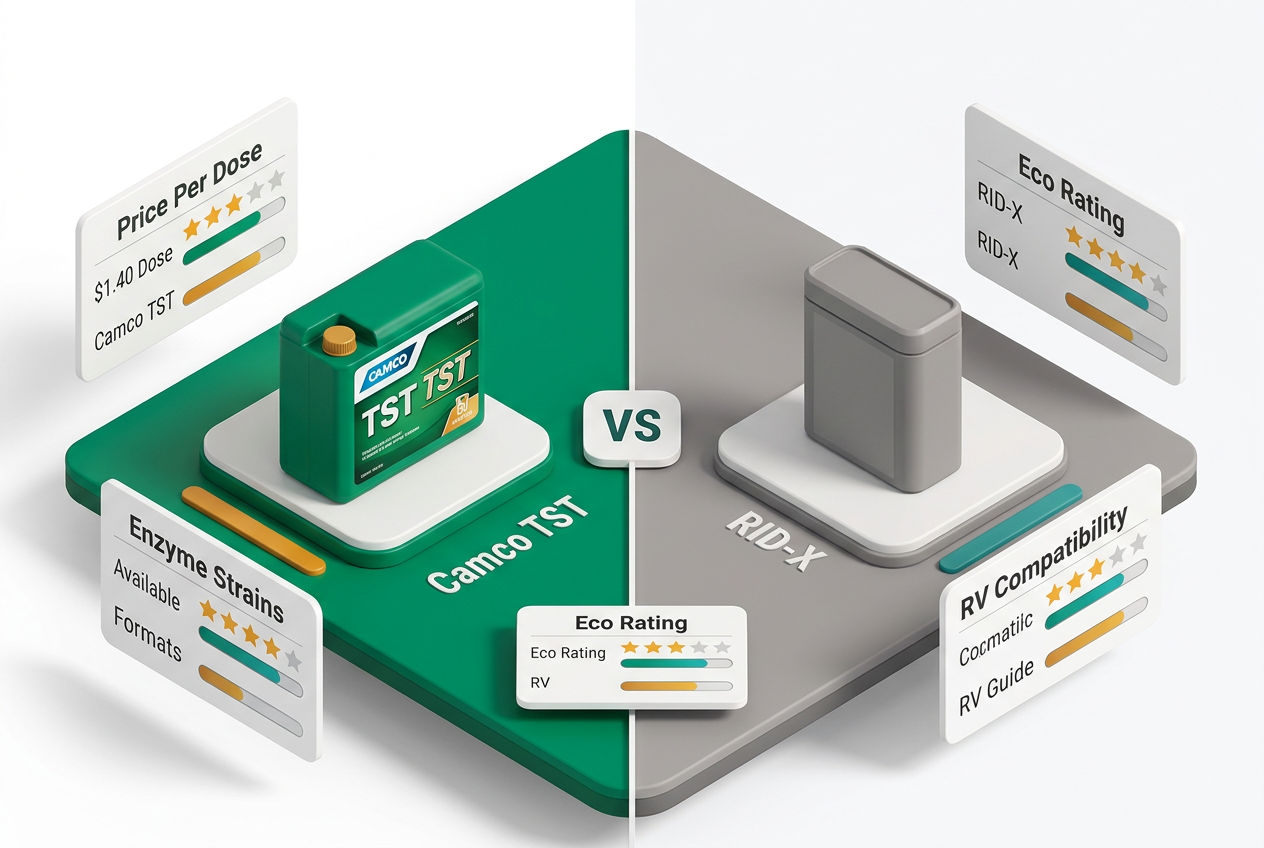
Camco wins for RV convenience and cost. RID-X edges ahead for residential septic maintenance. Neither is our top overall recommendation — more on that in the verdict below.
What About Alternatives? Camco vs. the Field
Beyond RID-X, a few other products compete in this space:
Green Gobbler — Enzyme and bacterial formula, heavier concentration than Camco, typically priced $15–$20 for a multi-dose supply. Marketed primarily for residential systems. See our Green Gobbler review for a deeper look.
Unique Camping + Marine — Popular in the full-time RV community. Bacterial-based (not just enzyme), which some long-term boondockers prefer. Higher price point at $20–$30 per supply.
Happy Campers — A mineral-based odor treatment rather than enzyme or bacterial. Works differently — doesn't break down waste but neutralizes odor compounds directly. Effective for odor but doesn't contribute to waste digestion.
Septifix — Our recommendation for home septic systems. These oxygen-release tablets carry 14 strains of live aerobic bacteria at roughly 10 billion CFU per tablet. The oxygen-release mechanism is what sets it apart: rather than simply adding bacteria that must compete with existing anaerobic populations, Septifix releases oxygen directly into the tank. That oxygen actively targets the odor-causing anaerobic bacteria and accelerates sludge breakdown in a way that enzyme-only or standard bacterial products don't replicate. It's made in the USA, non-toxic, and backed by a 60-day money-back guarantee. At about $3–$4 per treatment with simple one-tablet flush dosing — no measuring, no mixing — it's what we'd recommend if you're treating a residential system. See the full Septifix review or how it compares in the RID-X vs. Septifix breakdown.
For a broader look at the residential category, the septic tank maintenance guide covers product selection alongside the mechanical habits (water use, garbage disposal impact, pump scheduling) that matter more than any single product choice.
Are Camco Septic Treatments Environmentally Safe?
Yes — all Camco TST products are formaldehyde-free and biodegradable. This matters more than it used to. Older RV treatments used formaldehyde or bronopol as their primary biocides. California and several New England states have moved to restrict or prohibit formaldehyde-based tank treatments at campgrounds and dump stations specifically because those compounds were killing the beneficial bacteria in campground septic systems downstream.
Camco's enzyme formula doesn't carry that risk. Cellulase, protease, and lipase are naturally occurring biological compounds — they break down in the environment without leaving chemical residue. For RVers who dump at campground stations or use vault toilets, this is a genuine environmental consideration, not just marketing language.
According to guidance from the University of Arkansas Cooperative Extension Service, enzyme-based treatments pose no documented harm to soil biology or groundwater when used at normal dosing levels — a meaningful distinction from older chemical treatment approaches.
Can You Use Camco RV Septic Treatment in a Home Toilet?
Yes, and this is a question that comes up when RV owners also use their camper's treatment products for their house. Camco RV septic treatment — specifically the liquid TST — can be flushed through a residential toilet into a standard septic tank without causing harm. The enzyme formula is safe for porcelain, PVC, and ABS drain lines.
The practical limitation isn't safety — it's dose scaling. A standard 4 oz Camco dose is calibrated for a 40-gallon RV holding tank. Your home's 1,000 to 1,500-gallon tank would need 25 times that dose to achieve comparable enzyme concentration. At $13 for 40 oz (10 standard RV doses), treating a full residential tank at equivalent concentration would run roughly $1.30 × 25 = $32.50 per monthly treatment. That's significantly more expensive than residential-specific products already formulated at appropriate concentrations for large tanks.
Using Camco occasionally as a supplemental flush is fine. Using it as your primary residential septic treatment is cost-inefficient compared to purpose-built alternatives. See our guide to what kills septic bacteria for more on what residential tanks actually need.
Camco for RV Use: A Realistic Field Assessment
What does Camco TST actually look like in real-world RV use? Consider a scenario most full-timers know: you're three days into a week-long boondocking trip in southern Utah. Temperatures are pushing 95°F during the day. A 40-gallon black tank is getting daily use from two adults. By day three, odor control becomes a real quality-of-life issue, not just a theoretical one.
Camco TST pod users in this situation — based on reports from RV forums and verified Amazon reviews — consistently report odor control holding through 5–7 days in heat above 90°F when a pod is used immediately after the previous dump. That's a real performance metric, not a marketing claim. The enzyme activity is measurably accelerated in warm conditions, which aligns with the biochemistry: enzyme reaction rates increase with temperature up to the point of protein denaturation (roughly 140°F+, well above any realistic tank temperature).
Where Camco falls short in RV use: tanks that sit for extended periods without dumping — think seasonal RV storage or infrequent weekend use — may benefit more from a bacterial-based product that can establish a living colony. Enzymes don't persist the way Bacillus cultures do.
For full-time RVers or frequent weekend campers, Camco TST is a legitimate, cost-effective choice. For the broader picture of RV holding tank management, treatment product is one variable among several — water volume, toilet paper type, and dump frequency matter just as much.
The Verdict: Should You Buy Camco Septic Tank Treatment?
For RV use: yes, with confidence. Camco TST — in either drop-in or liquid format — is a reliable, affordable enzyme treatment for black tank odor and waste breakdown. It's formaldehyde-free, widely available, and genuinely effective for the 3–7 day tank turnover cycle typical of active RV use. If you want the most convenient format, the DROP-INs are hard to beat at $0.73–$0.93 per treatment. If you want flexibility and lower cost per dose, the 40 oz liquid wins.
For home septic use: Camco is fine, but it's not our pick. It won't hurt your system. Used monthly, it provides a low-level enzyme supplement that may marginally improve waste breakdown. But a 1,500-gallon residential tank serving a family of four needs more than enzyme catalysts optimized for 40-gallon RV tanks. For residential maintenance, the product that earns our recommendation is Septifix.
Septifix delivers 14 strains of live aerobic bacteria at roughly 10 billion CFU per tablet — far beyond the bacterial support Camco provides. The oxygen-release mechanism actively attacks odor-causing anaerobic bacteria and sludge in a way no enzyme-only product replicates. One tablet, flushed directly down the toilet, no measuring. Made in the USA, non-toxic, and backed by a 60-day money-back guarantee. At $3–$4 per treatment, it's cost-competitive with Camco used at residential-appropriate concentrations.
Neither Camco nor Septifix replaces pumping. The EPA is clear: no additive eliminates the need for professional tank pumping every 3–5 years (every 2 years if you have a garbage disposal). If your tank is overdue, find a local service through our septic pumping and cleaning page before worrying about which treatment product to buy. Treatment products are maintenance tools, not repairs.
Use Camco in your RV. Use Septifix in your house. Pump your tank on schedule regardless.
Related Rid-X & Septic Treatment Guides
- The Best Rid-X Alternatives
- The Best Septic Tank Smell Removers
- Septic Smell When It Rains? Why It Happens & How to Fix It
- Can You Use Rid-X in an RV Black Tank? What to Know First
- Is Rid-X Safe for Septic Tanks, Toilets & Pipes?
- How Often Should You Use Rid-X? Directions, Dosing & Timing
- What's Actually in Rid-X? Ingredients Explained
- Does Rid-X Unclog Drains or Toilets?
- Rid-X vs. Green Gobbler: Which Septic Treatment Wins?
- Green Gobbler Septic Treatment Review: Pods, Packets & Results
- Where to Buy SeptiFix
- Bio-Clean Septic Treatment Review: Does It Work?
- Cabin Obsession Septic Tank Treatment Review
- Septic Tank Treatments at Walmart vs. Home Depot vs. Online
- Septic Smell Coming From Toilet? Causes & How to Fix It
- Septic Smell From Shower Drain? Causes & How to Fix It
- Septic Tank Smell After Pumping? Causes & How to Fix It
- Septic Smell From Roof Vent? Causes & How to Fix It
- Is Septic Tank Smell Dangerous? Gases, Risks & When to Worry
- Septic Tank Diagram With Dimensions
- Septic Tank Cross-Section Diagram: Every Part Labeled
- Septic System Diagram With a Pump
- Septic Tank Plumbing Diagram: From House to Drain Field
- Aerobic Septic System Diagram: How Each Part Works
- Are Septic Tank Treatments Necessary?
- How to Handle How Often to Use Septic Tank Treatment: Step by Step
- Septic Treatment Tablets vs. Powder vs. Liquid: Which Is Best?
- Best Septic Tank Treatment for Slow Drains
- Yeast, Baking Soda & Milk in Your Septic Tank: Myths Tested
Frequently Asked Questions
Is the Camco TST enzyme treatment worth buying for an RV?
Yes — Camco TST is one of the more reliable enzyme treatments in the RV holding tank category and a reasonable choice for most RV owners. It's formaldehyde-free, available in convenient drop-in pod form, and averages 4.3 to 4.5 stars across more than 10,000 Amazon reviews. For active RV users who dump every 3–7 days, the enzyme formula handles odor and waste breakdown effectively at a cost of $0.73–$1.50 per treatment. The drop-in pods — pre-measured for a standard 40-gallon black tank — make dosing simple. The liquid is slightly more cost-effective for larger tanks. Where Camco falls short: tanks that sit for extended periods between dumps benefit more from bacterial products with living Bacillus cultures that can establish a persistent colony. For routine, active RV use with regular dumping, Camco TST earns a straightforward recommendation. It's not the most sophisticated product in the category, but it does what it claims.
How does this Camco septic tank treatment review rate it for home use?
For residential septic systems, this Camco septic tank treatment review rates it as safe but not optimal. Camco TST won't harm a home septic system — it's biodegradable and enzyme-based — but the formula is calibrated for 40-gallon RV holding tanks with fast turnover, not 1,000 to 1,500-gallon anaerobic residential tanks that sit for months between pumpings. At the standard 4 oz dose, Camco is highly diluted in a full-size residential tank. A 1,000-gallon tank treated monthly at that concentration receives enzyme support at roughly 0.04% tank volume. Purpose-built residential products like Septifix deliver 10 billion CFU per tablet across 14 bacterial strains, plus an oxygen-release mechanism that actively targets odor and sludge. For residential use, Septifix is the more appropriate tool. Camco used monthly as a supplemental flush is harmless, but it shouldn't be your primary residential treatment strategy.
What is the difference between Camco TST Drop-Ins and the liquid?
Camco TST Drop-Ins and the TST Ultra-Concentrated Liquid use essentially the same enzyme formula — cellulase, protease, and lipase — in different delivery formats. The Drop-Ins are pre-measured dissolvable pods, each calibrated for one standard 40-gallon RV black tank. They require no measuring and dissolve on contact with water. The liquid requires measuring roughly 4 oz per 40 gallons of tank capacity, which adds a minor step but allows flexible dosing for tanks of different sizes. On cost per treatment, a 30-count Drop-In pack at $22 runs about $0.73 per pod; a 40 oz liquid bottle at $13 runs about $1.30 per standard treatment. For RV use with a consistent 40-gallon black tank, pods are the more convenient and slightly cheaper option per dose. For home septic users trying to scale dosing to a larger tank, liquid is more practical — though purpose-built residential products are the better choice at that scale.
How does the Camco RV holding tank treatment compare to bacterial-based products?
Camco's RV holding tank treatment is enzyme-based, meaning it uses biological catalysts — cellulase, protease, lipase — to accelerate waste breakdown. Bacterial-based products like Unique Camping + Marine or the residential-focused Septifix use living bacterial cultures (typically Bacillus strains) that can reproduce and establish themselves in the tank environment. The practical difference: enzymes work fast but don't persist. Once you dump and refill, the enzyme concentration resets with the next dose. Bacteria can theoretically colonize the tank walls and maintain a population between dumps. For RV users who dump every few days, the persistence advantage matters less — enzymes are sufficient and often cheaper. For residential septic systems or RVers who store their unit for weeks between uses, bacterial products have a meaningful edge. Camco TST is not a bacterial product. If bacterial colonization is your goal, it's the wrong tool — look at products explicitly listing Bacillus CFU counts on the label.
Does Camco work in cold weather, and what should northern RV users know?
Enzyme activity slows significantly below 50°F and drops further below 40°F — a documented biochemical limitation, not a Camco-specific flaw. According to guidance from the University of Arkansas Cooperative Extension Service, enzyme reaction rates roughly halve for every 10°C (18°F) drop in temperature below optimal range. For RVers in Minnesota, Wisconsin, or Montana using Camco TST in fall or spring camping when overnight temperatures drop into the 40s, the treatment is measurably less effective than it would be at summer temperatures. In winterized RVs sitting below freezing, enzyme activity essentially stops. Northern RV users should plan treatment schedules around warmer active-use months and not rely on Camco to maintain tank health during cold-weather storage. Bacterial products with dormant-capable Bacillus spores handle temperature variation better than enzyme-only formulas — the spores remain viable through freezing and reactivate when temperatures rise. For four-season or shoulder-season RVers, this is a meaningful distinction worth factoring into product selection.
Should I use Camco or Septifix for my home septic system?
For a residential septic system, Septifix is the stronger choice. Camco TST is formulated for 40-gallon RV holding tanks and uses an enzyme-only mechanism; at residential tank volumes of 1,000 to 1,500 gallons, the standard dose delivers minimal bacterial support. Septifix uses a fundamentally different approach: oxygen-release tablets that carry 14 strains of live aerobic bacteria at roughly 10 billion CFU per tablet. That oxygen release actively targets odor-causing anaerobic bacteria and sludge buildup in a way Camco's enzyme formula cannot replicate. Dosing is equally simple — one tablet flushed down the toilet monthly, no measuring. At $3–$4 per treatment, it's cost-competitive with Camco used at residential-appropriate concentrations. Septifix is made in the USA, non-toxic, and backed by a 60-day money-back guarantee. One important caveat for either product: neither replaces professional pumping. The EPA recommends pumping every 3–5 years regardless of additive use. If your tank is overdue, schedule service before investing in any treatment product.
Sources & Methodology
- EPA SepticSmart Program — epa.gov/septic. Agency guidance on residential septic maintenance, additive efficacy, and pumping frequency recommendations.
- University of Arkansas Cooperative Extension Service — "Septic System Additives: Do They Help?" Published guidance on enzyme and bacterial additive performance and environmental safety.
- Amazon Product Listings — Camco TST Drop-Ins (B00K2D8KFO), Camco TST Ultra-Concentrated Liquid (B00022RZK0), and RID-X Septic Treatment (B000BQTMFE). Star ratings and review counts as of July 2025.
- Camping World & Walmart Retail Pricing — In-store and online pricing for Camco TST formats, verified July 2025.
- Manufacturer Product Labels — Camco TST ingredient disclosures (cellulase, protease, lipase), formaldehyde-free certification, and dosing instructions per label copy reviewed June–July 2025.
Free download
Not ready for the Handbook? Start with the free Fridge Card.
The Do / Don’t card the whole family can see, plus the Survival Kit: emergency flowchart, warning-sign decoder and pump-schedule card. One printable PDF.
Was this article helpful?
Frequently Asked Questions
Recommended Resources
📖 Related Articles
- Septic Tank Enzymes: What You Need to Know
- The Best Septic Tank Treatment Pods (Top Picks)
- Do Septic Tank Additives Actually Work? (The Science)
- Rid-X for Septic Tanks: Does It Help or Hurt?
- Green Gobbler Septic Treatment Review: Pods, Packets & Results
- The Complete Septic Tank Maintenance Guide
- What Kills Septic Tank Bacteria? (14 Things to Avoid)
- RV Holding Tank: The Complete Guide
💰 Cost Guides
🔧 Services
Find Septic Professionals Near You
Compare licensed, verified septic companies by area — top county markets and cities below, or browse all 50 states.
County markets
Popular cities
