
Quick Answer
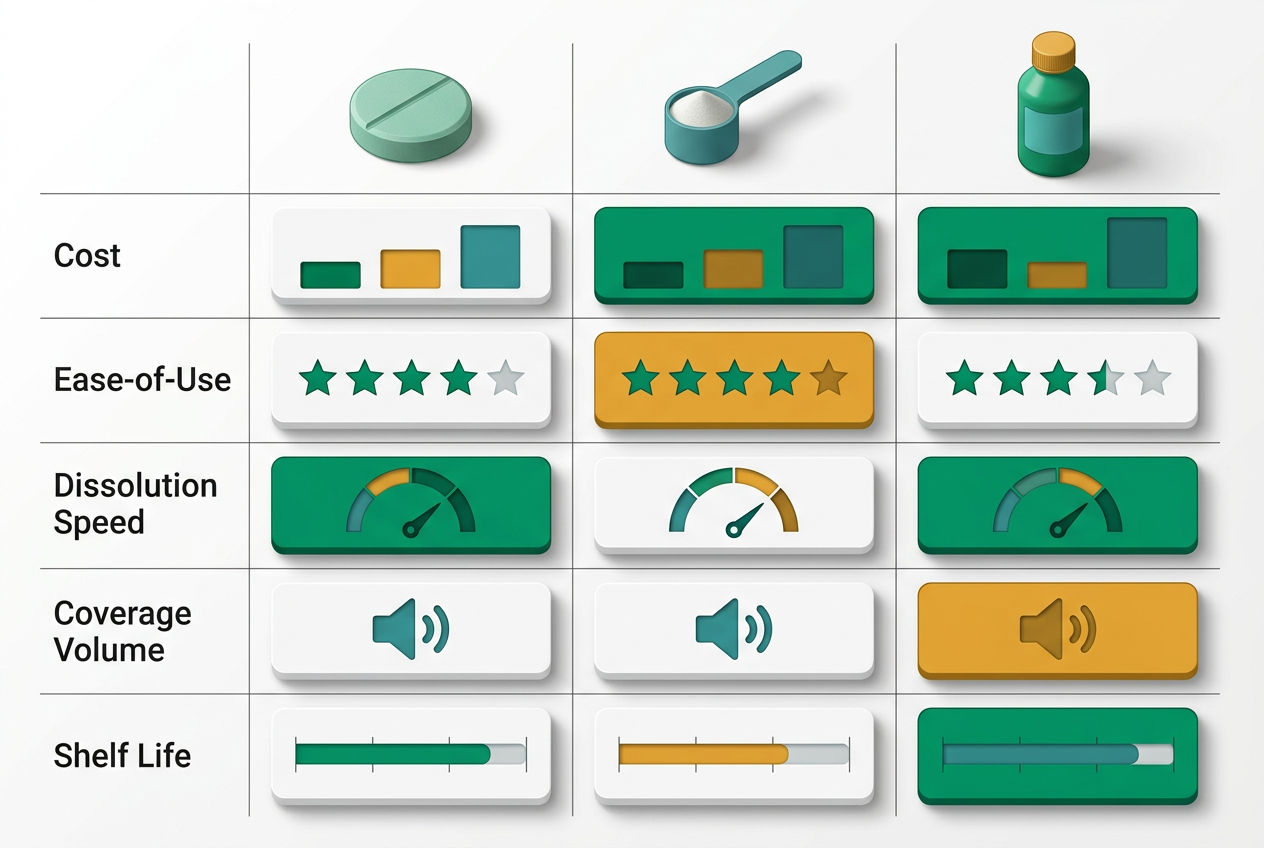
Septic tank treatment tablets vs. powder vs. liquid — three formats, dozens of brands, and one very common question: does the form factor actually matter?
Short answer: yes, and the difference shows up in your drain field's lifespan, not just your monthly budget. The format you choose affects how fast bacteria reach your tank, how many colony-forming units (CFU) survive shipping and storage, and whether the product even works in cold climates.
About 21 million U.S. households rely on septic systems, according to the EPA — roughly 1 in 5 homes. Most of those homeowners are guessing on maintenance. If your tank costs $300–$600 to pump (and that's the good outcome — a drain field replacement can run $5,000–$20,000), choosing the right monthly treatment product is worth five minutes of research.
This guide gives you the honest comparison: how each format works, where each one wins, and which one we'd actually recommend flushing down your toilet tonight.
Key Takeaways
- Tablets are the most convenient format — one flush, no measuring, long shelf life (2–5 years)
- Liquids activate fastest but cost more per month ($5–$15) and have the shortest shelf life (1–2 years)
- Powders offer high CFU flexibility for large tanks but require measuring and dissolve slower in cold water
- All three formats contain bacteria and/or enzymes — the difference is delivery speed and survivability
- No format replaces pumping; treatments are maintenance supplements, not system repairs
What's the Quickest Way to Choose Between Septic Tank Treatment Tablets vs. Powder vs. Liquid?
If you have a standard 1,000–1,250-gallon tank, a household of 2–4 people, and a warm-to-moderate climate, tablets are the format to pick. One flush per month, consistent dosing, no measuring errors, and a shelf life that forgives the occasional missed dose. For larger tanks (1,500+ gallons) or heavily used systems, powder gives you CFU flexibility. For cold-climate emergencies or fast-acting treatment needs, liquid wins on activation speed.
That's the short answer. The rest of this article explains exactly why — and what the numbers actually look like.
Why Do Septic Tanks Need Treatment at All?
A healthy septic tank is a biological system. Billions of anaerobic bacteria break down the solid waste that enters your tank — turning it into liquid effluent that drains to your drain field and relatively harmless gases that vent out. When that bacterial colony gets disrupted, waste accumulates faster, sludge builds up, and your drain field starts receiving effluent it can't handle.
What kills those bacteria? Plenty of things you use every day — antibacterial soaps, bleach-based cleaners, and even some laundry detergents. You can read the full list in our article on what kills septic bacteria.
The point is that even with careful habits, your bacterial population takes hits regularly. Septic tank treatments — whether tablet, powder, or liquid — reintroduce bacteria and enzymes to compensate. Your tank's bacterial colony is like a garden: it grows back if you give it what it needs, but you have to be consistent.
If you're fuzzy on how a septic system works at a basic level, that article is worth skimming first.
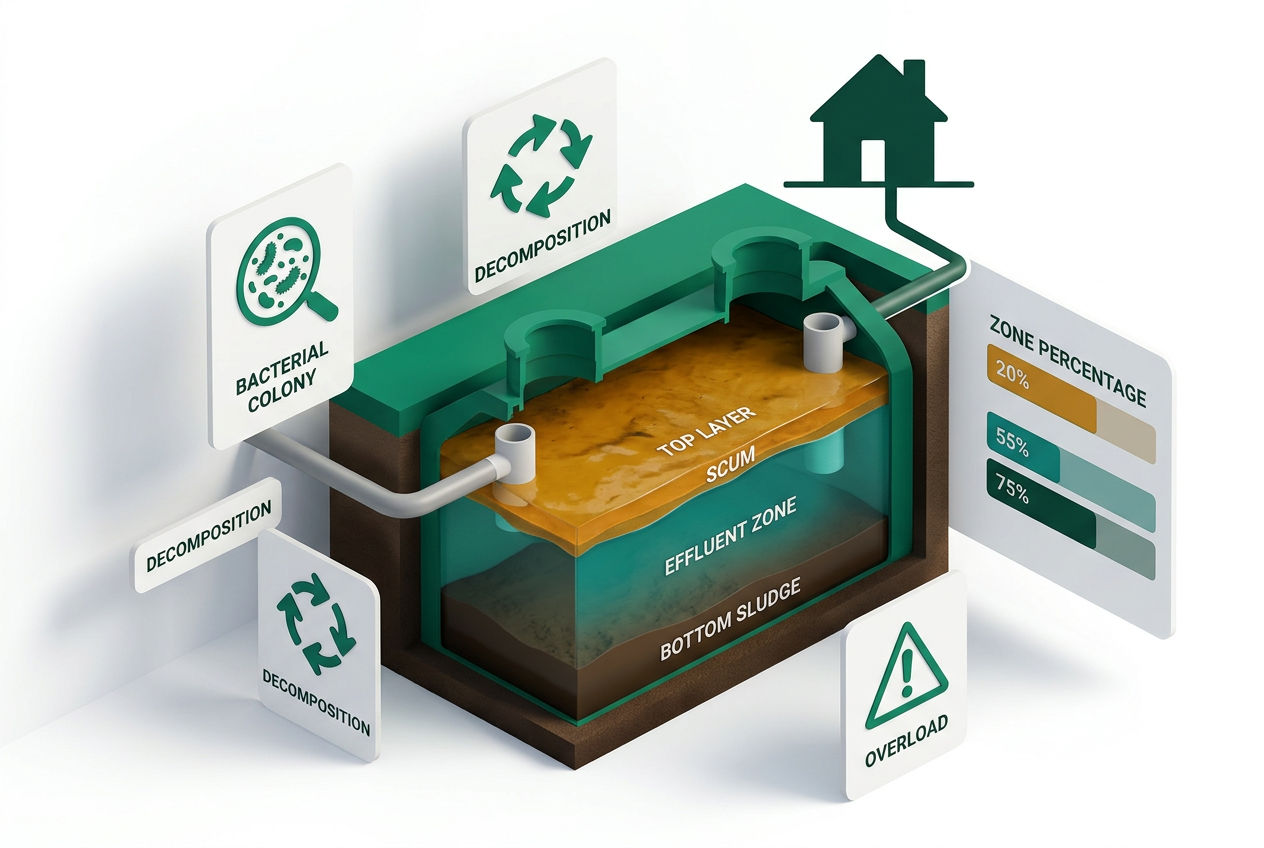
What's Actually Inside Septic Treatments? Bacteria vs. Enzymes Explained
Before comparing formats, it helps to understand what's in the bottle (or bag, or blister pack).
Bacteria are living microorganisms — specifically strains like Bacillus subtilis, Bacillus licheniformis, and related species — that actively consume organic waste. They reproduce and establish colonies. This is the core active mechanism of any serious septic tank biological treatment.
Enzymes are proteins that speed up chemical reactions. They break down specific compounds — proteases for proteins, lipases for fats, amylases for starches, cellulases for paper. Enzymes work fast but don't reproduce. Once they're consumed or washed out, they're gone.
Most products combine both. CFU (Colony-Forming Units) is the standard measure of bacterial potency. A product listing 1 billion CFU per dose is delivering 1 billion viable bacteria capable of reproducing. Higher isn't always better — strain diversity and bacterial viability at the time of use matter just as much as raw count.
For a deeper look at how these ingredients work together, see our septic tank enzymes guide and our overview of septic tank bacteria.
How Do Septic Tank Treatment Tablets Work — and Who Are They Best For?
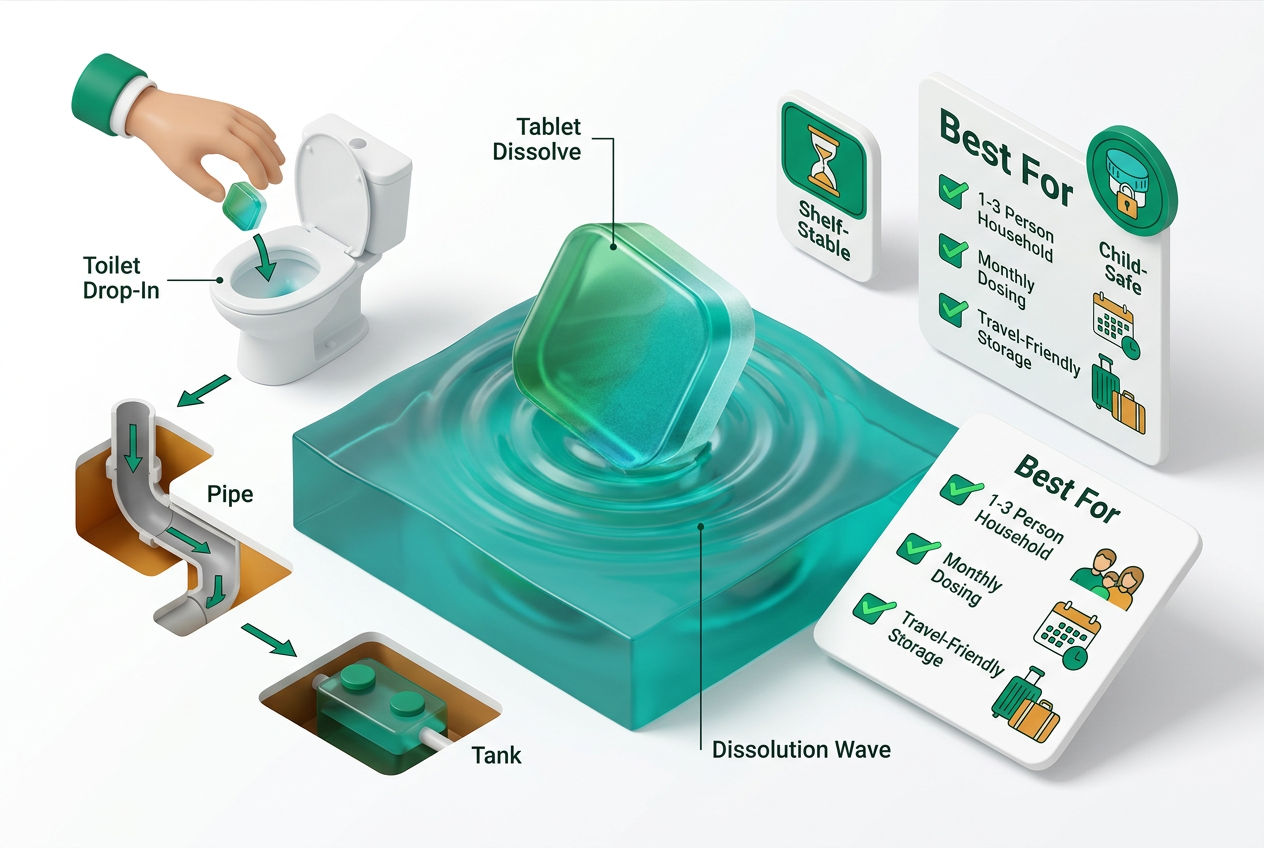
How Tablets Work
Tablets are pre-measured, compressed doses of bacteria, enzymes, and typically some inert binder material. You drop one in the toilet and flush. The tablet sinks into the tank and dissolves slowly over 24–72 hours, releasing bacteria steadily rather than all at once.
Dissolve rate is affected by water temperature. In a 1,000-gallon tank where the water sits at 55°F (common in northern states during winter), tablet dissolution can stretch toward the 72-hour end of that range. In a warm-climate tank sitting at 70°F+, closer to 24 hours.
What Tablets Do Well
Convenience is the obvious win. One tablet, one flush, done. No measuring, no mixing, no risk of over-dosing. Most come in 6- or 12-month supply packs, making monthly treatment genuinely easy to maintain — which matters because consistency is what makes treatments effective.
Shelf life is exceptional. Properly stored tablets last 2–5 years. The compressed, low-moisture format keeps bacteria in a dormant, stable state. If you buy a 12-month supply and life gets busy, those tablets sitting in your cabinet aren't dying on you.
Cost per treatment is usually the lowest: $3–$8/month, especially when bought in bulk. A 12-pack of most tablet brands runs $25–$40.
Dosing for tank size is typically handled by varying how many tablets you flush. A 1,000-gallon tank usually needs one tablet monthly; a 1,500-gallon tank might require two.
Where Tablets Fall Short
Slow dissolution is a real issue in cold climates. If you're in Minnesota or upstate New York and your tank sits in cold soil through winter, a tablet may still be partially dissolving when your next dose is due. Bacterial activity also slows in cold tank water, which compounds the issue.
Tablet CFU counts typically range from 1–5 billion CFU per dose, which is serviceable for most residential 1,000–1,250-gallon systems but may underserve larger tanks or heavily used systems.
Best For
- Homeowners who want simple, consistent monthly maintenance
- 750–1,250-gallon tanks serving households of 2–4 people
- Warm climates (Southeast U.S., Gulf Coast, Southwest)
- Anyone prone to forgetting their monthly treatment schedule
Is Septic Tank Powder Treatment Better for Large or High-Usage Systems?
How Powder Works
Powders are similar in chemistry to tablets — bacteria, enzymes, and sometimes mineral carriers — but delivered in a loose granular form. You measure out a dose (typically by the scoop or packet), mix it with warm water, and pour it down a drain or flush it down the toilet.
Dissolution time for powder is faster than tablets: typically 2–12 hours depending on water temperature and granule size. The pre-mixing step speeds things up considerably. Pour it into a gallon of warm water, stir for 30 seconds, flush — and bacteria are dispersing through your tank within a couple of hours.
What Powders Do Well
Dosing flexibility is the biggest advantage. Got a 1,500-gallon concrete tank serving a family of six with a garbage disposal? You can double your dose without buying a different product. Many septic service contractors recommend powder precisely because dosage can be calibrated to system size and household usage.
Here's a worked example: a household of five people in a 1,500-gallon tank generates roughly 20–25% more waste than the standard 1,000-gallon/4-person scenario that most tablet products are calibrated for. Using a powder product that delivers 10 billion CFU at standard dose, you can scale to 15 billion CFU simply by adding 50% more powder — something you cannot do with pre-dosed tablets.
CFU counts in powder products vary widely — anywhere from 2 billion to 20+ billion CFU per dose, depending on the brand. The higher end of that range makes powder a legitimate option for large tanks or systems that have been neglected.
Powder products are also widely available at hardware stores and farm supply stores, often in bulk quantities that drive the cost per treatment down.
Where Powder Falls Short
The measuring step introduces human error. Add too little and you're undertreating. Add too much — can you overdose a septic system? Technically yes, though it's rarely dangerous. Flooding a tank with excess bacteria can create a temporary pH imbalance, but the more realistic risk is simply wasting money. A heavy-handed scoop doesn't proportionally improve your results.
Shelf life is moderate: 2–4 years, shorter than tablets because granular products absorb ambient moisture more readily. If your cabinet is in a humid basement, powder stored there for two years may have degraded bacterial viability.
Cold-water dissolution is better than tablets but still affected by temperature. In a 45°F tank (common in Midwest systems during January), powder mixed in warm water will still cool quickly and slow activation.
Best For
- Larger tanks: 1,250–1,500+ gallons
- High-usage households (5–6 people, with garbage disposal)
- Homeowners who want to customize dosing
- Rural areas where bulk purchasing from farm supply stores makes economic sense
When Does Septic Treatment Liquid Outperform Tablets and Powder?
How Liquid Works
Liquid septic treatments are bacterial and enzyme concentrates suspended in water. Pour a measured amount into the toilet, flush, and bacteria are already in solution — no dissolution time required. They disperse through the tank within minutes to hours and can begin colonizing and breaking down waste almost immediately.
CFU counts in liquid treatments typically range from 5–10 billion CFU per ounce, though this varies significantly by product. Because bacteria are already in an active (or semi-active) state, they can outperform tablets and powders in terms of immediate impact.
What Liquids Do Well
Speed of activation is unmatched. If you're dealing with a slow drain or early signs of a backup, liquid treatment gets bacteria working faster than any other format. For a system under stress — after a party, during a high-occupancy week, or following a bleach cleaning incident — liquid can be the right emergency format.
Cold-climate performance is the other standout. In upstate New York, Vermont, Minnesota, or Michigan, liquid treatments have a meaningful edge from November through March. There's no dissolution delay, no compressed binder to soften in cold tank water. The bacteria go straight in.
Where Liquids Fall Short
Shelf life is the weakest of all three formats: typically 1–2 years. Bacteria in liquid suspension are metabolically active and have a shorter dormancy window than their tablet or powder counterparts.
Cost per month is highest: typically $5–$15/month, depending on the product and dose size. For a standard monthly maintenance program, liquid costs 2–3x what a tablet regimen runs.
Storage and handling are slightly more involved — liquids can spill, need to be kept away from temperature extremes, and often come in packaging that's harder to store long-term.
Best For
- Cold climates (Upper Midwest, New England, Pacific Northwest winters)
- Emergency or fast-response septic treatment situations
- Systems recovering from antibiotic or chemical disruption
- Homeowners who don't mind a slightly higher monthly cost for maximum activation speed
Septic Tank Treatment Tablets vs. Powder vs. Liquid: Head-to-Head Comparison
| Feature | Tablets | Powder | Liquid |
|---|---|---|---|
| Dissolution time | 24–72 hours | 2–12 hours | Minutes |
| Typical CFU per dose | 1–5 billion | 2–20+ billion | 5–10 billion/oz |
| Shelf life | 2–5 years | 2–4 years | 1–2 years |
| Monthly cost | $3–$8 | $3–$10 | $5–$15 |
| Dosing flexibility | Low (fixed per tablet) | High (adjustable) | Medium |
| Cold-climate performance | Poor | Moderate | Best |
| Convenience | Best | Moderate | Moderate |
| Human error risk | Lowest | Highest | Moderate |
Does Septic Treatment Actually Replace Pumping?
No. This needs a direct answer before going any further: no septic tank treatment — tablet, powder, or liquid — replaces professional pumping.
The EPA's official position is that biological additives are not a substitute for regular septic system maintenance, including inspection and pumping. The agency does not endorse any additive as a replacement for pumping. The University of Minnesota Extension, one of the more rigorous sources of septic system research in the country, notes that most additives tested in peer-reviewed conditions show limited evidence of dramatic performance improvement in well-functioning systems — but that in systems subjected to routine bacterial stress, biological additives show measurable benefit in maintaining effluent quality.
What does that mean practically? Septic treatments help maintain a healthy bacterial population and slow sludge accumulation. They do not eliminate sludge that has already built up. Most residential tanks need pumping every 3–5 years regardless of what treatment you use — see our guide on how often to pump a septic tank and what that service costs.
A $5/month treatment habit that keeps your bacterial colony healthy is worth doing. Monthly treatment as a pumping substitute is not.
Which Format Should You Choose? Our Recommendation
Here's how to pick based on your actual situation:
Choose tablets if: You have a standard 750–1,250-gallon tank, a household of 2–4 people, live in a moderate-to-warm climate, and want the simplest possible monthly maintenance routine.
Choose powder if: Your tank is 1,500 gallons or larger, your household has 5+ people or runs a garbage disposal, and you want CFU flexibility to scale your dose based on seasonal usage.
Choose liquid if: You're in a cold climate (Minnesota, Vermont, upstate New York, Michigan), dealing with an active odor or slow-drain situation, or treating a system that's recovering from chemical disruption.
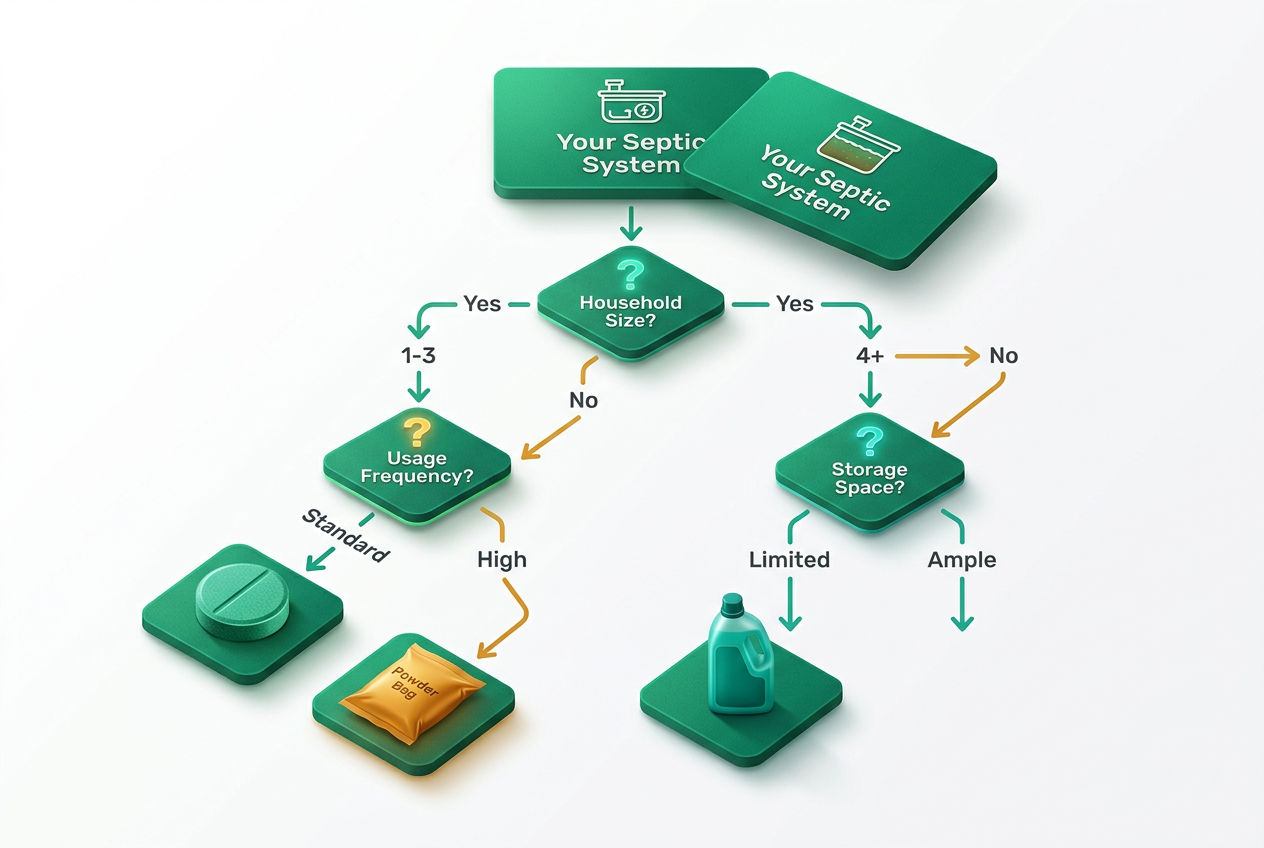
Our Pick: Septifix
For most homeowners — standard tank, moderate household, looking for consistent monthly maintenance — the format we recommend is tablets, and the product we recommend is Septifix.
Here's why it earns that recommendation specifically:
Septifix tablets carry 14 strains of live aerobic bacteria at approximately 10 billion CFU per tablet — significantly higher than the 1–5 billion CFU typical of competing tablet brands. Crucially, the formula includes an oxygen-release mechanism: as the tablet dissolves, it releases oxygen into the tank, which directly targets odor-causing anaerobic bacteria and accelerates sludge breakdown. That oxygen-release mechanism is what separates Septifix from generic tablet competitors — it's not just a bacterial reintroduction, it's actively creating an environment hostile to the organisms that cause odor and backup.
Dosing is simple: one tablet per flush, once a month. No measuring, no mixing, no risk of over- or under-dosing. At roughly $3–$4 per treatment in a standard 12-dose supply, it's among the most cost-effective tablet options available. The product is made in the USA, non-toxic, and backed by a 60-day money-back guarantee.
If the tablet format fits your situation based on the criteria above — standard tank size, household of 2–4, moderate climate — Septifix is the specific product we'd point you toward. It delivers a higher CFU count than most tablet competitors, pairs those bacteria with an oxygen-release mechanism that powder and liquid formats don't replicate, and keeps the monthly routine down to a single flush. Worth noting: the EPA's position is that no additive is required for a properly maintained septic system, and Septifix won't change the math on your pumping schedule. But if you're going to use a tablet treatment, this is the one we recommend.
Honest caveat: Septifix is a maintenance product. It will help keep your bacterial colony healthy, slow sludge accumulation, and reduce odor. It will not rescue a failing system, clear a drain field that's already saturated, or substitute for pumping a tank that's overdue. If you're seeing sewage backing up into your home, contact a licensed septic professional before reaching for any treatment product.
For a detailed product breakdown and a side-by-side with Rid-X, see our Rid-X vs. Septifix comparison.
Do Septic Additives Actually Work? What the Research Says
The short version: biological additives — bacteria and enzyme products — show real benefit in systems under bacterial stress. Chemical additives (solvents, surfactants) are a different story, and some state regulators have moved to restrict them.
Per Washington State Department of Health guidelines, chemical septic additives are not recommended and may damage drain field soils. Biological additives are treated as low-risk and potentially beneficial, but are not required.
The National Onsite Wastewater Recycling Association (NOWRA) takes a similar position: biological additives won't fix a broken system, but they support bacterial populations in systems exposed to routine household chemical stressors.
For a full evidence-based breakdown, see our article on whether septic additives work.
Related Rid-X & Septic Treatment Guides
- The Best Rid-X Alternatives
- The Best Septic Tank Smell Removers
- Septic Smell When It Rains? Why It Happens & How to Fix It
- Can You Use Rid-X in an RV Black Tank? What to Know First
- Is Rid-X Safe for Septic Tanks, Toilets & Pipes?
- How Often Should You Use Rid-X? Directions, Dosing & Timing
- What's Actually in Rid-X? Ingredients Explained
- Does Rid-X Unclog Drains or Toilets?
- Rid-X vs. Green Gobbler: Which Septic Treatment Wins?
- Green Gobbler Septic Treatment Review: Pods, Packets & Results
- Where to Buy SeptiFix
- Bio-Clean Septic Treatment Review: Does It Work?
- Cabin Obsession Septic Tank Treatment Review
- Camco Septic Tank Treatment Review
- Septic Tank Treatments at Walmart vs. Home Depot vs. Online
- Septic Smell Coming From Toilet? Causes & How to Fix It
- Septic Smell From Shower Drain? Causes & How to Fix It
- Septic Tank Smell After Pumping? Causes & How to Fix It
- Septic Smell From Roof Vent? Causes & How to Fix It
- Is Septic Tank Smell Dangerous? Gases, Risks & When to Worry
- Septic Tank Diagram With Dimensions
- Septic Tank Cross-Section Diagram: Every Part Labeled
- Septic System Diagram With a Pump
- Septic Tank Plumbing Diagram: From House to Drain Field
- Aerobic Septic System Diagram: How Each Part Works
- Are Septic Tank Treatments Necessary?
- How to Handle How Often to Use Septic Tank Treatment: Step by Step
- Best Septic Tank Treatment for Slow Drains
- Yeast, Baking Soda & Milk in Your Septic Tank: Myths Tested
Frequently Asked Questions
What is the difference between septic tank treatment tablets vs. powder in cold climates?
In cold climates, septic tank treatment tablets vs. powder comes down to dissolution speed and bacterial activation temperature. Tablets dissolve over 24–72 hours in ideal conditions, but in a tank sitting at 45–55°F — common in Minnesota, Michigan, or Vermont from November through March — dissolution can stretch past 72 hours, meaning bacteria reach your tank slowly and activate sluggishly. Powder, pre-mixed in warm water before flushing, gets bacteria into solution faster and reduces the temperature-dependent dissolution lag. However, even powder mixed in warm water cools quickly once it enters a cold tank. For truly cold-climate systems, liquid treatment is the most reliable format because there is no dissolution step at all — bacteria disperse immediately upon entering the tank. If tablets are your preferred format, dose in fall before soil temperatures drop significantly. Consult your county extension office for local soil temperature guidance.
Is septic tank biological treatment better than enzyme-only products?
Yes, for long-term maintenance. Enzyme-only septic products break down specific compounds — fats, proteins, starches — quickly, but enzymes do not reproduce. Once the dose is consumed or flushed through to the drain field, the benefit ends. Septic tank biological treatment products containing live bacteria — particularly multi-strain formulas with Bacillus subtilis and related species — establish active colonies that continue breaking down waste between doses. The most effective products combine both: enzymes for fast initial breakdown and bacteria for sustained colony establishment. A product like Septifix delivers 14 strains of live aerobic bacteria at approximately 10 billion CFU per tablet alongside enzymatic activity. For a system recovering from antibiotic or bleach disruption, biological recolonization is the priority — enzyme-only products won't restore the bacterial population your tank needs to process solid waste effectively over the long term.
What is the best septic tank powder treatment for a large tank?
The best septic tank powder treatment for a large tank — 1,500 gallons or more — is one that delivers high CFU counts and allows dose scaling. Look for products with at least 5–10 billion CFU per standard dose and clear instructions for scaling up. Powder is the preferred format for large tanks precisely because you can increase the dose proportionally: a 1,500-gallon tank serving five people may need 50–100% more bacterial input than the standard 1,000-gallon single-household scenario. Farm supply stores like Tractor Supply Co. often carry bulk powder products at lower per-treatment costs than retail hardware stores. Check the bacterial strain list on the label — products listing three or more distinct Bacillus strains tend to be more effective across the range of organic compounds your tank processes. Avoid products that lead with enzyme content and list bacteria as secondary; for a large, high-usage tank, bacterial density is the priority.
Can you use septic tank liquid treatment every month, or is it only for emergencies?
Septic tank liquid treatment can absolutely be used as a regular monthly maintenance product — it is not solely an emergency format. That said, most homeowners who use liquid treatments monthly do so because of cold-climate constraints (no dissolution delay) or because their system has a history of bacterial disruption. For standard maintenance in moderate climates, tablets offer equivalent bacterial delivery at lower cost ($3–$8/month vs. $5–$15/month for liquid) and significantly longer shelf life (2–5 years vs. 1–2 years). Where liquid treatment earns its monthly cost is in systems in the Upper Midwest or New England that experience extended cold seasons, households where aggressive cleaning products are used regularly, or systems with a history of slow drains or backup. If you choose a liquid product for monthly use, store it away from temperature extremes — heat and freezing both degrade bacterial viability faster than manufacturer shelf-life estimates assume.
How do septic treatment tablets compare to Rid-X?
Septic treatment tablets vary widely by brand — the tablet format itself is not a single product. Rid-X is one of the most widely recognized tablet and powder brands in the U.S., and it uses Bacillus bacteria alongside cellulase, protease, lipase, and amylase enzymes. It works, and it's widely available. Where it falls short compared to products like Septifix is CFU count and bacterial strain diversity. Rid-X tablets typically deliver fewer bacterial strains and lower CFU counts than Septifix's 14-strain, approximately 10 billion CFU formula. Septifix also includes an oxygen-release mechanism that Rid-X does not — a meaningful functional difference for odor control and anaerobic bacteria suppression. Both are biological, non-toxic, and safe for standard residential septic systems. For a detailed side-by-side, see our Rid-X vs. Septifix comparison. Neither product replaces pumping, and both are most effective when used consistently every month.
What should I do if my septic tank smells even after treatment?
Persistent odor after using a septic tank treatment — regardless of format — usually signals one of three things: the bacterial colony hasn't fully reestablished yet (give it 2–3 treatment cycles), there's a mechanical issue unrelated to bacterial health (damaged inlet baffle, venting problem, failing Polylok PL-122 filter), or the tank is overdue for pumping and sludge accumulation is severe enough that treatment alone can't compensate. The most common mistake homeowners make is treating odor as purely a biological problem when it's actually a structural or capacity problem. If odor persists after two or three months of consistent treatment, the next step is a professional inspection — not a higher-dose treatment product. A licensed technician can assess sludge and scum layer depth, inspect the inlet and outlet baffles, and determine whether pumping or repair is needed. See our article on slow drains and septic systems for related warning signs.
Sources & Methodology
This article draws on the following sources:
- U.S. Environmental Protection Agency — Septic Systems Overview and guidance on septic additives (epa.gov)
- University of Minnesota Extension — Research on septic system additives and biological treatment effectiveness
- Washington State Department of Health — Guidance on chemical vs. biological septic additives
- National Onsite Wastewater Recycling Association (NOWRA) — Position statement on septic system additives
- Septifix manufacturer specifications — CFU count, bacterial strain list, and product composition as published
- Rid-X product labeling — Enzyme and bacterial strain information as published on product packaging
Format comparisons (dissolution time, shelf life, CFU ranges, cost estimates) are based on published manufacturer specifications and industry-standard ranges for each product category. Cost ranges reflect typical retail pricing as of Q1–Q2 2025 and may vary by region and retailer.
Free download
Not ready for the Handbook? Start with the free Fridge Card.
The Do / Don’t card the whole family can see, plus the Survival Kit: emergency flowchart, warning-sign decoder and pump-schedule card. One printable PDF.
Was this article helpful?
Frequently Asked Questions
Recommended Resources
📖 Related Articles
- What Is a Drain Field? (And How Does It Work?)
- The Best Septic-Safe Laundry Detergents
- What Kills Septic Tank Bacteria? (14 Things to Avoid)
- What Is a Septic System? How It Works (Visual Guide)
- Septic Tank Enzymes: What You Need to Know
- How Septic Tank Bacteria Work (And Why They Matter)
- Septic System Backing Up? Causes & Emergency Steps
- Emergency Septic Tank Treatment? Causes & How to Fix It
- How Often Should You Pump Your Septic Tank?
- Do Septic Tank Additives Actually Work? (The Science)
- Slow Drains With Septic: Is It the Plumbing or the Tank?
💰 Cost Guides
🔧 Services
Find Septic Professionals Near You
Compare licensed, verified septic companies by area — top county markets and cities below, or browse all 50 states.
County markets
Popular cities
