
Quick Answer
Instant Power Septic Shock reviews split hard between "fixed my problem" and "total waste of money" — and the reason for that split tells you almost everything you need to know before buying. The product works in specific, narrow circumstances. It fails in others. Whether it helps or does nothing usually depends on what's actually wrong with your system, not on the product quality itself.
In 60 words: Instant Power Septic Shock is a 67.6 fl oz bacterial enzyme treatment containing over 500 billion bacteria and four enzyme types. It reliably reduces odor within 3–5 days in systems with low bacterial populations. It does not fix structural failures, clogged drain fields, or overfull tanks. For routine maintenance, we recommend Septifix tablets instead — better strain diversity, cleaner dosing.
Key Takeaways
- Instant Power Septic Shock contains over 500 billion bacteria and four enzyme types (lipase, protease, amylase, cellulase) in a 67.6 fl oz bottle priced around $12–$18.
- Most users report odor reduction within 3–5 days; flow improvement (if any) takes 2–4 weeks.
- It works best as a maintenance boost in systems that are fundamentally healthy — not as a repair tool for failing drain fields.
- Washington State's Department of Health and other state agencies have published skeptical guidance on septic additives; this product is no exception to that scrutiny.
- If your system has active backups, pooling water, or gurgling drains, no shock treatment replaces a professional inspection.
Does Instant Power Septic Shock Really Work?
Instant Power Septic Shock can work — but only in specific circumstances. For a 1,000–1,500 gallon conventional tank that's sluggish after a holiday weekend, a cold winter, or antibiotic use by household members, a bacterial dose this size may genuinely help restore microbial balance. Odor complaints tend to resolve within 3–5 days when the underlying cause is low bacterial count rather than a structural issue. Flow improvement, if the problem is early-stage biomat buildup on leach laterals, takes 2–4 weeks and is far less predictable.
What it cannot do: reverse a clogged drain field, fix a cracked baffle wall, clear a plugged effluent filter, or compensate for a tank that's at full sludge capacity. According to the EPA's SepticSmart program, no additive eliminates the need for routine pumping — a 1,000-gallon tank serving a four-person household typically needs pumping every 3–4 years regardless of what you add to it.
What's Actually in the Bottle?
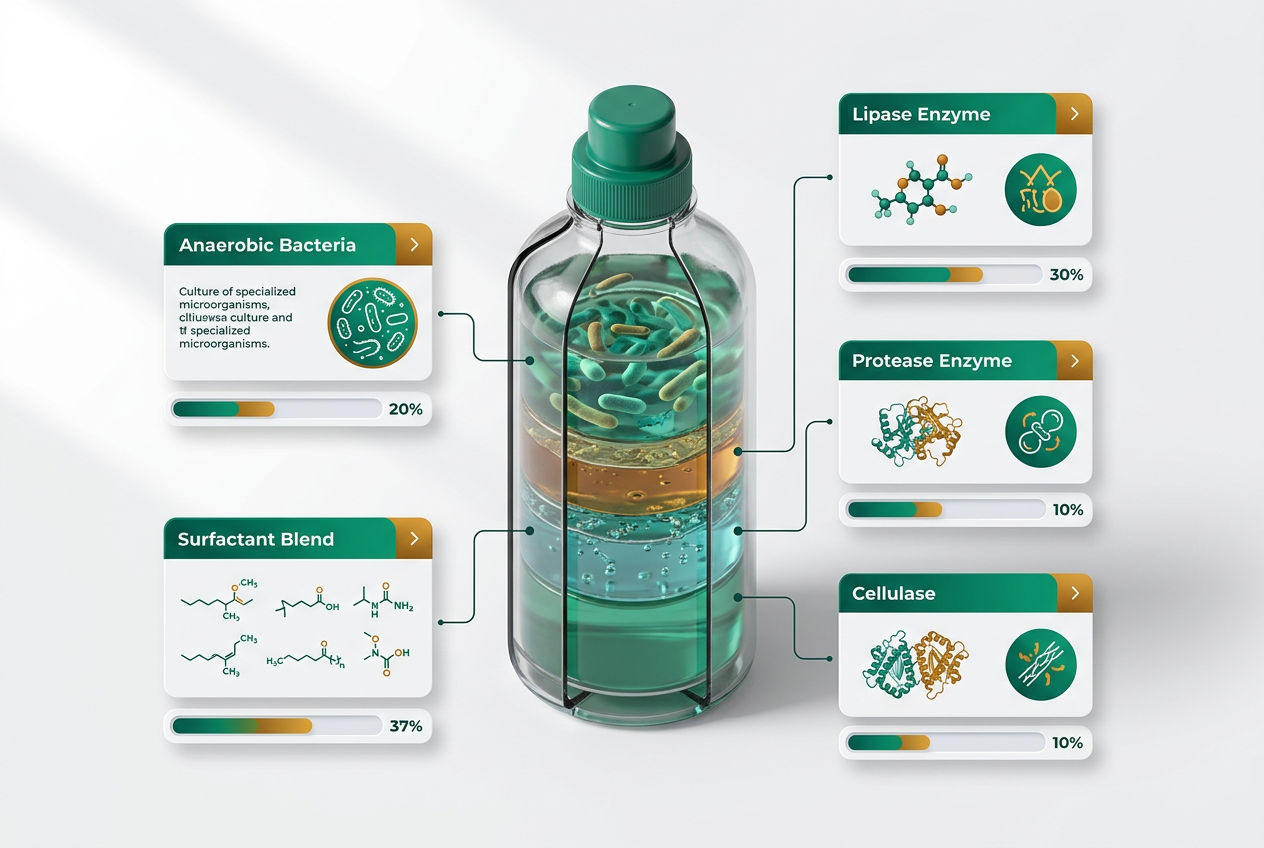
The 67.6 fl oz container holds four enzyme types and over 500 billion bacteria. The bottle comes from Scotch Corporation, the same company behind the broader Instant Power drain and septic product line. The bacterial count is meaningful — roughly comparable to competing products in this price range.
The four enzyme types listed matter because each targets a different waste category:
- Lipase breaks down fats, oils, and grease — the same stuff that causes septic tank biomat buildup over time.
- Protease handles proteins from food waste and human waste.
- Amylase targets starches and carbohydrates.
- Cellulase works on plant-based fiber, paper, and toilet paper residue.
Four enzyme types is a competitive profile. Most budget septic treatments list only two or three. The bacteria strains themselves are anaerobic — they thrive in the oxygen-depleted environment of a conventional septic tank, which is appropriate for this application. For a deeper look at why tank oxygen levels matter, see our aerobic vs. anaerobic septic system comparison.
One honest limitation worth noting: the label doesn't disclose specific bacterial strains or CFU counts per strain, so you're trusting the aggregate "500 billion" claim. For context, that's about the same claim made by Rid-X's Professional formula and slightly less than what some premium alternatives provide per dose. The lack of strain-level transparency is a real gap — not a dealbreaker, but something to know going in.
Instant Power Septic Shock Instructions: How to Use It
The directions are simple, but a few timing details make the difference between the product working and it washing out before bacteria can establish.
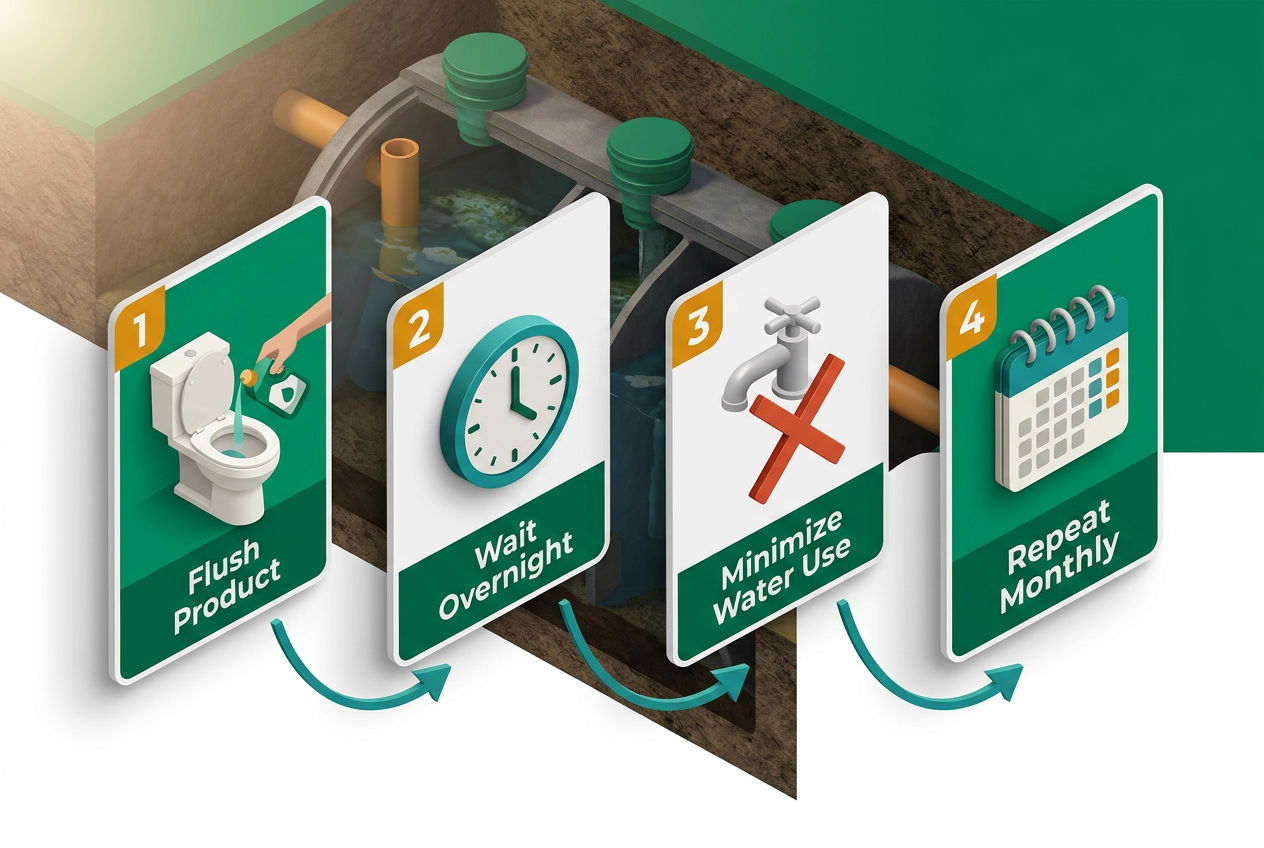
Standard initial shock dose: Pour the entire 67.6 fl oz bottle directly into your toilet. Flush once. Do this at night so the bacteria have 6–8 hours of minimal water usage to establish in your tank. Avoid running the dishwasher, washing machine, or taking long showers for at least 8 hours after treatment.
For best results:
- Use after periods of heavy household traffic (holidays, guests, vacation rentals reopening after winter).
- Use in spring after cold months slow bacterial activity — according to University of Minnesota Extension research on septic system performance in cold climates, bacterial populations can drop significantly below 40°F, making spring reintroduction one of the most defensible use cases for any bacterial additive.
- Follow the initial shock dose with a monthly maintenance treatment (Instant Power makes a separate monthly product, though any quality monthly bacterial treatment works).
What NOT to do:
- Don't treat immediately after using bleach-based cleaners, antibacterial soaps, or drain chemicals. These kill the bacteria you're trying to add. Wait 48–72 hours. For a complete list of household products that disrupt tank biology, see our guide on what kills septic bacteria.
- Don't use this product and then run five loads of laundry the same day — hydraulic overload will flush most of the bacteria out before they colonize.
- Don't skip pumping and use this as a substitute. If your 1,500-gallon tank hasn't been pumped in 6+ years, no bacterial treatment will meaningfully reduce the sludge layer. Get it pumped first; add bacteria after.
How Long Does Septic Shock Treatment Take to Work?
The timeline depends entirely on what you're treating. Here's a direct breakdown:
| Problem Being Treated | Expected Timeline | Realistic Outcome |
|---|---|---|
| Septic tank odor (mild) | 3–5 days | Good — most users see improvement |
| Slow drains (bacterial imbalance) | 1–2 weeks | Moderate — depends on cause |
| Slow drains (early biomat) | 2–4 weeks | Uncertain — some improvement possible |
| Active backup / gurgling | No timeline | Not appropriate — call a pro |
| Failing drain field | Never | Product cannot address this |
Sources: Aggregate user reviews from Amazon (4.1/5 stars, 3,000+ reviews) and Home Depot; Washington State Department of Health septic additive guidance; EPA SepticSmart program.
What Do Real Instant Power Septic Shock Reviews Say?
On Amazon, Instant Power Septic Shock holds a 4.1 out of 5 star average across more than 3,000 reviews. On Home Depot's platform, ratings cluster similarly around 4.0–4.2. Reading through the septic shock treatment reviews in detail, the pattern is consistent enough to draw real conclusions.
Common praise themes:
- Odor reduction within a week, especially in systems that had been dormant over winter.
- Easy to use — pour and flush, no measuring.
- Affordable at $12–$18 per bottle compared to $300–$600 for a professional pump-out.
Common complaints:
- "Didn't do anything" — almost always from users with systems that needed pumping or had structural problems.
- Inconsistent results on older systems with heavy sludge accumulation.
- Some users expected results within 24 hours and were disappointed.
The complaint pattern is consistent with what the product actually is: a bacterial booster, not a repair tool. A tank that's 70% full of sludge doesn't need more bacteria — it needs a pump truck. When those users call this product a failure, they're right about their experience. They're wrong about what caused it.
Instant Power Septic Shock vs. Rid-X and Other Competitors
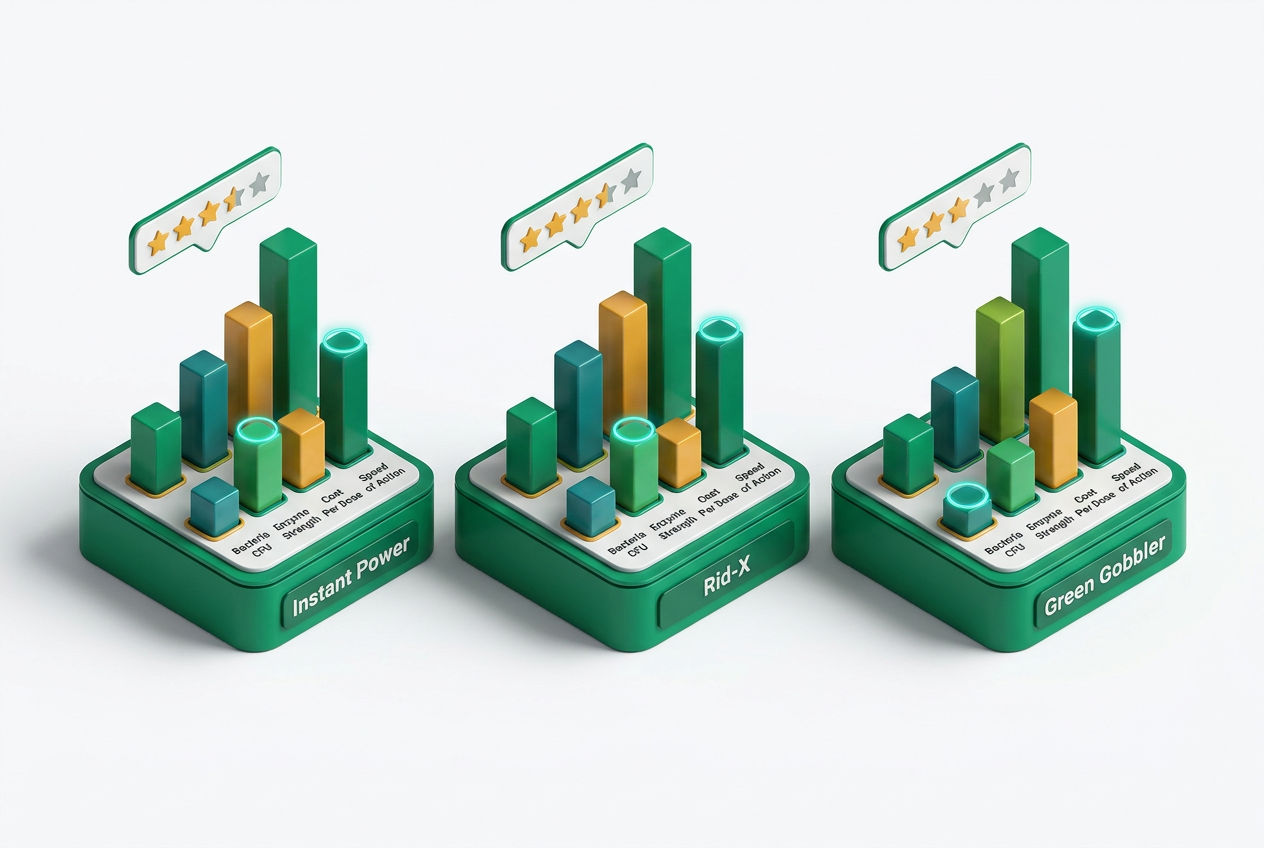
Instant Power is a reasonable mid-tier product, but it's not our top pick. Here's how the instant power septic shock vs. rid-x comparison plays out, along with the rest of the competitive field.
Rid-X: Similar bacterial count claims, widely available, lower per-treatment cost when bought in bulk. The formula is narrower — fewer enzyme types listed. You can read a detailed breakdown in our Rid-X vs. Septifix comparison, which covers the same formulation differences that apply here.
Green Gobbler Septic Saver: Pod-based format, easier to dose, but lower bacteria count per treatment and more expensive per use. See our Green Gobbler septic review for specifics.
Bio-Clean: A professional-grade product with a proven multi-strain formula. More expensive ($30–$50 per container) but often recommended by licensed contractors. Our Bio-Clean septic review covers it in depth.
Septifix — Our Pick: This is the product we recommend, and the reason is formulation. Septifix uses sodium percarbonate tablets that release oxygen directly into your tank as they dissolve. That oxygen matters because it creates a brief aerobic environment that targets odor-causing anaerobic bacteria and accelerates sludge breakdown in a way that liquid bacterial treatments don't replicate. Each tablet delivers approximately 10 billion CFU across 14 strains of live bacteria, plus the oxygen-release mechanism.
Dosing is simple — one tablet per flush, no measuring a half-gallon bottle. It's made in the USA, non-toxic, and comes with a 60-day money-back guarantee. At roughly $3–$4 per monthly treatment, it's cost-competitive with Instant Power on a per-dose basis.
To be direct: Septifix doesn't replace pumping either. No additive does — that's the EPA's position and ours. But if you're going to use a bacterial treatment, the oxygen-releasing tablet format has a more defensible mechanism than standard liquid bacterial products. Read the full breakdown in our Septifix review.
Can You Put Too Much Septic Treatment in Your Tank?
Over-dosing bacterial enzyme treatments is rarely dangerous, but it is wasteful — and it points to a misunderstanding of how these products work.
A conventional 1,000-gallon anaerobic tank has a finite amount of organic waste for bacteria to consume. Flooding it with billions more bacteria than the food supply supports doesn't accelerate breakdown — the excess bacteria simply die off and become part of the organic load themselves. A useful way to think about it: imagine adding 500 extra workers to a job site with tools for only 50. The extra workers don't speed things up. They get in the way and eventually leave.
More practically: using a full 67.6 fl oz shock bottle monthly is overkill for a normally functioning system. The shock dose is designed for problem situations — post-antibiotic disruption, post-holiday overload, spring reactivation. Once your system stabilizes, a smaller monthly maintenance treatment (roughly one Septifix tablet or an equivalent low-dose liquid product) is all you need.
Over-treating doesn't harm the tank, but it does drain your wallet. Budget the shock dose for the 3–4 situations a year where it's genuinely warranted.
Is Instant Power Septic Shock Safe for All Septic Systems?
Yes, with two honest caveats.
First, bacterial enzyme treatments like this one are designed for conventional anaerobic septic tanks. If you have an aerobic treatment unit (ATU) — a system that already injects oxygen to support aerobic bacteria — adding anaerobic bacterial products can disrupt the biological balance those systems are designed to maintain. Check your system type before treating. Our aerobic vs. anaerobic septic system guide explains the difference and what each type needs.
Second, "safe" doesn't mean "effective everywhere." Mound systems, drip irrigation systems, and constructed wetland systems have different treatment dynamics. According to Washington State's Department of Health, which maintains some of the most detailed state-level guidance on septic additives in the country, there is no peer-reviewed evidence that bacterial additives benefit alternative system types — and the agency explicitly advises against relying on them as maintenance substitutes.
For standard in-ground conventional systems, Instant Power Septic Shock poses no known risk to tank components, drain field media, or soil biology when used as directed.
When Should You Call a Professional Instead?
My neighbor ignored a soft, soggy patch of lawn near his septic drain field for two springs in a row. He added bacterial treatments, poured enzyme powder down every drain, and convinced himself it was a slow recovery. By year three, effluent was surfacing. Drain field replacement quotes came in between $8,000 and $18,000 — a range consistent with what our septic pumping cost guide documents for mid-Atlantic states. A $150 inspection in year one would have caught the problem at the biomat stage, when aeration and resting could still have reversed it.
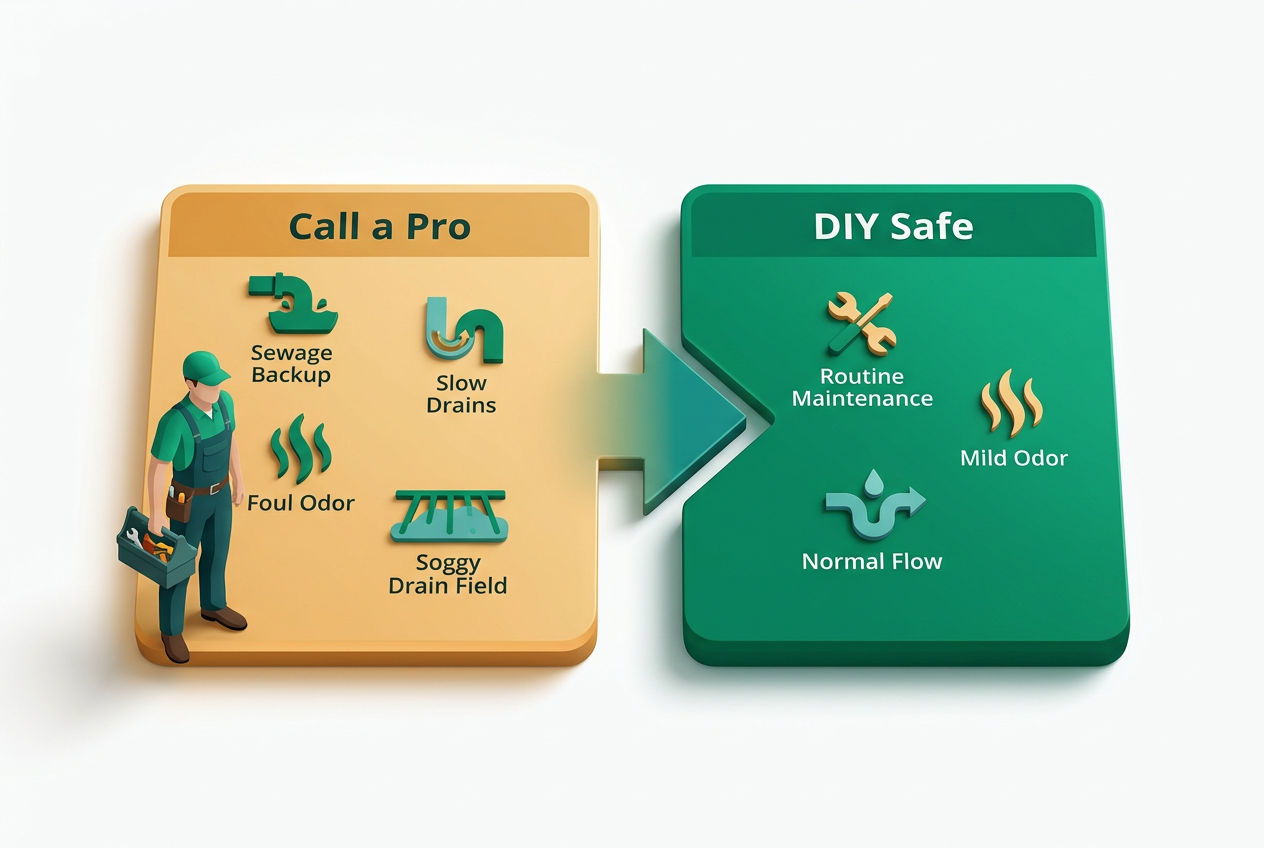
Call a professional — not a shock treatment — if you notice any of these:
- Sewage odors inside the house that don't clear within 5 days of treatment
- Wet or spongy ground over the drain field, especially with a sulfur smell
- Gurgling sounds from multiple fixtures simultaneously
- Drains backing up in the lowest fixtures of the house
- The tank hasn't been pumped in more than 5 years and you're starting treatment for the first time
These are signs your drain field may be failing — and no bacterial product addresses the underlying cause. Book a professional septic inspection before spending another dollar on additives.
If none of those warning signs apply — your system is pumped on schedule, functioning normally, and you simply want ongoing bacterial support — then the treatment we recommend in that situation is Septifix. Unlike enzyme-only powders, each tablet releases oxygen alongside 14 strains of live aerobic bacteria (around 10 billion CFU), which is what does the real work against odor and sludge buildup. Dosing is straightforward: one tablet flushed monthly, at roughly $3–$4 per treatment. It won't substitute for pumping — the EPA is clear that no additive is required for a properly maintained system — but if you're going to use a maintenance treatment, this is the one we'd point you toward. You can also read our side-by-side breakdown at Rid-X vs. Septifix.
The Verdict: Should You Buy Instant Power Septic Shock?
Instant Power Septic Shock is a legitimate, reasonably priced bacterial enzyme treatment from a real manufacturer (Scotch Corporation) with a real enzyme profile. It earns its 4.1-star average in the specific circumstances it's designed for: spring reactivation, post-antibiotic recovery, post-holiday overload in a fundamentally healthy system.
What it's not: a drain field repair, a sludge remover, a pumping substitute, or a fix for any structural problem. The septic shock treatment reviews that call it useless almost always come from systems that needed physical service, not biological reinforcement.
If your system is healthy and you want a maintenance additive: Instant Power works. But for the same money — roughly $3–$4 per monthly treatment — Septifix offers 14 bacterial strains, the oxygen-release mechanism that targets odor and sludge simultaneously, and simpler one-tablet dosing without measuring. That's why it's our pick. For a direct side-by-side formulation comparison with Rid-X in the same price tier, see our Rid-X vs. Septifix breakdown.
Whatever product you choose: if the problem persists after two weeks of treatment, stop treating and start calling. A septic pumping and cleaning service will tell you more in one visit than six months of additives.
Related Rid-X & Septic Treatment Guides
- Aerobic Septic System Diagram: How Each Part Works
- Are Septic Tank Treatments Necessary?
- Best Septic Tank Treatment for Slow Drains
- Bio-Clean Septic Treatment Review: Does It Work?
- Cabin Obsession Septic Tank Treatment Review
- Camco Septic Tank Treatment Review
- Green Gobbler Septic Treatment Review: Pods, Packets & Results
- How Often Should You Use Rid-X? Directions, Dosing & Timing
- How to Handle How Often to Use Septic Tank Treatment: Step by Step
- Is Rid-X Safe for Septic Tanks, Toilets & Pipes?
- Is Septic Tank Smell Dangerous? Gases, Risks & When to Worry
- The Best Rid-X Alternatives
- Does Rid-X Unclog Drains or Toilets?
- Can You Use Rid-X in an RV Black Tank? What to Know First
- What's Actually in Rid-X? Ingredients Explained
- Rid-X vs. Green Gobbler: Which Septic Treatment Wins?
- Septic Tank Smell After Pumping? Causes & How to Fix It
- Septic Smell From Roof Vent? Causes & How to Fix It
- Septic Smell From Shower Drain? Causes & How to Fix It
- Septic Smell Coming From Toilet? Causes & How to Fix It
- Septic Smell When It Rains? Why It Happens & How to Fix It
- Septic System Diagram With a Pump
- Septic Tank Cross-Section Diagram: Every Part Labeled
- Septic Tank Diagram With Dimensions
- Yeast, Baking Soda & Milk in Your Septic Tank: Myths Tested
- Septic Tank Plumbing Diagram: From House to Drain Field
- The Best Septic Tank Smell Removers
- Septic Tank Treatments at Walmart vs. Home Depot vs. Online
- Septic Treatment Tablets vs. Powder vs. Liquid: Which Is Best?
- Where to Buy SeptiFix
- Rid-X Platinum Review: Is the Upgrade Worth It?
- Zep Septic Defense Review: Does It Beat Rid-X?
- The Best Septic Tank Sludge Dissolvers
- The Best Septic Treatment for Toilet Paper Breakdown
Frequently Asked Questions
Does Instant Power Septic Shock actually work, or is it a waste of money?
Instant Power Septic Shock works when the problem is bacterial — specifically, when your tank's microbial population has been disrupted by cold temperatures, antibiotic use, or chemical cleaners. In those situations, the product's 500+ billion bacteria and four-enzyme formula (lipase, protease, amylase, cellulase) can restore odor control within 3–5 days and improve slow drainage over 2–4 weeks. It is not a waste of money for a healthy system that needs a seasonal boost.
Where it fails — and where the negative septic shock treatment reviews come from — is in systems with structural problems. A tank that's overfull with sludge, a cracked baffle, a plugged effluent filter, or a failing drain field cannot be fixed by adding bacteria. Bacterial products address biological imbalance only. If your drains are backing up or you have wet spots over the drain field, no additive replaces a professional inspection. Spend the $15 on the product only after you've ruled out a mechanical or structural cause. Otherwise, put that money toward a pump-out. The EPA recommends pumping every 3–4 years for a 1,000-gallon tank serving four people, regardless of additives used.
How does Instant Power Septic Shock compare to Rid-X?
In a direct instant power septic shock vs. Rid-X comparison, the two products are closer than their marketing suggests. Both claim bacterial counts in the hundreds of billions. Both are anaerobic bacterial formulas designed for conventional septic tanks. The practical differences come down to enzyme breadth, format, and price per treatment.
Instant Power lists four enzyme types (lipase, protease, amylase, cellulase) on its label. Rid-X's standard formula lists fewer, though its Professional grade is more comparable. Instant Power is sold as a one-time shock dose in a 67.6 fl oz bottle at $12–$18. Rid-X is sold in multiple formats including powder, liquid, and dissolvable packs, which makes it easier to size for monthly maintenance.
Neither product discloses specific bacterial strain identities or per-strain CFU counts — a transparency gap both share. For that reason, neither lands at the top of our recommendations. Our pick is Septifix, which uses an oxygen-release tablet mechanism delivering 14 bacterial strains per dose, addresses odor and sludge through a different (and more documented) pathway, and costs roughly $3–$4 per monthly treatment. See the full Rid-X vs. Septifix comparison for a detailed formulation breakdown.
What is the best septic shock treatment available right now?
The best septic shock treatment depends on what you're trying to accomplish. For a one-time bacterial reset after antibiotic use or a dormant winter, Instant Power Septic Shock or Rid-X Professional both deliver adequate bacterial volume at an accessible price point.
For ongoing monthly maintenance — which is where most homeowners should focus — our recommendation is Septifix. Each tablet delivers approximately 10 billion CFU across 14 strains of live aerobic bacteria, combined with a sodium percarbonate oxygen-release mechanism. That oxygen briefly aerates the tank environment, targeting odor-causing anaerobic bacteria and accelerating sludge breakdown through a pathway that standard liquid bacterial treatments don't replicate. Dosing is one tablet per flush — no measuring a large bottle, no timing precision required. It's made in the USA, non-toxic, and backed by a 60-day money-back guarantee.
Honest caveat: no septic shock treatment, including Septifix, replaces professional pumping. According to EPA SepticSmart guidance, a 1,000-gallon tank serving a four-person household needs pumping every 3–4 years regardless of additives. The best treatment program pairs a quality bacterial product with a regular pump-out schedule — not one instead of the other.
How long does it take for septic shock treatment to work?
Timeline depends on the problem you're addressing. For mild septic odor caused by low bacterial count, most users see improvement within 3–5 days. For slow drainage linked to bacterial imbalance rather than a structural issue, expect 1–2 weeks. For early-stage biomat buildup on leach field laterals, improvement — if it comes — typically takes 2–4 weeks and is the least predictable outcome in this product category.
There are two situations where no timeline applies: active sewage backup and failing drain fields. If drains are backing up or you have pooling water over the leach field, bacterial shock treatment is not appropriate and you should not be waiting for it to work. These are signs of a physical or structural problem that requires a licensed septic contractor, not a biological product.
One practical tip: treat at night when water usage is minimal. Pouring the full bottle into a toilet and flushing before bed gives the bacteria 6–8 hours to establish in the tank before the next morning's hydraulic load. Treating in the morning and then running the washing machine two hours later sends most of the bacteria out of the tank before they can colonize.
Is Instant Power Septic Shock safe for aerobic septic systems?
Instant Power Septic Shock is formulated for conventional anaerobic septic tanks — the in-ground, gravity-fed systems found in most residential properties. It is not designed for aerobic treatment units (ATUs), and using it in an ATU can disrupt the aerobic bacterial populations those systems are engineered to maintain.
Aerobic systems work by injecting oxygen into the treatment chamber, which supports oxygen-dependent bacteria that break down waste more aggressively than anaerobic populations. Adding a large dose of anaerobic bacteria — which is what Instant Power provides — introduces organisms that compete with and can partially displace the aerobic community. The result is not dangerous, but it can temporarily reduce treatment efficiency in a system designed for aerobic processing.
According to Washington State's Department of Health, which publishes detailed state-level guidance on septic additives under Washington Administrative Code, there is no peer-reviewed evidence supporting the use of bacterial additives in alternative system types, including aerobic units, mound systems, and drip irrigation systems. If you're unsure which system type you have, check your original permit paperwork or call the contractor who last serviced your system. For conventional anaerobic tanks, the product is safe when used as directed.
Sources & Methodology
- EPA SepticSmart Program — guidance on pumping frequency, additive limitations, and homeowner maintenance responsibilities. epa.gov/septic
- Washington State Department of Health — state-level regulatory guidance on septic additives and alternative system types; published skepticism regarding additive efficacy applies to this product category.
- University of Minnesota Extension — research on septic system performance in cold climates; basis for spring reactivation use case recommendation.
- Amazon & Home Depot verified purchase reviews — aggregate rating data (4.1/5 stars, 3,000+ reviews) used to identify common praise and complaint patterns; reviews analyzed for problem-type correlation, not taken as efficacy evidence.
- Scotch Corporation product label — enzyme types, bacterial count claim, and volume information sourced directly from the Instant Power Septic Shock product label as of the most recent update date above.
This article reflects independent editorial analysis. We may receive compensation if you purchase through links on this page. Our product recommendations are not influenced by affiliate relationships — Septifix is recommended because of its formulation characteristics, not its commission rate.
Free download
Not ready for the Handbook? Start with the free Fridge Card.
The Do / Don’t card the whole family can see, plus the Survival Kit: emergency flowchart, warning-sign decoder and pump-schedule card. One printable PDF.
Was this article helpful?
Frequently Asked Questions
Recommended Resources
📖 Related Articles
- Septic Tank Biomat: What It Is and When It's a Problem
- Aerobic vs Anaerobic Septic Systems: How They Compare
- What Kills Septic Tank Bacteria? (14 Things to Avoid)
- Green Gobbler Septic Treatment Review: Pods, Packets & Results
- Bio-Clean Septic Treatment Review: Does It Work?
- Signs Your Drain Field Is Failing (And What to Do)
💰 Cost Guides
Find Septic Professionals Near You
Compare licensed, verified septic companies by area — top county markets and cities below, or browse all 50 states.
County markets
Popular cities
