
Quick Answer
The best septic tank smell remover is a bacterial enzyme treatment that replenishes beneficial microbes in your tank — not a chemical deodorizer that just masks the odor. Hydrogen sulfide gas (H₂S) causes that rotten egg smell, and restoring the aerobic and anaerobic bacteria that consume it is the only lasting fix. Products with 1–2 billion CFU per dose work. Most chemical products do not.
Key Takeaways
- That rotten egg smell is hydrogen sulfide gas — detectable by humans at concentrations as low as 0.5 parts per billion
- Bacterial enzyme treatments with at least 1–2 billion CFU per dose are the most effective septic odor eliminators and septic smell removers on the market
- Chemical drain cleaners can kill up to 99% of beneficial septic bacteria in a single use — making odor worse over time
- Indoor septic smell often points to a dry P-trap, failed wax ring, or cracked vent pipe — not the tank itself
- If odor persists after 2–4 weeks of consistent treatment, schedule a professional inspection
- The best septic tank treatment for odor combines a high-CFU bacterial product with a consistent monthly dosing schedule
Why Does Your Septic Tank Smell So Bad All of a Sudden?
Septic tanks don't randomly start smelling. Something changed. The most common triggers are bacterial die-off from antibacterial cleaners or bleach, an overfull tank pushing gases back through your plumbing, heavy rainfall saturating the drain field, or a blocked septic vent pipe redirecting odors into your home instead of the atmosphere.
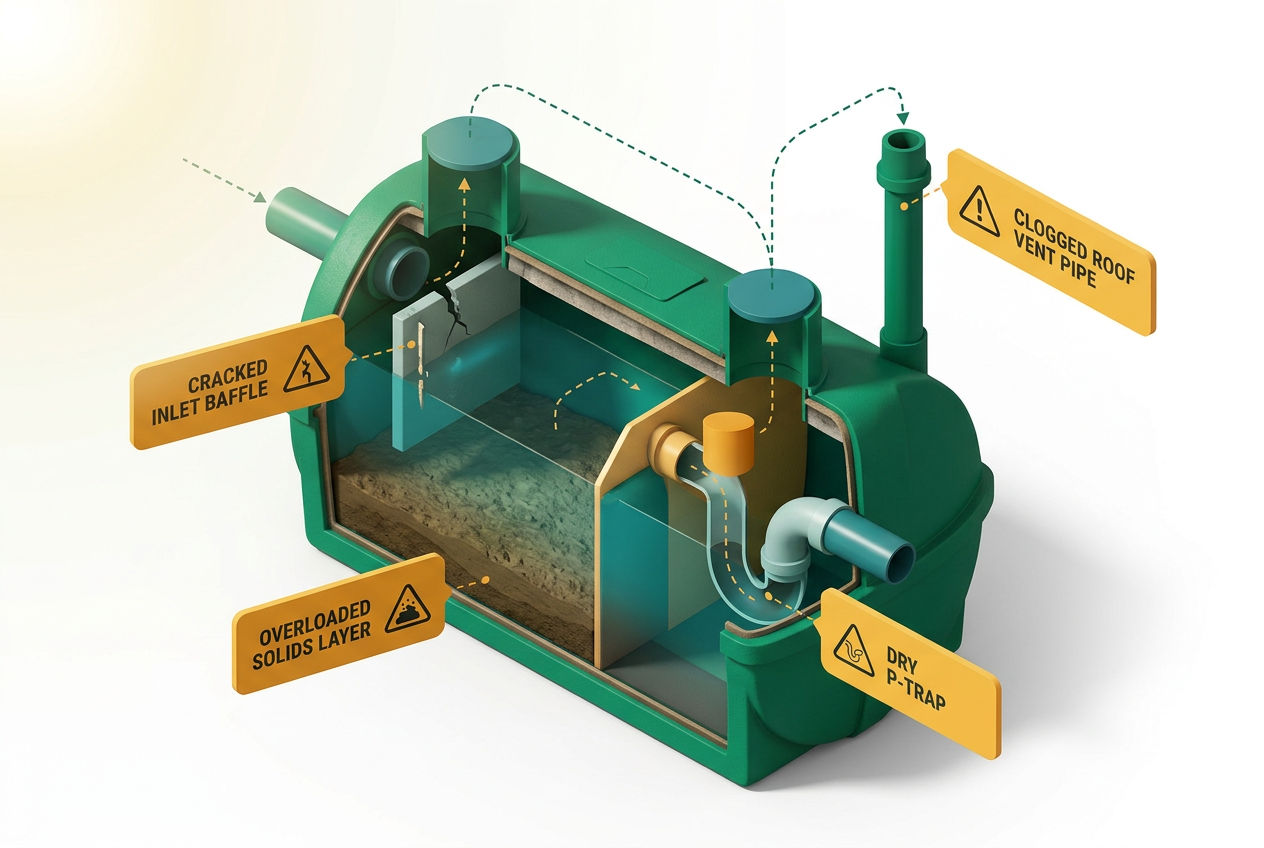
The specific culprit is hydrogen sulfide (H₂S) — a byproduct of anaerobic decomposition. It smells like rotten eggs at concentrations as low as 0.5 parts per billion, according to OSHA exposure data. Your nose picks it up before almost any instrument can.
A healthy septic system produces some H₂S, but a well-functioning bacterial colony consumes most of it before it escapes. Heavy rain deserves special mention. Saturated soil around the drain field prevents effluent from absorbing properly. The system backs up slightly, pressure builds, and gas finds its way out — either through the ground surface or back through your pipes. If the smell spikes every time it rains hard, that's your drain field giving you a warning. For more on that specific pattern, read our guide on septic smell when it rains.
Sudden bacterial die-off is the other common culprit. One round of antibiotics flushed through the system, or a cleaning session where someone poured bleach down every drain, can crash the microbial population. Without bacteria processing the waste, gas production spikes and doesn't get consumed.
Is Septic Tank Smell Dangerous to Your Health?
At typical residential exposure levels, septic smell is unpleasant but not acutely dangerous. At concentrations above 100 ppm, however, hydrogen sulfide becomes immediately dangerous to life and health (IDLH) — that's OSHA's threshold. At that level, H₂S can paralyze your sense of smell and cause rapid unconsciousness.
You're unlikely to hit 100 ppm from a residential septic tank venting normally. But a confined space — like a crawlspace with a cracked vent pipe, or a basement near a failed baffle — can concentrate gases to dangerous levels faster than you'd expect. The EPA flags rotten egg odor complaints in residential environments starting at 0.008–0.13 ppm depending on context.
The practical takeaway: if the smell is strong enough to make your eyes water indoors, or you feel dizzy or nauseous in a confined space near your tank, leave the area and ventilate before investigating. And don't ever open a septic tank lid and lean in. For a full breakdown of the health risks, see is septic smell dangerous.
What Can You Put in a Septic Tank to Get Rid of the Smell?
Here's an honest breakdown of what works as a septic smell remover, what's marginal, and what you should leave on the shelf — organized by product type and mechanism.

Bacterial Enzyme Treatments — The Best Septic Odor Eliminator
Biological septic treatments introduce concentrated colonies of aerobic and anaerobic bacteria, along with the enzymes they produce, directly into your tank. These organisms consume the organic matter that generates hydrogen sulfide in the first place. You're not covering up the smell — you're eliminating the source.
To be effective, a product needs at least 1–2 billion CFU (colony-forming units) per dose. That's the threshold where you're actually adding meaningful microbial mass to a 1,000–1,500 gallon tank. Products that list "billions of bacteria" without specifying the count are usually underdosed.
Worked example: A household of four generates roughly 120–150 gallons of wastewater per day. In a standard 1,000-gallon tank, that means complete liquid turnover approximately every 6–8 days. A single underdosed treatment of 100 million CFU — common in bargain products — represents less than 0.01% of the bacterial population a healthy tank needs. At 5.4 billion CFU (Rid-X's stated dose), you're introducing enough viable organisms to establish a meaningful colony within 24–72 hours. The math matters when choosing a product.
Rid-X is the most widely available option and a reasonable starting point. A standard monthly dose for a 1,000-gallon tank is about 9.8 oz of powder. According to the product's own label and EPA Safer Choice program documentation, Rid-X contains Bacillus species bacteria specifically selected for septic system conditions. Our Rid-X septic review covers what it actually does well and where it falls short.
Green Gobbler and Bio-Clean are strong alternatives — see our Green Gobbler septic review and Bio-Clean septic review for head-to-head comparisons.
Enzyme-based treatments typically show measurable odor reduction within 24–72 hours of dosing. Full bacterial colony re-establishment takes 2–4 weeks of consistent monthly treatment. For a 1,000-gallon tank serving a household of four, a monthly maintenance dose of 8–16 oz is the standard range. Skip a few months, and you're starting over. These products work on a schedule, not a one-time fix. Our guide to how often to use septic tank treatment goes deeper on dosing cadence.
Honest limitation: Bacterial additives are not a substitute for pumping. University of Arkansas Cooperative Extension research has shown that septic tank additives — biological or otherwise — do not meaningfully reduce sludge accumulation or extend pump-out intervals. When sludge depth in a 1,000-gallon tank exceeds approximately 12 inches, no additive compensates. Pumping is required. The best septic tank treatment for odor works only when the tank itself is functional.
Activated Charcoal Vent Filters — Best for Outdoor Odors
If the smell is coming from your vent stack rather than through your drains, a bacterial additive won't do much. The gas is escaping into the air before it can be consumed in the tank. An activated charcoal filter that attaches to the top of your septic vent pipe can significantly reduce outdoor odors, especially for drain field vents and tank vents close to living areas.
These filters need replacement every 1–3 years depending on use and humidity. High-humidity climates — Florida, the Gulf Coast, Pacific Northwest — shorten their effective life. The Polylok PL-122 is a widely used model that fits standard 3- and 4-inch vent pipe diameters; replacement carbon inserts run approximately $25–$40. They're a solid fix for odors wafting across a patio but won't address indoor smell caused by plumbing issues.
Baking Soda and Vinegar — Honest Assessment
Does the classic baking soda and vinegar trick help septic smell? A small amount of baking soda — say, a cup flushed monthly — is roughly pH-neutral enough not to harm your bacterial colony. It won't meaningfully treat odor either. Vinegar is mildly acidic; in small amounts it's probably fine, but the effervescent reaction people love is carbon dioxide production, not bacterial stimulation. Neither will fix a real odor problem. If you want to explore this more, our article on natural septic tank treatment covers what actually works in the DIY category.
Septic Tank Smell Removers — Product Comparison
Choosing the right septic smell remover depends on your tank size, the severity of the odor problem, and whether you need a maintenance product or a recovery treatment after bacterial die-off. The table below compares the leading options by key specs.

| Product Type | Best Use | CFU Range | Treatment Interval | Avg. Cost |
|---|---|---|---|---|
| Bacterial powder (Rid-X) | Monthly maintenance | 5.4B CFU/dose | Monthly | $10–$20 |
| Bacterial liquid (Green Gobbler) | Fast reseeding after die-off | 1–5B CFU/dose | Monthly | $15–$30 |
| Enzyme + bacteria (Bio-Clean) | Heavy odor, slow drains | Not listed | Monthly | $30–$50 |
| Treatment pods (Septifix) | Convenience, aerobic boost | Varies | Monthly | $20–$40 |
| Charcoal vent filter | Outdoor vent odor | N/A — non-bacterial | Replace annually | $25–$60 |
Sources: Product manufacturer specifications; SepticTankHub.com product research team.
What to Skip: Products That Make Septic Smell Worse
Not every product marketed as a septic odor solution actually works — and some actively damage the bacterial ecosystem that controls odor. Here's what to avoid.
Chemical Drain Cleaners
Pour Drano or a similar caustic product down your drain, and you don't just clear a clog — you wage chemical warfare on your entire microbial ecosystem. Chemical drain cleaners can kill up to 99% of beneficial septic bacteria with a single use, according to manufacturer testing and university extension research. The bacterial colony that took weeks to establish gets wiped out in minutes.
Dead bacteria means unprocessed waste. Unprocessed waste means more hydrogen sulfide. You've traded a clogged drain for an odor problem that's worse and lasts longer. For safer alternatives, check out our guide on septic-safe drain cleaner and our broader article on what kills septic bacteria.
Bleach-Heavy Products
Same problem. The septic system depends on anaerobic bacteria to function. Bleach — even diluted from normal household use — is bactericidal by design. Occasional small amounts from laundry or surface cleaning pass through in quantities your system can handle. But concentrated bleach poured into drains to "disinfect" a smelly system is exactly backwards. You're killing the organisms that eliminate the odor.
Heavy Chemical Deodorizers
Products sold as "septic deodorizers" that use synthetic fragrances and chemicals to mask smell are a short-term band-aid at best. Many contain surfactants or antimicrobial compounds that suppress bacterial activity. They treat your nose, not your tank. For a full list of household products that damage your system, our septic-safe cleaning products guide is worth bookmarking.
Why Does Your House Smell Like Septic When There's No Tank Problem?
Here's a scenario: your system was pumped eight months ago, it's working fine by every measure, but you're getting a sewer smell inside your home. In this case, the tank is rarely the cause. The three most common culprits for indoor septic odor that have nothing to do with your tank are dry P-traps, a failed wax ring under a toilet, or a cracked or blocked vent pipe.
Dry P-traps are the most frequent and easiest fix. The curved section of pipe under every sink, tub, and floor drain holds a small amount of water that physically blocks sewer gas from entering your living space. When a drain goes unused for a few weeks — a guest bathroom, a basement utility sink — that water evaporates and the barrier disappears. The fix is pouring a cup of water down the drain. For drains that go weeks between uses, add a tablespoon of vegetable oil after the water — it floats on the surface and dramatically slows evaporation.
Wax ring failure allows sewer gas to bypass the toilet seal at floor level. Press gently on the sides of your toilet base. If it rocks even slightly, the wax ring has likely failed or is failing. This is a $100–$200 plumber repair and should not be deferred — it gets worse, not better. See our guide on septic smell from toilet for diagnosis steps.
Blocked or cracked vent pipes prevent the negative-pressure equalization your plumbing needs to drain properly. Instead of gases venting through the roof, they find the next available exit — which is often your drain. In the Pacific Northwest and upper Midwest, spring thaw can shift vent pipe joints. In Minnesota specifically, frost can partially block vent stacks on very cold nights; a common fix is increasing vent pipe diameter from 3 inches to 4 inches to reduce ice accumulation. Check our septic smell from roof vent guide for step-by-step vent diagnostics.
For shower-specific odor problems, our septic smell from shower drain article covers hair trap and P-trap diagnosis in detail.
How Often Should You Treat Your Septic Tank for Odor?
The standard recommendation is monthly bacterial treatment for routine maintenance. For a 1,000-gallon tank serving a household of four, one full-dose treatment per month maintains a stable microbial population under normal conditions. But normal conditions vary significantly by season, household behavior, and geography.
After bacterial die-off — from antibiotic use, a bleach cleaning episode, or a pump-out — double the standard dose for the first two months. A tank that's been pumped is essentially a clean slate; you're re-establishing a colony from near zero, and a single standard dose won't get you there. For the same 1,000-gallon tank: 16–20 oz of bacterial powder for months one and two post-pump, then drop back to the 8–12 oz monthly maintenance dose.
Seasonal adjustments by region:
- Pacific Northwest and upper Midwest (April–May): Add a reseeding dose after spring thaw, when vent shifts and soil saturation commonly stress the system.
- Coastal Southeast — Georgia, Louisiana, Florida (June–August): Heat accelerates decomposition and gas production. Consider twice-monthly dosing during peak summer months.
- Northern climates (October): A preventive treatment before ground freeze helps establish a strong bacterial colony before the system experiences cold-weather slowdowns.
If you're going to add a bacterial treatment to that schedule, Septifix is the product we recommend for odor-specific situations. Each tablet delivers 14 strains of aerobic bacteria — roughly 10 billion CFU — along with an oxygen-release mechanism that directly targets the anaerobic conditions responsible for sulfur odors and sludge buildup. Dosing is straightforward: one tablet flushed down the toilet, no measuring involved, at around $3–$4 per treatment. It's made in the USA, non-toxic, and backed by a 60-day money-back guarantee. That said, no additive replaces a pump-out on its recommended schedule; the EPA is clear that additives are not required for a properly functioning system, and Septifix is best understood as a maintenance aid rather than a substitute for mechanical service.
For a full dosing schedule framework, see our guide on how often to pump septic tank — which covers the intersection of pump intervals and treatment schedules.
Seasonal Factors That Affect Septic Odor
Septic odor isn't constant throughout the year. The same system that's odor-free in March may produce noticeable smell in July or after a major rainstorm in November. Understanding the seasonal pattern helps you anticipate and treat proactively rather than reactively.

Spring: Heavy rainfall and snowmelt saturate drain fields across the Pacific Northwest and upper Midwest. Effluent can't absorb properly, which creates mild system backup and increased gas pressure. Vent pipe joints shifted by frost heave may also redirect odors that previously escaped cleanly. An April bacterial reseeding dose addresses both the biological stress from winter slowdown and the increased decomposition load from spring water infiltration.
Summer: In coastal Georgia, Louisiana, and Florida — and anywhere else with sustained heat above 85°F — anaerobic decomposition accelerates. Hydrogen sulfide production increases. If your bacterial colony is marginal, summer heat pushes it past the threshold where odor becomes noticeable. This is also when effluent filters like the Polylok PL-122 benefit most from inspection; biomat buildup on filter membranes is fastest in warm months.
Fall and Winter: In northern climates, soil temperature below 40°F significantly slows bacterial activity. Your tank's microbes are less efficient, and odor can increase slightly as biological processing lags. A pre-winter treatment in October, before ground temperatures drop, helps maintain colony strength. Frost-blocked vent stacks are a winter-specific problem in Minnesota and similar climates.
When a Smell Remover Isn't Enough: Call a Professional
Bacterial treatments and charcoal filters solve most residential septic odor problems. But there are specific conditions where a product cannot substitute for a licensed inspector or pumping contractor.
Call a professional if:
- Odor persists after 3–4 weeks of consistent bacterial treatment at the correct dose
- You notice soft spots or unusually lush, wet grass over your drain field (indicates surfacing effluent)
- Multiple drains in the home are slow simultaneously — this suggests a main line or baffle issue, not bacterial imbalance
- The smell is accompanied by sewage backing up into tubs or floor drains
- Sludge depth in your tank exceeds 12 inches (requires measurement during inspection)
A septic inspection runs $150–$450 depending on scope and region — see our septic inspection cost guide for regional breakdowns. That's a minor cost compared to drain field failure, which averages $5,000–$20,000 depending on system size and soil conditions. Early odor treatment is, in the bluntest terms, an investment in avoiding that bill. A $15 monthly bacterial treatment versus a potential drain field replacement is not a close comparison.
Drain field failure is not something any additive fixes. If the drain field is compromised, the only lasting solutions are repair or replacement.
Related Rid-X & Septic Treatment Guides
- Aerobic Septic System Diagram: How Each Part Works
- Are Septic Tank Treatments Necessary?
- Best Septic Tank Treatment for Slow Drains
- Bio-Clean Septic Treatment Review: Does It Work?
- Cabin Obsession Septic Tank Treatment Review
- Camco Septic Tank Treatment Review
- Green Gobbler Septic Treatment Review: Pods, Packets & Results
- How Often Should You Use Rid-X? Directions, Dosing & Timing
- How to Handle How Often to Use Septic Tank Treatment: Step by Step
- Is Rid-X Safe for Septic Tanks, Toilets & Pipes?
- Is Septic Tank Smell Dangerous? Gases, Risks & When to Worry
- The Best Rid-X Alternatives
- Does Rid-X Unclog Drains or Toilets?
- Can You Use Rid-X in an RV Black Tank? What to Know First
- What's Actually in Rid-X? Ingredients Explained
- Rid-X vs. Green Gobbler: Which Septic Treatment Wins?
- Septic Tank Smell After Pumping? Causes & How to Fix It
- Septic Smell From Roof Vent? Causes & How to Fix It
- Septic Smell From Shower Drain? Causes & How to Fix It
- Septic Smell Coming From Toilet? Causes & How to Fix It
- Septic Smell When It Rains? Why It Happens & How to Fix It
- Septic System Diagram With a Pump
- Septic Tank Cross-Section Diagram: Every Part Labeled
- Septic Tank Diagram With Dimensions
- Yeast, Baking Soda & Milk in Your Septic Tank: Myths Tested
- Septic Tank Plumbing Diagram: From House to Drain Field
- Septic Tank Treatments at Walmart vs. Home Depot vs. Online
- Septic Treatment Tablets vs. Powder vs. Liquid: Which Is Best?
- Where to Buy SeptiFix
- Rid-X Platinum Review: Is the Upgrade Worth It?
- Zep Septic Defense Review: Does It Beat Rid-X?
- The Best Septic Tank Sludge Dissolvers
- The Best Septic Treatment for Toilet Paper Breakdown
- Instant Power Septic Shock Review: Does It Work?
Frequently Asked Questions About Septic Smell Removers
What is the best septic tank smell remover for a 1,000-gallon tank?
The best septic tank smell remover for a standard 1,000-gallon tank is a bacterial enzyme product with at least 5 billion CFU per dose, applied monthly on a consistent schedule. Rid-X (9.8 oz powder dose) is the most widely available option and meets the CFU threshold for meaningful bacterial reseeding. Green Gobbler's liquid formula works well for faster reseeding after bacterial die-off because it disperses more quickly through the tank than powder. Bio-Clean is the strongest option for tanks with heavy odor and slow drain symptoms, as it combines both enzymes and bacteria. Whichever product you choose, the dosing interval matters as much as the product itself — skipping months resets your progress. For a 1,000-gallon tank with a household of four, apply the full manufacturer dose on the same day each month. After a pump-out or bacterial die-off event, double the dose for the first two months before dropping to maintenance levels.
What is a septic odor eliminator and how does it differ from a deodorizer?
A septic odor eliminator addresses the biological source of hydrogen sulfide gas by introducing live bacteria and enzymes that consume the organic matter producing the smell. A septic deodorizer, by contrast, uses synthetic fragrances or chemical compounds to mask the odor without treating the underlying cause. The distinction matters because many products marketed as "septic deodorizers" contain surfactants or antimicrobial agents that suppress the beneficial bacteria your tank depends on — effectively worsening the long-term odor problem while providing short-term fragrance relief. True septic odor eliminators are biological products: bacterial powders, liquids, or pods containing viable CFU counts above 1–2 billion per dose. When evaluating any product, check the label for CFU count and bacterial strain listings. If the active ingredients list only fragrances or chemical compounds with no bacterial content, it's a deodorizer, not an eliminator. For lasting results, choose elimination over masking.
What is the best septic tank treatment for odor after pumping?
The best septic tank treatment for odor after pumping is a double-dose bacterial reseeding treatment applied immediately after the pump-out, followed by a second full double-dose the following month, then a return to standard monthly maintenance dosing. A freshly pumped tank has had its bacterial colony almost entirely removed along with the sludge. Without active reseeding, the tank takes 6–12 weeks to re-establish adequate bacterial populations naturally — during which time odor is likely and waste processing is incomplete. For a 1,000-gallon tank, this means 16–20 oz of a high-CFU bacterial powder (or the liquid equivalent) for months one and two post-pump, then dropping to the standard 8–12 oz monthly dose. Rid-X, Green Gobbler, and Bio-Clean all work for this purpose. The key is not to skip the first two months — that's when the colony is most vulnerable and odor is most likely to return.
Can a septic smell remover fix a rotten egg smell in the house?
A septic smell remover can fix rotten egg smell in the house if the source is bacterial imbalance in the tank causing hydrogen sulfide gas to back up through drains. However, indoor rotten egg smell is more often caused by dry P-traps, a failing wax ring under a toilet, or a cracked vent pipe — none of which a bacterial treatment addresses. Before purchasing a smell remover, diagnose the source: pour water into every drain you haven't used recently (guest bathrooms, basement sinks, utility drains) and wait 30 minutes. If the smell reduces, dry P-traps were the culprit — a free fix. Press on the base of each toilet; rocking indicates a failed wax ring requiring a plumber. If all P-traps are wet and toilets are sealed but smell persists, a bacterial treatment targeting the tank itself is the appropriate next step. Misdiagnosing the source wastes money and delays the actual fix.
How long does it take for a septic odor eliminator to work?
A septic odor eliminator typically produces noticeable odor reduction within 24–72 hours of the first dose, with full bacterial colony re-establishment taking 2–4 weeks of consistent treatment. The 24–72 hour window reflects the time for introduced bacteria to disperse through the tank liquid and begin actively consuming hydrogen sulfide-producing organic matter. The longer 2–4 week timeline reflects how long it takes for those bacteria to multiply to population levels sufficient to maintain consistent odor control without continued supplementation. Factors that affect the timeline include water temperature (cold tanks slow bacterial activity), competing chemicals in the wastewater (antibacterial soap residue, bleach traces), and tank fill level. A tank that is overfull or has surfacing effluent will not respond to biological treatment until the hydraulic problem is corrected. If there is no measurable improvement after 3–4 weeks of correct dosing, the odor source may require professional inspection rather than continued product application.
Is there a natural septic smell remover that actually works?
The most effective natural septic smell remover is a bacterial enzyme treatment derived from naturally occurring soil bacteria — which technically qualifies as natural, though it's sold commercially. Truly DIY natural approaches have significant limitations. Baking soda (one cup monthly) is pH-neutral enough to avoid harming bacterial colonies but provides no meaningful odor control. Yeast — sometimes recommended in older home guides — introduces some fermentation activity but at concentrations far too low to impact a 1,000-gallon system. Citrus enzyme cleaners are mildly acidic and best kept away from septic systems in quantity. The honest answer is that for genuine bacterial imbalance causing odor, no kitchen-cabinet remedy matches a commercial bacterial product with verified CFU counts. For minor, transient odor from a healthy system — like a slight smell after heavy rain — waiting 24–48 hours and ensuring drains aren't dry is usually sufficient without any product at all. For persistent odor, a commercial biological treatment is the evidence-supported choice.
Sources & Methodology
-
OSHA Hydrogen Sulfide Safety Data — Occupational Safety and Health Administration. IDLH value of 100 ppm and detection threshold data. https://www.osha.gov/hydrogen-sulfide
-
EPA Residential Odor Complaint Thresholds — U.S. Environmental Protection Agency guidance on H₂S in residential environments (0.008–0.13 ppm range). Referenced from EPA indoor air quality documentation.
-
University of Arkansas Cooperative Extension — Research on septic tank additive effectiveness and sludge accumulation. Referenced without direct link; available through UA Division of Agriculture cooperative extension publications.
-
Rid-X Product Specifications — Manufacturer label data and EPA Safer Choice program documentation. CFU count (5.4 billion per dose) verified against current product labeling as of Q1 2025.
-
Polylok PL-122 Product Documentation — Manufacturer specifications for activated carbon vent filter dimensions and replacement interval guidelines.
Methodology note: Product CFU counts were verified against current manufacturer labels and third-party retailer listings. Where CFU data was not publicly disclosed by the manufacturer (Bio-Clean), this is noted as "Not listed" in the comparison table rather than estimated. Cost ranges reflect national retail pricing as of Q1 2025.
Free download
Not ready for the Handbook? Start with the free Fridge Card.
The Do / Don’t card the whole family can see, plus the Survival Kit: emergency flowchart, warning-sign decoder and pump-schedule card. One printable PDF.
Was this article helpful?
Frequently Asked Questions
Recommended Resources
📖 Related Articles
- Septic Smell When It Rains? Why It Happens & How to Fix It
- Is Septic Tank Smell Dangerous? Gases, Risks & When to Worry
- Rid-X for Septic Tanks: Does It Help or Hurt?
- Green Gobbler Septic Treatment Review: Pods, Packets & Results
- Bio-Clean Septic Treatment Review: Does It Work?
- How to Handle How Often to Use Septic Tank Treatment: Step by Step
- The Best Natural Septic Tank Treatment (Top Picks)
- The Best Septic-Safe Drain Cleaners (and What to Never Pour In)
- What Kills Septic Tank Bacteria? (14 Things to Avoid)
- Septic-Safe Cleaning Products: The Complete List (Safe vs. Avoid)
- Septic Smell Coming From Toilet? Causes & How to Fix It
- Septic Smell From Roof Vent? Causes & How to Fix It
- Septic Smell From Shower Drain? Causes & How to Fix It
- How Often Should You Pump Your Septic Tank?
💰 Cost Guides
🔧 Services
Find Septic Professionals Near You
Compare licensed, verified septic companies by area — top county markets and cities below, or browse all 50 states.
County markets
Popular cities
