
Quick Answer
A septic smell in your house is caused by sewer gases—primarily hydrogen sulfide—escaping through failed plumbing seals, dry P-traps, blocked vent pipes, or a full or failing septic tank. Most causes have a fast DIY fix. A few signal serious system failure and need a pro today.
Key Takeaways
- That rotten egg smell is hydrogen sulfide gas—detectable at 0.5 ppb, and dangerous above 50 ppm
- Dry P-traps are the #1 DIY cause; fix in under 2 minutes by running water
- A full septic tank can push gases back through your drains—pumping costs $300–$600
- Blocked roof vent stacks and failed wax rings are common but overlooked sources
- Drain field failure is the most serious cause; act early before a $5,000–$20,000 repair becomes unavoidable
Is Septic Smell in the House Dangerous?
That rotten egg odor isn't just unpleasant—it's a sign that hydrogen sulfide (H₂S) gas is present in your living space. The EPA and OSHA have documented H₂S danger thresholds that every homeowner should know: you can detect it at as little as 0.5 parts per billion. At 2–5 ppm, you'll notice headaches and nausea. At 50 ppm, it becomes genuinely dangerous to breathe. Above 100 ppm, it's immediately life-threatening.

Septic gas also contains methane, which is odorless, colorless, and flammable. A heavy concentration in a basement or crawlspace can ignite from a water heater pilot light or light switch spark.
Bottom line: don't ignore this smell. Crack a window, ventilate the space, and start diagnosing the source now.
The 6 Most Common Causes of Septic Smell Inside Your Home
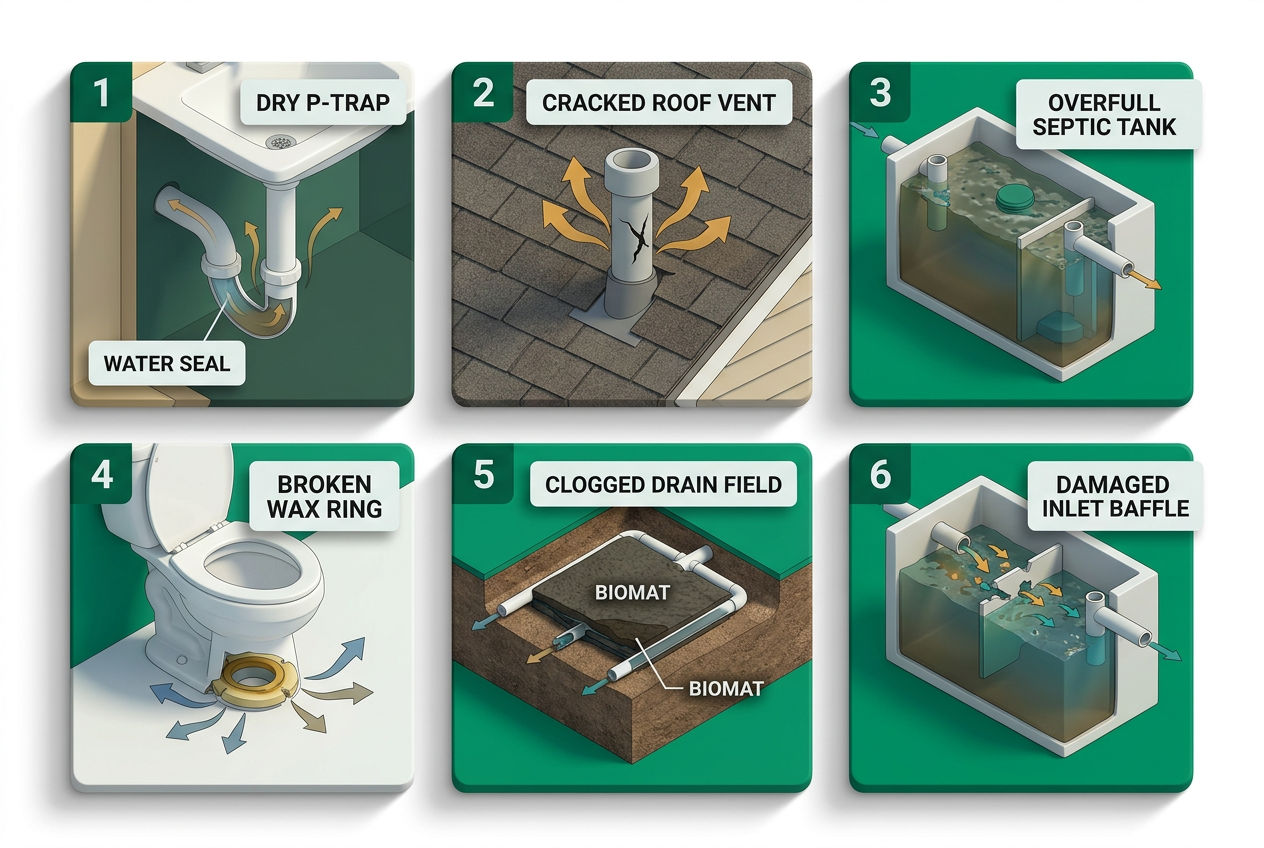
1. Dry P-Trap (The Most Common Culprit)
A P-trap is the curved section of pipe beneath every drain in your home. It holds a small amount of water that acts as a seal, physically blocking sewer gas from rising up through the drain into your living space. If a drain goes unused for 3–5 weeks—think a guest bathroom, a basement utility sink, or a seasonal cabin—that water evaporates. The seal disappears. Gas comes in.
Fix it: Run water in every drain for 30–60 seconds. That's it. The trap refills and the seal is restored.
If you're in an arid climate like Arizona or New Mexico, P-trap evaporation happens faster due to low indoor humidity. Running infrequently used drains once a month prevents the problem entirely.
Also check floor drains in laundry rooms and basements—these are the most commonly neglected traps in the home.
2. Blocked or Frozen Roof Vent Stack
Your septic system needs to breathe. Sewer gases are vented up through a pipe that exits through your roof—called the roof vent stack or soil stack. When that pipe gets blocked by a bird's nest, leaf debris, or a wasp nest in summer, gas has nowhere to go but back down into your drains.
In northern climates (Minnesota, Wisconsin, upstate New York), vent stacks can ice over completely when temperatures drop below 0°F. The stack narrows as condensation freezes on the interior walls until the pipe seals shut. Gas backs up through every drain in the house.
Fix it: In warm months, you or a plumber can clear the stack with a plumber's auger from the roof. In winter, a licensed plumber can thaw a frozen vent stack with hot water or steam. Never attempt roof work on ice.
Autumn is the highest-risk season for debris blockages—especially if large trees overhang your roofline.
3. Failed Wax Ring Toilet Seal
Every toilet sits on a wax ring that seals the base of the toilet to the floor flange. Over time—usually after 20–30 years, or sooner if a toilet rocks—that wax ring cracks or deforms. The seal fails. Gas escapes around the base of the toilet directly into your bathroom.
Signs of a failed wax ring:
- Smell is strongest near the toilet base
- Toilet rocks or shifts when you sit
- Water stains on the ceiling of the room below (in multi-story homes)
Fix it: Wax ring replacement is a manageable DIY job for confident homeowners. Turn off the water supply, disconnect the supply line, unscrew the floor bolts, lift the toilet straight up, scrape off the old wax, and press a new ring (about $8–$15) into place. If the flange is cracked or corroded—common in older Northeast homes with cast iron pipes—that's a plumber call.
4. Full Septic Tank Pushing Gas Back
When your septic tank fills up with sludge and scum, there's less airspace and less room for the normal bacterial processes to operate. Gas pressure builds. That pressure can force hydrogen sulfide back through your drain lines and into the house.
The EPA recommends pumping every 3–5 years for most households. A 1,000-gallon tank serving a family of four typically needs pumping every 3–4 years. Add a garbage disposal to that setup, and you're looking at every 2 years. Learn how often you should be pumping your tank to stay ahead of this.
A standard pump-out costs $300–$600 nationally, depending on tank size and your region. You can see a detailed breakdown by state and tank size in our septic pumping cost guide.
Fix it: Call a licensed pumping company. The smell should resolve within 24–48 hours of pumping if the tank was the cause.
5. Blocked or Failing Effluent Filter
Many modern septic tanks have an effluent filter (sometimes called an outlet baffle filter) installed at the outlet pipe. Brands like Polylok PL-122 and Zabel A1800 are commonly installed during new system builds. These filters catch solids before they flow into the drain field—but they also clog over time.
A heavily clogged effluent filter creates back-pressure in the tank, which pushes gas up through your home's drains. This is more common in systems that are overdue for maintenance.
Fix it: The filter can usually be pulled out of the outlet baffle and rinsed with a garden hose over the tank opening. Plan to do this every time you pump. If you're not sure whether your tank has a filter, a septic inspection will confirm it.
6. Drain Field Failure — The Serious One
If you've checked the P-traps, confirmed your tank was recently pumped, and the smell persists—or if you're also seeing wet spots in your yard over the septic area or noticing unusually green grass over the drain field—you may have a failing drain field.
When the drain field fails, partially treated effluent can't absorb into the soil. It backs up through the system and pushes gas into the house. This often happens because of biomat buildup: a layer of anaerobic bacteria and organic matter that clogs the soil interface in the leach laterals. Biomat can develop within months of system overload.
Drain field issues are also more common after heavy rain. A saturated drain field—especially in high water table areas like coastal Florida, Louisiana, or the Pacific Northwest—can't accept liquid, forcing gases and effluent back through the system. Our article on septic systems after heavy rain covers this in detail.
Drain field replacement costs $5,000–$20,000+ depending on soil conditions, system size, and local permitting requirements. Early intervention can sometimes allow for drain field rejuvenation instead of full replacement—a much cheaper option. But you need a pro to assess it.
Cause vs. Fix: Quick Reference
| Cause | DIY Fix? | Urgency | Typical Cost |
|---|---|---|---|
| Dry P-trap | Yes — run water | Low | $0 |
| Blocked vent stack | Partial | Medium | $100–$300 |
| Failed wax ring | Yes (if flange OK) | Medium | $8–$75 |
| Full septic tank | No — call a pumper | Medium-High | $300–$600 |
| Clogged effluent filter | Yes (at pump-out) | Medium | $0–$50 |
| Drain field failure | No — call a pro | High | $5,000–$20,000+ |
Cost estimates are national averages. Source: SepticTankHub.com cost research, EPA OnSite Wastewater guidelines.
Why Does the Smell Get Worse at Night?
You're not imagining it. Sewer gas odors often intensify overnight because:
- Barometric pressure drops in the evening, which reduces the "pull" that normally draws gases up and out through the vent stack
- Household pressure changes when HVAC systems cycle off—especially in tightly sealed modern homes
- P-traps in unused bathrooms have had all day to evaporate slightly more
If the smell is strongest in one specific bathroom and only at night, start with that room's P-trap and vent stack.
Why Does the House Smell Like Septic After Heavy Rain?
Rain-related odors usually point to two things. First, saturated soil around the drain field forces gases back through the pipe system. The drain field can't absorb effluent fast enough, so pressure builds upstream. Second, changes in atmospheric pressure before and after storms affect how efficiently vent stacks draw gas away from the house.
If this happens once after an unusually heavy storm, monitor it. If it happens every time it rains, your drain field may be undersized, overloaded, or failing. Get a septic inspection before the next wet season.
How to Get Rid of Septic Smell in Your House Fast
Work through this checklist in order:
- Run every drain in the house for 60 seconds — refill all P-traps
- Pour water into floor drains in basement, laundry room, and garage
- Check the toilet base — push gently; if it rocks, the wax ring is suspect
- Look at your maintenance log — when was the tank last pumped?
- Go outside and look at the drain field area for wet ground or lush green patches
- Check the roof vent (visually from ground level) for visible debris or ice
If steps 1–3 fix it, you had a dry P-trap or wax ring issue. If not, and your tank hasn't been pumped in 3+ years, schedule a pump-out. If the smell continues after pumping, you need a licensed technician to inspect the distribution box, baffle walls, and drain field laterals.
Do NOT pour bleach or harsh chemicals down the drains to mask the smell. Bleach kills the beneficial bacteria in your septic tank that break down waste—and it doesn't address the source. For safe alternatives, see our guide to septic-safe cleaning products.
A Note on Septic Additives
Bacterial additives like Rid-X add beneficial microbes to your tank. Some homeowners reach for them when they notice a smell, hoping it'll solve the problem. Honestly? The research doesn't support that. A 2004 study reviewed by Virginia Cooperative Extension found no peer-reviewed evidence that additives eliminate the need for pumping or reverse drain field degradation. Our full breakdown of whether septic additives actually work covers this in detail.
If your tank is full, no additive will fix it. If your drain field is failing, no additive will reverse the biomat. Pump the tank first. Diagnose the real cause second.
When to Call a Septic Professional Immediately
Call a licensed septic technician today—not next week—if you notice:

- The smell is strong and constant, not just occasional
- Multiple drains are slow or gurgling (read more: slow drains and your septic system)
- Sewage is backing up into a tub or sink
- Wet, spongy ground over the drain field
- The tank was pumped recently and the smell returned quickly
Sewage backup is a health emergency. If raw effluent is surfacing in your home, contact an emergency septic service and keep people and pets away from the affected area until it's resolved. Our sewage backup cleanup guide covers containment steps while you wait for a pro.
Preventing Septic Smell Long-Term
The best fix is the one you never need. A few habits make a real difference:
- Pump on schedule. Every 3–5 years for most households (EPA recommendation). Every 2 years if you run a garbage disposal regularly.
- Run infrequently used drains monthly. Thirty seconds of water flow keeps every P-trap sealed.
- Have the effluent filter cleaned at every pump-out. Takes 5 minutes and prevents backpressure.
- Get a septic inspection every 1–3 years (per EPA guidelines). A licensed inspector can spot a degrading baffle or early-stage biomat before it becomes a drain field replacement. Our septic inspection cost guide shows what to expect to pay.
- Protect the drain field. No vehicles, no deep-rooted trees, no redirected downspouts draining toward the field. See signs your drain field is failing so you catch problems early.
Conventional septic systems last 20–30 years with proper maintenance. Neglect the basics and that timeline shrinks fast.
Sources & Methodology
- U.S. Environmental Protection Agency — Septic Systems: Pumping frequency recommendations, system lifespan data, and H₂S safety thresholds. epa.gov/septic
- OSHA Hydrogen Sulfide Standards: H₂S exposure thresholds (2–5 ppm symptoms; 50 ppm danger; 100 ppm immediately life-threatening). Referenced from OSHA 29 CFR 1910.1000.
- Virginia Cooperative Extension — Septic System Maintenance: Review of peer-reviewed literature on septic additive effectiveness (Publication 448-407).
- National Onsite Wastewater Recycling Association (NOWRA): System component terminology and effluent filter maintenance guidance. nowra.org
- SepticTankHub.com Cost Research: Pumping cost ranges ($300–$600 national average), drain field replacement costs ($5,000–$20,000+), and wax ring replacement costs compiled from contractor data across 50 states.
Think you've found the source? Find a licensed septic professional near you to confirm your diagnosis and get the fix done right.
Free download
Not ready for the Handbook? Start with the free Fridge Card.
The Do / Don’t card the whole family can see, plus the Survival Kit: emergency flowchart, warning-sign decoder and pump-schedule card. One printable PDF.
Was this article helpful?
Frequently Asked Questions
Recommended Resources
📖 Related Articles
- How Often Should You Pump Your Septic Tank?
- Wet Spot in Yard Over Septic: What It Means & How to Fix It
- Green Grass Over Septic Tank: Normal or Warning Sign? (2026 Diagnostic Guide)
- Heavy Rain and Septic Systems: What Happens and What to Do
- Leach Field Rejuvenation: The Complete Guide
- Septic-Safe Cleaning Products: The Complete List (Safe vs. Avoid)
- Do Septic Tank Additives Actually Work? (The Science)
- Slow Drains With Septic: Is It the Plumbing or the Tank?
- Sewage Backup Cleanup: What to Do, Costs & Safety
- Signs Your Drain Field Is Failing (And What to Do)
💰 Cost Guides
Find Septic Professionals Near You
Compare licensed, verified septic companies by area — top county markets and cities below, or browse all 50 states.
County markets
Popular cities
