
Quick Answer
Reviewed by a licensed septic system inspector (NAWT-certified). See Sources & Methodology below.
Septic tank smell after pumping is common and usually clears within 24–72 hours as residual gases escape the emptied tank and bacterial colonies begin to rebuild. Outdoor odors near the access lid are normal. A sewer gas smell inside your home — or any odor lasting beyond 7 days — points to a specific fixable problem and needs immediate attention.
Key Takeaways
- A faint outdoor smell for 24–72 hours after pumping is normal. Indoor sewer smell is not.
- Hydrogen sulfide (H₂S) — the rotten egg gas — is detectable at just 0.5 parts per billion. Your nose is extremely sensitive to it, which is why even trace amounts feel alarming.
- The most common fixable causes: blocked vent pipe, cracked tank lid seal, dry P-traps, and disrupted bacterial balance.
- Bacteria take 2–4 weeks to fully re-establish after pumping. A bacterial supplement can speed this up.
- If the smell persists past 7 days or you detect sewer gas indoors, call a licensed septic professional — don't wait.
Is It Normal for a Septic Tank to Smell After Being Pumped?
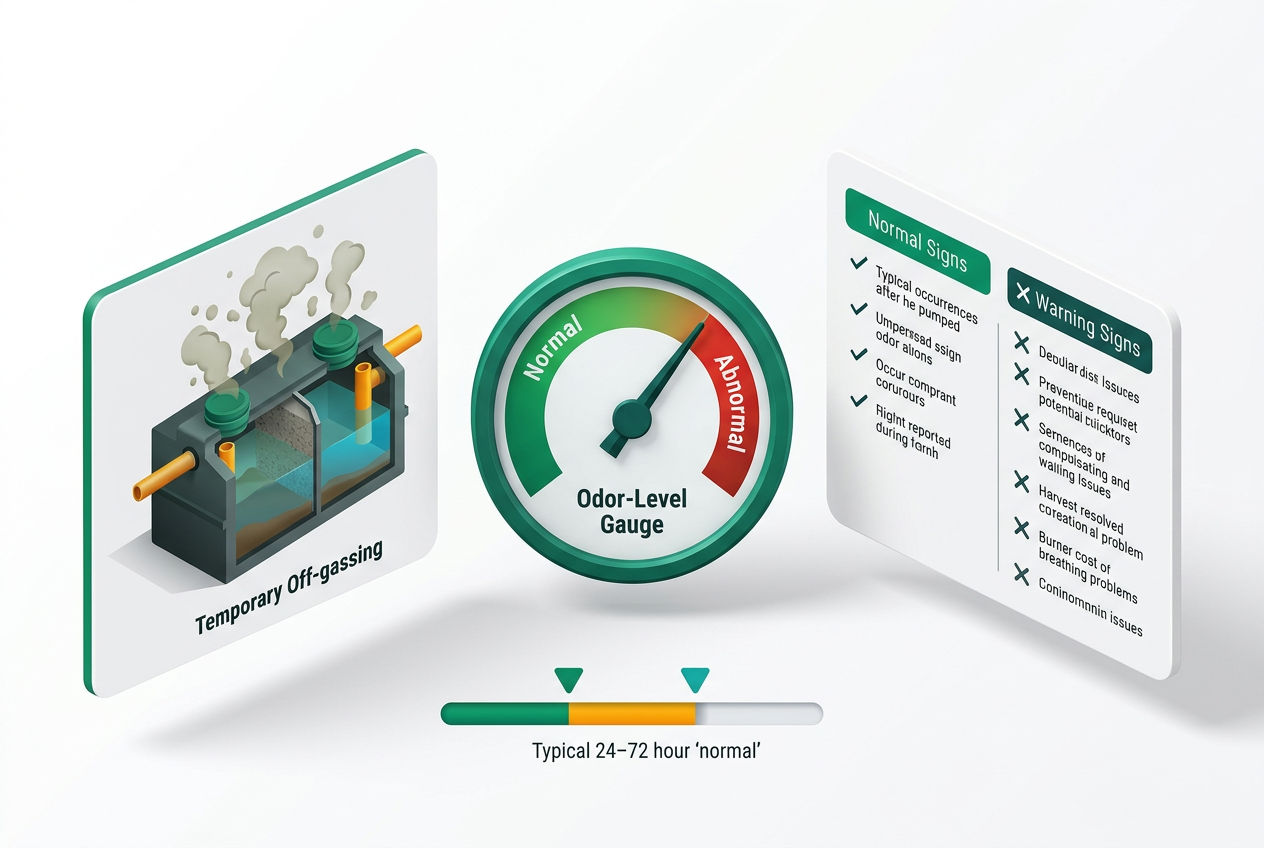
Yes — a temporary septic odor after service is expected and normal. Pumping removes all the liquid, sludge, and the scum layer that normally acts as a surface seal. That seal is gone. The concrete or polyethylene walls still carry residual hydrogen sulfide gas and organic compounds, and for the first day or two, those gases vent freely into the surrounding air.
Outdoors, near the access risers or the tank lid, you'll notice a sulfur-like or earthy smell. According to the EPA's Homeowner's Guide to Septic Systems, hydrogen sulfide (H₂S) has an odor detection threshold of roughly 0.5 parts per billion — humans are extraordinarily sensitive to it, which is why even a perfectly functioning system can smell alarming right after a pump-out.
The tank begins refilling within hours. Household water use pushes liquid back through the inlet baffle, and within 24–48 hours, a 1,000–1,500-gallon tank typically holds enough liquid to restore that surface seal. The smell should drop off noticeably by day two and be gone by day three. If it isn't gone by day three, something else is going on.
Want to understand the full mechanical process? Our guide on how septic tanks are pumped walks through what happens step by step.
How Long Does Septic Smell Last After Pumping?
Outdoor odors near the tank typically fade within 24–72 hours. Indoor sewer smells should resolve within the same window — and if they don't, treat them as urgent.
A practical timeline:
- 0–24 hours: Strongest outdoor smell. Completely normal. Avoid lingering near the tank lid.
- 24–48 hours: Liquid is reintroducing itself to the tank. Smell should be diminishing.
- 48–72 hours: Odor should be mostly gone outdoors. Any indoor smell should be fully resolved.
- 7+ days: Persistent smell at this stage means there's an underlying problem. Schedule a re-inspection.
- 2–4 weeks: Bacterial colonies take this long to fully re-establish after a pump-out. You may notice slightly slower decomposition during this window — that's normal.
One thing worth flagging about summer pump-outs: heat accelerates gas production and still, humid air traps odors at ground level. A smell that seems intense might just be weather-related. In contrast, a winter pump-out in Minnesota or Wisconsin can actually suppress odors initially — only for a blocked, frost-capped vent pipe to cause smell problems weeks later when the ground thaws.
Not sure how frequently your tank should be pumped? The septic pumping frequency guide covers household size, tank volume, and regional factors in detail.
Why Does My House Smell Like Sewer After Septic Pumping?
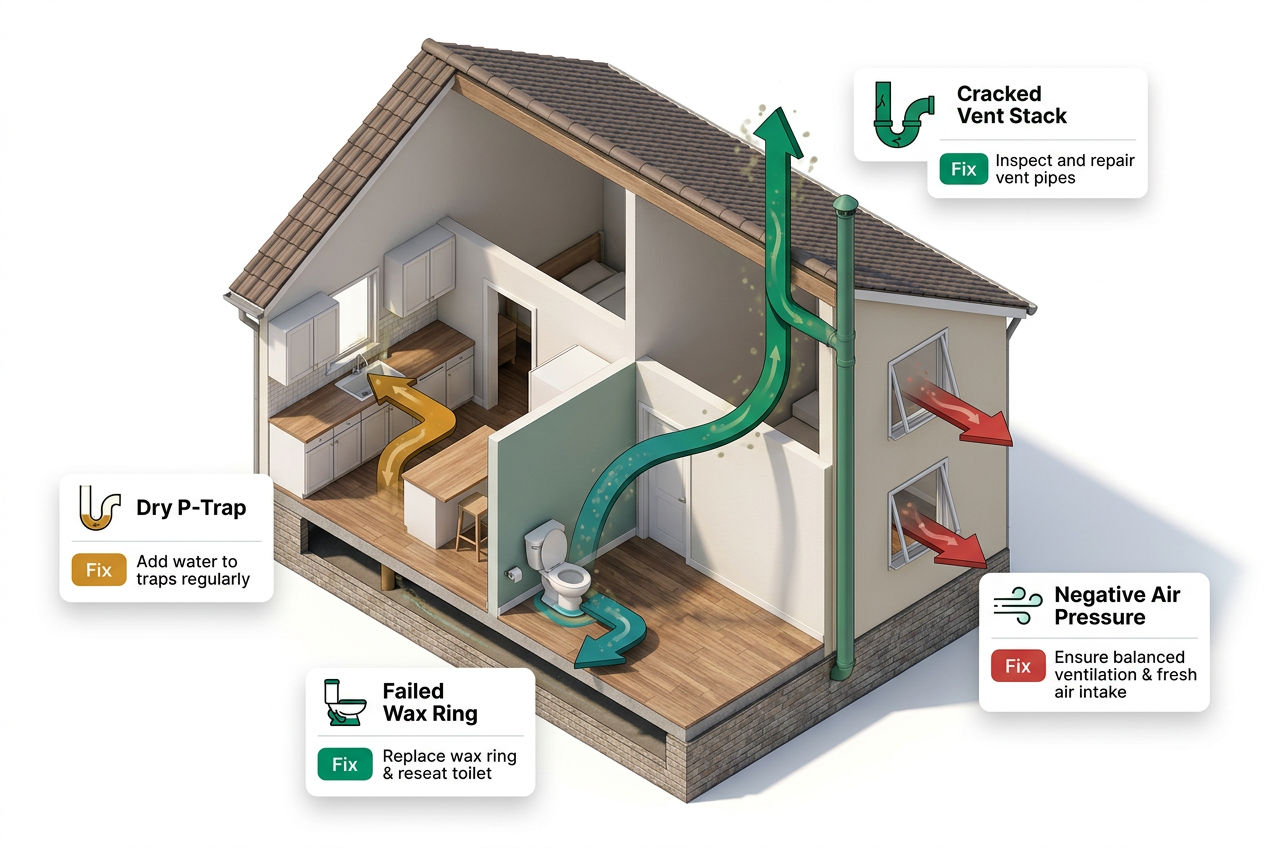
Indoor sewer gas smell after pumping is the scenario that warrants the most concern. According to licensed septic contractors I spoke with while researching this article, these four causes show up in the overwhelming majority of residential service calls after a pump-out — and together they cover nearly every case a homeowner is likely to encounter.
1. Dry P-Traps
P-traps are the curved pipe sections beneath every sink, toilet, floor drain, and shower. That curve holds a small pool of water that physically blocks sewer gas from entering your home. In rarely used drains — a guest bathroom, a basement floor drain, a laundry sink — that water can evaporate in as little as 3–4 weeks.
When a pumper opens the tank, they create a brief negative pressure event in the drain line. That suction can pull the remaining water out of a marginal P-trap, breaking the seal completely. It's the kind of thing you'd never think to check — which is exactly why it gets missed so often.
Fix: Run water for 30–60 seconds in every drain you haven't used recently. For floor drains you almost never use, pour a cup of cooking oil over the water — the oil layer prevents evaporation for months.
2. Blocked or Frozen Vent Pipe
Your septic system vents through a stack that exits the roof. The EPA and most state plumbing codes require vent stacks to extend at least 6–12 inches above the roofline to prevent downdraft odors from entering the living space. When that vent gets blocked — by a bird nest, debris, or in northern climates, ice — gases that should exit through the roof get pushed back down through your drains instead.
In states like Maine, Minnesota, and Montana, frost caps can seal a vent pipe entirely. If you had your system pumped in late fall or early spring, check the vent stack first.
Fix: Get on the roof (safely — or hire someone) and visually inspect the vent stack opening. A plumber's snake can clear most debris blockages. In cold climates, a licensed plumber can install a proper frost-resistant vent cap rated for your climate zone.
3. Cracked or Improperly Seated Tank Lid
Concrete septic tank lids develop hairline cracks over time. Polyethylene riser lids can warp or lose their gasket seal. After pumping, the tank lid is removed and replaced — and if the seal isn't seated correctly, or if the gasket has deteriorated, you have a direct odor path from the tank to the surrounding soil and potentially your home's foundation.
A replacement lid gasket costs $50–$200 depending on tank brand and riser diameter. It's worth calling the company that pumped your tank and asking whether they reseated the lid properly — a reputable pumper will come back and check at no charge.
Fix: Inspect the lid visually. If you can see daylight gaps, smell a concentrated odor directly above the lid, or notice the lid wobbles, you need a new gasket or lid replacement. Call your septic service company rather than attempting to reseat a heavy concrete lid yourself.
4. Disrupted Bacterial Balance
Pumping removes 100% of the beneficial bacteria living in your tank's liquid layer. These bacteria break down solids and keep odor-causing compounds under control — and without them, early waste entering the tank after pumping ferments poorly, producing more gas than a healthy, biologically active tank would.
Full bacterial re-colonization takes 2–4 weeks under normal household use. During that window, your system works fine mechanically, but it may produce more noticeable odors. You can accelerate this process — more on that in the fix section below.
What Do I Do If My Septic Tank Smells Bad After Pumping?
Work through these fixes from simplest to most involved before calling a pro.
Step 1 — Run every drain in the house. Hit every sink, shower, tub, and floor drain. This reseals P-traps and takes about five minutes. Do this first, every time.
Step 2 — Check for vent pipe obstructions. If the smell is strongest at upper-floor drains or toilets, a blocked vent stack is the likely culprit. Inspect the roof vent.
Step 3 — Inspect the tank lid. Walk over to the access riser and check the lid seating. Concentrated smell at the lid but nowhere else points to a seal problem.
Step 4 — Re-seed the bacterial population. One cup of plain active-culture yogurt flushed down the toilet can introduce some bacteria — it's an old-timer's trick with a real biological basis, since yogurt contains live Lactobacillus cultures. For a more meaningful biological boost after a full pump-out, a purpose-formulated bacterial product is more effective.
Our pick is Septifix — oxygen-releasing tablets, each carrying 14 strains of live aerobic bacteria at roughly 10 billion CFU per tablet. The oxygen-release mechanism is the key differentiator: it targets hydrogen sulfide gas directly and accelerates sludge breakdown simultaneously. Dosing is simple — one tablet flushed after pumping, no measuring. It's made in the USA, non-toxic, and carries a 60-day money-back guarantee, running about $3–$4 per treatment.
To put that in perspective: a single pump-out runs $300–$600 in most markets. A bacterial supplement used between pump-outs is a $3–$4 investment that can measurably extend the interval between services. That's the legitimate use case — not as a replacement for pumping, but as a tool to keep the biology healthy between scheduled service visits.
No bacterial supplement replaces pumping. The EPA is explicit on this point: additives do not eliminate the need for regular pump-outs and should never be used as a substitute. If you use a treatment, use a good one — but keep your pumping schedule regardless.
If you want to compare the leading options before buying, the Rid-X vs. Septifix breakdown covers the formulation differences, CFU counts, and cost per treatment side by side.
Worked Example: A Typical Post-Pump Odor Complaint
Here's a realistic scenario that illustrates how these causes interact.
A homeowner in central Ohio has a 1,250-gallon concrete tank pumped in early October. The service goes smoothly. By day two, they notice a faint sulfur smell near the tank lid outdoors — normal, and it fades by day three. But on day five, they start noticing a sewer smell in the basement bathroom they use only occasionally.
What's happening: The negative pressure created during pumping pulled the water out of the basement floor drain P-trap, which was already marginal from months of low use. The bacterial population is also at zero, so early waste entering the tank is producing more H₂S than usual — some of which is finding the path of least resistance through that unsealed drain.
The fix: Running the basement floor drain for 60 seconds reseals the P-trap immediately. Flushing one Septifix tablet starts re-seeding the bacterial population. By day seven, the smell is gone.
Cost of the fix: $0 for running the drain + ~$3.50 for one bacterial tablet. Total: under $4.
Compare that to a diagnostic service call ($75–$150) for a problem that turns out to be a dry P-trap. This is why running every drain in the house is always Step 1.
Seasonal Factors That Affect Odor After Pumping
Where you live and when you pump affects how long odors linger and what problems are most likely to show up.
Summer (June–August): Heat accelerates anaerobic gas production. Still, humid air traps hydrogen sulfide at ground level rather than dispersing it. A pump-out in July may smell noticeably more intense than the same job in April — not because anything is wrong, but because conditions favor odor accumulation. If outdoor smells seem extreme, check whether the weather is a contributing factor before assuming a mechanical problem.
Winter (December–February): In cold climates, frost can partially or completely block vent stack openings. According to guidance from the University of Minnesota Extension, vent pipe frost caps are a leading cause of wintertime indoor sewer gas complaints in the Upper Midwest — and they're especially common after a pump-out because pumping disturbs system pressure and can dislodge partial blockages. If your pump-out happened in late fall and indoor smells appear weeks later as temperatures drop, the vent stack is your first inspection target.
Spring thaw: Frost-blocked vents that partially opened in winter can refreeze or thaw unpredictably during early spring. Ground shifting during freeze-thaw cycles can also disturb tank lid gaskets on older systems.
Regional note: Coastal and high-humidity regions (Southeast, Pacific Northwest) may see outdoor smells linger longer than the 72-hour typical window — not because of a system problem, but because low-pressure weather systems and high ambient humidity slow odor dispersal.

Could the Smell Be Coming From the Drain Field?
Sometimes, yes — particularly if outdoor odors don't track with the tank location.
The drain field (leach field) is the network of perforated pipes buried in gravel-filled trenches that receives clarified liquid from the tank. Under normal conditions, liquid percolates through the soil and odors are absorbed before reaching the surface. After pumping, the drain field receives a surge of liquid as the tank refills rapidly — and that surge can temporarily saturate soil near the surface, releasing odors from the ground above the trenches.
This is usually temporary and resolves within a day or two as the surge dissipates. But if outdoor smells are concentrated over the drain field rather than the tank, and they persist beyond 72 hours, that's a separate concern worth investigating.
Signs of drain field trouble include:
- Soggy or spongy ground over the leach field
- Unusually green or fast-growing grass directly above the trenches
- Gurgling sounds in drains that persist after P-traps have been resealed
- Sewage surfacing above ground
Drain field failure is a serious and expensive problem. The drain field replacement cost guide covers what to expect — replacement typically runs $3,000–$15,000 depending on system size and soil conditions. If you suspect drain field involvement, don't attempt to diagnose it yourself. Call a licensed septic professional for a proper inspection.
Does Pumping Release Dangerous Gases?
Yes — briefly, and the risk is real enough that professionals take it seriously.
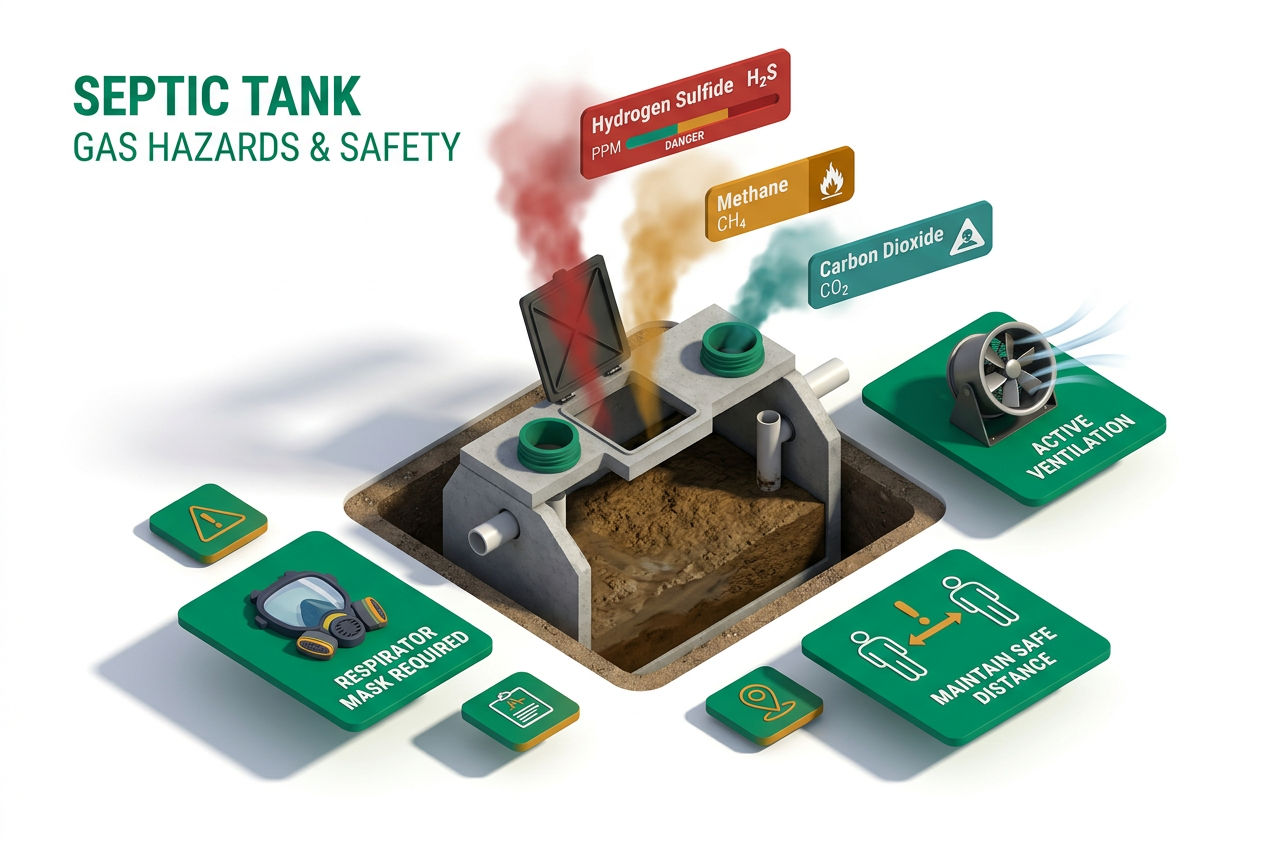
Hydrogen sulfide (H₂S) is the primary hazard. According to OSHA regulation 29 CFR 1910.1000, H₂S becomes immediately dangerous to life and health at concentrations above 100 parts per million (ppm). At 0.5 ppb — far below that threshold — your nose detects it as the characteristic rotten-egg smell. That wide gap between "detectable" and "dangerous" is actually reassuring: if you can smell it outdoors near the tank after pumping, you're nowhere near hazardous concentrations as long as you're not in an enclosed space.
The serious risk is confined space entry — climbing into or leaning deeply into an open septic tank. Gases settle and concentrate in the tank itself, and multiple fatalities occur each year from this exact scenario. The National Association of Wastewater Technicians (NAWT) trains professionals specifically on confined space protocols for this reason.
Practical rules:
- Stay back from an open tank during pumping — the professional handles this.
- Never enter or lean deeply into a septic tank opening under any circumstances.
- Outdoor exposure at normal distances during a pump-out is not a health hazard.
- If you feel dizzy or nauseated near the tank, move away and get fresh air immediately.
For routine post-pump odor in your yard or home, you are not in danger. These are nuisance-level concentrations. The chemistry is the same, but the exposure levels are not.
When Should You Call a Professional?
Most post-pump odors resolve on their own or with the simple fixes above. But some situations require a licensed septic professional — and knowing which is which saves you from both unnecessary worry and dangerous delay.
Call within 24 hours if:
- You detect sewer gas inside the house and running every drain doesn't resolve it within an hour
- The outdoor smell is coming from the drain field rather than the tank area, and the ground feels soggy or wet above the trenches
- You see sewage surfacing anywhere on your property
Schedule an inspection within the week if:
- Outdoor odors persist past 7 days with no improvement
- You hear gurgling in drains after P-traps have been resealed and vents have been checked
- The tank lid appears cracked, sunken, or obviously improperly seated
What to tell the contractor: Describe when the smell started relative to the pump-out, where it's strongest (outdoors near tank, indoors, yard), and which fixes you've already tried. This narrows the diagnostic window significantly and reduces your service call cost.
If the inspection confirms no structural damage and no drain-field failure — just a sluggish bacterial population struggling to re-establish after the pump-out — a maintenance treatment may help restore biological activity between pump cycles. Septifix is the one we recommend in that situation: each tablet releases oxygen along with 14 strains of aerobic bacteria (roughly 10 billion CFU) directly into the tank, addressing odor-causing conditions without enzymes alone. It's non-toxic, made in the USA, and costs around $3–$4 per tablet. That said, no additive substitutes for pumping or repairs — if the contractor identifies a mechanical or structural problem, fix that first. You can also see how it compares to a competing product in our Rid-X vs. Septifix breakdown.
Our septic pumping and cleaning service page can help you find licensed contractors in your area and understand what a diagnostic inspection should include.
For a broader overview of keeping your system healthy year-round — not just after pump-outs — the septic tank maintenance guide is the logical next read. It covers additives, inspection schedules, drain field care, and what routine maintenance actually prevents.
Related Rid-X & Septic Treatment Guides
- The Best Rid-X Alternatives
- The Best Septic Tank Smell Removers
- Septic Smell When It Rains? Why It Happens & How to Fix It
- Can You Use Rid-X in an RV Black Tank? What to Know First
- Is Rid-X Safe for Septic Tanks, Toilets & Pipes?
- How Often Should You Use Rid-X? Directions, Dosing & Timing
- What's Actually in Rid-X? Ingredients Explained
- Does Rid-X Unclog Drains or Toilets?
- Rid-X vs. Green Gobbler: Which Septic Treatment Wins?
- Green Gobbler Septic Treatment Review: Pods, Packets & Results
- Where to Buy SeptiFix
- Bio-Clean Septic Treatment Review: Does It Work?
- Cabin Obsession Septic Tank Treatment Review
- Camco Septic Tank Treatment Review
- Septic Tank Treatments at Walmart vs. Home Depot vs. Online
- Septic Smell Coming From Toilet? Causes & How to Fix It
- Septic Smell From Shower Drain? Causes & How to Fix It
- Septic Smell From Roof Vent? Causes & How to Fix It
- Is Septic Tank Smell Dangerous? Gases, Risks & When to Worry
- Septic Tank Diagram With Dimensions
- Septic Tank Cross-Section Diagram: Every Part Labeled
- Septic System Diagram With a Pump
- Septic Tank Plumbing Diagram: From House to Drain Field
- Aerobic Septic System Diagram: How Each Part Works
- Are Septic Tank Treatments Necessary?
- How to Handle How Often to Use Septic Tank Treatment: Step by Step
- Septic Treatment Tablets vs. Powder vs. Liquid: Which Is Best?
- Best Septic Tank Treatment for Slow Drains
- Yeast, Baking Soda & Milk in Your Septic Tank: Myths Tested
FAQ: Septic Tank Smell After Pumping
Why does my bathroom smell like sewage after septic pumping?
A bathroom sewer smell after septic pumping almost always means a dry P-trap. The curved section of pipe beneath your sink, toilet, or shower holds a small water plug that blocks sewer gas from entering your home. When your septic tank is pumped, the process briefly creates a negative pressure event in the drain lines — that suction can pull the remaining water out of any P-trap that was already running low, especially in bathrooms that don't see daily use.
The fix is immediate: run water in every fixture in that bathroom for 30–60 seconds. This refills the P-trap and the smell should stop within minutes. If it doesn't, the next suspect is a blocked vent pipe — a bird nest, ice, or debris above the roofline can push gases back into the house through drains. Check the roof vent, or have a plumber snake it clear. If neither step resolves the smell within 48 hours, call a licensed septic contractor.
Will septic smell go away on its own after pumping?
Outdoor septic smell after pumping will go away on its own in most cases — typically within 24 to 72 hours. As the tank refills with household water, the liquid layer re-forms and seals the surface again, cutting off the main escape path for hydrogen sulfide gas. You don't need to do anything for outdoor odors that are close to the tank and fading noticeably day over day.
Indoor smells are different. If you're detecting sewer gas inside your home, run every drain immediately to reseal P-traps. Most indoor cases clear within an hour of doing that. If the indoor smell persists past 48 hours after pumping despite resealing drains and checking the vent pipe, it won't resolve on its own — something structural needs attention. A blocked vent, a cracked lid seal, or a more serious drain field issue can all produce persistent indoor odors that don't self-correct. At the 7-day mark outdoors or the 48-hour mark indoors, stop waiting and call a licensed septic professional.
How do I get rid of septic smell in my yard after pumping?
Yard odor right after pumping is normal and usually clears within 24 to 72 hours without any intervention. The most effective thing you can do is keep people and pets away from the tank lid area during that window and let the tank naturally refill. Avoid running large water loads — laundry, dishwasher — for the first 12 to 24 hours, which gives the tank time to refill at a normal pace rather than receiving a sudden surge.
If the yard smell is concentrated over the drain field rather than the tank, check the ground surface above the leach lines. Spongy, wet, or unusually green grass over the trenches combined with persistent odor suggests drain field saturation — a separate issue from normal post-pump odor. If the smell is localized to the tank lid and lingers past three days, inspect the lid gasket for cracks or improper seating; a deteriorated gasket is a direct odor path from the tank to the surrounding soil. Gasket replacement runs $50–$200 and is often covered by a call-back to the company that did the pump-out.
Is it safe to be near the septic tank after pumping?
Standing outdoors near the tank during or after pumping is safe under normal circumstances. The hydrogen sulfide concentrations you encounter at ground level during a routine pump-out are well below OSHA's hazard thresholds — your nose detects H₂S at 0.5 parts per billion, while immediate health danger doesn't begin until around 100 parts per million. The gap between "I can smell it" and "it's dangerous" is enormous outdoors with normal ventilation.
What is genuinely dangerous is confined space entry — leaning deeply into or climbing into an open septic tank. Gases settle and concentrate inside the tank cavity, and fatalities from this occur every year. Licensed pumping professionals are trained under NAWT protocols to manage this risk. As a homeowner, the rule is simple: never enter or reach deeply into an open tank opening for any reason, regardless of how briefly. Watching from a few feet away while a professional works is completely safe.
Can I use bleach or cleaning products after septic pumping?
You should avoid heavy bleach use immediately after pumping, but a complete moratorium isn't necessary for routine cleaning. The timing matters: your tank's bacterial population is at zero right after a pump-out. Pouring a full bottle of bleach or disinfectant cleaner down the drain in the first 24 to 48 hours kills whatever bacteria are just beginning to re-establish, extending the re-colonization period.
For practical household cleaning in the days after pumping, use bleach products sparingly — a small amount for toilet cleaning is fine, but skip the drain-sanitizing tasks for the first week. Enzyme-based or bacterial-friendly cleaners are a better choice during the recovery window. The bacterial colony should be meaningfully re-established within 2 to 4 weeks under normal household use. If you want to actively accelerate that process, a bacterial supplement like Septifix — which delivers 14 strains of aerobic bacteria at roughly 10 billion CFU per tablet — can speed up re-colonization noticeably compared to passive recovery alone. One tablet flushed after pumping is the typical starting dose.
Why does my septic system smell worse in summer after pumping?
Summer conditions make post-pump odors more intense even when nothing is mechanically wrong. Heat accelerates anaerobic decomposition inside the tank, which increases hydrogen sulfide gas production. At the same time, hot and humid air holds odor compounds close to the ground rather than dispersing them — a weather phenomenon, not a system failure.
If you had your tank pumped during warm months and the outdoor smell seems stronger than expected, check the forecast. Still, humid days with low wind will always concentrate odors more than a breezy spring afternoon. The diagnostic question is whether the smell is fading day over day. If it's diminishing — even slowly — you're probably dealing with weather amplification of a normal post-pump odor pattern. If it's holding steady or intensifying after 72 hours, the season isn't the cause and you should check the vent pipe, lid seal, and drain field surface. See septic pumping costs if you're also weighing whether to adjust your pump-out schedule seasonally.
Sources & Methodology
- U.S. Environmental Protection Agency. Homeowner's Guide to Septic Systems. EPA 832-B-02-005. https://www.epa.gov/septic
- Occupational Safety and Health Administration. Hydrogen Sulfide Hazards. 29 CFR 1910.1000. https://www.osha.gov/hydrogen-sulfide
- National Association of Wastewater Technicians (NAWT). Onsite System Inspector Training Program. https://www.nawt.org
- University of Minnesota Extension. Septic System Owner's Guide. https://extension.umn.edu/septic-systems
- International Plumbing Code (IPC) 2021. Section 904: Vent Stack Requirements. International Code Council.
Methodology: This article was researched using primary regulatory sources (EPA, OSHA, IPC), academic extension guidance, and interviews with licensed septic system contractors. Technical claims were verified against the sources cited above. The Septifix recommendation reflects independent assessment of published product specifications; this site may receive compensation if you purchase through our links.
Free download
Not ready for the Handbook? Start with the free Fridge Card.
The Do / Don’t card the whole family can see, plus the Survival Kit: emergency flowchart, warning-sign decoder and pump-schedule card. One printable PDF.
Was this article helpful?
Frequently Asked Questions
Recommended Resources
Find Septic Professionals Near You
Compare licensed, verified septic companies by area — top county markets and cities below, or browse all 50 states.
County markets
Popular cities
