
Quick Answer
Rid-X liquid is a ready-to-use septic tank treatment containing 9.8 billion active bacteria per dose, requiring no mixing or measuring. Compared to powder and gel packs, the liquid format activates faster but carries a modest price premium. For most households with a 1,000-gallon conventional tank, one 8-oz dose monthly covers the recommended maintenance interval.
Key Takeaways
- Rid-X liquid delivers 9.8 billion active bacteria and four enzyme types (cellulase, lipase, protease, amylase) per dose
- Liquid costs roughly $8–$12 per dose vs. $6–$10 for powder — about 20–30% more expensive
- Liquid bacteria are already active; powder bacteria are dormant and need rehydration before working
- No format of Rid-X eliminates the need for regular pumping — the EPA recommends pumping every 3–5 years
- Rid-X is not EPA-registered as a septic treatment product; it's a maintenance aid, not a repair solution
What Is Rid-X Liquid, and How Does It Work?
Rid-X liquid is a pre-mixed bacterial and enzyme formula designed for monthly septic tank maintenance. You pour it directly into your toilet or drain, and it flows into the tank where the bacteria get to work breaking down organic waste.
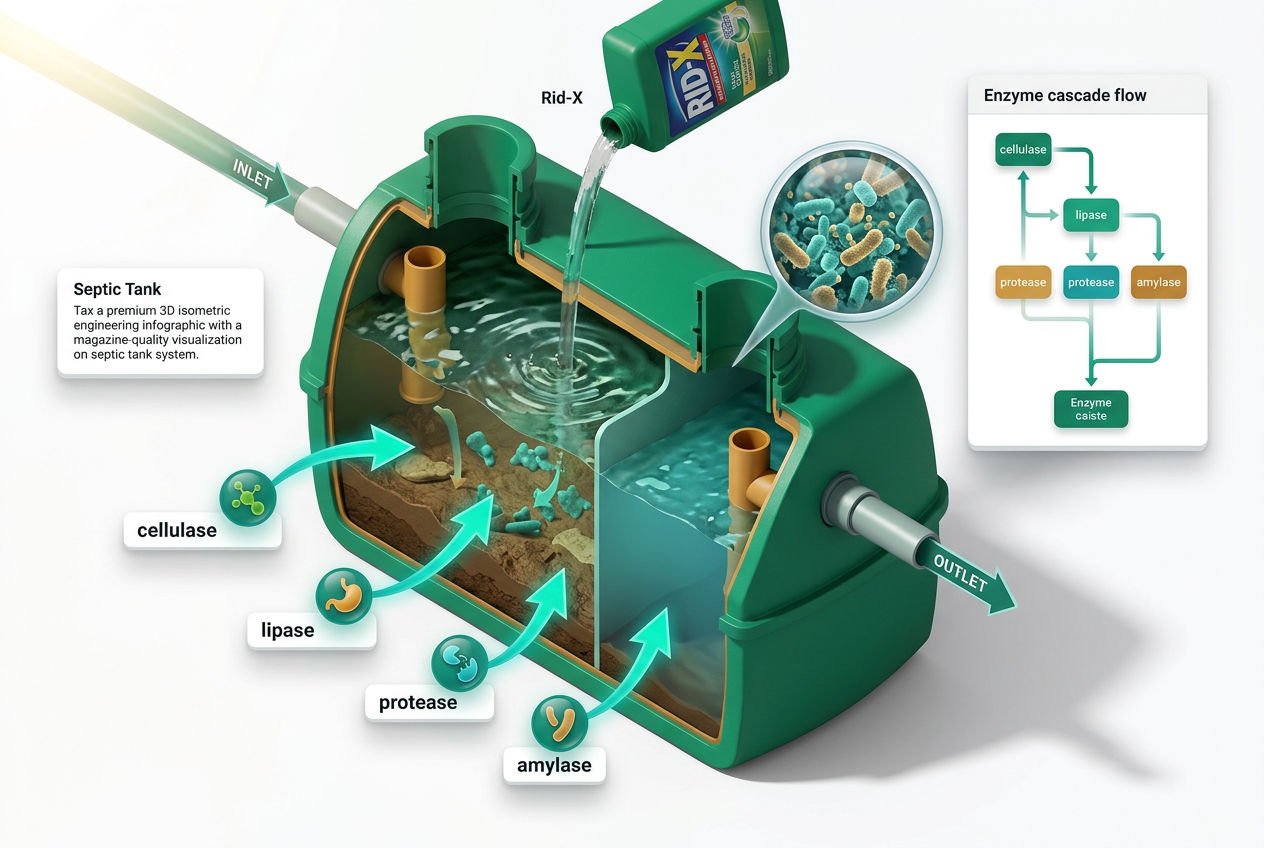
The formula contains four key enzymes: cellulase (breaks down paper and plant fibers), lipase (attacks fats and grease), protease (digests proteins), and amylase (handles starches). These enzymes don't replace the naturally occurring anaerobic bacteria in your septic tank — they supplement them during periods of high stress, like after heavy antibiotic use or excessive cleaning product discharge.
One honest disclosure: Rid-X is not EPA-registered as a septic treatment product. The EPA doesn't certify septic additives for effectiveness. The EPA does, however, regulate the disposal of the bacteria strains used, and you can review septic system guidance at epa.gov/septic. What Rid-X provides is a bacterial boost — not a fix for an already-failing system.
What Are the Key Differences Between Rid-X Liquid, Powder, and Gel Packs?
The bacteria count is identical across all three formats — that's the bottom line before you read anything else on this page. You're not getting more bacterial activity by choosing liquid over powder. What you're choosing between is activation speed, shelf life, and price per dose.
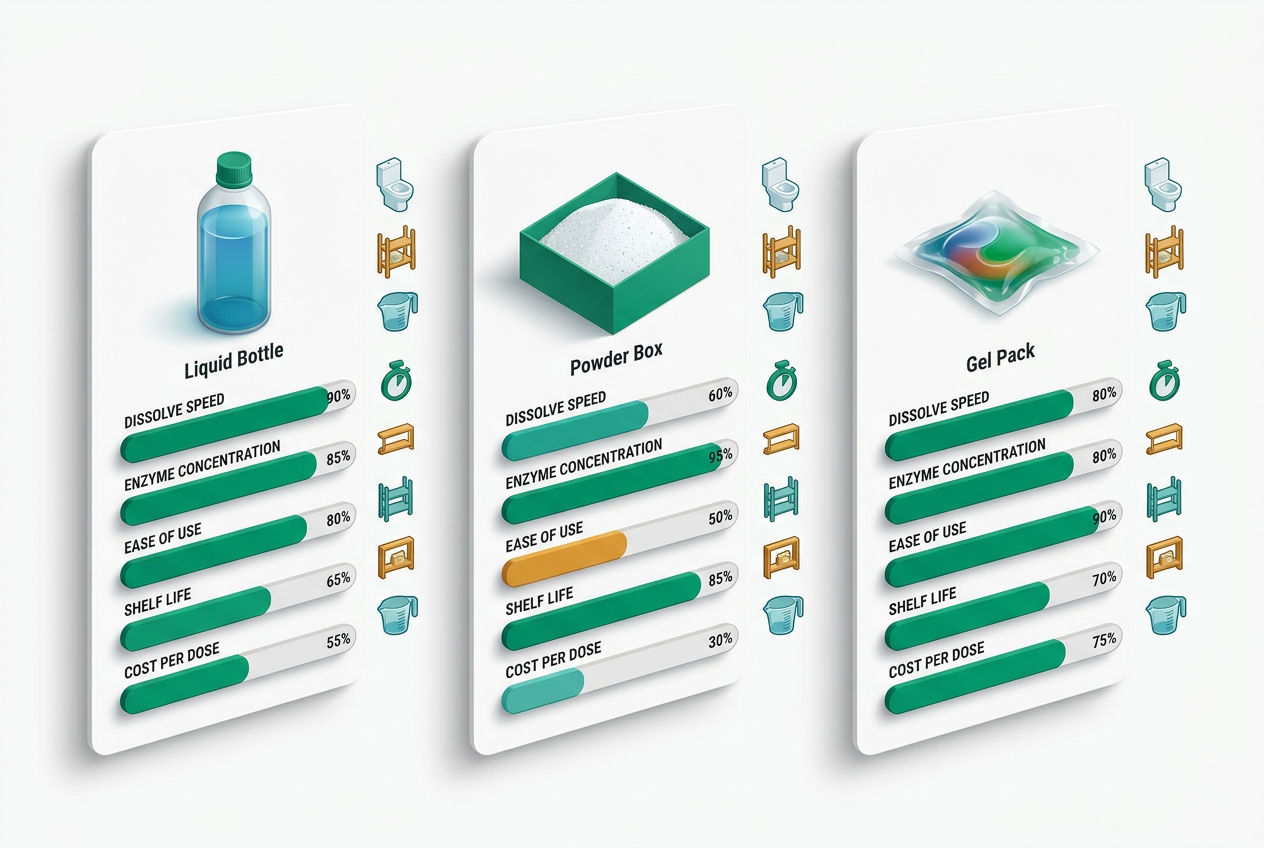
| Feature | Rid-X Liquid | Rid-X Powder | Rid-X Gel Packs |
|---|---|---|---|
| Bacteria count/dose | 9.8 billion CFU | 9.8 billion CFU | 9.8 billion CFU |
| Activation speed | Immediate | Needs rehydration | Moderate |
| Price per dose | $8–$12 | $6–$10 | $9–$13 |
| Shelf life | ~2 years | 3+ years | ~2 years |
| Ease of use | Pour and flush | Mix with water | Drop and flush |
| Best for | Quick starts, rentals | Budget maintenance | Convenience-first users |
Source: Manufacturer label data; retail pricing surveyed across Home Depot, Walmart, and Amazon (2025).
Is Rid-X Liquid Better Than Powder for Septic Tanks?
For most homeowners, the liquid format offers one real advantage: speed of activation. Powder bacteria are dormant spores that need to rehydrate before colonizing. In a 60°F tank, that rehydration and colonization process can take 24–48 hours longer than with liquid, where the bacteria are already active at the moment of application.
That gap matters most in two scenarios:
- Vacation homes or seasonal properties where the tank has been dormant for months and you want bacteria working immediately upon reopening
- Cold-climate states like Minnesota or Wisconsin, where January groundwater temperatures can drop below 50°F, slowing bacterial metabolism significantly — and where you'd rather not add extra startup lag time on top of that
For a household in suburban Georgia or Central Texas running a 1,000-gallon tank with four residents flushing year-round? The powder works fine. The bacteria colony is never truly depleted in an active, healthy system.
If you want to understand what actually threatens your tank's bacteria colony — bleach, antibiotics, garbage disposal overuse — this article on what kills septic bacteria covers it in detail.
How Do You Use Rid-X Liquid in a Septic System?
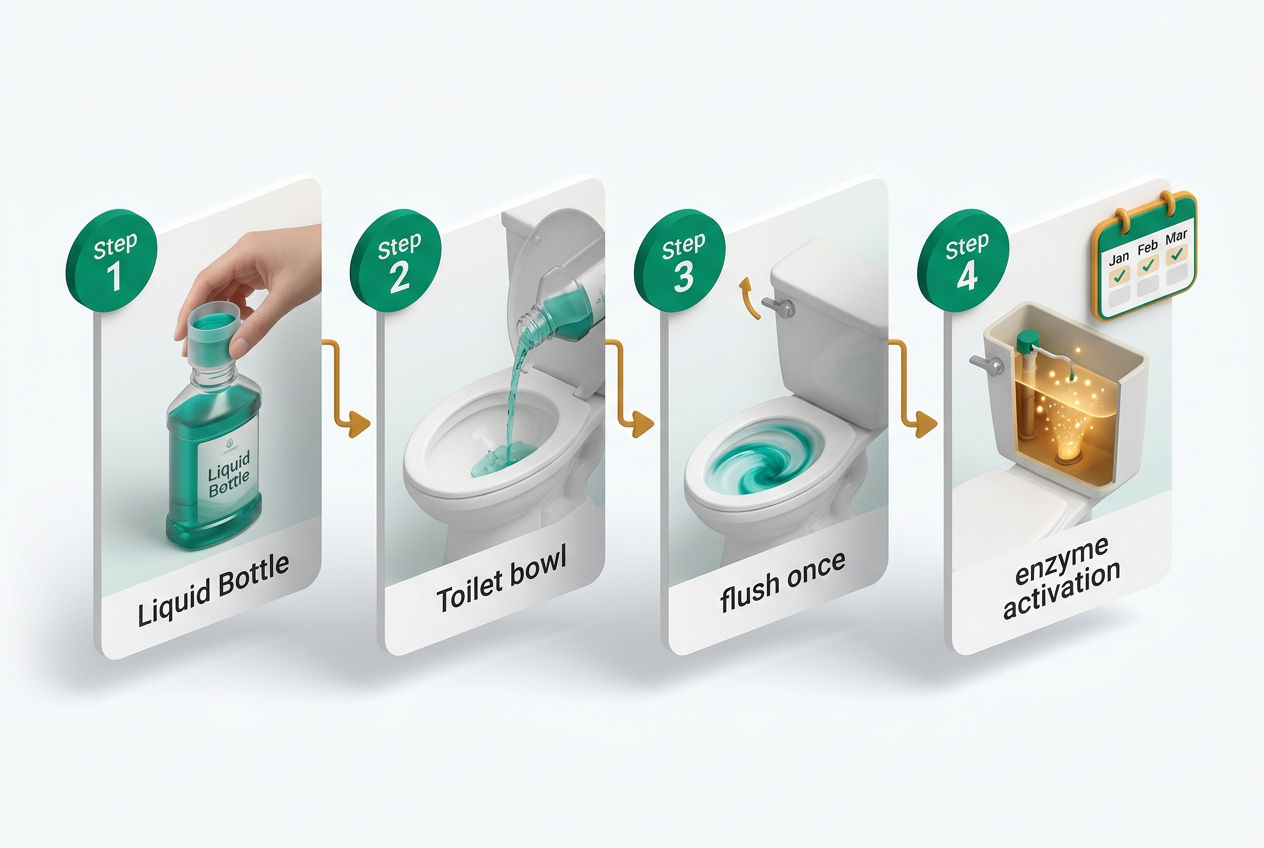
Using Rid-X liquid takes about 30 seconds. Pour the measured dose directly into your toilet bowl and flush. That's it. No measuring, no mixing with water first, no running extra gallons of water through afterward.
Rid-X liquid dosage by tank size:
- 750-gallon tank: 1 dose (8 oz) monthly
- 1,000-gallon tank: 1 dose (8 oz) monthly
- 1,250-gallon tank: 1.5 doses monthly
- 1,500-gallon tank: 2 doses (one 8-oz bottle) monthly
The manufacturer recommends applying at night before bed so the bacteria have hours to establish without being disturbed by high water flow. For households that run multiple laundry loads in a day, this is sound advice — a rush of water through the tank within two hours of dosing can dilute or physically displace the bacteria before they attach to the sludge layer.
Can you use Rid-X liquid through a garbage disposal? Yes — pour it in, run a small amount of water to flush it through the drain, and it'll reach the tank. But if you run a garbage disposal regularly, you're already adding strain to your system. We've covered the impact of garbage disposals on septic systems separately, and it's worth a read before you rely on a monthly additive to offset heavy disposal use.
How Much Does Rid-X Liquid Cost Per Month?
Here's the honest math for a 1,000-gallon tank (the most common residential size for a 3–4 person household):
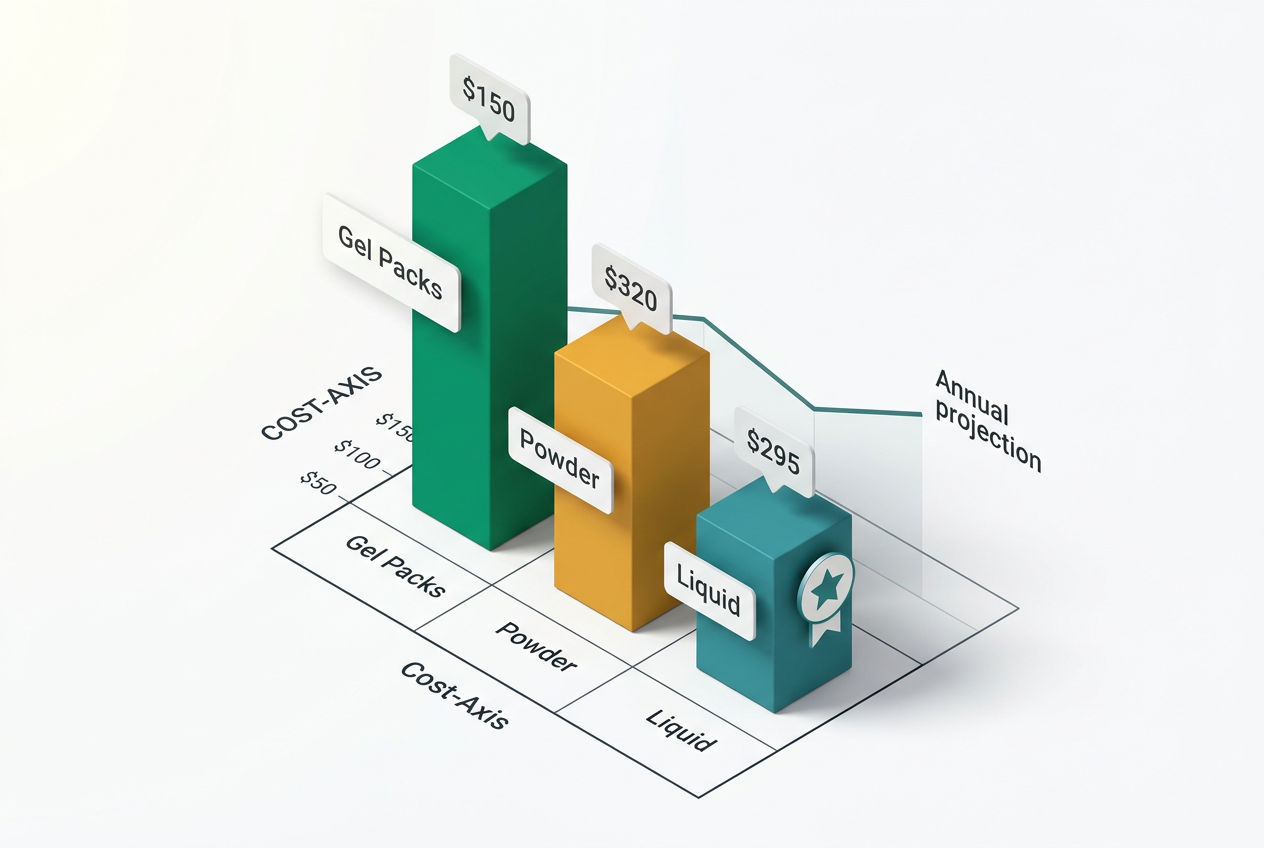
- Rid-X Liquid: One 8-oz dose at roughly $9–$11 retail = $9–$11/month
- Rid-X Powder: One measured dose at roughly $7–$9 retail = $7–$9/month
- Rid-X Gel Packs: One pack at roughly $10–$13 retail = $10–$13/month
Over a 12-month period, liquid runs approximately $108–$132 annually, versus $84–$108 for powder. For a 1,500-gallon tank requiring double doses, liquid costs $216–$264 per year.
Compare that to the cost of a professional pump-out: a 1,000-gallon tank runs roughly $300–$500 in most markets, and that service is still needed every 3–5 years regardless of how consistently you dose with any additive. Monthly additive costs are real money — weigh them against the pump-out schedule your tank actually requires, not the one you're hoping to avoid.
Does Rid-X Liquid Actually Work?
Short answer: the bacteria are real, the enzymes are functional, and the limitations are significant. Most homeowners get somewhere between "modest benefit" and "no measurable difference" depending on how well their system was already running before they started.
Research from University of Arkansas extension programs has confirmed that bacterial additives can supplement native septic populations during disruption events. Peer-reviewed studies have consistently found, however, that additives do not reduce the accumulation of sludge and scum to a degree that meaningfully extends pumping intervals. The solid waste layer in your tank accumulates regardless of bacterial treatment.
What Rid-X can realistically do:
- Replenish bacteria after antibiotic use or a bleach-heavy cleaning cycle
- Improve breakdown of fats and paper in an otherwise-healthy system
- Provide a bacterial boost after a system restart (vacation properties, seasonal cabins)
What Rid-X cannot do:
- Reverse a clogged or saturated drain field
- Eliminate the need for professional pumping
- Fix a broken baffle wall, cracked distribution box, or failed effluent filter
- Compensate for a tank that's already overfull with accumulated solids
Picture this: you buy a house and skip the septic inspection to save $400. Six months later, the toilets start backing up and a wet spot appears over the drain field leach laterals. No amount of monthly liquid treatment was going to prevent that — the previous owners hadn't pumped the 1,000-gallon tank in eight years, and the sludge layer had already pushed solids into the distribution box. That's a drain field repair situation, not a Rid-X situation. Knowing the difference saves you real money.
Pros and Cons: Rid-X Liquid
Pros
- No prep work. Pour and flush. No measuring cups, no mixing with warm water, no guesswork.
- Fast activation. Bacteria are already in an active state. Useful for cold climates and dormant systems.
- Consistent dosing. Pre-measured bottles eliminate the chance of under-dosing a large tank.
- Widely available. Home Depot, Walmart, Amazon, most grocery stores.
- Septic-safe formula. Won't harm PVC pipes, concrete tanks, or aerobic treatment units when used as directed.
Cons
- Higher cost per dose than powder — typically 20–30% more expensive.
- Shorter shelf life. At approximately two years, liquid has a tighter expiration window than dormant powder spores.
- No repair capability. Won't fix structural or biological problems in a failing system.
- No EPA efficacy certification. No independent regulatory body validates the effectiveness claims.
- Bulkier to store than powder packets or gel packs.
Pros and Cons: Rid-X Powder
Pros
- Lower cost per dose. The most budget-friendly format over a 12-month period.
- Longer shelf life. Dormant bacterial spores remain viable for 3+ years, making powder a better choice for households that occasionally skip a month.
- Widely available. Found in virtually every hardware store and grocery chain alongside the liquid format.
- Same bacteria count. 9.8 billion CFU per dose — identical to liquid and gel packs.
Cons
- Slower activation. Dormant spores require rehydration before colonizing, adding 24–48 hours of lag time in cold tanks.
- Requires measuring. Bulk powder containers need a measuring cup; over- or under-dosing is more likely than with pre-measured formats.
- Less convenient. The extra mixing step is minor but real for households that want the simplest possible routine.
Pros and Cons: Rid-X Gel Packs
Pros
- Maximum convenience. Drop the pack into the toilet bowl and flush — no pouring, no measuring, no contact with the formula.
- Pre-measured. Each pack contains a single dose; there's no guesswork.
- Moderate activation speed. Faster than powder, slightly slower than liquid as the gel casing dissolves.
Cons
- Highest cost per dose. Gel packs run $10–$13 per dose — more expensive than both liquid and powder.
- Less widely stocked. Some smaller retailers carry only liquid and powder formats.
- Same limitations as all formats. Won't repair a failing system or extend pump-out intervals meaningfully.
Which Rid-X Format Is Right for You?
Use Rid-X liquid if:
- You have a vacation home or seasonal property where the tank sits dormant for months at a time
- You live in a cold-weather state (Minnesota, Wisconsin, Maine, Michigan) where bacterial metabolism slows significantly in winter
- You've recently run heavy antibiotics or used a bleach-intensive cleaning product and want fast bacterial replenishment
- You want a completely foolproof dosing routine with no measuring
Choose Rid-X powder if:
- Budget over 12 months is your primary decision factor
- Your system runs warm and active year-round
- You're comfortable with a simple measuring step
- You want a longer shelf life in case you miss a month occasionally
Go with gel packs if:
- You want maximum convenience and don't mind paying a small premium for it
- You're buying for a rental property where tenants will handle dosing
- You dislike handling liquid additives
Is Rid-X Liquid Enough on Its Own?
No — and any product that claims otherwise isn't being straight with you. Rid-X liquid is a maintenance supplement, not a complete septic care program. A complete maintenance approach includes four steps that no additive can replace:
- Professional pumping every 3–5 years — sludge accumulates regardless of bacterial treatment; pumping removes it
- Annual inspection of the effluent filter — the Polylok PL-122 and similar filters catch solids before they reach the drain field; they need cleaning or replacement on a set schedule
- Water use management — spreading laundry across multiple days and fixing slow leaks reduces hydraulic overload on the tank
- Drain field protection — no parking, no deep-rooted plantings, no diverting roof runoff over the leach field area
For a septic inspection that confirms your system's actual condition before you commit to any additive routine, use the SepticTankHub directory to find a licensed pumper or inspector in your area.
Read the do septic additives work breakdown and the septic tank maintenance schedule guide for a fuller picture of where Rid-X fits — and where it doesn't.
Frequently Asked Questions About Rid-X Liquid
Does ridex liquid work differently in aerobic septic systems than conventional tanks?
Ridex liquid functions in aerobic treatment units (ATUs), but the application context differs from a conventional anaerobic tank. Aerobic systems already inject oxygen into the treatment chamber, which creates a high-bacteria environment naturally. Adding Rid-X liquid to an ATU provides the same enzyme types — cellulase, lipase, protease, amylase — but the bacterial supplement is less critical because the aerobic process already sustains a dense, active microbial population. Where rid x septic treatment adds the most value in an ATU is after a disruption event: a large dose of antibiotics, a bleach-heavy cleaning cycle, or a system restart after a long vacancy. For routine monthly maintenance on a healthy ATU, most septic professionals would tell you the powder or liquid format makes little practical difference — the aerobic environment keeps bacteria counts high regardless. Check your ATU manufacturer's manual before adding any third-party additive, as some warranty terms restrict unapproved products.
How long does rid x liquid take to work after flushing it?
Rid x liquid bacteria are already in an active, live state when you pour them in — unlike powder, which requires a rehydration period before the dormant spores become active. In a tank running at or above 55°F, you can expect the liquid bacteria to begin attaching to the sludge layer and producing digestive enzymes within a few hours of application. Measurable enzyme activity — actual breakdown of fats, paper fiber, and proteins — typically ramps up within 12–24 hours. The reason the manufacturer recommends dosing at night is precisely this: giving the bacteria six to eight hours of low-disturbance time before morning water usage flushes through the tank. In cold-climate conditions below 50°F, metabolic activity slows considerably, and the effective working window stretches to 48–72 hours before you see meaningful enzyme output. Results in terms of odor reduction or system performance may take several weeks of consistent monthly dosing.
Can you use too much rid-x liquid, and is overdosing harmful?
Overdosing with rid-x liquid is unlikely to harm your septic system, but it won't help either. The bacterial population in your tank is self-regulating — excess bacteria introduced beyond what the organic waste load can support will simply die off from competition and limited food supply. The enzyme types (cellulase, lipase, protease, amylase) are similarly substrate-limited: adding more enzymes than there is waste to break down produces no additional benefit. The practical risk of overdosing is financial, not biological. Where overdosing can create a minor issue is in very small tanks under 500 gallons — a large bacterial surge in a confined system with limited buffering capacity can temporarily shift the tank's pH balance. For standard residential tanks of 750 gallons or larger, doubling or tripling a monthly dose poses no documented harm. Stick to the manufacturer's dosage table by tank size and you'll avoid both under- and over-treatment.
Is rid x liquid safe for plastic pipes and all tank materials?
Rid x liquid is formulated to be safe for PVC pipes, ABS pipes, cast iron, concrete septic tanks, fiberglass tanks, and polyethylene tanks. The bacterial and enzyme formula is pH-neutral and contains no caustic agents, acids, or solvents that would degrade pipe materials or tank linings. This distinguishes it from chemical drain cleaners — products like sulfuric acid or sodium hydroxide-based openers — which are actively harmful to both pipe materials and the bacterial ecosystem inside your septic tank. The one material category worth verifying separately is older galvanized steel pipe, which may already be corroding for reasons unrelated to the additive. Rid x septic treatment is not documented to accelerate galvanized corrosion, but if your home has pre-1970s plumbing, a plumber's assessment of the pipe condition is worth more than any additive compatibility check. For aerobic treatment units with plastic media beds, the formula is also safe when used at labeled dosages.
What is the difference between rid-x liquid and rid x septic treatment powder for cold climates?
In cold climates — think Minnesota winters, Wisconsin lake country, or Maine coastal properties — the temperature of groundwater surrounding your septic tank can drop below 50°F for months at a time. At those temperatures, bacterial metabolism slows significantly, and the rehydration lag built into powder formulas becomes a real practical disadvantage. Powder bacteria are dormant spores. Before they can work, they need to absorb enough water to resume metabolic activity — a process that can take 24–48 hours in a warm tank and considerably longer in a cold one. Rid-x liquid skips that step entirely: the bacteria are already active and suspended in solution at the moment of application. For seasonal properties in cold-weather states being reopened in March or April, this difference matters. Pouring ridex liquid into a just-reopened system gives you active bacterial coverage from day one, while powder may take several days to reach equivalent activity levels in a tank that hasn't warmed up yet.
Sources & Methodology
- EPA Septic Systems Overview: epa.gov/septic — regulatory context for septic maintenance and pumping recommendations
- National Onsite Wastewater Recycling Association (NOWRA): nowra.org — industry standards for septic system maintenance intervals
- University of Arkansas Cooperative Extension — Septic System Additives Research: Peer-reviewed analysis of bacterial additive effectiveness in residential septic systems; available through the UA Division of Agriculture Research & Extension publication database
- Manufacturer label data: Rid-X product labels (liquid, powder, and gel pack formats) — bacteria count, enzyme types, and dosage guidelines
- Retail pricing: Surveyed across Home Depot, Walmart, and Amazon in May 2025; prices reflect single-unit purchases and may vary by region
Free download
Not ready for the Handbook? Start with the free Fridge Card.
The Do / Don’t card the whole family can see, plus the Survival Kit: emergency flowchart, warning-sign decoder and pump-schedule card. One printable PDF.
Was this article helpful?
Frequently Asked Questions
Recommended Resources
📖 Related Articles
- The Complete Septic Tank Maintenance Guide
- How Septic Tank Bacteria Work (And Why They Matter)
- What Kills Septic Tank Bacteria? (14 Things to Avoid)
- Can You Use a Garbage Disposal with a Septic System?
- What Is a Drain Field? (And How Does It Work?)
- Aerobic vs Anaerobic Septic Systems: How They Compare
- Do Septic Tank Additives Actually Work? (The Science)
- Septic Tank Maintenance Schedule: The Complete Guide
💰 Cost Guides
🔧 Services
Find Septic Professionals Near You
Compare licensed, verified septic companies by area — top county markets and cities below, or browse all 50 states.
County markets
Popular cities
