
Quick Answer
A septic pump tank is a watertight chamber that sits after your septic tank. It holds settled effluent until an effluent pump sends it to the drainfield. Float switches control when the pump runs. Homes need one when the drainfield sits uphill, uses pressure distribution, or is built as a mound.
Is there a second green lid in your yard and a control box with a red light on a post? Then you have a septic system with a pump. That setup adds parts, power needs, and maintenance habits that a plain gravity system doesn't have.
If you're new to pumped systems, start with our complete septic pump guide. It's the hub for this topic. The sections below focus on the pump tank itself.
Key Takeaways
- A septic pump tank (also called a dosing tank or pump chamber) holds liquid effluent, not raw sewage. It pumps that effluent to the drainfield.
- According to Purdue Extension, the pump chamber should be at least as large as the septic tank. That lets it hold about one day of reserve after the alarm sounds.
- According to the EPA, mound systems are pressure-dosed sand filters, so they almost always need a pump tank.
- Effluent pump replacement commonly runs $500–$2,500 in the installer quotes we reviewed. Access and system complexity drive the range.
- Float switches usually fail before the pump does.
How Does a Septic System With a Pump Work?
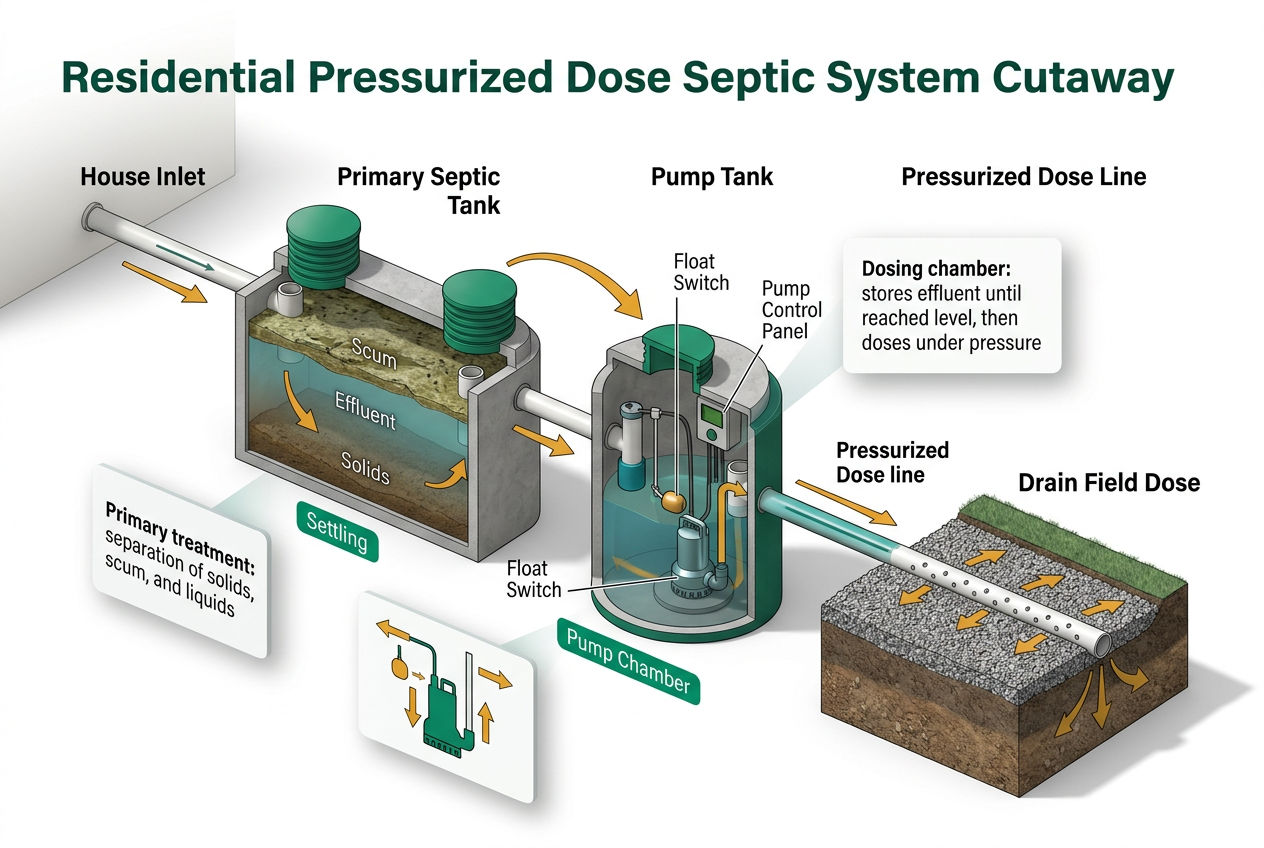
It works in two stages. Wastewater first settles in the septic tank, where solids sink and scum floats. The clearer effluent then flows into a pump tank. When the level rises to a set point, a float switch turns on an effluent pump. The pump pushes a measured dose to the drainfield.
Here's the path, step by step:
- House to septic tank. Everything you flush and drain flows by gravity into the septic tank. Baffle walls and an effluent filter keep sludge and scum in place.
- Septic tank to pump chamber. Liquid effluent flows into the pump tank. This can be a separate tank or a sealed second compartment.
- Floats decide when to pump. A float tree usually holds three floats: pump-off, pump-on, and a high water alarm float.
- Pump sends a dose. The effluent pump pushes liquid through a feedline to a distribution box, a low pressure pipe (LPP) network, or a mound.
- Line drains back. According to Purdue Extension's construction guide, the feedline and manifold must drain back to the pump chamber. That keeps water from sitting in the pipes and freezing.
The control panel runs the show. With demand dosing, the pump runs whenever the "on" float lifts. With timed dosing, a timer sends small doses on a schedule. That spreads flow evenly and protects the soil on heavy-use days. Michigan EGLE's Technical Guide for Pressure Mound Systems defines both approaches for that state.
People often confuse an effluent pump with a sewage ejector or grinder pump. Effluent pumps handle liquid that's already been settled. Grinder pumps chew up raw sewage. Our effluent pump vs. grinder pump comparison covers when each one makes sense.
What's the Difference Between a Septic Tank and a Septic Dosing Tank?
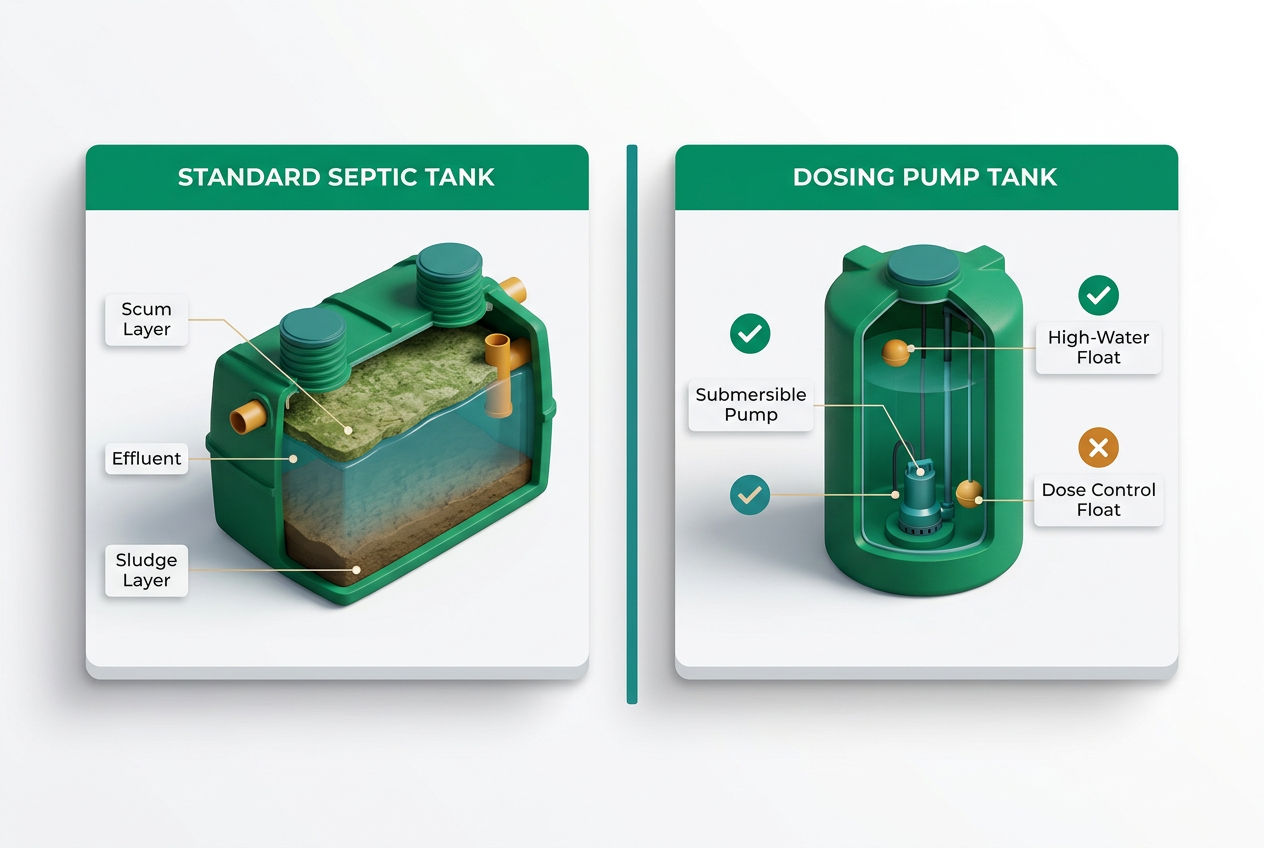
Treatment happens in the first tank, where solids settle and break down. A dosing tank only stores the liquid that leaves the septic tank. It then pumps that liquid out in controlled doses. Because it receives clarified effluent, a healthy dosing tank should hold very little sludge.
The terms "pump tank," "pump chamber," and "dosing tank" mean roughly the same thing. A lift station usually refers to a pump setup that moves raw sewage. It's common for a basement bathroom or a house that sits below the street sewer. See our lift station guide if that's your situation.
Can the pump go inside a two-compartment septic tank instead of a separate tank? Sometimes. Infiltrator/ADS addresses this in a Question of the Week post. According to that post, a separate pump chamber may work better if your drainfield design calls for a larger dose volume. You also must check local code to confirm the combined setup is allowed. Some counties approve it, and others don't.
A dosing tank won't fix a septic tank that's sending solids downstream. If baffles break or the effluent filter clogs, sludge ends up in the pump chamber. That chokes the pump and fouls the drainfield orifices. A screened pump vault, such as Orenco's Biotube vault, cuts down on solids reaching the pump. It still doesn't replace regular pumping. Our guide to how often to pump a septic tank covers the schedule.
Why Would a Home Need a Septic Pump Tank?
Gravity is the deciding factor. A pump tank goes in when effluent can't flow downhill to good soil or when the drainfield design needs pressure. Typical triggers include a drainfield uphill from the tank, shallow soil, a high water table, bedrock, or a pressure distribution design. Mound and LPP systems almost always need one because they depend on even, pressurized dosing.
The EPA's mound system fact sheet describes mounds as pressure-dosed sand filters. That's why they nearly always include a dosing tank. According to the EPA, the design dates back to North Dakota in the late 1940s. It's still common across the Upper Midwest. Our mound septic systems guide goes deeper on how they're built.
Geography shapes what you'll see:
- Upper Midwest (Minnesota, Wisconsin, Michigan, the Dakotas): Mounds are common where soil is shallow or wet. Minnesota regulates these systems under Minnesota Rules Chapter 7080. Wisconsin regulates them under SPS 383. Michigan publishes a full technical guide for pressure mounds.
- Pacific Northwest and Southeast: LPP and other pressure systems show up often on tight lots and in soils that need even spreading.
- Hilly lots anywhere: If the best soil sits above the house, the effluent has to go uphill. Our article on septic systems on a slope explains the layout choices.
- Ontario: Pump chambers fall under Ontario Building Code article 8.6.1.3. That's according to the Ontario Onsite Wastewater Association's Pump Chamber Guidance Document.
Here's a common situation for rural buyers. The listing says "conventional septic," and then the inspector finds a control panel behind the garage. You don't need to walk away from the house. You do need to budget for a pump, floats, and an alarm, because each part has its own lifespan and electrical needs. Before closing, ask the seller for the pump's install date and any service records.
How Big Should a Septic Pump Tank Be?
Match or exceed the septic tank's volume. According to Purdue Extension, that size lets the chamber hold at least one day of reserve storage after the high water alarm goes off. The buffer gives you time to call for service when a pump or float fails. Purdue Extension's guide to building a pressure distribution system states the rule plainly.
In practice, a home with a 1,000-gallon septic tank would get a pump chamber of 1,000 gallons or more. Your local code may set a different minimum, so your designer has the final say. For septic tank sizing by bedroom count, see our septic tank size chart.
Worked example: what reserve storage buys you
Say a 4-person household uses about 250 gallons of water a day. That's a round number for illustration. According to the EPA's WaterSense program, the average American uses roughly 82 gallons of water a day at home. Indoor use alone is lower, so 250 gallons is a realistic figure for a family of four.
Now suppose the pump's float fails at 9 p.m. on a Friday.
- The alarm sounds once effluent rises past the alarm float.
- The space above that float is sized to hold about one day of flow. In this example, that's roughly 250 gallons.
- Suppose the family skips laundry and dishwasher loads and takes short showers. Use can drop to around 100 gallons a day. 250 ÷ 100 = 2.5 days of buffer.
- If they ignore the alarm and keep living normally, the chamber fills by Saturday night. Effluent can then back up into the septic tank and eventually the house.
A Friday-night failure is manageable if you cut water use right away. Don't expect the reserve to cover a week of normal living. Plan on a weekend at most.
Dose volume matters too. According to the OOWA guidance, the chamber must be big enough for the required dose volume. Sizing it tight to save money can backfire if the drainfield design calls for larger doses.
What Does a Septic System With a Pump Cost?
A pumped system costs more than a gravity system. Replacing just the effluent pump commonly runs $500–$2,500. A new pump tank with floats, panel, and wiring adds well beyond that to a full install. The total covers the pump tank, effluent pump, floats, control panel, alarm, and electrical work. Those costs come on top of the septic tank and drainfield. Mounds usually cost the most because of the imported sand fill.
Where these numbers come from, and their limits: The ranges below come from our review of published installer and contractor price pages for effluent pump service. They are not a national survey, and they aren't from a government source. We couldn't verify reliable national figures for complete new installs, so we haven't published a single number for that. Prices swing widely with soil, permits, region, and site access. Treat these as planning ranges and get itemized quotes from licensed installers.
| Component or job | Typical range (installer quotes reviewed) | What moves the price |
|---|---|---|
| Effluent pump replacement (parts + labor) | $500–$2,500 | Pump horsepower, head height, vault access |
| Float switch replacement | $150–$500 | Number of floats, service call fees |
| Control panel / alarm replacement | $300–$1,200 | Simplex vs. duplex, timer controls |
| Dedicated electrical circuit | Varies widely | Distance from the house panel, local electrician rates |
Our septic installation cost guide breaks down whole-system pricing by system type. For pump-only jobs, see our septic pump replacement cost guide.

How Is a Septic Pump Tank Installed?

DIY Septic Blueprint
Thinking about building it yourself?
The complete, plain-English plan to size, permit and install your own septic system — designed for homeowners, not contractors. Skip the $15,000–$25,000 quotes and do it right the first time.
Get the DIY Blueprint — $67 →Instant download · 8 modules + 3 bonus guides · 60-day money-back guaranteeA licensed installer handles the install under a permit, following a design approved by your local health department. The main steps look like this:
- Design and permit. A designer or soil professional sizes the tank, pump, and dose based on soil tests and the drainfield type.
- Excavation and setting. The tank is set level on a stable base. Risers bring the lid to grade so you can reach it for service.
- Watertightness. Many codes require a leak test. Groundwater seeping into the chamber makes the pump run far more often than it should.
- Pump, vault, and floats. The pump sits on a block or in a screened vault, off the tank floor. The floats are set at elevations the designer specifies.
- Electrical. The pump and alarm should run on separate circuits, so a tripped pump breaker doesn't also silence the alarm. A licensed electrician should do this work where code requires it.
- Startup and inspection. The installer checks run time, dose volume, and alarm function before the inspector signs off.
If you're replacing an existing pump rather than building new, our septic pump repair and replacement service page explains what a service visit includes.
How Do You Maintain a Septic Pump Tank?
Most pump tank problems trace back to the septic tank upstream, so maintenance starts there.
- Pump the septic tank on schedule. According to the EPA's SepticSmart program, most household septic tanks should be pumped every three to five years.
- Clean the effluent filter. Hose it off over the septic tank opening, not onto the lawn, during routine service.
- Test the alarm. Most panels have a test switch. Press it every few months so you know the alarm works.
- Have the pump chamber inspected at each septic service. A technician can check the floats, measure pump draw, and look for sludge buildup.
- Watch run time. Some panels include a cycle counter or elapsed-time meter. A sudden jump can point to a leaking fixture or groundwater getting in.
Pumped systems carry one honest drawback: they depend on electricity and moving parts. A gravity system can run for decades with little attention. A pumped system will need a new pump and floats at some point, no matter how well you care for it.
What Should You Do When the Septic Alarm Goes Off?
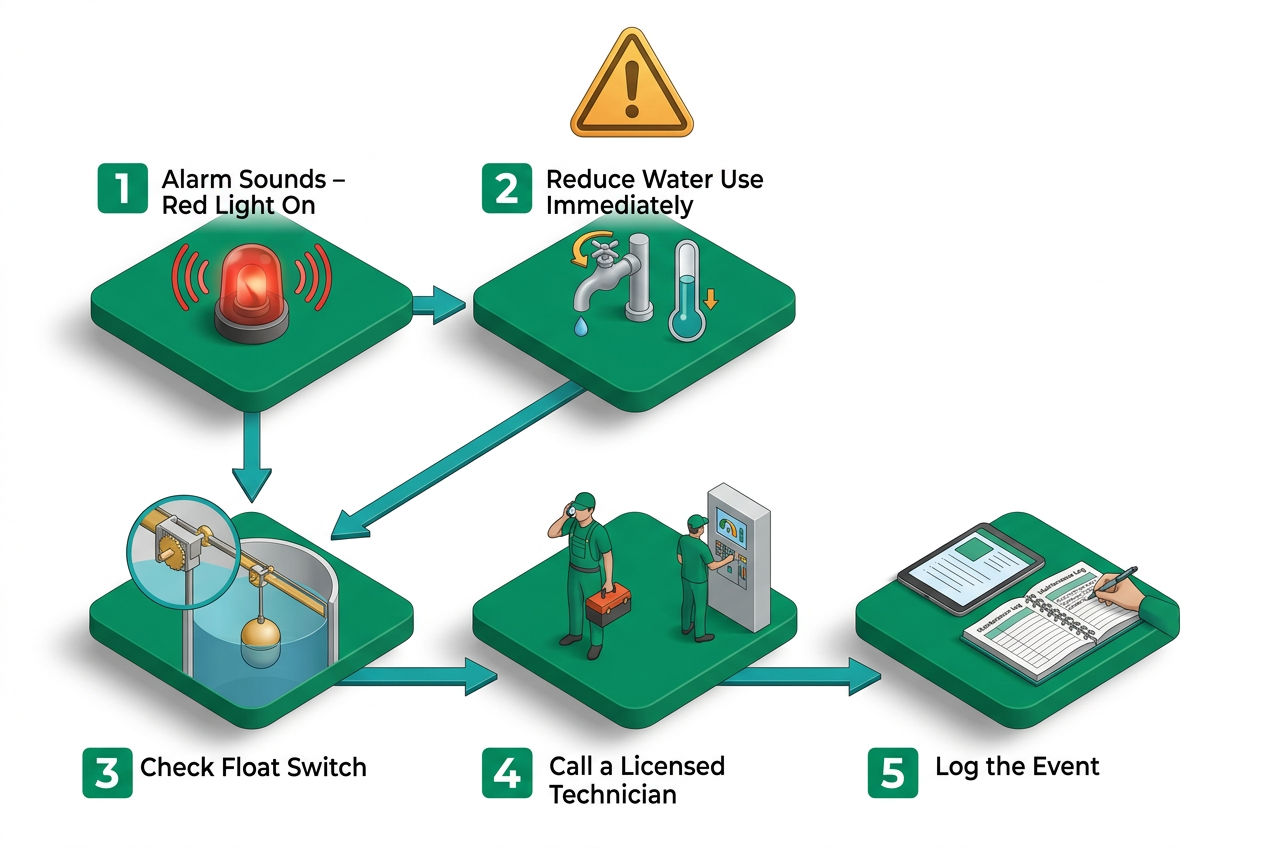
Cut water use right away, then troubleshoot.
- Silence the alarm with the panel's silence button. Don't unplug or switch off the panel.
- Stop using water. Hold off on laundry, dishwashers, and long showers.
- Check the breakers. A tripped pump breaker is a common, easy fix. If it trips again right after you reset it, stop and call a pro.
- Wait a few hours. After heavy use, the pump may simply catch up and the alarm will clear on its own.
- Call for service if the alarm returns or won't clear. Persistent wet spots or odors over the drainfield can signal a deeper problem. Our guide to drainfield failure signs explains what to look for.
Never climb into a pump tank. Septic gases can be deadly in a confined space.
More Septic Design & Install Guides
- Septic Holding Tank: Cost, Sizes, Rules & Holding Tank vs. Septic System
- Conventional Septic System: How It Works, What It Costs & When You Can Use One
- Drip Septic System: How Drip Dispersal Works, Cost & Design
- Septic System for a 2-Bedroom House: Tank Size, Drain Field & Cost
- Septic System for a 5-Bedroom House: Tank Size, Drain Field & Cost
- Concrete Septic Tank Price: 1,000-Gallon and Other Sizes in 2026
- How Long Is a Perc Test Good For? Expiration and Retesting Explained
- How to Backfill a Septic Tank
- Septic Inspection Before Backfill: What the Inspector Checks
- Septic system design: the complete guide
- Can you install your own septic system? Rules by state
Frequently Asked Questions
How long does a septic effluent pump last?
A well-installed effluent pump often lasts 7 to 15 years. Float switches usually wear out sooner. That's a general range drawn from installer guidance, not a guaranteed figure, and real lifespan varies a lot. The biggest factor is how much solid material reaches the pump. A septic tank that's pumped on schedule, with a clean effluent filter, sends cleaner liquid downstream. That means less wear on the impeller. Short cycling also shortens pump life. It happens when floats are set too close together or groundwater leaks into the chamber, and it makes the motor start far more often than designed. Pumps sized correctly for the head height and dose volume also run cooler and last longer. If your pump is past ten years old, ask your service provider to measure its amp draw at the next visit. A rising reading can warn you of failure before an alarm does.
Do all septic systems need a pump?
No. Many septic systems run entirely on gravity and never need a pump. A gravity system works when the drainfield sits lower than the septic tank and the soil can absorb effluent without pressure. You need a pump tank when gravity can't do the job. That happens when the drainfield sits uphill from the tank, or when shallow soil, a high water table, or bedrock forces a mound. It's also needed when the design calls for pressure distribution, such as a low pressure pipe system. According to the EPA, mound systems are pressure-dosed sand filters, so they almost always include a dosing tank. Your county health department or septic designer decides based on soil tests and site conditions. If you're buying a rural home, look for a control panel or alarm box on the property. It's the quickest sign that the system relies on a pump.
What happens if the septic pump stops working?
If the pump fails, effluent keeps flowing into the pump chamber but nothing sends it out. The level rises until it lifts the high water alarm float, which sets off the alarm. According to Purdue Extension, a chamber sized at least as large as the septic tank holds about one day of reserve storage after the alarm goes off. That buffer gives you time to get help. Cut water use sharply, check the pump's breaker, and call a septic professional. If you ignore the alarm, the chamber fills completely. Effluent then backs up into the septic tank and can eventually reach your home's lowest drains. It can also surface in the yard. A pump failure is not an emergency if you act quickly, but it is a problem you should never wait on. A Friday-night alarm usually means a weekend of light water use until service arrives.
How often should a septic pump tank be cleaned?
Most pump tanks only need cleaning when the septic tank before them is pumped, if any sludge has built up. According to the EPA, household septic tanks typically need pumping every three to five years. That interval depends on household size, tank size, and water use. A healthy pump chamber receives settled effluent, so it should collect very little sludge. During routine service, the technician should open the pump tank and check for solids. They should clean the pump screen or vault and confirm the floats move freely. If heavy sludge shows up in the pump chamber, that's a warning sign rather than normal wear. It usually means a broken baffle, a missing or clogged effluent filter, or an overdue septic tank pumping upstream. Fix the cause, or the pump and drainfield orifices will keep clogging. Don't pump the pump tank and skip the septic tank.
Can I replace a septic pump myself?
Some handy homeowners do, but it's often not the best choice, and some jurisdictions don't allow it. The job means working over an open tank full of effluent and lifting a heavy, wet pump. It also means disconnecting wiring and plumbing, then resetting the floats at exact elevations. Septic tanks give off gases that can be deadly, so you should never lean into or enter the chamber. Electrical work on pump circuits may require a licensed electrician under local code. Some states and counties also require a licensed installer or a permit for component replacement. Check with your local health department first. Matching the replacement pump matters too. A pump with the wrong flow or head rating can underdose or overdose the drainfield, which shortens the drainfield's life. In the installer quotes we reviewed, professional replacement runs about $500–$2,500. For most homeowners, that cost is worth paying to avoid those risks.
Sources & Methodology
This article draws on extension, government, and industry sources:
- Purdue Extension, ID-164: Building a Pressure Distribution System (pump chamber sizing, reserve storage, feedline drainback)
- U.S. EPA, Mound Systems fact sheet; EPA SepticSmart guidance (pumping interval); EPA WaterSense (household water use)
- Michigan EGLE, Technical Guide for Pressure Mound Systems (demand and timed dosing)
- Ontario Onsite Wastewater Association, Pump Chamber Guidance Document (Ontario Building Code 8.6.1.3, dose volume)
- Infiltrator/ADS, Question of the Week (sealed pump chambers in two-compartment tanks)
- Minnesota Rules Chapter 7080; Wisconsin SPS 383
Limitations: Cost ranges come from a review of published installer pricing, not a controlled national survey. Lifespan figures are general industry ranges, not manufacturer warranties. Local codes vary, and your licensed designer and health department have the final word on sizing and installation.
Free download
Not ready for the Blueprint? Start free.
Grab the free DIY Septic Planning Kit — the permit-first checklist, perc-test cheat sheet, and sizing tables that keep your build from getting red-tagged.
Was this article helpful?
Frequently Asked Questions
Recommended Resources
📖 Related Articles
- Septic Pumps Explained: Types, Costs & When You Need One
- Effluent Pump: A Side-by-Side Comparison
- What Is a Lift Station? How Sewage Lift Stations Work
- Mound Septic System: $10K–$25K Cost & How It Works (2026)
- Septic System on a Slope: What Works on Hillsides and Steep Lots
- Septic Tank Sizes & Dimensions Chart (by Bedrooms)
Find Septic Professionals Near You
Compare licensed, verified septic companies by area — top county markets and cities below, or browse all 50 states.
County markets
Popular cities
