
Quick Answer
A conventional septic system is a buried watertight tank connected to a gravel or chamber drainfield, where effluent soaks into unsaturated soil for treatment. Most run on gravity alone. Installed cost typically falls between $3,500 and $12,000, but only lots with enough suitable soil and an acceptable perc rate qualify.
Key Takeaways
- A conventional septic system is a tank plus a soil absorption field, usually gravity-fed and with few moving parts.
- Typical 2026 installed cost: $3,500–$12,000. Difficult sites and high-cost markets can exceed $15,000.
- Your lot needs roughly 36–48+ inches of usable soil above groundwater or rock. The exact number depends on your state.
- Most counties cap perc rates near 60 minutes per inch. Fail that, and you're pricing a mound or aerobic unit at $10,000–$25,000.
If you're buying rural land or replacing an old system, a conventional septic system is the option you hope your lot qualifies for. It's the cheapest, simplest design out there. But "simple" doesn't mean "allowed everywhere." This guide covers how it works, what you'll pay, and how to tell if your soil will pass. If you're weighing a hands-on approach, our DIY septic system guide explains what owners can legally do themselves.
How Does a Conventional Septic System Work?
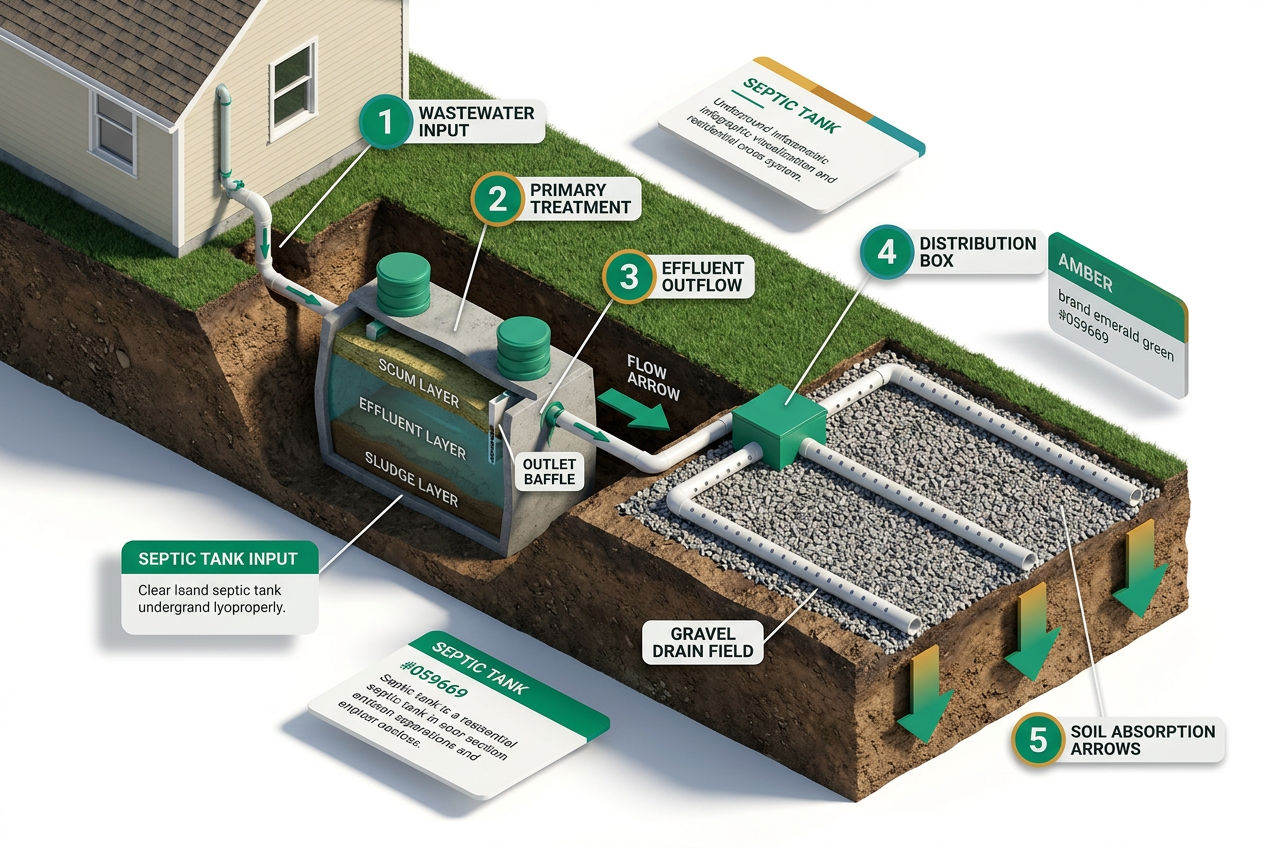
A conventional septic system works in two stages. First, all household wastewater flows through one main drain into a buried tank, where solids settle and anaerobic bacteria break them down. Then the clarified liquid, called effluent, flows into a drainfield of trenches. Soil microbes finish the treatment as the effluent filters down.
The U.S. EPA describes the tank as a buried, watertight container made of concrete, fiberglass, or polyethylene. Inside, three layers form:
- Scum (fats, oils, grease) floats on top.
- Sludge (heavy solids) sinks to the bottom.
- Effluent sits in the middle.
Compartments and a T-shaped outlet baffle keep sludge and scum from leaving the tank. Many installers add an effluent filter at the outlet for extra protection. A household with three or four bedrooms usually gets a 1,000-gallon septic tank, and larger homes often step up to 1,250 or 1,500 gallons. Your state code sets the exact minimum by bedroom count.
From the tank, effluent travels to a distribution box (D-box) that splits flow evenly among the leach laterals. The EPA calls the drainfield "a shallow, covered excavation made in unsaturated soil." That word "unsaturated" matters. Soil has to contain air for bacteria to kill pathogens. Waterlogged soil can't do the job.
What Do the Drainfield Trenches Look Like?
Rockingham County, North Carolina, offers a typical spec. Conventional gravel trenches run 24–30 inches deep and 36 inches wide, spaced 9 feet apart on center, and follow the land's contour. Each trench holds a 4-inch perforated pipe bedded in washed stone.
Many installers now swap stone for plastic chambers, such as the Infiltrator Quick4 line. These gravelless chamber systems still count as conventional in most states. Some counties even allow a shorter trench length with chambers.
Is a Gravity Fed Septic System the Same as Conventional?
Mostly, yes. A gravity fed septic system uses natural slope to move wastewater from house to tank to drainfield with no pump, and that's the classic conventional design. But "conventional" describes the tank-and-trench layout, not the power source. Some conventional systems need a pump when the drainfield sits uphill.
Harnett County, North Carolina, states it plainly: a conventional system "may require a pump depending on the location of the house and the septic system area." Picture a house built in a hollow, with the only good soil 80 feet up the slope. The tank still works the same way. You just add a pump chamber, a float switch, and an alarm to push effluent uphill.
That pump changes your long-term costs. A pure gravity septic system has almost nothing to break. A pumped version needs a pump replacement every so often, plus electricity, and it stops working during power outages. If you get to choose, a gravity layout is worth some extra trenching.
How Much Does a Conventional Septic System Cost?
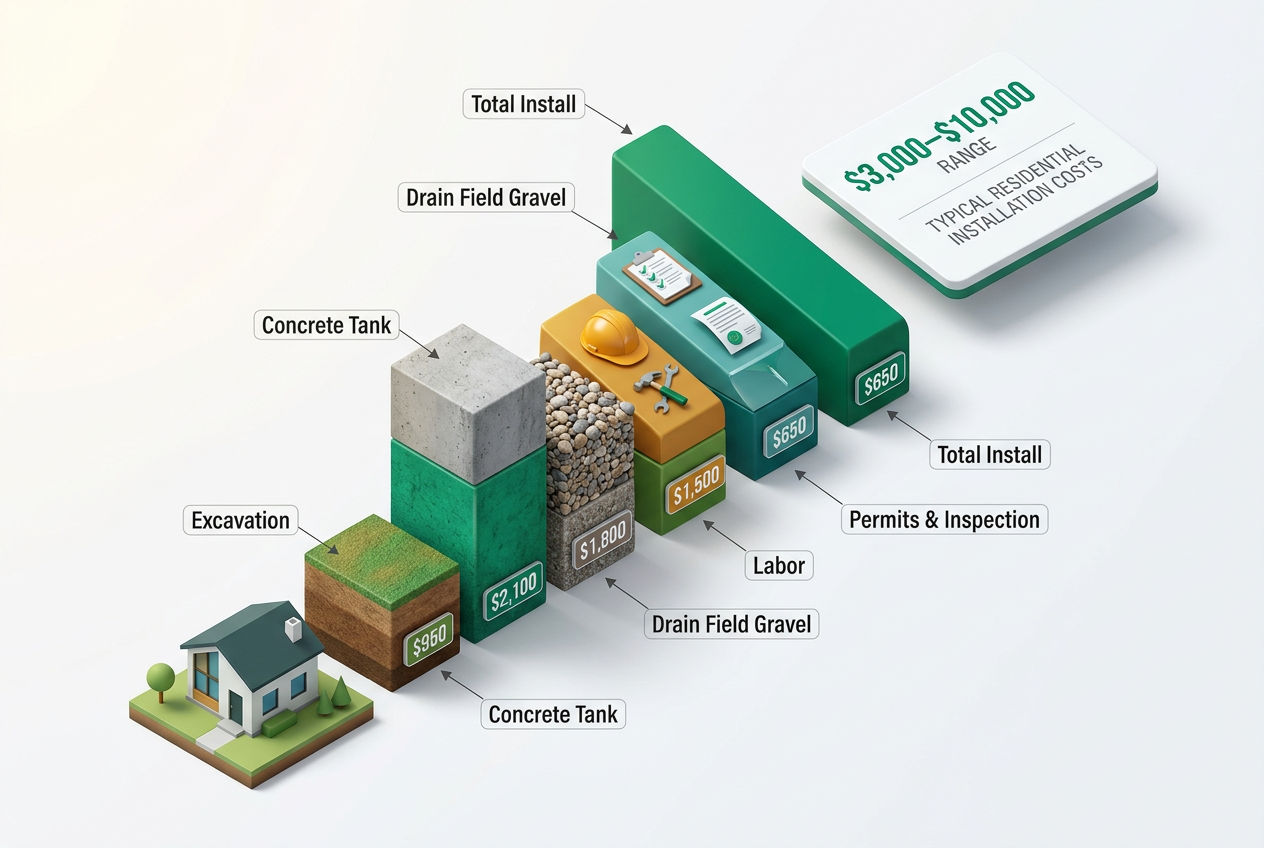
A conventional septic system typically costs $3,500 to $12,000 installed in 2026. HomeGuide puts the range at $3,500–$8,500, while SepticSage cites $3,000–$12,000. One estimator lists $12,400–$21,400 for a 3-bedroom home, which reflects high-cost markets. Sources disagree, so get at least three local quotes.
SepticSage points out that the tank itself is only $900–$2,700 of the bill. The rest goes to the drainfield, excavation, design, and permits. Here's how the conventional septic system cost stacks up against the alternatives you'd face on a tougher lot:
| System Type | Installed Cost (2026) | Best Fit |
|---|---|---|
| Conventional gravity | $3,500–$12,000 | Good soil, 36"+ depth |
| Conventional w/ pump | $5,000–$14,000 | Drainfield uphill |
| Mound system | $10,000–$25,000 | Shallow soil, high water |
| Aerobic (ATU) | $10,000–$25,000 | Poor soil, small lots |
| Engineered system | $15,000–$50,000 | Very difficult sites |
Sources: HomeGuide (2026), SepticSage, and SepticTankHub pricing review. Pump-assisted range is a SepticTankHub estimate. Figures are commercial estimates, not government data.
Worked Example: A 3-Bedroom Home
Here's an illustrative bid for a 3-bedroom house on decent loam in the rural Southeast:
- 1,000-gallon concrete tank, delivered and set: $1,600
- Drainfield (about 300 linear feet of trench): $3,200
- Excavation and backfill: $1,400
- Perc test and soil evaluation: $600
- Design and permit fees: $700
- Total: about $7,500
Move that same house to coastal Massachusetts or the Pacific Northwest and the number often climbs past $15,000. Labor rates, engineering requirements, and permit fees all run higher there. See our septic installation cost guide for state-by-state ranges.
Timing matters too. In northern states, frozen ground stops excavation and perc testing for months. Spring backlogs can push installs out by 6–10 weeks, so book your soil test in late summer or fall if you can.
What Soil Do You Need for a Conventional Septic System?
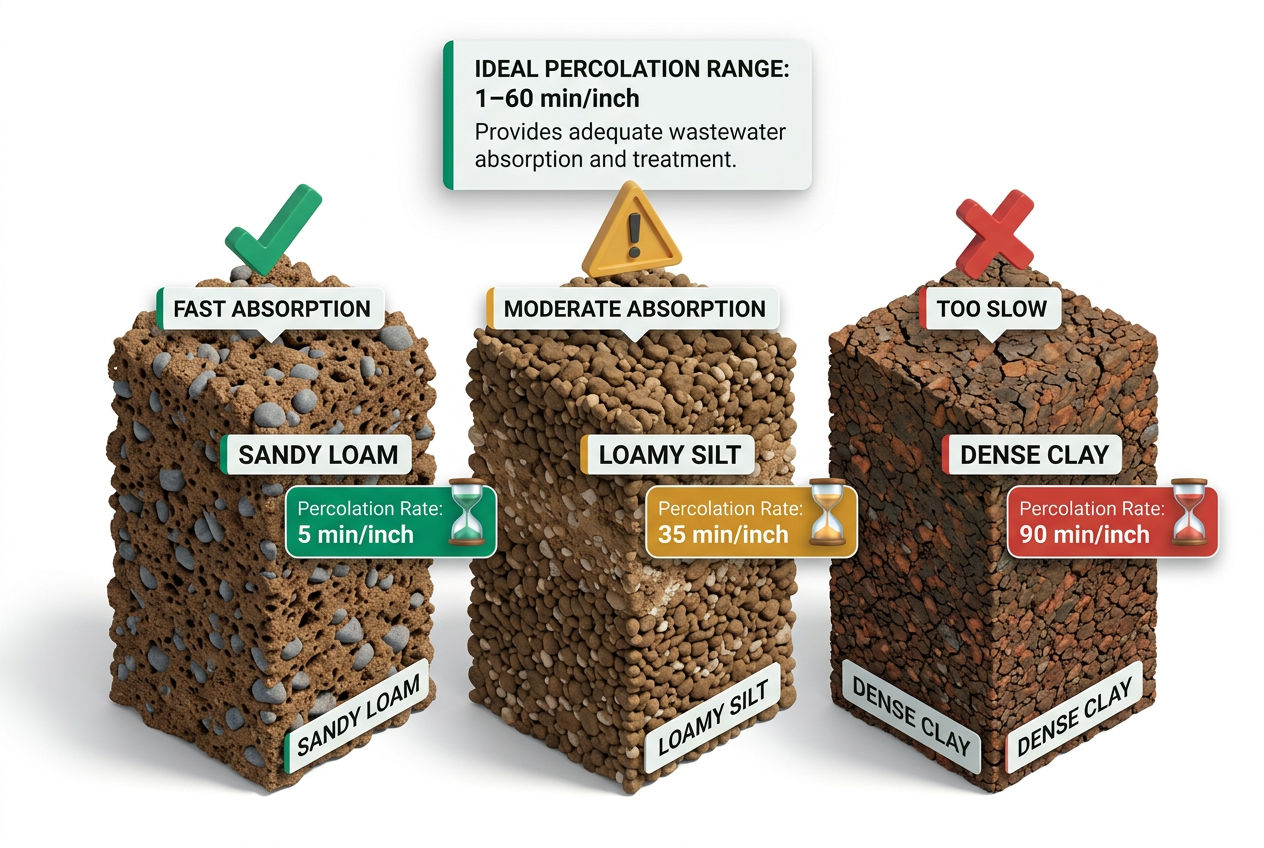
You need two things: enough unsaturated soil depth and a perc rate within local limits. Most jurisdictions require 36–60 inches of suitable soil between the trench bottom (or ground surface) and the seasonal high water table, bedrock, or restrictive layers. The perc rate usually must fall between 10 and 60 minutes per inch.
Depth rules vary sharply by state:
- North Carolina (Harnett County): at least 36 inches of suitable or provisionally suitable soil.
- New York (Appendix 75-A): at least 4 feet of usable soil above rock, unsuitable soil, or high seasonal groundwater.
- Malibu, California: 5 feet of vertical separation between the bottom of leaching trenches and seasonal high groundwater.
Perc limits vary as well. The University of Missouri Extension recommends perc results in the 10–60 MPI range. Nationally, 60 MPI is a common cutoff for gravity systems, but local rules range from 30 to 120 MPI. Soil that drains too fast, under about 5–10 MPI, can fail too. Effluent rushes to groundwater before bacteria can treat it.
Want to know how testing works before the county soil scientist shows up? Read our percolation test guide.
Some jurisdictions also require a wet-season water table evaluation, so a dry-August test may not count. Coastal plains, Florida, and the Gulf Coast fail more often because of high water tables. Clay soils and shallow bedrock in parts of the Midwest and New England cause similar trouble.
Conventional Septic vs. Mound System: Which Do You Need?
DIY Septic Blueprint
Thinking about building it yourself?
The complete, plain-English plan to size, permit and install your own septic system — designed for homeowners, not contractors. Skip the $15,000–$25,000 quotes and do it right the first time.
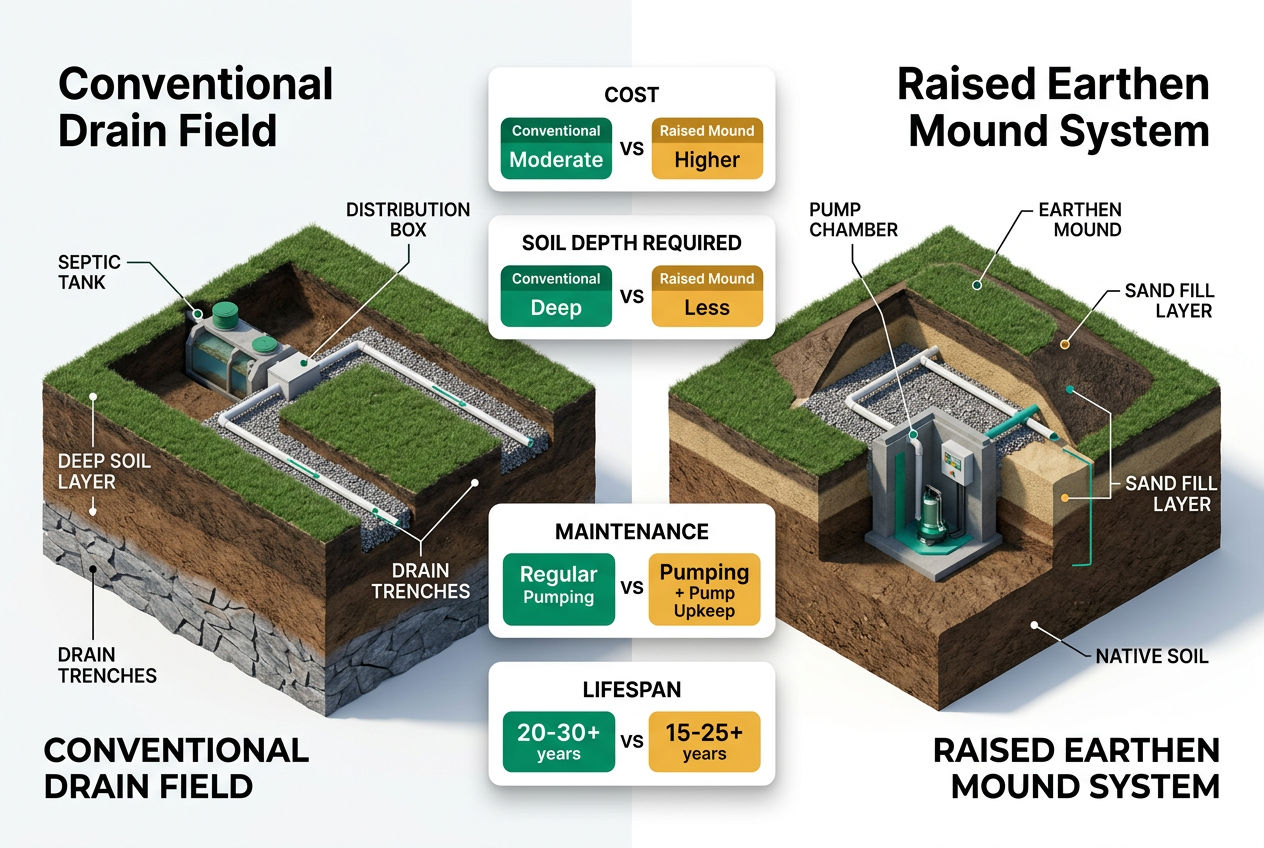
Get the DIY Blueprint — $67 →Instant download · 8 modules + 3 bonus guides · 60-day money-back guaranteeYou need a conventional septic system if your lot has enough deep, well-drained soil. You need a mound system if your soil is too shallow, too wet, or sits too close to bedrock. A mound builds an engineered sand bed above grade and pressure-doses effluent into it, roughly doubling cost or more.
Your county health department makes the call, not you or your installer. The EPA confirms that onsite systems are regulated by states, tribes, and local governments rather than federally. The choice depends on lot size, slope, soil, and budget.
Here's a scenario I see often. A buyer finds a cheap 2-acre parcel and budgets $8,000 for septic. The soil evaluation finds mottled clay at 22 inches, a sign of seasonal saturation. Now they're looking at a mound septic system for $18,000 or an aerobic septic system with its own maintenance contract. That $10,000 surprise is why you should make any land offer contingent on a passing soil test.
If your test already came back bad, our guide to failed perc test options walks through every path forward.
How Do You Maintain a Conventional Septic System?
Maintaining a conventional septic system mostly means pumping the tank every 3–5 years, keeping solids and grease out, and protecting the drainfield. Rockingham County, NC, sets that 3–5 year interval. Exact timing depends on tank size and household size. A 1,000-gallon tank with five people fills faster than one with two.
As a rough guide, a 4-person home on a 1,000-gallon tank should plan on pumping about every 3 years. Add a garbage disposal and that interval gets shorter. Use our guide on how often to pump your septic tank to get a schedule for your household.
What a conventional system can't do matters just as much:
- It can't handle grease, wipes, or heavy chemical use without clogging the biomat in the drainfield.
- It can't recover by itself once the drainfield soil is sealed. Additives won't reverse it.
- It doesn't treat wastewater to the level an aerobic unit does, which is why some lakefront and coastal zones require upgrades.
Spring is the riskiest season. Saturated soils slow absorption, and that's when you'll spot soggy grass or odors over the field. Schedule pumping and inspections in late summer or fall, when the soil is driest and problems are easier to diagnose.
How Long Does a Conventional Septic System Last?
A well-maintained conventional septic system often lasts decades. Commonly cited estimates put concrete tanks at 20–30+ years and drainfields at roughly 15–25 years. These figures are industry rules of thumb, not government data. Soil type, pumping habits, and water use matter more than age alone.
The drainfield usually fails first. When it does, you don't always need a whole new system. If the tank is sound, a drainfield replacement runs about $3,000–$15,000 depending on size, soil, and region. Your site still has to meet current depth and perc rules, though. A lot that qualified in 1985 may need a mound today.
Ready to price a new system or replacement? Find a septic installer near you and request a site evaluation before you sign anything.
Sources & Methodology
We built this guide from government and university sources. Cost data comes from commercial estimators and is presented as ranges.
- U.S. EPA, How Septic Systems Work: Tank and drainfield function, sludge and scum separation, unsaturated soil requirement.
- U.S. EPA, Frequent Questions on Septic Systems: State, tribal, and local regulation of onsite systems.
- Rockingham County, NC, Types of Septic Systems: Trench dimensions and 3–5 year pumping interval.
- University of Missouri Extension, EQ401: 10–60 MPI perc range for absorption fields.
- New York State Department of Health, Appendix 75-A: 4-foot usable soil requirement.
- HomeGuide (2026): Installed cost ranges for conventional, alternative, and engineered systems.
Lifespan figures are industry estimates and haven't been independently verified. Always confirm depth, setback, and perc rules with your county health department.
About the Author
The SepticTankHub editorial team writes plain-English guides on septic installation, maintenance, and costs. Every article is checked against EPA guidance, state health codes, and university extension research.
More Septic Design & Install Guides
- Septic Pump Tank: How a Septic System With a Pump Works, Costs & Installs
- Septic Holding Tank: Cost, Sizes, Rules & Holding Tank vs. Septic System
- Drip Septic System: How Drip Dispersal Works, Cost & Design
- Septic System for a 2-Bedroom House: Tank Size, Drain Field & Cost
- Septic System for a 5-Bedroom House: Tank Size, Drain Field & Cost
- Concrete Septic Tank Price: 1,000-Gallon and Other Sizes in 2026
- How Long Is a Perc Test Good For? Expiration and Retesting Explained
- How to Backfill a Septic Tank
- Septic Inspection Before Backfill: What the Inspector Checks
- Septic system design: the complete guide
- Can you install your own septic system? Rules by state
Frequently Asked Questions
What is a conventional septic system?
A conventional septic system is a buried watertight tank connected to a soil absorption field, usually gravel trenches or plastic chambers. Wastewater flows from your house into the tank. There, solids settle into sludge, grease floats as scum, and anaerobic bacteria break down organic matter. The clarified effluent then flows through a distribution box into perforated pipes in the drainfield. It filters through unsaturated soil, where microbes remove pathogens and nutrients before the water reaches groundwater. Most conventional systems run entirely on gravity and have no moving parts, which keeps them cheap and dependable. They do require a lot with enough suitable soil depth, often 36–48 inches, plus an acceptable perc rate. Your county health department decides whether your property qualifies after a soil evaluation.
How much does a conventional septic system cost in 2026?
Conventional septic system cost typically runs $3,500 to $12,000 installed in 2026. HomeGuide estimates $3,500–$8,500, while SepticSage cites $3,000–$12,000. The tank itself is only $900–$2,700 of that total. Most of the money goes to the drainfield, excavation, perc testing, design, and permit fees. A 3-bedroom home on good soil in the rural Southeast might come in around $7,500. The same system in the Northeast or on the West Coast can top $15,000 because of higher labor and permit costs. Sloped lots that need a pump add more. If your site fails the soil test, expect $10,000–$25,000 for a mound or aerobic unit. Get at least three written local bids, and confirm whether each one includes permits and the soil evaluation.
How does a gravity fed septic system work?
A gravity fed septic system uses natural slope to move wastewater without any pump or electricity. Sewage leaves the house through a 4-inch drain pipe set on a steady downhill grade into the septic tank. Solids settle in the tank while effluent rises to the outlet baffle. As new water enters, an equal amount of effluent flows out by gravity to a distribution box. The box splits it evenly among the drainfield trenches. From there, the effluent seeps through gravel or chambers into the soil. Since there's no pump, float switch, or alarm to fail, gravity systems have the lowest operating costs of any septic design. The catch is layout. The tank and drainfield must sit lower than the house. If the only good soil is uphill, you'll need a pump chamber.
What is the difference between a gravity septic system and a pressure system?
A gravity septic system relies on downhill flow to spread effluent through the drainfield. A pressure system uses a pump to dose effluent under pressure through small-diameter pipes. Gravity systems are cheaper, simpler, and keep working during power outages. However, effluent tends to load the first part of each trench most heavily. Pressure distribution spreads effluent evenly across the whole field. That makes it a better fit for marginal soils, uphill drainfields, and mound systems. It adds a pump chamber, a float switch, a high-water alarm, and electricity costs, and the pump will eventually need replacing. Many states still classify a pumped tank-and-trench layout as conventional. Your county may require pressure distribution when soil depth is borderline or when the drainfield sits higher than the tank outlet.
What soil do you need for a conventional septic system?
A conventional septic system needs enough unsaturated, permeable soil and a perc rate within local limits. Depth rules vary by state. North Carolina's Harnett County requires at least 36 inches of suitable soil. New York requires 4 feet of usable soil above rock or seasonal groundwater. Malibu, California, demands 5 feet of separation below leaching trenches. Perc rates usually need to fall between about 10 and 60 minutes per inch, per the University of Missouri Extension. Some jurisdictions allow anywhere from 30 to 120 MPI. Heavy clay, shallow bedrock, and high water tables are the most common reasons sites fail. These problems show up often in Florida, the Gulf Coast, coastal plains, and parts of New England. A licensed soil evaluator or county sanitarian makes the final determination.
Free download
Not ready for the Blueprint? Start free.
Grab the free DIY Septic Planning Kit — the permit-first checklist, perc-test cheat sheet, and sizing tables that keep your build from getting red-tagged.
Was this article helpful?
Frequently Asked Questions
Recommended Resources
📖 Related Articles
- DIY Septic System: How to Build Your Own (Step-by-Step)
- 1000-Gallon Septic Tank: Dimensions, Cost & Concrete vs Plastic
- What Is a Distribution Box in a Septic System?
- Perc Test (Percolation Test): What It Is & How It Works
- Mound Septic System: $10K–$25K Cost & How It Works (2026)
- Aerobic Septic System (ATU) Cost: $10K–$20K Install (2026)
- Land Failed the Perc Test? Here Are Your Options
- How Often Should You Pump Your Septic Tank?
💰 Cost Guides
🔧 Services
Find Septic Professionals Near You
Compare licensed, verified septic companies by area — top county markets and cities below, or browse all 50 states.
County markets
Popular cities
