
Quick Answer
Septic distribution box installation means setting a concrete or plastic box between the septic tank and the drainfield so effluent splits evenly into each trench. The inlet sits higher than the outlets, and every outlet sits at the same height. The box sits level on the base your code requires, and you water-test it before backfill, often with an inspector watching.
Key Takeaways
- The inlet must sit higher than the outlets, and every outlet must sit at the same height (Santa Cruz County Environmental Health; New York Appendix 75-A.7).
- Massachusetts Title 5 and New York's Appendix 75-A both require at least a 2-inch drop from the inlet invert to the outlet inverts.
- Base rules differ: crushed stone or a concrete pad in Massachusetts, 12 inches of sand or pea gravel in New York, a cement or grout pad in Santa Cruz County, and level undisturbed soil (not a concrete slab) for Tuf-Tite boxes.
- Flow levelers such as Tuf-Tite Speed Levelers or the Polylok Equalizer fine-tune each outlet after the box is set.
- Angi puts septic distribution box replacement at $500–$1,500, or about $1,000 on average (updated December 2025).
NDSU Extension describes a common warning sign of distribution box trouble: the soil gets soggy over one trench but stays dry over the others. Its advice is to open the box, check the water flow to the outlets, and re-level the box if needed.
The box is small, but it controls how the whole drainfield ages. This guide covers septic d-box installation from the base up. It explains how to level the box, how to test it, and what a distribution box inspection looks for.
What Does a Septic Distribution Box Do?
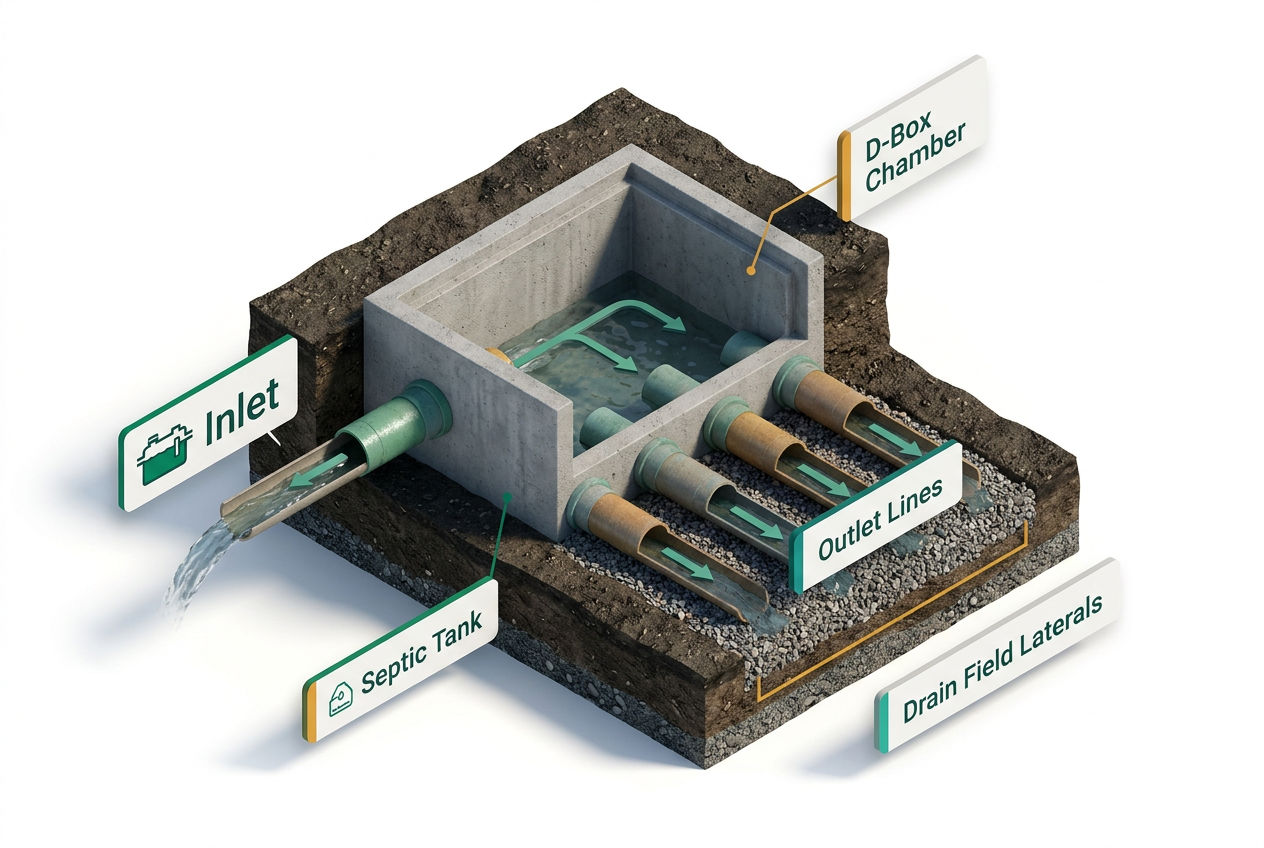
A septic distribution box receives effluent from the tank through one inlet pipe and divides it equally among several outlet pipes. Each outlet feeds one drainfield trench, also called a lateral. All the outlets sit at the same height, so each trench should get the same share of water, and the load spreads across the whole field.
The trouble starts when the box tilts. NDSU Extension's guide says that if the box gets tilted, the trench served by the lowest outlet will receive the greatest amount of effluent. It also says frost action or flooding makes keeping all outlets at the same elevation for the life of the system "virtually impossible," which is why boxes need checking. Your drainfield is only as healthy as its most overloaded trench.
Boxes come in two main materials:
- Precast concrete: Santa Cruz County notes that boxes are typically made of polyethylene or reinforced concrete with plumbing "knock outs," and requires the piping to be resealed with grout or caulking compound.
- Polyethylene (plastic): Tuf-Tite's boxes are injection-molded HDPE with snap-in pipe seals. New York's Appendix 75-A requires a bed of sand or pea gravel at least 12 inches thick under any box to minimize frost action and reduce movement.
Box size and outlet count vary. NDSU says boxes usually have three outlets, while manufacturer lines go higher: Tuf-Tite makes 7- and 9-hole boxes, and Polylok's 2026 catalog lists 6-, 7- and 8-hole round boxes. Check the spec sheet for your model. For a full overview of parts and types, see our septic distribution box guide.
D-boxes also have a limit on terrain. NDSU Extension's guide Individual Home Sewage Treatment Systems (AE-892) says distribution boxes are used only on level terrain and drop boxes are required for trench systems on hillsides. If your field runs downhill, read our guide to a septic system on a slope before you buy anything.
Can You Do a Septic Distribution Box Installation Yourself?
Whether you can legally install or replace a septic distribution box yourself depends on your state and county. Call your local health department first, because the rules vary widely.
Some examples of how far local rules go: Santa Cruz County, California keeps a list of approved distribution devices, and Environmental Health staff must confirm the flow adjustment during the construction inspection. Massachusetts sets d-box construction and design rules in Title 5 (310 CMR 15.232), and New York sets them in 10 NYCRR Appendix 75-A.7. Our page on septic system permit requirements explains how to find your local code.
If you're weighing a hands-on build, start with our DIY septic system pillar guide. It covers which jobs homeowners can usually take on and which ones they can't.
How Do You Install a Septic Distribution Box Step by Step?
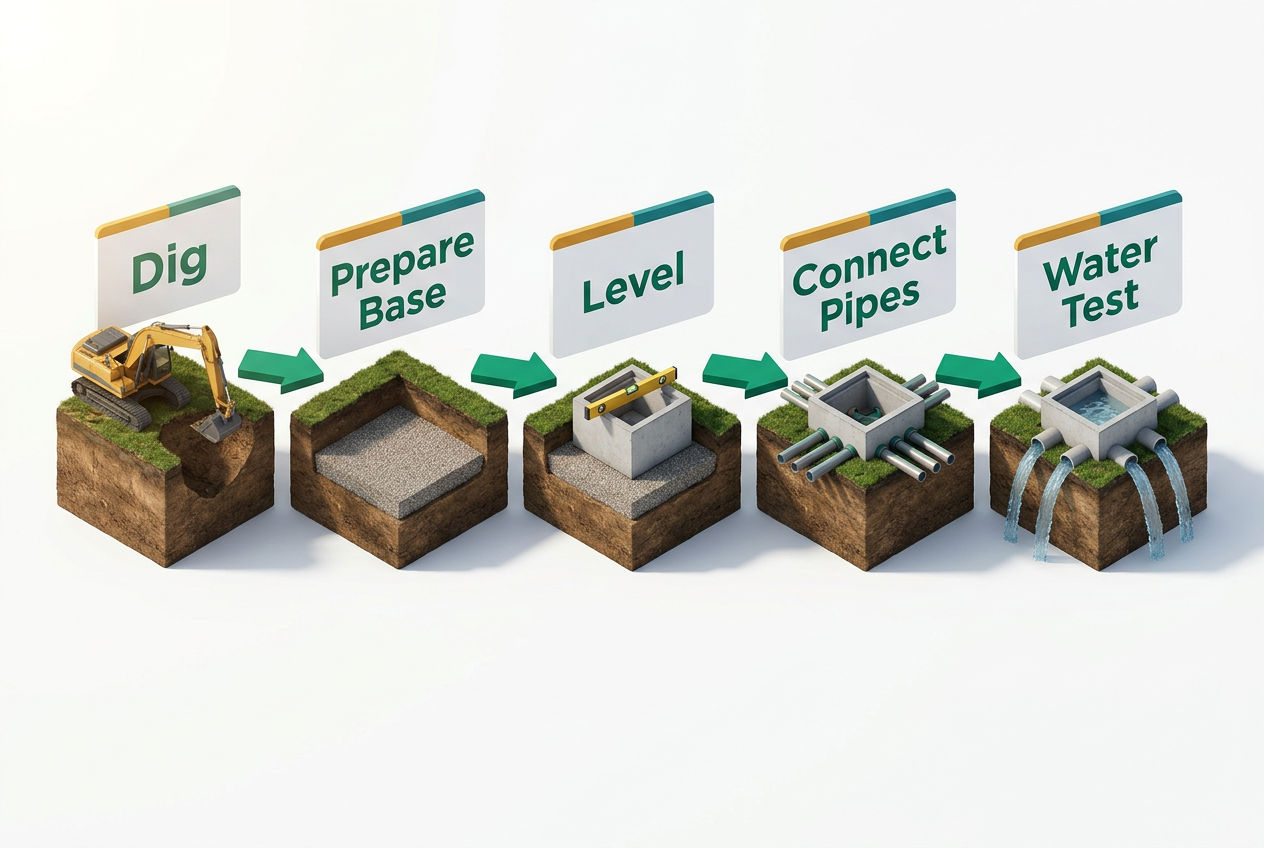
To install a septic distribution box, follow these steps:
- Dig to the elevations on your plan.
- Build the required base and set the box level.
- Connect the inlet higher than the outlets and seal every pipe.
- Water-test for even flow.
- Add a riser if your code requires one.
- Get any required inspection before you backfill.
The steps below assume a permitted, gravity-fed conventional system.
Step 1: Dig to plan depth, and no deeper
Excavate to the elevations shown on your approved design. Santa Cruz County says the location of the box, its plumbing and the required elevations must be worked out in advance. A Saskatchewan Onsite Wastewater Management Association (SOWMA) article by Jim Anderson and David Gustafson names over-excavating the trenches for the supply pipes as a common mistake with drop boxes, and warns that backfilling without proper pipe support can knock boxes out of level.
If you dig too deep, rebuild to the base your code specifies rather than throwing loose dirt back in.
Step 2: Build a solid base
Base rules differ by code and by box, so follow yours:
- Massachusetts Title 5: a plastic box must sit level on a mechanically compacted, stable base topped with 6 inches of crushed stone, or on a concrete pad at least 6 inches thick and 1.5 times the box's bottom area.
- New York Appendix 75-A.7: a bed of sand or pea gravel at least 12 inches thick.
- Santa Cruz County: the box must be "wet set" on a pad of cement or grout on level undisturbed or mechanically compacted soil.
- NDSU Extension: a base of crushed rock or gravel to keep the box level.
- Tuf-Tite: position the box on level virgin soil, and do not place it on a concrete slab.
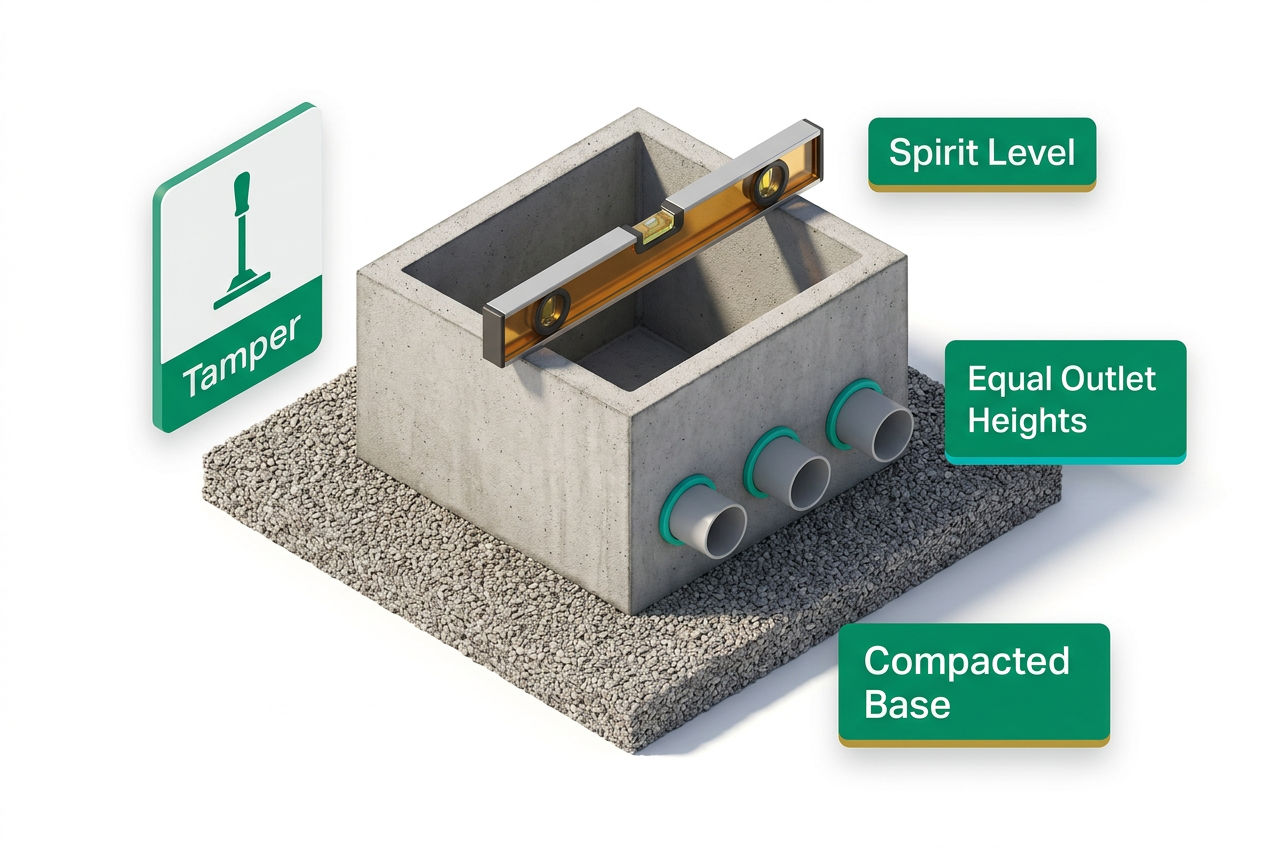
Compact what you build, then check it with a level before the box goes in.
Step 3: Set the inlet higher than the outlets
Santa Cruz County requires the inlet to sit higher than the outlets, with all outlets at the same level. Massachusetts Title 5 requires every outlet invert to sit at least 2 inches below the inlet invert, and New York's Appendix 75-A sets the same 2-inch minimum drop. Tuf-Tite's 7- and 9-hole boxes are built with a 2-inch drop.
The pipe from the tank to the box needs steady fall at the slope your design specifies. Title 5 requires an inlet tee, baffle or splash plate when that slope exceeds 0.08 feet per foot, and New York requires an inlet baffle when it exceeds 1/2 inch per foot. See our septic pipe slope guide for details.
Worked example: Your tank outlet is 20 feet from the box.
- If your design calls for 1/8 inch per foot, the pipe drops 2.5 inches over that run.
- If it calls for 1/4 inch per foot, it drops 5 inches.
Say the tank outlet invert sits at 30 inches below grade. The box inlet would land between 32.5 and 35 inches below grade. With the 2-inch inlet-to-outlet drop that Massachusetts and New York require, the outlets would land between 34.5 and 37 inches below grade. Mark these target heights on grade stakes before you set the box.
Step 4: Connect and seal the pipes
Use the pipe your code allows. NDSU says d-box inlets and outlets commonly are 4 inches in diameter to accommodate plastic pipe. Tuf-Tite's snap-in seals come in versions for SDR 35 (ASTM 3034) and for Schedule 40 or 4-inch corrugated pipe, with plugs for unused holes.
Sealing rules differ too. Santa Cruz County requires the piping to be resealed with grout or caulking compound. The SOWMA article recommends a flexible rubber boot rather than concrete or mortar, warning that concrete will crack and let roots and water in.
Bed every pipe on firm material. Tuf-Tite says the bottoms of all pipes should rest on virgin soil, and SOWMA warns that backfilling without proper support can knock boxes out of level or crack the supply lines.
Leave room below the outlets. New York requires at least 2 inches of clearance between the outlet inverts and the bottom of the box, to prevent short-circuiting and reduce solids carry-over. Massachusetts requires a sump of at least 6 inches below the outlet invert. The invert is the bottom inside edge of the pipe.
Step 5: Level the outlets and run a flow test
Check the box with a level, then run water through it. Adjust until every outlet flows at the same moment. The full d-box leveling procedure is in the next section.
Step 6: Add access, then call for inspection
Access rules depend on your code. New York requires the box's removable cover to be no more than 12 inches below grade, or an extension collar to within 12 inches of the surface. Massachusetts requires risers on any box buried more than 9 inches below grade. SOWMA recommends risers brought to grade so a service provider can check the box. A septic riser to grade saves a dig every time someone needs to check the box.
How Do You Level a Septic Distribution Box?
To level a septic distribution box:
- Set it on the base your code requires.
- Check it with a level in both directions.
- Flood it with water and watch the outlets until flow is equal at every pipe.
- Fine-tune with flow levelers as needed.
A box that looks level but flows unevenly still isn't level.
A typical d-box leveling sequence looks like this:
- Rough level: Lay a level across the box, then rotate it 90 degrees and check again. Tuf-Tite says to level the box and all pipes, backfill the pipes to within two feet of the box, then recheck the box's level.
- Water test: Massachusetts Title 5 checks the outlets by flooding the box to the height of the outlet inverts after all lines are sealed, and requires any outlet that isn't at the same elevation to be adjusted. Santa Cruz County requires adequate water on site for the flow test.
- Watch each outlet: Water should start leaving every outlet at the same moment.
- Fine-tune: Adjust any outlet that runs early or late, then retest.
Flow levelers make fine-tuning much easier. Tuf-Tite's instructions for its Speed Levelers say to insert one into each outlet pipe, fill the box until the water touches the "Inner Guide Ring" of the highest leveler, then rotate each one until its Flo-Hole sits just above the water level and add water to check that it enters all the Flo-Holes at once. Polylok's 2026 catalog lists a 4-inch Equalizer (item 3049); distributor listings describe its knob as adjusting in 1/16-inch increments over a 7/8-inch range.
Levelers have limits. They correct small errors, not a box that is badly out of level or sitting on a soft base. Fix the base first, then use levelers for the last fraction of an inch.
Why Do Distribution Boxes Go Out of Level?

DIY Septic Blueprint
Thinking about building it yourself?
The complete, plain-English plan to size, permit and install your own septic system — designed for homeowners, not contractors. Skip the $15,000–$25,000 quotes and do it right the first time.
Get the DIY Blueprint — $67 →Instant download · 8 modules + 3 bonus guides · 60-day money-back guaranteeDistribution boxes go out of level because the ground or pipes around them move. NDSU Extension names frost action and flooding, and SOWMA warns that backfilling without proper pipe support can knock a box out of level. New York requires its 12-inch sand or pea gravel bed specifically to minimize frost action and reduce movement.
Warning signs include a soggy strip over one trench, which NDSU calls a common sign of d-box trouble, along with the signs covered in our article on signs your drain field is failing.
A practical check: open the box lid or riser and run water through it. NDSU recommends opening the box and checking the flow to the outlets when one trench stays soggy. If one outlet is flowing well before the others, re-level the box or reset the levelers before that trench clogs.
What Does an Inspector Check at a Distribution Box Inspection?
At a distribution box inspection, the inspector confirms the items your local code sets out. In Santa Cruz County, for example, Environmental Health staff must confirm that flow out of the box has been properly adjusted as part of the construction inspection. See our guide to septic inspection before backfill.
Based on the codes cited in this guide, an inspector may check:
- Level and flow: A water test shows equal flow to every outlet.
- Elevations: The inlet is above the outlets by the required drop (2 inches in Massachusetts and New York), with the required space below the outlets (a 2-inch clearance in New York, a 6-inch sump in Massachusetts).
- Base: The base your code requires, with no loose fill.
- Seals: Sealed pipe entries, and unused holes plugged.
- Materials: The box model is on the approved list where one exists, and the pipe is the correct type.
- Access: A riser or extension collar, if the depth calls for one.
Take dated photos of the open box, the level readings, and the water test. If the inspector or a future buyer asks questions, you'll have a record.

How Much Does Septic Distribution Box Replacement Cost?
Angi puts septic distribution box replacement at $500–$1,500, with an average of about $1,000 (Angi, updated December 2025). Box material, outlet count, labor, excavation and permits change the final price.
| Item | Typical range |
|---|---|
| D-box replacement (installed) | $500–$1,500 (avg. ~$1,000, Angi) |
| Box only, plastic | $70–$200 (Angi) |
| Box only, concrete | $90–$400 (Angi) |
| Permit and inspection | Set by your county or state |
These are Angi's national figures. Angi also notes that some states, such as Oregon and Florida, require a repair permit before work starts. For broader repair pricing, see our septic repair cost guide.
Ask every bidder three questions before you hire:
- Will you pull the permit?
- What goes under the box?
- Will you install flow levelers and water-test the box in front of the inspector?
If you'd rather hand off the whole job, find a septic installer near you and get quotes from local pros.
Frequently Asked Questions
How do you install a distribution box for a septic system?
Install a distribution box by following your approved plan in order:
- Excavate to the elevations on your design.
- Build the base your code or box maker specifies.
- Set the box so the inlet sits above the outlets and every outlet sits at the same height.
- Seal each pipe entry with the method your code or box allows, and plug any unused holes.
- Check the box with a level, then flood it with water and confirm every outlet flows at once.
- Adjust with flow levelers if needed, and add a riser if your code requires one at the box's depth.
- Get any required inspection before backfilling.
Check with your county health department before you dig, because base, elevation and approved-model rules vary by jurisdiction.
How level does a septic d-box need to be?
Level enough that every outlet starts flowing at the same moment during a water test. Massachusetts Title 5 (310 CMR 15.232) makes that the test: all outlet inverts must be equal, as determined by flooding the box to the height of the outlet inverts after the lines are sealed, and any that aren't must be adjusted.
NDSU Extension explains why it matters: if the box tilts, the trench served by the lowest outlet gets the most effluent. Start with a stable base and a level check across the box, then fine-tune with flow levelers such as Tuf-Tite Speed Levelers or the Polylok Equalizer. Levelers correct small errors, not a box sitting on soft or settling fill.
What are flow equalizers and do I need them?
Flow equalizers are inserts that fit into each outlet pipe inside a distribution box. Each one has an adjustable opening or weir that sets the height where effluent spills into that line. Tuf-Tite's Speed Levelers fit 3- or 4-inch PVC pipe and rotate by hand; Tuf-Tite sets them by filling the box until water touches the guide ring of the highest leveler, then turning each Flo-Hole to just above the water line. Polylok's 2026 catalog lists a 4-inch Equalizer (item 3049), which distributor listings say adjusts in 1/16-inch increments over a 7/8-inch range.
Tuf-Tite pitches its levelers as a way to fix a tilted box without digging it up and re-leveling it. Some codes don't mention them, so check what yours accepts.
They won't fix a badly tilted box or a failing base. Correct the base first, then use levelers for the final adjustment.
How much does septic distribution box replacement cost?
Angi puts septic distribution box replacement at $500 to $1,500, with an average of about $1,000 (Angi, updated December 2025). Angi lists the box itself at $70 to $200 for plastic and $90 to $400 for concrete, and notes that some states, such as Oregon and Florida, require a repair permit before work starts.
Angi's figures point to several things that change the total:
- Labor and excavation equipment
- Box material and outlet count
- Local permit and inspection fees
Get at least two bids. Ask who pulls the permit, what base material they'll use, and whether they'll install flow levelers. If a drainfield trench has already failed, a new box alone won't repair it.
Does a distribution box need to be inspected before backfilling?
It depends on your jurisdiction, and some require it. Santa Cruz County, California, for example, requires Environmental Health staff to confirm during the construction inspection that flow out of the box has been properly adjusted, and requires adequate water on site for the flow test. Depending on your code, an inspector may check:
- That the box is level and passes a water flow test
- That the inlet sits above the outlets by the required drop
- That the outlet inverts clear the box floor by the required distance
- That joints are sealed and pipes properly supported
- That the box model is approved, where a list exists
- That a riser or extension collar is installed if the box's depth requires one
Ask your health department whether an inspection is required before you backfill, and photograph your level readings and flow test for your records.
Sources & Methodology
This guide draws on state and county regulations, university extension guidance, manufacturer literature, and published cost data. Where codes and manufacturers disagree, the text names each one.
- Santa Cruz County Environmental Health, Local Agency Management Program, Appendix E (August 2, 2021): inlet and outlet levels, wet-set cement or grout pad, grout or caulking seals, flow test witnessed at inspection, approved devices.
- Massachusetts DEP, Title 5, 310 CMR 15.232 Distribution Boxes (text via Cornell LII): base, 2-inch outlet drop, flooding test, 6-inch sump, risers deeper than 9 inches.
- New York State Department of Health, 10 NYCRR Appendix 75-A.7 (effective March 16, 2016): 12-inch cover limit and extension collar, outlets at the same level, 12-inch sand or pea gravel bed, 2-inch drop, 2-inch outlet clearance.
- NDSU Extension, Individual Home Sewage Treatment Systems (AE-892, revised August 2006) (copy hosted by the North Dakota DEQ): level terrain vs. drop boxes, crushed rock or gravel base, tilted boxes, soggy-trench warning sign.
- SOWMA, Installing D-Boxes (Jim Anderson and David Gustafson): over-excavation, pipe support, rubber boots vs. mortar, inspection ports and risers.
- Tuf-Tite, 7-Hole Distribution Box, 9-Hole Distribution Box and Speed Levelers specification sheets (distributor-hosted copies): placement, pipe seals, 2-inch drop, leveler setting procedure.
- Polylok, Wastewater Products Catalog, Spring 2026: Equalizer item 3049 and d-box models. The 1/16-inch and 7/8-inch figures come from distributor product listings.
- Angi, How Much Does a Septic Distribution Box Replacement Cost? (updated December 28, 2025): replacement cost, box prices, permit examples.
Limitations: Septic codes are set locally. Elevation figures, approved materials, and licensing rules in this guide may not match your jurisdiction. Your county health department's approved design takes priority over anything here.
Free download
Not ready for the Blueprint? Start free.
Grab the free DIY Septic Planning Kit — the permit-first checklist, perc-test cheat sheet, and sizing tables that keep your build from getting red-tagged.
Was this article helpful?
Frequently Asked Questions
Recommended Resources
📖 Related Articles
- What Is a Drain Field? (And How Does It Work?)
- What Is a Distribution Box in a Septic System?
- Septic System on a Slope: What Works on Hillsides and Steep Lots
- Septic System Permit Cost & State Requirements (2026 Guide)
- DIY Septic System: How to Build Your Own (Step-by-Step)
- Septic Pipe Slope: The Right Fall From House to Tank to Drain Field
- How to Install Septic Tank Risers: Riser Kit Guide
- Signs Your Drain Field Is Failing (And What to Do)
- Septic Inspection Before Backfill: What the Inspector Checks (Checklist)
💰 Cost Guides
🔧 Services
Find Septic Professionals Near You
Compare licensed, verified septic companies by area — top county markets and cities below, or browse all 50 states.
County markets
Popular cities
