
Quick Answer
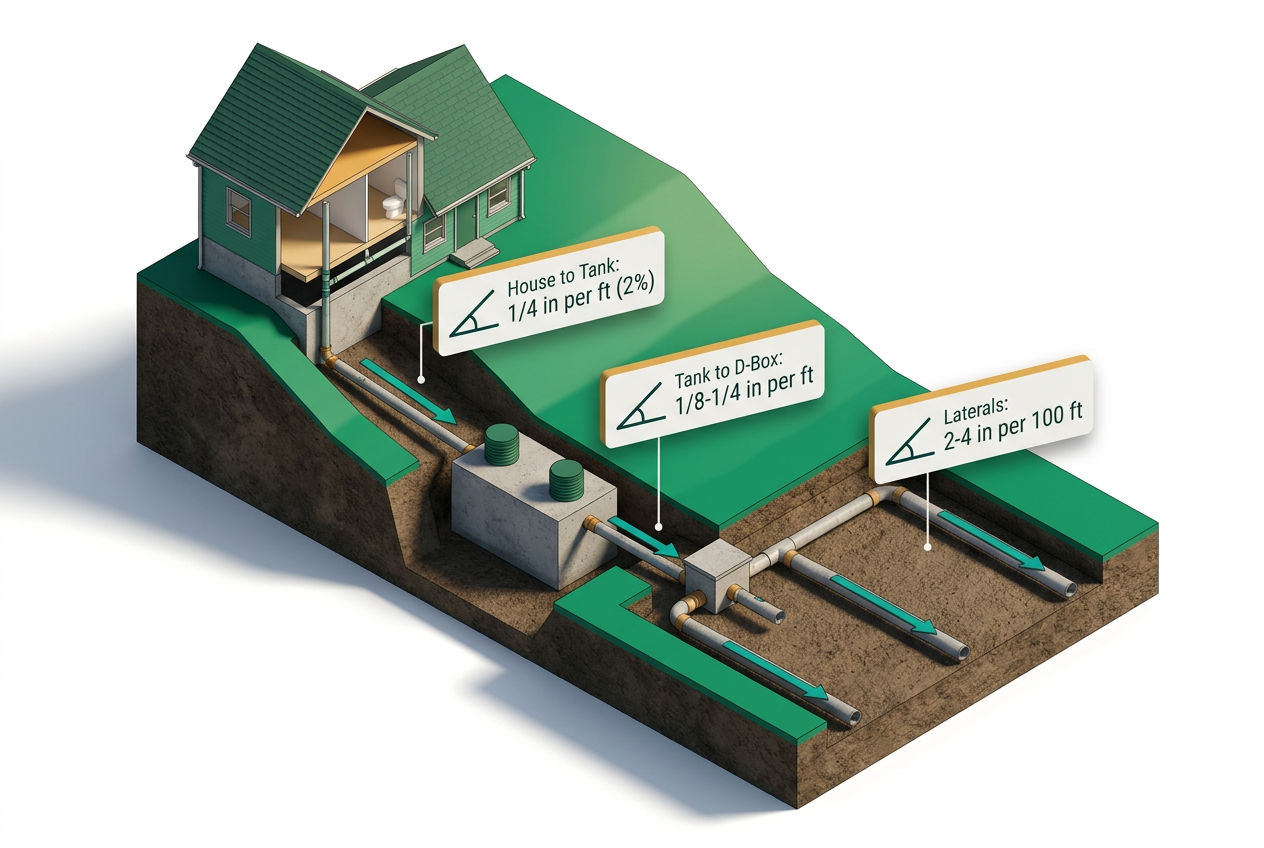
Septic pipe slope is the downhill fall a septic line needs to carry waste by gravity. The standard is 1/4 inch per foot (about 2%) from house to tank, at least 1/8 inch per foot from tank to distribution box, and nearly level, 2-4 inches per 100 feet, in drain field laterals.
Key Takeaways
- House to tank: aim for 1/4 inch of fall per foot. Codes allow 1/8 inch on 4-inch pipe only in some cases.
- Tank to distribution box: 1/8 inch per foot minimum, 1/4 inch is fine.
- Drain field laterals: level or close to it, usually 2-4 inches per 100 feet.
- Total drop = run length in feet x slope in inches per foot.
- If the drops don't fit your lot's depth limits, you need a pump tank or a different system, not a flatter pipe.
A septic system has three separate pipe runs, and each one wants a different slope. Get one wrong and you'll see it later as slow drains, a clog that keeps coming back, or a soggy patch in the yard. If you want the big picture first, this septic system diagram shows how the house, tank and drain field connect.
What Are the Three Slopes in a Septic System?
A gravity septic system uses three slopes. The building sewer from the house to the tank runs at about 1/4 inch per foot. The effluent line from the tank to the distribution box runs at 1/8 to 1/4 inch per foot. The drain field laterals run nearly level, so effluent spreads out instead of rushing to the far end. Pipe slope is one of the fixed numbers in any septic system design.
Here's the quick reference most installers work from. Treat it as a starting point, because your state or county rule book wins every time.
| Pipe run | Typical slope | Percent grade | Drop per 50 ft |
|---|---|---|---|
| House to tank | 1/4 in per ft | 2.08% | 12.5 in |
| House to tank (code min.) | 1/8 in per ft | 1.04% | 6.25 in |
| Tank to D-box | 1/8-1/4 in per ft | 1-2% | 6.25-12.5 in |
| Drain field laterals | 2-4 in per 100 ft | 0.17-0.33% | 1-2 in |
| Steep-run caution | Over 1/2 in per ft | Over 4.17% | Over 25 in |
Sources: International Plumbing Code Table 704.1 and Uniform Plumbing Code drainage slope rules for building sewers; lateral slopes reflect common state onsite wastewater rules and university extension guidance. Your local permit office sets the final numbers.
Why does each run differ? The building sewer carries raw sewage with solids, so it needs enough speed to keep paper and waste moving. After the tank settles out the solids, the effluent line carries mostly liquid. The laterals have a different job altogether: they need to dose the whole trench evenly.
What Is the Correct Septic Line Slope From House to Tank?
The correct septic line slope from house to tank is 1/4 inch per foot, about a 2% grade, on a 4-inch pipe. The International Plumbing Code allows 1/8 inch per foot for 3- to 6-inch pipe, and the Uniform Plumbing Code lets the local authority approve 1/8 inch where 1/4 inch isn't practical.
So why do most pros aim for 1/4 inch when 1/8 inch is legal in many places? Margin. A pipe set at exactly 1/8 inch has no room for error. If the trench bottom settles a half inch in one spot, you've got a belly, a low point where water sits and toilet paper piles up. A pipe set at 1/4 inch can take a little settling and still drain.
A few details matter as much as the number:
- Pipe type. Most building sewers use 4-inch Schedule 40 PVC or SDR-35 sewer pipe (ASTM D3034). Check which one your county allows under driveways.
- Bedding. Lay the pipe on compacted sand or fine gravel, not on rocks or loose fill. Rocks create high spots. Loose fill creates low ones.
- Cleanouts. Most codes want one near the foundation and more at sharp bends and long runs, often every 75-100 feet. Our guide to the septic clean out covers where they go and why.
- Tank depth. The pipe's slope and length set how deep the tank inlet ends up. That's why tank depth varies so much from house to house, as explained in how deep a septic tank is buried.
Can a Septic Pipe Slope Be Too Steep?
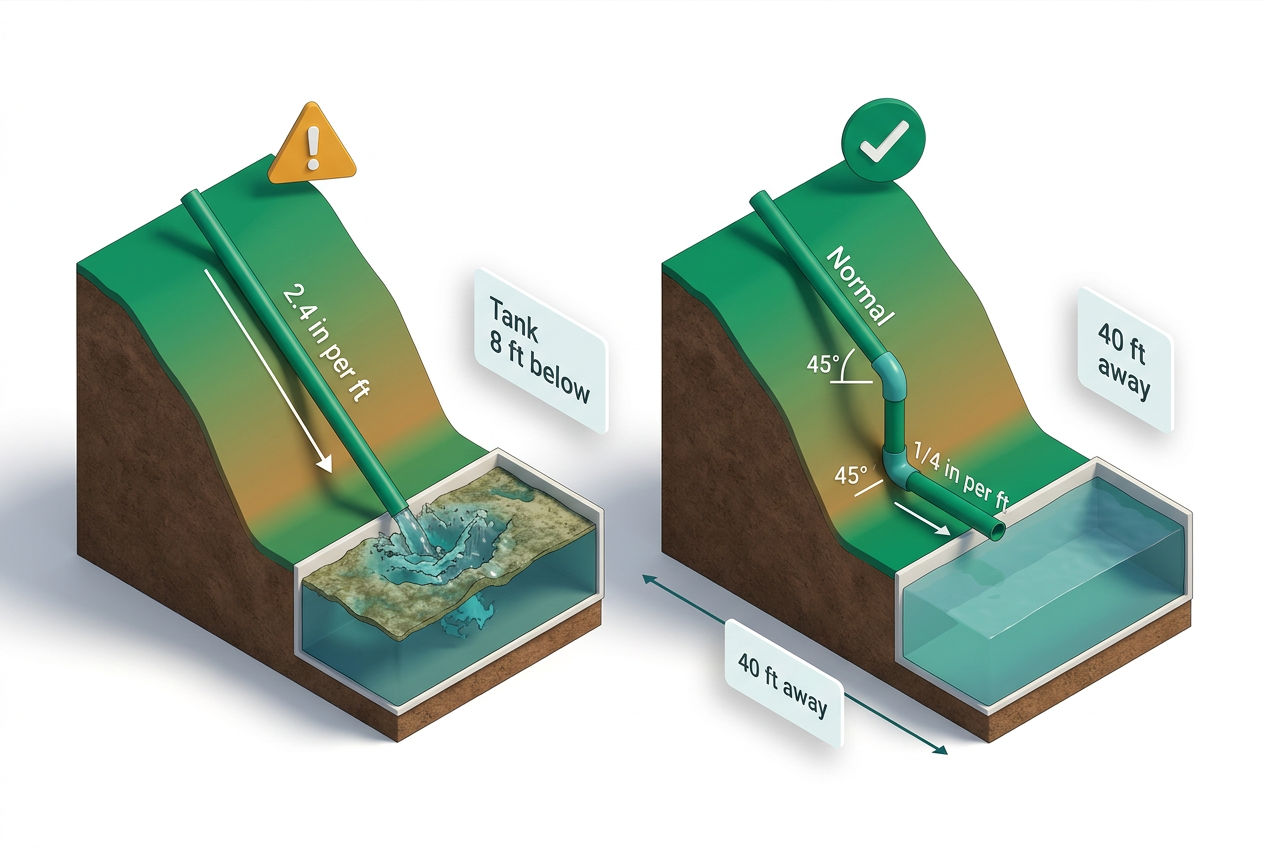
A septic pipe slope can be steeper than ideal, but steep is less of a problem than flat. The old claim that water "outruns" the solids is debated. The real risk is fast, turbulent flow hitting the tank inlet and stirring up the scum layer, so many installers keep the last 10 feet at 1/4 inch per foot.
Picture a house on a hillside where the tank sits 8 feet below the foundation, just 40 feet away. That works out to 2.4 inches of fall per foot. Running a straight pipe at that angle sends a slug of water into the tank hard enough to churn the scum layer and, over time, push solids toward the outlet.
The usual fix is to lose the height in one place. Installers run the pipe at a normal slope, add a vertical drop or two 45-degree fittings, and then return to 1/4 inch per foot for the final stretch into the tank. Some local codes also set a maximum slope, so ask before you dig. If your whole lot is steep, septic systems on a slope covers stepped trenches and other layouts built for hills.
What Should the Septic Tank Outlet Pipe Slope Be?
The septic tank outlet pipe slope should be at least 1/8 inch per foot from the tank to the distribution box, and 1/4 inch per foot is common and acceptable. Inside the tank, the outlet invert usually sits 2-3 inches lower than the inlet invert, so liquid leaves the tank but floating scum stays behind.
That inlet-to-outlet drop is built into the tank by the manufacturer, so you don't set it yourself. You do have to make sure the tank is set level. A 1,000-gallon tank that tips an inch toward the inlet can shrink that 2-3 inch drop to almost nothing, and then effluent backs up toward the house.
The effluent line is usually solid (not perforated) pipe. Because a working tank and effluent filter hold back most solids, this run can be flatter than the building sewer. But it can't be level. Effluent sitting in a flat line can grow a slime layer and freeze in a cold snap.
At the far end, the line feeds the distribution box. The D-box has to be dead level so each outlet gets the same share. If you're checking an older system, our guide to the septic distribution box shows how to spot a tilted box and fix it with speed levelers.
Should Drain Field Pipes Be Level or Sloped?
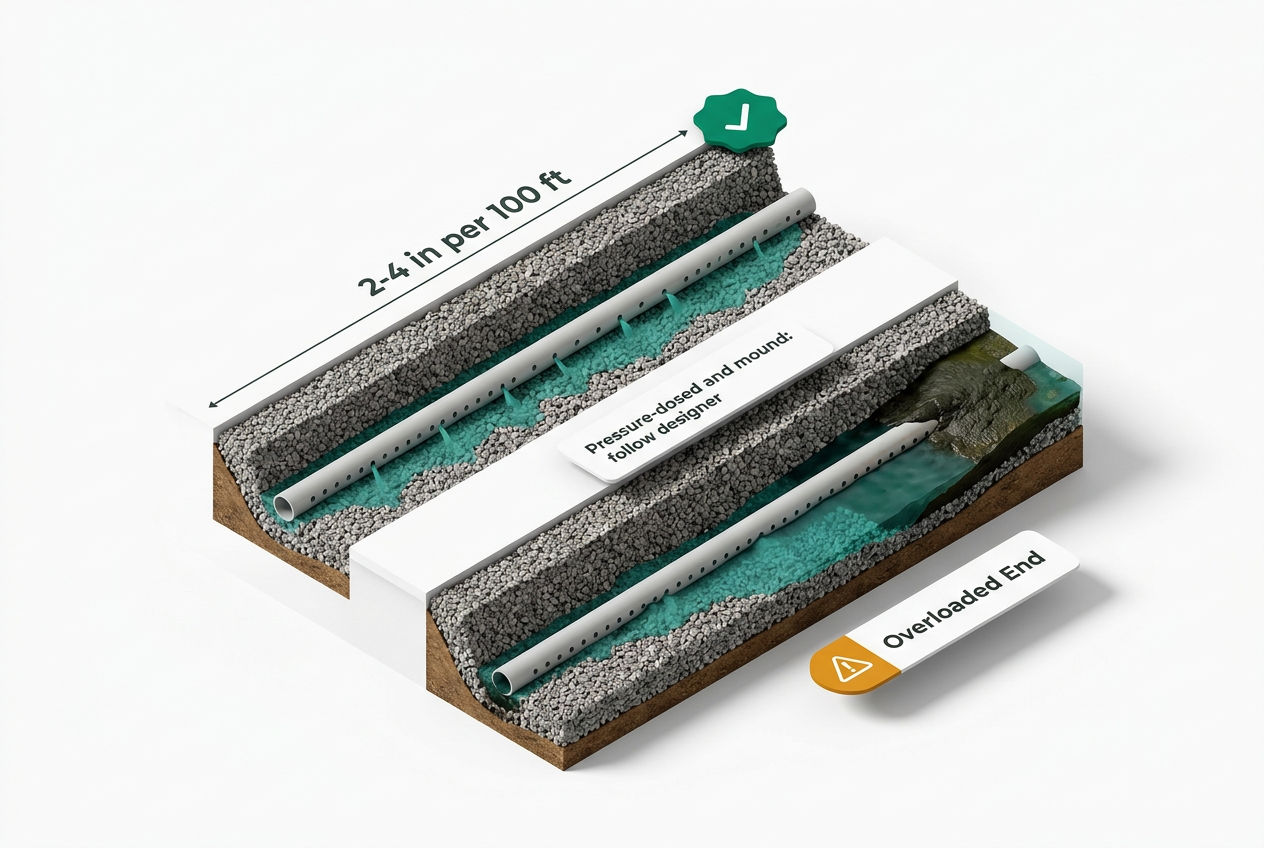
Drain field pipes should be level or very close to level. Many state codes allow 2-4 inches of fall per 100 feet for gravity perforated laterals, and some cap it near 6 inches. Trench bottoms are often required to be level. Too much slope sends effluent to the low end of each trench, overloading it.
Think about what a lateral does. It isn't a drain pipe, it's a spreader. Effluent fills the pipe, seeps out through the holes, and soaks into the gravel or chamber below. If the pipe tilts steeply, most of the liquid runs to the last 10 feet of trench. That end grows a thick biomat and fails early while the first half stays dry.
The best layout for your lot depends on the pipe or chamber you use. Perforated pipe in gravel, gravelless pipe and plastic chambers each have their own install rules, which you'll find in our guide to drain field pipe types and layouts.
Pressure-dosed systems and mound systems are different. They use a pump to push effluent through small holes, so lateral slope matters less than even pressure. Follow the designer's drawings for those, not gravity rules.
How Does a Septic Line Slope Calculator Work?
A septic line slope calculator multiplies run length by slope. The formula is total drop in inches = run length in feet x slope in inches per foot. A 60-foot building sewer at 1/4 inch per foot drops 15 inches. The same run at 1/8 inch per foot drops 7.5 inches.
You can do this on a phone calculator. Here are the conversions and examples that come up most:
- 1/4 inch per foot = 0.25 inches per foot = about 2.08% grade
- 1/8 inch per foot = 0.125 inches per foot = about 1.04% grade
- 40 ft at 1/4 inch = 10 inches of drop
- 75 ft at 1/4 inch = 18.75 inches of drop
- 100 ft lateral at 3 inches per 100 ft = 3 inches of drop
To go the other way, divide the drop by the length. If your tank inlet has to sit 12 inches below the point where the pipe leaves the house, and the tank is 64 feet away, your slope is 12 ÷ 64 = 0.19 inches per foot. That's above 1/8 inch, so it passes most codes, but it's under the 1/4 inch target.
Worked Example: Does Gravity Work on Your Lot?
Here's where slope math really earns its keep. Say you have a flat lot and a 3-bedroom house with a 1,000-gallon tank.
- The house drain leaves the foundation 18 inches below grade.
- The tank is 50 feet away. At 1/4 inch per foot, that's 12.5 inches of drop. The tank inlet sits about 30.5 inches deep.
- The tank's outlet is 3 inches lower: 33.5 inches deep.
- The D-box is 20 feet away. At 1/8 inch per foot, that's 2.5 inches more: 36 inches deep.
- The D-box outlets sit about 1 inch lower: 37 inches.
Now compare that to your soil report. If the perc test and soil evaluation say trench bottoms can't go deeper than 30 inches because of a seasonal high water table, gravity doesn't work here. You can't fix it by flattening the pipes below code. You need a pump tank, a mound, or another design. Our septic pump guide explains how pump tanks lift effluent to a field that sits too high.
Change one number and the picture flips. If the yard falls 18 inches between the house and the field, the laterals end up only about 19 inches below the surface there, and gravity works fine. That's why designers shoot elevations across the whole site before they draw anything.
How Do You Set and Check Septic Pipe Slope?

DIY Septic Blueprint
Thinking about building it yourself?
The complete, plain-English plan to size, permit and install your own septic system — designed for homeowners, not contractors. Skip the $15,000–$25,000 quotes and do it right the first time.
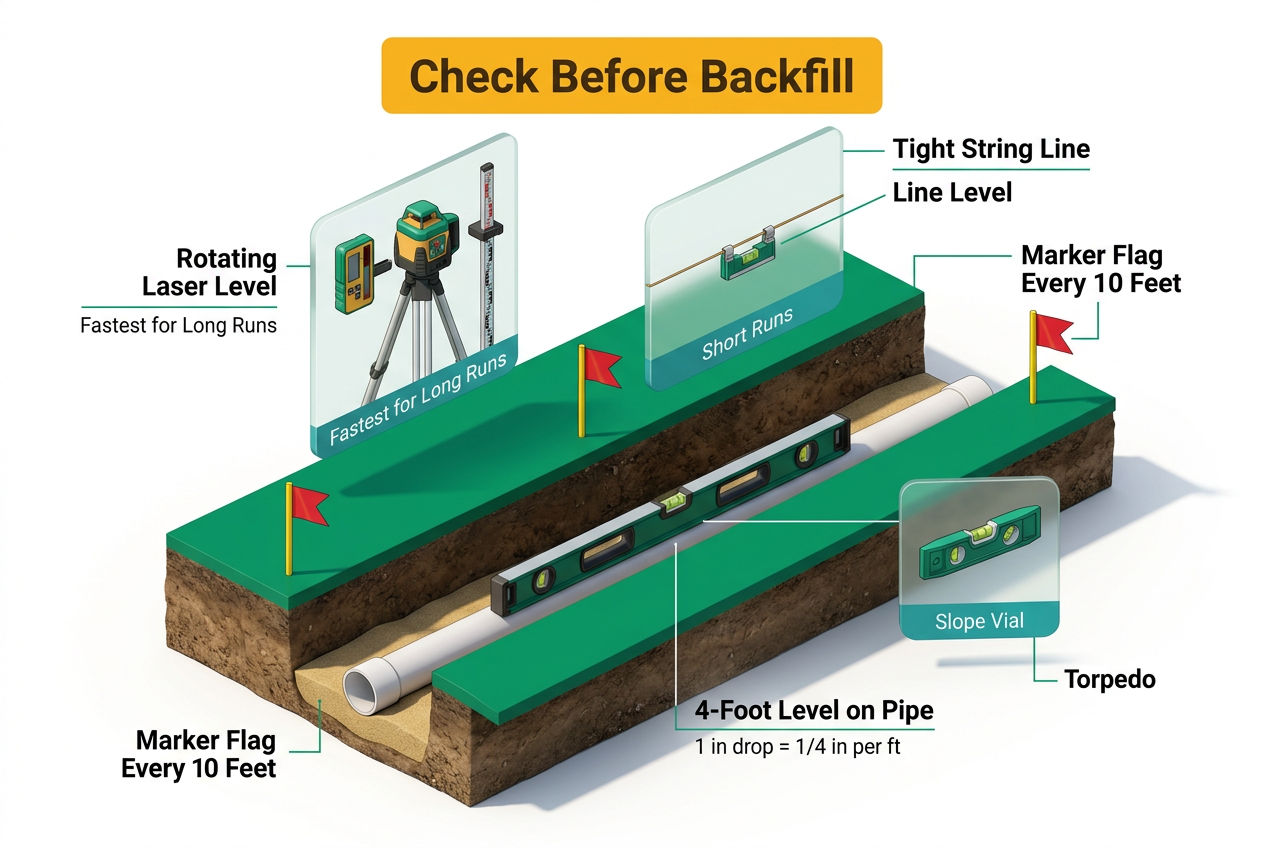
Get the DIY Blueprint — $67 →Instant download · 8 modules + 3 bonus guides · 60-day money-back guaranteeYou set septic pipe slope by marking the starting and ending invert elevations, then grading the trench bottom between them with a laser level, transit or tight string line. Check every 10 feet with a level and a measuring rod. A 4-foot level should show about 1 inch of drop for a 1/4-inch-per-foot run.
Tools that make this easier:
- Rotating laser level with a grade rod. The fastest method for long runs. Rentals often run $50-$100 a day.
- String line and line level. Cheap and accurate for short runs if you pull the string tight and measure down from it every few feet.
- Pipe slope level. Some torpedo levels have a marked vial for 1/4 inch per foot. Handy for checking each joint.
Check slope before you backfill. Once the trench is closed, the only way to see a belly is a camera. If you're building your own system, the DIY septic system guide walks through the full sequence, including which steps most counties make you show the inspector before you cover anything.
What Happens If Your Septic Pipe Slope Is Wrong?
If your septic pipe slope is wrong, you'll usually see slow drains, gurgling toilets, clogs that return to the same spot, or sewage odors. A flat or bellied building sewer lets solids settle. A lateral with too much slope overloads one end of the trench. A sewer camera inspection, often $150-$500, shows exactly where the problem is.
Slope problems often show up years after the install. Clay soil swells and shrinks. Freeze-thaw cycles in places like Minnesota and Maine, where frost can reach 4-5 feet down, heave pipe that wasn't buried deep enough. Roots push pipe up. Heavy trucks crush it down. If your drains have slowed and pumping didn't help, slow drains in a septic system walks through the likely causes in order.
The fix is usually digging up the bad section and relaying it on fresh bedding. Costs for that run about $50-$250 per linear foot, depending on depth, soil and what's on top of the pipe. A short section near the house might cost a few hundred dollars. A 60-foot line under a driveway can run several thousand. See our septic repair cost guide for typical price ranges on line and field repairs.
Who Sets the Septic Pipe Slope Rules Where You Live?
Your state onsite wastewater program and your county health department set the septic pipe slope rules where you live. Most borrow the 1/4 and 1/8 inch per foot numbers from the plumbing codes, but lateral slopes, trench depths and inspection steps vary. Always pull the local rule book before you dig.
A few examples show how much this varies:
- Texas regulates onsite systems under TCEQ's Chapter 285 rules, but many counties act as the authorized agent that issues permits and inspects.
- Minnesota follows MPCA Chapter 7080, and its deep frost means building sewers need more cover, which eats into your available fall.
- Florida runs its onsite sewage program at the state level. Flat ground and a high water table across much of the state push many lots toward mounds or pump systems.
In flat coastal areas like the Gulf Coast and the Carolina coastal plain, you'll often work at the minimum slope. In the Ozarks, Appalachia and the Pacific Northwest, the problem is usually too much fall. Either way, the inspector's sign-off is what counts. If you're buying a house and want the lines checked, a septic inspection with a camera can confirm the slope before closing. You can also find a local installer or inspector from the SepticTankHub homepage.
Sources & Methodology
- U.S. EPA, Septic Systems (https://www.epa.gov/septic): homeowner guidance on how gravity septic systems, tanks and drain fields work. epa.gov/septic
- International Code Council, International Plumbing Code (IPC), Table 704.1: minimum drainage pipe slopes by pipe diameter. iccsafe.org
- IAPMO, Uniform Plumbing Code (UPC): building sewer slope rules and the local-authority exception for 1/8 inch per foot.
- State onsite wastewater rules: Texas TCEQ Chapter 285, Minnesota MPCA Chapter 7080 and Florida's onsite sewage program, referenced for how states and counties enforce slope, depth and inspection steps. tceq.texas.gov
- NOWRA (https://www.nowra.org) and university extension septic publications, including Penn State Extension and Texas A&M AgriLife Extension: installation practice for laterals, D-boxes and bedding. nowra.org
Slope figures in this article reflect common code minimums and installer practice. Cost ranges are national estimates and vary by region, soil and access.
Primary sources to read: International Plumbing Code, Chapter 7 (sanitary drainage) · Texas TCEQ: OSSF permits · Minnesota Rules chapter 7080 (SSTS standards) · Texas A&M AgriLife OSSF program
More Septic Design & Install Guides
- Septic system design: the complete guide
- Septic tank excavation
- Septic systems on a slope
- Gravel for a leach field
- Leach field design and sizing
- How long a septic install takes
- Can you install your own septic system? Rules by state
Frequently Asked Questions
What is the correct septic line slope from the house to the tank?
The correct septic line slope from the house to the tank is 1/4 inch of fall per foot, about a 2% grade, on a standard 4-inch pipe. The International Plumbing Code allows 1/8 inch per foot for 3- to 6-inch pipe, and the Uniform Plumbing Code lets the local authority approve 1/8 inch when 1/4 inch isn't practical. Most installers still aim for 1/4 inch because it gives a margin for settling. A pipe set at exactly 1/8 inch can develop a belly if the trench bottom sinks even half an inch, and that low spot collects paper and solids. Lay the pipe on compacted sand or fine gravel, keep it free of rocks, and add cleanouts near the foundation and at sharp bends. Your county health department has the final word, so check its rules before you dig.
What should the septic tank outlet pipe slope be?
The septic tank outlet pipe slope should be at least 1/8 inch per foot from the tank to the distribution box, and 1/4 inch per foot is common and fine. This run carries mostly liquid effluent because the tank and effluent filter hold back solids, so it can be flatter than the line from the house. It should never be level, though, since standing effluent can build up slime and freeze in cold weather. Inside the tank, the outlet invert usually sits 2-3 inches below the inlet invert. That drop is built in by the manufacturer, but it only works if the tank is set level. A tank that tilts toward the inlet can lose most of that drop. At the far end, the D-box must be level so every lateral gets an equal share of effluent.
How does a septic line slope calculator work?
A septic line slope calculator multiplies the length of the pipe run by the slope. The formula is total drop in inches = run length in feet x slope in inches per foot. A 50-foot line at 1/4 inch per foot drops 12.5 inches. A 50-foot line at 1/8 inch per foot drops 6.25 inches. To find the slope you already have, divide the drop by the length: 10 inches of drop over 60 feet is about 0.17 inches per foot. You can run these numbers on any phone calculator. The real value comes from adding up every run: house to tank, the tank's built-in inlet-to-outlet drop, tank to D-box, and the D-box outlets. Compare the final depth to the deepest trench your soil report allows. If the numbers don't fit, you need a pump tank or a different system design.
Can a septic pipe slope be too steep?
A septic pipe slope can be steeper than ideal, but a steep pipe causes fewer problems than a flat one. The common claim that liquids "outrun" solids on a steep pipe is debated among installers. The clearer risk is fast, turbulent flow slamming into the tank inlet, stirring up the scum layer and pushing solids toward the outlet. For that reason, many installers keep the last 10 feet before the tank at 1/4 inch per foot. On a hillside lot, the usual fix is to run the line at a normal slope, drop elevation in one spot with a vertical drop or two 45-degree fittings, and then return to 1/4 inch per foot into the tank. Some counties set a maximum slope for building sewers, so confirm the local limit before you lay any pipe.
Should drain field pipes be level or sloped?
Drain field pipes in a gravity system should be level or very close to level. Many state codes allow 2-4 inches of fall per 100 feet in perforated laterals, and some cap it at about 6 inches per 100 feet. Trench bottoms are often required to be level. A lateral is a spreader, not a drain, so its job is to let effluent seep out evenly along the whole trench. If the pipe slopes too much, most of the effluent runs to the low end, overloads that section, and causes it to fail early while the rest of the trench sits dry. Pressure-dosed and mound systems work differently because a pump pushes effluent through small holes, so follow the designer's plan for those. Your county's permit drawings will list the exact lateral slope allowed.
Free download
Not ready for the Blueprint? Start free.
Grab the free DIY Septic Planning Kit — the permit-first checklist, perc-test cheat sheet, and sizing tables that keep your build from getting red-tagged.
Was this article helpful?
Frequently Asked Questions
Recommended Resources
📖 Related Articles
💰 Cost Guides
🔧 Services
Find Septic Professionals Near You
Compare licensed, verified septic companies by area — top county markets and cities below, or browse all 50 states.
County markets
Popular cities
