
Quick Answer
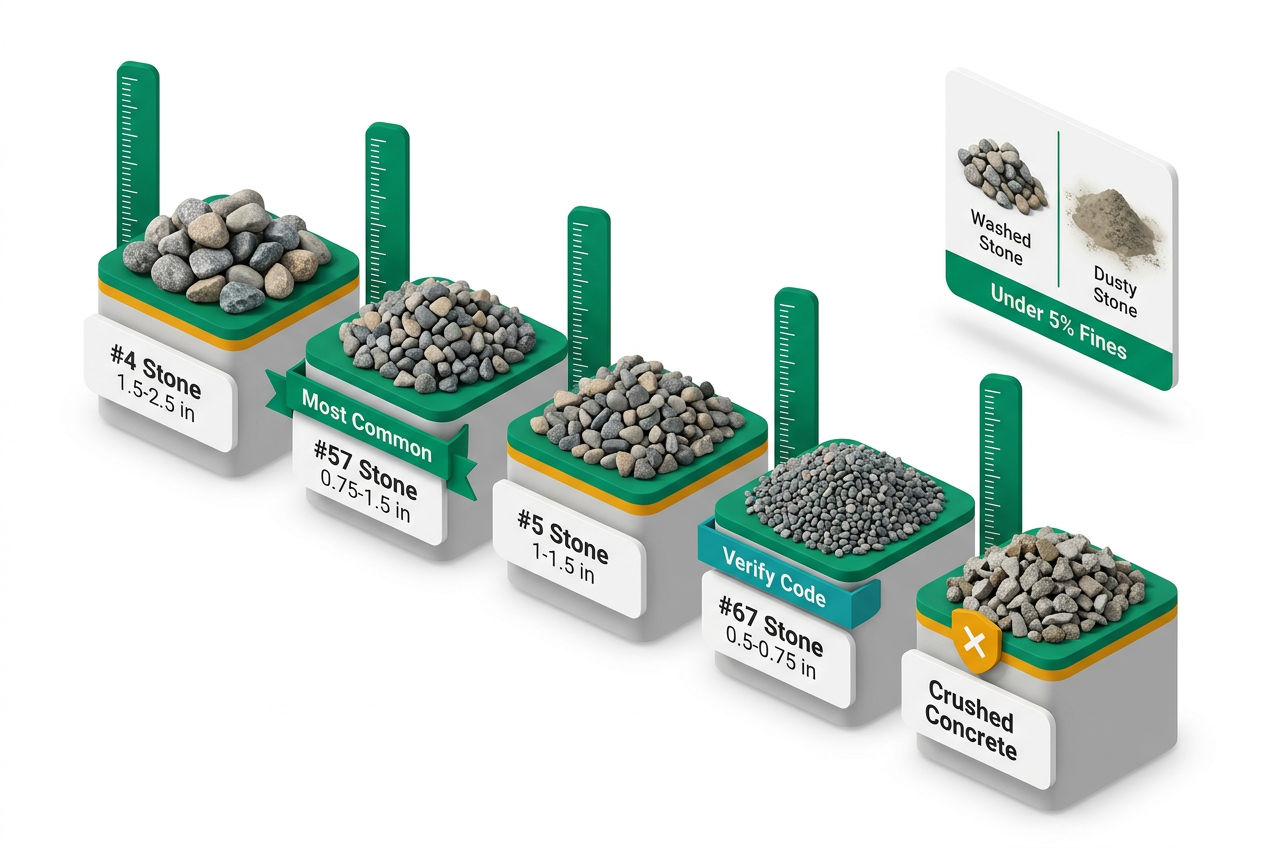
Gravel for a leach field must be clean, washed stone ranging from ¾ inch to 2½ inches in diameter, with less than 5% fines content. Most state codes specify #57 or #4 stone as the standard drain field aggregate. Total gravel depth in the trench typically runs 12–36 inches, and a conventional 3-bedroom system requires 33–48 tons depending on local design requirements.
Key Takeaways
- Use washed, clean stone sized ¾ inch to 2½ inches — #57 stone is the most widely specified product
- Gravel depth below the perforated pipe: minimum 6 inches (many codes require 12 inches)
- Gravel depth above the pipe: minimum 2 inches, up to 4 inches in some jurisdictions
- A 3-bedroom system with three 50-foot trenches needs roughly 33 cubic yards (47–48 tons) of aggregate
- Gravel costs $25–$75 per ton delivered; total material cost for an average residential system runs $500–$3,000+
Septic gravel isn't glamorous. Nobody frames photos of a fresh drain field trench. But get the aggregate wrong — wrong size, wrong depth, wrong amount — and you'll be staring at soggy ground, sewage odors, and a drain field repair bill that starts at $3,000 and climbs fast. This guide gives you the exact specs contractors use, so you can verify what you're being quoted and understand why each number matters.
For background on how the drain field fits into the overall system, the what is a drain field guide is a good starting point before you get into gravel specifics.
What Size Gravel Is Best for a Leach Field?
The industry standard for leach field gravel size is ¾ inch to 2½ inches — washed, clean stone with less than 5% fines content. The two most commonly specified products are ASTM #57 stone (ranging from ¾ inch to 1½ inches) and #4 stone (ranging from 1½ inches to 2½ inches). Most residential systems use #57 stone because it's widely available and meets code in the vast majority of states. Stone size is set during septic system design, along with trench length and depth.
Here's why size matters so much. Drain field aggregate isn't just filler — it's a functional component. The void space between the stones (called pore space) is where effluent temporarily holds while the surrounding soil absorbs it. Stones that are too small pack too tightly, reduce pore space, and slow the absorption rate. Stones that are too large leave gaps that can allow the perforated distribution pipe to shift or settle unevenly.
Fines are the other critical factor. "Fines" means dust, sand, and tiny particles that cling to unwashed stone. Even a small percentage of fines can migrate down into the soil and clog the biomat zone over time — which is exactly the kind of slow-motion failure that turns a healthy drain field into a failed one. Always specify washed stone. If your contractor is quoting "crushed stone" without specifying washed, ask the question directly.
ASTM Gravel Size Comparison for Drain Fields
| Stone Designation | Size Range | Fines Content | Typical Use |
|---|---|---|---|
| #4 Stone | 1½ in – 2½ in | < 5% washed | Larger trench fills, deeper beds |
| #57 Stone | ¾ in – 1½ in | < 5% washed | Most common residential spec |
| #5 Stone | 1 in – 1½ in | < 5% washed | Alternative to #57 in some regions |
| #67 Stone | ½ in – ¾ in | < 5% washed | Occasionally used; verify local code |
| Crushed Concrete | Varies | Often high | Generally not approved — see below |
Source: ASTM International stone size designations; state health department code specifications vary.
Can you use crushed concrete instead of gravel for a leach field? Most state health departments don't approve it. Crushed concrete often contains high fines content, can leach calcium into the soil, and may alter the soil pH in ways that harm the biological processes your drain field depends on. A handful of counties allow it under specific conditions, but it's the exception. Don't substitute it without written approval from your local health department.
How Deep Should the Gravel Be in a Leach Field?
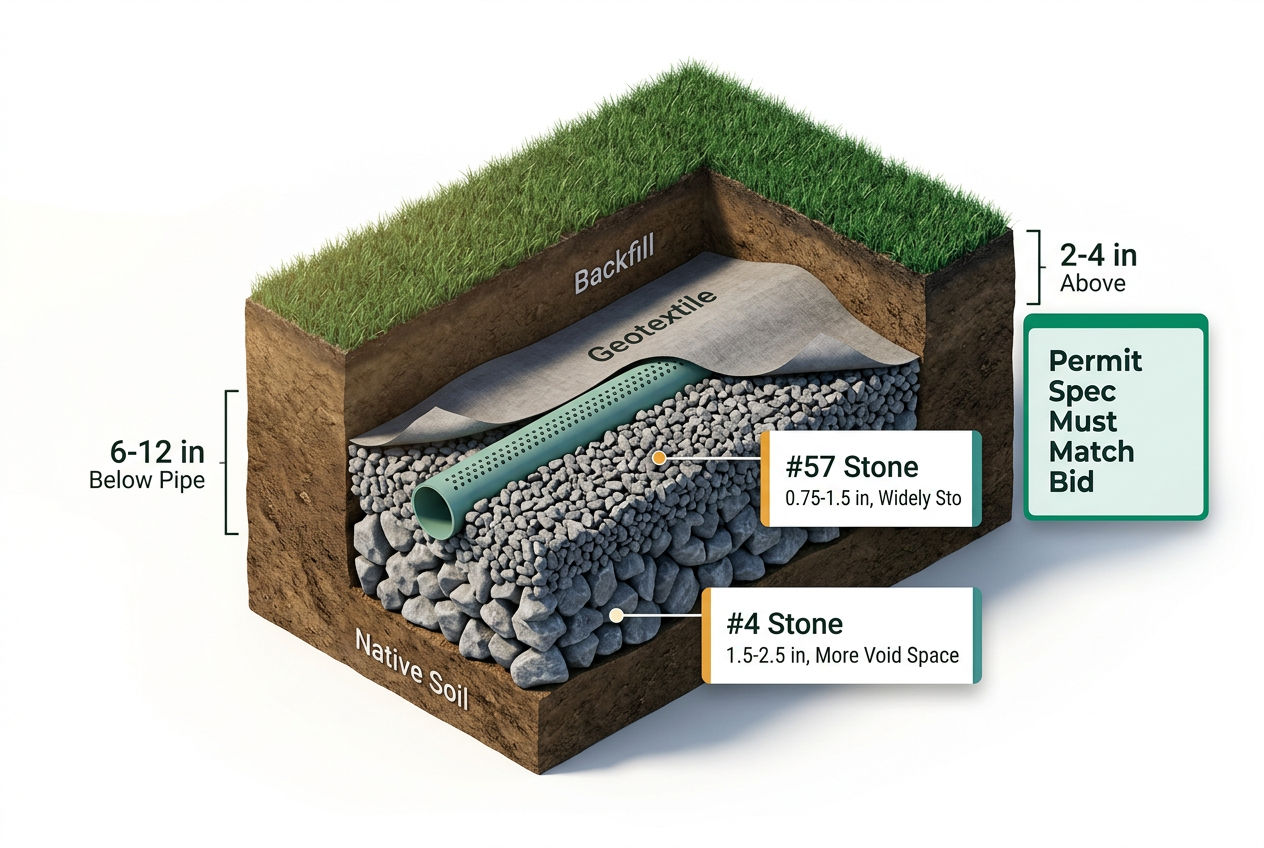
A properly constructed gravel leach field requires at least 6 inches of aggregate below the perforated distribution pipe and at least 2 inches above it — but many state codes set higher minimums. Most systems end up with 12–24 inches of total gravel depth in the trench, and some jurisdictions in the Northeast require up to 36 inches. Set the pipe on that bed at the grade your design specifies; see our guide to septic pipe slope.
The gravel below the pipe creates a receiving bed. Effluent exits the perforated pipe, filters down through that gravel layer, and enters the native soil at the trench bottom where biological treatment happens. The gravel above the pipe protects it from being crushed during backfill and allows air circulation — critical for the aerobic bacteria that break down waste.
Above the top gravel layer, installers lay a permeable geotextile fabric to prevent soil migration into the aggregate, then backfill with native soil to grade. This fabric layer is easy to skip on a DIY install and is frequently where DIY systems fail within five years.
Standard Trench Dimensions
- Trench width: 18–36 inches (most residential systems use 24–36 inches)
- Trench depth: Varies widely — typically 24–60 inches total, depending on required gravel depth and soil conditions
- Gravel below pipe: 6–12 inches minimum (12 inches is the more common modern spec)
- Gravel above pipe: 2–4 inches
- Trench spacing: 6–10 feet center-to-center (varies by state)
- Trench length: 25–100+ feet per lateral
Your local health department sets these numbers, not federal standards. The drain field depth guide breaks down how frost depth, water table, and soil type affect how deep your trenches need to go.
How Many Tons of Gravel Do You Need for a Drain Field?
Use this formula to calculate cubic yards of aggregate needed:
Length (ft) × Width (ft) × Depth (ft) ÷ 27 = Cubic Yards
Then multiply cubic yards by 1.4 to convert to tons (the standard weight for washed stone).
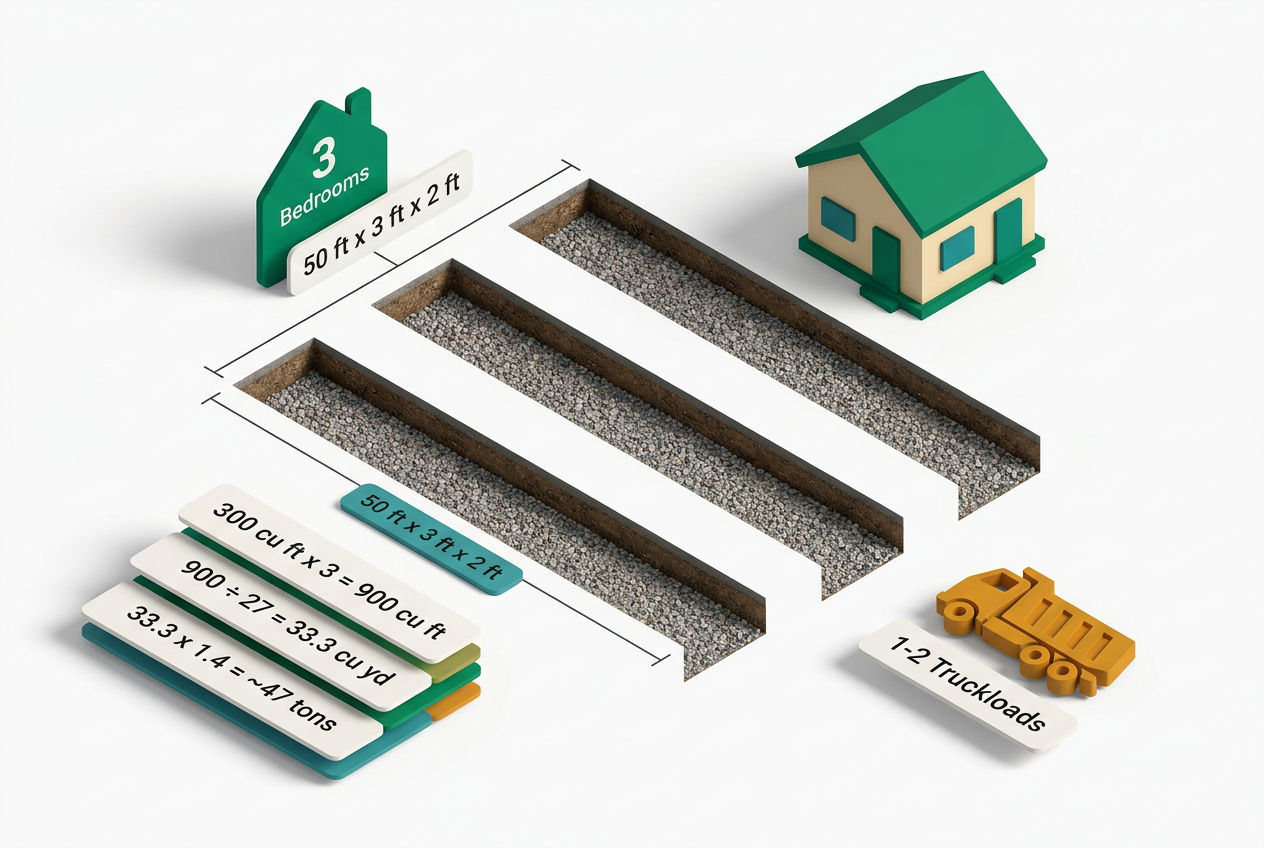
Worked Example: 3-Bedroom Home
A typical 3-bedroom home in a jurisdiction using 150 gallons per day per bedroom as the design flow, with a percolation rate of around 30 minutes per inch, might require three lateral trenches, each 50 feet long, 3 feet wide, and 2 feet of total gravel depth.
- Volume per trench: 50 × 3 × 2 = 300 cubic feet
- Three trenches: 300 × 3 = 900 cubic feet
- Convert to cubic yards: 900 ÷ 27 = 33.3 cubic yards
- Convert to tons: 33.3 × 1.4 = approximately 46–47 tons
That's a full dump truck load — sometimes two, depending on your supplier's haul capacity. For a quick sanity check, the rule of thumb is roughly 1 ton of gravel covers about 80 square feet at 6 inches deep.
A larger system — say, a 5-bedroom home with four 75-foot trenches at the same dimensions — could easily top 90 tons. Want to plug in your own numbers? Use our gravel calculator below.
Use this calculator to estimate your gravel needs before calling suppliers for quotes:

DIY Septic Blueprint
Thinking about building it yourself?
The complete, plain-English plan to size, permit and install your own septic system — designed for homeowners, not contractors. Skip the $15,000–$25,000 quotes and do it right the first time.
Get the DIY Blueprint — $67 →Instant download · 8 modules + 3 bonus guides · 60-day money-back guaranteeThe leach field size chart can help you determine how many linear feet of trench your system requires before you calculate aggregate volumes.
What Does Leach Field Gravel Cost?
Washed drain field gravel costs $25–$75 per ton or $35–$100 per cubic yard, depending on your region, the stone type, and delivery distance. #57 stone tends to sit in the middle of that range — typically $35–$55 per ton in the Midwest and Southeast, and $55–$75 per ton in New England and the Pacific Northwest where supply is tighter.
For the 3-bedroom example above (47 tons), you're looking at roughly $1,650–$3,525 just for materials before any delivery surcharges. Add delivery at $150–$400 per load, and your aggregate budget for a typical residential system runs $1,800–$4,000 for materials and delivery alone.
That's just the gravel. Full drain field replacement cost — including excavation, pipe, fabric, labor, permits, and inspection — typically runs $3,000–$15,000 for a conventional trench system. Gravel usually represents 20–30% of the total installed cost.
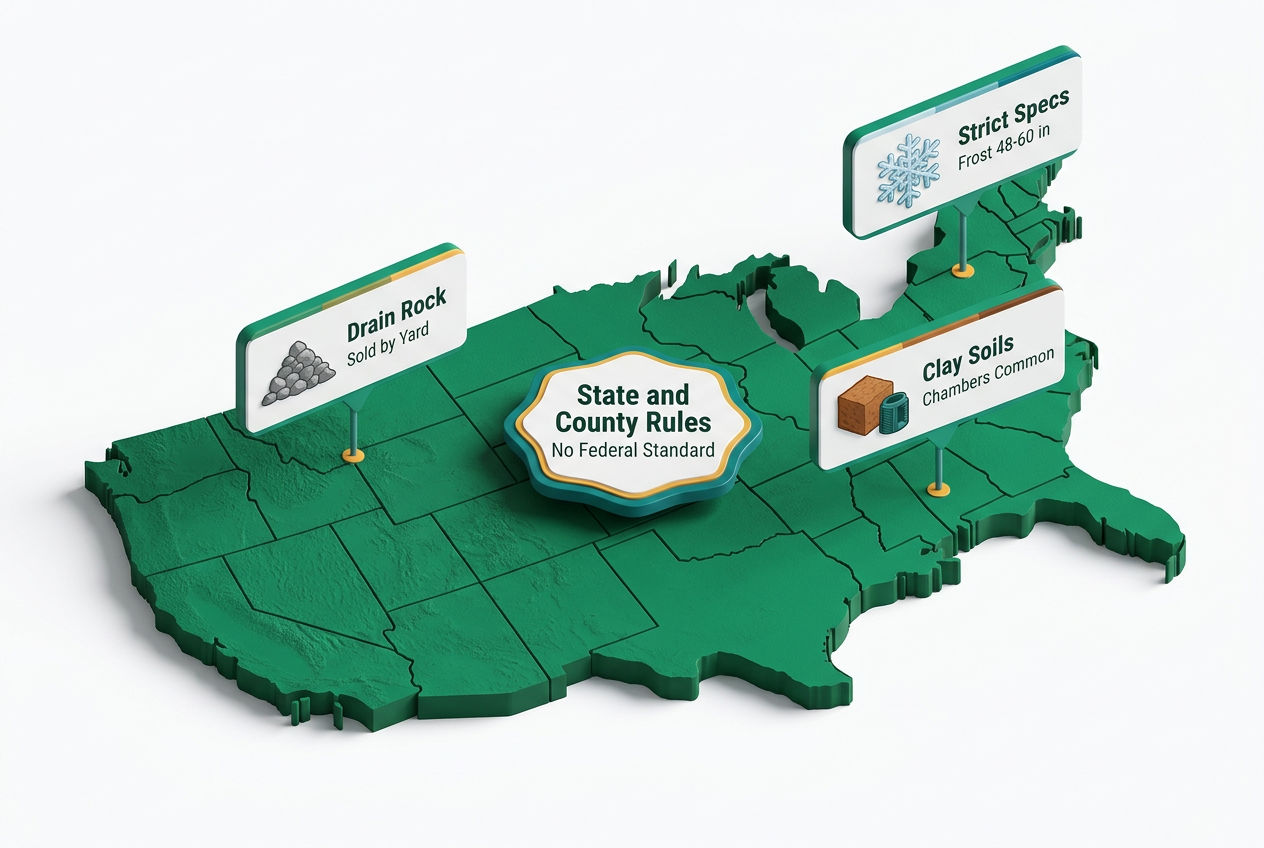
Regional note: In Western states like Montana, Idaho, and Wyoming, contractors often call leach field gravel "drain rock" rather than gravel, and it's frequently sold by the yard rather than the ton. If you're getting quotes in those areas, confirm whether the supplier is quoting by weight or volume to avoid surprises.
What's the Difference Between #57 Stone and #4 Stone for a Drain Field?
#57 stone runs ¾ inch to 1½ inches in diameter. #4 stone runs 1½ inches to 2½ inches. Both are ASTM-designated washed aggregates appropriate for septic drain field aggregate, and both appear in state code specifications across the country.
The practical difference comes down to availability and application. #57 stone is the most widely stocked product at quarries nationwide, so it's usually easier to source and comparably priced. #4 stone has larger void spaces, which can be beneficial in soils with very slow percolation rates because it allows effluent to distribute across the trench more freely before entering the native soil. Some engineers specify #4 stone for the lower bed layer and #57 stone closer to the pipe.
If your contractor bids one and your permit specifies the other, ask why before the material is ordered. Switching stone sizes after a permit is issued may require an amendment.
Do You Need Gravel for a Leach Field, or Can You Use Chambers Instead?
Gravel isn't the only option. Chamber systems — plastic arch-shaped units that replace the gravel bed entirely — are approved in most states and have become increasingly common, particularly in the Southeast and Midwest. The comparison between leach field chambers and pipe-and-gravel systems covers the tradeoffs in detail.
Chamber systems generally cost 30–50% more for materials compared to conventional gravel trench systems, but they eliminate the aggregate cost entirely and reduce excavation volume. Installation is faster, which can offset some of the material premium in labor-intensive markets.
What chambers can't do: they don't perform better than gravel systems in every soil type. In very sandy soils with extremely fast percolation, conventional gravel beds sometimes distribute effluent more evenly than chambers. Your site's perc rate — determined by a percolation test before any permit is issued — should drive the system selection decision, not just cost.
For properties where a failed perc test makes conventional systems impossible, the failed perc test options guide outlines alternatives like mound systems, sand filters, and aerobic treatment units.
Regional and Seasonal Factors That Affect Gravel Specifications
Gravel specifications are governed at the state and county level. There is no single federal standard. That means the depth, stone size, and trench dimensions your neighbor in a different county uses may not be legal on your property.
Northeast (New England, Mid-Atlantic): Massachusetts Title 5 regulations are among the strictest in the country, with detailed aggregate specifications and depth-to-groundwater requirements. Frost depth in northern New England reaches 48–60 inches, which affects minimum burial depth for distribution lines. Expect tighter specs and higher total gravel volumes.
Southeast: Clay-heavy soils in Georgia, Alabama, and Mississippi can restrict conventional gravel trench systems. Many southeastern counties approve chamber systems more readily than traditional aggregate beds because chambers are less sensitive to soil variability. If your soil has significant clay content, your installer may recommend a larger drain field footprint regardless of which system you choose.
Mountain West: Shallow rocky soils in Colorado, Montana, and Wyoming frequently make conventional deep trenches impossible. Mound systems — which are built above grade — are common, and "drain rock" is specified in lieu of traditional #57 stone in some county codes.
Pacific Northwest: Oregon and Washington have high water tables in many areas, especially coastal regions. Minimum separation between the bottom of the trench and the seasonal high water table is strictly enforced — often 24–36 inches — which limits how deep the gravel bed can extend.
Timing matters too. In northern states, leach field installation peaks from April through June when the ground is thawed and workable. Fall is a secondary window. If you're planning a new system or replacement, pulling permits and ordering stone in January or February — even if you can't install until April — locks in your contractor slot and can avoid seasonal price spikes on aggregate delivery.
For state-specific code details, check your state health department directly. The EPA's septic systems resource page at epa.gov/septic also provides a useful overview of federal guidance and links to state programs.
Hiring a Pro vs. DIY: What to Know Before You Buy That Gravel
Some states allow homeowners to install their own septic systems on their own property. Many don't. Even in states where DIY installation is technically permitted, you'll still need a permit, a soil evaluation, a perc test, and an inspection by the county sanitarian or health department before the system can be covered and placed in service.
The gravel calculation above assumes a permit-approved design. Buying aggregate before you have an approved design is a mistake — your county may specify a different stone size, different trench dimensions, or more linear footage than you estimated, leaving you with two tons of #57 stone you can't use.
If you're at the stage of researching specs and costs, a licensed installer in your area can usually provide a free or low-cost site assessment. Find a septic professional near you to get quotes based on your actual soil conditions and local code — not generic estimates.
Gravel is one item on the full septic system parts list.
Sources & Methodology
- U.S. Environmental Protection Agency — Septic Systems Overview: epa.gov/septic. Used for general guidance on drain field function and design principles.
- ASTM International Stone Size Designations: ASTM D448 Standard Classification of Sizes of Aggregate for Road and Bridge Construction. Referenced for #4, #5, #57, and #67 stone size definitions.
- State Health Department Codes: Specifications for gravel depth, trench dimensions, and aggregate fines content were cross-referenced against codes from Massachusetts (Title 5), Minnesota Pollution Control Agency (MPCA), Oregon DEQ, and Texas OSSF regulations. pca.state.mn.us
- National Onsite Wastewater Recycling Association (NOWRA): nowra.org. Referenced for industry-standard drain field aggregate specifications and chamber system comparisons.
- Material cost data: Regional aggregate pricing sourced from quarry supplier published rate sheets and contractor quotes collected across six U.S. regions, current as of early 2026.
Primary sources to read: ASTM D448 aggregate size classification · EPA Onsite Wastewater Treatment Systems Manual (EPA/625/R-00/008) · MassDEP: Title 5 new construction · Minnesota Rules chapter 7080 (SSTS standards)
More Septic Design & Install Guides
- Septic system design: the complete guide
- Leach field design and sizing
- Septic tank excavation
- Septic pipe slope: the right fall per foot
- Mound system design
- How long a septic install takes
- Can you install your own septic system? Rules by state
Frequently Asked Questions
What size gravel is best for a leach field?
The best gravel for a leach field is clean, washed stone sized between ¾ inch and 2½ inches in diameter, with less than 5% fines content. ASTM #57 stone (¾ inch to 1½ inches) is the most commonly specified product nationwide and is approved under most state health department codes. Some engineers specify #4 stone (1½ inches to 2½ inches) for the lower trench bed in slow-percolation soils. Always confirm the exact specification with your local county health department before purchasing aggregate — stone size requirements vary by jurisdiction and are not set at the federal level. Using unwashed stone or stone with high fines content is one of the leading causes of premature drain field clogging.
How deep should the gravel be in a leach field?
Most state codes require a minimum of 6–12 inches of washed aggregate below the perforated distribution pipe and 2–4 inches above it, for a combined gravel depth of roughly 12–36 inches depending on jurisdiction. The gravel below the pipe serves as a receiving bed where effluent distributes before entering native soil. The layer above the pipe protects it during backfill and supports aerobic biological activity. In Massachusetts under Title 5, for example, aggregate depth requirements are strictly enforced and must be documented during inspection. Always check your county sanitarian's requirements — a trench that's 6 inches short on gravel depth may fail inspection and require reopening.
How many tons of gravel do I need for a drain field?
Calculate cubic yards first using this formula: Length (ft) × Width (ft) × Depth (ft) ÷ 27. Then multiply cubic yards by 1.4 to convert to tons. For a typical 3-bedroom home with three trenches, each 50 feet long, 3 feet wide, and 2 feet of aggregate depth, the math works out to approximately 33 cubic yards — or roughly 46–48 tons of washed stone. Larger homes, faster-draining soils requiring longer laterals, or jurisdictions requiring deeper gravel beds can push that figure to 90 tons or more. Get your permit-approved design before ordering material — trench dimensions in the approved plan determine the actual quantity needed.
What is the difference between #57 stone and #4 stone for a drain field?
#57 stone ranges from ¾ inch to 1½ inches in diameter. #4 stone ranges from 1½ inches to 2½ inches. Both are ASTM-designated washed aggregates approved for septic drain field use in most states. #57 stone is more widely stocked at quarries and is the default spec for most residential systems. #4 stone has larger void spaces, which can be advantageous in soils with slow percolation rates because it allows effluent to spread across the trench bottom more freely. Some engineers layer both: #4 stone in the lower bed, #57 near the pipe. If your permit specifies one and your contractor bids the other, clarify before ordering — substituting unapproved aggregate can trigger a failed inspection.
Do you need gravel for a leach field, or can you use chambers instead?
Gravel is not the only approved option. Plastic chamber systems — arch-shaped units installed in a trench without aggregate — are permitted in most states and eliminate the need for drain field aggregate entirely. Chambers typically cost 30–50% more for materials than conventional #57 stone, but they reduce excavation volume and installation time. They work well in many soil types but are not universally superior — in very sandy soils with extremely fast percolation, conventional gravel beds sometimes distribute effluent more evenly. Your site's percolation rate and local code should drive the system selection. Talk to a licensed installer about which option makes the most engineering and economic sense for your specific property.
Free download
Not ready for the Blueprint? Start free.
Grab the free DIY Septic Planning Kit — the permit-first checklist, perc-test cheat sheet, and sizing tables that keep your build from getting red-tagged.
Was this article helpful?
Frequently Asked Questions
Recommended Resources
📖 Related Articles
- What Is a Drain Field? (And How Does It Work?)
- How Deep Should a Drain Field Be?
- Average Leach Field Size Chart: The Complete Guide
- Infiltrator Septic Chambers: How They Work, Cost & Installation
- Leach Field Chambers: A Side-by-Side Comparison
- Perc Test (Percolation Test): What It Is & How It Works
- Land Failed the Perc Test? Here Are Your Options
💰 Cost Guides
🔧 Services
Find Septic Professionals Near You
Compare licensed, verified septic companies by area — top county markets and cities below, or browse all 50 states.
County markets
Popular cities
