
Quick Answer
The average leach field size chart for a residential home starts at roughly 150–250 square feet of absorption trench area for a 1-bedroom home and scales to 750–1,200 square feet for a 6-bedroom home — before accounting for soil type, which can double or triple those numbers if your ground drains slowly.
Size your drain field too small and you'll be dealing with soggy ground, sewage odors, and a failing system within a few years. Size it correctly and a properly maintained field lasts 25–30 years or more.
Key Takeaways
- A 3-bedroom home typically needs 400–600 sq ft of leach field absorption area on average soil (15–30 min/inch perc rate).
- Soil percolation rate is the single biggest sizing variable — clay soil can require 3–4× more absorption area than sandy loam.
- Most codes require a 100% reserve area, meaning your lot needs space for a second full-size drain field.
- There is no single national standard. State and county health departments set the rules.
- Standard residential trenches run 1–3 feet wide, 18–36 inches deep, and 30–100 feet long, spaced 6–10 feet apart.
Average Leach Field Size Chart by Number of Bedrooms
Most state health codes use bedroom count as the baseline sizing metric because it's a reliable proxy for daily wastewater flow. The EPA's guidance on septic systems estimates residential wastewater generation at approximately 110–150 gallons per day (GPD) per bedroom, depending on fixture type, household habits, and jurisdiction.
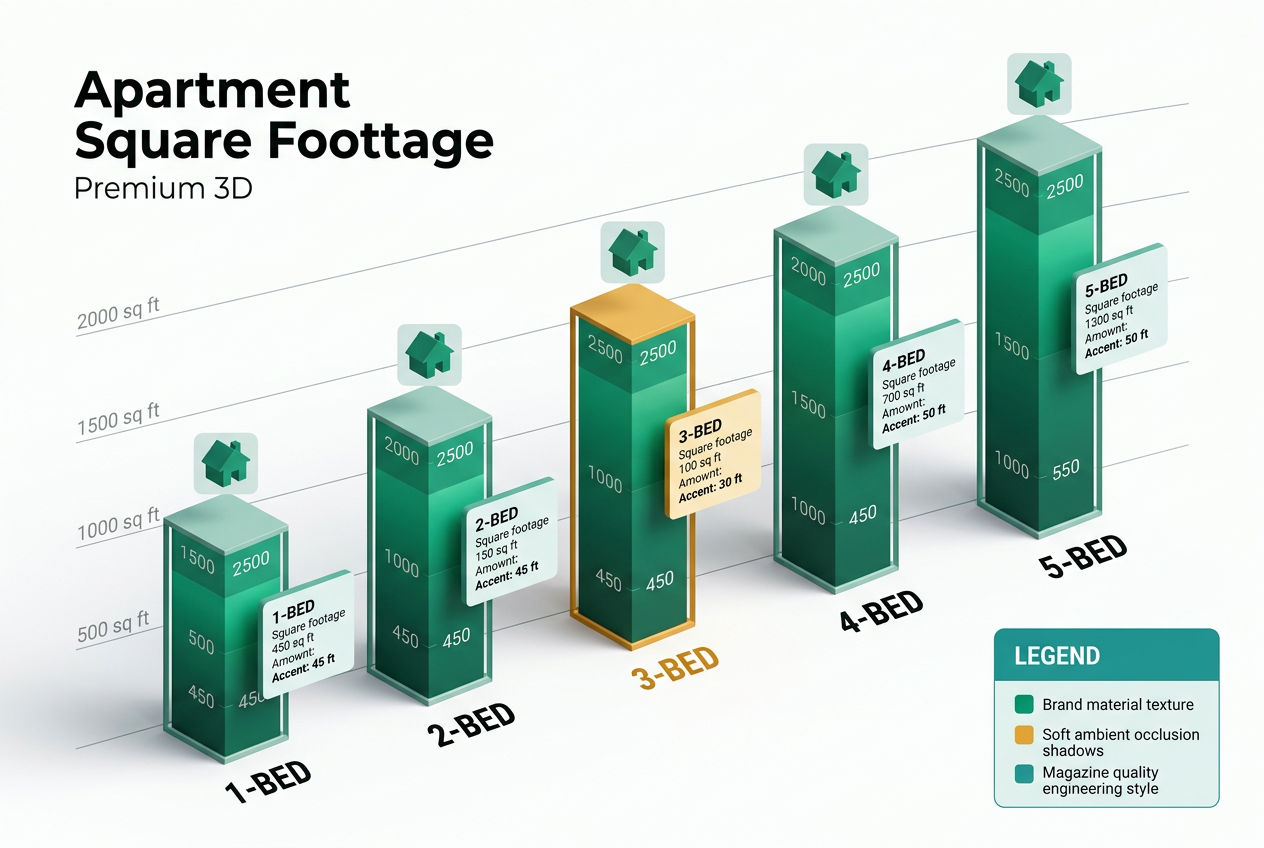
Here's what that translates to in terms of absorption area:
| Bedrooms | Est. Daily Flow (GPD) | Absorption Area — Moderate Soil* | Absorption Area — Clay Soil* |
|---|---|---|---|
| 1 BR | 150–225 GPD | 150–250 sq ft | 300–500 sq ft |
| 2 BR | 225–300 GPD | 250–400 sq ft | 500–750 sq ft |
| 3 BR | 300–450 GPD | 400–600 sq ft | 750–1,100 sq ft |
| 4 BR | 450–600 GPD | 500–800 sq ft | 900–1,400 sq ft |
| 5 BR | 600–750 GPD | 600–1,000 sq ft | 1,100–1,800 sq ft |
| 6 BR | 750–900 GPD | 750–1,200 sq ft | 1,300–2,100 sq ft |
Moderate soil = loam with a perc rate of 15–30 min/inch. Clay soil = 45–60 min/inch. All figures are general estimates. Your local health department code governs actual required sizing.
Source: EPA Onsite Wastewater Treatment Systems Manual (EPA/625/R-00/008); state health department sizing tables (NC DHHS, FL DOH Chapter 64E-6 FAC, MN MPCA Chapter 7080).
Clay soil changes the math dramatically. A 3-bedroom home on loam needs roughly 500 sq ft of trench area. Put that same house on Georgia red clay, and you might need 900–1,100 sq ft — or the health department rejects a conventional system entirely and requires a mound septic system instead.
How Does Soil Type Affect Leach Field Dimensions and Sizing?
Soil type affects leach field size more than any other single variable. A perc test — short for percolation test — measures how fast water absorbs into your soil, expressed in minutes per inch (MPI). Slower absorption means a larger required field. Perc test sizing results are the multiplier that turns your bedroom count into actual square footage.
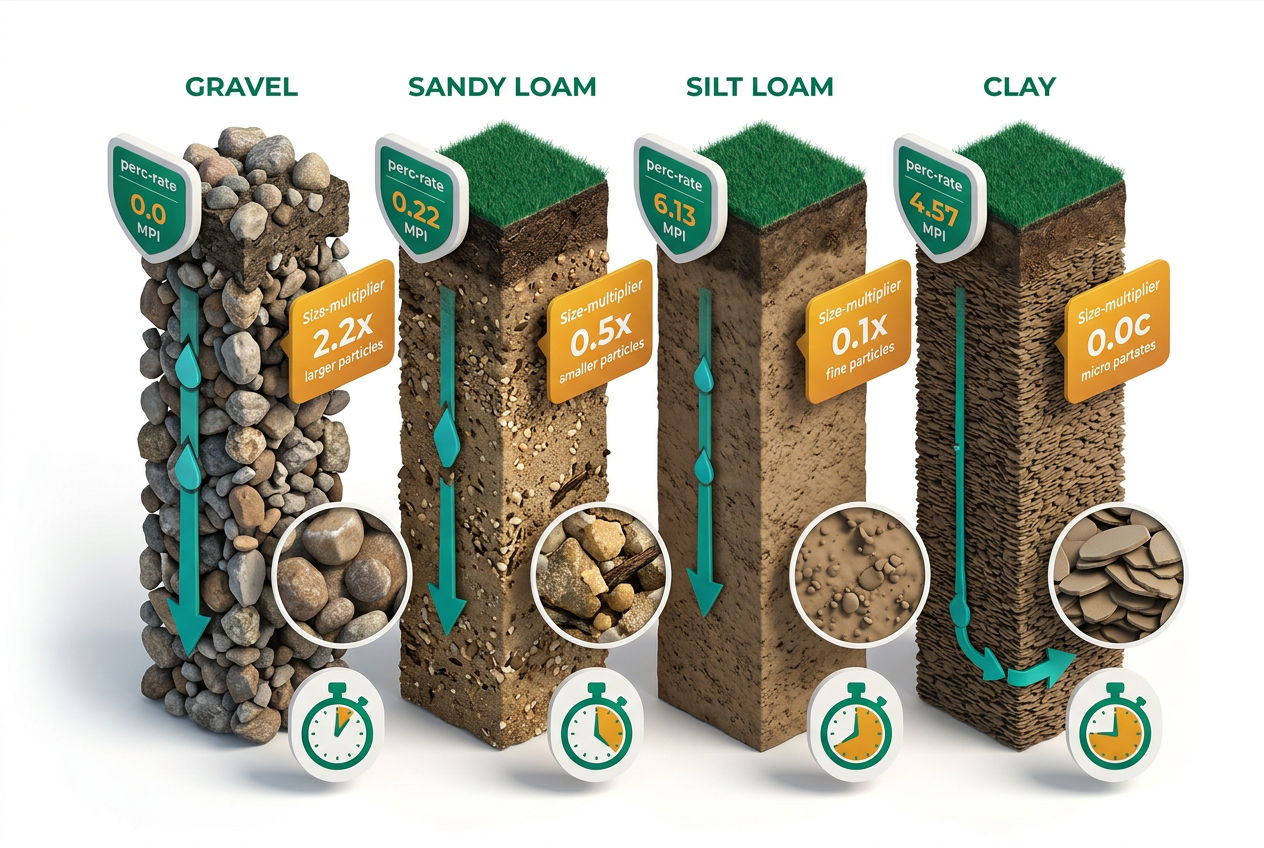
Here's how soil type maps to perc rate and sizing impact:
| Soil Type | Perc Rate (MPI) | Relative Field Size | Notes |
|---|---|---|---|
| Gravel / Coarse Sand | 1–5 MPI | Smallest | Too-fast perc can be a problem; pre-treatment may be required |
| Sandy Loam | 5–15 MPI | Small–Moderate | Ideal range for conventional systems |
| Loam | 15–30 MPI | Moderate | Most common residential soil type |
| Clay Loam | 30–60 MPI | Large | Field size increases significantly |
| Heavy Clay | 60+ MPI | Oversized or unsuitable | Many codes reject conventional systems above 60 MPI |
A percolation rate faster than 3 MPI is actually a red flag in many states — water passes through the soil too quickly for adequate pathogen removal. In that case, your local code may require a sand filter system or additional pre-treatment before the effluent reaches the leach field.
Read more about what happens when a perc test goes wrong in either direction.
The honest limitation here: perc test results vary depending on season, soil moisture at the time of the test, and the technician's methodology. A test conducted during a drought may show a faster rate than a test run in spring. Some states require tests to be run during specific seasons for this reason. Always treat perc test results as directional, and have your licensed designer confirm sizing before finalizing any permit application.
Always get your perc test results before estimating field size. The number of bedrooms gives you a starting point. The perc rate gives you the multiplier.
What Are Standard Leach Field Trench Dimensions?
Absorption area is measured in square feet, but the actual field is built as a series of trenches. Most states specify minimum and maximum leach field dimensions for those trenches. Here's what's typical:
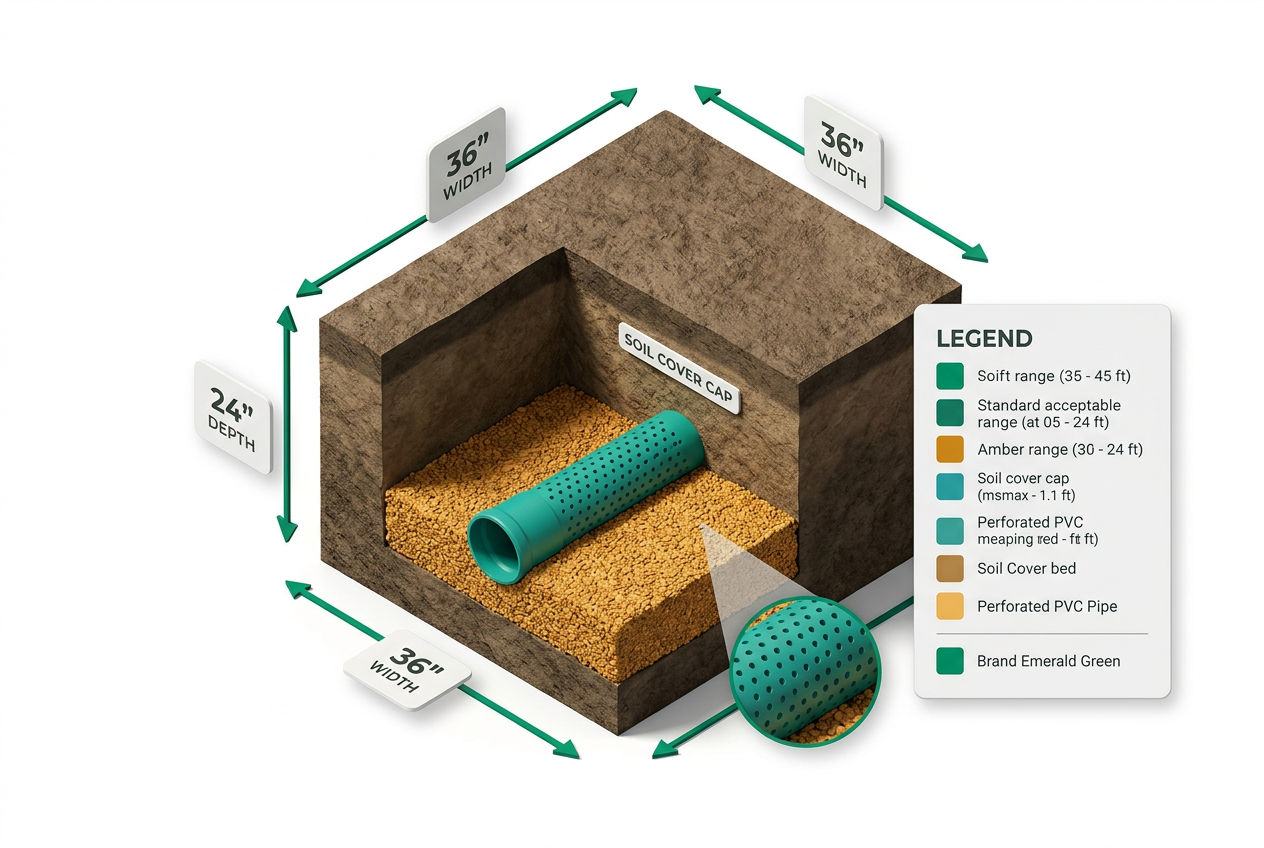
- Trench width: 1–3 feet (12–36 inches). Wider trenches increase absorption area per linear foot.
- Trench depth: 18–36 inches to the bottom of the gravel bed. Frost-affected states like Minnesota specify a minimum pipe depth of 18 inches below grade, with frost protection required for shallower runs.
- Pipe diameter: Standard 4-inch perforated PVC leach laterals, or Infiltrator Water Technologies Quick4 chamber systems as an alternative.
- Trench length: Typically 30–100 feet per trench. Most designers keep individual trenches under 100 feet to maintain even effluent distribution.
- Trench spacing: 6–10 feet center-to-center between parallel trenches, measured from trench wall to trench wall.
- Gravel bed: 6–12 inches of ¾-inch washed drain rock beneath and around the pipe.
Worked example — average drain field size for a 3-bedroom home in North Carolina:
A 3-bedroom home in North Carolina on loam soil (25 MPI perc rate) requires approximately 450 square feet of absorption area under the NC DHHS sizing tables. Using 2-foot-wide trenches, that's 225 linear feet of trench — achievable as three parallel trenches, each 75 feet long, spaced 8 feet apart center-to-center.
Total trench footprint: 24 feet wide × 75 feet long = 1,800 sq ft of lot space consumed for the primary field. That's before the mandatory 100% reserve area, which doubles the lot requirement to approximately 3,600 sq ft set aside specifically for the septic system. On a half-acre lot with a house and driveway already in place, that 3,600 sq ft can be a tight fit — which is exactly why a site evaluation precedes permit issuance in every NC county.
For more on how these fields go in the ground, see our drain field installation guide.
How Big of a Leach Field Do You Need for a 3-Bedroom House?
A 3-bedroom home is the most common residential scenario, so it gets its own section. Most homeowners can expect a 3-bedroom system to require 400–600 sq ft of actual trench absorption area on typical residential soils, with the full drain field footprint (including setbacks and reserve area) consuming 2,000–5,000+ sq ft of lot space.
Here's what that looks like with real numbers:
- Best case (sandy loam, 10 MPI): ~350–400 sq ft absorption area. Three trenches, each 50 feet long, 2 feet wide. Field complete.
- Average case (loam, 20 MPI): ~450–550 sq ft. Three to four trenches, each 60–75 feet long.
- Challenging case (clay loam, 45 MPI): ~800–1,000 sq ft. Six to eight trenches, or a switch to chamber-style infiltrators like Infiltrator Quick4 Plus, which offer more absorption area per trench foot.
- Poor soil (heavy clay, 65+ MPI): Conventional trench system likely rejected. A mound system or alternative septic system is required.
If you're buying rural property and the listing says "3-bedroom, 1-acre lot," don't assume there's room for a septic system and a leach field plus the reserve area. An acre is 43,560 sq ft, but once you subtract the house footprint, driveway, setbacks from the well, property lines, and water features, the usable drain field area can get tight fast.
Our septic system cost guide for rural property buyers covers exactly what to verify before you sign.
How Do Setbacks and Reserve Areas Affect Total Field Size?
The trench absorption area is only part of the land you need. Every code jurisdiction requires setback distances between the leach field and other features, plus a 100% replacement reserve area.
Here are typical minimums — always verify locally, because these vary by state and county:
- Drinking water well: 50–100+ feet (Massachusetts Title 5 requires 150 feet in many soil conditions)
- Property lines: 5–10 feet minimum
- Structures and foundations: 10–25 feet
- Surface water, ponds, streams: 50–100 feet
- Driveways and paved surfaces: 10–15 feet
- Reserve replacement area: 100% of primary field size (most states mandate this)
The reserve requirement is the one that catches homeowners off guard. Your county health department won't approve a permit unless your lot can physically accommodate two full drain fields — the primary and the backup. If you ever need drain field repair or replacement, that reserve space is what makes it possible without relocating your house.
Small-lot situations require creative solutions — see our guide on septic systems for small lots.
Regional Variations: Your State Changes Everything

DIY Septic Blueprint
Thinking about building it yourself?
The complete, plain-English plan to size, permit and install your own septic system — designed for homeowners, not contractors. Skip the $15,000–$25,000 quotes and do it right the first time.
Get the DIY Blueprint — $67 →Instant download · 8 modules + 3 bonus guides · 60-day money-back guaranteeThere is no federal leach field sizing standard. The EPA publishes guidelines through its Onsite Wastewater Treatment Systems Manual (EPA/625/R-00/008), but actual regulatory authority sits with state and county health departments. The differences are substantial.
Massachusetts operates under Title 5 (310 CMR 15.000), one of the most stringent frameworks in the country. Title 5 requires a point-of-sale inspection for any property transfer involving an existing septic system, and it mandates a 150-foot setback from private wells in many soil conditions. The state also restricts conventional systems in high groundwater areas, pushing designers toward pressure-dosed or innovative/alternative (I/A) systems with nitrogen-reduction components. For a 3-bedroom home in eastern Massachusetts on silty soil, an I/A system with an engineered leaching structure might cost 40–60% more than a conventional system in a neighboring state.
Florida administers septic under Chapter 64E-6 of the Florida Administrative Code (FAC). The state's shallow water table — often 12–24 inches below grade in coastal counties — means most new systems require mounding or performance-based treatment systems. The standard absorption area formula in Florida is based on hydraulic loading rates per square foot per day, which maps differently to the MPI-based perc test results used in the North.
Minnesota regulates under Chapter 7080 of Minnesota Rules, administered by the Minnesota Pollution Control Agency (MPCA). The state's Type I through Type IV soil classifications determine system type. Type IV soils (the tightest clays) prohibit conventional systems; Type I and II allow standard trenches. Minnesota also mandates that all new system designs be submitted by a licensed designer — not just a contractor — which is a meaningful consumer protection requirement that several other states have not adopted.
Texas leaves most septic regulation to individual counties under OSSF (On-Site Sewage Facility) rules, with the Texas Commission on Environmental Quality (TCEQ) setting the baseline. In East Texas, the Tyler Formation soils — a dense, iron-rich clay formation common in Smith, Cherokee, and Rusk counties — routinely produce perc rates above 60 MPI. Conventional trench systems are frequently rejected in these counties, and alternative systems including aerobic treatment units (ATUs) are the norm rather than the exception.
Oregon requires that all new system designs be prepared and stamped by a licensed engineer or a registered on-site system designer under OAR 340-071. This is similar to Minnesota's requirement and means a DIY design isn't a legal option for most installations.
For a cost breakdown by state and system type, our drain field replacement cost guide includes regional pricing data. And if your soil or lot situation is complicated, connect with a licensed septic contractor in your area who knows your county's specific requirements.
Can a Leach Field Be Too Big?
Most homeowners worry about undersized fields, but oversized fields create their own problems — and they're worth understanding before you request extra capacity "just in case."
When a leach field is significantly oversized relative to actual wastewater flow, the effluent gets distributed so thinly across the trench area that the soil never maintains consistent moisture. In highly permeable soils (under 5 MPI), an oversized field can dry out between loading cycles. This matters because the biological treatment layer — called the biomat — requires consistent moisture to sustain the microbial community that actually treats the effluent before it reaches groundwater. An oversized field in sandy soil can actually reduce treatment effectiveness by preventing the biomat from establishing.
Some states have responded to this by setting maximum absorption area limits as well as minimums. Oregon's administrative rules, for instance, allow designers to right-size systems for actual flow rather than defaulting to maximum bedroom-based estimates when the household's actual water use data supports a smaller design.
The practical implication: if you're designing a vacation cabin used only on weekends, or a retirement home for two adults in a 4-bedroom house, ask your designer whether a flow-based design (using actual measured water use rather than the bedroom proxy) is permitted under your county's rules. In some jurisdictions, it will save money and produce a better-performing system.
What Does Leach Field Installation Cost?
Leach field installation cost varies widely by system size, soil conditions, site access, and region. Here are general ranges for a new conventional trench system on a residential lot with typical soil conditions:

| System Size | Estimated Installation Cost |
|---|---|
| 1–2 bedroom (simple soil) | $3,000–$6,000 |
| 3-bedroom standard | $5,000–$12,000 |
| 4-bedroom, moderate soil | $8,000–$15,000 |
| 4+ bedroom, clay soil | $12,000–$25,000+ |
| Mound system (any size) | $15,000–$35,000+ |
| Alternative/engineered system | $20,000–$50,000+ |
These ranges reflect total installed cost including excavation, pipe, gravel or chamber media, distribution box, and inspection fees. They do not include the septic tank itself (typically $1,500–$4,000 additional for a new tank), perc testing ($200–$800), or engineering fees if required by your state.
Clay soil and difficult site access are the two factors most likely to push costs toward the top of the range. If your lot requires blasting, retaining walls, or a pump system to move effluent uphill to the field, costs can exceed these ranges significantly.
For a detailed regional breakdown, see our full drain field replacement cost guide.
Frequently Asked Questions
What is the average leach field size for a 3-bedroom house?
The average leach field size for a 3-bedroom house is 400–600 square feet of trench absorption area on moderate residential soil with a percolation rate between 15 and 30 minutes per inch. That translates to three or four parallel trenches, each 60–75 feet long and 2 feet wide, spaced 8 feet apart. The total lot space consumed — including the mandatory 100% reserve area that most states require — typically runs 2,000–4,000 square feet. On clay soil with a perc rate of 45–60 MPI, the same 3-bedroom home may require 750–1,100 square feet of absorption area, pushing the total footprint closer to 5,000 square feet. These figures are general estimates. Your county health department's sizing tables, combined with your actual perc test results, govern the legally required size. Always confirm with a licensed septic designer before purchasing land or submitting a permit application.
How do I use a leach field size chart to estimate what I need?
To use an average leach field size chart effectively, start with your bedroom count to find the estimated daily wastewater flow in gallons per day, then cross-reference that flow against your soil's percolation rate from a perc test. Bedroom count determines demand; perc rate determines how much trench area your soil needs to absorb that demand safely. For example, a 4-bedroom home generating 500–600 GPD on loam soil (20 MPI) typically needs 500–800 square feet of absorption area. On clay loam at 50 MPI, that same home may need 900–1,400 square feet. The chart numbers are starting points — your local health department's official sizing tables may use different loading rates or require additional factors like seasonal high groundwater depth, system age, or proximity to sensitive areas. Use the chart to budget and plan, then verify every number with a licensed professional before construction.
What leach field dimensions are required by code?
Standard leach field dimensions vary by state, but most jurisdictions specify trenches 1–3 feet wide, 18–36 inches deep to the bottom of the gravel bed, and no longer than 100 feet per individual trench run. Trench spacing is typically 6–10 feet center-to-center. Gravel depth beneath the perforated pipe is usually 6–12 inches of ¾-inch washed drain rock. In frost-prone states like Minnesota, pipe depth minimums are set specifically to prevent freezing — Minnesota Rules Chapter 7080 requires pipe burial deep enough to provide thermal protection through the design winter. Some states allow chamber systems like the Infiltrator Quick4 Plus in place of gravel-and-pipe trenches; these can offer more absorption area per linear foot. Because leach field dimensions are set by local code, the only authoritative source for your project is your county health department's onsite sewage regulations, not national averages.
What is the difference between drain field size and leach field size?
Drain field size and leach field size refer to the same measurement — the total square footage of soil absorption area in your onsite sewage system. "Drain field" and "leach field" are regional synonyms for the same component: the network of perforated pipes or chamber units buried in gravel-filled trenches that distribute septic tank effluent into the surrounding soil. Some states use "leach field" as the formal regulatory term (North Carolina, Massachusetts), while others use "drain field" or "absorption field" (Florida, Minnesota). Regardless of terminology, the sizing methodology is identical — daily wastewater flow divided by the soil's hydraulic loading rate, expressed in gallons per square foot per day. Average drain field size for a typical 3-bedroom home on moderate soil is 400–600 square feet of trench area, matching average leach field size figures. The terms are interchangeable for practical planning purposes.
How does perc test sizing affect the leach field area I need?
Perc test sizing directly determines how many square feet of trench your soil requires to safely absorb your home's wastewater. A faster perc rate means the soil absorbs water quickly, so less trench area is needed. A slower rate means the soil is denser or more compact, and you need more absorption surface to prevent effluent from backing up. Specifically, most sizing tables express soil capacity as a loading rate in gallons per square foot per day — a loam soil at 20 MPI might accept 0.5–0.8 gallons per square foot per day, while clay loam at 50 MPI might only accept 0.2–0.3 gallons per square foot per day. For a 3-bedroom home generating 400 GPD, that difference means the clay loam soil requires roughly twice the trench area of the loam soil. Perc tests must be conducted by a licensed professional in most states, and results are valid for a defined period — typically 2–5 years — before re-testing is required.
Sources & Methodology: Sizing figures derived from EPA Onsite Wastewater Treatment Systems Manual (EPA/625/R-00/008); NC DHHS Wastewater Section design rules; Florida Administrative Code Chapter 64E-6 FAC; Minnesota Rules Chapter 7080 (MPCA); Oregon Administrative Rule 340-071; Massachusetts Title 5 (310 CMR 15.000); Texas TCEQ OSSF rules. Regional soil data from USDA Web Soil Survey. Product references (Infiltrator Quick4, Infiltrator Quick4 Plus) are independent mentions for informational purposes; no commercial relationship exists. All absorption area figures are general estimates for planning purposes. Consult your local health department and a licensed septic designer for site-specific requirements.
About This Article: Researched and written by the editorial team at SepticTankHub.com with technical input from licensed septic system designers practicing in North Carolina, Minnesota, Massachusetts, and Texas. Reviewed against current state administrative codes as of publication date. This article is for informational purposes only and does not constitute engineering advice.
Free download
Not ready for the Blueprint? Start free.
Grab the free DIY Septic Planning Kit — the permit-first checklist, perc-test cheat sheet, and sizing tables that keep your build from getting red-tagged.
Was this article helpful?
Frequently Asked Questions
Recommended Resources
📖 Related Articles
- What Is a Drain Field? (And How Does It Work?)
- Mound Septic System: $10K–$25K Cost & How It Works (2026)
- Perc Test (Percolation Test): What It Is & How It Works
- How to Install a Septic Drain Field
- Alternative Septic Systems: Options When a Standard System Won't Work
- Buying Rural Property? Septic System Checklist
- Septic System for Small Lots: Options When Space Is Tight
💰 Cost Guides
🔧 Services
Find Septic Professionals Near You
Compare licensed, verified septic companies by area — top county markets and cities below, or browse all 50 states.
County markets
Popular cities
