
Quick Answer
Leach field chambers are hollow, arch-shaped plastic units buried in trenches that replace the crushed stone in a traditional drainfield. They distribute septic effluent across the soil absorption area, and they now dominate new residential septic installations across the United States.
Have you ever watched a contractor load your job ticket, flip to a page of chamber specs, and realize you have no idea what you're looking at or whether the unit they've chosen actually fits your soil and lot conditions? That gap — between what contractors assume homeowners know and what homeowners actually know — is what this comparison is built to close. Specific models, real specs, real costs, honest tradeoffs, so you can evaluate what's being proposed rather than just sign off on it.
Key Takeaways
- Infiltrator Water Technologies holds over 70% of the chamber market; the Quick4 Plus is the most widely installed residential chamber in the U.S.
- Chamber systems typically cost $3,000–$8,000 installed vs. $4,000–$12,000+ for pipe-and-gravel systems on a standard residential lot.
- Chambers eliminate the need for 50–70 tons of gravel on a typical install — a major labor and cost advantage.
- Expected lifespan is 20–30+ years for quality HDPE chambers when properly installed.
- Always verify which specific chamber models your county health department approves before purchasing anything.
What Are Leach Field Chambers and How Do They Work?
Leach field chambers — also called drainfield chambers or septic chamber systems — replace the crushed stone layer in a conventional absorption field. Each unit is an open-bottomed arch. Effluent flows from your septic tank into a distribution pipe, enters the first chamber, and spreads down the trench. The open bottom allows liquid to contact native soil directly. Sidewall perforations add additional infiltrative surface area.
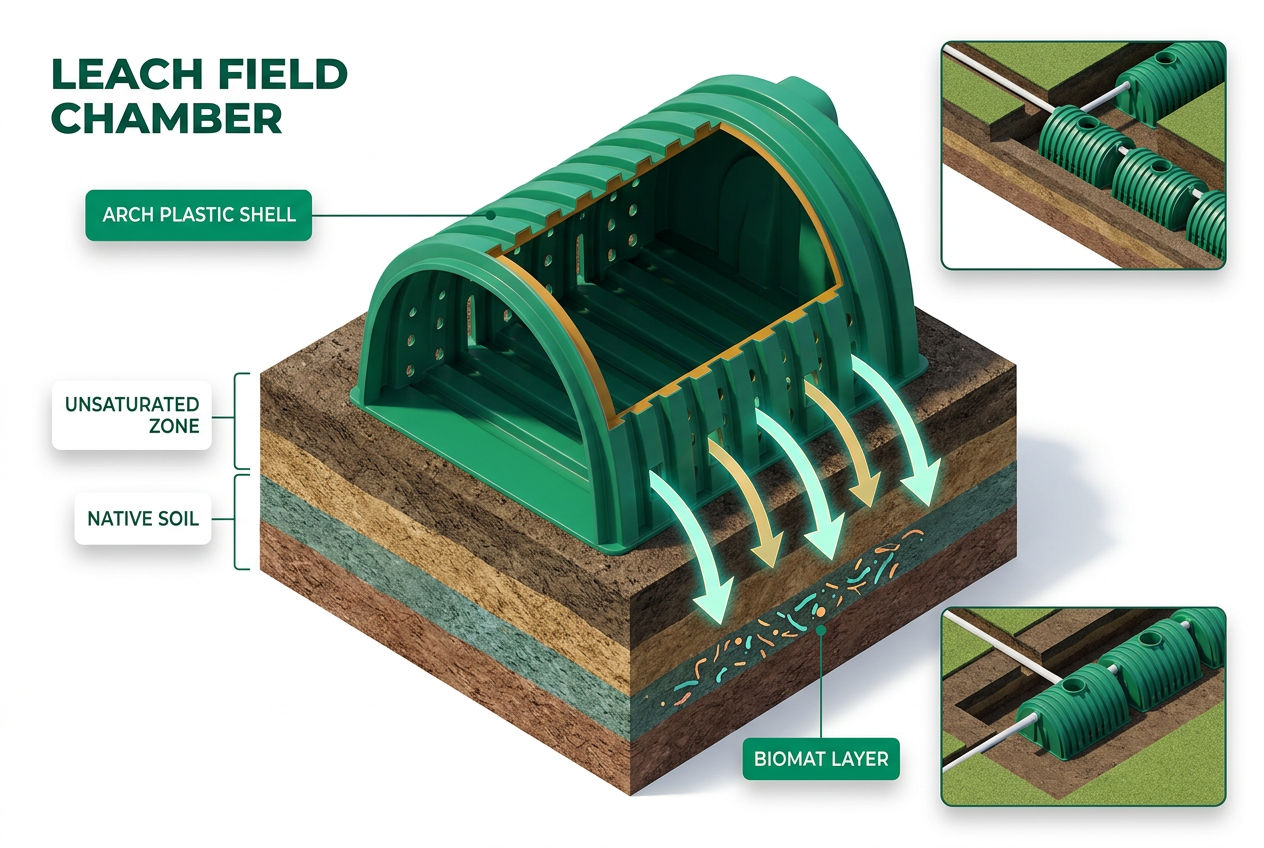
The chamber itself creates the void space that gravel would normally provide — no crushed aggregate, no fabric filter sock around a perforated pipe, no gravel trucks backing down your driveway. That void space is where effluent temporarily holds before soil absorption pulls it through.
The EPA recognizes chamber systems as a proven alternative to conventional drainfields. According to EPA guidance on septic systems (epa.gov/septic), gravelless systems including chambers are approved for use in virtually all 50 states, though specific product approvals still vary at the county level. For a deeper look at how the drainfield itself functions within the overall system, see our guide on what a drain field is and how it works.
Key Differences: Leach Field Chambers vs. Pipe and Gravel
Before comparing chamber brands against each other, it helps to understand how the entire category stacks up against the system it replaced.
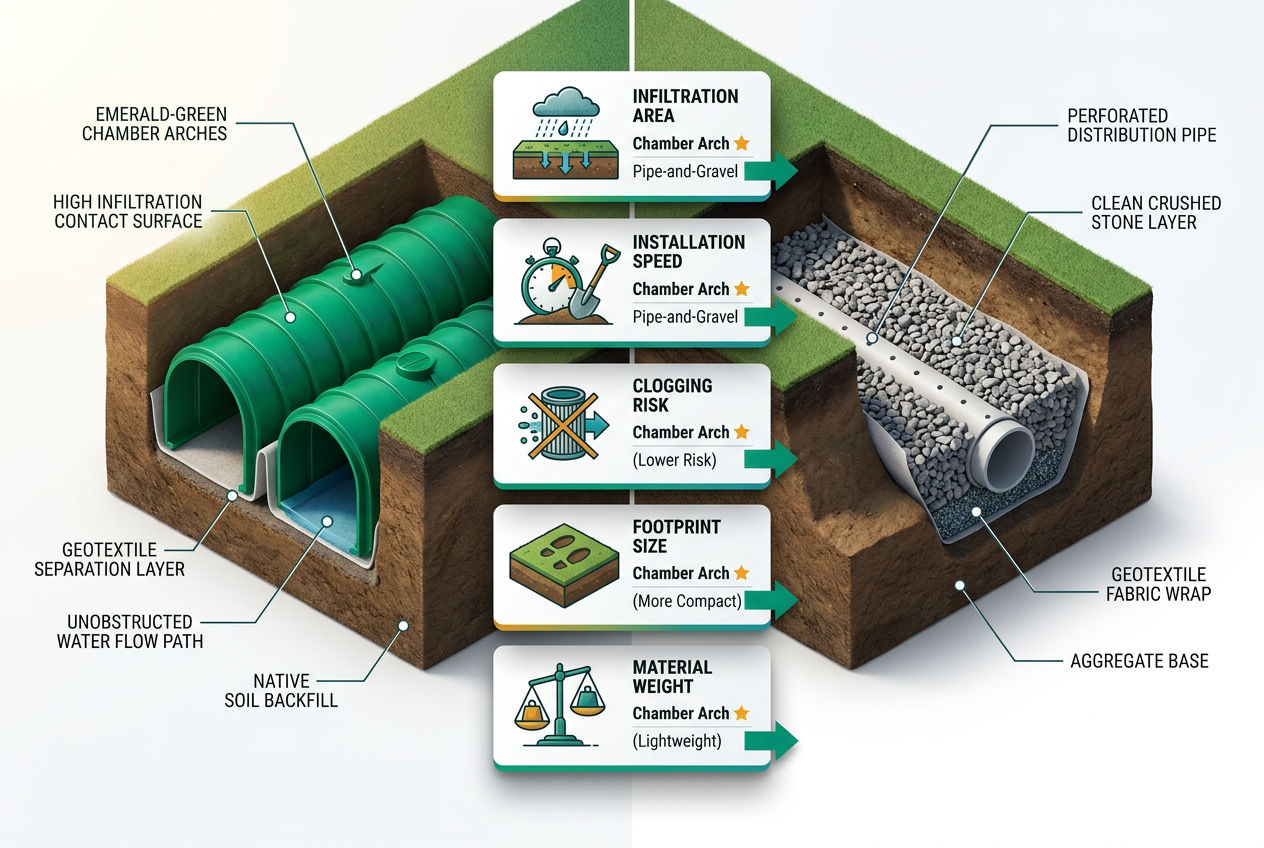
Side-by-Side: Chamber System vs. Pipe-and-Gravel Drainfield
| Factor | Chamber System | Pipe & Gravel |
|---|---|---|
| Material | HDPE or polypropylene plastic | Perforated pipe + crushed stone |
| Gravel required | None | 50–70 tons (typical residential) |
| Installed cost | $3,000–$8,000 | $4,000–$12,000+ |
| Installation time | 30–50% faster | Standard baseline |
| Expected lifespan | 20–30+ years | 20–30 years |
| Field size reduction | Up to 20–30% (jurisdiction-dependent) | Baseline |
Sources: EPA septic system guidance; NOWRA industry data; contractor estimates from national installer surveys.
The gravel savings alone change the economics significantly. Eliminating gravel means fewer truck trips, less excavation, and faster backfill. On a 3-bedroom home in western North Carolina, where gravel delivery to a steep rural lot can add $1,500–$2,500 to a conventional install, chambers often pay for themselves before the inspector even shows up.
That said, chambers aren't a universal fix. Clay soils with low percolation rates — common in the Georgia Piedmont or the Ohio River Valley — don't benefit from chamber storage volume if the native soil simply can't absorb effluent fast enough. A perc test still determines whether your soil can handle any type of drainfield system.
Which Leach Field Chamber Brands Are Actually Available?
Walk into most septic supply houses in the U.S. and you'll find two or three chamber lines stocked — Infiltrator dominates, ADS competes in specific regions, and EZflow fills a specific niche for narrow lots. Here's what each product actually delivers, including where they fall short.
Infiltrator Quick4 Plus Standard Chamber
Infiltrator Water Technologies reports over 30 million chambers installed, and the Quick4 Plus accounts for the bulk of that volume. It's the unit most contractors already have spec'd, and most county health departments have an approval file for it going back years.
Specs:
- Dimensions: 53.5" long × 34.5" wide × 12" high
- Storage capacity: approximately 12 gallons per unit
- Weight: approximately 22 lbs
- Material: High-density polyethylene (HDPE)
- Load rating: Traffic-rated with proper soil cover (typically 12–24 inches depending on jurisdiction)
The wider 34.5-inch footprint means more infiltrative surface area per linear foot of trench than a standard-width chamber. For a 3-bedroom home generating roughly 300 gallons per day (GPD) of effluent, you'd typically need 30–40 Quick4 Plus units depending on your soil's loading rate — faster-draining sandy loam soils might handle 0.5–0.8 GPD per square foot, while slower soils drop to 0.2–0.4 GPD per square foot.
Where it gets complicated: The wider profile requires a wider trench cut. In rocky New England soils where blasting or heavy excavation is involved, that extra 12 inches of trench width adds real excavation cost. Some contractors default to the standard-width unit in those conditions specifically to keep the trench cut manageable.
For more on Infiltrator products specifically, see our Infiltrator septic chambers guide.
Infiltrator Quick4 Standard Chamber
Same 53.5-inch length as the Plus, but narrower — 22 inches wide versus 34.5 inches. Capacity drops to roughly 8 gallons per unit, and the unit weighs only about 12 lbs. The Standard fits in a 24-inch-wide trench, which matches most conventional drainfield trench specs and is easier to permit in jurisdictions that haven't updated their code to accommodate wider units.
When the Standard makes more sense than the Plus:
- Your county requires trench widths at or under 24 inches
- You're replacing a failed pipe-and-gravel system in an existing trench where width is fixed
- Your installer has more experience with the Standard and the labor quote reflects it
Where it falls short: More units are required to achieve the same total storage volume as the Plus. More units means more end caps, more connections, and a slightly longer installation timeline. On a system requiring 40 Quick4 Standard units, you're looking at roughly 35 additional pounds of material compared to 30 Quick4 Plus units — not a dealbreaker, but a real factor in tight-access installs.
ARC 24 Chamber by ADS (Advanced Drainage Systems)
ADS enters the chamber market with the ARC series. The ARC 24 is 47 inches long × 24 inches wide, with a capacity of roughly 9 gallons per unit and a weight of approximately 15 lbs. ADS generated $2.8 billion in revenue in fiscal year 2024 and is the dominant player in HDPE drainage pipe — which means the ARC line has strong distribution and contractor familiarity in regions where ADS pipe is already the default.
The 47-inch length differs from Infiltrator's 53.5-inch standard, which matters when calculating the number of units per trench run. Running the math before ordering saves confusion at the supply house.
ARC 24 strengths:
- Lighter per-unit weight than the Quick4 Plus, which matters for single-person handling on remote lots
- Familiar brand for contractors already using ADS pipe products — one vendor relationship, one delivery
- Competitive per-unit pricing in some regional markets, particularly in the Southeast where ADS distribution is dense
Where to be careful: Infiltrator's larger installed base means more published soil loading rate data and more county health departments with ARC-specific approval already on file. In jurisdictions that maintain an approved products list — which is most of them — confirm ARC 24 is specifically listed before your contractor orders materials. This is not hypothetical; projects have been delayed when inspectors found the approved products list didn't include the ARC series.
EZflow by Infiltrator
EZflow takes a fundamentally different approach. Rather than arch chambers, EZflow uses polystyrene aggregate wrapped around a perforated pipe, sold in 10-foot bundle lengths. It's gravelless like chambers, but it functions more like a high-performance pipe-and-gravel replacement than a chamber system.
EZflow fits narrow trenches — as small as 10–12 inches wide — and works well on tight lots or in areas where a conventional-width trench isn't feasible. It's also flexible enough to follow gradual curves, which matters on odd-shaped lots where a straight trench run isn't possible.
EZflow is not traffic-rated. Heavy vehicles over an EZflow field will crush the polystyrene aggregate. If your drainfield is anywhere near a driveway, parking area, or equipment path, EZflow is the wrong product for that location. For more on what can and can't go over a drainfield, see can you drive over a drain field.
EZflow also lacks the per-linear-foot storage volume of a full-width chamber, so your drainfield size will often need to be larger to compensate when local health code uses storage volume in the sizing calculation.
How Much Do Leach Field Chambers Cost?
Per-unit pricing for chambers runs $40–$120 depending on brand, size, and regional distributor pricing. The Quick4 Plus typically lands at $55–$85 per unit through a wholesale supply house. The Quick4 Standard is $40–$65 per unit. ARC 24 runs similarly to the Quick4 Standard in most markets.
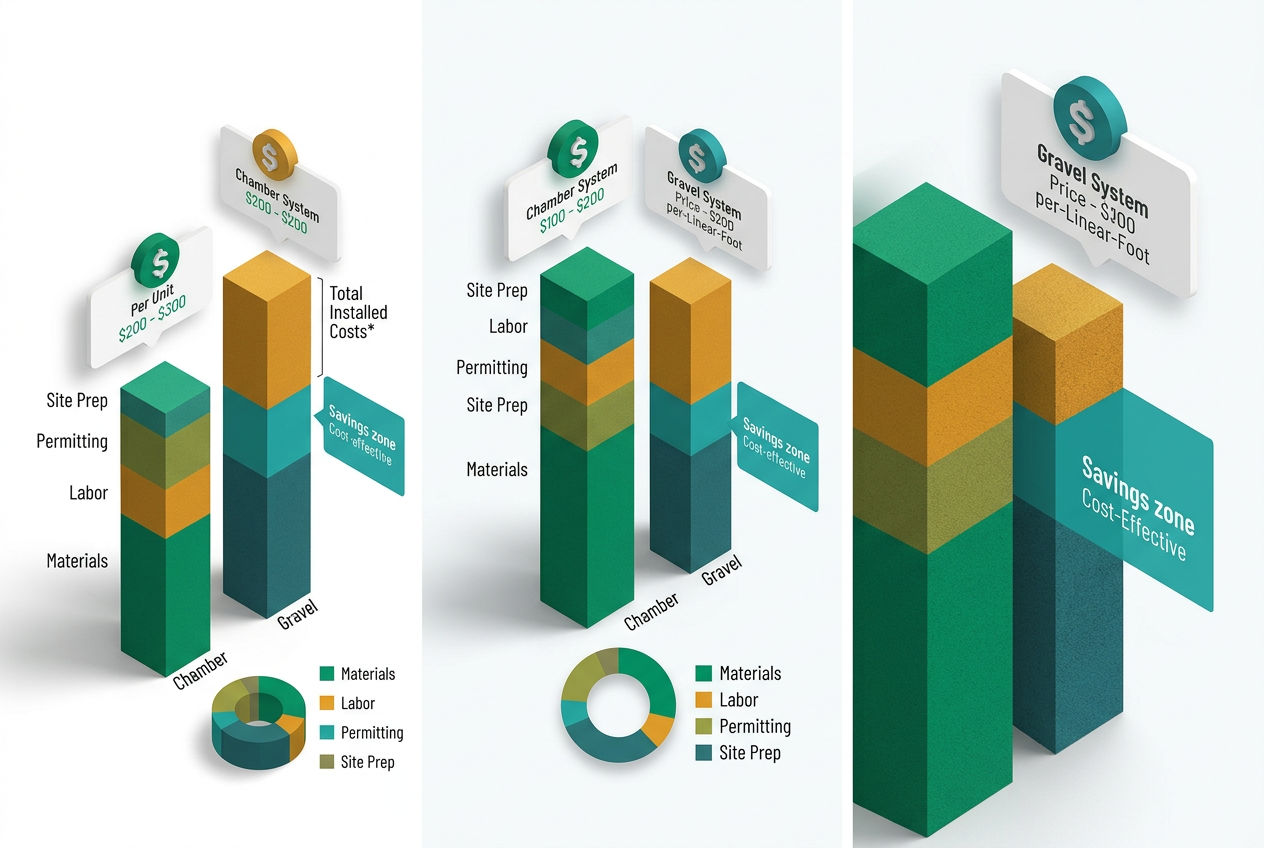
Per-unit cost in isolation is almost meaningless. What matters is total installed system cost.
Worked example: A 3-bedroom home in Central Virginia with sandy loam soil (loading rate: 0.6 GPD/sq ft, daily flow: ~300 GPD) needs roughly 500 square feet of infiltrative area. Using Quick4 Plus chambers at approximately 17 sq ft of infiltrative surface per unit, that's about 30 units.
- Material cost: $1,650–$2,550
- Excavation, backfill, distribution manifold, end caps, labor: $2,850–$3,950
- Total installed: approximately $4,500–$6,500
A pipe-and-gravel system on the same lot, factoring in gravel delivery, runs $6,500–$9,500 — $2,000–$3,000 more for comparable performance.
For a full breakdown of what drives replacement costs when a drainfield fails, see our drain field replacement cost guide. If you're comparing chamber systems against more specialized alternatives, our overview of alternative septic systems covers the broader landscape. Connect with licensed septic installers in your area to get quotes specific to your lot conditions and local material pricing.
How Long Do Leach Field Chambers Last?

DIY Septic Blueprint
Thinking about building it yourself?
The complete, plain-English plan to size, permit and install your own septic system — designed for homeowners, not contractors. Skip the $15,000–$25,000 quotes and do it right the first time.
Get the DIY Blueprint — $67 →Instant download · 8 modules + 3 bonus guides · 60-day money-back guaranteeQuality HDPE chambers — Infiltrator Quick4 Plus, Quick4 Standard, and the ARC 24 — carry expected lifespans of 20–30+ years when properly installed and maintained. According to Penn State Extension's onlot sewage program guidance, chamber systems installed in the 1980s and early 1990s are still in service in Pennsylvania, which provides real-world confirmation of 30+ year performance in varied soil conditions.
What shortens chamber lifespan:
- Overloading: Consistently sending more than the design flow volume overwhelms the soil's absorption capacity. The chambers themselves don't fail — the biomat that forms at the soil interface does.
- Non-biodegradable solids: Wipes, feminine hygiene products, and similar items can bridge chamber openings and disrupt flow distribution.
- Vehicle traffic: Even traffic-rated chambers require minimum soil cover depths. Vehicles on inadequate cover compress and crack units.
- Failed septic tank maintenance: Sludge and scum that escape the tank because it hasn't been pumped will clog chamber sidewall perforations and accelerate biomat development.
For more on what determines how long a drainfield stays functional, see how long drain fields last. And if you're trying to identify whether an existing system is already showing stress, signs a drain field is failing covers the early warning indicators worth knowing.
Which Is Right for You? Scenario-Based Verdicts
Standard residential new construction, cooperative soil, no access constraints: Quick4 Plus. The wider footprint reduces total unit count, installation is fast, and approval is nearly universal. The small premium over the Quick4 Standard disappears in the labor savings.
Replacement system in existing narrow trenches: Quick4 Standard or EZflow, depending on trench width. If the original trench was cut for a 24-inch pipe-and-gravel system, the Standard drops in without reexcavation. EZflow works when trench width is the binding constraint.
Rocky or blasted-ledge lots in New England: Quick4 Standard. The narrower trench cut reduces excavation cost enough to offset the higher unit count.
Tight urban or suburban lot with irregular shape: EZflow for flexible routing, but only if there's zero possibility of vehicle traffic over the field. If traffic is any possibility, the Standard in multiple shorter runs is the safer call.
Jurisdiction with an ADS-dominant supply chain: ARC 24 is worth pricing. If ADS is already approved on your county's list and your contractor works with ADS regularly, the per-unit savings and single-vendor logistics can make it competitive.
Mound systems or alternative configurations: Standard arch chambers don't always translate directly to mound or pressure-dosed systems. See mound septic systems for what changes when effluent is pumped uphill rather than gravity-fed.
Regional Considerations: Where Chambers Outperform Gravel and Where to Be Careful
Southeast (Georgia, Alabama, South Carolina): Sandy coastal plain soils absorb well, but red clay Piedmont soils can be challenging. Chambers work fine in sandy areas. In red clay, the perc test result drives the decision more than the chamber choice does. ADS has strong regional distribution here.
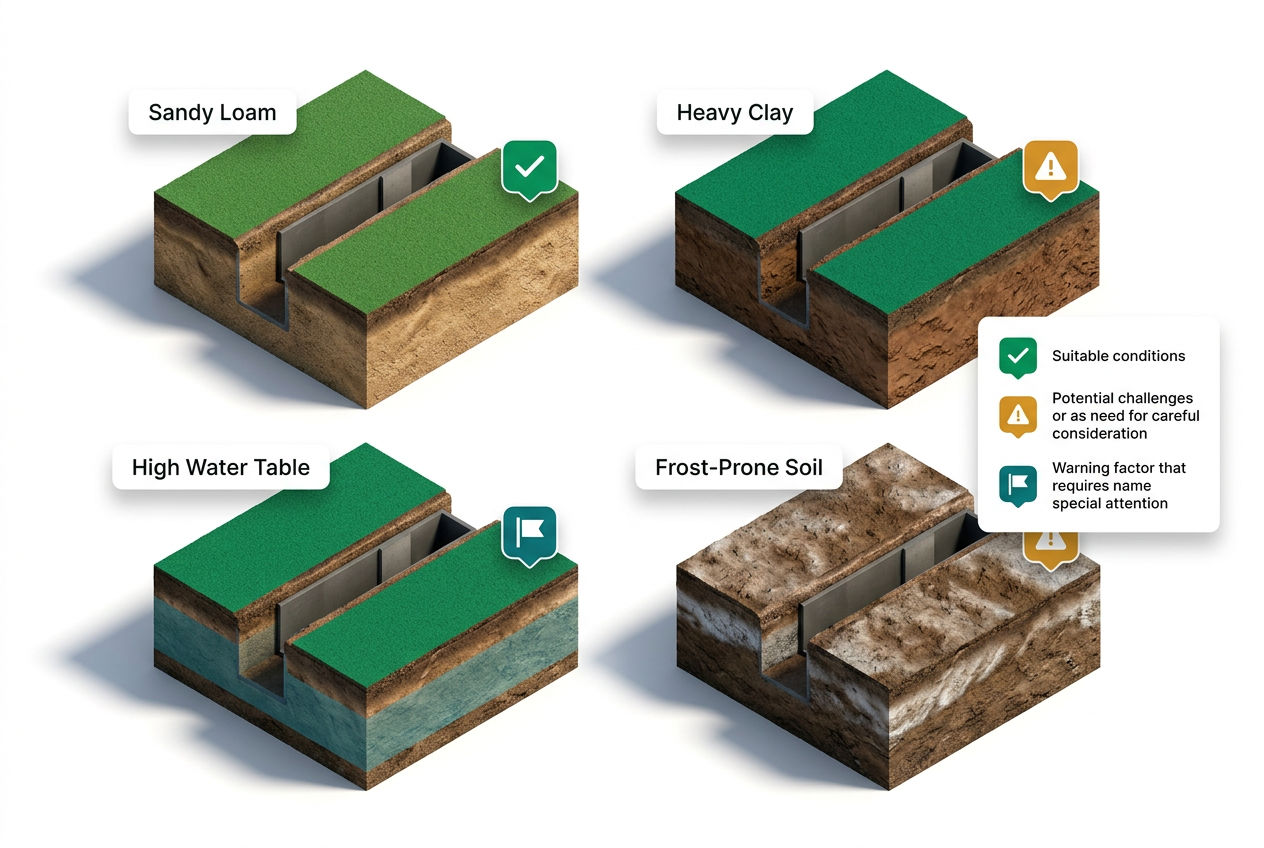
Mid-Atlantic (Virginia, Maryland, Pennsylvania): Highly variable soils — loam in the Shenandoah Valley, serpentine and shale in piedmont areas, heavy clay in tidal areas. Penn State Extension's onlot program data is the most useful regional reference. Most counties have approved Infiltrator products for years; ARC 24 approval varies by jurisdiction.
New England: Rocky soils and high groundwater tables make site prep the dominant cost. Chambers save on gravel but don't save on ledge blasting. In jurisdictions with seasonally high water tables, setback requirements to groundwater may limit chamber depth and system placement.
Midwest (Ohio, Indiana, Illinois): Heavy clay soils in the Ohio River Valley and northern glacial till regions have slow percolation rates that limit any absorption system. Chambers add storage volume, but if the soil's hydraulic conductivity is the binding constraint, chamber choice matters less than total field area.
Mountain West (Colorado, Idaho, Montana): Seasonal freeze depth and permit requirements vary dramatically by elevation and county. Some high-altitude counties require deeper burial or insulation details that affect which chamber profiles are practical.
Frequently Asked Questions About Leach Field Chambers
How many leach field chambers do I need for a 3-bedroom house?
Most 3-bedroom homes are designed around a daily effluent flow of 300 gallons per day. The number of chambers you need depends on two variables: the infiltrative surface area each chamber provides, and your soil's hydraulic loading rate — how many gallons per day each square foot of soil can absorb.
For Quick4 Plus chambers, each unit provides approximately 17 square feet of infiltrative surface. Sandy loam soil with a loading rate of 0.6 GPD per square foot needs roughly 500 square feet of infiltrative area, which works out to about 30 Quick4 Plus units. If you're in slower soil — clay loam at 0.3 GPD per square foot — that same house needs 1,000 square feet of infiltrative area, meaning roughly 60 units.
Your county health department or licensed designer calculates this from your perc test results and assigns a final required field size. That number, not a rule-of-thumb estimate, is what goes on the permit. Get the perc test done first; everything else follows from that result.
Can I install leach field chambers myself without a contractor?
Technically, some states allow homeowners to install their own septic systems on their primary residence, but the practical barriers are significant enough that DIY chamber installation rarely makes sense. You still need a permitted design drawn up from perc test results, county health department approval before breaking ground, and a licensed inspector to sign off on the completed system before it can be put into service — and many inspectors require a licensed installer of record on the permit even if the homeowner does the physical work.
Beyond the regulatory side, proper installation requires precise trench grade (typically 1–2 inches per 100 feet), correct distribution manifold sizing, proper end cap placement, and correct soil cover depth. Errors in any of those steps cause premature system failure that voids any product warranty. The chamber materials themselves might cost $1,500–$2,500; a failed system because of improper installation can cost $8,000–$15,000 to replace. Most homeowners who look seriously at DIY installation end up concluding the licensed contractor route is the lower-risk option.
Do leach field chambers need to be pumped or cleaned out?
The chambers themselves don't get pumped — that's the septic tank's job. What chambers require is that the septic tank upstream of them gets pumped on schedule, typically every 3–5 years for a standard residential system. When a tank goes too long without pumping, accumulated sludge and floating scum escape into the distribution system and clog the chamber sidewall perforations and the soil interface below the chambers.
Once the soil interface clogs with biosolids — a layer called a biomat — the drainfield loses absorption capacity and effluent backs up. Recovering a clogged drainfield is possible in some cases through resting the field or biological treatments, but it's expensive and not always successful. The most effective maintenance for a chamber system is simply keeping the septic tank pumped on schedule and avoiding sending non-biodegradable solids or high-strength waste (grease, harsh chemicals) into the system. Chambers themselves are passive — they have no mechanical components that wear out or require servicing.
What's the difference between Infiltrator chambers and ADS chambers?
Both Infiltrator Quick4 chambers and ADS ARC chambers are HDPE arch units that function on the same principle — open bottom, perforated sidewalls, gravity distribution from a manifold. The practical differences come down to dimensions, regional availability, and permit approval status.
Infiltrator Quick4 Plus units are 53.5 inches long and 34.5 inches wide; ARC 24 units are 47 inches long and 24 inches wide. The different lengths mean different unit counts per trench run, and the different widths affect trench excavation requirements. Infiltrator has a larger installed base and more counties with its products already on approved lists, which matters in jurisdictions that require specific product pre-approval. ADS has stronger distribution in regions where its HDPE pipe is dominant, and some contractors can simplify procurement by sourcing both pipe and chambers from one vendor. Neither is categorically superior — the right choice depends on what's approved in your county, what your contractor stocks, and which dimensions fit your lot's trench geometry.
Are leach field chambers approved in all states?
Chamber systems are approved for use in all 50 states as a recognized gravelless alternative to conventional pipe-and-gravel drainfields, per EPA guidance. However, state-level approval doesn't automatically mean every chamber model is approved in every county. Permit authority for septic systems sits at the county or local health department level in most states, and those departments maintain their own approved products lists.
In practice, Infiltrator Quick4 chambers are approved in the vast majority of U.S. counties — the company has spent decades getting product approvals jurisdiction by jurisdiction. ADS ARC chambers have approval in many counties but not all, particularly in states where ADS entered the market more recently. EZflow approvals vary more widely because it's a different product category than standard arch chambers.
The reliable approach: before your contractor orders any materials, ask your county health department to confirm which specific chamber models appear on their approved list for residential drainfields. That conversation takes five minutes and prevents the much longer delay of ordering unapproved materials.
Sources & Methodology
- EPA Septic System Guidance (epa.gov/septic): Classification of chamber systems as approved gravelless alternative; state adoption data
- Penn State Extension Onlot Sewage Program: Long-term chamber performance data in Mid-Atlantic soil conditions; installation guidance
- NOWRA (National Onsite Wastewater Recycling Association): Industry cost benchmarks and installer survey data
- Infiltrator Water Technologies product specifications: Quick4 Plus and Quick4 Standard dimensional data, capacity ratings, and installation guidelines (infiltratorwater.com)
- ADS (Advanced Drainage Systems) product specifications: ARC 24 dimensional data and capacity ratings (adspipe.com)
- Contractor cost estimates: Verified against quotes from licensed septic installers in Virginia, North Carolina, Pennsylvania, and Ohio during 2024–2025
Installed cost ranges reflect regional variation and should be verified with licensed contractors in your specific jurisdiction. Soil loading rates used in worked examples are illustrative; your actual system sizing requires a licensed soil scientist or designer working from your site-specific perc test results.
Free download
Not ready for the Blueprint? Start free.
Grab the free DIY Septic Planning Kit — the permit-first checklist, perc-test cheat sheet, and sizing tables that keep your build from getting red-tagged.
Was this article helpful?
Frequently Asked Questions
Recommended Resources
📖 Related Articles
- What Is a Drain Field? (And How Does It Work?)
- Perc Test (Percolation Test): What It Is & How It Works
- Infiltrator Septic Chambers: How They Work, Cost & Installation
- Can You Drive or Build Over a Drain Field?
- Leach Field Size by Bedrooms: Drain Field Sizing Chart (2026)
- Alternative Septic Systems: Options When a Standard System Won't Work
- How Long Do Drain Fields Last? Lifespan Guide
- Signs Your Drain Field Is Failing (And What to Do)
- Mound Septic System: $10K–$25K Cost & How It Works (2026)
💰 Cost Guides
Find Septic Professionals Near You
Compare licensed, verified septic companies by area — top county markets and cities below, or browse all 50 states.
County markets
Popular cities
