
Quick Answer
A septic system on a slope is a buildable option on most hillside lots, provided the drain field trenches follow the land's contour and the grade stays within local limits, often 15-30%. Steeper or shallow-soil sites usually need serial distribution, pressure dosing, or drip dispersal.
Key Takeaways
- Most states allow a septic system on a slope, but conventional trenches are usually capped somewhere between 15% and 30% grade.
- Trenches must run level along the contour, not straight downhill.
- Steep lots often need drop boxes, pressure dosing, or drip tubing.
- A field uphill from the house needs a pump chamber and alarm.
- Expect $4,000-$12,000 for a simple gravity system and $8,000-$30,000+ for engineered hillside designs.
Picture this: you found the perfect wooded lot with a view, and the seller says it "perks fine." Then the soil evaluator walks the hill with a clinometer and frowns. A slope doesn't kill a septic permit by itself. What matters is how steep it is, how deep the soil runs before rock or water, and whether the design keeps effluent underground instead of seeping out the hillside below.
This guide covers what works, what fails, and what it costs. If you're weighing an owner-built system, start with our DIY septic system guide so you know which steps your county lets you do yourself.
Can You Put a Septic System on a Slope?
Yes. A septic system on a slope is legal and common in hilly states, as long as the grade falls within your state's limits and the soil is deep enough. Gentle slopes of 2-10% often help gravity flow. Past roughly 15%, most codes require special layouts, and past 25-30%, conventional trenches are usually off the table.
Rules vary by state and county. North Carolina's rules have long treated uniform slopes under 15% as suitable, 15-30% as provisionally suitable, and anything steeper than 30% as unsuitable for a standard system unless an engineered design proves otherwise. Those rules now sit in the state's 15A NCAC 18E code, so confirm the current wording with your county health department. Many other states use similar breakpoints, but some are stricter for specific system types.
Slope also isn't the only test. An evaluator digs soil pits and runs a perc test to check depth to bedrock, depth to the seasonal high water table, and how fast water moves through the soil. Our perc test guide explains what they look for. A gentle slope with 18 inches of soil over ledge can fail. A 20% slope with 5 feet of loam may pass easily.
How Is Slope Measured for a Septic Permit?
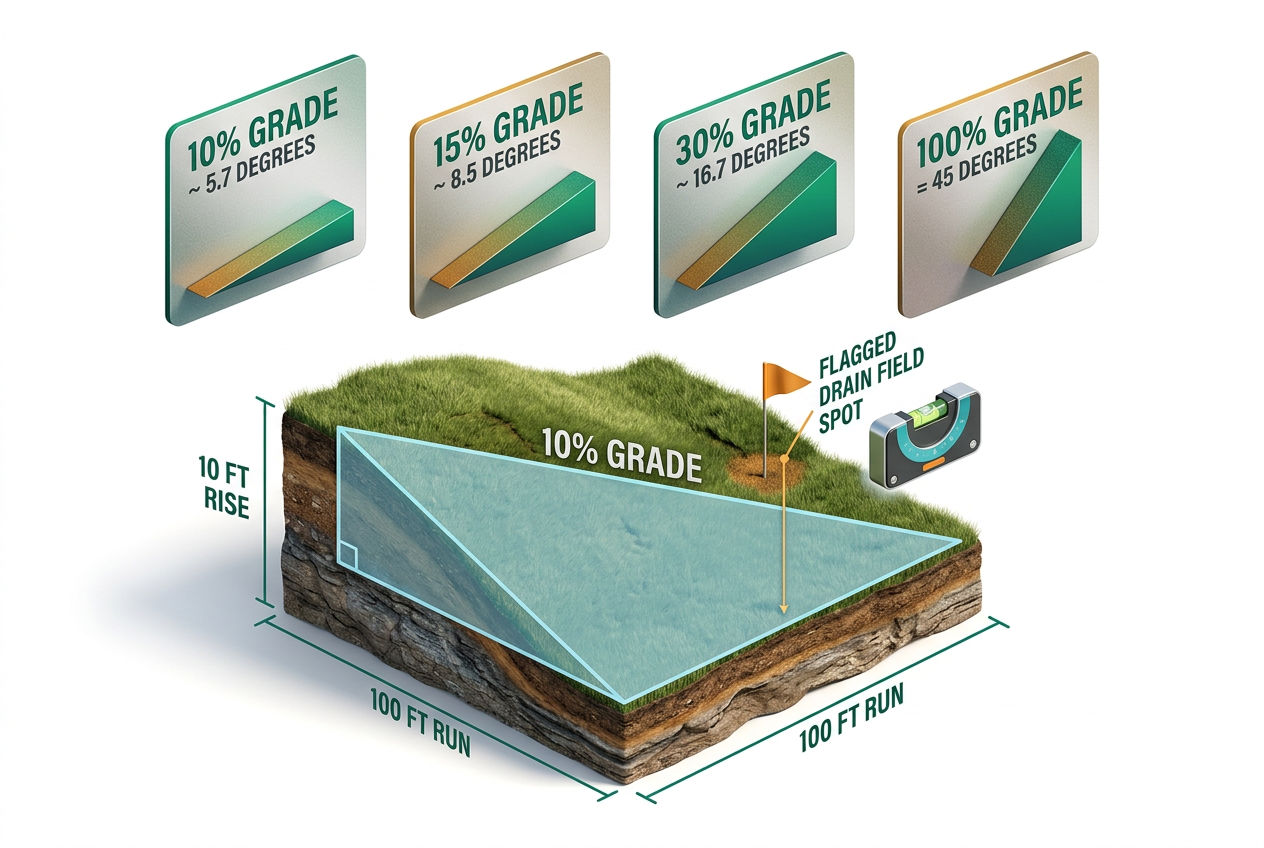
Slope is measured as percent grade: vertical drop divided by horizontal distance, times 100. A hill that falls 10 feet over 100 feet is a 10% slope. Septic codes almost always use percent, not degrees, so a 30% limit is only about 17 degrees, much gentler than it sounds.
Some quick conversions help when you're walking a lot:
- 10% slope is about 5.7 degrees
- 15% slope is about 8.5 degrees
- 30% slope is about 16.7 degrees
- 100% slope is 45 degrees
Evaluators measure slope across the specific spot where the drain field will go, not the whole parcel. A lot that averages 25% may have a bench or shoulder at 12% that works fine. That's why a good site plan matters so much on hillside land.
How Does Slope Help or Hurt a Septic System?
A moderate slope helps a septic system by letting wastewater flow by gravity from house to tank to field with no pump. A steep slope hurts it by pushing effluent sideways through the soil, where it can surface downhill, erode trenches, and overload the lowest part of the field.
The biggest risk is called breakout. Effluent moves down through the soil, hits a denser layer, and then travels along that layer downhill until it pops out of the hillside as a wet, smelly seep. You'll see lush grass, black slime, or a soggy patch below the field. That's a health code violation, not just a nuisance.
The second risk is uneven loading. Water always takes the easiest path. On a slope with a single distribution header, the lowest trench gets most of the flow and fails years early, while the upper trenches stay nearly dry.
Third is construction damage. Heavy equipment on wet hillside soil smears trench walls and compacts the ground. Rain on freshly cut trenches can wash fill downhill before grass takes hold.
Should the Septic Tank and Drain Field Be Uphill or Downhill?
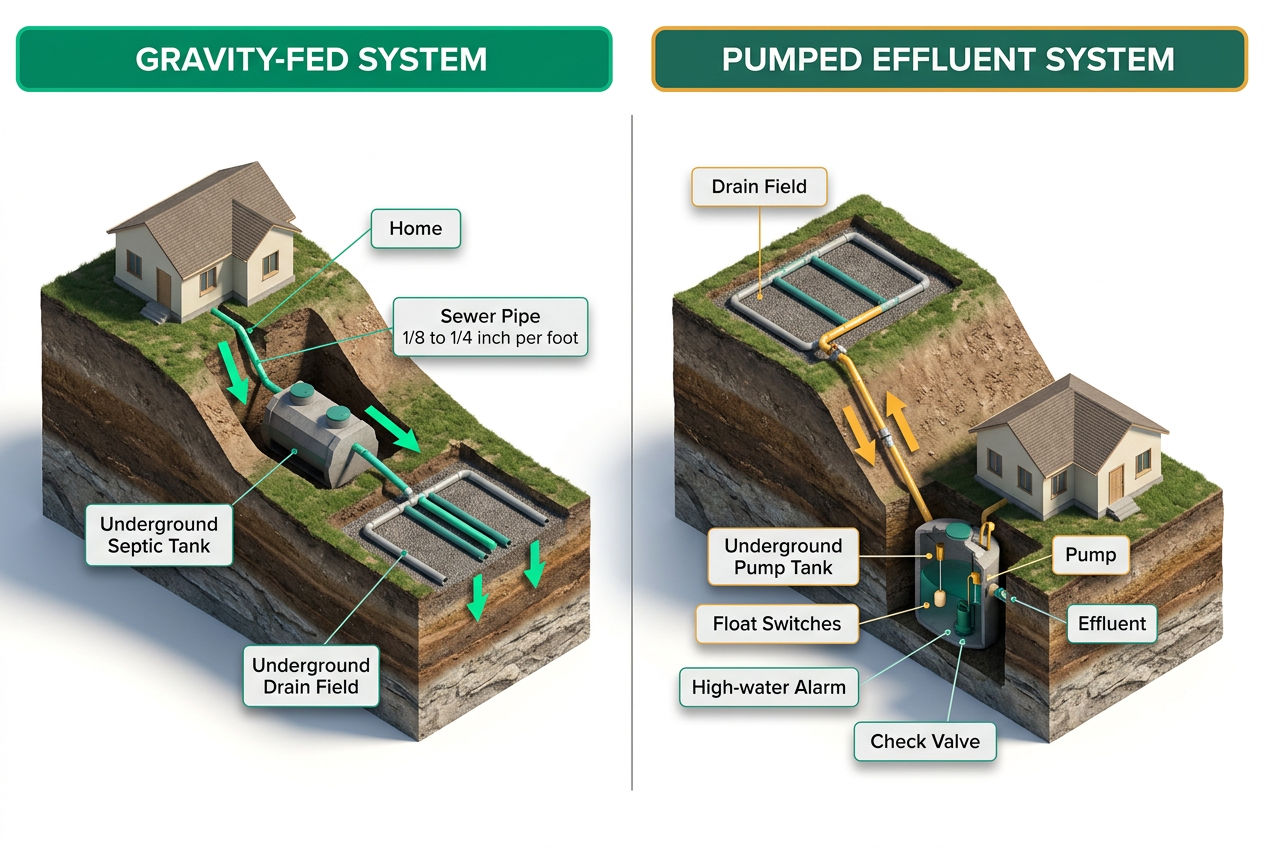
The septic tank should sit downhill from the house, and the drain field should ideally sit downhill from the tank. That arrangement lets gravity do all the work. If the only good soil is uphill, you can still build, but you'll need a pump chamber and effluent pump to push water up to the field.
Most plumbing codes call for 1/8 to 1/4 inch of fall per foot on the building sewer between the house and the tank. Steeper isn't automatically a problem, but very steep runs should be laid out by your installer to avoid sharp drops right at the tank inlet.
An uphill field adds parts that wear out. A typical pump setup includes a separate pump tank, an effluent pump, float switches, a high-water alarm, and a check valve. Pumps often last 7-15 years. Our septic pump guide covers sizing and lifespan. The honest downside: a pumped system stops during a power outage once the pump tank's reserve fills, so you'll need to limit water use until power returns.
Which Septic Designs Work Best on Steep Lots?
The best steep slope septic system designs keep each trench level and spread effluent evenly. Contour trenches with serial distribution work on moderate hills. Pressure distribution handles steeper or tighter sites. Drip dispersal fits the steepest lots. Mound systems usually suit only gentle slopes, often under 6-12%, depending on soil and state rules.
Contour trenches. Every trench follows one elevation line across the hill, with a level bottom. Trenches stack like terraces, with undisturbed soil left between them. This is the starting point for almost any leach field on a slope.
Serial distribution with drop boxes. Effluent fills the top trench first, then spills through a drop box to the next trench down. Each trench is used fully before the next one gets water. This beats a standard septic distribution box on hills, because a D-box that settles even half an inch out of level sends most flow to one line.
Pressure distribution. A pump doses small-diameter laterals with drilled holes several times a day. Every hole gets about the same amount of water, no matter the grade. It's common in Washington, Oregon, and other states with steep, shallow soils.
Drip dispersal. Flexible tubing with emitters is buried 6-12 inches deep along the contour. Because it's shallow and tiny, it can wind between trees and rock outcrops. It usually requires pretreatment, a filter, a control panel, and a service contract. That's real ongoing cost.
Mounds. A mound septic system raises the field above shallow soil, but on steep ground the mound's downhill toe gets too long and unstable. Many codes cap mounds at gentle grades.
| System Type | Typical Slope Fit | Typical Cost |
|---|---|---|
| Gravity contour trenches | Up to ~15-25% | $4,000-$12,000 |
| Serial drop-box trenches | Up to ~25-30% | $6,000-$15,000 |
| Pressure distribution | Up to ~30% | $8,000-$18,000 |
| Drip dispersal | Often 30%+ with design | $12,000-$30,000+ |
| Mound system | Usually under 6-12% | $10,000-$25,000+ |
Source: SepticTankHub compilation of state onsite wastewater codes, EPA Onsite Wastewater Treatment Systems Manual guidance, and published contractor pricing. Slope limits and prices vary by state, county, and soil.
What Does a Hillside Drain Field Look Like in Practice?
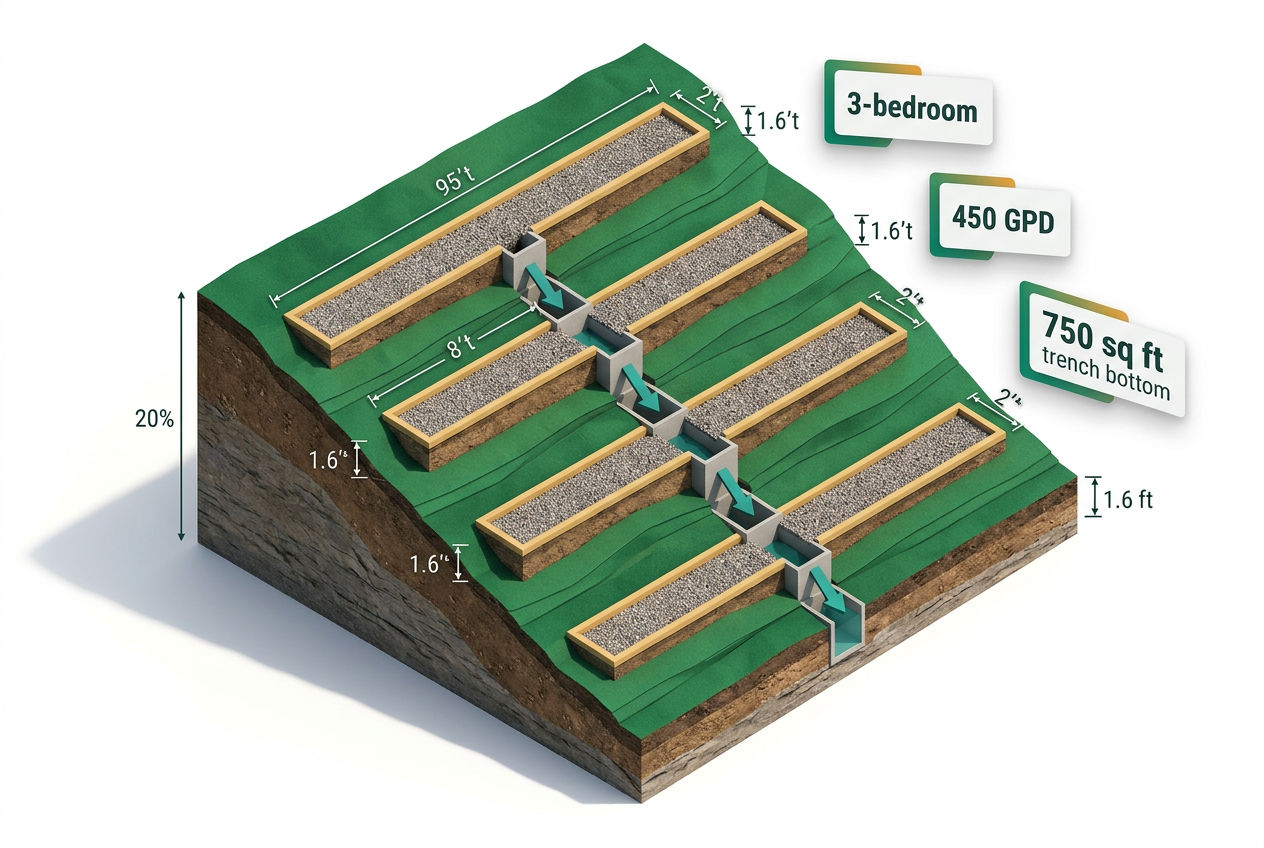
A hillside drain field for a typical 3-bedroom home might be four level trenches stacked down the slope, each stepping down a foot or two, linked by drop boxes. The exact size comes from your daily flow and soil's absorption rate, which the designer pulls from the perc test results.
Here's a worked example. Many states size a 3-bedroom home at 450 gallons per day (150 gallons per bedroom). Say the soil allows 0.6 gallons per square foot per day. That's 450 ÷ 0.6 = 750 square feet of trench bottom. With 2-foot-wide trenches, you need 375 feet of trench, so four trenches about 95 feet long.
Now put it on a 20% slope with trenches spaced 8 feet apart, center to center. The three gaps between four trenches cover 24 feet of horizontal distance. At 20%, that's a drop of about 4.8 feet, or roughly 1.6 feet between each trench. Each one sits level, and drop boxes carry overflow down to the next. The septic system design process puts those numbers on a scaled plan for the permit.
How Do You Install a Septic System on a Slope Step by Step?

DIY Septic Blueprint
Thinking about building it yourself?
The complete, plain-English plan to size, permit and install your own septic system — designed for homeowners, not contractors. Skip the $15,000–$25,000 quotes and do it right the first time.
Get the DIY Blueprint — $67 →Instant download · 8 modules + 3 bonus guides · 60-day money-back guaranteeInstalling a septic system on a slope follows the same permit path as any system, with extra steps for layout and erosion control. You'll get a soil evaluation, a stamped design, a permit, and inspections. The difference is in surveying contours precisely and protecting the hillside during and after excavation.
- Site and soil evaluation. Expect $300-$1,500 for perc testing and soil pits, depending on your state.
- Design and permit. Engineered or licensed designs on steep lots often run $500-$2,500+. Your plan must show setback distances from wells, streams, property lines, and steep drop-offs. Many codes also require a buffer between the lowest trench and any cut bank or road cut.
- Stake the contours. The installer uses a laser level to mark each trench line at a single elevation.
- Divert water first. An upslope curtain drain or diversion swale keeps runoff and groundwater from flooding the field.
- Excavate in dry weather. Dig only when soil crumbles in your hand. Wet clay smears and seals trench walls.
- Build trench by trench. Install drop boxes or pressure laterals, then gravel or chambers, then cover.
- Stabilize right away. Seed, straw, and silt fence go down the same week. Bare hillside fill washes out in the first big storm.
Want a sense of what the full project costs? Our septic installation cost guide breaks down tanks, fields, and labor by region.
What Problems Show Up With a Leach Field on a Slope?
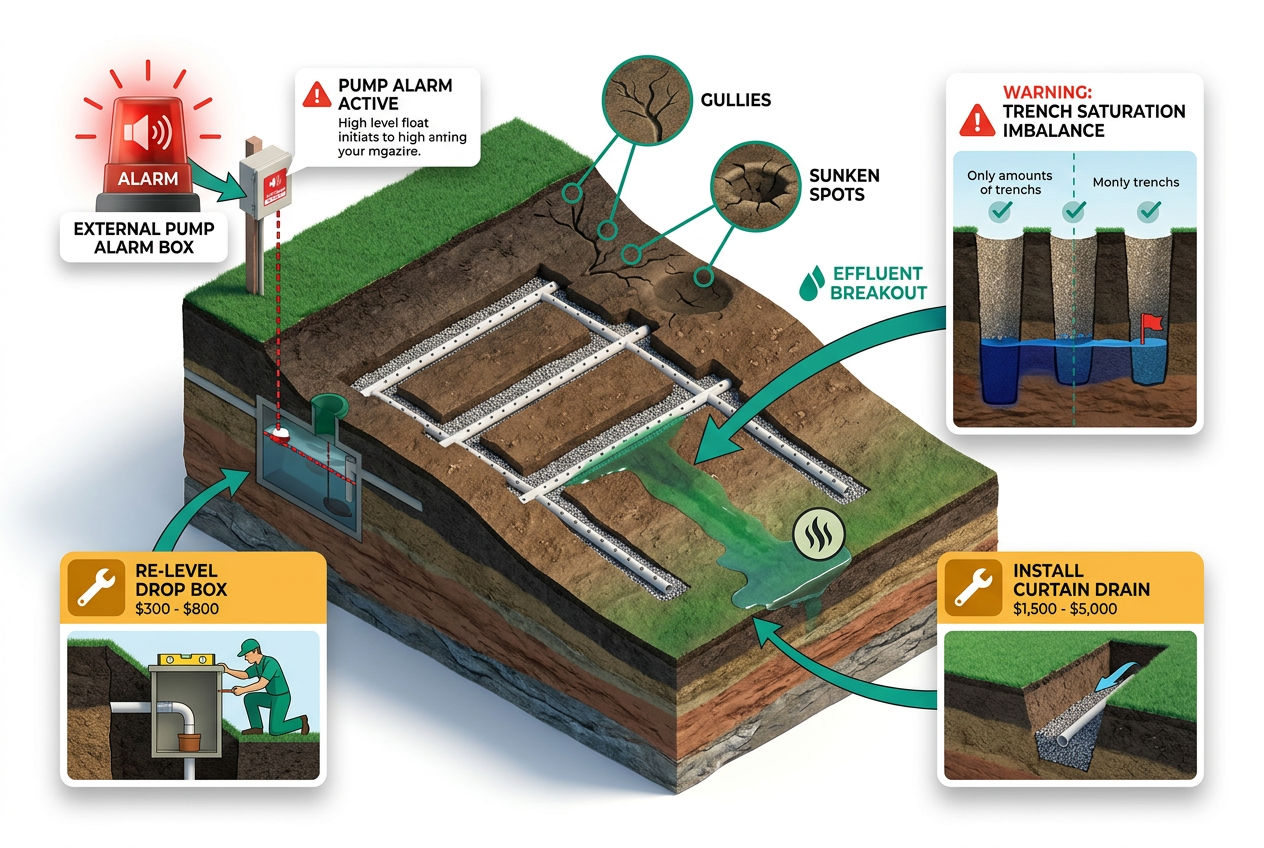
The most common problems with a leach field on a slope are effluent surfacing downhill, the lowest trench failing first, erosion over the trenches, and pump failures on uphill systems. Most trace back to poor layout or rushed construction, not the slope itself.
Watch for these signs:
- A wet, green, or smelly strip below the field, especially after heavy rain or snowmelt
- Sunken spots or gullies across the trench lines
- Slow drains or gurgling when the lowest trench is saturated
- A pump alarm that sounds repeatedly
Spring is when most hillside breakout shows up, because snowmelt raises groundwater right when the soil is coldest and slowest. If you spot any of these, compare them with the signs of a failing drain field and call a pro before it spreads. Fixes range from re-leveling a drop box ($300-$800) to adding a curtain drain ($1,500-$5,000) to replacing the field.
How Do Regional Conditions Change Hillside Septic Design?
Regional soils and rules shape hillside septic design more than slope alone. Appalachian and New England hills often have shallow soil over rock. The Pacific Northwest has steep ground and wet winters. Central Texas has thin, rocky soil. Each pushes designers toward different system types and different permit rules.
- Appalachia (WV, KY, TN, NC, VA): Steep, shallow soils make serial distribution and drip common. If you're building in North Carolina, review our North Carolina septic regulations before buying land.
- New England: Ledge is everywhere. Massachusetts Title 5 and Vermont's Wastewater System and Potable Water Supply Rules both require licensed designers for most new systems.
- Pacific Northwest: Some counties test groundwater during the wet season only, so a summer purchase may wait months for a permit.
- Texas Hill Country: The TCEQ sets rules under 30 TAC Chapter 285, and county authorized agents issue permits. Aerobic treatment with spray or drip dispersal is common on rocky slopes.
- Mountain West: Snow limits the build season, and frost depth adds burial requirements.
How Do You Maintain a Septic System on a Hillside?
Maintaining a septic system on a hillside means pumping the tank on schedule, keeping surface water away from the field, protecting the slope from erosion, and checking pumps or drop boxes every year or two. Hillside fields punish neglect faster, because solids that escape the tank overload the lowest trench first.
Most households pump every 3-5 years, per EPA guidance. Keep downspouts and driveway runoff pointed away from the trenches. Never drive equipment across a slope field, and keep trees with aggressive roots at least 10-20 feet away. If you have a pump system, test the alarm twice a year. Drip systems need filter flushing and an annual service visit.
Ready to Build on a Sloped Lot?
A sloped lot is rarely a dead end. It just needs the right design and a crew that has built on hills before. Ask any installer how many contour, serial, or pressure-dosed fields they've built in your county in the past two years. Find vetted septic installation pros near you, or start your search from the SepticTankHub homepage to compare local companies.
Sources & Methodology
- U.S. EPA Septic Systems program (https://www.epa.gov/septic) — pumping intervals, system types, and the Onsite Wastewater Treatment Systems Manual's guidance on site evaluation and slope. epa.gov/septic
- North Carolina Department of Health and Human Services, On-Site Water Protection (https://www.ncdhhs.gov) — slope suitability classes under the state's onsite wastewater rules (now 15A NCAC 18E).
- Texas Commission on Environmental Quality (https://www.tceq.texas.gov) — 30 TAC Chapter 285 rules for on-site sewage facilities and county authorized agents. tceq.texas.gov
- NOWRA (https://www.nowra.org) — industry terminology and design practice for pressure distribution and drip dispersal. nowra.org
- SepticTankHub editorial research — cost ranges compiled from published contractor pricing and state permit fee schedules. Prices vary by region and soil.
Primary sources to read: EPA Onsite Wastewater Treatment Systems Manual (EPA/625/R-00/008) · EPA: types of septic systems · University of Minnesota Onsite Sewage Treatment Program
More Septic Design & Install Guides
- Septic system design: the complete guide
- Septic pipe slope: the right fall per foot
- Mound system design
- Septic options for clay soil
- Septic tank excavation
- Leach field design and sizing
- Can you install your own septic system? Rules by state
Frequently Asked Questions
What is the maximum slope for a septic system on a slope?
Most states cap conventional gravity trenches somewhere between 15% and 30% grade, measured across the drain field area. North Carolina's rules, for example, have long treated slopes under 15% as suitable, 15-30% as provisionally suitable, and over 30% as unsuitable for standard systems. Mound systems usually face tighter limits, often 6-12%, because their downhill toe becomes too long and unstable on steeper ground. Drip dispersal and pressure distribution can often go steeper with an engineered design. Remember that 30% grade is only about 17 degrees, so many hills that look steep are within limits. Your county health department or licensed designer will measure the exact spot where the field goes and tell you which systems that grade allows.
How do you go about installing a septic system on a slope?
Installing a septic system on a slope starts with a soil evaluation and perc test, then a licensed design and county permit. The installer stakes each trench along a single contour line with a laser level, so every trench bottom is level. Upslope water gets diverted with a curtain drain or swale before digging starts. Excavation happens in dry weather to avoid smearing the soil. Trenches are built one at a time, linked by drop boxes or pressure laterals, then covered and seeded right away with straw and silt fence to stop erosion. On steep lots, expect design fees of $500-$2,500+ and total costs of $8,000-$30,000 depending on the system type, soil depth, and access for equipment.
Can a leach field on a slope be built uphill from the house?
Yes, a leach field on a slope can sit uphill from the house, but it needs a pump. Wastewater still flows by gravity into the septic tank below the house. From there, effluent goes to a pump chamber, where an effluent pump and float switches send it uphill to the field in measured doses. You'll also need a high-water alarm and a check valve. This setup often adds $1,500-$4,000 to the project, and the pump typically needs replacement every 7-15 years. The trade-off is reliance on power. During an outage, the pump tank's reserve fills, so you'll need to limit water use. Pressure dosing does have one upside: it spreads effluent more evenly than gravity flow.
What is the best steep slope septic system?
The best steep slope septic system depends on soil depth and grade. On moderate hills up to about 25-30%, contour trenches with serial drop boxes are often the simplest and cheapest choice, roughly $6,000-$15,000. On steeper or tighter sites, pressure distribution spreads effluent evenly through small drilled laterals, usually $8,000-$18,000. On the steepest or rockiest lots, drip dispersal is often the only permitted option, since its shallow tubing can follow contours and wind around trees. Drip typically runs $12,000-$30,000+ and needs pretreatment and a service contract. Mound systems rarely suit steep ground. A licensed designer will choose based on your soil pits, perc results, and your state's slope rules.
Why does effluent surface below a septic system on a slope?
Effluent surfaces below a septic system on a slope when it travels sideways through the soil instead of soaking down. This happens when a dense layer, like clay, hardpan, or bedrock, sits close under the trenches. Water hits that layer and flows downhill along it until it seeps out of the hillside. Uneven loading makes it worse, because the lowest trench receives the most flow. You'll usually notice it in spring or after heavy rain, as a wet, green, or smelly strip below the field. Fixes include re-leveling drop boxes, adding an upslope curtain drain, switching to pressure dosing, or rebuilding the field. Surfacing effluent is a health hazard, so call a licensed septic pro promptly.
Free download
Not ready for the Blueprint? Start free.
Grab the free DIY Septic Planning Kit — the permit-first checklist, perc-test cheat sheet, and sizing tables that keep your build from getting red-tagged.
Was this article helpful?
Frequently Asked Questions
Recommended Resources
📖 Related Articles
- DIY Septic System: How to Build Your Own (Step-by-Step)
- Perc Test (Percolation Test): What It Is & How It Works
- Septic Pumps Explained: Types, Costs & When You Need One
- What Is a Distribution Box in a Septic System?
- Mound Septic System: $10K–$25K Cost & How It Works (2026)
- Septic System Design: Layouts, Drawings & Requirements
- Septic System Setback Requirements: How Far From the House?
- Signs Your Drain Field Is Failing (And What to Do)
🔧 Services
Find Septic Professionals Near You
Compare licensed, verified septic companies by area — top county markets and cities below, or browse all 50 states.
County markets
Popular cities
