
Quick Answer
A septic inspection before backfill is the official check of a new system while the tank, pipes and drainfield are still exposed. A health department inspector confirms the work matches the approved permit plans. Most counties require 24 to 48 hours' notice, and the system can't be covered until it passes or is formally released.
Key Takeaways
- The inspection happens with everything still visible: tank, pipes, distribution box and drainfield.
- Notice rules differ. Summit County, UT asks for 48 hours. District Health Department #10 in Michigan asks for 24.
- Some towns inspect two or three times during installation. Salem, NH checks the bed bottom and then does a final.
- Inspectors compare the work to your approved plan, so depths, materials and layout must match.
- Never backfill early. You may have to dig it all back up.
Picture this. Your installer has the tank set, the trenches open and the pipe laid. It's 3 p.m. on a Friday, and rain is in the forecast. He says, "Let's just cover it. The county never really looks." That one decision could cost you a second excavation. This guide walks you through what happens at a septic inspection before backfill, what the inspector looks for, and how to pass on the first visit.
What Is a Septic Inspection Before Backfill?
A septic inspection before backfill is a required permit step for a new or replacement system. A local health official looks at the open installation before any soil goes back on top. The job is to confirm that the tank, piping and drainfield were built exactly as the approved plan shows, while every part is still visible.
The rule is simple. Once soil covers it, nobody can see it. That's why counties insist on seeing it open. The Genesee County Health Department in Michigan states that the Health Department must inspect the tank and drainfield before backfilling. Southwest Utah Public Health puts it in capital letters on its septic application checklist: every system needs a final inspection BEFORE BACKFILLING to confirm it matches the submitted plans.
Some people mix this up with the inspection done when a house sells. That's a different thing. A sale inspection checks how an existing, buried system is performing. If that's your situation, see our guide to septic inspections for home buyers.
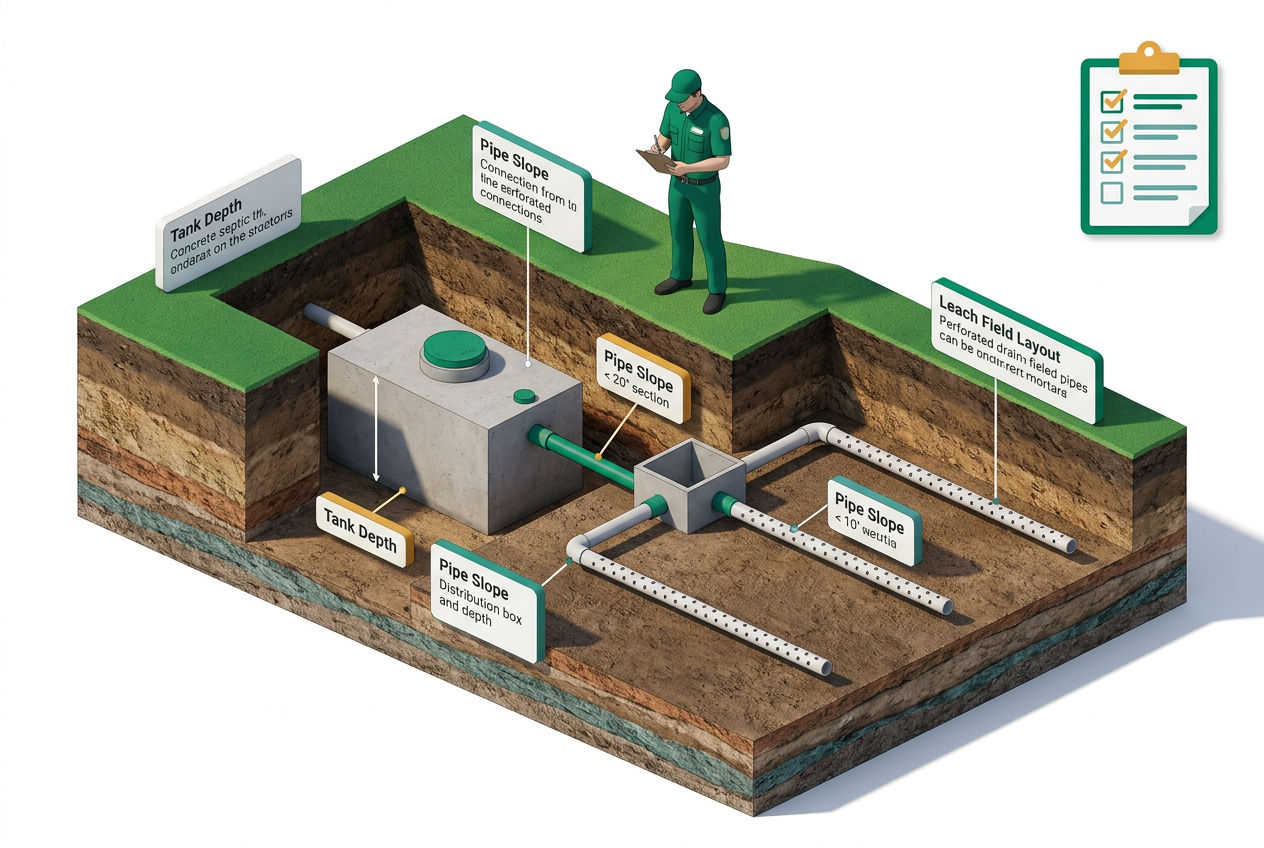
Who does the inspection?
In most of the U.S., it's a sanitarian from the county health department. That isn't true everywhere, though. In Massachusetts and New Hampshire, a town board of health often handles it. In Ontario, it's usually the municipal building department. In Washington, Skagit County Public Health describes the step as a final inspection "to observe the installed system prior to backfill." A private inspector can't stand in for the permitting agency.
How Much Notice Do You Need Before the Septic Final Inspection?
Most jurisdictions require 24 to 48 hours' notice before you backfill. Summit County, Utah, and Salem, New Hampshire, both ask for 48 hours. District Health Department #10 in Michigan asks for 24 hours. Your permit card or approval letter should list the exact rule and phone number for your area.
Here's how the timing plays out in practice. Say your installer expects to finish laying the drainfield by Wednesday afternoon in Summit County. Under the Summit County Health Department's 48-hour rule, the call should go in by Monday afternoon. If he waits until Wednesday to call, your open trenches sit until Friday. Open trenches collect rain, and soggy sidewalls can smear. Some installers schedule the call once they know the finish date, not once they're done.
District Health Department #10 in Michigan adds a useful fallback. If the sanitarian can't reach the site within 24 hours, the sanitarian may let the owner or contractor complete a "Contractor Affidavit" and then cover the system. Note the word "may." It's permission you get from the inspector, not a right you claim.
Inspection notice rules in five jurisdictions
| Jurisdiction | Notice required | Inspections noted |
|---|---|---|
| Summit County, UT | 48 hours | Before backfill |
| DHD #10, MI | 24 hours | Final; affidavit option |
| Salem, NH | 48 hours | Bed bottom + final |
| Carlisle, MA | Check with town | Up to 3 in fee |
| Southwest Utah | Per department | Final before backfill |
Sources: Summit County Health Department (UT); District Health Department #10 (MI); Town of Salem, NH Health FAQ; Town of Carlisle, MA Board of Health fee schedule; Southwest Utah Public Health Department Septic Application Checklist (Rev 7/24).
How Many Inspections Does a New Septic System Need?
A new septic system needs at least one inspection before backfill, but many towns require more. Salem, New Hampshire, inspects the bed bottom and then does a final inspection before backfilling. Carlisle, Massachusetts, includes up to three inspections in its filing fee for single-family systems under 2,000 gallons per day.
The bed-bottom inspection matters most in sand-bed and mound regions. The inspector checks the excavated bottom before stone or sand goes in. That's when soil smearing, compaction or a missed layer of fill is easy to spot. Monroe County, Michigan, uses a similar checkpoint. Prior to covering the bed with clean sand backfill, the Health Department must inspect it.
If you're early in the process, our septic system permit requirements guide explains how permits, perc tests and inspections fit together.
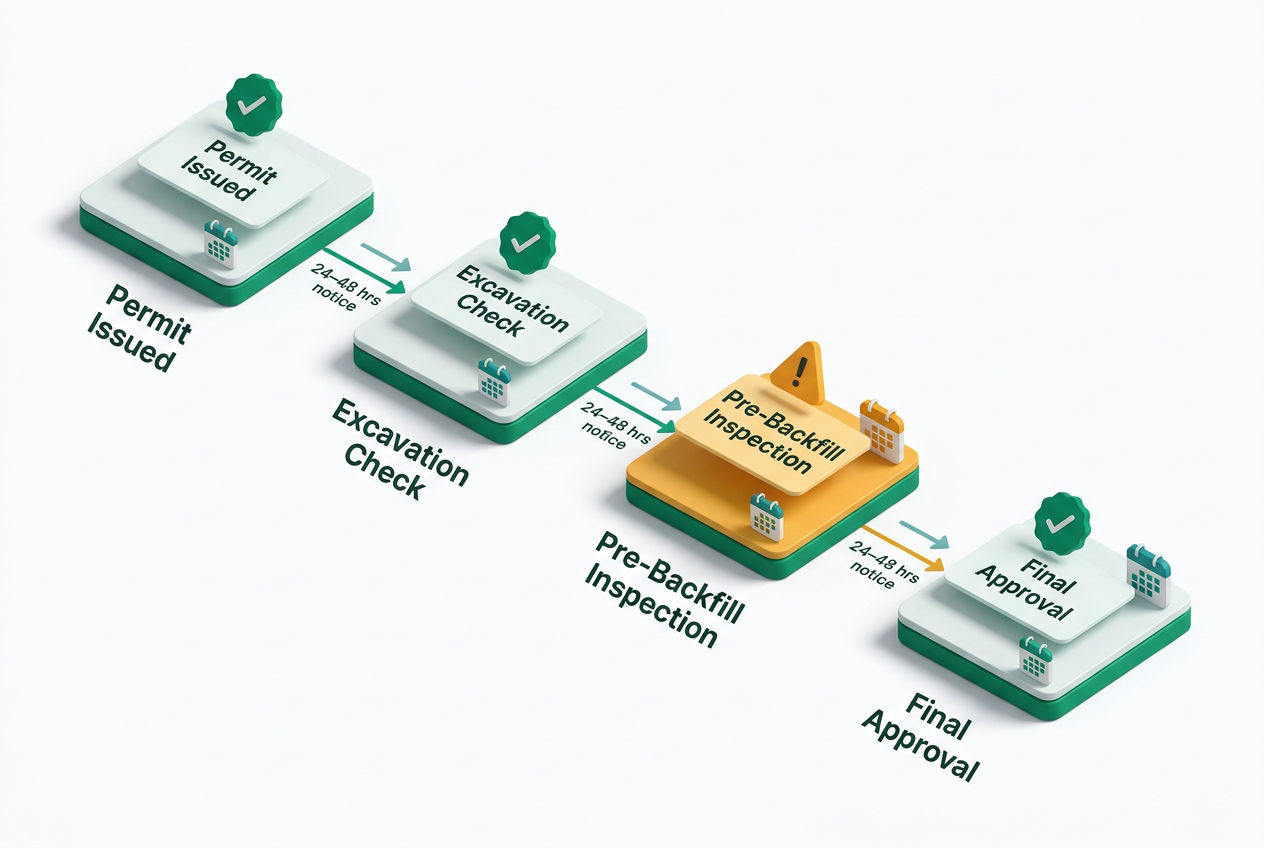
Septic Final Inspection Checklist: What Does the Inspector Look For?
A septic inspector looks for one thing above all: does the installed system match the approved plan? That covers tank location and size, pipe depth and grade, distribution box level, trench or bed dimensions, stone or sand depth, and the barrier over the fill. Pump tanks and alarms get checked too, where you have them.
Use this septic final inspection checklist the day before the inspector arrives. Rules vary, so treat it as a starting point and confirm details with your health department.

Before the inspector arrives
- Permit is posted or on site, along with the approved plan.
- Inspection was scheduled with the required notice (24 or 48 hours, depending on your area).
- As-built drawing is done or ready to hand over (more on this below).
- Every component is uncovered: tank top, inlet and outlet, building sewer, D-box and full trench or bed length.
- Trenches are pumped out or protected if it rained.
- Installer or owner-installer will be present to answer questions.
The septic tank
- Tank size matches the plan. A permit for a 1,250-gallon tank won't pass with a 1,000-gallon tank in the hole.
- Tank sits level on a firm, undisturbed or properly prepared base.
- Inlet and outlet baffles are in place and undamaged.
- Effluent filter is installed if your design requires one.
- Risers and access lids are fitted where required, and lids are secured. See our septic tank risers guide.
- Tank location meets setbacks to wells, property lines and the foundation on your plan.
- Watertightness test done if your jurisdiction requires it. Some do. Many don't. Ask.
Pipes and distribution box
- Building sewer and tank-to-field lines are the specified pipe type.
- Pipe runs at the grade shown on the plan. Our septic pipe slope guide covers how grade is set.
- Distribution box is level so effluent splits evenly. A D-box tipped even slightly sends most flow down one line. See our septic distribution box guide.
- Perforated laterals are installed at the depth shown on the plan, holes facing the right way.
Drainfield or bed
Southwest Utah's plan checklist spells out what inspectors compare in the trenches:
- Depth and width of the excavation.
- Depth and size of the gravel or stone used as fill.
- Depth of the perforated drain line.
- A barrier separating gravel fill from backfill, such as filter fabric.
- Trench or bed bottoms are level and not smeared or compacted by equipment.
- Setbacks from wells, surface water and property lines match the approved site plan. Our setback requirements page explains typical rules, but your local code wins.
Pump tank, float and alarm
If your design uses a second tank with an effluent pump, expect a closer look. Monroe County, Michigan, says the Health Department will inspect the pump components when a system uses a second pump tank. Have these ready:
- Pump installed with floats set to the design levels.
- High-water alarm wired and working. The inspector may ask you to lift the float to test it.
- Electrical connections done per local code (often a separate electrical permit).
Learn more in our septic pump tank guide.
Paperwork
- As-built drawing showing actual locations and distances.
- Installer license number, unless you're an approved owner-installer.
- Any material receipts or product spec sheets the department requests.
What Is an As-Built Drawing, and Is It Required?

DIY Septic Blueprint
Thinking about building it yourself?
The complete, plain-English plan to size, permit and install your own septic system — designed for homeowners, not contractors. Skip the $15,000–$25,000 quotes and do it right the first time.
Get the DIY Blueprint — $67 →Instant download · 8 modules + 3 bonus guides · 60-day money-back guaranteeAn as-built drawing, also called a record drawing, is a sketch of the system as it was actually installed. It shows where the tank, D-box and laterals ended up, measured from fixed points like house corners. Many jurisdictions require it. Trent Lakes, Ontario, requires one before or at the pre-backfill inspection.
Plans and reality drift apart. A boulder forces the tank 6 feet north. A trench gets shortened to dodge a tree root. The as-built records those changes. The Municipality of Trent Lakes says the layout must be sent ahead of the site inspection or handed to the inspector on site.
Few homeowners think about this, and it's a real reason inspections stall. Here's the honest limitation: an as-built only helps if it's accurate. A sketch drawn from memory a week later is close to useless. Ask your installer to take tape measurements from two fixed points to each tank lid and the D-box before the inspector arrives. Twenty years from now, when someone needs to pump the tank or find the drainfield, that drawing saves a lot of probing.
What Happens If Your Installer Backfills Before the Inspection?
If a system is backfilled before the required inspection, the health department can make you uncover it so it can be seen. That means paying for excavation again, and it may delay your certificate of approval or occupancy permit. The only safe exception is written permission, like Michigan DHD #10's Contractor Affidavit.
Some departments may accept photos or an affidavit in narrow cases, but don't count on it. Get any exception in writing, with the inspector's name and the date. If you're working with a contractor, put "no backfill without inspection approval or written release" in your contract.
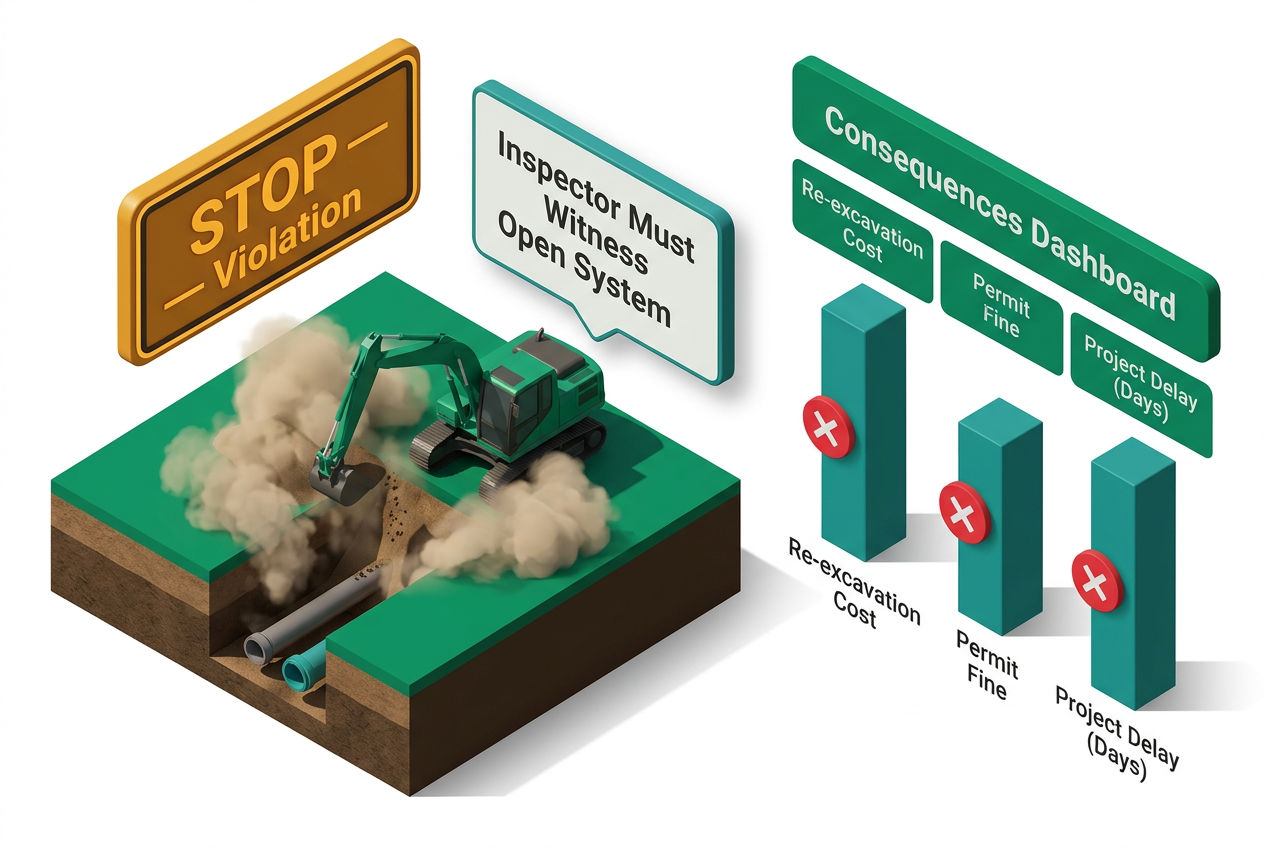
What if you fail the inspection?
A failed inspection usually isn't a disaster, which is why it pays to inspect while everything is open. The inspector writes up what's wrong, such as an unlevel D-box or a short trench. The installer fixes it, and you schedule a reinspection. Some departments charge for return visits. Ask what your county charges when you pull the permit so it isn't a surprise. Our failed septic inspection guide covers next steps.
Once you pass, the department typically issues a certificate of approval or operating permit. Then backfilling can begin. Our how to backfill a septic tank guide explains how to do it without cracking the tank or crushing pipe.
Can a Homeowner Install Their Own Septic System and Get It Inspected?
Some places allow homeowners to install their own septic system, but many don't. District Health Department #10 in Michigan allows owner-installers. Genesee County, Michigan, allows it only under Environmental Health supervision. Many other states and counties require a licensed septic contractor. Either way, an owner-built system gets the same inspection before backfill.
Owner-installers fail more often on details pros do by habit, like leveling a D-box with a 4-foot level or keeping equipment off the trench bottom. If you're weighing this, read our DIY septic system pillar guide first. Then compare the numbers in our septic installation cost guide.
How Do Seasons and Groundwater Affect the Timeline?
Weather and groundwater can push your inspection back by weeks or months. In northern states, frozen ground and snow slow both installation and inspections. Summit County, Utah, doesn't run perc tests from November 27 to March 1. High spring groundwater can also trigger monitoring requirements or a change to a mound design.
Summit County's rules show how groundwater changes the plan. If groundwater turns up, the Health Inspector can require Ground Water Monitoring during the season of peak flow, usually spring. If you missed that window, you might wait close to a year. Sites with a high water table often end up with a raised design. Read more in our high water table septic guide.
Rain matters too. An open trench that fills with water can smear clay soil on the trench walls and bottom. Smeared soil absorbs effluent poorly. In clay-heavy areas, try to schedule the inspection for a dry stretch, and keep the inspection window as tight as the notice rules allow.
How Can You Pass the Septic Inspection on the First Try?
You pass the septic inspection on the first try by matching the approved plan exactly, scheduling with the right notice, and having everything uncovered and the as-built drawing ready. Most failures come from small things: an unlevel D-box, wrong stone depth, a missing filter fabric barrier or a tank moved without notice.
A few habits make the difference:
- Walk the site with the plan in hand the day before. Measure trench lengths and depths yourself.
- Call the health department early. Ask what they check and whether they want anything sent ahead.
- Don't swap materials. If the plan says a 1,500-gallon concrete tank, a plastic one may need re-approval first.
- Be there. Inspectors often explain small fixes on the spot, and you'll learn where everything is.
- Hire a licensed installer who knows your county. Local experience is worth a lot here.
Need an installer who's done this many times in your county? Browse local pros on our septic installation services page and compare quotes.
Sources & Methodology
We built this checklist from published requirements of county and municipal health agencies. Specific numbers come only from these sources. Requirements vary by location, so confirm details with your local health department.
- Genesee County Health Department (MI): Requires the tank and drainfield to be inspected before backfill; $100 permit and inspection for tank-only replacements since January 1, 2022.
- Southwest Utah Public Health Department: Septic Application Checklist (Rev 7/24) listing trench details checked against plans.
- Summit County Health Department (UT): 48-hour notice rule, winter perc test limits and groundwater monitoring.
- District Health Department #10 (MI): 24-hour notice, Contractor Affidavit option and owner-installer rules.
- Municipality of Trent Lakes (ON) and Town of Salem (NH): As-built drawing requirement and two-stage inspection schedule.
For general background on how septic systems work, see the U.S. EPA's septic systems pages.
More Septic Design & Install Guides
- Septic Pump Tank: How a Septic System With a Pump Works, Costs & Installs
- Septic Holding Tank: Cost, Sizes, Rules & Holding Tank vs. Septic System
- Conventional Septic System: How It Works, What It Costs & When You Can Use One
- Drip Septic System: How Drip Dispersal Works, Cost & Design
- Septic System for a 2-Bedroom House: Tank Size, Drain Field & Cost
- Septic System for a 5-Bedroom House: Tank Size, Drain Field & Cost
- Concrete Septic Tank Price: 1,000-Gallon and Other Sizes in 2026
- How Long Is a Perc Test Good For? Expiration and Retesting Explained
- How to Backfill a Septic Tank
- Septic system design: the complete guide
- Can you install your own septic system? Rules by state
Frequently Asked Questions
Who does the septic inspection before backfill, the county or a private inspector?
The septic inspection before backfill is done by the permitting agency, not a private inspector. In most U.S. counties, that's a sanitarian from the county health department. Genesee County, Michigan, for example, requires the Health Department to inspect the tank and drainfield before backfilling. In parts of New England, a town board of health handles it, as in Salem, New Hampshire. In Ontario, the municipal building department usually takes the role. A private inspector you hire can still be useful. They can review the work before the official visit and spot problems early. But their sign-off doesn't replace the agency's approval. Only the permitting authority can issue the certificate of approval or operating permit that lets you cover the system and use it. Check your permit paperwork for the right office and phone number.
How much notice is needed to schedule a new septic system inspection?
Most jurisdictions require 24 to 48 hours' notice to schedule a new septic system inspection. Summit County, Utah, puts the responsibility on the installer or property owner to call the Health Department 48 hours before backfill. Salem, New Hampshire, also asks for 48 hours, for both the bed-bottom and final inspections. District Health Department #10 in Michigan asks for 24 hours. If its sanitarian can't reach the site in that window, the sanitarian may let the owner or contractor sign a Contractor Affidavit and cover the system. That's permission, not an automatic right. Call as soon as you know your finish date rather than waiting until the last pipe is laid. Open trenches exposed to rain for extra days can smear soil and cause problems that the inspector may flag.
What does a septic inspector look for on a new system?
A septic inspector looks mainly for whether the installed system matches the approved plan. That includes tank size and location, inlet and outlet baffles, any required effluent filter, risers and lids, pipe type and grade, and a level distribution box. In the drainfield, Southwest Utah Public Health lists excavation depth and width, gravel depth and size, perforated drain line depth, and the barrier between gravel and backfill. Inspectors also check setbacks from wells, property lines and foundations against the site plan. If you have a pump tank, Monroe County, Michigan, notes the pump components are inspected as well, often including the float settings and high-water alarm. Some jurisdictions also ask for a watertightness test. Finally, many want an as-built drawing showing where everything actually ended up.
What is on a septic final inspection checklist?
A septic final inspection checklist covers four areas: the tank, the pipes and distribution box, the drainfield, and the paperwork. For the tank, confirm size, level placement, baffles, effluent filter and secured lids. For pipes, check the specified pipe type, correct grade and a level D-box. In the drainfield, verify trench depth and width, stone depth, lateral depth and a fabric barrier over the stone. If you have a pump tank, test the floats and high-water alarm. For paperwork, have your permit, approved plan, installer license number and as-built drawing on site. Trent Lakes, Ontario, for example, requires the as-built layout before or at the inspection. Most important of all, leave everything uncovered. An inspector can't approve what they can't see, so backfilling early can mean digging it all back up.
What happens if my installer backfills before the septic inspection before backfill?
If your installer covers the system before the septic inspection before backfill, the health department can require you to uncover it. That means paying for excavation a second time, plus delays to your certificate of approval or occupancy. The only safe exception is written permission from the inspector. District Health Department #10 in Michigan, for example, may allow a Contractor Affidavit when its sanitarian can't reach the site within 24 hours. Don't rely on verbal promises like "the county never checks." Protect yourself in the contract. Add a line that says no backfill happens without inspection approval or a written release. Ask for photos of every stage too. Photos don't replace an inspection, but they help if questions come up later about depths, stone or pipe placement.
Free download
Not ready for the Blueprint? Start free.
Grab the free DIY Septic Planning Kit — the permit-first checklist, perc-test cheat sheet, and sizing tables that keep your build from getting red-tagged.
Was this article helpful?
Frequently Asked Questions
Recommended Resources
📖 Related Articles
- Septic Inspection for Home Buyers: Complete Checklist
- Septic System Permit Cost & State Requirements (2026 Guide)
- How to Install Septic Tank Risers: Riser Kit Guide
- Septic Pipe Slope: The Right Fall From House to Tank to Drain Field
- What Is a Distribution Box in a Septic System?
- Septic System Setback Requirements: How Far From the House?
- How to Find Your Septic Drain Field
- Septic Inspection Failed: What Happens Next (Buyer's Guide)
- DIY Septic System: How to Build Your Own (Step-by-Step)
- High Water Table and Septic Systems: What You Need to Know
🔧 Services
Find Septic Professionals Near You
Compare licensed, verified septic companies by area — top county markets and cities below, or browse all 50 states.
County markets
Popular cities
