
Quick Answer
The average concrete septic tank price in 2026 is about $1,300 for the tank alone, according to Angi, with a typical range of $700 to $2,000. A 1,000-gallon tank costs $900–$1,500, and a 1,500-gallon tank costs $1,500–$2,500. Crane-truck delivery adds $300–$800. A fully installed tank can reach $6,500 before the drain field.
Key Takeaways
- The national average concrete septic tank price is about $1,300 for the tank alone (Angi).
- A 1,000-gallon precast tank costs $900–$1,500. A 1,500-gallon tank costs $1,500–$2,500.
- Delivery needs a boom or crane truck and adds $300–$800, depending on distance from the precast yard.
- A 1,000-gallon concrete tank weighs 8,000–12,000 lbs. You can't move it without heavy equipment.
- Installed, the full project often lands between $3,500 and $6,500 before the drain field.
Why does a $1,400 tank turn into a $6,000 estimate? Most homeowners ask that the first time they compare a precast yard's price list with an installer's quote. The tank itself is usually one of the cheaper large lines on the bill. Delivery, excavation, permits, and removal of the old tank make up most of the rest. Below, we break the concrete septic tank cost into each of those lines so you can check a quote line by line. This page is part of our septic system cluster. For how the full system fits together, start with the pillar: our DIY septic system guide.
What Is the Concrete Septic Tank Price by Size?
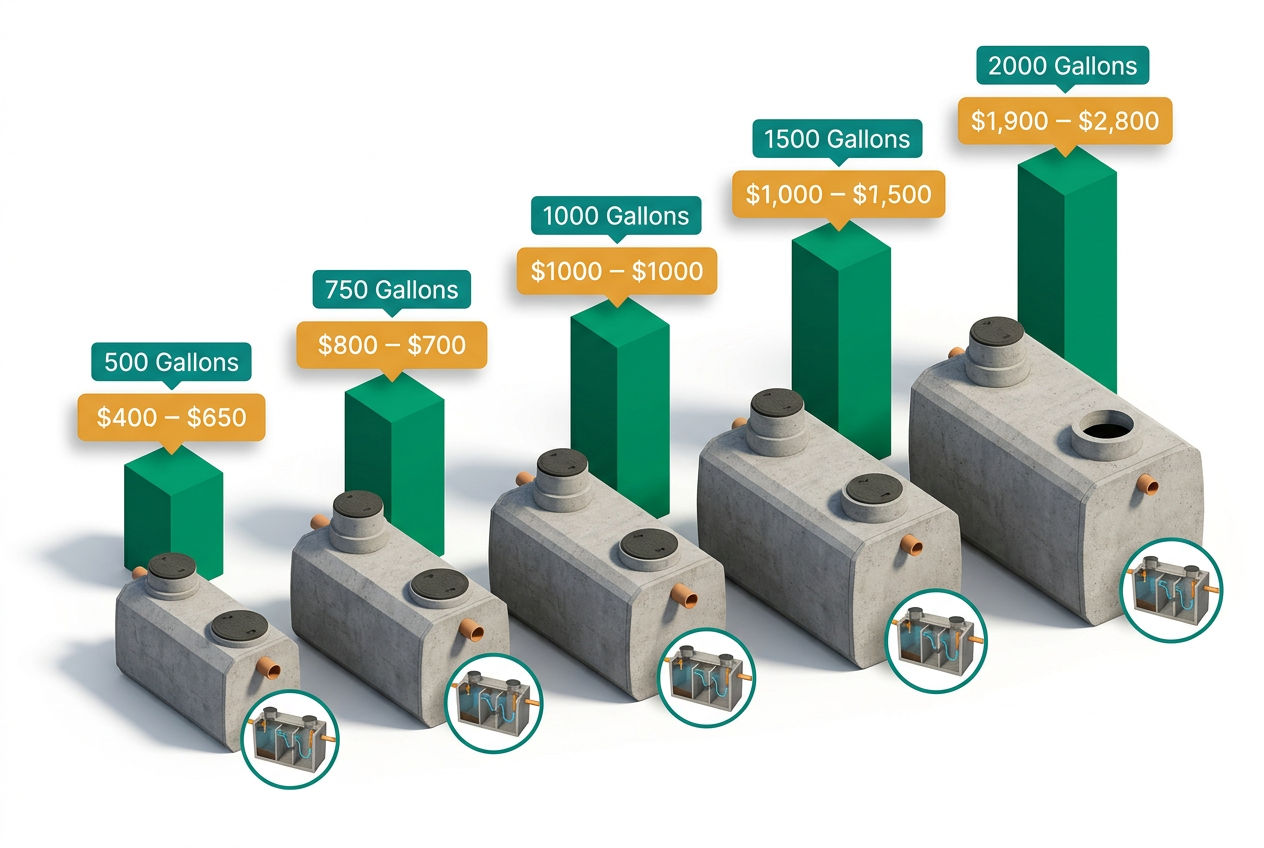
The concrete septic tank price is $900–$1,500 for 1,000 gallons and $1,500–$2,500 for 1,500 gallons, based on Angi's 2026 data. Manufacturer prices fall inside those ranges. A.J. Foss lists its 1,000-gallon tank at $1,412.50 average retail and its 1,500-gallon monolithic tank at about $2,112.50 in New Hampshire. Those are tank-only prices. They don't include the truck, the hole, or the crew.
Here's how the main numbers stack up:
| Item | Typical 2026 range | Source |
|---|---|---|
| National average tank | $1,300 | Angi |
| 1,000-gallon tank | $900–$1,500 | Angi; A.J. Foss |
| 1,500-gallon tank | $1,500–$2,500 | Angi; A.J. Foss |
| 2,000-gallon tank | ~$2,000–$3,500 (est.) | Secondary source |
| Crane-truck delivery | $300–$800 | Septic and Well |
Sources: Angi (2026 concrete tank cost guide), A.J. Foss product pages, Septic and Well (2026). The 2,000-gallon figure comes from a single secondary source and should be treated as a rough estimate. Ask local precast yards for current quotes.
What about 750- and 1,250-gallon tanks? Precast yards make them, but we couldn't verify reliable national pricing. As a rule of thumb, a 750-gallon tank should price below the 1,000-gallon range and a 1,250-gallon tank between the 1,000 and 1,500 ranges. Call two yards and compare. For a size-by-size overview of every material, see our septic tank size chart.
What Changes the 1000 Gallon Concrete Septic Tank Price?
The 1000 gallon concrete septic tank price swings mostly on construction type, concrete strength, and how far you live from the plant. A two-piece (mid-seam) tank usually costs less than a monolithic (one-piece) tank. Traffic-rated H-20 tanks, built to sit under driveways, cost more than standard tanks.
Here's what to look for on a spec sheet:
- Monolithic vs. mid-seam. A mid-seam tank is poured in two halves and sealed with butyl rope at the joint. That seam is a weak point in wet soil. A monolithic tank has no seam below the lid, which is why A.J. Foss markets its 1,500-gallon monolithic tank as ideal for high water tables.
- Concrete strength. The A.J. Foss 1,000-gallon tank uses 5,000 PSI concrete. Ask any yard what PSI they pour. Higher numbers mean a denser tank that resists cracking.
- Standards compliance. Ask whether the tank meets ASTM C1227, the standard specification for precast concrete septic tanks, and whether the plant holds National Precast Concrete Association (NPCA) certification. Many state codes reference one or both.
- Compartments and baffles. Most new tanks have two compartments with a baffle wall. Some codes require an effluent filter on the outlet baffle, which adds cost.
- Load rating. Will a truck ever drive over it? If yes, you need an H-20 rated tank. A standard tank under a driveway can crack, and that repair costs far more than the upgrade.
One more detail on the 1,000-gallon size. A.J. Foss now lists its 1,000-gallon tank for pump stations, holding tanks, and add-ons to existing systems. It was formerly rated for 2 bedrooms. That tells you many newer codes push homes toward bigger tanks. Our 1,000-gallon septic tank guide covers its dimensions and uses in detail.
What Is the 1500 Gallon Concrete Septic Tank Price?
The 1500 gallon concrete septic tank price runs $1,500–$2,500 for the tank alone, per Angi. A.J. Foss's 1,500-gallon monolithic tank sits near the middle of that range at about $2,112.50. Expect the same delivery charge as a smaller tank, sometimes a little more, because the 12,500-lb load may need a larger boom truck. This size usually serves 4- and 5-bedroom homes, covered in the sizing section below.
How Much Does Concrete Septic Tank Delivery Cost?
Concrete septic tank delivery cost runs $300–$800, according to Septic and Well. The tank has to arrive on a flatbed with a crane or boom, and the price rises with distance from the precast yard. Some yards include local delivery and setting in the tank price, so ask before you compare quotes.
Here's how delivery can flip a comparison. Say two yards quote the same 1,000-gallon tank. Yard A charges $1,250. Yard B charges $1,450. Yard A is 70 miles away and adds $700 for the boom truck, for $1,950 total. Yard B is 15 miles out and sets the tank for $350, for $1,800 total. The "cheaper" tank costs $150 more delivered.
Ask every yard these four questions:
- Is delivery included, and how many miles does it cover?
- Will the driver set the tank in the hole, or just drop it?
- How close can the truck get? Booms have limited reach, often only a few feet past the truck bed edge on smaller trucks.
- Who pays if the truck can't reach and needs to come back?
Timing matters too. In northern states, seasonal frost laws restrict heavy loads on many local roads, often from late winter into spring, and some yards stop deliveries entirely during that window. Check before you schedule excavation.
Access matters a lot. Soft lawns, septic setbacks, and tight side yards can stop a loaded truck cold. If you need help finding yards near you, see where to buy a septic tank.
How Much Does a 1,000-Gallon Concrete Septic Tank Weigh?
A 1,000-gallon concrete septic tank weighs 8,000–12,000 lbs, according to Septic and Well. A plastic tank of the same size weighs just 150–300 lbs. For comparison, A.J. Foss lists its 1,500-gallon monolithic tank at 12,500 lbs. That weight is why delivery needs a crane truck.
The weight has a downside and an upside. It drives up delivery cost and rules out hand-carrying a tank into a backyard with no truck access. But it also keeps the tank in the ground. In a high water table, an empty plastic tank can float up after pumping. A heavy concrete tank resists that buoyancy, though very wet sites may still need anti-flotation measures. Read more in our guide to septic systems in high water tables.
Size matters for the hole, too. The A.J. Foss 1,000-gallon tank measures 8' x 5'8" x 5'2". Your excavator will dig wider than that to leave room for bedding and backfill.
What Size Concrete Septic Tank Do You Need?
Your tank size is set by your state or county code, usually based on bedroom count. Angi reports that most local rules require at least 750 gallons. Many jurisdictions require 1,000 gallons for a 3-bedroom home, but rules differ, so confirm with your county health department before you buy anything.
Bedrooms, not people, drive sizing because codes assume each bedroom could hold two people. A 4-person family in a 3-bedroom house sizes the same as a 2-person couple in that house.
As a general pattern (not a legal rule):
- 2–3 bedrooms: often 1,000 gallons
- 4 bedrooms: often 1,250–1,500 gallons
- 5 bedrooms: A.J. Foss rates its 1,500-gallon monolithic tank for 5 bedrooms
Some states add size for garbage disposals. Others require bigger tanks across the board. Check your state on our regulation pages, such as New Hampshire septic regulations, and see our 3-bedroom house septic guide for typical setups.
What Does a Concrete Septic Tank Cost Installed?

DIY Septic Blueprint
Thinking about building it yourself?
The complete, plain-English plan to size, permit and install your own septic system — designed for homeowners, not contractors. Skip the $15,000–$25,000 quotes and do it right the first time.
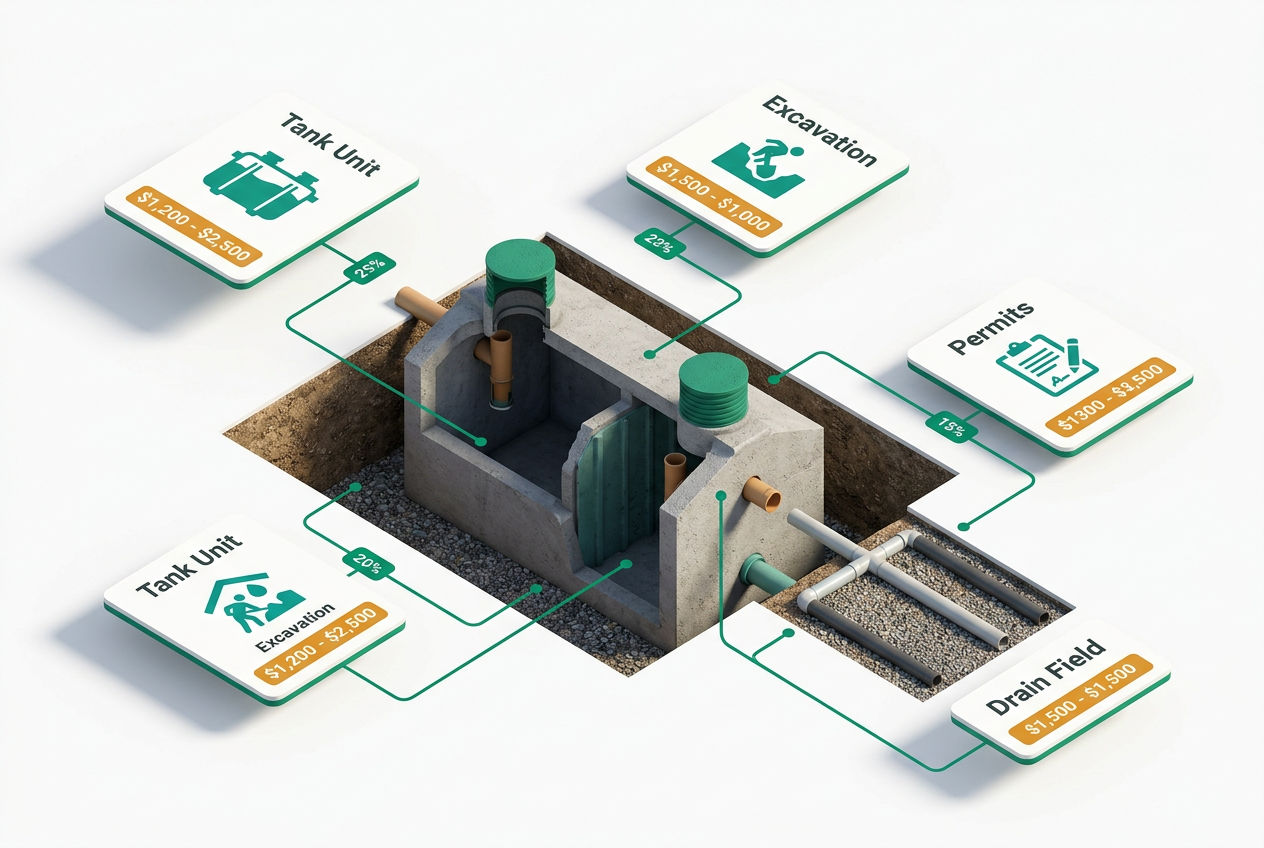
Get the DIY Blueprint — $67 →Instant download · 8 modules + 3 bonus guides · 60-day money-back guaranteeAn installed concrete septic tank usually costs $3,500 to $6,500 for the tank, delivery, excavation, and setting. Angi says the total project can reach $6,500 once labor is included. A full new system with a drain field costs far more, because the drain field is often the largest single expense.
Worked example (illustrative, not a real quote). Here's how the lines might add up for a tank-only replacement on a 3-bedroom home in southern New Hampshire. The tank price is A.J. Foss's published average retail. Delivery uses the Septic and Well range. The excavation, removal, and permit figures are our own assumptions within typical ranges, so treat them as placeholders for your local quotes.
| Line | Example cost | Basis |
|---|---|---|
| 1,000-gallon precast tank | $1,412.50 | A.J. Foss average retail |
| Boom-truck delivery, ~25 miles | $450 | Within Septic and Well's $300–$800 |
| Excavation and setting | $2,200 | Assumed; varies widely with soil |
| Removing or abandoning old tank | $600 | Assumed |
| County permit | $250 | Assumed; fees vary by county |
| Total | $4,912.50 |
That total lands inside the $3,500–$6,500 installed range. Your numbers will differ, but each line should appear on a fair quote. If a quote lumps everything into one number, ask for a breakdown. Hitting ledge rock in New England can double excavation time. Sandy soil in the coastal South digs fast and cheap.
Other lines to expect:
- Perc test and permit. Needed on new installs and many replacements. See our perc test cost guide.
- Risers and lids. Bring access to grade so pumping is easy. Our septic tank risers guide covers options.
- Drain field. Not included in tank pricing at all. For full system budgets, see our septic installation cost guide.
If you're replacing a failed tank, our septic tank replacement cost page goes deeper.
Is Concrete or Plastic Cheaper, and Which Lasts Longer?
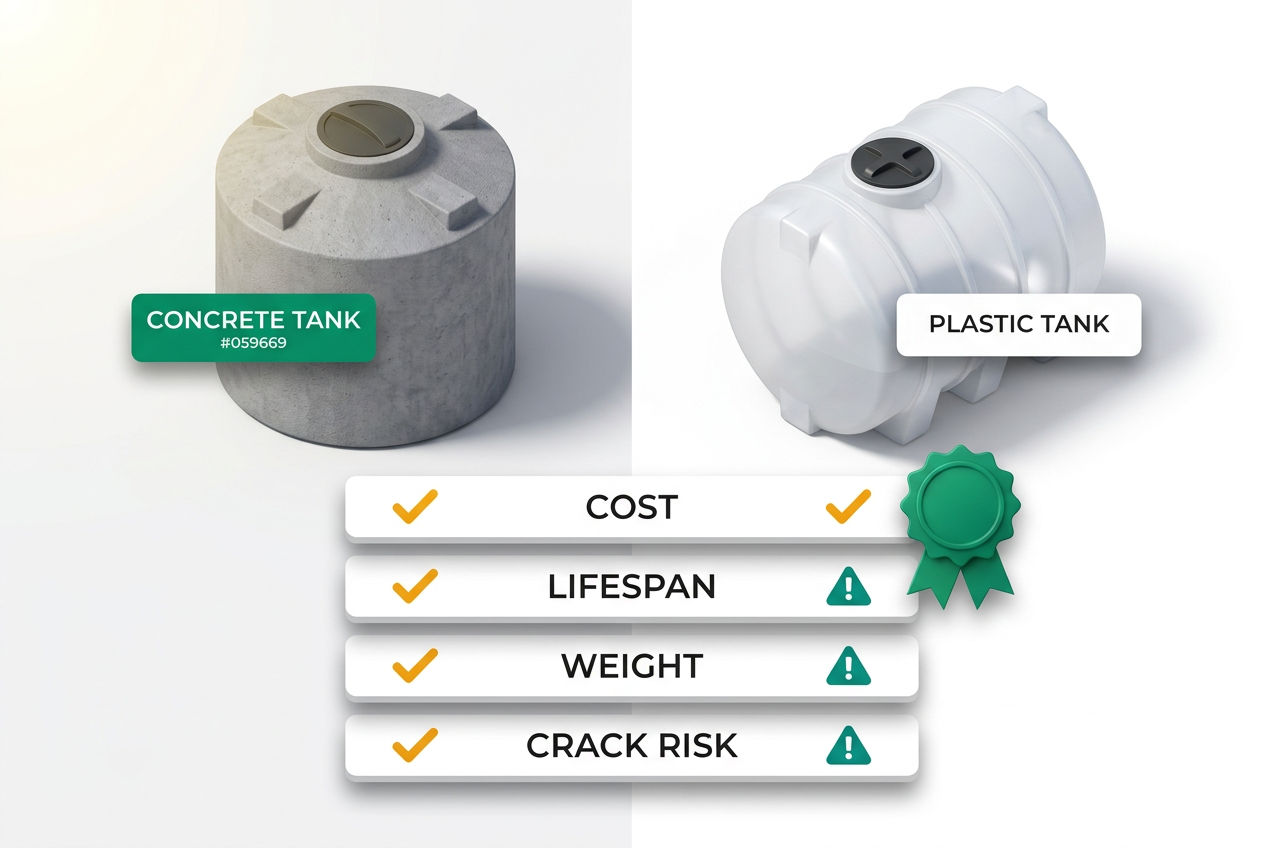
Plastic tanks often cost less to deliver, but the tank-price gap with concrete is smaller than many people expect. A plastic tank weighs a few hundred pounds, so it can ride on a pickup or small trailer and skip the $300–$800 crane fee. Concrete tanks, on the other hand, commonly last 40 years or more with routine pumping, and their weight resists flotation in wet ground.
The total cost comparison depends on your site:
- Easy truck access, dry soil: concrete is usually competitive, and its durability is a strong argument.
- No truck access or remote lot: plastic can save hundreds on delivery.
- High water table: concrete's weight is an advantage, though both materials may need anti-flotation steps.
- Code limits: some counties restrict or require specific materials, so check first.
See our full concrete vs. plastic septic tank comparison for side-by-side numbers.
What Are the Limits of a Concrete Septic Tank?
A concrete tank can crack, corrode, and leak, and it can't fix a failing drain field. Hydrogen sulfide gas from wastewater slowly attacks concrete above the liquid line, especially in older or lower-strength tanks. Mid-seam joints can leak groundwater in, which overloads the drain field. And if a backyard has no truck access, a concrete tank may not be practical at any price.
An honest limitation of this guide: our prices come from national cost guides and one New England manufacturer. Prices in the West, Midwest, and South can differ, and precast yards update price lists often. Use these numbers to judge whether a quote is reasonable, not as a substitute for local quotes.
Maintenance protects your investment either way. Most tanks need pumping every 3–5 years. See our septic tank pumping cost guide to budget for it.
More Septic Design & Install Guides
- Septic Pump Tank: How a Septic System With a Pump Works, Costs & Installs
- Septic Holding Tank: Cost, Sizes, Rules & Holding Tank vs. Septic System
- Conventional Septic System: How It Works, What It Costs & When You Can Use One
- Drip Septic System: How Drip Dispersal Works, Cost & Design
- Septic System for a 2-Bedroom House: Tank Size, Drain Field & Cost
- Septic System for a 5-Bedroom House: Tank Size, Drain Field & Cost
- How Long Is a Perc Test Good For? Expiration and Retesting Explained
- How to Backfill a Septic Tank
- Septic Inspection Before Backfill: What the Inspector Checks
- Septic system design: the complete guide
- Can you install your own septic system? Rules by state
Frequently Asked Questions
How much is a 1,000-gallon concrete septic tank?
A 1,000-gallon concrete septic tank costs $900–$1,500 for the tank alone, according to Angi's 2026 data. A.J. Foss lists its 1,000-gallon tank at $1,412.50 average retail in New Hampshire, which sits near the top of that range. Those prices don't include delivery, which typically adds $300–$800 because the 8,000–12,000-lb tank needs a crane or boom truck. They also don't include excavation, setting, permits, or removing an old tank. Installed, a tank-only project often lands between $3,500 and $6,500. Prices vary by region, concrete strength, and construction type. Monolithic and H-20 traffic-rated tanks cost more than standard mid-seam tanks. Get quotes from at least two precast yards and ask whether delivery and setting are included before you compare.
How much is a 1,500-gallon concrete septic tank?
A 1,500-gallon concrete septic tank costs $1,500–$2,500 for the tank alone, based on Angi's 2026 data. A.J. Foss lists its 1,500-gallon monolithic tank at about $2,112.50 in New Hampshire and rates it for homes with up to 5 bedrooms. That tank weighs about 12,500 lbs, so expect crane-truck delivery in the $300–$800 range, sometimes more for long distances or larger trucks. Installation, excavation, and permits add more. This size usually suits 4- and 5-bedroom homes, but your county code sets the actual minimum. Confirm the required size with your local health department before ordering, because a tank that's too small won't pass inspection and can't easily be swapped once it's set in the ground.
Is a concrete septic tank cheaper than plastic?
It depends on the site. Concrete and plastic tank prices often fall in similar ranges, but a concrete tank needs a crane or boom truck for delivery, which adds $300–$800. A plastic tank weighs only 150–300 lbs and can often be delivered without heavy equipment. So on a remote lot or a backyard with poor truck access, plastic is frequently cheaper overall. On an accessible site, the gap narrows, and concrete's longer service life and resistance to flotation may make it the better value. Some local codes also limit which materials you can use. Compare full delivered-and-installed quotes for both materials rather than tank list prices alone.
How long does a concrete septic tank last?
A well-built concrete septic tank commonly lasts 40 years or more with regular pumping every 3–5 years. Lifespan depends on concrete strength, construction quality, and soil conditions. High-PSI concrete, such as the 5,000 PSI used in A.J. Foss tanks, resists cracking better than weaker mixes. Hydrogen sulfide gas can slowly corrode concrete above the waterline, and mid-seam joints can leak in wet soil over time. Inspections during routine pumping catch most problems early, such as cracked baffles or seam leaks. Installing risers makes those inspections easier and cheaper. A tank that meets ASTM C1227 and comes from an NPCA-certified plant gives you a better starting point for a long service life.
Sources & Methodology
We compiled 2026 pricing from national cost guides and manufacturer listings, then cross-checked ranges across sources. Where only one secondary source existed (the 2,000-gallon estimate), we flagged it. The worked example combines published prices with labeled assumptions.
- Angi, "Concrete Septic Tank Cost" (2026)
- A.J. Foss, 1,000-gallon and 1,500-gallon monolithic septic tank product pages
- Septic and Well, concrete septic tank cost and weight data (2026)
- U.S. News, septic tank cost coverage
- ASTM International, ASTM C1227: Standard Specification for Precast Concrete Septic Tanks
- National Precast Concrete Association (NPCA) plant certification program
Written by our editorial team. Prices researched November 2026 from published supplier and cost-guide data; confirm current prices with your local precaster.
Primary sources to read: EPA: Types of Septic Systems · EPA: How Your Septic System Works · National Precast Concrete Association · University of Minnesota Onsite Sewage Treatment Program
How Do You Get Accurate Local Quotes?
The fastest way to get an accurate concrete septic tank price is to collect itemized quotes from two precast yards and two installers. Ask each yard for the delivered-and-set price, and ask each installer to separate excavation, removal, and permit costs. Then compare line by line against the ranges above. To connect with local pros, visit our septic services page.

Free download
Not ready for the Blueprint? Start free.
Grab the free DIY Septic Planning Kit — the permit-first checklist, perc-test cheat sheet, and sizing tables that keep your build from getting red-tagged.
Was this article helpful?
Frequently Asked Questions
Recommended Resources
📖 Related Articles
- DIY Septic System: How to Build Your Own (Step-by-Step)
- Septic Tank Sizes & Dimensions Chart (by Bedrooms)
- 1000-Gallon Septic Tank: Dimensions, Cost & Concrete vs Plastic
- Where to Buy a Septic Tank (Types, Prices & What to Ask)
- High Water Table and Septic Systems: What You Need to Know
- Septic System for a 3-Bedroom House: Tank Size, Drain Field & Cost
- How Much Does a Perc Test Cost? (2026 Pricing)
- How to Install Septic Tank Risers: Riser Kit Guide
- Septic Tank Replacement Cost 2026: $5,000–$15,000 (Full Breakdown)
- Concrete vs Plastic Septic Tanks: Which Is Better?
🔧 Services
📍 Find Local Pros
Find Septic Professionals Near You
Compare licensed, verified septic companies by area — top county markets and cities below, or browse all 50 states.
County markets
Popular cities
