
Quick Answer
A septic system for a 2 bedroom house is usually sized for about 300 gallons per day and uses a 750- to 1,000-gallon tank. Texas allows 750 gallons, but many counties require at least 1,000 gallons. Drain field size depends on your soil. Conventional systems often cost an estimated $3,000–$10,000 installed.
By the Editorial Team. Figures are checked against state codes, the EPA Onsite Wastewater Treatment Systems Manual, and HUD Handbook 4000.1. See Sources & Methodology below.
Key Takeaways
- Code sizes septic systems by bedroom count, not by the number of people or bathrooms. Two bedrooms equal about 300 gallons per day.
- Expect a 750–1,000-gallon tank. Texas allows 750 gallons for 1–2 bedrooms. Many counties require 1,000 gallons.
- Your perc test sets the drain field size. It can range from about 400 to over 1,200 sq ft of trench area.
- Conventional systems cost an estimated $3,000–$10,000. Mound and aerobic systems cost about $10,000–$20,000 or more.
- A 1,000-gallon tank serving 1–2 people usually needs pumping every 4–5 years.
A 2 bedroom cottage, an ADU behind the main house, or a 2 bedroom ranch with an old tank out back all raise the same three questions. How big does the system need to be? What will it cost? Will the county approve it? The sections below answer each question with numbers you can check against your local code.
What Size Septic Tank Do You Need for a 2 Bedroom House?
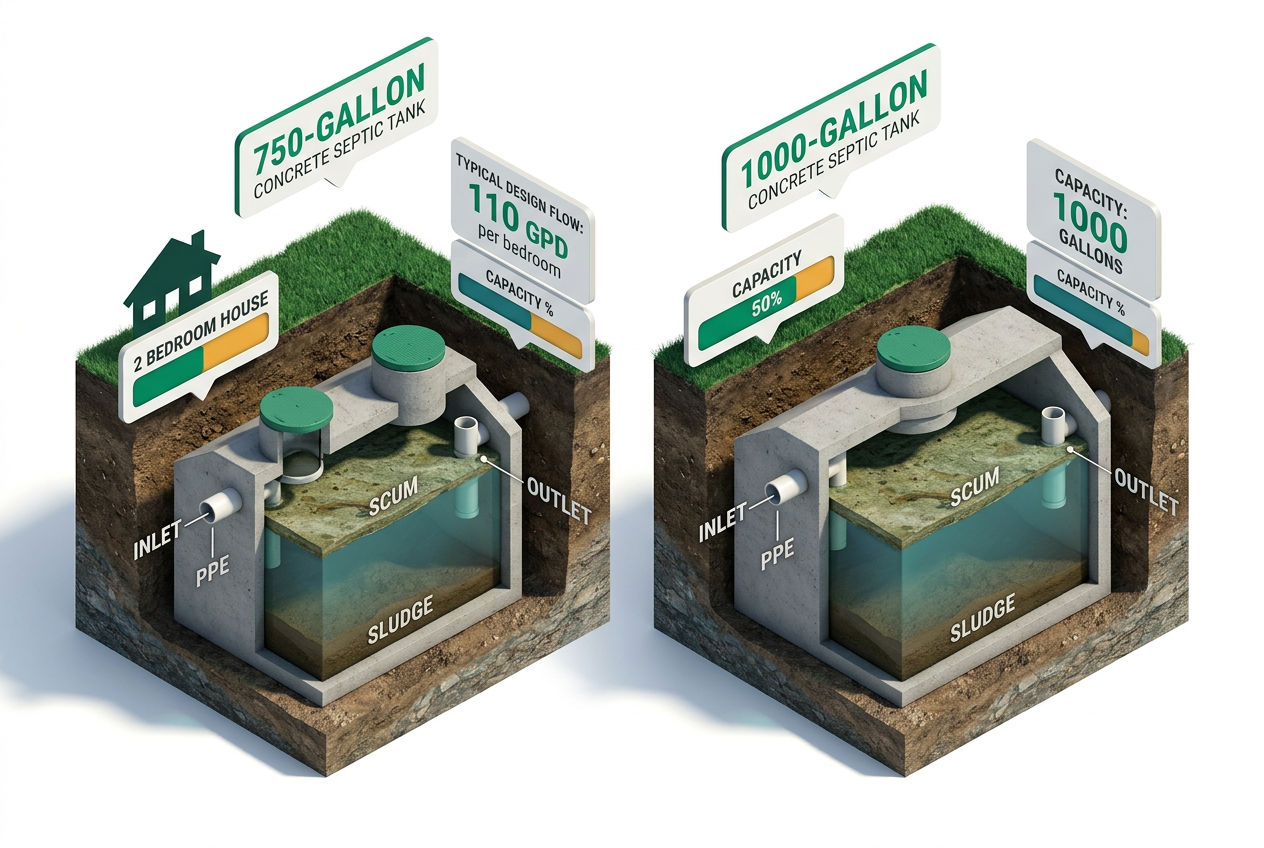
The septic tank size for a 2 bedroom house is usually 750 to 1,000 gallons. Designers estimate about 150 gallons per day per bedroom, which comes to 300 gallons per day. The tank should hold roughly two days of flow, plus extra room for sludge. Your state or county code sets the actual minimum.
Two bedrooms at 150 gallons each produce 300 gallons per day. Two days of retention requires 600 gallons. The tank also needs space for solids. Sludge settles on the bottom and scum floats on top. That extra storage is the reason 600-gallon tanks rarely show up on residential permits.
State minimums differ:
- Texas: 750 gallons for a 1–2 bedroom home. This figure assumes 180 gallons per day with water-saving fixtures, according to QuickFlow Septic's summary of Texas rules.
- Florida: The Department of Health sets minimums by bedroom count. Secondary sources list both 900 and 1,000 gallons for 2 bedrooms. Check Chapter 64E-6 of the Florida Administrative Code or call your county health department.
- Many other counties: 1,000 gallons is the minimum for any house, including a one-bedroom.
Tank maker NTO Tank recommends 1,000–1,500 gallons for homes with 2 or fewer bedrooms. It also calls for at least 27 sq ft of liquid surface area. That surface area gives solids room to settle before effluent reaches the outlet baffle. For other bedroom counts, see our septic tank size chart.
What a bigger tank can't do: A 1,500-gallon tank lengthens the time between pumpings. It does not enlarge the drain field. If your soil can't absorb 300 gallons a day, extra tank capacity won't solve the problem.
Is a 1,000-Gallon Tank Better Than a 750-Gallon Tank?
For most 2 bedroom homes, a 1,000-gallon tank is the better choice, even where 750 gallons is legal. It holds more solids, so you pump less often. It also leaves room to add a third bedroom later. The price difference between the two sizes is usually small compared with the total job cost.
Here is a common permit problem. An owner builds a 2 bedroom cabin in Texas with a 750-gallon tank. A few years later, the owner wants to finish the loft as a bedroom. The county then reviews the house as a 3 bedroom design, and the existing tank and field may not meet code. A 1,000-gallon tank installed at the start often avoids a second excavation.
Tank material also matters. Concrete tanks are heavy and durable, and they resist floating in high groundwater. Polyethylene (plastic) tanks are light enough to haul onto tight or remote sites without a crane truck. Plastic tanks need proper anchoring where the water table is high, and some counties limit which models they approve. Our guide to a 1,000-gallon septic tank compares both materials.
How Big Does a Drain Field Need to Be for a 2 Bedroom House?
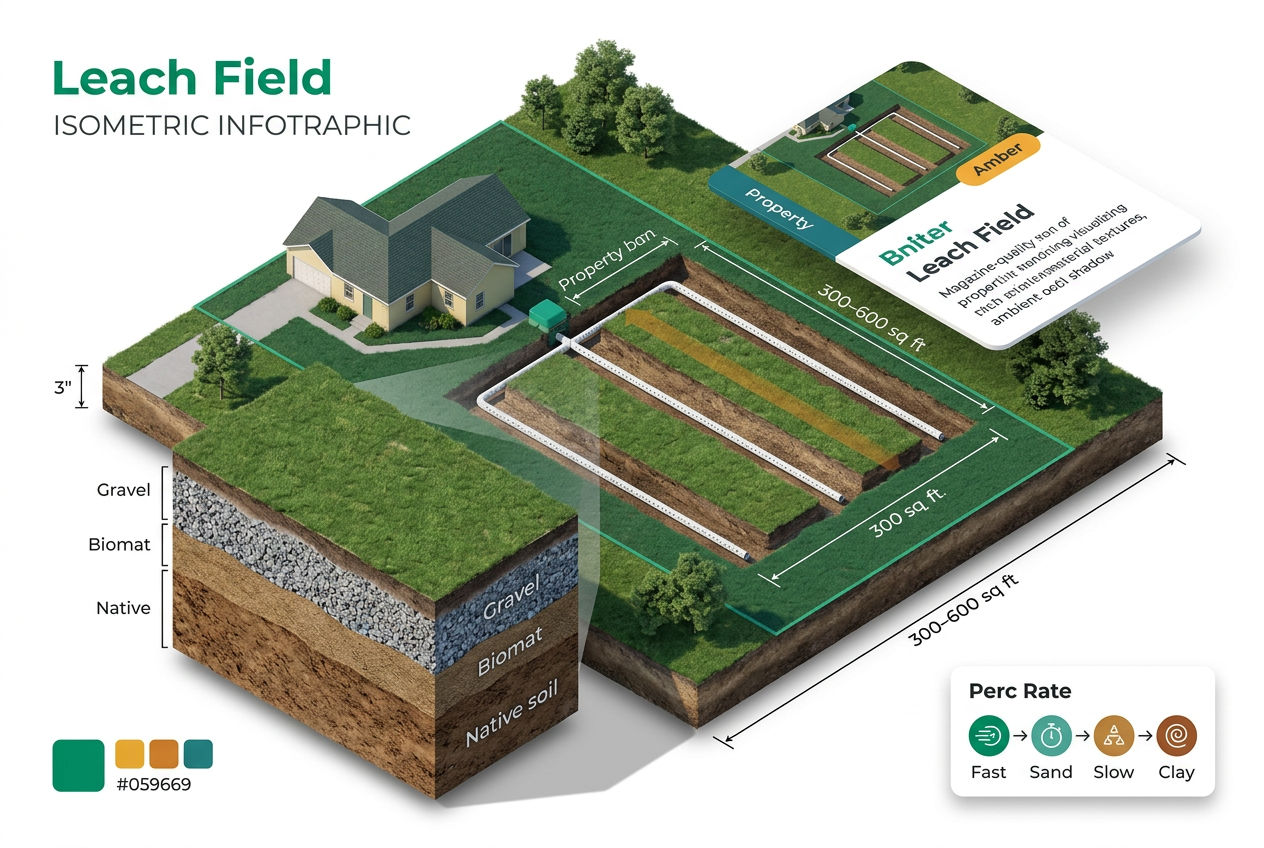
The drain field size for a 2 bedroom house usually falls between 400 and 1,200 square feet of absorption area. Sandy soil sits near the low end. Tight clay sits near the high end or fails the test entirely. To find the area, divide the daily design flow by your soil's loading rate.
Published ranges vary widely. VDW Water & Wastewater lists 400–600 sq ft for a conventional 1–2 bedroom field. NTO Tank lists 800–2,500 sq ft. The gap probably comes from what each source measures. The smaller figure likely covers trench-bottom area in good soil. The larger figure likely covers the total footprint, including trench spacing and poorer soils.
Worked example (illustrative loading rates):
| Soil Type | Loading Rate* | Area for 300 GPD |
|---|---|---|
| Sandy loam | 0.8 gal/sq ft/day | ~375 sq ft |
| Loam | 0.6 gal/sq ft/day | ~500 sq ft |
| Silt loam | 0.45 gal/sq ft/day | ~670 sq ft |
| Clay loam | 0.25 gal/sq ft/day | ~1,200 sq ft |
| Heavy clay | Often unsuitable | Mound/ATU likely |
Area = 300 GPD ÷ loading rate. These loading rates are examples only, in the general range shown in the EPA Onsite Wastewater Treatment Systems Manual. Your state code or county health department sets the actual rates for your soil. The figures show trench-bottom area only. The total yard footprint is larger once trench spacing is included.
Your perc test result, measured in minutes per inch, tells the designer which loading rate applies. A fast perc means a smaller field. A slow perc means a larger field or a different type of system. Our perc test guide explains how the test is run.
Trench layout takes up more space than the absorption area alone. Three trenches, each 3 feet wide and 60 feet long, give you 540 sq ft of trench bottom. Add 6 feet of undisturbed soil between trenches, and the footprint grows to about 60 by 21 feet before setbacks. Some states allow reduced sizing for gravelless chamber systems from makers such as Infiltrator Water Technologies. Whether you qualify depends on state approval.
Setbacks also use space. Wells, property lines, and foundations each need clearance. HUD Handbook 4000.1, which governs FHA-insured loans, lists a minimum of 50 feet from a well to a septic tank and 100 feet from a well to a drain field. Local rules may be stricter, so confirm the distances with your designer. If you're unsure how the field works, start with what a drain field is.
How Much Does a Septic System for a 2 Bedroom House Cost?
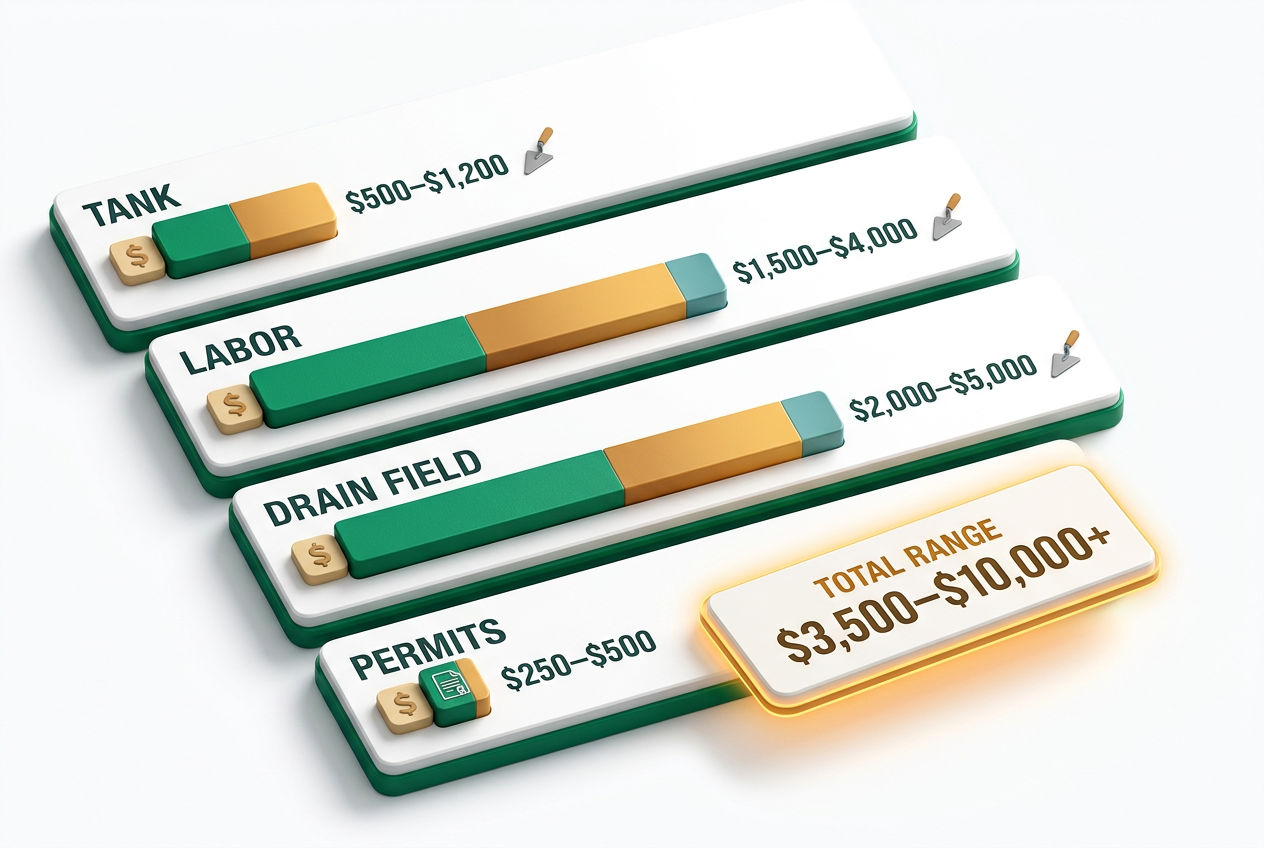
A 2 bedroom septic system cost is often estimated at $3,000–$10,000 for a conventional gravity system. Mound systems and aerobic treatment units often cost $10,000–$20,000 or more. Soil, permits, site access, and local labor rates cause most of the difference. Get at least three written quotes before you commit.
The total usually includes:
- Site and soil evaluation, or perc test. The county requires this before it issues a permit.
- System design. Some states require a licensed designer or engineer.
- Permit fees paid to the county health department.
- The tank, made of concrete or plastic, including delivery and setting.
- Excavation and drain field. This is usually the largest line item.
- Final inspection and backfill.
Sample budget for a conventional system in loam soil (estimates only):
| Item | Estimated Cost |
|---|---|
| Perc test / soil evaluation | $700 |
| Design | $800 |
| Permit | $400 |
| 1,000-gallon concrete tank, set | $1,800 |
| 500 sq ft drain field | $3,500 |
| Inspection and backfill | $300 |
| Total | $7,500 |
Swap the loam for clay loam and the field grows to about 1,200 sq ft. At a similar cost per square foot, that adds roughly $5,000 and pushes the total past $12,000. A failed perc test can push the job into mound pricing.
Full replacement of a failed system is often quoted at $15,000–$30,000, because the old components have to be removed first. Replacing only the tank costs about $3,000–$7,000, according to TheSeptic.Guide. Treat all of these figures as starting estimates, not quotes. For a fuller breakdown, see our septic installation cost guide.
Where costs jump: Rocky ground can double excavation time. Mountain lots may need a pump chamber with a float switch to push effluent uphill. Clay soils across much of the Southeast and Midwest often fail standard perc tests, which can require a mound system. Sandy coastal areas may require advanced treatment to control nitrogen.
Which System Type Fits a 2 Bedroom Home?

DIY Septic Blueprint
Thinking about building it yourself?
The complete, plain-English plan to size, permit and install your own septic system — designed for homeowners, not contractors. Skip the $15,000–$25,000 quotes and do it right the first time.
Get the DIY Blueprint — $67 →Instant download · 8 modules + 3 bonus guides · 60-day money-back guaranteeA conventional gravity system is the cheapest and simplest option for a 2 bedroom house when the soil percs well and groundwater sits deep. Mound systems handle shallow soil or high water tables. Aerobic treatment units (ATUs) suit poor soils and tight lots, but they add ongoing maintenance costs.
- Conventional gravity: The tank feeds a distribution box, which sends effluent into leach laterals. This system has no moving parts and costs the least.
- Chamber system: A conventional layout that uses plastic chambers instead of gravel. It is lighter to install, and some states allow a smaller footprint.
- Mound: A pump moves effluent into an engineered sand mound built above the native soil. It works where seasonal groundwater is too high for a standard field. Read more about mound septic systems.
- Aerobic treatment unit: An aerator compressor adds oxygen, so the unit treats wastewater more thoroughly before it reaches the field. ATUs are common in Texas, where many counties require an ongoing maintenance contract. The compressor needs electricity, and its parts wear out.
Limitation: No system type can fix a lot that is too small for the required setbacks and field area. If the lot can't fit the system, the county may deny the permit or limit the house to fewer bedrooms. Heavy clay creates similar limits. Our guide to septic systems in clay soil covers the options.
Does a Septic System for a 2 Bedroom ADU Follow the Same Rules?
Usually, yes. Most counties size an ADU's wastewater load by its bedroom count, just as they do for a main house. The county then decides whether the ADU can share the existing system or needs a separate one. A shared system must be sized for the combined bedrooms of both buildings.
For example, a 3 bedroom main house plus a 2 bedroom ADU counts as 5 bedrooms in many jurisdictions. That combined load often exceeds what the original tank and field were designed to handle. See our ADU septic requirements guide before you draw up plans.
What Counts as a Bedroom for Septic Sizing?
Most health departments count any room that could reasonably be used for sleeping as a bedroom. That usually means a room with an egress window, a door, and often a closet. The room's label on the floor plan doesn't decide the matter. An office that meets these criteria may count.
This rule matters when you remodel. If you turn a den into a bedroom, the county may require a larger tank or field before it signs off on the permit. Ask the health department how it defines a bedroom before you finalize plans. If you're comparing sizes, our 3 bedroom septic system guide shows how the numbers change.
How Often Should You Pump a 2 Bedroom Septic Tank?
A 1,000-gallon tank serving 1–2 people usually needs pumping every 4–5 years. A 750-gallon tank serving a family of four may need pumping every 2–3 years. The EPA's SepticSmart program recommends inspections every 1–3 years and pumping every 3–5 years for a typical household.
How many people live in the house matters more than how many bedrooms it has. Garbage disposals, long showers, and laundry done all on one day shorten the interval. At each service, ask the pumper for a sludge-judge reading and a baffle check, and keep the records. Our how often to pump a septic tank guide has an interval chart by tank size and household size.

Can You Install a Septic System Yourself?
In most states, no. You usually can't legally install a full system without a license, although a few rural jurisdictions allow homeowner installs on owner-occupied property. Even where DIY is allowed, you still need a permitted design, a soil evaluation, and county inspections. Mistakes in grading or trench depth can cause the field to fail early.
Read our DIY septic installation guide for state-by-state limits. Most homeowners save time and avoid failed inspections by hiring a licensed installer. You can request quotes through our septic installation services page.
When Should You Schedule the Soil Test?
Schedule the soil evaluation during the wettest part of the year, if your county allows it. Seasonal high groundwater is what usually disqualifies a site, and a dry-season test can miss it. Soil scientists look for mottling, which is gray and orange streaking in the soil that shows where water sits seasonally.
In northern states, frozen ground often closes the testing window from late fall through early spring. Book early, because evaluators and installers fill their schedules quickly once the ground thaws.
What Should You Do Next?
Your next step is a call to your county health department. Ask three questions: What is the minimum tank size for 2 bedrooms? Who is approved to run the perc test? What are the required setbacks from wells and property lines? With those answers in hand, get three written installer quotes based on the same design.
Does your county count a home office as a bedroom? Can a future ADU share this system? Asking now costs nothing. Finding out after the tank is in the ground can mean another excavation.
More Septic Design & Install Guides
- Septic Pump Tank: How a Septic System With a Pump Works, Costs & Installs
- Septic Holding Tank: Cost, Sizes, Rules & Holding Tank vs. Septic System
- Conventional Septic System: How It Works, What It Costs & When You Can Use One
- Drip Septic System: How Drip Dispersal Works, Cost & Design
- Septic System for a 5-Bedroom House: Tank Size, Drain Field & Cost
- Concrete Septic Tank Price: 1,000-Gallon and Other Sizes in 2026
- How Long Is a Perc Test Good For? Expiration and Retesting Explained
- How to Backfill a Septic Tank
- Septic Inspection Before Backfill: What the Inspector Checks
- Septic system design: the complete guide
- Can you install your own septic system? Rules by state
Frequently Asked Questions
Is a 1,000-gallon septic tank big enough for a 2 bedroom house?
Yes. A 1,000-gallon tank meets or exceeds the minimum for a 2 bedroom house in almost every U.S. jurisdiction. At the standard design flow of 300 gallons per day, it holds a little over three days of wastewater (1,000 ÷ 300 ≈ 3.3). That exceeds the two-day retention most designers aim for and leaves room for sludge and scum to build up between pumpings. It also gives you some margin if a third bedroom is added later, although the drain field may still need to grow. Many counties set 1,000 gallons as the minimum for any home, so this size is often required, not just recommended. Confirm your local minimum with the county health department before you buy a tank, because some areas require a two-compartment design or a specific approved model.
How many gallons per day is a 2 bedroom septic system designed for?
Most codes design a septic system for a 2 bedroom house at about 300 gallons per day, based on 150 gallons per bedroom. Some states use lower figures. Texas, for example, uses 180 gallons per day for a 1–2 bedroom home with water-saving fixtures, which is why it allows a 750-gallon tank. The design flow is deliberately conservative. A couple living in the house may actually use only 100–150 gallons a day. Codes size for the house's potential occupancy, not for the current household, because future owners may have more people living there. This design flow drives both the tank size and the drain field calculation, so it's the first number your designer will confirm.
Can a 2 bedroom house use a smaller drain field?
Sometimes. A smaller field is possible when the soil percs quickly or when your state approves reduced sizing for chamber systems or advanced treatment units. Sandy loam with a fast perc rate might need only about 375 sq ft of trench bottom for 300 gallons per day. Clay loam might need around 1,200 sq ft. Some states allow a percentage reduction for gravelless chambers from approved manufacturers. Others allow reductions when an ATU pre-treats the effluent. You can't pick a smaller field on your own. The county sets the loading rate based on your soil evaluation, and the designer has to follow it. If your lot is tight, ask the designer which reductions your state allows.
What does a septic system for a 2 bedroom house cost to replace?
Full replacement of a failed septic system for a 2 bedroom house is often quoted at $15,000–$30,000. Replacement costs more than new construction because the old tank and field have to be removed or abandoned, and the new field often has to go in a different spot on the lot. Replacing only the tank costs about $3,000–$7,000, according to TheSeptic.Guide. If the original field failed because of poor soil, the replacement may need to be a mound or an ATU, which pushes costs toward the high end. Get a camera inspection and a soil evaluation before accepting a quote, so you know whether you're replacing one component or the whole system.
Sources & Methodology
We based the sizing figures on state codes where we could access them, and on manufacturer and installer guidance where we couldn't. Cost ranges come from published installer and industry estimates. They are not field quotes and will vary by region. The loading rates in the drain field table are examples only and are not code values.
- U.S. EPA, Onsite Wastewater Treatment Systems Manual (EPA/625/R-00/008) and the SepticSmart program: design flow, loading rate ranges, and pumping intervals.
- HUD Handbook 4000.1: well-to-septic setback distances for FHA-insured properties.
- Texas Administrative Code, Title 30, Chapter 285 (TCEQ On-Site Sewage Facilities), as summarized by QuickFlow Septic.
- Florida Administrative Code, Chapter 64E-6: Florida tank minimums.
- NTO Tank: tank size and liquid surface area recommendations.
- VDW Water & Wastewater: conventional drain field ranges.
- TheSeptic.Guide: tank replacement cost estimates.
Limitation: Septic rules are set locally and change over time. Treat this guide as a starting point for your conversation with the county health department and a licensed designer, not as a substitute for either.
Free download
Not ready for the Blueprint? Start free.
Grab the free DIY Septic Planning Kit — the permit-first checklist, perc-test cheat sheet, and sizing tables that keep your build from getting red-tagged.
Was this article helpful?
Frequently Asked Questions
Recommended Resources
📖 Related Articles
- Septic Tank Sizes & Dimensions Chart (by Bedrooms)
- 1000-Gallon Septic Tank: Dimensions, Cost & Concrete vs Plastic
- Perc Test (Percolation Test): What It Is & How It Works
- What Is a Drain Field? (And How Does It Work?)
- Mound Septic System: $10K–$25K Cost & How It Works (2026)
- How Often Should You Pump Your Septic Tank?
🔧 Services
Find Septic Professionals Near You
Compare licensed, verified septic companies by area — top county markets and cities below, or browse all 50 states.
County markets
Popular cities
