
Quick Answer
The septic tank size for a 5 bedroom house is typically 1,500 gallons. That figure assumes a design flow of about 750 gallons per day (150 gallons per bedroom). Some codes and designers choose 2,000 gallons for extra margin. The drain field is sized separately and often needs 750–1,500 square feet, depending on your soil.
By the editorial team. Tank sizes and formulas were checked against the state codes cited in the Sources & Methodology section below.
Key Takeaways
- A 1,500-gallon tank is the usual minimum for 5 bedrooms. A 2,000-gallon tank is the conservative choice.
- Septic codes count bedrooms, not people. A 5-bedroom house is sized as 5 bedrooms even if only two people live there.
- Design flow is usually 150 gallons per bedroom per day, which equals 750 gpd for 5 bedrooms.
- Your perc test sets the drain field size. Slow clay can double the field.
- Rules vary by state. Nevada allows 1,500 gallons for 6 bedrooms, while other codes require 1,750–2,000.
Say you're adding a fifth bedroom, or you're looking at a 5-bedroom listing with an old permit. Which tank size will pass inspection, and how much yard will the field need? The answers depend on your state code and your soil, and published sources don't always agree. The sections below show where they differ. For the bigger picture on planning a system, start with our complete DIY septic system guide.
What Is the Septic Tank Size for a 5 Bedroom House?
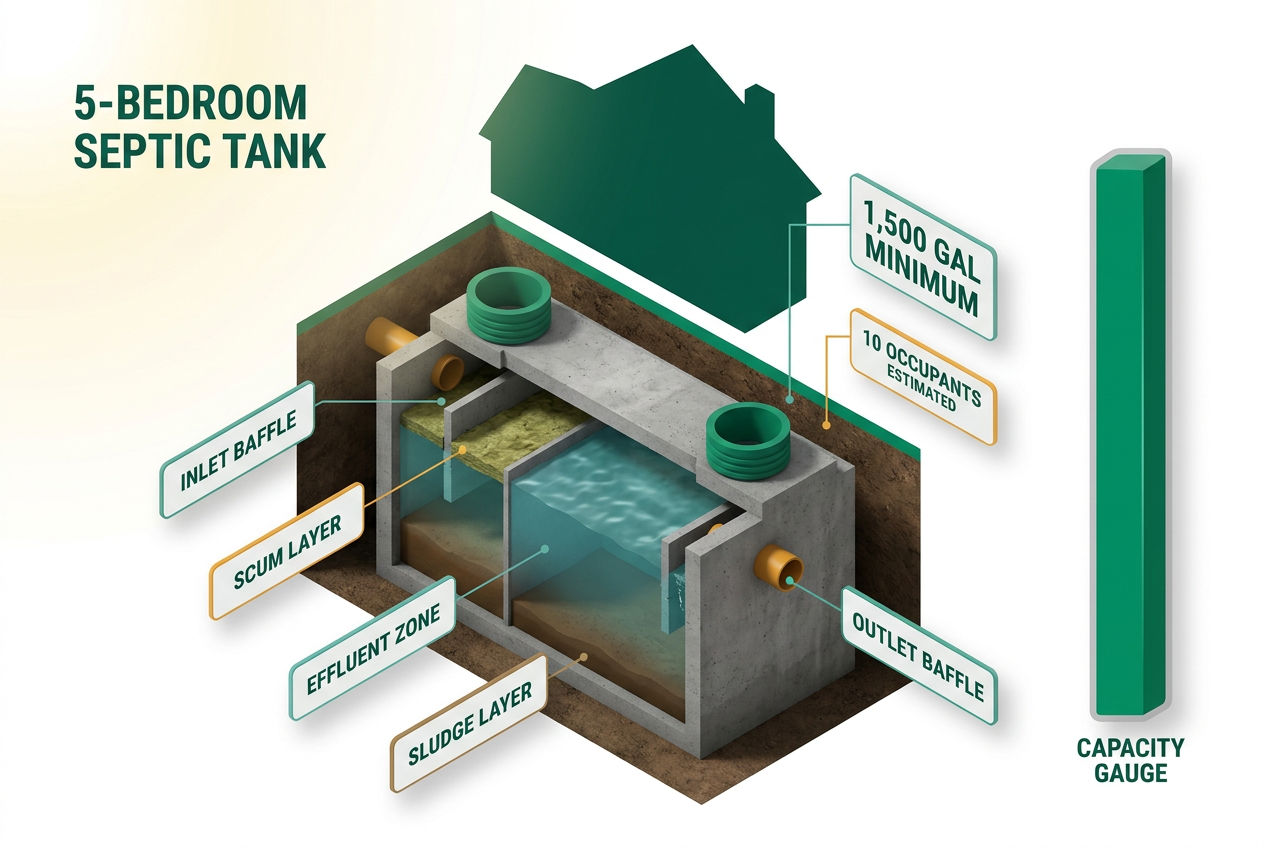
A 5-bedroom house needs at least a 1,500-gallon septic tank under most U.S. codes and industry charts. According to Minnesota's onsite sewage rule (Minn. R. 7080.1930), the minimum for five bedrooms is 1,500 gallons. Angi and most installer charts list the same figure. Some designers go up to 2,000 gallons for larger households, garbage disposals, or homes that host a lot of guests.
The 1,500-gallon figure comes from a simple calculation. Most codes assume 150 gallons of wastewater per bedroom per day, so five bedrooms produce 750 gallons per day. Many state codes then require the tank to hold about twice the daily design flow. That gives solids time to settle and leaves room for sludge and scum to build up between pumpings. Doubling 750 gpd gives 1,500 gallons.
The case for 2,000 gallons isn't a different formula. It's a decision to add margin. Some states, including Minnesota, require extra tank capacity when a garbage disposal is installed, because food waste adds solids. A larger tank also helps in three practical ways:
- More settling time. Solids have longer to sink, so fewer of them reach your leach laterals.
- Longer pumping intervals. More room for sludge means fewer pump truck visits.
- A buffer for heavy use. A Thanksgiving with 14 people won't push solids into the field.
A 2,000-gallon tank usually costs only a few hundred dollars more than a 1,500-gallon one. The field is the expensive part to replace, so that trade-off often makes sense.
Most installers will also suggest a two-compartment tank. A baffle wall separates the first chamber, where most solids settle, from the second chamber, which feeds clearer effluent to the outlet. You can add an effluent filter, such as a Polylok or Zabel model, to the outlet tee for about $50–$150. It keeps solids from reaching your field.
Do Septic Codes Count Bedrooms or Occupants?
Septic codes size tanks by bedroom count, not by how many people live in the house. For example, New Mexico's Liquid Waste Disposal regulations (20.7.3 NMAC) and Tennessee's subsurface sewage rules (Tenn. Comp. R. & Regs. 0400-48-01) both size residential systems by bedrooms. The reason is that owners change but bedrooms stay. A retired couple's 5-bedroom house might sell to a family of seven next year.
This catches people off guard. Suppose you turn a den into a fifth bedroom before you list your house. The buyer's appraiser counts five bedrooms, but the county records show a septic permit for four. The sale stalls while someone works out whether your 1,000-gallon tank is legal for that bedroom count.
What counts as a "bedroom" depends on local rules. Many health departments count any room with a closet and a window that could be used for sleeping, including offices and "bonus rooms." If you're finishing a basement, call your county health department before framing, not after.
The rule also works in the other direction. If your county permitted a 4-bedroom system, you may not be able to legally market the house as a 5-bedroom. Our 4-bedroom septic system guide covers what that smaller system looks like. If you're on the buying side, add the septic permit to your home inspection checklist so the bedroom count gets confirmed before closing.
Septic Tank Size Chart by Bedroom Count
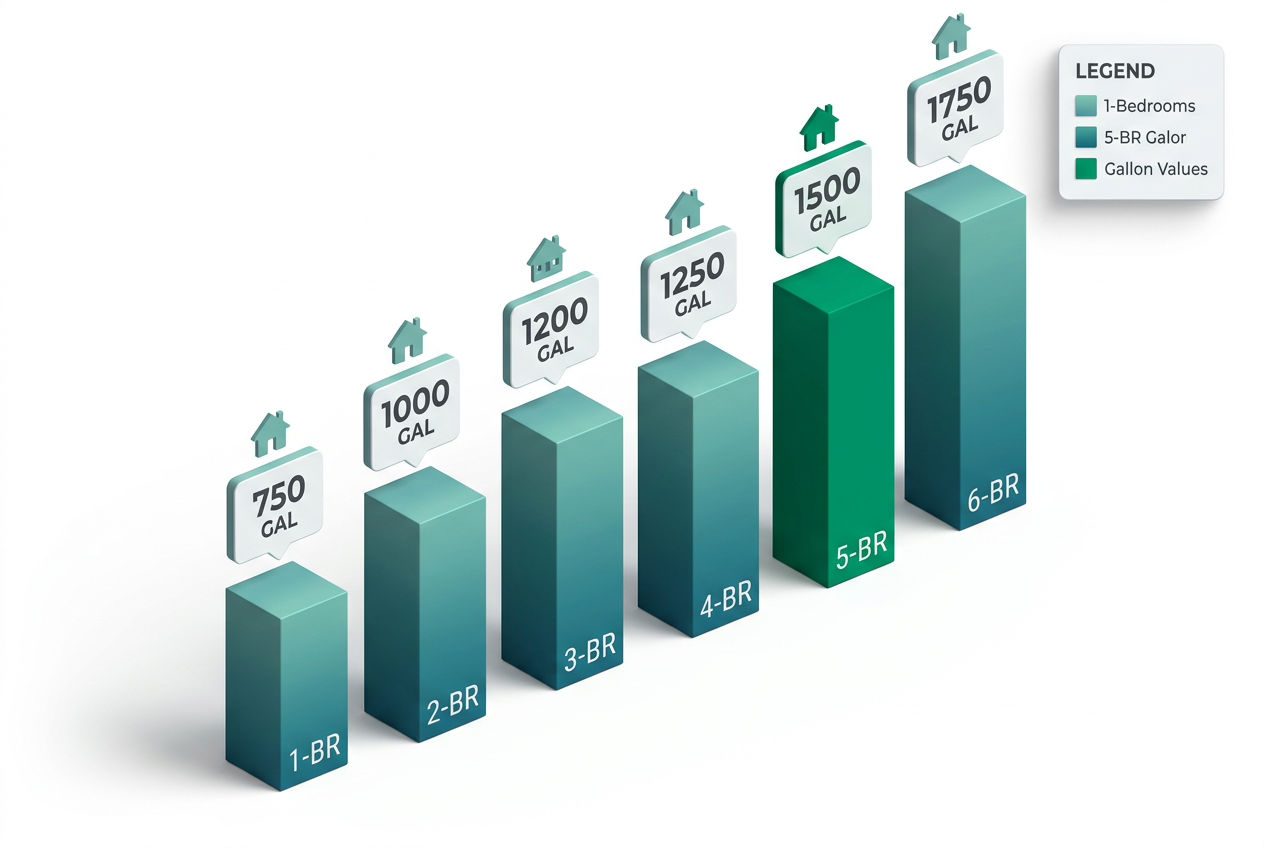
Tank minimums rise by roughly 250 gallons per added bedroom on most industry charts. Some state codes, such as Nevada's, step up more slowly.
| Bedrooms | Common Chart Size | Nevada Code Minimum | Design Flow (150 gpd/BR) |
|---|---|---|---|
| 3 | 1,000 gal | 1,000 gal | 450 gpd |
| 4 | 1,250 gal | 1,200 gal | 600 gpd |
| 5 | 1,500 gal | 1,500 gal | 750 gpd |
| 6 | 1,750 gal | 1,500 gal | 900 gpd |
| 7 | 2,000+ gal (engineered) | 1,650 gal | 1,050 gpd |
Sources: Nevada Administrative Code § 444.8306 via Cornell LII; A1 Septic Tanks bedroom chart; design flow calculated at 150 gallons per bedroom per day. Your state's code is the final word.
For every bedroom count from 1 to 10, see our full septic tank size chart.
What Is the Septic Tank Size for a 6 Bedroom House?
A 6-bedroom house needs a septic tank of 1,500 to 2,000 gallons, depending on your state. Nevada's code allows 1,500 gallons for 5 or 6 bedrooms. Common industry charts list 1,750 gallons. Some codes require 2,000 gallons or more once you reach six bedrooms.
The gap between states is large. Two code formulas handle houses above six bedrooms differently:
- Nevada (NAC 444.8306): Add 150 gallons to the 1,500-gallon base for each bedroom above six. An 8-bedroom house needs 1,800 gallons.
- Other codes cited by InspectApedia: Add 250 gallons, plus 7 square feet of tank surface area, for each bedroom above six. The same 8-bedroom house would need 2,000 gallons.
Once you pass six or seven bedrooms, most counties want an engineered design instead of a standard chart, so expect to hire a licensed designer or PE. Large homes also often need a pump chamber with a float switch to dose the field evenly. A gravity system has trouble spreading that much effluent across long trenches.
What Is the Leach Field Size for a 5 Bedroom House?
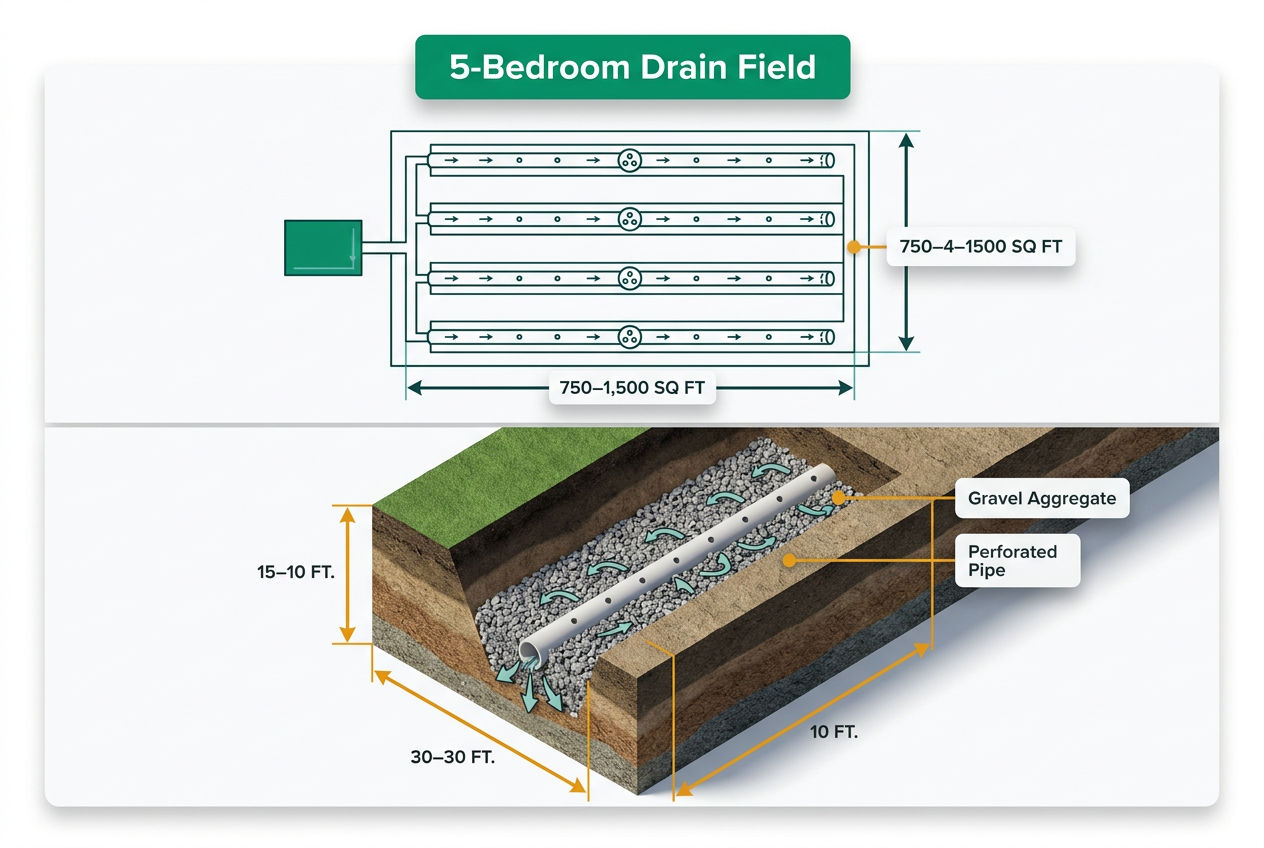
A leach field for a 5-bedroom house typically needs 750 to 1,500 square feet of absorption area, based on 150 to 300 square feet per bedroom. Your soil's absorption rate, measured by a perc test, decides where you fall in that range. Slow clay soils push you to the top of it, or past it.
The field is sized separately from the tank. The tank only holds and settles waste. The drain field does the real treatment: effluent soaks into the soil, where microbes clean it.
Worked Example: Sizing Trenches for 750 GPD
Your designer divides the daily flow by the soil's loading rate. That rate is the number of gallons each square foot of trench bottom can absorb per day.
- Moderate soil (loam), 0.8 gal/sq ft/day: 750 ÷ 0.8 ≈ 938 sq ft of trench bottom. With 3-foot-wide trenches, that's about 313 linear feet. You could lay it out as four laterals of roughly 78 feet each.
- Slow soil (silty clay), 0.4 gal/sq ft/day: 750 ÷ 0.4 ≈ 1,875 sq ft. That's about 625 linear feet of 3-foot trench, which means twice the digging, twice the gravel, and twice the yard space.
These loading rates are examples. Your county assigns the real one based on your perc test results, which are usually given in minutes per inch.
Standard Trench Specs
Conventional trenches usually run 18–36 inches deep and 1–3 feet wide. Each trench holds a 4-inch perforated PVC pipe laid on 6–12 inches of washed gravel. A distribution box splits the flow evenly between laterals.
Gravelless chamber systems from makers like Infiltrator Water Technologies can sometimes reduce the required footprint, if your state grants a sizing credit. Ask your designer whether yours does. You can read more about how a drain field is installed.
A bigger tank won't make up for a small field. If your soil can't absorb 750 gallons a day, a 2,000-gallon tank only delays the backup. It doesn't prevent it.
How Does Soil and Region Change a Septic System for a 5 Bedroom House?

DIY Septic Blueprint
Thinking about building it yourself?
The complete, plain-English plan to size, permit and install your own septic system — designed for homeowners, not contractors. Skip the $15,000–$25,000 quotes and do it right the first time.
Get the DIY Blueprint — $67 →Instant download · 8 modules + 3 bonus guides · 60-day money-back guaranteeSoil and region can turn a 5-bedroom septic system from a $10,000 conventional build into a $25,000+ mound system. Clay soils in the Southeast and Midwest need larger fields. Shallow bedrock in New England, the Ozarks, and the Texas Hill Country often forces a mound. Coastal sandy areas may require advanced treatment near water.
Common regional conditions include:
- Georgia and Carolina red clay: Perc rates often run 60+ minutes per inch, and five bedrooms can need 1,500 sq ft of trench or more. See our clay soil septic guide.
- New England and the Ozarks: Ledge or bedrock 2–3 feet down leaves too little soil to treat effluent. A mound system design builds that soil up with imported sand.
- New Jersey, the Chesapeake Bay, and Florida's coasts: Sandy soil drains fast, sometimes too fast to treat effluent before it reaches groundwater. Some counties require nitrogen-reducing aerobic treatment units near sensitive water.
- Upper Midwest: Frost depth and seasonal high water tables limit how shallow trenches can sit. Many counties only allow perc and soil tests during certain months, so book early.
Design flow assumptions also vary. According to New York's residential design standards (10 NYCRR Appendix 75-A), design flow can drop to 110 gallons per bedroom per day when water-saving fixtures are installed. Many other states hold to 150 gpd. On a 5-bedroom house, that's 550 gpd versus 750 gpd, and the gap carries straight into field size. If you're on a private well, the field location also has to meet setback distances. Our guide to well water testing explains how to check that your water stays clean after the system goes in.
How Much Does a Septic System for a 5 Bedroom House Cost?
A septic system for a 5-bedroom house typically costs $10,000 to $18,000 for a conventional gravity system and $20,000 to $35,000 or more for a mound or aerobic system. According to Angi and HomeGuide cost data, the 1,500-gallon tank itself usually runs $1,500 to $3,000 for materials. The drain field, excavation, and permits make up most of the total.
| System Type | Typical 5-Bedroom Cost |
|---|---|
| Conventional gravity | $10,000–$18,000 |
| Pressure-dosed / pump chamber | $14,000–$22,000 |
| Chamber (gravelless) | $11,000–$19,000 |
| Mound | $20,000–$35,000+ |
| Aerobic treatment unit (ATU) | $15,000–$30,000 |

Worked Cost Example
The following example assumes a conventional system in moderate loam:
- 1,500-gallon two-compartment concrete tank, delivered: $2,400
- 313 linear feet of trench at about $25 per foot (excavation, gravel, pipe): $7,825
- Distribution box, effluent filter, risers: $900
- Perc test and design: $1,200
- Permit: $600
- Total: about $12,925
If you move the same house to silty clay, the trench doubles to about 625 feet. That adds roughly $7,800, and the total reaches about $20,700. That's why the perc test matters more to your budget than the tank does. For line-item pricing by region, see our septic system installation cost guide.
These numbers are estimates. Local labor rates, rock excavation, and access for the truck can move any of them by thousands. Get at least three written quotes.
Concrete or Plastic Tank?
Concrete tanks are heavier and last longer, often 40+ years. Plastic and fiberglass tanks are lighter and easier to set where a crane truck can't reach. Some counties restrict plastic tanks in high water tables because they can float when empty. Compare the trade-offs in our concrete vs. plastic septic tank guide.
What Permits Do You Need for a 5-Bedroom System?
You'll need a septic permit from your county or state health department before installation, and most jurisdictions also require a soil evaluation and an approved design. Permit fees commonly run $300 to $1,500. The permit records the bedroom count, which follows the house through every future sale.
The usual sequence:
- Soil evaluation or perc test by a licensed evaluator.
- System design based on 5 bedrooms and your soil's loading rate.
- Permit application and plan review.
- Installation by a licensed installer.
- Final inspection before backfill.
Skipping a step can mean digging the system back up for inspection. State-by-state details are in our septic permit requirements guide.
How Often Should a 5-Bedroom Septic Tank Be Pumped?
A 1,500-gallon tank serving a busy 5-bedroom house usually needs pumping every 2 to 4 years. The EPA's SepticSmart program recommends inspection every 3 years and pumping every 3 to 5 years for typical households. Large families and garbage disposal use shorten that interval.
Don't rely on a fixed calendar. Ask your pumper to measure the sludge and scum layers at each visit. Pump when solids fill about a third of the tank. Installing risers to grade costs a few hundred dollars and saves digging every time. See our septic pumping schedule for intervals by tank size and household.
What Size Septic Tank Do I Need for a 5 Bedroom House With a Garbage Disposal?
For a 5-bedroom house with a garbage disposal, plan on about 2,000 gallons, or a 1,500-gallon tank with an added compartment if your code allows it. Disposals add food solids that settle in the first chamber, so the sludge layer builds faster. Minnesota's rule, for example, requires extra tank capacity when a disposal is installed. Check your state's rule before ordering the tank.
Need Help Sizing or Installing Your System?
A licensed installer can confirm your county's bedroom definition, schedule the perc test, and quote the tank and field together. Find local pros through our septic installation services page.
More Septic Design & Install Guides
- Septic Pump Tank: How a Septic System With a Pump Works, Costs & Installs
- Septic Holding Tank: Cost, Sizes, Rules & Holding Tank vs. Septic System
- Conventional Septic System: How It Works, What It Costs & When You Can Use One
- Drip Septic System: How Drip Dispersal Works, Cost & Design
- Septic System for a 2-Bedroom House: Tank Size, Drain Field & Cost
- Concrete Septic Tank Price: 1,000-Gallon and Other Sizes in 2026
- How Long Is a Perc Test Good For? Expiration and Retesting Explained
- How to Backfill a Septic Tank
- Septic Inspection Before Backfill: What the Inspector Checks
- Septic system design: the complete guide
- Can you install your own septic system? Rules by state
Frequently Asked Questions
What size septic tank do I need for a 5 bedroom house?
Most codes require at least 1,500 gallons for a 5-bedroom house. That number comes from a design flow of 150 gallons per bedroom per day, or 750 gpd, multiplied by about two days of retention. Minnesota's rule and most industry charts list 1,500 gallons as the minimum. Many designers recommend 2,000 gallons if you have a garbage disposal, a large household, or frequent guests. The larger tank costs a few hundred dollars more and stretches the time between pumpings. Your county health department sets the legal minimum, so confirm the number before ordering a tank.
Is a 1,000-gallon septic tank enough for 5 bedrooms?
No. A 1,000-gallon tank is sized for about 3 bedrooms under most codes. At 750 gallons per day of design flow, a 1,000-gallon tank holds well under two days of flow. Solids won't have enough time to settle before effluent reaches the field. If you're adding bedrooms to a house with a 1,000-gallon tank, most counties will require a tank upgrade and possibly a larger field before the new bedroom count can be permitted. Selling a house as a 5-bedroom with a 3-bedroom permit can also stall the sale.
How big is the leach field for a 5 bedroom house?
The leach field size for a 5 bedroom house is usually 750 to 1,500 square feet of absorption area. Your perc test decides where you fall. In loam with a loading rate of 0.8 gallons per square foot per day, 750 gpd needs about 938 square feet, or roughly 313 feet of 3-foot trench. In slow clay at 0.4, the same house needs about 1,875 square feet. Chamber systems may earn a size credit in some states. Shallow bedrock or a high water table may require a mound instead of trenches.
Does a home office count as a bedroom for septic sizing?
Often, yes. Many health departments count any room that could reasonably be used for sleeping, usually a room with a closet, a window, and a door. Under that definition, offices, dens, and finished basement rooms can count. The definition varies by county, so check before you remodel. If a room is counted as a bedroom, your system must be sized for it, even if no one sleeps there. Getting the count right early avoids permit problems and stalled home sales later.
How much does a septic system cost for a 5 bedroom house?
A conventional 5-bedroom system usually costs $10,000 to $18,000. Mound and aerobic systems often run $20,000 to $35,000 or more. The tank is a small share of that, about $1,500 to $3,000. Field size drives most of the cost. In our worked example, moving the same house from loam to clay raised the estimate from about $12,900 to about $20,700, because the trench length doubled. Get a perc test before you budget, and collect at least three written quotes from licensed installers.
Sources & Methodology
Tank minimums and add-on formulas were taken directly from state code text where available. Design flow figures use 150 gallons per bedroom per day unless a state specifies otherwise. Cost ranges combine published national averages and are rounded. They are not quotes. This article doesn't replace your county's code or a licensed designer's plan.
- Nevada Administrative Code § 444.8306, tank capacity by bedroom (via Cornell LII)
- Minnesota Rules 7080.1930, septic tank capacity
- New York 10 NYCRR Appendix 75-A, wastewater treatment standards for individual household systems
- New Mexico 20.7.3 NMAC, Liquid Waste Disposal and Treatment
- Tennessee Comp. R. & Regs. 0400-48-01, subsurface sewage disposal systems
- U.S. EPA, Onsite Wastewater Treatment Systems Manual (EPA/625/R-00/008) and the SepticSmart homeowner program
- University of Minnesota Onsite Sewage Treatment Program, homeowner septic guidance
- InspectApedia, septic tank size tables
- A1 Septic Tanks, tank size by bedrooms chart
- Angi and HomeGuide, septic installation cost data
Free download
Not ready for the Blueprint? Start free.
Grab the free DIY Septic Planning Kit — the permit-first checklist, perc-test cheat sheet, and sizing tables that keep your build from getting red-tagged.
Was this article helpful?
Frequently Asked Questions
Recommended Resources
📖 Related Articles
- DIY Septic System: How to Build Your Own (Step-by-Step)
- Septic System for a 4-Bedroom House: Tank Size, Drain Field & Cost
- Septic Tank Sizes & Dimensions Chart (by Bedrooms)
- What Is a Drain Field? (And How Does It Work?)
- Perc Test (Percolation Test): What It Is & How It Works
- How to Install a Septic Drain Field (Leach Field), Step by Step
- Septic System for Clay Soil: The Options That Actually Pass
- Mound System Design: Sizing, Layout & Construction Explained
- Concrete vs Plastic Septic Tanks: Which Is Better?
🔧 Services
Find Septic Professionals Near You
Compare licensed, verified septic companies by area — top county markets and cities below, or browse all 50 states.
County markets
Popular cities
