
Quick Answer
The right septic tank size for a 4-bedroom house is 1,250 to 1,500 gallons for the tank alone — but that's just the starting point. Your drain field, soil conditions, local code, and household habits all shape what your complete system needs to look like. This guide gives you the real numbers: tank dimensions, leach field square footage, installation costs, and the regional differences that can swing your budget by $10,000 or more.
Key Takeaways
- Most states require a 1,250- to 1,500-gallon tank for a 4-bedroom home
- A 4-bedroom house generates 400–600 gallons per day (GPD) of wastewater
- Leach field size ranges from 800 to 2,500+ sq ft based on soil percolation
- Total installation cost runs $7,000–$15,000 for a conventional system; $15,000–$25,000+ for engineered alternatives
- Septic sizing is based on bedrooms, not occupants — codes use bedrooms because occupancy changes
What Size Septic Tank Does a 4-Bedroom House Need?
A 4-bedroom house needs a septic tank of at least 1,250 gallons, and 1,500 gallons is the standard in many states. The EPA recommends sizing based on the number of bedrooms because occupancy fluctuates — a family of two might own a 4-bedroom home today and rent it to six people tomorrow. Bedrooms set a predictable, code-enforceable ceiling for potential wastewater load. For how tank size fits into the rest of the plan, see our septic system design guide.
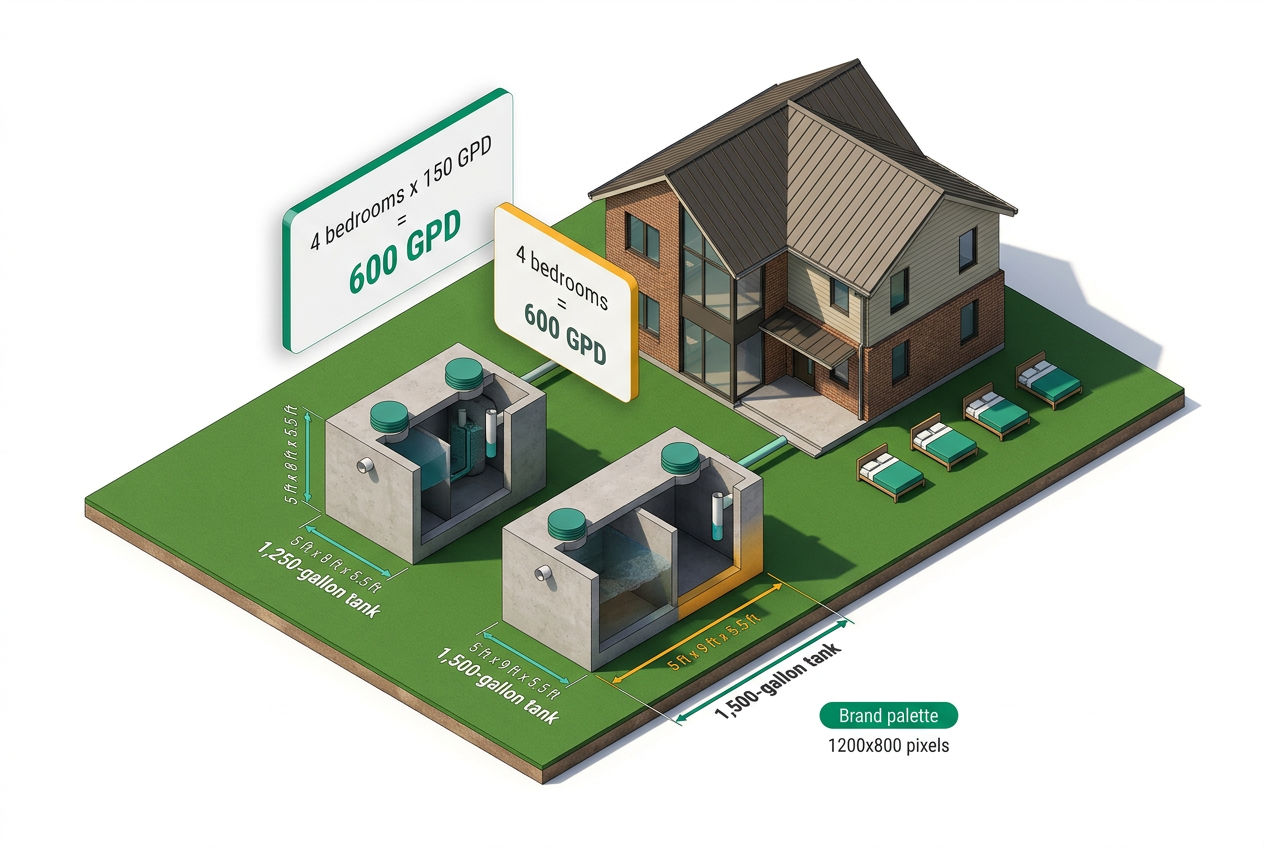
Sizing works like this: most jurisdictions assume 150 gallons per bedroom per day in design load. Four bedrooms × 150 GPD = 600 GPD maximum daily flow. Your tank needs to hold at least two to three days of flow in reserve — giving you that 1,250 to 1,500-gallon baseline before any solids accumulation is factored in.
A 1,250-gallon concrete tank runs roughly 5 ft wide × 8 ft long × 5.5 ft deep. Step up to a 1,500-gallon tank and you're looking at approximately 5 ft × 9 ft × 5.5 ft. That extra foot of length matters if your lot is tight. Plan your site layout around those footprints before you pour the slab.
Septic Tank Size Chart by Bedroom Count
Use this table to see how 4-bedroom sizing compares across the range of residential homes. The 4-bedroom row is your target — the others give you context for resale, additions, or future planning.
| Bedrooms | Min. Tank Size | Typical GPD | Drain Field (avg soil) |
|---|---|---|---|
| 1–2 BR | 750–1,000 gal | 150–300 GPD | 400–800 sq ft |
| 3 BR | 1,000–1,250 gal | 300–450 GPD | 600–1,500 sq ft |
| 4 BR | 1,250–1,500 gal | 400–600 GPD | 800–2,500 sq ft |
| 5 BR | 1,500–1,750 gal | 500–750 GPD | 1,200–3,000+ sq ft |
| 6 BR | 1,750–2,000 gal | 600–900 GPD | 1,500–4,000+ sq ft |
Sources: EPA Onsite Wastewater Treatment Systems Manual; NOWRA Design Standards; state health department code summaries.
For a deeper look at sizing across all tank sizes, see our septic tank size chart by bedrooms resource.
How Many Gallons Per Day Does a 4-Bedroom House Produce?
A 4-bedroom house produces approximately 400–600 gallons of wastewater per day under normal residential use. The 400 GPD figure assumes modest water use — a couple with two kids, efficient fixtures, and no garbage disposal. The 600 GPD ceiling reflects the design maximum: four occupied bedrooms with full daily usage.
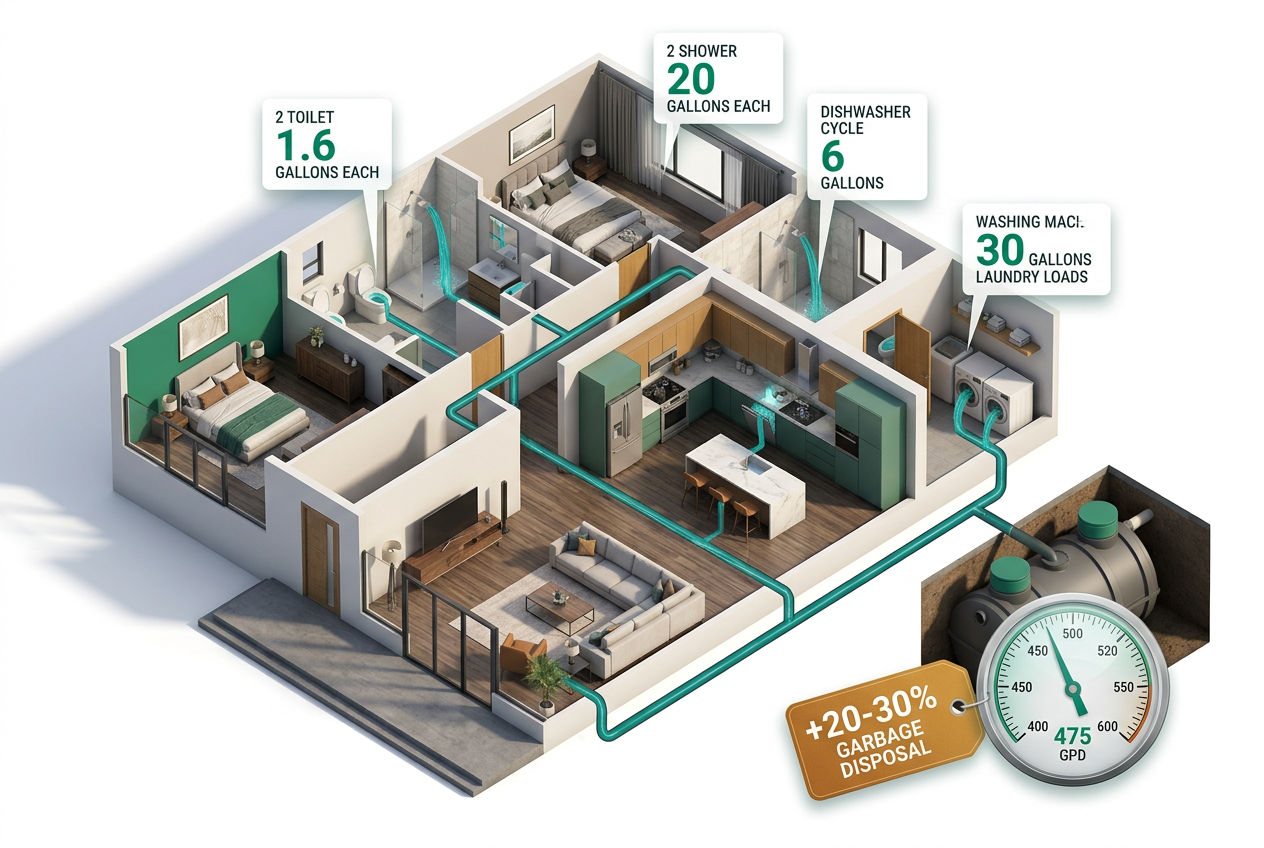
Here's a practical example. A family of five in a 4-bedroom home in Ohio averages 480 GPD based on 2.5 flushes per person per day (at 1.6 gallons per flush), two showers at 20 gallons each, one dishwasher cycle at 6 gallons, and two laundry loads at 30 gallons each. Run the numbers and you're at roughly 475 gallons before anyone fills a bathtub.
Add a garbage disposal and that daily flow jumps by 20–30%, because food solids and grease load up the tank faster. The University of Minnesota Extension Service recommends that homes with garbage disposals size up — a 4-bedroom house with a disposal warrants a 1,500-gallon minimum rather than the 1,250-gallon baseline. Want to know more about how disposals interact with your tank? See our garbage disposal and septic system guide.
Is a 1,000-Gallon Tank Big Enough for a 4-Bedroom House?
No — a 1,000-gallon septic tank is not big enough for a 4-bedroom house in almost every U.S. jurisdiction. A 1,000-gallon septic tank is the standard minimum for a 3-bedroom home in many states. At 400–600 GPD of incoming flow, a 1,000-gallon tank simply can't hold enough liquid to allow adequate settling time before effluent reaches the drain field.
Inadequate settling means partially treated effluent entering the leach laterals — and that's the fastest way to prematurely clog a drain field. Replacing a failed drain field runs $5,000–$20,000. A 1,000-gallon tank might pass inspection in a small number of rural counties with outdated codes, but you'd be building right at the margin of failure.
If you're buying an older home and the inspector finds a 1,000-gallon tank serving four bedrooms, treat that as a red flag. It's worth factoring a septic repair cost buffer into your offer.
How Big of a Leach Field Do You Need for a 4-Bedroom House?
The leach field size for a 4-bedroom house typically falls between 800 and 2,500 square feet, but that range is almost entirely driven by your soil's percolation rate — not your bedroom count alone.
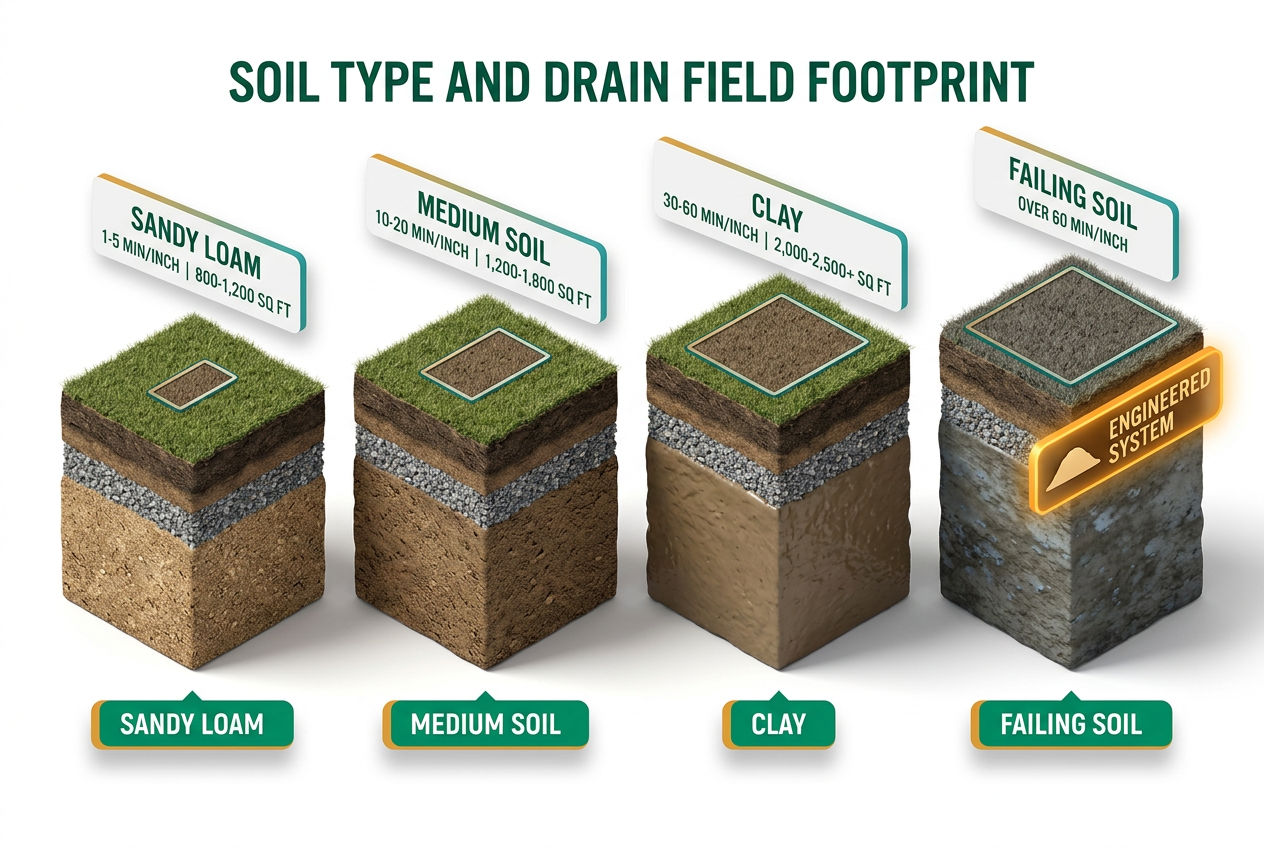
A percolation test (perc test) measures how fast water absorbs into your soil. Sandy or loamy soil might perc at 1–5 minutes per inch, meaning effluent disperses quickly and your drain field can be compact. Clay-heavy soil percs at 30–60+ minutes per inch — sometimes failing entirely — meaning you need a much larger field or an alternative system. Our perc test guide walks through exactly how that test works and what the results mean for your design.
Here's how soil type translates to real square footage for a 4-bedroom home:
- Sandy/loamy soil (1–5 min/inch): 800–1,200 sq ft
- Medium soil (10–20 min/inch): 1,200–1,800 sq ft
- Clay soil (30–60 min/inch): 2,000–2,500+ sq ft
- Failing soil (60+ min/inch): Engineered system required (mound, aerobic, sand filter)
Standard drain field trenches run 1–3 feet wide, 18–36 inches deep, and are spaced 6–10 feet apart center-to-center. A 1,500-square-foot field might consist of six trenches, each 100 feet long and 2.5 feet wide. That layout needs a lot footprint of roughly 100 ft × 70 ft minimum — before setback requirements.
Most jurisdictions require your drain field to sit at least 50–100 feet from any well or water source, 10 feet from property lines, and 25 feet from foundations. Many counties require a minimum lot size of 0.5–1 acre to legally install a conventional system. To understand the full scope of how a leach field works, including trench configurations and maintenance, that linked guide covers it in detail.
How Much Does a Septic System Cost for a 4-Bedroom House?
A complete conventional septic system for a 4-bedroom house costs $7,000–$15,000 installed in most U.S. markets. That includes the tank, drain field excavation, distribution box, and labor. Alternative engineered systems — mound, aerobic, sand filter — push that range to $15,000–$25,000 or higher.
Here's how the costs break down:
| Component | Low Estimate | High Estimate |
|---|---|---|
| Septic tank (1,250–1,500 gal, concrete, installed) | $3,000 | $7,000 |
| Conventional drain field | $3,000 | $10,000 |
| Engineered/alternative system | $10,000 | $20,000+ |
| Perc test & site evaluation | $250 | $1,000 |
| Permit fees | $200 | $2,000 |
| Septic system design (engineer) | $500 | $2,000 |
| Total — conventional system | $7,000 | $15,000 |
| Total — engineered system | $15,000 | $25,000+ |
Sources: Angi national contractor survey data 2024; HomeAdvisor cost database; NOWRA industry pricing surveys.
For the full breakdown of what drives those numbers up or down, see our septic installation cost guide.
Tank material also matters. A concrete tank ($700–$2,000 for the tank alone before installation) is the most common choice — heavy, durable, 40+ year lifespan. Plastic/poly tanks run $500–$2,500 and are easier to transport to tight lots. Fiberglass tanks ($1,200–$3,000) resist corrosion well in acidic soils. Each material has tradeoffs in structural integrity, buoyancy in high water table areas, and local contractor familiarity. Our concrete vs. plastic septic tank comparison breaks down when each makes sense.
How Does Septic Tank Sizing Vary by Region?

DIY Septic Blueprint
Thinking about building it yourself?
The complete, plain-English plan to size, permit and install your own septic system — designed for homeowners, not contractors. Skip the $15,000–$25,000 quotes and do it right the first time.
Get the DIY Blueprint — $67 →Instant download · 8 modules + 3 bonus guides · 60-day money-back guaranteeYour zip code may matter as much as your bedroom count. Septic codes are set at the state and county level — not federally — and the variation is significant.
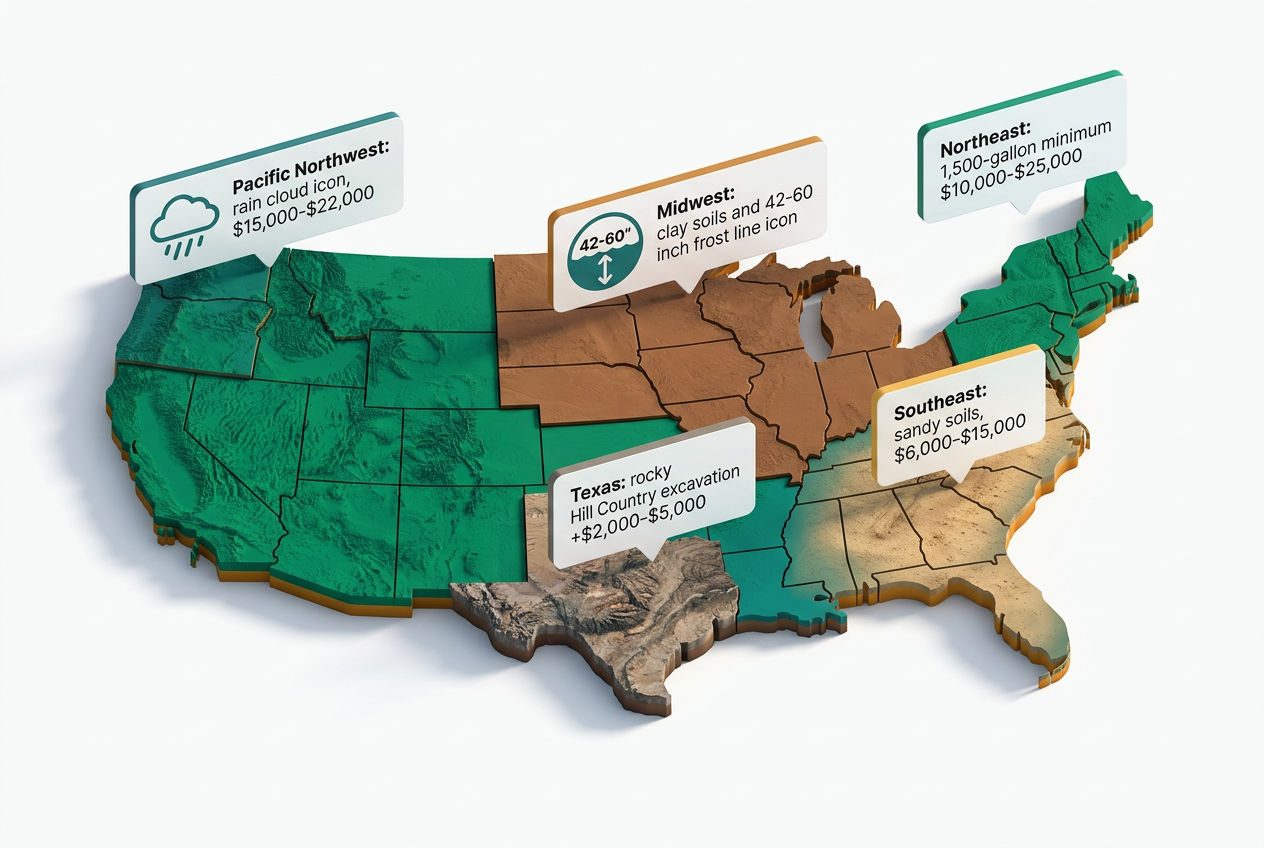
Northeast (Massachusetts, New Hampshire, Vermont, Maine, Connecticut): Massachusetts Title 5 and similar codes in neighboring states mandate a 1,500-gallon minimum for 4-bedroom homes. High water tables in coastal areas routinely trigger requirements for mound systems or engineered alternatives. Expect total costs of $10,000–$25,000 in this region. Check Massachusetts septic regulations for Title 5-specific requirements.
Southeast (Florida, Georgia, North Carolina, South Carolina): Sandy coastal soils often produce favorable perc rates, keeping drain fields smaller and costs moderate — $6,000–$15,000. Florida's high water table in coastal zones (Orlando, Miami, Jacksonville) can complicate conventional systems, frequently requiring elevated systems or specific setbacks from seasonal high water marks.
Midwest (Ohio, Indiana, Michigan, Minnesota, Wisconsin): Clay soils are common, pushing drain field sizes toward the 1,800–2,500 sq ft range. Frost depth in Minnesota reaches 42–60 inches, so tank burial depth and pipe insulation are code concerns. Many counties require a 1,250-gallon minimum. See Minnesota septic regulations for frost-zone requirements.
Texas: The Texas Commission on Environmental Quality (TCEQ) administers On-Site Sewage Facility (OSSF) rules, but county-level Authorized Agents handle permits and inspections. County-to-county variation is substantial. Rocky Hill Country soil can spike excavation costs by $2,000–$5,000 over flatland sites.
Pacific Northwest (Washington, Oregon): High annual rainfall combined with clay soils means many sites require mound systems or engineered drain fields. Environmental regulations near waterways add compliance layers and cost. Total system costs of $15,000–$22,000 are common.
Regardless of region, your first call should be to your county health department — they set the actual permit requirements and minimum tank sizes for your parcel. A local installer who pulls permits daily in your county is worth more than any national average.
Find a licensed septic installer in your area →
What About Alternative Septic Systems?
If your soil fails the perc test or your lot is too small for a conventional drain field, you're not out of options — but you are spending more money.
Mound systems build an elevated sand-and-gravel bed above grade when native soil absorption is too slow. Expect $12,000–$20,000 for a 4-bedroom mound system.
Aerobic treatment units (ATUs) use an aerator compressor to inject air into the treatment chamber, producing a higher quality effluent that can be dispersed via spray heads on a smaller area. These are common in Texas and parts of the South. ATU systems run $10,000–$20,000 installed, plus ongoing maintenance contracts ($200–$500/year) for the mechanical components.
Sand filter systems pass effluent through a constructed sand bed before it enters the drain field. Good for sensitive sites near water. Costs: $8,000–$18,000.
Gravelless chamber systems use Infiltrator Water Technologies plastic arch chambers instead of perforated pipe and gravel. Faster to install, lighter equipment needed, and roughly equivalent in cost to conventional trench systems — sometimes 10–15% cheaper. More on alternative septic systems if your site rules out conventional design.
How Often Should You Pump a 4-Bedroom Septic Tank?
The EPA recommends pumping most residential septic tanks every 3–5 years. For a 4-bedroom home with a 1,500-gallon tank and a family of four, that lands at the 3–4 year mark. Add a garbage disposal and you're down to every 2–3 years.
A family of six using a 1,250-gallon tank? Pump every 2 years — the sludge and scum layers accumulate faster, and when combined sludge and scum occupy more than one-third of tank capacity, you risk solid carryover into the drain field.
The professional tool for checking this is a sludge judge — a clear tube that lets a pumper measure sludge depth from the access riser. Any qualified licensed pumper should check this at every service visit. Plan on septic pumping costs of $300–$600 per pump-out nationally, or $275–$375 in a metro like Dallas and $400–$550 in rural Vermont where drive time and disposal fees run higher.
For a full maintenance schedule tied to household size, see how often to pump your septic tank.
Permits, Regulations & What to Expect From the Process
You cannot legally install a septic system without permits in virtually any U.S. jurisdiction. The septic system permit process typically includes a site evaluation, perc test, engineered design, permit application, installation inspection, and final approval before the system can be used.
Permit fees range from $200 to $2,000 depending on the county. The design phase — if your county requires a licensed engineer or soil scientist to stamp the plans — adds $500–$2,000. Some rural counties allow certified installers to design and permit simultaneously, cutting that cost.
Plan on 4–12 weeks from perc test to permit issuance in most jurisdictions. Spring and summer are peak seasons. If you're breaking ground in May, schedule your perc test in February. The septic system installation process guide covers every phase from site selection to final backfill.
Sources & Methodology
The cost estimates, tank sizing data, and drain field calculations in this article draw from the following primary sources:
- U.S. Environmental Protection Agency — Onsite Wastewater Treatment Systems Manual (EPA/625/R-00/008), available at epa.gov/septic. Used for GPD estimates, sizing methodology, and pumping frequency recommendations.
- National Onsite Wastewater Recycling Association (NOWRA) — Design standards and industry cost survey data, nowra.org.
- University of Minnesota Extension Service — Septic system sizing guidelines, garbage disposal impact data, and frost-zone recommendations for Midwest installations. extension.umn.edu
- State health department codes — Massachusetts Title 5, Texas TCEQ OSSF rules, Minnesota PCA requirements, and Florida DOH septic standards were reviewed for regional variations. tceq.texas.gov
- National contractor pricing databases — Angi (2024) and HomeAdvisor cost survey data used to establish installation cost ranges; regional adjustments based on contractor interviews. angi.com
Primary sources to read: EPA Onsite Wastewater Treatment Systems Manual (EPA/625/R-00/008) · University of Minnesota Onsite Sewage Treatment Program · Minnesota Rules chapter 7080 (SSTS standards) · Texas TCEQ: OSSF permits
More Septic Design & Install Guides
- Septic system design: the complete guide
- Septic system for a 2-bedroom house
- Septic system for a 5-bedroom house
- Septic system for a 3-bedroom house
- Leach field design and sizing
- How to do a perc test
- Mound system design
- What septic system design costs
- Can you install your own septic system? Rules by state
Frequently Asked Questions
What septic tank size do I need for a 4-bedroom house?
Most states require a minimum of 1,250 gallons for a 4-bedroom home, with many requiring 1,500 gallons. The EPA's sizing methodology assumes 150 gallons per bedroom per day — giving a 4-bedroom home a design load of 600 GPD. Your tank needs to hold two to three days of flow to allow solids to settle before effluent reaches the drain field. Homes with garbage disposals, water softeners, or large households should lean toward the 1,500-gallon size regardless of the state minimum. If you're in Massachusetts, Connecticut, or Vermont, 1,500 gallons is the statutory floor under Title 5 and equivalent codes. Always confirm the minimum with your county health department before purchasing a tank.
What is the leach field size for a 4-bedroom home?
Leach field size for a 4-bedroom house typically ranges from 800 to 2,500 square feet, depending almost entirely on your soil's percolation rate. Sandy soil absorbing at 1–5 minutes per inch needs a smaller field — roughly 800–1,200 sq ft. Clay soil at 30–60 minutes per inch pushes that to 2,000–2,500 sq ft or triggers an engineered system requirement. Standard trench dimensions run 1–3 ft wide, 18–36 inches deep, with trenches spaced 6–10 feet apart. A perc test, conducted by a licensed soil scientist or engineer, determines your soil's absorption rate and is required for permit approval in virtually every jurisdiction before design can begin.
How much does a septic system cost for a 4-bedroom house?
A complete conventional septic system for a 4-bedroom house costs $7,000–$15,000 installed nationally. That includes the tank ($3,000–$7,000 installed), conventional drain field ($3,000–$10,000), distribution box, and labor. If your soil fails the perc test and you need a mound, aerobic treatment unit, or sand filter system, expect $15,000–$25,000 or higher. Add $250–$1,000 for the perc test, $200–$2,000 for permits, and $500–$2,000 for an engineered design if required. Regional variation is significant: a system in rural Georgia might run $8,000 while the same 4-bedroom system in coastal Massachusetts often exceeds $20,000 due to code requirements, soil conditions, and higher labor rates.
How is 4-bedroom septic tank size determined — by bedrooms or by people?
Septic tank size for a 4-bedroom house is determined by bedroom count, not the number of people currently living there. Codes use bedrooms because occupancy changes — a couple might own a 4-bedroom house today, then rent it to six people next year. Bedrooms establish a consistent, enforceable design maximum. Most jurisdictions calculate design daily flow at 100–150 gallons per bedroom per day. Some older codes use 110 gallons per person per day for occupied bedrooms, but bedroom-based sizing has become the dominant standard across the country. If your state uses occupant-based sizing, it typically assumes two people per bedroom as a baseline, arriving at similar GPD figures as bedroom-based calculations.
How often should a 4-bedroom septic tank be pumped?
The EPA recommends pumping every 3–5 years for most residential septic systems. A 1,500-gallon tank serving a family of four in a 4-bedroom home typically needs pumping every 3–4 years. A family of six using the same tank should pump every 2 years — higher daily flow means sludge and scum layers accumulate faster. Add a garbage disposal and subtract a year from that interval. At every pump-out, ask your technician to measure sludge depth with a sludge judge and check the inlet and outlet baffles. If the outlet baffle has deteriorated, solid carryover into the drain field can cause $5,000–$20,000 in drain field damage — far more expensive than a $400 pump-out and baffle replacement caught early.
Free download
Not ready for the Blueprint? Start free.
Grab the free DIY Septic Planning Kit — the permit-first checklist, perc-test cheat sheet, and sizing tables that keep your build from getting red-tagged.
Was this article helpful?
Frequently Asked Questions
Recommended Resources
📖 Related Articles
- Septic Tank Sizes & Dimensions Chart (by Bedrooms)
- Can You Use a Garbage Disposal with a Septic System?
- 1000-Gallon Septic Tank: Dimensions, Cost & Concrete vs Plastic
- Perc Test (Percolation Test): What It Is & How It Works
- What Is a Drain Field? (And How Does It Work?)
- Concrete vs Plastic Septic Tanks: Which Is Better?
- Alternative Septic Systems: Types, Costs & When You Need One
- How Often Should You Pump Your Septic Tank?
- Septic System Permit Cost & State Requirements (2026 Guide)
- What to Expect During Septic System Installation
💰 Cost Guides
🔧 Services
Find Septic Professionals Near You
Compare licensed, verified septic companies by area — top county markets and cities below, or browse all 50 states.
County markets
Popular cities
