
Quick Answer
A failed septic inspection doesn't automatically kill your deal. But it does mean you're standing at a fork in the road, and the direction you choose in the next 10–14 days will either save you money or cost you a lot of it.
About 1 in 5 homes in the U.S. — roughly 60 million people, according to the EPA — rely on onsite septic systems. Failed inspections are common enough that experienced real estate attorneys handle them weekly. What matters now is knowing what you're dealing with, what it costs to fix, and how hard to push the seller.
💡 Key Takeaways:
- A failed septic inspection report doesn't mean you're stuck — you have real negotiating options.
- Repair costs range from $650 for a baffle replacement to $30,000+ for a full system replacement.
- FHA and VA loans require a functioning septic system — a failed inspection can block your financing entirely.
- Most purchase contracts include a 10–14 day septic contingency period to inspect and renegotiate.
- Drain field failure is the most serious and expensive problem; a simple pump-out is the least.
What Actually Fails a Septic Inspection?
Not all failures are created equal. A septic system inspection report can flag anything from a cracked lid to a completely saturated leach field. The difference matters enormously — both for your wallet and your negotiating position.
Common Failure Points
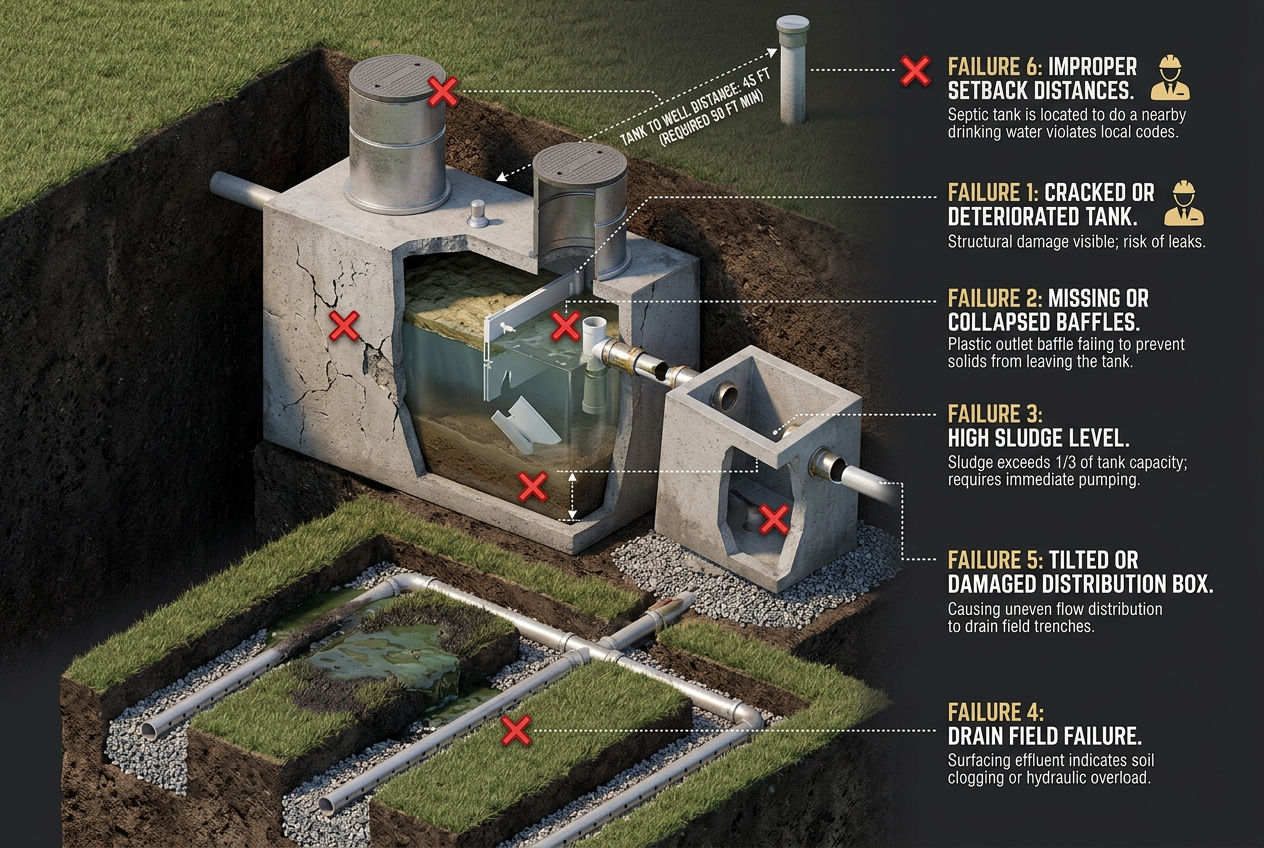
- Pumping overdue / tank full — Sludge and scum layers have exceeded the safe operating threshold (typically when combined sludge and scum layers fill more than 30–40% of tank capacity)
- Failed or missing baffles — The inlet and outlet baffles inside the tank direct flow and prevent solids from escaping into the drain field; a missing or corroded baffle is a code violation in most states
- Drain field / leach field failure — Effluent is surfacing in the yard, backing up into the home, or soil testing shows hydraulic failure; this is the big one
- Distribution box damage — A cracked or tilted distribution box sends uneven flow to leach laterals, accelerating drain field failure
- Effluent filter clogged or missing — A Polylok PL-122 or similar effluent filter should be present at the outlet tee; a missing filter means solids have been reaching the drain field unchecked
- High water table saturation — Especially common in spring when snowmelt raises the groundwater table; a saturated leach field can't absorb effluent
- Tank structural damage — Cracks, collapsed baffles, or corroded steel tanks
- Non-compliant setbacks — The system is too close to a well, property line, or waterway per current code, even if it was legal when originally installed
- Permit and code compliance issues — The system was expanded or modified without permits, or doesn't meet current county health department standards
⚠️ Warning: Some inspectors issue a conditional pass — the system passes but with noted deficiencies that need attention within a set timeframe. Don't treat a conditional pass as a clean bill of health.
Free download
Free: the Septic Fridge Card — what to flush, what never to.
The Do / Don’t card the whole family can see, plus the Survival Kit: emergency flowchart, warning-sign decoder and pump-schedule card. One printable PDF.
How Much Does It Cost to Fix a Failed Septic System?
Here's where most buyers need cold, hard numbers — not reassurance. Costs swing wildly based on what failed and where you live.
Septic Repair & Replacement Cost Overview
| Problem | Typical Repair Cost | Severity |
|---|---|---|
| Tank pumping (overdue) | $300–$600 | Minor |
| Baffle replacement | $650–$1,500 | Minor–Moderate |
| Effluent filter installation | $200–$500 | Minor |
| Distribution box repair/replace | $500–$2,500 | Moderate |
| Drain field repair (partial) | $2,000–$8,000 | Serious |
| Full drain field replacement | $8,000–$15,000 | Serious |
| Full septic system replacement | $15,000–$30,000+ | Critical |
Sources: NAWT (National Association of Wastewater Technicians), contractor data compiled by SepticTankHub, 2025.
📊 Quick Fact: A full system replacement on a standard 3-bedroom home — a 1,000–1,500 gallon tank plus new leach field — typically runs $15,000–$25,000 nationally. In difficult soil conditions requiring an engineered mound system or aerobic treatment unit, that number can climb past $50,000.
See our septic installation cost guide for a deeper breakdown.
For drain field problems specifically, costs depend heavily on soil type, lot size, and local permitting timelines. Our drain field replacement cost guide has state-by-state figures worth bookmarking before your next negotiation conversation.
For minor issues like a pump replacement or septic tank pumping, you might spend $300–$1,500 and close on schedule. Don't let a pumping flag on an inspection report send you into panic mode.
Who Pays for Septic Repairs After a Home Inspection?
Legally, nobody is automatically required to pay anything — it depends entirely on your purchase contract and how you negotiate. That said, here's how it typically plays out.
Understanding Seller Responsibility
If the seller disclosed the problem: They already lowered the price or factored it in. You may have less leverage, but you can still negotiate repair credits.
If the problem is newly discovered: This is your strongest position. A failed septic inspection on a system the seller presented as functional gives you significant leverage — and in some states, undisclosed known defects create legal liability for the seller. Read up on what happens when a seller didn't disclose septic problems if you suspect that's the case.
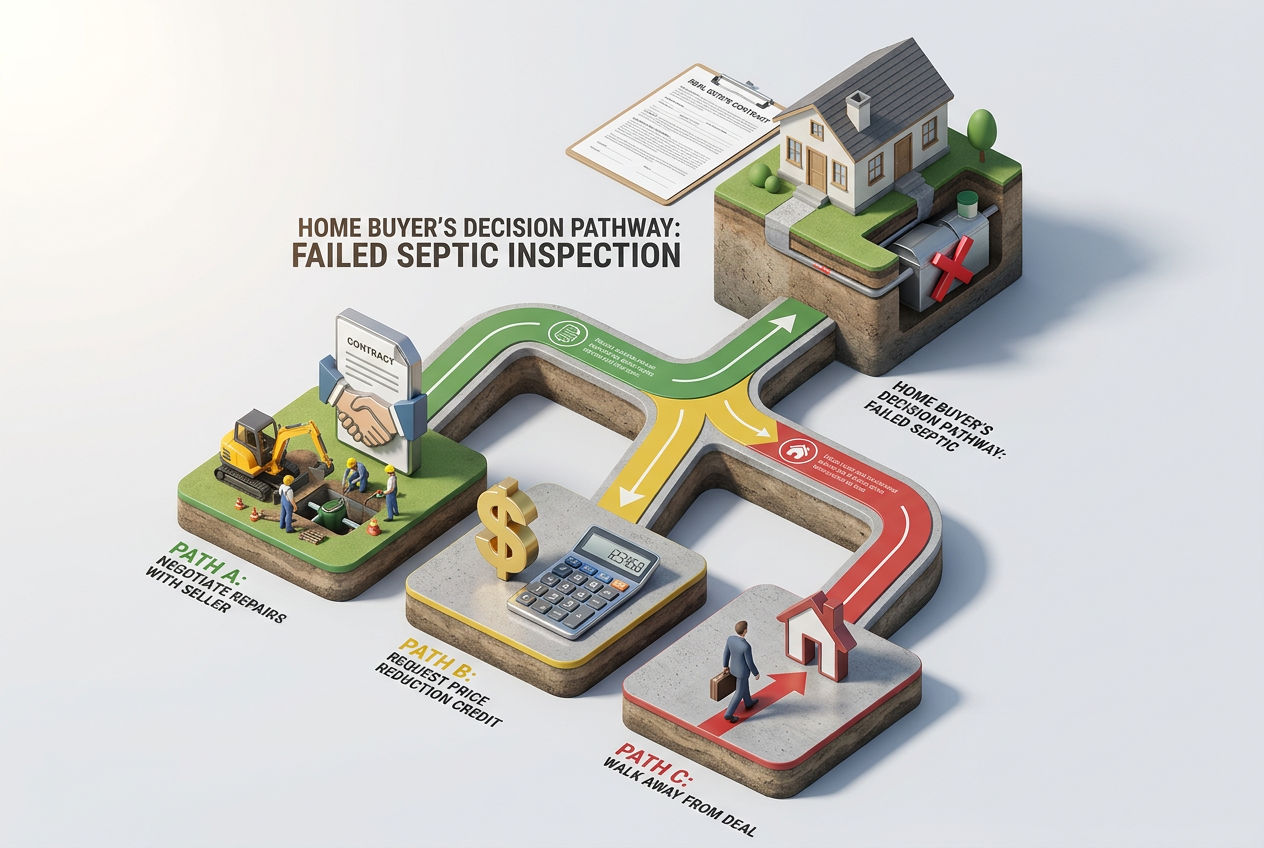
Your Three Main Negotiation Options
- Ask the seller to fix it before closing — You maintain oversight risk (rushed repairs, unlicensed contractors). Always require proof of permit and final inspection.
- Request a price reduction — Cleaner than a repair credit. You control the repair process after closing.
- Negotiate a septic escrow holdback — A negotiated dollar amount (typically 1.25–1.5x the repair estimate) is held in escrow and released to the seller once repairs are verified complete. This works well when repairs can't be finished before closing but the seller wants to close on time.
✅ Pro Tip: How hard you push depends on the repair cost relative to the home's value. On a $400,000 home, a $3,000 drain field repair is a rounding error. A $28,000 system replacement is a different conversation entirely.
For detailed negotiation scripts and tactics, see our guide on how to negotiate septic repairs after inspection.
What Is a Septic Contingency Clause — and Do You Have One?
A septic contingency clause gives you the right to exit the contract without penalty if the septic inspection fails and you can't reach an acceptable resolution with the seller. Most purchase agreements in rural and suburban markets include one automatically.
The typical contingency window is 10–14 days from the date of inspection. If you're past that window or your contract doesn't include one, you may be limited in your ability to walk away without losing your earnest money deposit.
⚠️ Warning: Check your contract now. If you're unsure, call your real estate attorney today — not tomorrow. Missing the contingency deadline is one of the most expensive mistakes buyers make in this situation.
In states with mandatory point-of-sale septic inspections — Massachusetts (Title 5), Maryland, New Jersey, and parts of Pennsylvania and Indiana — the rules are more formalized, and sellers often can't legally close without a passing inspection or an approved repair plan on file with the local board of health.
Should You Walk Away From a House With Septic Problems?
This is the question most buyers are really asking. There's no universal answer, but there is a framework.
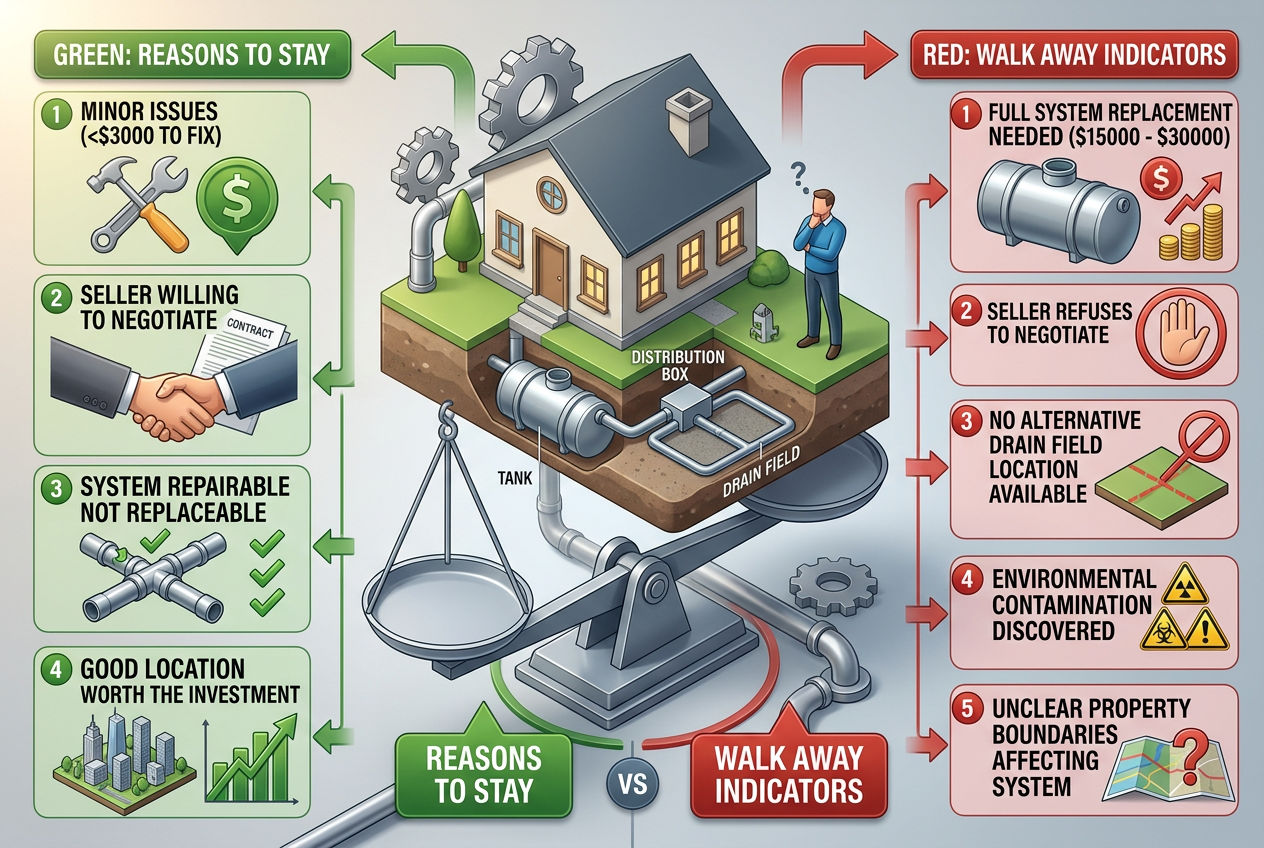
Lean Toward Staying and Negotiating If:
- The failure is minor (baffle replacement, pumping, effluent filter)
- The seller is willing to negotiate a fair credit or price reduction
- The home's purchase price already reflects the system's age or condition
- You're buying in a rural area where most homes of similar age have similar systems
- A licensed septic contractor (not just the inspector) has confirmed the repair scope and cost
Seriously Consider Walking Away If:
- The drain field has failed and the lot may not support a replacement system (failed perc test on remaining property)
- The system is non-compliant and the county health department won't approve a repair permit
- Full replacement cost exceeds 10% of the purchase price and the seller won't negotiate meaningfully
- FHA or VA financing is involved and the lender won't approve the loan with a conditional system (more on this below)
- The seller is hiding information or has modified the system without permits
📊 Real-World Example: You're under contract on a 1970s farmhouse in rural Ohio. The inspector flags a failed distribution box and saturated leach laterals in two of four drain field zones. The seller offers a $4,000 credit. Your contractor quotes $11,000–$14,000 for a partial drain field replacement, with a caveat that the other two zones may fail within 3–5 years. That's a scenario where walking away — or demanding a full price renegotiation — makes more sense than accepting the token credit.
How Do FHA and VA Loans Handle a Failed Septic Inspection?
If you're using FHA or VA financing, a failed septic inspection isn't just a negotiation problem — it's a loan approval problem.
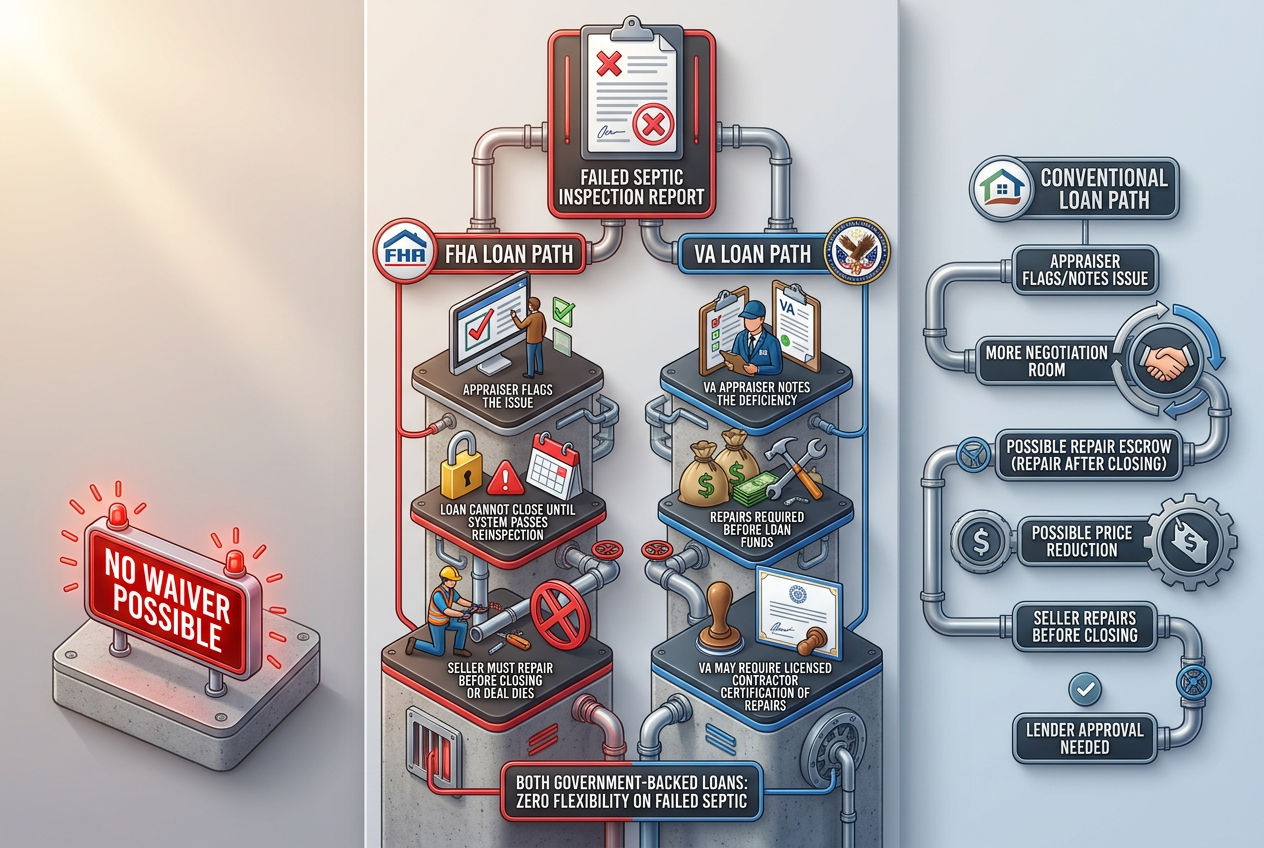
Both FHA and VA guidelines require the septic system to be in proper working order at the time of closing. An appraiser working on an FHA or VA loan is required to note any visible septic deficiencies, and underwriters can — and do — condition loan approval on a passing septic inspection.
💡 Key Takeaway: This means the seller effectively has no choice: fix the system, or the deal dies. That changes your leverage considerably. The seller can't simply refuse to negotiate if their only buyer has government-backed financing and a mandatory repair condition tied to the loan.
If repairs will take 2–6 weeks (typical for drain field work, including permitting), plan for a closing delay of 30–60+ days. Build that into your rate lock timeline and your moving arrangements.
Can You Sell a House With a Failed Septic Inspection?
If you're the seller reading this — yes, you can sell, but your options narrow significantly.
Your Three Selling Options
Option 1: Sell as-is to a cash buyer at a discounted price. Cash buyers (often investors) will factor the full repair cost plus a risk premium into their offer. Expect offers 15–25% below market value if a full system replacement is needed.
Option 2: Complete repairs before re-listing. In states with mandatory inspections, this may be required anyway. A system that passes Title 5 in Massachusetts, for example, immediately removes a major objection for any buyer using conventional financing.
Option 3: Disclose the failure and negotiate with buyers. This is the most common path for sellers who want to stay on the market without completing expensive repairs upfront.
⚠️ Warning: What you cannot do — legally or ethically — is conceal a known failure. Seller disclosure laws vary by state, but knowingly hiding a failed septic inspection from a buyer is grounds for post-closing litigation in virtually every jurisdiction. Review your state's disclosure requirements with a real estate attorney.
How Long Do Septic Repairs Actually Take?
Timelines matter as much as costs when you're trying to close a deal.
| Repair Type | Work Duration | Total Timeline (With Permitting) |
|---|---|---|
| Tank pumping or baffle replacement | 1–3 days | 1–3 days (no permit usually required) |
| Distribution box repair/replacement | 2–5 days | 1–2 weeks (may require permit) |
| Partial drain field repair | 1–2 weeks | 2–6 weeks (permitting varies by county) |
| Full drain field replacement | 2–3 weeks | 4–8 weeks (permitting + soil testing) |
| Full system replacement | 3–6 weeks | 6–12 weeks (permitting + soil testing) |
⚠️ Regional Warning: In rural areas with fewer licensed contractors, add 2–4 weeks to any estimate. Winter construction in northern states is another wildcard — frozen ground in Minnesota or Wisconsin can make drain field excavation physically impossible from December through March, forcing a spring delay. If you're buying in January in the Upper Midwest and a drain field replacement is needed, build a realistic 90–120 day closing timeline into your expectations.
For reference on what septic inspections should cover and how they're conducted, our guide to the septic inspection process explains what inspectors are actually looking for — useful context for evaluating your inspection report.
If you want to verify the inspection findings independently before negotiating, book a second-opinion inspection with a licensed professional through our directory. A second inspector has no stake in the deal and may find the problem is less severe — or confirm it's exactly what the report says.
Checklist: Your Next Steps After a Failed Septic Inspection
- Read the full inspection report — Categorize findings as minor, moderate, or critical
- Check your contract for a septic contingency clause — Note the expiration date
- Get an independent repair quote — Hire a licensed septic contractor (not the inspector) to scope the work and provide a written estimate; find a contractor near you
- Research permit requirements — Call your county health department to confirm whether a repair permit is needed and what the typical approval timeline is
- Consult your lender — If you're using FHA/VA financing, confirm what conditions the underwriter will require
- Negotiate with documented numbers — Use the contractor's written estimate, not a verbal ballpark, in your repair credit request
- Set a deadline — Give the seller a clear response deadline tied to your contingency window
Sources & Methodology
- U.S. Environmental Protection Agency (EPA) — Septic system statistics, groundwater contamination data, and general maintenance guidance. www.epa.gov/septic
- National Association of Wastewater Technicians (NAWT) — Industry cost benchmarks and inspection standards. www.nawt.org
- National Onsite Wastewater Recycling Association (NOWRA) — System performance standards and contractor licensing guidance. www.nowra.org
- State health department guidelines — Massachusetts Title 5 regulations, Maryland MDE septic requirements, and Indiana State Department of Health onsite system rules were referenced for regional accuracy.
- SepticTankHub contractor network — Repair cost ranges compiled
Need help with your septic system? Find trusted septic professionals near you to get free quotes. Browse local septic companies in Michigan or Pennsylvania.
Was this article helpful?
Frequently Asked Questions
Recommended Resources
📖 Related Articles
💰 Cost Guides
🔧 Services
Find Septic Professionals Near You
Compare licensed, verified septic companies by area — top county markets and cities below, or browse all 50 states.
County markets
Popular cities
