
Quick Answer
By the SepticTankHub editorial team. Sources are listed at the end.
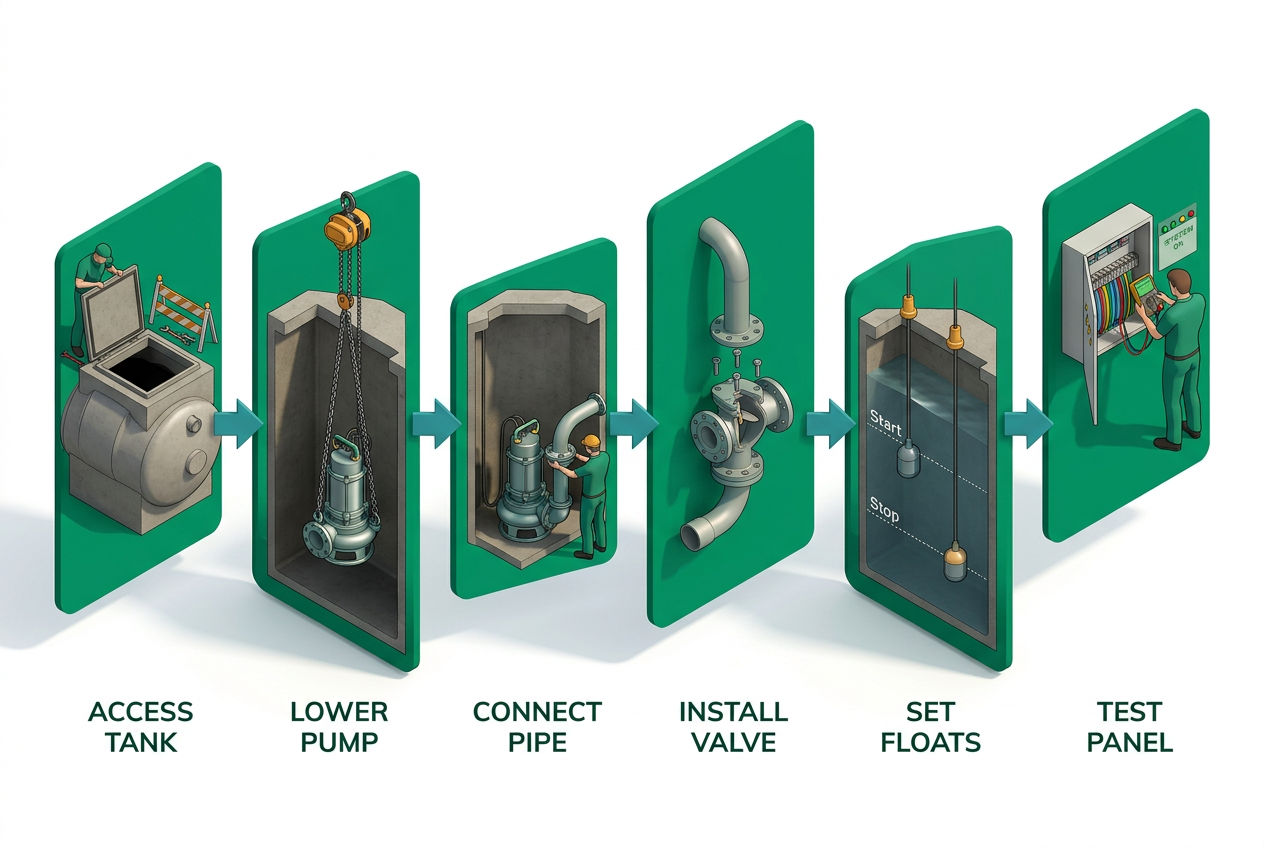
Here is how to install a septic pump: first kill power at the breaker and the control panel. Next, have the chamber pumped down and lift the old pump out by its rope. Then install the new effluent pump with a union and valve (and a check valve if your design calls for one), set the off, on and alarm floats, connect it to the panel, and test one full dose.
Key Takeaways
- HomeAdvisor puts a septic pump replacement at $1,000 or more. A standard effluent pump swap runs about $500–$1,800 by our estimate, and grinder pumps cost more.
- A standard simplex chamber uses floats for pump off, pump on and high-water alarm.
- Use your system designer's or the manufacturer's float settings before any rule of thumb.
- Always shut off power and never climb into a tank. OSHA says very high hydrogen sulfide levels can cause collapse within one or two breaths and death within minutes.
- Some states and counties require a permit or a certified professional for pump work. Ask before you start.
If the high-water alarm is sounding and the chamber is full to the riser lid, check the pump and floats before buying anything; the alarm section below lists the checks in order. The nine steps that follow cover a full replacement, and the hire-a-pro section marks the point where a licensed installer should take over. For background on pump systems in general, see our complete guide to septic pumps.
⚠️ Safety First
- Turn off the pump and alarm breakers and switch the control panel to OFF before you touch anything. Washington's Department of Health says to turn off power at the circuit breaker and unplug all power cords before handling the pump or floats.
- Never enter a septic or pump tank. Wisconsin's Department of Health Services warns that hydrogen sulfide in extremely high concentrations "can cause loss of consciousness and death," and that oxygen levels below 12% can cause unconsciousness and death "very quickly and without warning." Do all work from the surface.
- Ask your county health department about permits before you start. Our septic permit requirements guide explains what to ask.
- Wear gloves and eye protection. Wash up before you eat or drink.
What Does a Septic Pump Do, and Which Type Do You Need?
A septic effluent pump moves liquid from a septic pump tank (the pump chamber) to a drainfield, mound or pressure distribution system. Floats in the chamber turn it on and off. An effluent pump is built for liquid with small solids only. A grinder pump or sewage pump handles raw sewage, so you can't swap one type for the other.
An effluent pump sits after the septic tank, often inside a screened pump vault. Zoeller's instructions say its effluent and dewatering pumps "are not designed for use in pits handling raw sewage," and that effluent systems should not pass solids larger than ¾ inch, to keep big solids out of leaching fields and mounds. A grinder pump breaks up raw waste coming straight from the house. Our effluent pump vs. grinder pump comparison explains the differences in detail.
Residential effluent pumps include the Zoeller N152 (4/10 hp), Liberty's FL series and Orenco's PF series. Grinder pumps such as Liberty's Omnivore series are a separate category.
Your system design sets the pump size. The designer chose the pump from two numbers. The first is flow, in gallons per minute. The second is total dynamic head, which is the vertical lift plus friction loss in the pipe. A mound 80 feet away and 12 feet uphill needs a very different pump than a drainfield just downhill. If you have a mound, our mound septic system guide explains why its dosing is so specific.
Pull your permit file or as-built drawing and match the model, or call the designer. If you haven't seen how the parts connect, look at this septic system diagram with pump first.
What a pump can't do: a new pump won't fix a failing drainfield. If the old pump ran nonstop because the field is saturated, a new pump will only send more water to a field that can't take it.
What Parts and Tools Do You Need for Septic Tank Pump Installation?
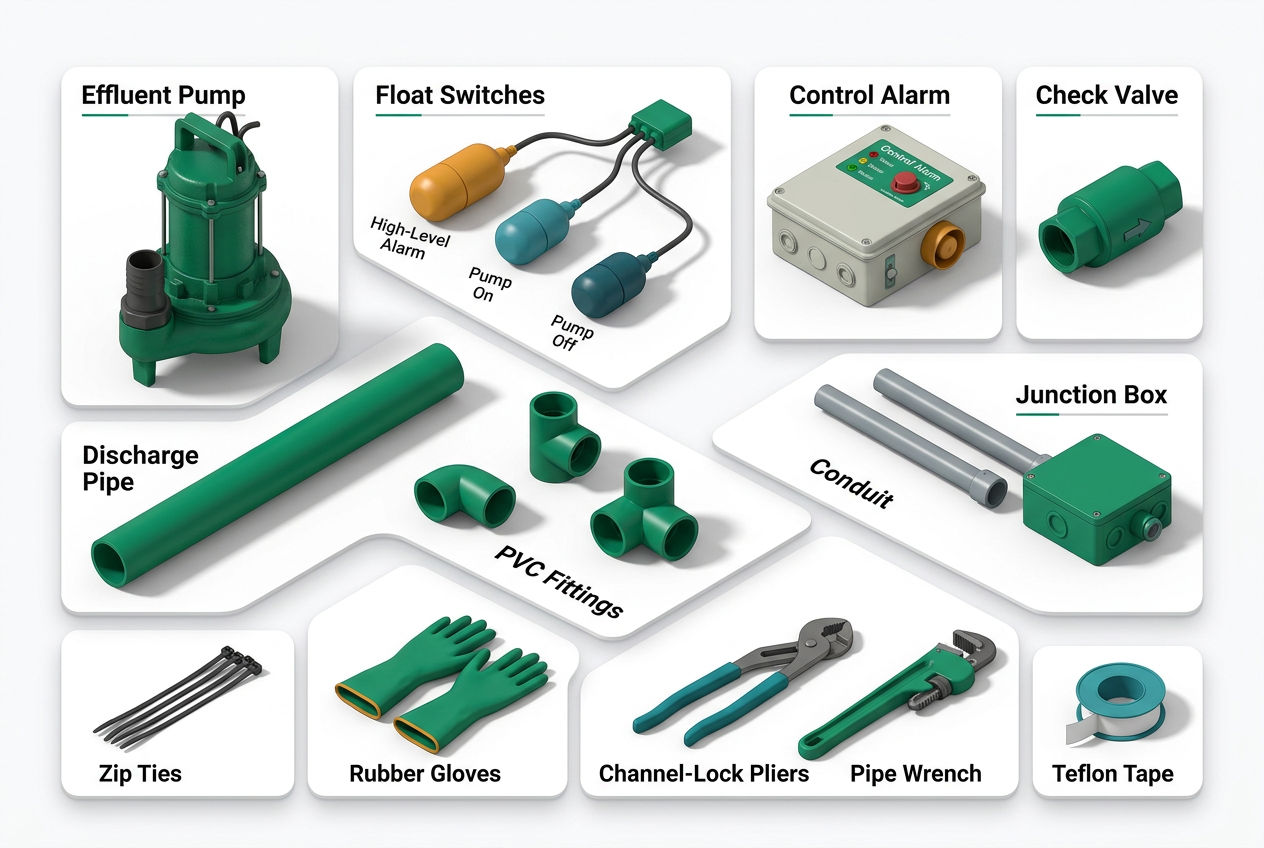
A standard septic tank pump installation needs:
- the correct effluent pump
- floats on a float stem or bracket
- a union, a valve, and a check valve if your design calls for one
- PVC fittings and a lift rope
- a watertight splice or junction box
- a working control or alarm panel
For tools, you need a PVC saw, primer and cement, a tape measure and a drill.
Parts list:
- Effluent pump matched to your design (same voltage, and close to the original flow and head)
- Discharge pipe and fittings no smaller than the pump's discharge. Zoeller says to use full-size discharge pipe; its N152, for example, has a 1½-inch threaded discharge.
- Union, so you can pull the pump later without cutting pipe
- Check valve, if your design calls for one (see the freezing-climate section below)
- Gate or ball valve on the discharge line
- Float stem or bracket with clamps, plus pump-off, pump-on and alarm floats
- Nylon rope or another non-corrosive lift line, as Washington's Department of Health recommends
- A watertight junction box for any splices (Zoeller says to splice only in a watertight junction box)
- Control panel (simplex for one pump, duplex for two) with a high-water alarm
Tools: PVC saw, primer and cement, tape measure, marker, drill, flashlight, and a long-handled grabber hook.
While the chamber is open, check the septic effluent filter or pump screen. Washington's Department of Health recommends installing an effluent filter or pump screen if your system doesn't have one.
Washington's Department of Health, in its guide to pressure distribution systems (DOH 337-087), says the pump discharge pipe "should have a union and valve for easy removal of the pump." With those in place, a later pump swap is a short job. Without them, you spend an afternoon cutting pipe.
How to Install a Septic Pump Step by Step: Where Do You Start?
Once the chamber is pumped, a like-for-like effluent pump swap takes about half a day (SepticTankHub estimate). Step 1 confirms the pump model, and each later step depends on the one before it.
Step 1: Confirm the pump against your system design
Check the old pump's nameplate for horsepower, voltage and model number. Compare it to your permit file. Don't "upgrade" to a bigger pump. Too much flow can overload a pressure distribution network or a mound.
Step 2: Shut off power and pump down the chamber
Turn off the pump and alarm breakers, then set the panel switch to OFF. Have a pumper empty the chamber. HomeAdvisor puts a one-time pumping at $290–$550; see our septic pumping cost guide.
If the ground is waterlogged, ask the pumper before you empty the tank. The EPA warns that "pumping out a tank that is in saturated soil may cause it to 'pop out' of the ground."
Step 3: Pull the old pump
Open the union on the discharge line. Lift the pump straight up by its rope or handle. Never lift a pump by its power cord. Zoeller's instructions say the same. Rinse the pump with a hose over the open riser so the water drains back into the tank.
Step 4: Install the new pump, check valve and union
Set the pump on its stand, on blocks or in its pump vault, as the maker specifies. Zoeller sells an optional pump stand that "eliminates the need for blocks or bricks under the pump," says the pump needs a hard, flat surface beneath it, and says the pump must be level with the floats clear of the basin sides.
Dry-fit the discharge pipe first. Then glue these parts in order:
- the discharge pipe from the pump
- the check valve (if your design uses one), with its flow arrow pointing away from the pump
- the union
- the shutoff valve
Zoeller recommends putting the union and check valve just above the basin so the pump is easy to remove. When a check valve is installed, Zoeller's instructions call for a 3/16-inch vent hole drilled in the discharge pipe, even with the top of the pump and below the check valve, to purge trapped air. Some pumps have this built in: Orenco says its PF-series pumps have a 1/8-inch bypass orifice "to prevent air bind." Follow your pump's own manual.
Step 5: Mount the floats
Clamp the floats to the float stem or bracket at the heights in your design. The next section covers float heights in detail. On tethered floats, keep each tether at the length the manufacturer specifies. SJE Rhombus's instructions show the pumping range growing with tether length, so a longer tether changes your dose volume.
Step 6: Wire the pump and alarm
Route the cords to a watertight junction box or straight to the control panel, and tape or clamp the pump cord to the discharge pipe, clear of the floats, as Zoeller directs. Washington's Department of Health says the alarm should be on an electrical circuit separate from the pump, and that the pump should have its own circuit with its own breaker or fuse. With separate circuits, a tripped pump breaker can't also cut power to the alarm.
Electrical work is where DIY stops for many owners. Zoeller says the installation must comply with the National Electrical Code and all local codes, and that electrical circuits and hardware should be installed by a qualified licensed electrician. If you're running a new circuit or replacing the panel, hire one.
Step 7: Test the cycle and measure the dose
Restore power. Let the chamber fill, or add water with a hose. Watch the pump turn on at the "on" float and shut off at the "off" float. Measure in inches how far the water level dropped. That number is your drawdown. The worked example below shows how to turn it into gallons.
Step 8: Test the alarm
Washington's Department of Health says the alarm should have a buzzer and an easily visible light, and that a push-to-test button should be checked regularly. Press the push-to-test button on the panel. Then lift the alarm float by hand with the grabber hook. You should get both the horn and the light. If the panel has a silence button, check that it works as the panel manual describes.
Step 9: Secure the riser lid
Bolt the lid down with its screws. Washington's Department of Health notes that people do fall into septic tanks, cites a child's death as a reminder to check for damaged or missing lids, and says to "use bolts, screws, or other locks to secure the lids." If your lid sits below grade, consider adding a riser.
How High Should the Floats Be Set in a Septic Pump Tank?
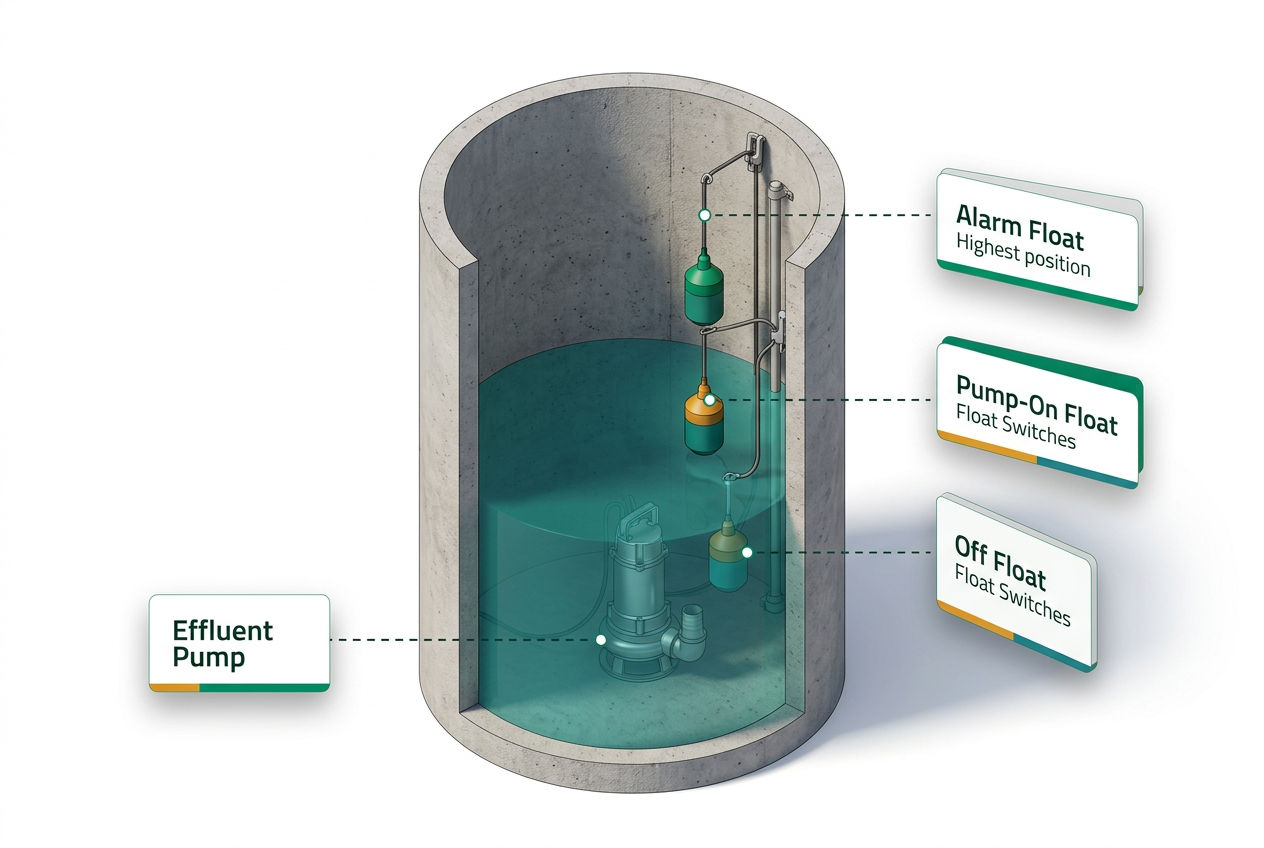
Start with your system designer's settings, then the pump maker's. Zoeller's instructions leave on-off spacing to "local or national standards and guidelines." In a typical simplex chamber, the three floats sit in this order from bottom to top:
- Pump-off float: Zoeller says the best place for the "off" point is above the motor housing, and never below the pump's discharge. Orenco says its lowest float must sit above the pump's minimum liquid level.
- Pump-on float: set above the off float by the drawdown that delivers your designed dose.
- High-water alarm float: above the pump-on level. Where site plans give no settings, Orenco's instructions for its pump vaults in tanks of 1,000 gallons or more set the alarm at the tank inlet's invert, pump-on 2 inches below the alarm and pump-off 2½ inches below pump-on.
Worked example (SepticTankHub illustration): turning inches into gallons. For a rectangular chamber, multiply the inside length by the inside width in inches, then divide by 231, the number of cubic inches in a U.S. gallon. That gives you gallons per inch of depth.
- A chamber measuring 96" × 60" inside holds 96 × 60 ÷ 231 ≈ 24.9 gallons per inch.
- Assume a household sends 240 gallons a day to the chamber.
- If the design calls for 4 doses a day, each dose is about 60 gallons.
- 60 gallons ÷ 24.9 gallons per inch ≈ 2.4 inches of drawdown between the on and off floats.
Your designer's flow and dose numbers replace these assumptions. Orenco's instructions use the same method: determine the gallons per inch for the tank, then divide the volume by it to set the float distance.
Caveat: Round or tapered tanks don't hold the same gallons per inch from top to bottom. Use the manufacturer's capacity chart instead of this formula. If your measured drawdown in Step 7 doesn't match the design dose, adjust the floats. Don't change the pump.
How Do You Install an Effluent Pump in a Freezing Climate?
In cold regions, many designs rely on the discharge line draining back into the chamber after each dose, so it can't freeze. University of Minnesota septic guidance says that when the pump in the last tank shuts off, "it is critical" that all the effluent drains back into the tank through a weep hole, typically a ¼-inch hole in the lowest part of the piping in the manhole. It lists "check valves that do not allow effluent to drain back" as a common pump-tank problem.
That differs from Zoeller's general instructions, which call for a check valve and a union in the discharge line. Your system design decides which applies. In practice, this means:
- Follow the design. If the as-built drawing shows no check valve, don't add one.
- Keep the slope. A drain-back line must slope steadily toward the chamber with no low spots.
- Don't change the dose. The water that drains back is pumped again on the next cycle, and your designer's dose settings account for it.
- Ask about insulation. The University of Minnesota notes that buryable foam board, 1 to 3 inches thick, can be placed over a tank to insulate it.
Why Is the Septic Alarm Going Off After You Replace a Septic Pump?

DIY Septic Blueprint
Thinking about building it yourself?
The complete, plain-English plan to size, permit and install your own septic system — designed for homeowners, not contractors. Skip the $15,000–$25,000 quotes and do it right the first time.
Get the DIY Blueprint — $67 →Instant download · 8 modules + 3 bonus guides · 60-day money-back guaranteeThe alarm means the water reached the alarm float before the pump emptied the chamber. Washington's Department of Health lists a tripped breaker, an unplugged pump or float cord, and floats tangled on the power cord, lifting rope or pump screen among the causes to check. After a new install, also check the valve and the vent hole. Check them in this order:
- Power. Confirm that both breakers are on and the panel switch is on AUTO, not OFF.
- Floats. Look for floats tangled on the stem, cords or rope. Lift the on float with the grabber hook and listen for the pump.
- Valve. Make sure the shutoff valve you installed is fully open.
- Air lock. If the pump runs but moves little or no water, Zoeller's troubleshooting chart says to make sure the vent hole is clear when a check valve is used.
- Electrical. Leave amp-draw testing on a live circuit to a licensed electrician or pump professional.
Our septic tank alarm guide covers each cause in detail. The septic pump troubleshooting guide covers pumps that run nonstop or won't start. If the alarm still sounds after these checks, call a licensed pro. Don't keep resetting it.

When Should You Hire a Pro Instead of Doing Effluent Pump Installation Yourself?
Hire a licensed installer when your county requires one, when the pump model or size changes, or when the work involves new wiring, a new panel, or a pressurized mound or drip system. A like-for-like swap on an accessible chamber is often a manageable DIY job where it's legal. If you're planning to build a whole system yourself, start with our DIY septic system guide.
Check the rules first. Washington's on-site sewage rules (WAC 246-272A) and Florida's Chapter 62-6 both regulate repairs to onsite systems. Florida's rule 62-6.003 requires a system construction permit before any repair, and rule 62-6.002 defines what counts as a repair, so ask whether your pump swap qualifies. Snohomish County, Washington, for example, certifies septic professionals, including monitoring and maintenance specialists, and lists the companies that employ them. Call your health department before you buy parts.
DIY is reasonable when:
- the replacement pump is the same model, voltage and size
- the union and valve already exist
- the panel and wiring are in good condition
- your county allows owner repairs
Call a pro when:
- you can't identify the original pump or design
- the panel, conduit or splices are damaged
- you have a pressure distribution, mound or drip system
- the pump failed because the drainfield is saturated
A local septic repair pro can handle the install, the permit and the final inspection.
What Is the Septic Pump Installation Cost in 2026?
HomeAdvisor's septic repair cost guide puts septic pump repair at about $250–$400 and a full replacement at $1,000 or more. By our estimate, most standard effluent pump swaps run $500–$1,800, including labor and basic fittings. Grinder pumps, new control panels and permits push the total higher. For a full breakdown, see our septic pump replacement cost guide.
| Item | Typical cost | Source |
|---|---|---|
| Septic pump (part) | $250–$1,000 | HomeAdvisor |
| Pump repair | $250–$400 | HomeAdvisor |
| Full pump replacement | $1,000 or more | HomeAdvisor |
| Installed effluent pump swap | $500–$1,800 | SepticTankHub estimate |
| Grinder pump, installed | $1,500–$4,000+ | SepticTankHub estimate |
| Control panel with alarm | $300–$1,000 | SepticTankHub estimate |
| Pumping the chamber | $290–$550 | HomeAdvisor |
| Permit (where required) | $50–$400 | SepticTankHub estimate |
HomeAdvisor figures come from its 2025 septic repair cost guide. SepticTankHub estimates are national planning ranges, not quotes. Get two written quotes that list the pump model.
How Do You Keep a New Septic Pump Running?
A new pump lasts longest when the system around it is maintained. Washington's Department of Health recommends checking the pump chamber, pump and floats every year and following the pump maker's maintenance recommendations. The EPA says household septic tanks are typically pumped every 3–5 years.
- Clean the effluent filter or pump screen when the system is serviced.
- Test the alarm regularly with the push-to-test button.
- Spread washing machine use throughout the week, as the EPA's SepticSmart guidance advises.
- Keep wipes, grease and chemicals out of the drains. Zoeller warns that wipes and similar items stress non-grinder pumps and can block discharge piping.
Frequently Asked Questions
How much does it cost to replace a septic pump?
HomeAdvisor's septic repair cost guide puts septic pump repair at about $250–$400 and a full pump replacement at $1,000 or more, with the pump itself in a $250–$1,000 range. For a standard effluent pump swap including labor, a SepticTankHub estimate is $500–$1,800. Grinder pumps cost more. HomeAdvisor puts a one-time tank pumping at $290–$550 if the chamber needs emptying first. A new control panel or a permit adds to the total. To compare quotes fairly, ask each contractor to list the exact pump model, the warranty, and whether pumping and permits are included. SepticTankHub estimates are national planning ranges, not quotes, so get two written quotes before you commit.
Can I replace a septic pump myself?
Sometimes, if your county allows owner repairs and the job is a like-for-like swap. That means the same pump model and voltage, an existing union and valve, and a control panel in good condition. Never enter the tank, and always shut off the power before you handle the pump. Zoeller's instructions say to shut off the breaker and unplug the pump first. Call a licensed installer if you can't identify the original pump, the wiring or panel is damaged, you have a pressurized mound or drip system, or the pump failed because the drainfield is saturated. Check with your county health department before buying parts, because some jurisdictions require a permit or a certified professional for pump work.
What are the correct septic pump float settings?
Use your system designer's settings first, then the manufacturer's. Zoeller's effluent pump instructions say the best place for the pump-off point is above the motor housing, and never below the pump's discharge. The pump-on float sits above it by the drawdown needed for one designed dose, and the high-water alarm sits above pump-on. Where site plans give no settings, Orenco's instructions for its pump vaults in tanks of 1,000 gallons or more set the alarm at the tank inlet's invert, pump-on 2 inches below the alarm and pump-off 2½ inches below pump-on. To find the right drawdown, calculate gallons per inch for your chamber and divide the dose volume by it. On tethered floats, SJE Rhombus's instructions show the pumping range growing with tether length, so keep each tether at the specified length. After installing, run one full cycle and measure the actual drawdown against the design.
Should the pump and the septic alarm be on separate circuits?
Yes. Washington State's Department of Health says the high-water alarm should be on an electrical circuit separate from the pump, and that the pump should have its own circuit with its own breaker or fuse. Zoeller's instructions also recommend a separate branch circuit for the pump, sized to the National Electrical Code. The reason: if the pump jams and trips its breaker, the alarm still has power and can warn you before the chamber overflows. Check your control panel's wiring diagram. Zoeller says electrical work should be done by a qualified licensed electrician, and the installation must meet the NEC and local codes.
How long does a septic effluent pump last?
As a SepticTankHub estimate, a quality effluent pump often lasts around 7–15 years, but life depends on how often it cycles and what reaches it. Washington's Department of Health recommends an effluent filter or pump screen if your system doesn't have one, to keep solids away from the pump. Floats set too close together make the pump start and stop more often. Zoeller lists a pump that starts and stops too often, or runs but moves little water, among the problems to troubleshoot. Washington's Department of Health recommends checking the pump chamber, pump and floats every year. When you replace the pump, also check the floats and panel.
Do you need a check valve when installing a septic pump in a cold climate?
Not always. University of Minnesota septic guidance says that when the pump in the last tank shuts off, it is critical that all the effluent drains back into the tank, typically through a ¼-inch weep hole in the lowest part of the piping in the manhole. It lists check valves that stop that drain-back as a common pump-tank problem. Zoeller's general instructions, by contrast, call for a check valve and a union in the discharge line, so your system design decides which applies. Follow your as-built drawing. If it shows no check valve, do not add one, and keep the line sloping back toward the chamber with no low spots. The University of Minnesota also notes that buryable foam board, 1 to 3 inches thick, can be placed over a tank to insulate it.
What size effluent pump should I install in my septic system?
Match the pump to your original system design, not just the horsepower on the old nameplate. Designers size pumps from two numbers: required flow in gallons per minute and total dynamic head, which is the vertical lift plus friction loss in the pipe. That is why a mound 80 feet away and 12 feet uphill needs a very different pump than a drainfield just downhill. Read the old pump's nameplate for horsepower, voltage and model number, then compare it to your permit file or as-built drawing. Don't upgrade to a bigger pump, because too much flow can overload a pressure distribution network or a mound. If the records are missing, contact the original system designer before buying a replacement.
Sources & Methodology
We reviewed state guidance, extension guidance, federal safety sources and manufacturer installation instructions. Always follow your own system design and local code where they differ from this guide.
- Washington State Department of Health, Understanding and Caring for Your Pressure Distribution System, DOH 337-087 (January 2025): doh.wa.gov PDF. Union and valve, lift rope, separate alarm and pump circuits, buzzer and light, push-to-test, effluent filter or pump screen, power-off caution, yearly checks, alarm causes.
- Washington State Department of Health, Septic Tank Lid Safety: doh.wa.gov. Securing lids.
- Zoeller, installation instructions FM2676 for effluent, sump and sewage pumps including models 151/152/153 (2026): zoellerpumps.com PDF. Check valve and union, gate or ball valve, 3/16-inch vent hole, pump-off point, pump stand, cord handling, watertight splices, separate branch circuit, NEC and licensed electrician, solids limits, troubleshooting.
- Zoeller N152 product page: ca.zoeller.com. 4/10 hp, 1½-inch discharge.
- Orenco Systems, Float Switch Settings and Adjustments, NIN-MF-DA-1 (Rev. 4, 10/21): odl.orenco.com PDF. Default float settings, gallons-per-inch method. Orenco PF-series pumps: orenco.com. Bypass orifice.
- SJE Rhombus float switch installation instructions (single-pump switches). Tether length and pumping range.
- Liberty Pumps product listings for FL-series effluent pumps and Omnivore-series grinder pumps (libertypumps.com and distributor listings).
- University of Minnesota Onsite Sewage Treatment Program, "Seasonal care": septic.umn.edu/seasonal-care. Drain-back, weep holes, check-valve problems, tank insulation.
- U.S. EPA, Septic Systems: What to Do After the Flood: epa.gov PDF. Tanks popping out of saturated soil.
- U.S. EPA, SepticSmart, "How to Care for Your Septic System": epa.gov. Pumping interval, water use.
- OSHA, Hydrogen Sulfide Hazards: osha.gov. Knockdown and death at high concentrations.
- Wisconsin Department of Health Services, Sewer Gas: dhs.wisconsin.gov. Hydrogen sulfide and low-oxygen hazards.
- Washington Administrative Code, Chapter 246-272A, On-Site Sewage Systems.
- Florida Administrative Code, Chapter 62-6, rule 62-6.003: law.cornell.edu. Permits for repairs.
- Snohomish County Health Department, Septic Contractors & Certification: snohd.org.
- HomeAdvisor, septic tank repair cost guide (2025): homeadvisor.com. Pump repair and replacement, pump part, pumping costs.
Free download
Not ready for the Blueprint? Start free.
Grab the free DIY Septic Planning Kit — the permit-first checklist, perc-test cheat sheet, and sizing tables that keep your build from getting red-tagged.
Was this article helpful?
Frequently Asked Questions
Recommended Resources
📖 Related Articles
- Septic Pumps Explained: Types, Costs & When You Need One
- Effluent Pump: A Side-by-Side Comparison
- Septic System Diagram With a Pump (How Pumped Systems Work)
- Septic Pump Tank: How a Septic System With a Pump Works, Costs & Installs
- Septic Pump Replacement? Causes & How to Fix It
- Septic System Permit Cost & State Requirements (2026 Guide)
- Mound Septic System: $10K–$25K Cost & How It Works (2026)
- Septic Tank Alarm Going Off? What It Means and What to Do
- DIY Septic System: How to Build Your Own (Step-by-Step)
- Septic Pump Replacement Cost: 2026 Price Guide
💰 Cost Guides
🔧 Services
Find Septic Professionals Near You
Compare licensed, verified septic companies by area — top county markets and cities below, or browse all 50 states.
County markets
Popular cities
