
Quick Answer
An above ground septic tank is a wastewater storage or treatment vessel installed at or above grade level rather than buried underground. These systems serve properties where soil conditions, water tables, or site limitations prevent conventional in-ground installation. Tank-only costs start around $800–$3,500, while fully installed systems run $2,500–$10,000 depending on complexity.
Key Takeaways
- Above-ground holding tanks store wastewater without treating it — they require pump-outs every 2–8 weeks, costing $250–$600 per service.
- A 500-gallon tank is the minimum practical size for a 2-bedroom cabin; a 3-bedroom year-round home needs 1,000–1,500 gallons.
- Polyethylene tanks are the most common material — lightweight, affordable, and rated for 20–30+ years.
- Almost every jurisdiction requires a permit for any wastewater system, including above-ground holding tanks.
- Freeze protection is non-negotiable in cold climates — exposed above-ground tanks need insulation wrap and heat tape rated for outdoor use.
Can You Have a Septic Tank Above Ground?
Yes, above-ground septic tanks are legal in most U.S. jurisdictions, but they come with significant restrictions. Most states allow above-ground holding tanks for seasonal or temporary use. Permanent above-ground systems serving year-round residences face much tighter scrutiny — many counties require engineering approval and limit their use to properties where no in-ground alternative is feasible.
The distinction matters. A holding tank sitting on a concrete pad at your hunting cabin is a very different regulatory animal than a residential above-ground septic system serving a full-time household. Your county health department makes the final call. According to the EPA, roughly 20% of U.S. homes — about 60 million people — rely on septic systems, and a meaningful portion of those in challenging terrain use above-ground or mound-based alternatives.
Before you order a tank, call your local health department and ask two questions: Is an above-ground holding tank permitted for my parcel? And what type of system does the county recommend given my soil report?
Holding Tank vs. Septic Tank: What's the Real Difference?
This is the question that trips up most first-time buyers. People use "septic tank" and "holding tank" interchangeably, but they describe fundamentally different systems.
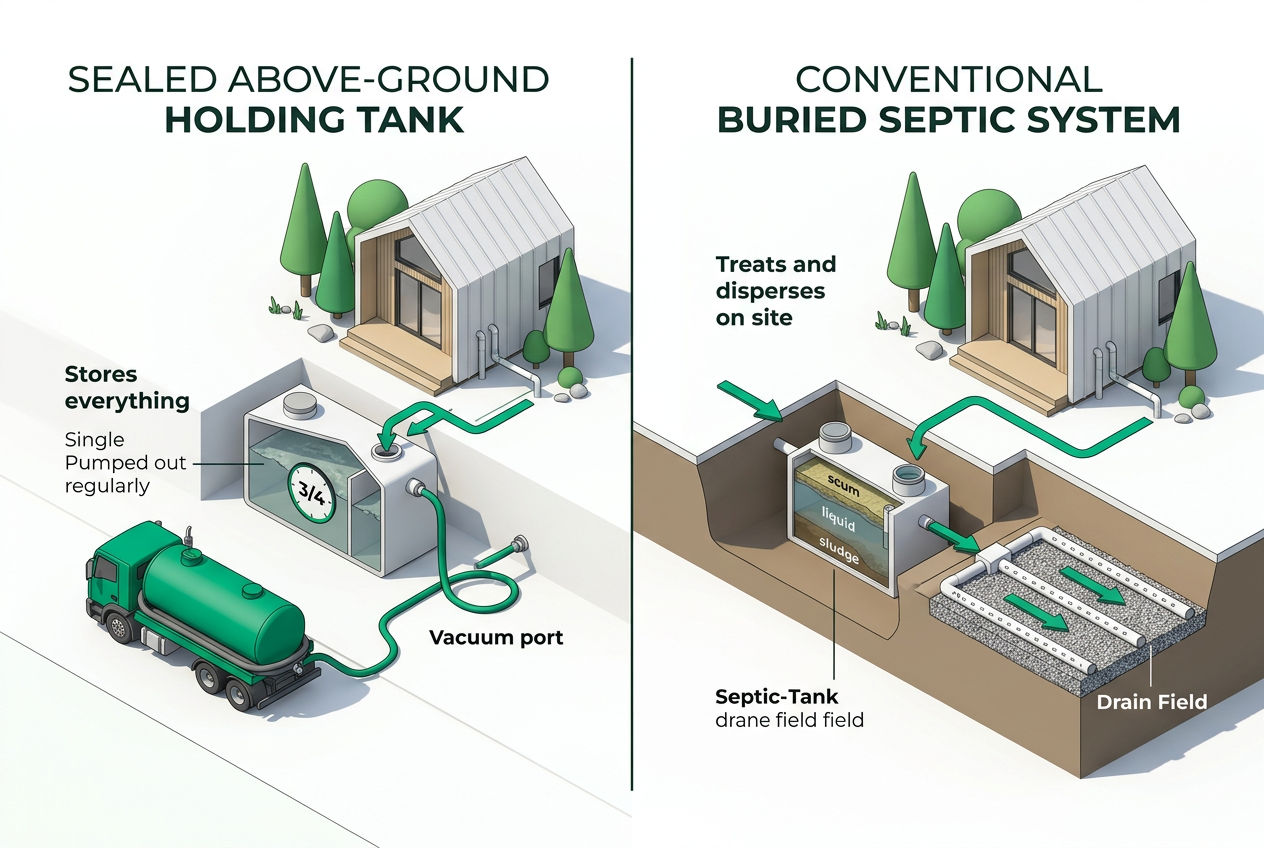
A conventional septic system processes wastewater. Solids settle, anaerobic bacteria break down organic material, and clarified effluent flows out to a drain field where soil filters it further. A properly sized septic tank serving a 3-bedroom home needs pumping roughly every 3–5 years, according to EPA guidelines.
A holding tank does none of that. It just holds. No processing, no drain field, no effluent leaving the tank. Every gallon that goes in must eventually come out by pump truck. That's the defining tradeoff.
| Feature | Holding Tank | Conventional Septic | Mound System |
|---|---|---|---|
| Treats wastewater? | No | Yes | Yes |
| Requires drain field? | No | Yes | Modified above-grade |
| Pump-out frequency | Every 2–8 weeks | Every 3–5 years | Every 3–5 years |
| Installed cost (typical) | $2,500–$6,000 | $5,000–$15,000 | $10,000–$20,000+ |
| Best for... | Seasonal/temp use | Year-round homes | Poor soil / high water table |
| Permit required? | Usually | Always | Always |
Sources: EPA SepticSmart Program; NAWT National Pumper Survey; NOWRA Cost Data
For a true apples-to-apples breakdown of what you'd pay for each option, see our septic system installation cost guide.
When Does an Above-Ground Septic System Actually Make Sense?
There are five clear scenarios where above-ground systems earn their place.
1. High water table. If your water table sits within 24 inches of the surface, a conventional drain field simply won't work — effluent won't percolate before reaching groundwater. Coastal properties in Florida, Louisiana, and South Carolina face this constantly. An above-ground holding tank sidesteps the problem entirely. Read more about high water table septic solutions specific to your region.
2. Failed perc test. If your soil failed a percolation test — meaning it absorbs water too slowly or too quickly — you have limited options. A holding tank is one of them. A mound septic system is another, though at $10,000–$20,000+, the cost is substantially higher. See your options after a failed perc test before committing.
3. Seasonal or cabin use. Picture a 500-square-foot cabin on a northern Minnesota lake, used 8 weekends a year. Installing a $12,000 conventional septic system makes no economic sense. A 500-gallon polyethylene holding tank for $1,800 installed does. The above ground septic tank for cabin use case is where these systems shine.
4. Temporary construction or event use. Building a home? You'll need a temporary septic solution during construction. A portable septic tank handles that 6–12 month window cleanly without the permit complexity of a permanent system.
5. Off-grid or remote properties. If your property is miles from a municipal sewer and conventional septic isn't feasible, a holding tank combined with a scheduled pump-out contract can be a workable long-term solution — especially on off-grid systems where overall water usage is carefully managed. If you've been researching building a septic system yourself for remote land, an above-ground holding tank is often the simpler system to get permitted.
DIY Septic Blueprint
Thinking about building it yourself?
The complete, plain-English plan to size, permit and install your own septic system — designed for homeowners, not contractors. Skip the $15,000–$25,000 quotes and do it right the first time.
Get the DIY Blueprint — $67 →Instant download · 8 modules + 3 bonus guides · 60-day money-back guaranteeTypes of Above-Ground Tanks: Materials and Configurations
Polyethylene (Plastic) Tanks
Polyethylene is what most people mean when they say "above ground septic tank." These rotationally-molded tanks are lightweight, corrosion-resistant, and available in sizes from 250 to 1,500 gallons. Manufacturers like Infiltrator Water Technologies produce tanks rated for 20–30+ years of service. They're easy to transport — even to remote properties by ATV trail — and hold up well to ground movement.
One limitation: most polyethylene tanks aren't rated for burial deeper than 36 inches without additional reinforcement. Above-grade or shallow-burial applications are their sweet spot. See our full breakdown in the plastic septic tank guide.
Fiberglass Tanks
Fiberglass tanks run 30–40 years with minimal maintenance. They're lightweight like polyethylene but better at resisting buoyancy in flood-prone areas when properly anchored. Expect to pay a 15–25% premium over comparable polyethylene tanks.
Concrete Tanks (for comparison)
Concrete tanks are almost always buried — they're heavy (a 1,000-gallon concrete tank weighs roughly 8,000–9,000 pounds) and difficult to position above grade. They're included here for context only. If you're comparing materials for a future in-ground installation, the concrete vs. plastic septic tank comparison covers the tradeoffs in detail.
Portable/RV-Style Tanks
Smaller portable units — typically 32 to 45 gallons — are designed for RVs, boats, and temporary toilet setups. These aren't the same as a permanent above-ground septic holding tank. Don't size a cabin system around portable RV tank specs.
How Big of a Tank Do You Need?
Sizing matters more than almost any other decision. Too small, and you're paying for pump-outs every two weeks. The EPA estimates that the average person generates 50–75 gallons of wastewater per day — and that number climbs with a garbage disposal, a dishwasher, or extra showers.
Here's a practical sizing reference:
- Weekend cabin, 1 bedroom, 2 occupants: 300–500 gallons minimum
- Seasonal cabin, 2 bedrooms, 4 occupants: 500–750 gallons
- Year-round small home, 2–3 bedrooms: 1,000–1,250 gallons
- Year-round home, 3–4 bedrooms: 1,500 gallons
For a more detailed breakdown by household size, our septic tank size chart walks through exact calculations. Our how big of a septic system do I need guide covers the full sizing methodology.
A worked example: A family of four at a northern Wisconsin lake house uses it every weekend June through September — roughly 32 days. At 60 gallons per person per day, that's 240 gallons daily. A 750-gallon tank gives them about 3 days of buffer before needing a pump-out. Realistically, they'd schedule a monthly pump-out during the season. A 1,000-gallon tank pushes that to every 4–5 days of consecutive use, or once every 5–6 weeks on a weekend-only schedule.
How Much Does an Above-Ground Septic Tank Cost?
Above-ground holding tank costs fall into three buckets: the tank itself, installation, and ongoing pump-outs.
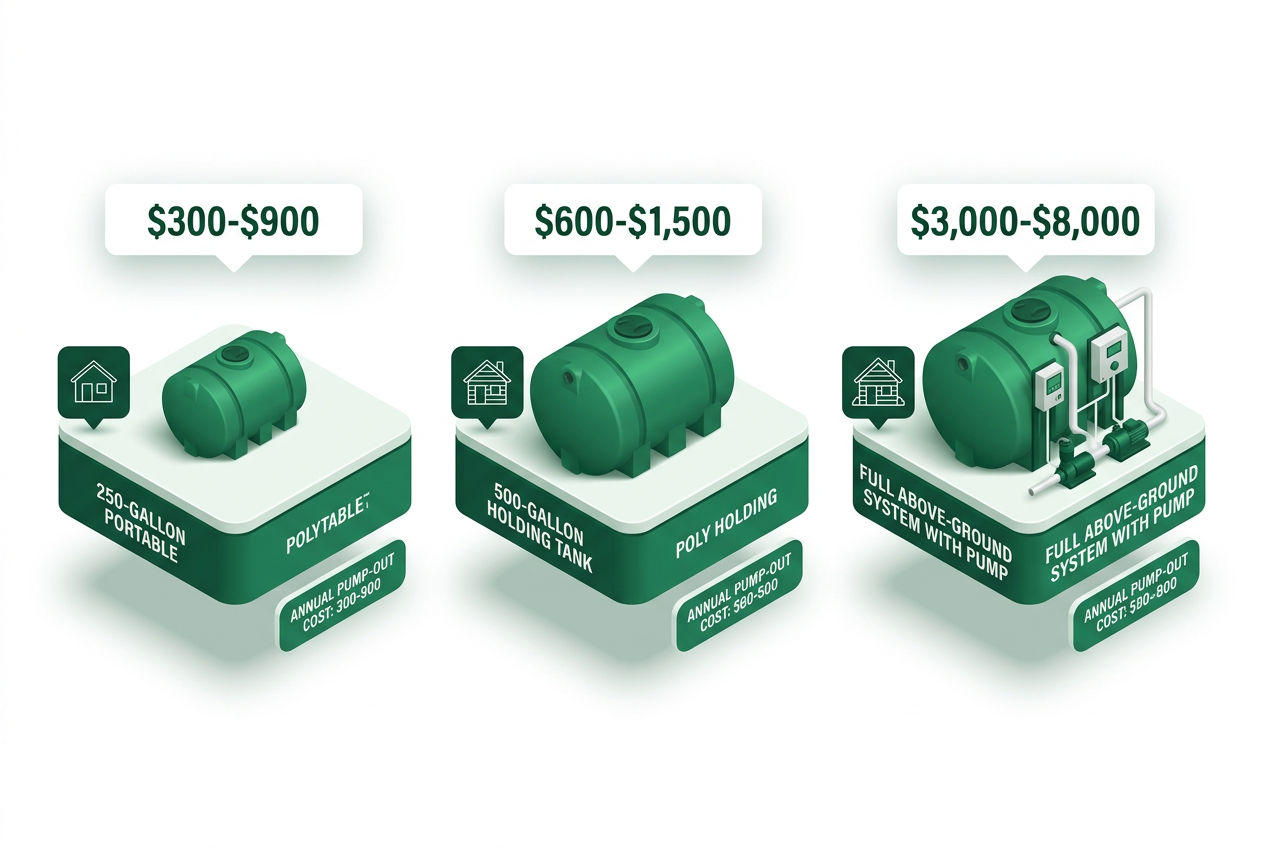
Tank only (not installed):
- 300-gallon polyethylene: $800–$1,200
- 500-gallon polyethylene: $1,000–$1,800
- 1,000-gallon polyethylene: $1,500–$2,500
- 1,500-gallon polyethylene: $2,200–$3,500
Installed system (tank + site prep + plumbing + permit):
- Simple cabin installation: $2,500–$5,000
- Residential above-ground system with alarm float and riser lid: $4,500–$10,000+
Ongoing pump-outs:
- National average: $250–$600 per visit
- Rural areas with long drive times (Montana, northern Minnesota): $350–$600+
- Florida and coastal Southeast: $275–$425
Annual operating cost reality check: A family using a 1,000-gallon holding tank year-round with weekly pump-outs pays $13,000–$31,000 annually in pump-out fees alone. That's why holding tanks make sense for seasonal cabins — not as a permanent residential solution. For detailed regional pricing, see our septic pumping cost guide.
The total cost of ownership calculation matters. If your alternative is a $15,000 mound system, a $4,000 holding tank installation penciled out — until you run the annual pump-out math.
Do You Need a Permit for an Above-Ground Septic Tank?
Yes, almost certainly. Nearly every jurisdiction in the United States requires a permit for any wastewater system, including above-ground holding tanks. The permit process typically involves submitting a site plan, specifying tank size and material, and getting approval from your county health department before installation.
Regulations vary significantly by state. Some states classify holding tanks separately from septic systems and allow them with fewer conditions. Others prohibit permanent holding tanks for year-round residences entirely. Minnesota's Pollution Control Agency (MPCA), for instance, requires licensed pumpers to file waste disposal manifests with the county after every pump-out — the state actively tracks holding tank usage. Florida's Department of Health regulates all onsite sewage treatment and disposal systems through county health departments with OSTDS permits required statewide.
Don't skip the permit. An unpermitted system can prevent you from selling the property and may require costly removal. Our septic system permit requirements guide covers the process state by state.
Installation: What to Expect
Above-ground tank installation is simpler than a conventional septic system — there's no drain field to excavate — but it still requires planning.
A typical installation involves:
- Site assessment and permit application — your county health department reviews your lot, soil conditions, and setback requirements from wells, property lines, and water bodies.
- Site prep — a level, compacted gravel or concrete pad to support the tank. A 1,500-gallon polyethylene tank full of water weighs over 13,000 pounds. The pad matters.
- Plumbing connection — a gravity-fed line from the house to the tank inlet. If the house sits lower than the tank (common with above-grade installations), an effluent pump and pump chamber are added to the system.
- Alarm installation — a float switch triggers a high-water alarm when the tank reaches 75–80% capacity. This is code in most jurisdictions and genuinely important — you do not want to overflow a holding tank.
- Final inspection — the county inspector signs off before the system goes live.
Professional installation is strongly recommended. The septic system installation process involves code knowledge, plumbing connections, and permit coordination that most DIYers underestimate. Our guide to DIY septic system installation is honest about where the line is.
How Often Does an Above-Ground Holding Tank Need to Be Pumped?
More often than you'd like. A 1,000-gallon holding tank serving a full-time family of four — generating 240 gallons of wastewater daily — fills in roughly 4 days. In practice, most residential holding tank users schedule pump-outs every 2–4 weeks. Seasonal cabin users might go 4–8 weeks depending on visit frequency and tank size.
Contrast that with a conventional septic tank, where the EPA recommends pump-outs every 3–5 years for most households. That's the maintenance gap that makes holding tanks impractical for year-round residential use.
Signs your tank needs immediate attention: slow drains throughout the house, gurgling sounds at fixtures, sewage odors near the tank, or the high-water alarm triggering. If the alarm sounds, call a septic pumping service the same day. Don't run water until the tank is emptied.
Schedule pump-outs before closing a seasonal property in fall. You don't want 800 gallons of wastewater sitting through a Minnesota winter.
Winterizing Your Above-Ground Tank: Don't Skip This
This is where above-ground systems get real. A buried tank at 48 inches depth in Minnesota is largely protected from freezing. An above-grade polyethylene tank at -20°F is not.
Freeze protection for above-ground tanks requires:
- Foam board insulation panels (2-inch rigid extruded polystyrene) wrapped around the tank exterior and secured with strapping.
- Self-regulating heat tape rated for outdoor use, run along the inlet and outlet pipes from the tank. Products from EasyHeat and Frost King are commonly used by installers in Wisconsin and Michigan.
- Insulated pipe sleeves on the first 10–15 feet of supply line from the house — this is where freezing actually happens most often.
- Pump-out before long idle periods — a tank holding wastewater that sits unused for weeks in sub-zero temperatures is at high risk. A frozen holding tank can cost $1,500–$3,500 to thaw and repair.
In the Rocky Mountain region and Alaska, above-ground systems often include buried heat trace systems controlled by a thermostat. It's more infrastructure, but it's far cheaper than a frozen tank failure in February.
For a full seasonal breakdown, our septic pipes freeze prevention guide covers pipe and tank protection in detail.
Honest Pros and Cons
Advantages:
- Lower upfront cost than mound or conventional systems
- No drain field needed — works on rocky soil, high water table sites, or non-perc land
- Portable configurations available for temporary needs
- Simple mechanical design with fewer failure points
- Faster installation, typically 1–3 days vs. several weeks for a mound system
Disadvantages:
- High ongoing pump-out costs — $3,000–$15,000+ annually for year-round use
- No wastewater treatment — purely storage
- Requires a pump truck to access the property regularly
- Freeze risk in cold climates requires additional equipment
- Many counties restrict or prohibit permanent residential use
- Property resale can be complicated — buyers may request conversion to conventional system
The honest answer: an above-ground holding tank is an excellent solution for a seasonal cabin, a temporary construction site, or a remote property where access and usage are carefully managed. It's a poor long-term choice for a year-round home unless no alternative exists. Run the 5-year total cost of ownership before committing — and have local septic professionals quote both options so you're comparing real numbers instead of national averages.
Sources & Methodology
This article draws on the following primary sources:
- U.S. Environmental Protection Agency — SepticSmart Program (epa.gov/septic): Wastewater generation estimates, pumping frequency recommendations, and national septic system statistics.
- National Association of Wastewater Technicians (NAWT) (nawt.org): Pump-out frequency data and licensed inspector standards.
- National Onsite Wastewater Recycling Association (NOWRA) (nowra.org): System cost ranges and installation best practices.
- Minnesota Pollution Control Agency (MPCA): Holding tank permit and manifest filing requirements referenced for regulatory specificity.
- Florida Department of Health — OSTDS Program: Onsite Sewage Treatment and Disposal System permit requirements referenced for Southeast regional guidance.
Cost ranges reflect 2025–2026 contractor survey data. Regional variations apply.
Free download
Not ready for the Blueprint? Start free.
Grab the free DIY Septic Planning Kit — the permit-first checklist, perc-test cheat sheet, and sizing tables that keep your build from getting red-tagged.
Was this article helpful?
Frequently Asked Questions
Recommended Resources
📖 Related Articles
- What Is a Septic System? How It Works (Visual Guide)
- High Water Table and Septic Systems: What You Need to Know
- Perc Test (Percolation Test): What It Is & How It Works
- Mound Septic System: $10K–$25K Cost & How It Works (2026)
- Land Failed the Perc Test? Here Are Your Options
- Tiny House Septic Systems: Cost, Tank Size & Options (2026)
- Off-Grid Septic Systems: Legal Options That Actually Work
- Plastic Septic Tanks: Sizes, Prices, Pros & Cons
- Concrete vs Plastic Septic Tanks: Which Is Better?
- Septic Tank Sizes & Dimensions Chart (by Bedrooms)
- What Size Septic System Do I Need?
- Septic System Permit Cost & State Requirements (2026 Guide)
- What to Expect During Septic System Installation
- Can You Install a Septic System Yourself?
- Freezing Pipes and Septic: How to Prevent Winter Damage
💰 Cost Guides
🔧 Services
Find Septic Professionals Near You
Compare licensed, verified septic companies by area — top county markets and cities below, or browse all 50 states.
County markets
Popular cities
