
Quick Answer
A septic system for an ADU is either your existing system, tied in and sometimes upgraded, or a separate second system on the same lot. Which one you get depends on your system's permitted bedroom count, its tank and drain field size, your soil, and your county health department's review.
Key Takeaways
- Septic systems are permitted for a set number of bedrooms. An ADU bedroom almost always counts.
- Tying in works only when the current tank and drain field have spare design capacity and pass inspection.
- If they don't, you upsize the tank, extend the drain field, or build a second system.
- State ADU laws ease zoning rules, but they don't override septic approval.
- Budget $1,500-$10,000 for a tie-in and $7,000-$40,000+ for a second system.
Picture this: your builder has the ADU plans drawn, the zoning check came back clean, and then the county environmental health office pulls your septic file. It says "permitted for 3 bedrooms." Your house already has three. That one line on a 20-year-old permit now decides your whole budget. Here's how to see it coming.
Can an ADU Tie Into an Existing Septic System?
Yes, an ADU can tie into an existing septic system if the system was sized for the total bedroom count after the ADU is built and it passes an inspection. Most systems built for the main house alone lack that spare capacity, so many tie-ins also require a bigger tank, more drain field, or both.
The key word is "permitted." Your county doesn't care how well the system seems to work today. It cares what the system was designed and approved for. A 3-bedroom house with a 1,000-gallon tank that has never backed up is still a 3-bedroom system on paper.
So the first job is finding your records. Ask the county for the original permit, the as-built drawing, and any repair permits. Then book a full septic inspection service that includes pumping the tank, checking the baffles and effluent filter, and probing or camera-scoping the drain field. A visual-only "walk-over" inspection won't satisfy most health departments for a new dwelling unit. Our step-by-step guide to tying into an existing septic system walks through the full capacity check, from permit records to the county review.
How Does an ADU Change Your Septic Design Flow?
An ADU adds design flow, the gallons per day (GPD) a septic system must be built to handle. Most states assign 110-150 GPD per bedroom. Massachusetts Title 5 uses 110 GPD, North Carolina uses 120 GPD, and many other states use 150 GPD. Adding one ADU bedroom adds that full amount, even if it sits empty. The same flow numbers drive every septic system design.
Design flow is deliberately conservative. Real indoor use runs closer to 50-70 gallons per person per day, but codes size for peak occupancy, roughly two people per bedroom. That's why "it's just a studio for my mom" doesn't change the math.
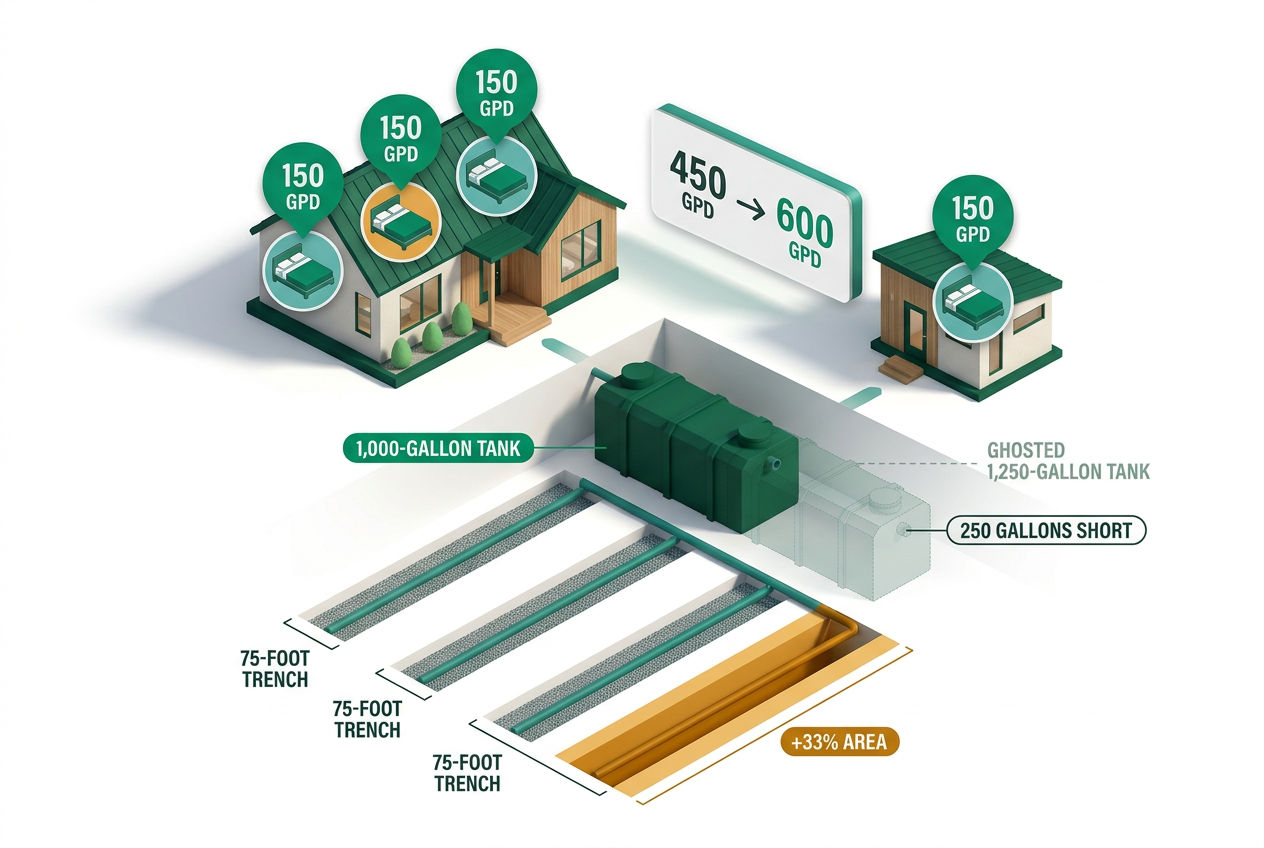
A worked example. Say your house has 3 bedrooms, a 1,000-gallon tank, and a drain field built for 450 GPD (150 GPD per bedroom). You add a 1-bedroom ADU:
- New design flow: 4 bedrooms × 150 GPD = 600 GPD
- Shortfall in the drain field: 150 GPD, or about 33% more absorption area needed
- Tank: many states require 1,250 gallons for 4 bedrooms, so you're 250 gallons short
In that case you'd likely add tank capacity (a second tank in series, or a replacement 1,250- or 1,500-gallon tank) and extend the field by roughly a third. If your field is 3 trenches of 75 feet, that's about one more 75-foot trench, assuming the soil and space allow it. Our guide to how big a septic system you need walks through the bedroom-to-tank math in more detail.
Studios are a gray area. Some counties count a studio ADU as one bedroom; others assign a flat GPD per dwelling unit. Ask before you finalize the floor plan, because a "den" with a closet and a door usually gets counted as a bedroom.
What Are the ADU Septic Requirements From the Health Department?
ADU septic requirements usually include proof of the existing system's permitted capacity, a recent inspection, a site plan showing setbacks, and often a soil evaluation or perc test. If the system needs changes, a licensed designer or engineer submits plans for approval before your building permit is released.
A typical submittal package looks like this:
- Existing system records: permit, as-built, and bedroom rating.
- Inspection report: tank condition, sludge and scum depths, drain field performance.
- Site plan: house, ADU, tank, field, reserve area, well, and property lines. See our septic setback requirements for typical distances, such as 50-100 feet from a private well and 5-10 feet from property lines.
- Soil data: a new perc test or soil profile if the field grows or a new system goes in. Our perc test guide explains what the tester is looking for.
- Design plans: required for any upgrade or second system.
One honest limitation: no inspection can promise a drain field will handle extra load for 20 more years. An inspector can tell you it's working now and how it's built. A field that's 25 years old and already ponding after heavy rain is a poor candidate for added flow, even if the paperwork technically allows it.
When Does Tying the ADU Into the Existing Septic Work?
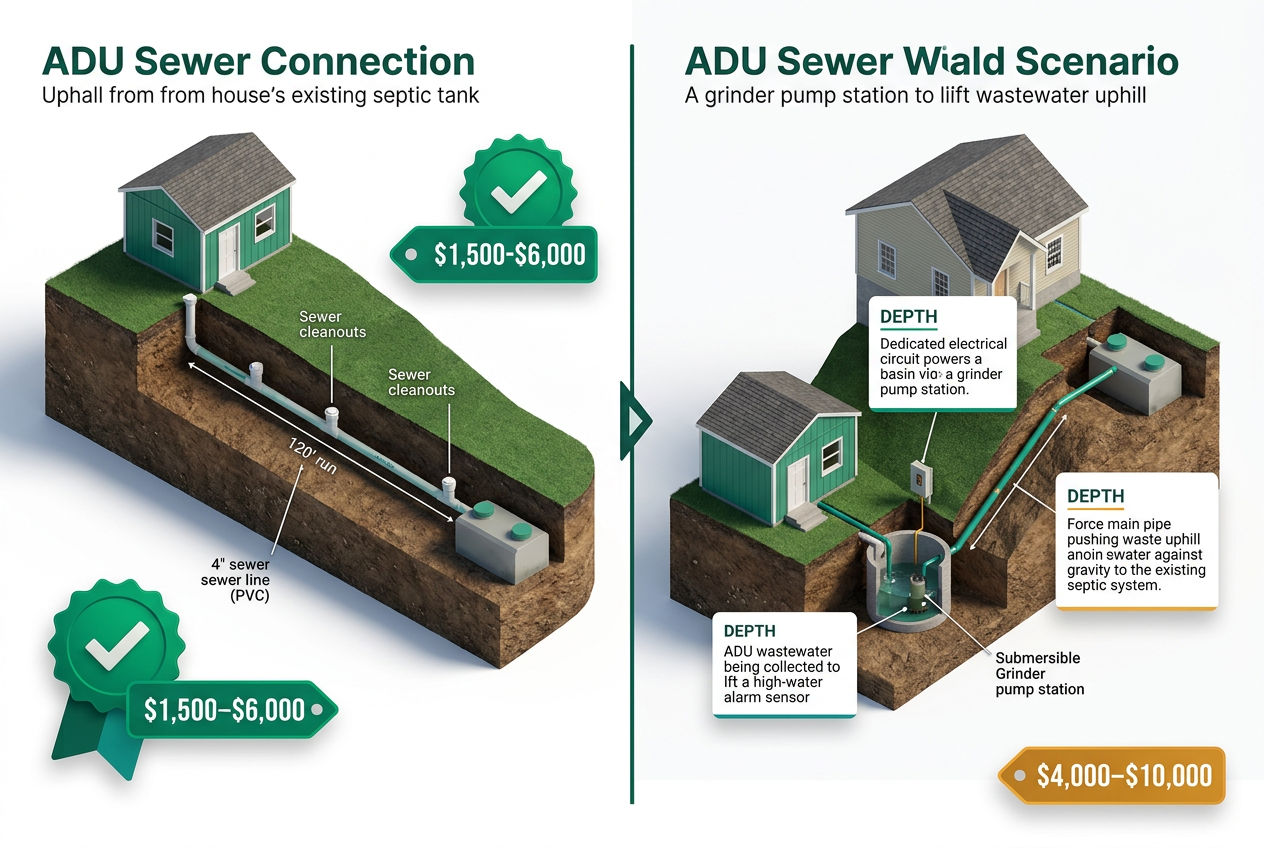
Adding an ADU to existing septic works best when the system has spare permitted capacity, the ADU sits uphill of the tank so wastewater flows by gravity, and the lot has room to run a 4-inch sewer line with proper slope. Gravity tie-ins are the cheapest path, often $1,500-$6,000 including trenching.
Gravity lines need fall. Most plumbing codes allow 1/8 inch per foot for 4-inch pipe, and installers often aim for 1/4 inch per foot. Over 120 feet, that's 15 to 30 inches of drop. Long runs also need cleanouts, typically at least every 100 feet and at major direction changes.
Some tie-ins connect the ADU line to the main house sewer before the tank. Others run to a separate inlet. Your designer will pick based on depth and distance. Either way, the tank's inlet baffle has to handle the combined flow.
When the ADU sits below the tank, or the run is long and flat, you'll need a pump. A small sewage ejector or grinder pump station at the ADU pushes waste up to the tank. Our comparison of effluent pumps vs. grinder pumps covers which type fits raw sewage versus settled effluent. Expect $4,000-$10,000 installed, plus a high-water alarm and a dedicated circuit. Pumps also add a failure point: a power outage means no flushing in the ADU until power returns.
Can You Upgrade the Existing System Instead of Replacing It?
Yes, you can often upgrade rather than replace. Common upgrades include adding a second tank in series, swapping in a larger tank, adding an effluent filter, and extending the drain field with new trenches or chambers. Upgrades typically cost $5,000-$20,000 and depend on having approved soil and room near the current field.
Upgrades look cheap on paper and get expensive in the dirt. A few things drive cost:
- Reserve area. Many states require a replacement area set aside for a future drain field. If the ADU or its driveway lands on it, the county may reject the project outright.
- Old components. If the inspection finds a cracked tank or a field near the end of its life, the county may require repair to current code first. A design review often turns a "small upgrade" into a partial rebuild.
- Soil limits. Clay or a high water table can block a conventional extension. Then you're looking at a mound, sand filter, or aerobic treatment unit, which pushes costs up fast. Our mound septic systems guide shows what that route involves.
Also plan for more pumping. A tank serving more people fills faster. A 1,000-gallon tank that needed pumping every 3-4 years for a family of four might need it every 2 years with two more people in the ADU. The EPA's general guidance of every 3-5 years assumes a tank sized for its household; see how often to pump a septic tank for the full schedule by tank and household size.
When Do You Need a Second Septic System for a Guest House?
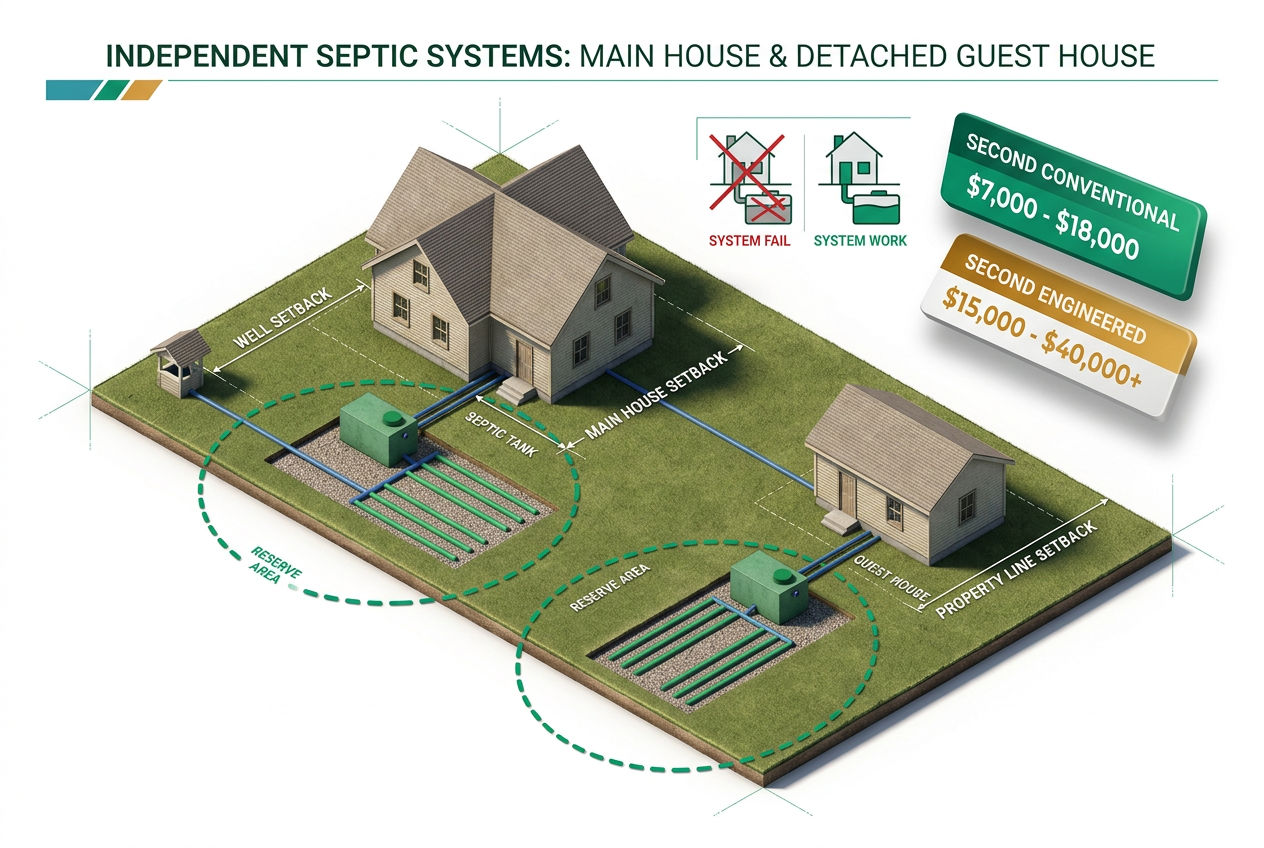
You need a second septic system for a guest house when the existing system can't be expanded, the guest house is too far or too low to connect affordably, or local code requires separate systems for separate dwellings. A conventional second system costs $7,000-$18,000; engineered systems on poor soil run $15,000-$40,000+. Detached workshops follow similar rules; see septic options for a shop or garage.
Separate systems bring real advantages. A failure in one doesn't take down both homes. You can also sell, rent, or split the property later without untangling a shared system.
Counties sometimes draw a bright line on size. San Luis Obispo County in California, for example, lets older ADUs under 800 square feet use or modify a combined system with the main house, but requires units of 800-1,200 square feet to have a separate system. Your county may draw a different line, or none.
The catch is land. A second system needs its own tank, drain field, reserve area, and setbacks from your well, the main house, and the property line. On a half-acre lot with an existing well, there may simply be no legal spot. That's the point where many owners shrink the ADU, switch to a junior ADU inside the house, or drop the project. Our septic installation cost guide breaks down what a full new system costs by type.
How Much Does a Septic System for an ADU Cost?

DIY Septic Blueprint
Thinking about building it yourself?
The complete, plain-English plan to size, permit and install your own septic system — designed for homeowners, not contractors. Skip the $15,000–$25,000 quotes and do it right the first time.
Get the DIY Blueprint — $67 →Instant download · 8 modules + 3 bonus guides · 60-day money-back guaranteeA septic system for an ADU costs about $1,500-$6,000 for a simple gravity tie-in, $5,000-$20,000 to upgrade an existing system, and $7,000-$40,000+ for a separate second system. Add $1,500-$6,000 for the inspection, soil testing, design, and permits that nearly every county requires first.
| ADU septic path | Typical cost | Best fit |
|---|---|---|
| Gravity tie-in | $1,500–$6,000 | Spare capacity, uphill |
| Tie-in with pump | $4,000–$10,000 | ADU below the tank |
| Upgrade tank + field | $5,000–$20,000 | Room to extend field |
| Second conventional | $7,000–$18,000 | Good soil, big lot |
| Second engineered | $15,000–$40,000+ | Clay, high water table |
Source: SepticTankHub estimates from published contractor pricing and county fee schedules, 2025-2026. Ranges vary widely by state, soil, and access.
The pre-construction costs break down roughly like this: a full inspection at $300-$900 (see our septic inspection cost guide), a perc test or soil evaluation at $750-$3,000, design or engineering at $500-$2,500, and permit fees from $200 to $2,500 depending on the county.
Regional pricing swings hard. A tie-in in sandy Central Florida soil may come in near the low end. The same tie-in in rocky New England ground, where trenching means a hydraulic hammer, can double.
How Do ADU Septic Rules Differ by State?
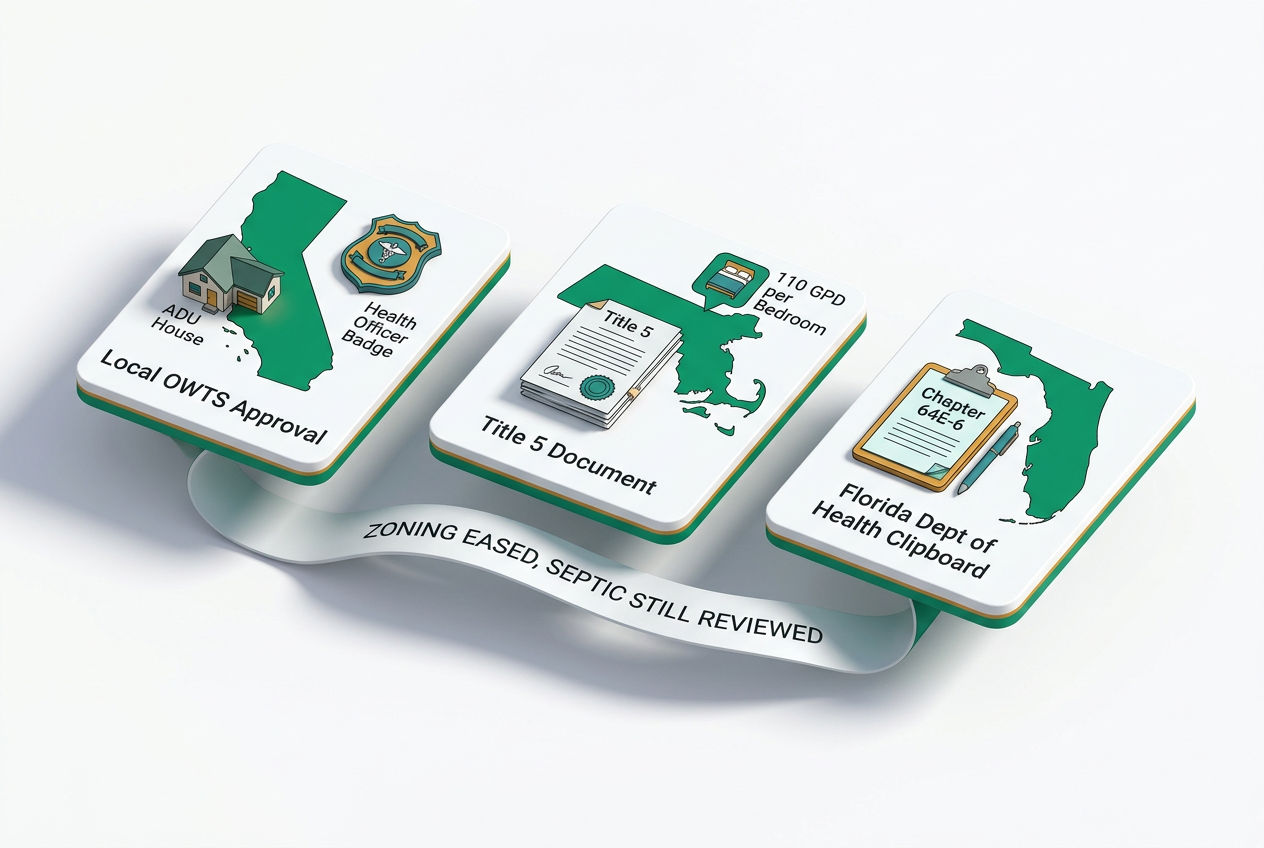
ADU septic rules differ mainly in how states size systems and who approves them. Some states use bedroom counts, some add square footage or flat per-unit flows, and most hand approval to county health departments. State ADU laws that speed up zoning approval still leave septic capacity to the health officer.
- California. State ADU law limits what cities and counties can require for zoning, but it still allows approval by the local health officer when a septic system is used. Counties run their programs under local plans approved through the State Water Resources Control Board's OWTS Policy. See California septic regulations for county specifics.
- Massachusetts. Title 5 sizes systems at 110 GPD per bedroom. Adding a bedroom, including an ADU bedroom, generally needs local Board of Health approval and a system that meets the new design flow.
- Florida. The Department of Health regulates onsite systems under Chapter 64E-6. Adding bedrooms or a dwelling typically triggers an existing-system evaluation, and some springs-protection areas push nitrogen-reducing systems.
- Texas. TCEQ sets the rules, and counties or other authorized agents issue permits. Texas sizes residential flow using both bedroom count and living-area square footage, and aerobic systems are common on clay soils.
- Washington. Local health jurisdictions apply state onsite rules. Many require a licensed designer and a full site evaluation for any added dwelling.
Season matters too. Some northern counties won't schedule soil tests when the ground is frozen, and some states require wet-season testing when the water table is highest. Start the septic review in late summer or fall if you want to build the following spring.
What Mistakes Derail ADU Septic Projects?
The most common mistakes are designing the ADU before checking septic capacity, building over the reserve drain field area, assuming state ADU law covers septic approval, and making an unpermitted tie-in. Each can stall a building permit, force a costly redesign, or create a problem at resale.
- Floor plan first, septic second. Get the septic answer before paying an architect for final drawings.
- Building on the reserve area. Once a foundation is poured there, you've used up your backup field.
- Calling a bedroom an "office." Health departments count rooms by their features, not their label.
- Unpermitted tie-ins. A buyer's inspector or lender may flag an ADU with no septic approval, and you may have to permit it, or undo it, before closing.
- Skipping the garbage disposal question. A disposal in the ADU kitchen adds solids. Some codes require a larger tank when one is installed.
Thinking about doing part of the work yourself? Read our DIY septic system guide first. Many counties allow homeowner installs on a primary residence but still require a licensed designer's plans and county inspections, and some don't allow homeowner work on an added dwelling at all.
When you're ready for quotes, use the SepticTankHub directory to find local septic designers and installers who already know your county's ADU review process.
Sources & Methodology
- U.S. EPA, Septic Systems program (epa.gov/septic): pumping intervals, system components, and homeowner guidance.
- Massachusetts DEP, Title 5 (310 CMR 15.000): 110 GPD per bedroom design flow and rules for increased design flow. mass.gov/dep
- North Carolina On-Site Water Protection rules (15A NCAC 18A): 120 GPD per bedroom design flow.
- California State Water Resources Control Board, OWTS Policy, and San Luis Obispo County ADU/OWTS submittal requirements: county-level ADU septic review and size thresholds. waterboards.ca.gov
- Florida Department of Health (Chapter 64E-6) and TCEQ (Chapter 285): state approval paths for added bedrooms and dwellings. floridahealth.gov
Cost ranges are SepticTankHub estimates drawn from published contractor pricing and county fee schedules. Your actual cost depends on soil, access, distance, and local code.
Primary sources to read: MassDEP: Title 5 new construction · California OWTS Policy · Florida DEP: onsite sewage permitting FAQ · Texas TCEQ: OSSF permits
More Septic Design & Install Guides
- Septic system design: the complete guide
- Small septic system for a shop or garage
- Septic system for a 3-bedroom house
- How to draw a septic site plan
- What septic system design costs
- Leach field design and sizing
- Can you install your own septic system? Rules by state
Frequently Asked Questions
What are the typical ADU septic requirements?
Typical ADU septic requirements include proof that your existing system is permitted for the total bedroom count, a recent inspection, a site plan with setbacks, and often a perc test or soil evaluation. Most counties start by pulling your original septic permit to see how many bedrooms it was approved for. If the ADU pushes you past that number, a licensed designer or engineer has to submit plans showing how the system will handle the added design flow, usually 110-150 gallons per day per bedroom depending on your state. Common outcomes are a bigger or second tank, an extended drain field, or a separate system. Your building permit generally won't be issued until environmental health signs off. Requirements vary by state and county, so call your local health department before you finalize ADU plans.
Can I use my existing septic system for a guest house?
You can use your existing septic system for a guest house only if it has spare permitted capacity for the extra bedrooms and passes a full inspection. Many systems are sized exactly for the main house, so a guest house often means adding tank capacity or drain field, even if the system works fine today. The guest house's location matters too. If it sits uphill of the tank, a gravity sewer line with about 1/8 to 1/4 inch of fall per foot may work for $1,500-$6,000. If it sits below the tank, you'll need a sewage ejector or grinder pump station, often $4,000-$10,000 installed. Some counties also require separate systems for detached units above a certain size. Check with your county before trenching anything.
How much does a septic system for a guest house cost?
A septic system for a guest house costs about $1,500-$10,000 if you can tie into the existing system, $5,000-$20,000 if the existing system needs upgrading, and $7,000-$40,000 or more for a separate second system. The wide range comes from soil and site conditions. A conventional gravity system on sandy, well-drained soil sits at the low end. A mound, sand filter, or aerobic system on clay or a high water table sits at the high end. Before construction, budget another $1,500-$6,000 for a full inspection, perc test or soil evaluation, design work, and permit fees. Costs also run higher in rocky regions where trenching takes heavy equipment, and in areas with strict nitrogen rules. Get at least two quotes from designers who know your county.
Is adding an ADU to existing septic always cheaper than a second system?
Adding an ADU to existing septic is usually cheaper, but not always. A simple gravity tie-in to a system with spare capacity might cost $1,500-$6,000, far less than a $7,000-$18,000 second conventional system. The math flips when the existing system is old, undersized, or near failure. If the inspection finds a cracked tank or a drain field that's ponding, the county may require bringing the whole system up to current code before approving added flow. That can turn a small tie-in into a $15,000-$25,000 rebuild. A long or downhill run that needs a pump also narrows the gap. In some cases a separate system for the ADU costs about the same and gives you two independent systems, which can help if you ever rent or sell.
Does a septic system for an ADU need a perc test?
A septic system for an ADU often needs a perc test or soil evaluation, but not every time. If you're tying into an existing system that already has enough permitted capacity, many counties accept the original soil data plus a current inspection. A new test is usually required when you extend the drain field, move it, or install a second system, because the new absorption area needs its own soil data. California's ADU law lets local agencies require a recent percolation test for ADUs served by septic. Perc tests and soil evaluations typically cost $750-$3,000. Timing can matter: some states require testing during the wet season, and northern counties may not test frozen ground. Schedule early so a seasonal window doesn't hold up your building permit.
Free download
Not ready for the Blueprint? Start free.
Grab the free DIY Septic Planning Kit — the permit-first checklist, perc-test cheat sheet, and sizing tables that keep your build from getting red-tagged.
Was this article helpful?
Frequently Asked Questions
Recommended Resources
📖 Related Articles
- What Size Septic System Do I Need?
- Septic System Setback Requirements: How Far From the House?
- Perc Test (Percolation Test): What It Is & How It Works
- Effluent Pump: A Side-by-Side Comparison
- Mound Septic System: $10K–$25K Cost & How It Works (2026)
- How Often Should You Pump Your Septic Tank?
- DIY Septic System: How to Build Your Own (Step-by-Step)
💰 Cost Guides
🔧 Services
Find Septic Professionals Near You
Compare licensed, verified septic companies by area — top county markets and cities below, or browse all 50 states.
County markets
Popular cities
