
Quick Answer
Buying a septic business means acquiring a recession-resistant service route with 15%–30% net margins, recurring regulatory-driven demand, and loyal customers. Small operations sell for $150K–$500K at 2x–4x SDE. Success depends on fleet condition, transferable permits, and customer concentration below 20% of revenue.
Septic systems serve roughly 21 million U.S. households—about 20% of all homes, according to the EPA—and those tanks don't stop filling just because the economy turns. Demand is steady, competition is local, and owners often have loyal customers who've called the same number for 15 years. But "the business looks good" is not a valuation strategy. The difference between a great deal and a disaster often comes down to one rusted truck you didn't inspect, a permit that doesn't transfer with the sale, or an owner whose personal relationships are the customer retention. This guide gives you the real numbers, the right questions, and the red flags that belong in every buyer's checklist when looking at a septic pumping business for sale.
Key Takeaways
- Small septic businesses typically sell for $150K–$500K; mid-size operations run $500K–$2M
- Valuation is usually 2x–4x SDE or 40%–60% of annual revenue
- Fleet condition, recurring contracts, and transferable permits drive value up or down significantly
- SBA 7(a) loans cover up to $5M with 10%–20% down—this is the most common financing method
- Customer concentration is the single biggest hidden risk: if one customer is more than 20% of revenue, that's a problem
Is Owning a Septic Business Profitable?
A well-run septic pumping operation nets 15%–30% after expenses, with gross margins typically running 40%–55%. A single vacuum truck generating $200,000–$300,000 in annual revenue at 20% net margin puts $40,000–$60,000 in the owner's pocket—per truck, per year. Add a second truck and a part-time dispatcher, and you can see why these businesses attract buyers.

The industry has durable demand fundamentals. According to the EPA, aging septic infrastructure across the U.S. is driving increased inspection and maintenance activity nationwide. States like Massachusetts (under Title 5 regulations), Wisconsin, and Minnesota have mandatory pumping or inspection schedules built into law—which means built-in recurring revenue that doesn't depend on marketing.
Septic pumping is also largely recession-resistant. Homeowners can delay a kitchen remodel. They can't delay a failing tank. Sellers of established routes know this, and they price accordingly.
If you want a deeper look at the financial picture before you commit, our guide on whether a septic business is profitable breaks down margins, revenue benchmarks, and realistic income expectations by business size.
How Do You Calculate Septic Business Valuation?
Most small septic businesses—the owner-operator running one or two trucks—are valued using seller's discretionary earnings (SDE). SDE starts with net profit, then adds back the owner's salary, personal expenses run through the business, depreciation, and any one-time costs. It represents the total financial benefit an owner-operator actually extracts from the business each year.
The standard multiple: 2x–4x SDE for owner-operator businesses. Larger companies with management in place (so the owner isn't also the driver) can command 3x–5x EBITDA. A quick rule of thumb for small pumping operations: 40%–60% of annual revenue as a starting septic business valuation.
So a business doing $600,000 per year might be worth $240,000–$360,000 before adjustments for fleet condition, contract quality, and local market dynamics.
A worked example:
A two-truck septic pumping company in rural Georgia does $480,000 in annual revenue. The owner pays himself $85,000, runs $12,000 in personal vehicle expenses through the business, and takes an $8,000 depreciation add-back. Adjusted SDE = $105,000. At a 3x multiple, the business is worth roughly $315,000. At 4x (if routes are well-documented and customer churn is low), it's $420,000. That range—$315K to $420K—is your negotiating corridor. The actual price depends on what you find in due diligence.
Regional factors matter here. A Massachusetts business with Title 5-mandated inspection revenue commands a higher multiple than a similarly sized Texas operation covering a large, low-density territory with no regulatory pumping requirements. Northeast and Pacific Northwest operators benefit from higher barriers to entry and regulatory-driven recurring contracts.
For context on what service pricing looks like in your target market before finalizing any offer, see what septic pumping costs in a typical residential market — that data feeds directly into your revenue validation during due diligence.
Septic Business Blueprint
Thinking about starting your own septic business?
The complete, plain-English playbook to start (or buy), license and grow a profitable septic business — the models, the money math, trucks, disposal, insurance, pricing and how to land your first customers.
Get the Blueprint — $297 →Instant access · 12-chapter playbook + 6-piece toolkit · 60-day money-back guaranteeWhat Does a Septic Business for Sale Actually Include?
Before you evaluate price, understand what you're buying. Most septic business acquisitions are asset purchases, not stock purchases. That distinction matters legally and financially.
In an asset purchase, you buy the trucks, equipment, customer list, trade name, and goodwill—but not the legal entity. You generally avoid inheriting unknown liabilities (lawsuits, unpaid taxes, environmental claims). Most buyers prefer this structure.
In a stock purchase, you buy the entire company, including its history. This can simplify some licensing transfers but exposes you to pre-existing liabilities. Sellers often prefer stock sales for tax reasons. A business attorney should review the structure before you sign—the choice has significant tax and liability consequences that no acquisition guide can fully substitute for.
Typical assets in a septic company acquisition:
| Asset | Typical Value Range | Notes |
|---|---|---|
| Vacuum/pump truck (new) | $150,000–$350,000+ | Higher end for combo units |
| Vacuum/pump truck (used) | $40,000–$150,000 | Age and tank capacity vary widely |
| Customer routes/list | $50,000–$200,000+ | Depends on retention and contract status |
| Permits & licenses | $0–$50,000 | Some states allow transfer; others require reapplication |
| Tools, hoses, equipment | $5,000–$25,000 | Often included in asset purchase |
| Business name/goodwill | Negotiated | Part of SDE multiple |
Source: Industry broker data; NOWRA market reports; buyer interviews.
Understanding how septic pumping services work operationally helps you assess whether the equipment list you're given actually supports the revenue claimed. And if the business you're evaluating includes installation or repair work alongside pumping, review septic system installation cost benchmarks to sanity-check that revenue stream independently.
What Should You Look for When You Buy a Septic Company?
This is where deals get confirmed or collapsed. Plan to spend 30–60 days on due diligence before signing anything.
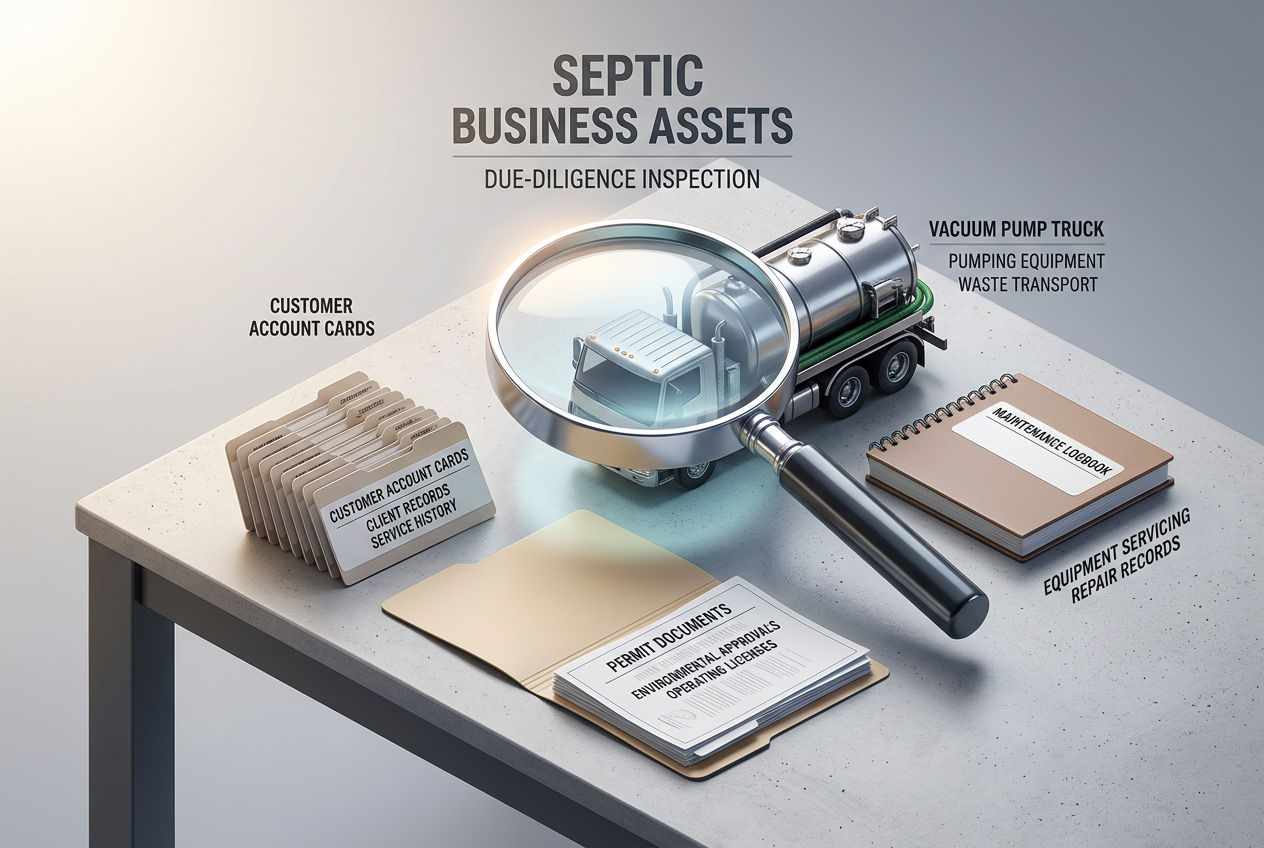
Financial records. Request three years of tax returns, not just P&L statements prepared by the seller's accountant. Tax returns are harder to manipulate. Compare reported revenue against bank deposits. Look for unusual spikes or dips and ask for explanations.
Customer concentration risk. If one commercial account—say, a trailer park or restaurant group—represents more than 20% of revenue, you're not buying a route business. You're buying a dependency. Lose that account and your SDE multiple collapses. Healthy pumping operations have no single customer above 10%–15% of revenue.
Customer retention rate. Ask for the customer list going back three years. Calculate how many accounts pumped in Year 1 still appear in Year 3. Anything above 70% annual retention is healthy for a residential pumping route. Below 60%, ask why.
Fleet inspection. Hire a diesel mechanic to inspect every truck before you close. A vacuum truck with a cracked tank or a failing pump motor is a $40,000–$80,000 repair waiting to happen. Check the tank capacity (most residential trucks run 2,000–4,000 gallons), pump hours, hose condition, and hydro-jetting equipment if included. Also verify whether trucks meet your state's DOT requirements for waste hauling.
Permits and licenses. This varies significantly by state. Florida requires a Registered Septic Tank Contractor (RSTC) license through the Department of Health. Massachusetts requires a certified Title 5 inspector credential, separate from the pumper license. Some states issue permits to the business entity; others tie them to the individual. If key licenses don't transfer, your closing timeline could extend by 90–180 days—or the deal could fall apart entirely.
Environmental liability. Ask for disposal manifests going back three to five years. Where does the septage go? Is it delivered to a licensed treatment facility? Some states allow land application of septage under EPA Part 503 regulations, but that practice is increasingly restricted. Any history of illegal dumping is a deal-ender—and potentially a federal liability.
For a broader look at what septic inspections reveal about system condition—useful context for evaluating a business serving residential customers—see our septic inspection overview.
To understand what a failing system actually looks like from a service perspective, septic system failure signs gives you the field-level context that helps you evaluate a seller's service history claims.
What Red Flags Should Stop You From Purchasing a Septic Company?
Some problems are negotiating chips. Others are exits. Here's the difference.
The owner IS the business. If customers call the owner's personal cell, if he knows every customer by name but has no documented routes, if reviews on Google mention him by first name—that goodwill doesn't transfer. It walks out the door with him on closing day.
No non-compete agreement. Without a signed non-compete, the seller can start a new company across the street the week after closing. Standard terms: three to five years, geographic radius matching the service area. Non-negotiable.
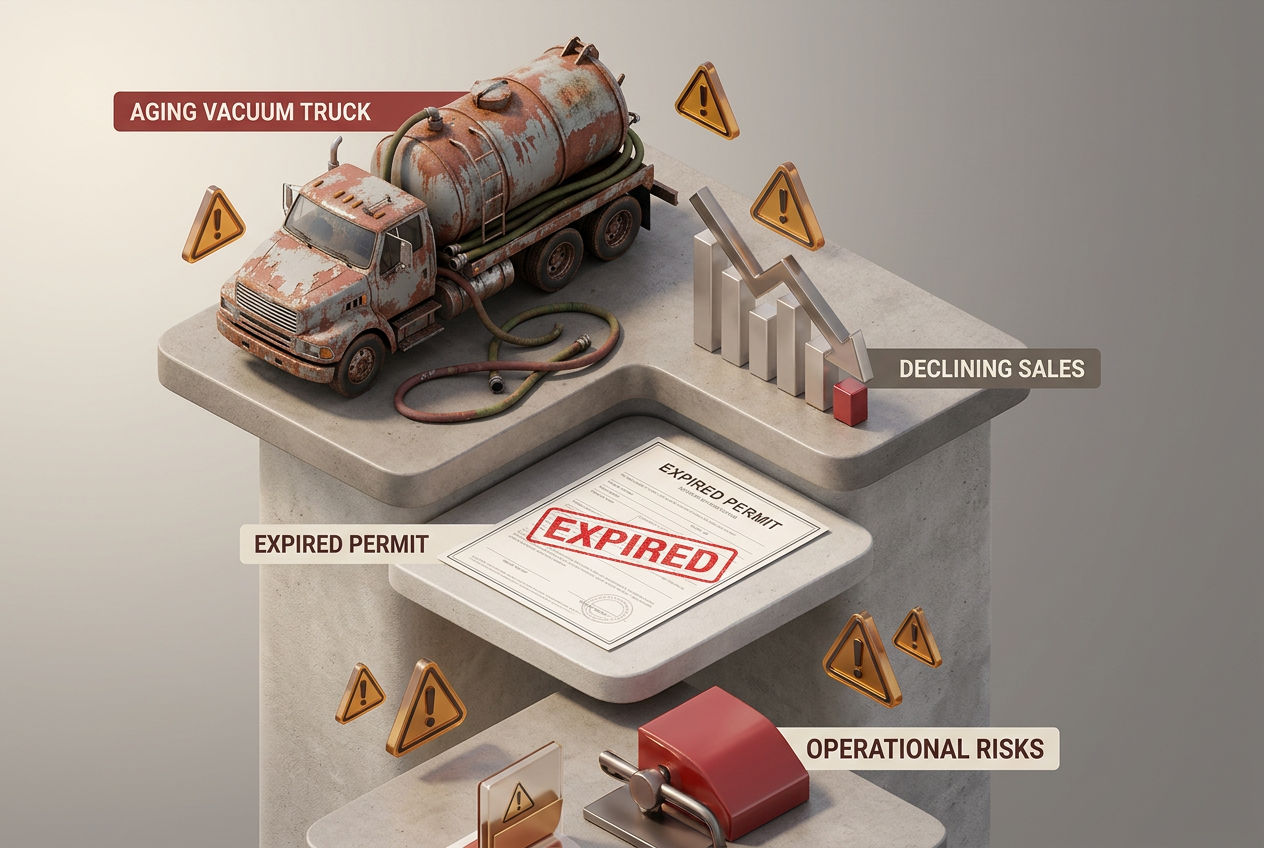
Deferred maintenance across the fleet. One aging truck is a risk you can price in. Two aging trucks with the same owner who's been letting them slide for years is a capital expenditure crisis waiting for you at Month 6.
Revenue trending down. Three years of flat revenue is acceptable. Three years of declining revenue with no clear explanation is a warning. Ask directly why the owner is selling, then verify that explanation against the financials. Motivations like retirement or health are verifiable; "I just want to move on" deserves scrutiny.
Permits that can't transfer. Discover this in due diligence, not at closing.
How Do You Finance a Septic Business Acquisition?
SBA 7(a) loans are the most common financing vehicle for acquisitions in this range. The SBA guarantees loans up to $5 million with terms up to 10 years for working capital, and up to 25 years for real estate. Down payment requirements typically run 10%–20% of the purchase price. On a $400,000 acquisition, that's $40,000–$80,000 in equity at closing. Verify current SBA terms at sba.gov before modeling your financing—guidelines change.
Seller financing is common in this industry, particularly for smaller transactions. A seller carrying 10%–30% of the purchase price as a promissory note signals confidence in the business and aligns their incentives with your success through the transition period. It also fills the gap between SBA funding and purchase price.
Equipment financing can be structured separately for the trucks if the existing fleet needs immediate upgrading. Some lenders will finance used commercial vacuum trucks with as little as 10%–15% down, with terms of 48–72 months.
ROBS (Rollover for Business Startups) arrangements allow you to use retirement funds to capitalize an acquisition without early withdrawal penalties—but these structures require a specialist and carry compliance risk if not set up correctly. Consult a ROBS specialist before pursuing this route.
If you're weighing whether to acquire an existing operation versus building one, how to start a septic business from scratch gives you the ground-up cost comparison, which can sharpen your offer logic on an acquisition.
Where Can You Find a Septic Pumping Business for Sale?
Most septic businesses never list publicly. The owner tells a few people, gets a buyer through word of mouth, and closes quietly. That's the market you want access to.
Business brokers specializing in blue-collar service businesses are your best starting point. BizBuySell lists some septic operations, but brokers with trades-specific focus (not generalist business brokers) know which operators are approaching retirement age. The IBBA (International Business Brokers Association) directory is searchable by specialty.
Direct outreach works. Send personalized letters to 15–25 local septic companies in your target geography. Identify owner-operators who have been in business 15–25 years—they're in the natural exit window. A short, professional letter asking if they've ever considered transitioning the business generates responses more often than most buyers expect.
NOWRA (National Onsite Wastewater Recycling Association) and NAWT (National Association of Wastewater Technicians) both maintain member directories. Attend regional chapter meetings. Sellers often surface at industry events before they list anywhere publicly.
Timing matters. Late fall and winter are historically better periods for acquisition conversations in seasonal markets—volume is lower, operators are more reflective, and there's less pressure on near-term revenue performance.
What Should You Do in the First 90 Days After You Purchase a Septic Business?
You closed. Now the transition work begins—and the first 90 days determine whether your customers stay or start looking around.

Days 1–30: Stabilize and listen. Don't change anything visible. Keep the same phone number, the same scheduling process, and the same crew. Ride along on routes. Talk to every employee individually. Your first job is to understand what actually makes this business run—which is often different from what the paperwork says.
Days 31–60: Audit and document. Build a proper customer database if one doesn't exist. Map every route geographically. Photograph every piece of equipment. Confirm all permits are in your name. Review your top 20 accounts personally—call or visit and introduce yourself. Customer retention in the first 90 days is fragile; personal contact stabilizes it.
Days 61–90: Price and optimize. If the business hasn't raised prices in 2–3 years (common in owner-operated transitions), a modest increase is appropriate. According to industry operators surveyed by NAWT, a $25 increase per service call across 400 annual residential pumps generates $10,000 in additional annual revenue with minimal churn if communicated professionally. Review your disposal contracts—septage hauling rates vary, and renegotiating with your treatment facility at year one is appropriate.
For context on how other operators structure their service offerings post-acquisition, septic tank maintenance programs outlines recurring service models that stabilize revenue beyond one-time pump calls.
Sources & Methodology
- EPA: Estimates on U.S. septic system prevalence (approximately 21 million households); EPA Part 503 biosolids regulations governing septage land application. epa.gov
- NOWRA (National Onsite Wastewater Recycling Association): Market size data, member directory, regional chapter activity. nowra.org
- NAWT (National Association of Wastewater Technicians): Technician certification standards, member surveys on pricing and operations. nawt.org
- BizBuySell Insight Report: Small business transaction multiples and deal volume data for service industry acquisitions. bizbuysell.com
- SBA: Current 7(a) loan program terms, size standards, and lender directory. sba.gov
- Massachusetts Title 5 (310 CMR 15.000): State regulation governing on-site sewage disposal system inspections and pumping requirements.
- Florida Department of Health: Registered Septic Tank Contractor (RSTC) licensing requirements and application process.
- Valuation ranges based on broker interviews, buyer-reported transaction data, and NOWRA market reports. Individual transactions vary; consult a licensed business broker and attorney before making acquisition decisions.
Was this article helpful?
Frequently Asked Questions
Recommended Resources
📖 Related Articles
💰 Cost Guides
Find Septic Professionals Near You
Compare licensed, verified septic companies by area — top county markets and cities below, or browse all 50 states.
County markets
Popular cities
