
Quick Answer
A septic truck is a heavy-duty vacuum vehicle that removes accumulated solids, liquids, and scum from septic tanks, cesspools, and portable sanitation units. Most residential septic pumper trucks carry 1,500–5,000 gallons, generate 400–1,200+ CFM of suction, and can complete 8–15 service calls per day. Hiring one costs $300–$600 for a standard residential pump-out.
Key Takeaways
- Most residential septic trucks hold 1,500–5,000 gallons and use a 4-inch suction hose to empty your tank in 30 minutes to 2 hours.
- A standard pump-out for a 1,000-gallon tank costs $300–$600 nationally; rural locations and larger tanks push that higher.
- The EPA recommends pumping every 3–5 years for most households — add a garbage disposal and that interval drops to 2–3 years.
- Loaded trucks can weigh 60,000–80,000 lbs, which can crack concrete driveways — always flag access concerns before the truck arrives.
- New septic trucks cost $80,000–$250,000; a used unit runs $30,000–$100,000 for entrepreneurs entering the trade.
What Is a Septic Truck?
A septic truck — also called a septic pumper truck, pump truck, or honey wagon — is a vacuum tanker purpose-built for removing waste from onsite wastewater systems. The core setup is straightforward: a heavy-duty diesel chassis carries a sealed steel or aluminum tank, a vacuum pump driven by a power take-off (PTO) from the truck's engine, and a hose reel loaded with 50–200 feet of 4-inch suction hose.
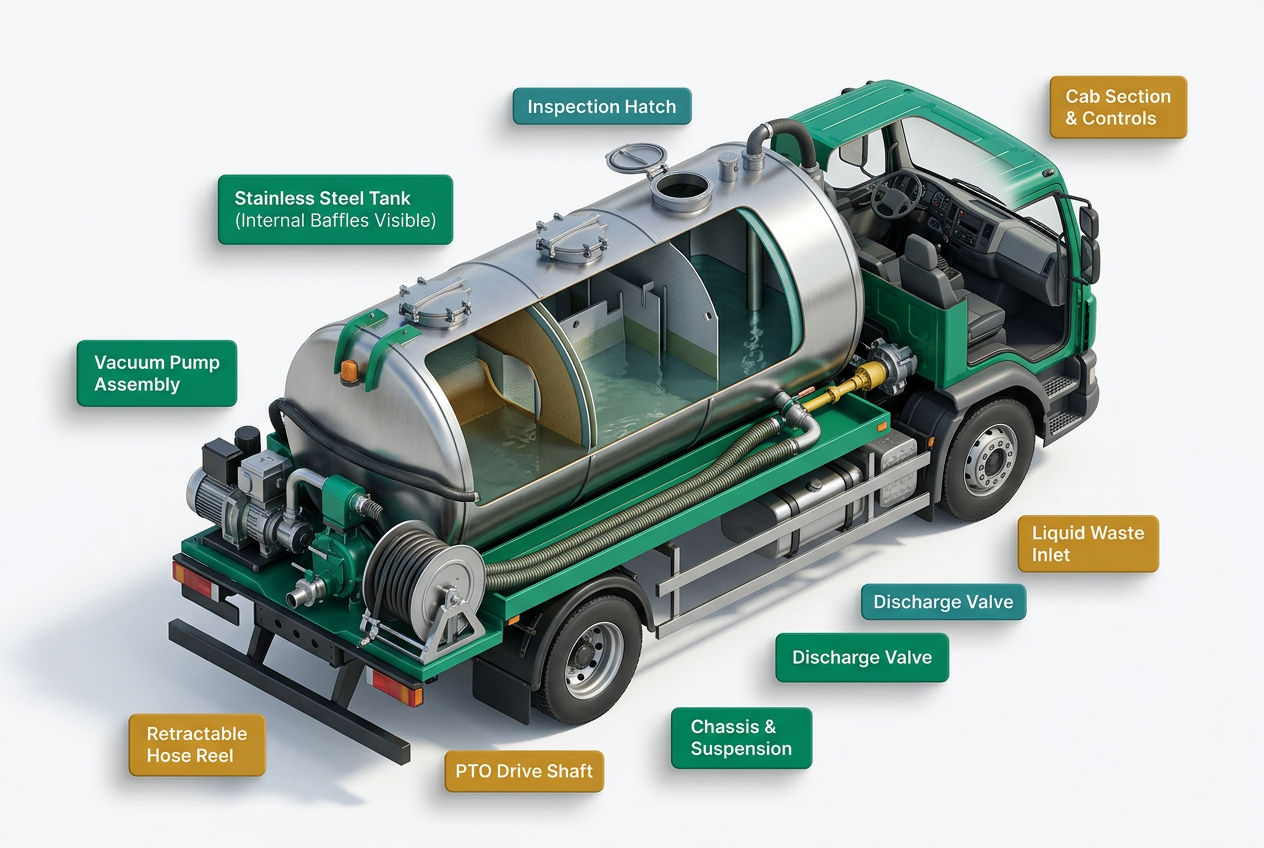
Think of it as an industrial wet-vac bolted to a semi-truck. When the operator engages the PTO, the vacuum pump pulls air from the tank, creating negative pressure. That pressure differential is what drags the waste up the hose and into the truck's holding tank.
Septic trucks are different from standard vacuum trucks, though the two terms overlap. A vacuum truck is the broader category — it includes grease trap trucks, hydro-jetters, and industrial vac units. A septic pumper truck is a vacuum truck configured specifically for residential and commercial wastewater. It typically has a smaller, lighter tank, a longer hose reel, and fittings sized for septic access lids.
To understand why these trucks matter, it helps to know how a septic system works. Solids settle at the bottom as sludge. Grease and lighter material float to the top as scum. The liquid layer in the middle — effluent — flows out to the drain field. The problem? Sludge and scum keep building. Without pumping, they eventually overflow into the effluent and clog the drain field. That's a $5,000–$25,000 drain field replacement. The septic truck is what prevents that.
How Does a Septic Truck Work?
A septic truck works by generating a vacuum inside its holding tank, then routing that vacuum through a suction hose dropped into your septic tank's access opening. The resulting pressure difference — typically equivalent to 25–27 inches of mercury — pulls liquids, sludge, and semi-solid material up through the 4-inch hose at rates of 150–300 gallons per minute on a well-maintained unit.
Here's what actually happens during a septic tank pumping service call:
- Locate and expose the lid. The technician finds your tank lid — ideally a riser lid already at grade, otherwise they'll probe or use your permit records to dig it up.
- Inspect before pumping. A good operator checks the inlet and outlet baffles, looks at the scum and sludge layers with a sludge judge (a clear acrylic tube), and notes any cracks or effluent filter issues. Polylok PL-122 effluent filters, for example, should be cleaned at every pump-out.
- Set the hose. The 4-inch suction hose drops into the tank. Some operators start with the liquid layer to reduce truck weight before attacking the sludge.
- Engage the PTO and pump. The vacuum pump runs — generating 400–800 CFM on a typical residential rig — and waste transfers into the truck's sealed holding tank.
- Backflush if needed. Some operators spray clean water back through the hose to break up compacted sludge or rinse tank walls. This is optional but worth asking about on tanks that haven't been pumped in 5+ years.
- Inspect and close. The operator checks baffle walls one more time, replaces any effluent filter, reseals the lid, and completes a service manifest.
The truck then hauls the waste to a licensed treatment facility — not a field, not a ditch. In Minnesota, for example, the MPCA requires licensed pumpers to file a disposal manifest with the county after every service. Similar requirements exist across most states, so be wary of any operator who can't produce documentation.
What Are the Different Types of Septic Trucks?
Not every truck you see pulling up to a tank lid is doing the same job. Equipment varies significantly by application.
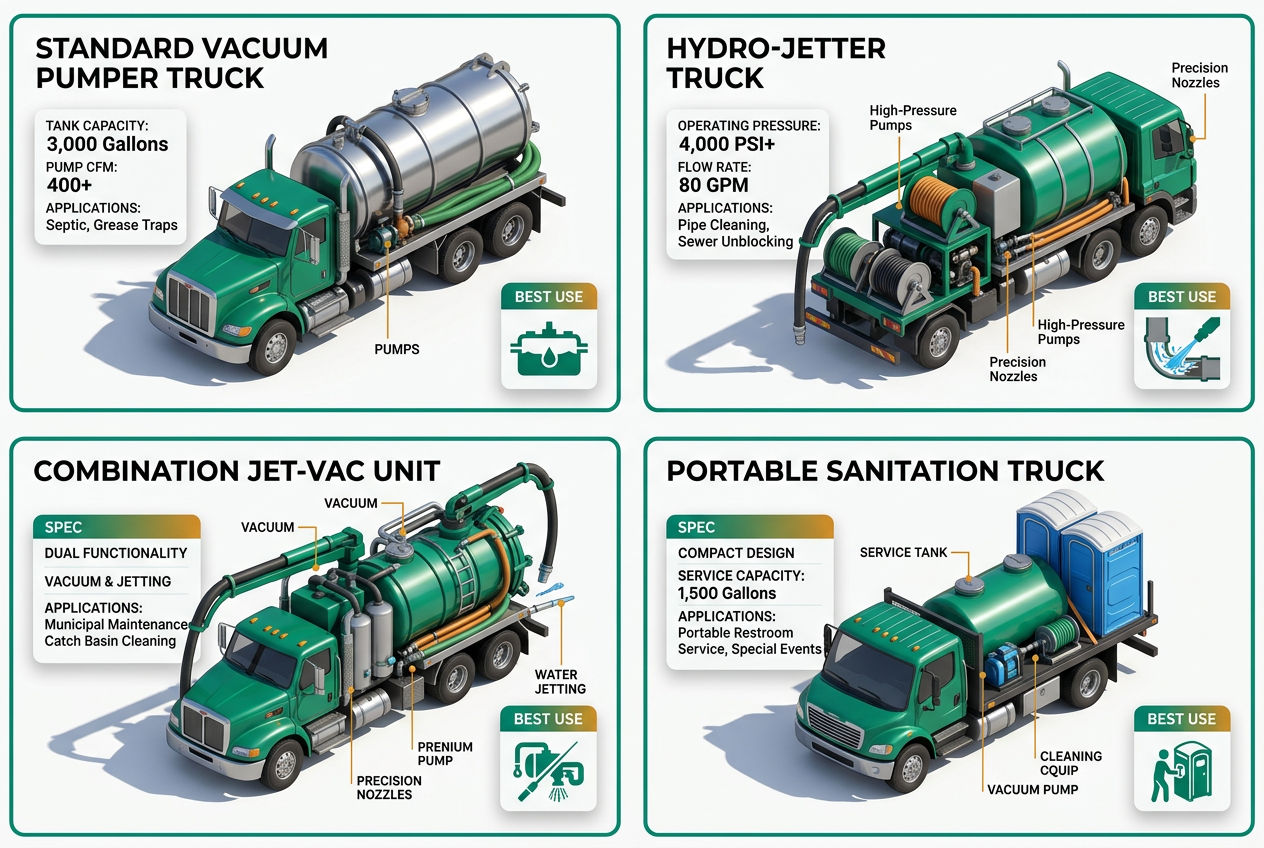
Standard septic pumper truck. The most common type. A tank truck chassis — often an International HX series, Peterbilt 348, Kenworth T370, or Ford F-750 for smaller builds — carrying a 2,000–4,000 gallon aluminum or steel tank. This is what shows up for your routine residential pump-out.
Combination jetter/vac truck. These rigs carry both a high-pressure water pump (for hydro-jetting drain lines) and a vacuum system. More expensive to operate but useful for contractors handling drain field line cleaning alongside pumping.
Cesspool truck. Functionally similar to a septic pumper, but often built with a larger tank (5,000–10,000 gallons) for the denser, older-style cesspools common in the Northeast. If you're on a cesspool rather than a septic tank, confirm your provider has the right equipment.
Grease trap truck. A vacuum truck configured for commercial food service grease interceptors. The tanks are often heated to keep grease from solidifying. Not interchangeable with a septic pumper for most purposes — though some multi-service companies run dual-purpose setups. Learn more about grease trap pumping services.
Industrial vacuum truck. Heavy-duty units with 6,000–10,000+ gallon tanks and 1,200+ CFM vacuum pumps. Used for municipal sewage, large commercial systems, and industrial waste — not typical residential service.
Septic Truck Specifications: What the Numbers Mean
If you're hiring a service or buying equipment, these specs matter.
| Spec | Residential Truck | Commercial/Industrial |
|---|---|---|
| Tank Capacity | 1,500–5,000 gal | 5,000–10,000+ gal |
| Vacuum Output | 400–800 CFM | 800–1,200+ CFM |
| Suction Hose Dia. | 4 inches | 4–6 inches |
| Hose Reel Length | 50–100 ft | 100–200 ft |
| Loaded Weight | 30,000–50,000 lbs | 60,000–80,000 lbs |
Sources: NOWRA equipment guidelines; manufacturer specs from Imperial Industries and Guzzler Manufacturing.
Why does loaded weight matter to you as a homeowner? A truck hauling 4,000 gallons of waste weighs roughly 50,000 lbs before you count the chassis itself. A fully loaded 6,000-gallon commercial unit can hit 80,000 lbs. Standard residential concrete driveways are engineered for vehicles under 8,000 lbs. Running a septic truck over an older or thin-poured driveway can crack slabs or leave ruts in asphalt. If your driveway is borderline, mention it when you book. Good operators know how to position or use boards to distribute weight.
How Much Does It Cost to Hire a Septic Pumping Truck?
A standard pump-out for a 1,000-gallon residential tank costs $300–$600 nationally, with most companies landing in the $350–$450 range for straightforward access. Larger tanks, difficult access, or add-on services push costs higher. See our full septic pumping cost guide for a detailed breakdown by region and tank size.

Real-world example: A 1,500-gallon concrete tank in suburban Atlanta with easy driveway access runs about $375–$450. That same tank on a rural property in northern Michigan — where the pumper drives 45 minutes each way and the ground is still soft from snowmelt — might run $500–$650. Distance, disposal fees, and seasonal demand all factor in.
Additional costs to know:
- Effluent filter cleaning: Usually included or $25–$50 extra
- Riser installation (so they never have to dig again): $200–$600 depending on depth
- Emergency/after-hours call: $150–$300 surcharge above the base rate
- Tanks over 1,500 gallons: Expect $0.10–$0.20 per gallon as a rough benchmark
Booking in early fall — before the ground freezes and before the spring rush — often saves you $50–$100 and gets you a faster appointment. Our emergency septic service page covers what to do if you can't wait.
How Often Do You Need a Septic Truck?
The EPA recommends septic tank pumping every 3–5 years for most households. But that's a starting point, not a universal rule.
A 1,000-gallon tank serving 2 people needs pumping roughly every 5–6 years. The same tank serving 4 people needs pumping every 3–4 years. Add a garbage disposal, and drop that interval by 12–18 months — ground food waste accelerates sludge accumulation significantly. Our dedicated guide on how often to pump a septic tank includes a full chart by tank size and household size.
If you're seeing any of these signs, don't wait for your scheduled interval:
- Slow drains throughout the house (not just one fixture)
- Gurgling sounds from toilets or drains
- Wet, spongy ground over the tank or drain field
- Sewage odor inside or outside the house
Those are signs your septic tank needs pumping now, not next spring.
What Happens During a Septic Service Call?

Septic Business Blueprint
Thinking about starting your own septic business?
The complete, plain-English playbook to start (or buy), license and grow a profitable septic business — the models, the money math, trucks, disposal, insurance, pricing and how to land your first customers.
Get the Blueprint — $297 →Instant access · 12-chapter playbook + 6-piece toolkit · 60-day money-back guaranteeMost homeowners have never watched the process closely. Here's what a professional pump-out looks like from driveway to departure.
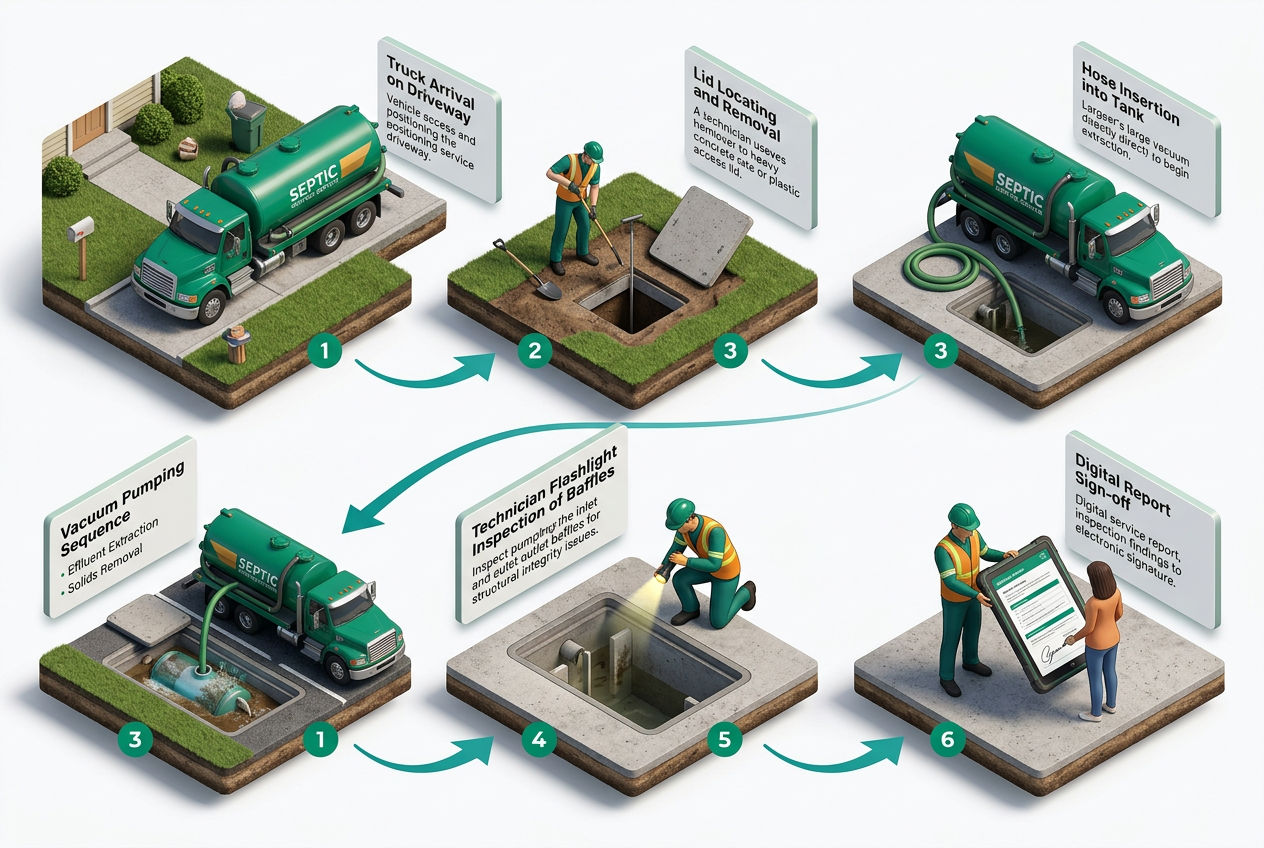
The truck arrives and the operator asks where the tank is. If you have a riser lid at grade, this is fast. If not, they'll probe or reference your permit records to locate it. Digging up a buried lid adds $50–$150 to the invoice, which is exactly why septic tank risers are worth installing once.
After exposure, a competent technician doesn't just jam the hose in and start the pump. They look. They check the inlet baffle — is it intact or collapsed? They measure the sludge layer with a sludge judge. They note whether effluent is the right color (gray-green is normal; dark brown with solids is a problem). They check whether the outlet baffle or effluent filter is intact.
Then they pump. A 1,000-gallon tank typically empties in 20–45 minutes. A 1,500-gallon tank might take 45–75 minutes. Access issues — a tank buried deeper than 24 inches, a lid that's cracked and needs replacement, roots in the access pipe — add time and cost. Read our full breakdown of how long septic pumping takes for a more detailed look.
When it's done, the operator should tell you the condition of your baffles, roughly how much sludge was present, and when they'd recommend the next service. If they just pump and leave without a word, that's a red flag.
Septic Trucks for Business Owners: Buying, Leasing, and Starting Out
About 21 million U.S. homes use septic systems, according to the EPA. The septic pumping industry generates roughly $5 billion annually (IBISWorld). A single truck running 10 jobs per day at $400 average brings in $4,000/day in gross revenue. The math is attractive — but the startup costs are real.
New septic truck prices range from $80,000 to $250,000 depending on chassis, tank size, and vacuum system brand. A mid-spec International HX515 chassis with a 3,500-gallon aluminum tank and a Fruitland RCF 400 vacuum pump — a common entry-level commercial setup — will run $110,000–$145,000 from a dealer like Imperial Industries or Lely Tank & Pumpenfabrik.
Used trucks range from $30,000 to $100,000. Budget $5,000–$15,000 for inspection, potential seal replacement, and hose reel servicing before the first job. Trucks last 10–20 years with proper maintenance, so a 7-year-old rig with documented service history is often a solid buy.
Operating costs per truck:
- Diesel fuel: 6–10 MPG on a loaded heavy chassis, roughly $150–$300/day in fuel
- Liability insurance: $8,000–$18,000/year depending on state and coverage limits
- Disposal fees: $25–$75 per load at the treatment facility
For a full startup cost breakdown, see our septic business startup costs guide. Our how to run a septic business pillar covers everything from licensing to routing software. And if you're evaluating whether this is the right move, is a septic business profitable? gives you the honest numbers.
Licensing requirements vary by state. Florida requires a Registered Septic Tank Contractor (RSTC) license through the Department of Health. Texas delegates septic contractor oversight to county-level Designated Representatives under TCEQ rules. Check our septic business license requirements guide for state-by-state details.
Seasonal and Regional Considerations
Septic trucks don't operate the same way year-round or in every climate.
Spring is peak demand season in cold-climate states. Frozen ground thaws, revealing systems that backed up over winter. Drain fields saturated from snowmelt can't absorb effluent properly. Heavy rainfall and septic systems is a topic worth reading before spring hits.
Fall is the smart homeowner's window. Demand hasn't peaked yet, pricing is stable, and you're not booking service with the ground frozen. Pumping before winter is especially important if you're in Minnesota, Wisconsin, or Michigan — ground frost can limit truck access from December through March.
Winter creates logistics challenges. In Minnesota, the frost line reaches 42–60 inches in severe winters. Trucks struggle to access systems when the lid is buried under frozen ground. Emergency calls spike in January and February when systems fail under pressure. Preventing septic pipes from freezing covers the protective steps worth taking before the cold sets in.
Southeast and Gulf Coast states have the opposite problem — year-round service is possible, but Florida's Department of Environmental Protection imposes strict rules on waste disposal. Septic waste must go to a licensed treatment facility, and contractors must maintain disposal records. Florida septic regulations details what to expect in that state.
Rural and western states often deal with access challenges. Remote Montana and Wyoming properties may require 100–200 feet of hose reel to reach tanks positioned away from access roads. That extended reach is one reason commercial trucks carry longer hose reels and higher-CFM vacuum systems.
How to Find a Reputable Septic Truck Service
Price matters, but it's not the only thing. A cheap pump-out that misses a cracked baffle or a clogged effluent filter can cost you a $15,000 drain field replacement 18 months later.
When evaluating a septic service company, ask:
- Are you licensed and insured? Ask for the license number and verify it with your state health department.
- Do you provide a written service report? A good operator documents baffle condition, sludge depth, and recommendations.
- Where does the waste go? They should be able to name the licensed treatment facility. Vague answers here are a problem.
- Do you clean effluent filters? If your system has one (common post-2000), it needs cleaning at every pump-out.
NAWT (National Association of Wastewater Technicians) maintains a directory of certified pumpers at nawt.org. NOWRA (National Onsite Wastewater Recycling Association) is another resource at nowra.org.
Ready to find a pro in your area? Search licensed septic pumping companies near you through our directory — every listed contractor has been vetted for licensing in their state.
Sources & Methodology
- U.S. Environmental Protection Agency — Septic Systems Overview (epa.gov/septic): Primary source for household pumping frequency recommendations and national septic system statistics (21 million homes).
- National Association of Wastewater Technicians (NAWT) (nawt.org): Equipment standards, technician certification requirements, and service best practices.
- National Onsite Wastewater Recycling Association (NOWRA) (nowra.org): Industry equipment guidelines and vacuum truck specifications.
- IBISWorld — Septic Tank & Related Services Industry Report: Revenue and market size figures for the U.S. septic pumping industry (~$5 billion annually).
- Minnesota Pollution Control Agency (MPCA): State-specific disposal manifest requirements for licensed septic pumpers; referenced for regulatory accuracy in cold-climate contexts.
- Manufacturer specifications: Tank capacity, CFM, and chassis data referenced from Imperial Industries, Lely Tank & Pumpenfabrik, and Fruitland Manufacturing product documentation.
Frequently Asked Questions
Q: How does a septic pumper truck work mechanically?
A septic pumper truck uses a vacuum pump driven by the truck engine's power take-off (PTO) to create negative pressure inside the sealed holding tank. That pressure difference — typically 25–27 inches of mercury — draws waste up through a 4-inch suction hose and into the truck. Residential trucks generate 400–800 CFM of suction, enough to empty a 1,000-gallon tank in 20–45 minutes. The holding tank is sealed and pressurized for transport. At the end of the route, the operator offloads at a licensed treatment facility, where the waste enters the municipal treatment process. The truck is then rinsed and ready for the next day's jobs.
Q: How many gallons can a septic truck hold?
Residential septic trucks typically hold 1,500–5,000 gallons. The most common size for suburban service routes is 2,500–3,500 gallons — large enough to handle two or three standard pump-outs before returning to the treatment facility. Commercial and industrial vacuum trucks hold 5,000–10,000+ gallons and are used for large-scale municipal or industrial jobs. Tank material is usually steel or aluminum. A 3,000-gallon aluminum tank weighs roughly 1,800 lbs empty; fully loaded with septic waste (which weighs about 8.3 lbs per gallon), that's nearly 27,000 lbs of cargo alone — which is why loaded trucks can exceed 60,000 lbs on the road.
Q: What is the difference between a septic truck and a vacuum truck?
A vacuum truck is the broad equipment category — any truck using suction to move liquid or semi-solid material. A septic pumper truck is a vacuum truck specifically designed for residential and commercial wastewater removal. The distinction matters because configuration varies: septic pumpers use 4-inch hoses, mid-range CFM pumps, and sealed tanks optimized for organic waste. Other vacuum trucks — like hydro-jetters, grease trap trucks, or industrial vac units — have different hose diameters, pump ratings, and tank designs suited to their specific applications. Some multi-service companies run combination rigs, but a true septic pumper is purpose-built for tank service.
Q: How much does a honey wagon cost to hire?
"Honey wagon" is the old-school colloquial term for a septic pumper truck, and hiring one costs $300–$600 nationally for a standard 1,000–1,500 gallon residential tank. Variables that push the price higher include rural location (longer drive time), tanks buried deeper than 24 inches (requiring excavation), after-hours or emergency service ($150–$300 surcharge), and tanks larger than 1,500 gallons (often priced at $0.10–$0.20 per gallon). A 2,500-gallon tank in a remote area could reasonably run $700–$900. Some companies charge a flat fee; others use per-gallon pricing. Always ask for an itemized quote so you know what's included — specifically whether effluent filter cleaning and a written service report are part of the base price.
Q: What should I know before starting a septic pumping business with a pump truck?
Starting a septic pumping business requires a licensed truck, state-issued contractor licensing, and a disposal agreement with a licensed treatment facility — you can't just pump waste and dump it anywhere. A new pump truck costs $80,000–$250,000; used units run $30,000–$100,000. Licensing requirements vary by state: Florida requires a Registered Septic Tank Contractor (RSTC) license through the Department of Health, while Texas routes oversight through county-level TCEQ representatives. Operating costs include diesel (6–10 MPG loaded), liability insurance ($8,000–$18,000/year), and disposal fees ($25–$75 per load). A single truck handling 10 jobs per day at $400 average generates $4,000 in daily gross revenue. Our full septic pumping business startup guide covers every step in detail.
Was this article helpful?
Frequently Asked Questions
Recommended Resources
📖 Related Articles
- Vacuum Truck: The Complete Guide
- What Is a Septic System? How It Works (Visual Guide)
- How Are Septic Tanks Pumped? The Complete Process
- Cesspool vs Septic Tank: Differences & What Replaces a Cesspool
- How Often Should You Pump Your Septic Tank?
- 8 Signs Your Septic Tank Needs to Be Pumped
- How to Install Septic Tank Risers (and Why You Should)
- Septic Effluent Filters: Do You Need One?
- How Long Does It Take to Pump a Septic Tank?
- Septic Business Startup Cost: 2026 Price Guide
- How to Run a Septic Business: Operations, Pricing & Growth
- Is a Septic Business Profitable? Real Owner Salary & Margins
- Septic Business License: The Complete Guide
- Heavy Rain and Septic Systems: What Happens and What to Do
- Freezing Pipes and Septic: How to Prevent Winter Damage
- How to Choose a Septic Service Company: 8 Questions to Ask
- Septic Pumping Business: The Complete Guide
💰 Cost Guides
Find Septic Professionals Near You
Compare licensed, verified septic companies by area — top county markets and cities below, or browse all 50 states.
County markets
Popular cities
