
Quick Answer
Porta potty rental cost runs $75–$150 per day for a standard unit in 2026, with monthly construction site rentals averaging $125–$225. Luxury restroom trailers and ADA-accessible units cost more. Delivery, pump-out service, and fuel surcharges add to the final bill. Prices vary by region, season, and rental duration.
Key Takeaways
- Standard porta potty rentals cost $75–$150/day or $125–$225/month for construction sites
- ADA-accessible units run 25–35% more than standard units
- Delivery, pump-out, and fuel surcharges can add $135–$390 to your total
- Summer and holiday weekends often trigger 15–25% price increases
- Plan 1 unit per 50 guests for a 4-hour event; add 20% more if alcohol is served
How Much Does a Porta Potty Rental Cost Per Day?
A standard portable toilet rental costs $75–$150 per day in 2026. That rate typically covers the unit itself, one initial service, and basic supplies like hand sanitizer. Delivery and pickup are usually billed separately.
If you need an ADA-compliant unit, budget $100–$200 per day. Luxury flushable units push that to $175–$300 per day.
Here's what's driving the spread in that range: your location, the vendor's fleet availability, and how far the truck has to drive. A single-day portable toilet rental in suburban Atlanta might run $85. The same unit in rural Vermont could hit $140 before the delivery fee even hits the invoice.
For a weekend porta potty rental (2–3 days), expect $150–$250 for standard units. That's often a better deal than paying the per-day rate twice, so always ask vendors about weekend pricing packages. According to the Portable Sanitation Association International (PSAI), weekend package pricing saves customers an average of 18% compared to booking two consecutive single-day rates.
2026 Portable Toilet Rental Price by Unit Type
| Unit Type | Per Day | Per Weekend | Per Month |
|---|---|---|---|
| Standard porta potty | $75–$150 | $150–$250 | $125–$225 |
| ADA/handicap-accessible unit | $100–$200 | $175–$325 | $150–$275 |
| Luxury flushable unit | $175–$300 | $300–$800 | $500–$1,500 |
| Restroom trailer (2-stall) | — | $500–$1,200 | — |
| Restroom trailer (4–6 stall) | — | $1,000–$3,500 | — |
| Hand-washing station add-on | $50–$100 | $75–$150 | $50–$100 |
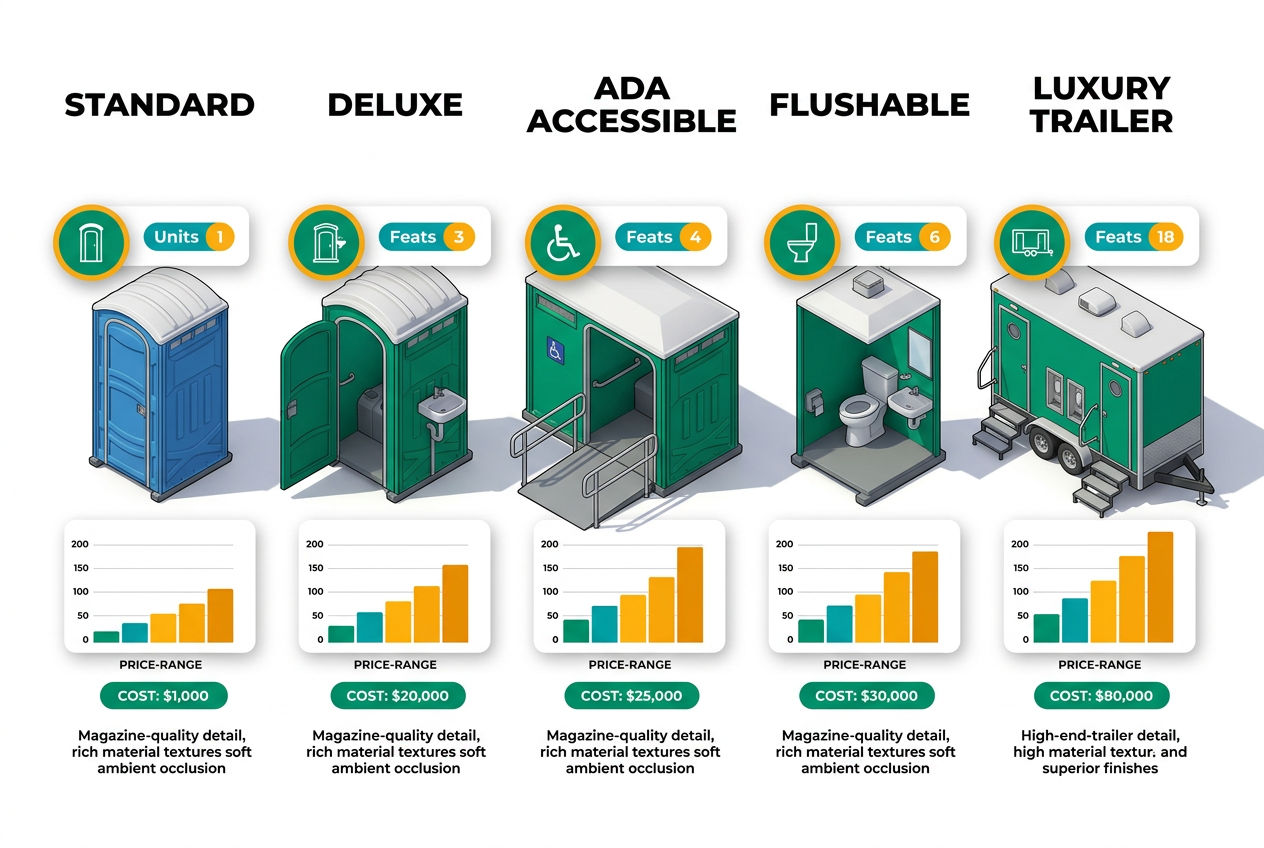
Pricing reflects 2026 national market averages. Rates vary by region and vendor. Always request itemized quotes from at least three local companies.
What Is Included in a Standard Porta Potty Rental?
A standard portable restroom rental covers the unit, initial delivery, one scheduled servicing, and basic consumables — toilet paper and hand sanitizer. That's it. The tank holds roughly 60–70 gallons of waste before it needs pumping.
What it does not include: electricity, running water, flushing, or climate control. You get a fiberglass or polyethylene enclosure, a seat, a holding tank, and a vent pipe. For outdoor events or job sites, that's usually enough. For a wedding or corporate event, you'll want to upgrade.
ADA-compliant units — sometimes marketed under brand names like the PolyJohn PC3000 or the NovaCan Titan ADA — are wider: typically 5 feet by 5 feet, with interior handrails, lower seat height, and a non-slip floor. OSHA's sanitation standards (29 CFR 1926.51) require at least one handicap-accessible unit for most commercial job sites, so this isn't just an upgrade — it's often a legal requirement.
Important limitation to acknowledge: Vendor pricing for "standard" units varies significantly in what's actually included. One company's base quote may include a weekly pump-out; another's may not. Always request an itemized quote rather than relying on a headline price. The per-day rates in this guide reflect the unit-only cost in most markets — delivery and service fees are almost always additional.
How Much Does a Porta Potty Rental Cost Per Month for a Construction Site?
Construction porta potty rental runs $125–$225 per month per unit in 2026, making it one of the most cost-effective sanitation options for long-term job sites. That monthly rate usually includes one weekly servicing visit, which covers pump-out, cleaning, and restocking supplies.
According to OSHA (29 CFR 1926.51), job sites with fewer than 200 employees must provide a minimum of one toilet per 20 workers. A crew of 20 workers needs one unit. A crew of 60 needs three. Run that math before you call a vendor.
California construction sites face stricter compliance costs under Cal/OSHA Title 8, Section 1526 — one reason portable restroom rental costs in California run 15–30% above the national average. High-rise and multi-story construction requires specialty units with roll-on/roll-off capability; those run $100–$200 per month on top of standard unit costs.
Servicing frequency matters. At standard usage, porta potties on construction sites need pump-out every 7–10 days. A crew working overtime in July heat may need twice-weekly service — and that adds up fast. Each pump-out visit costs $75–$150, so build that into your monthly budget from day one.
Worked example — 40-person construction crew, 3-month project:
- Units required (OSHA): 2 standard + 1 ADA = 3 units
- Monthly unit cost: 2 × $175 + 1 × $225 = $575/month
- Weekly pump-out (4 visits/month × 3 units × $100): $1,200/month
- Delivery/pickup (one-time): $300
- 3-month total estimate: ($575 + $1,200) × 3 + $300 = $5,625
That figure is consistent with what construction project managers report paying in mid-Atlantic and Midwest markets. Costs in coastal metros like San Francisco or Boston run 20–35% higher.
For more on what running a portable sanitation service actually looks like on the business side, see our guide on how to run a septic business. And if you're comparing portable toilet options against permanent restroom access for longer projects, our portable restroom cost comparison guide covers the full spectrum.
What Are the Extra Fees for Porta Potty Rentals?
Extra fees are where porta potty quotes go sideways. Here's every line item you might see on an invoice:
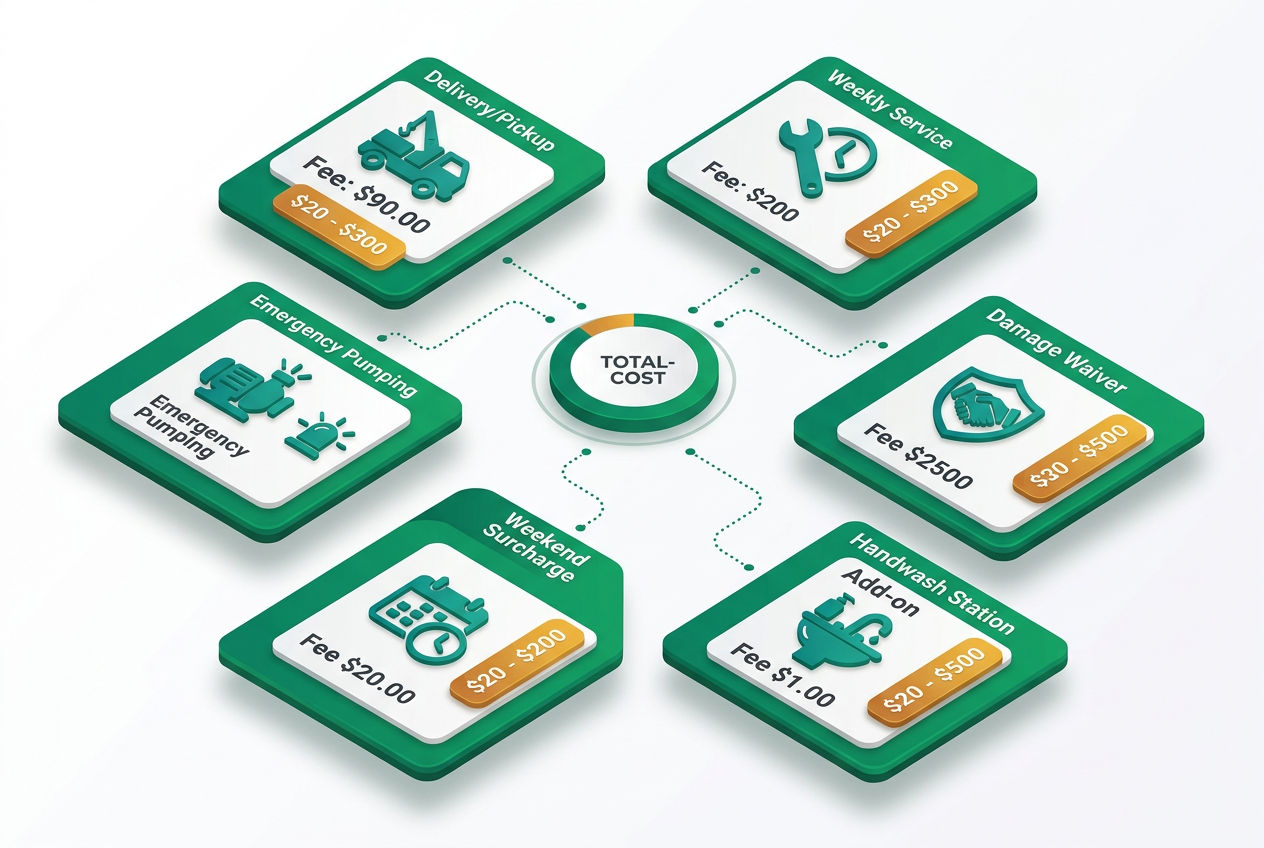
Delivery and pickup fee: $50–$200, depending on distance. A vendor 5 miles away charges less than one making a 40-mile round trip. Some companies bake this into their quoted rate. Most don't.
Pump-out / servicing fee: $75–$150 per visit. For a single-day event, this is often included. For a month-long construction rental, you'll pay for each scheduled service visit.
Cleaning and restocking fee: $25–$75 per visit, sometimes bundled with pump-out, sometimes not. Always ask.
Emergency or after-hours service: Add a 25–50% surcharge. If your unit overflows at 8 p.m. on a Friday before a Saturday event, you're paying premium rates.
Fuel surcharge: $10–$40 per delivery. With diesel prices volatile in 2026, many vendors have added this as a standard line item.
Damage or replacement fee: $200–$500+. This covers vandalism, tipping, or chemical damage. Most vendors require a credit card on file.
Permit fee for street placement: $50–$200 per unit in urban areas. Placing a unit on a public street or sidewalk in cities like New York, Boston, or Chicago requires a permit. That cost usually gets passed to you.
Ask for an itemized quote — not a ballpark — before signing anything. For a broader look at what portable sanitation businesses charge across service categories, see our porta potty business cost breakdown.
How Many Porta Potties Do You Need for an Event?
The industry standard is one porta potty per 50 guests for a 4-hour outdoor event. That's the baseline. Several factors push that number higher.
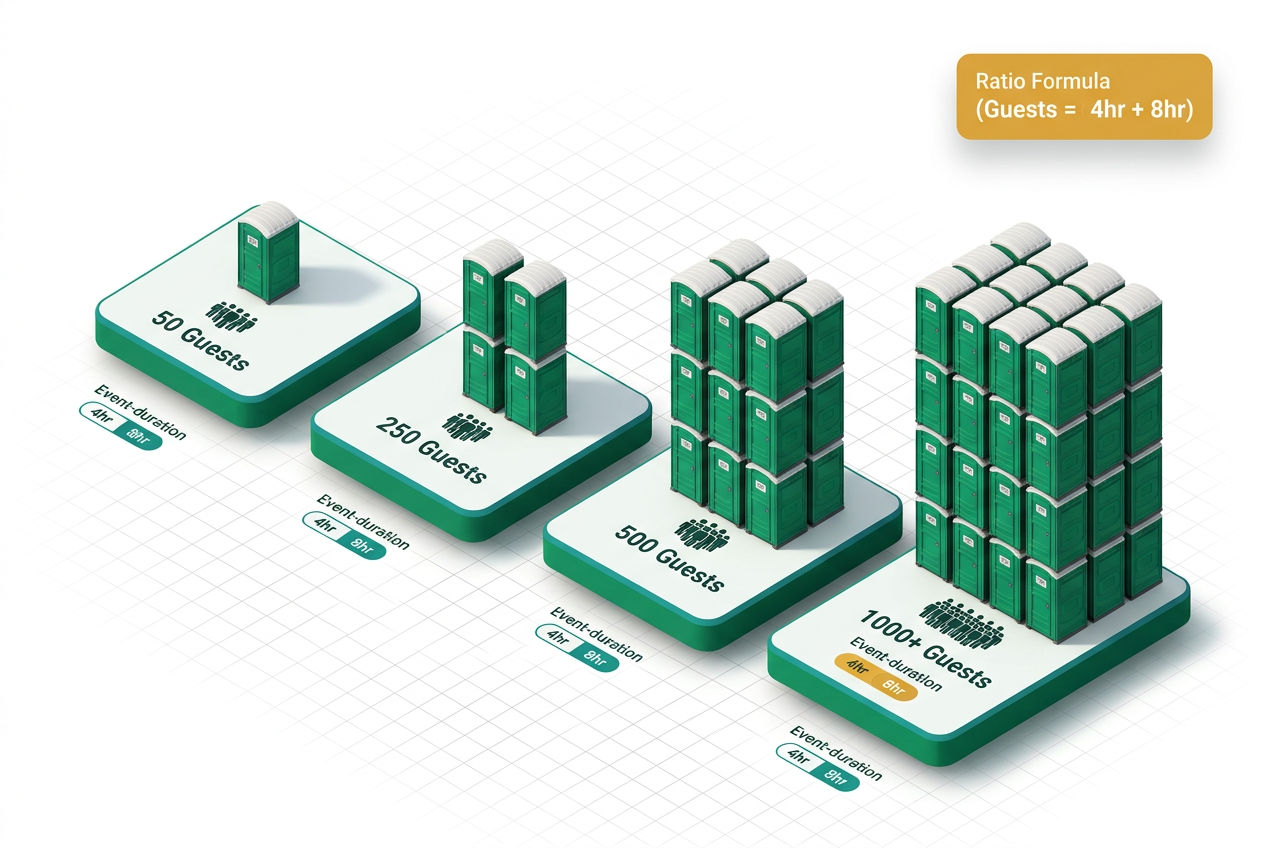
If alcohol is being served: Add 20% more units. Alcohol increases restroom use frequency significantly. A 200-person event would normally need 4 units. Add alcohol, and you need 5.
ADA compliance: Plan for at least one ADA-accessible portable restroom per 20 standard units. For a 200-person event with 4 standard units, add 1 ADA unit — minimum.
Event duration: The 1-per-50 rule applies to 4-hour events. Extend the event past 4 hours and either add units or schedule a mid-event pump-out.
Women vs. mixed attendance: Women statistically take longer per restroom visit. According to PSAI usage guidelines, events with majority female attendance should lean toward 1 unit per 40 guests.
Worked example — outdoor wedding reception: You're hosting a 300-person outdoor wedding reception: 5 hours, open bar, 60% female attendance.
- Base calculation: 300 ÷ 50 = 6 standard units
- Female-skew adjustment: Bump to 1 per 40 for 60% of guests → round up to 7 units
- Alcohol surcharge (+20%): 7 × 1.2 = 8–9 units
- ADA requirement: Add 1 ADA unit (minimum)
- Total: 9–10 units
At $150 per unit for a weekend rental, that's $1,350–$1,500 in unit costs before delivery, fees, or optional hand-washing stations. Add $200–$400 for delivery and you're looking at $1,550–$1,900 total — a realistic budget anchor for a mid-size outdoor reception.
For detailed sanitation planning guidance, our portable restroom planning guide breaks event-specific unit counts down further by event type.
What Is the Difference Between a Standard and Luxury Porta Potty Rental?

Septic Business Blueprint
Thinking about starting your own septic business?
The complete, plain-English playbook to start (or buy), license and grow a profitable septic business — the models, the money math, trucks, disposal, insurance, pricing and how to land your first customers.
Get the Blueprint — $297 →Instant access · 12-chapter playbook + 6-piece toolkit · 60-day money-back guaranteeStandard and luxury units serve completely different use cases — and the price difference reflects that.
A standard portable toilet is a single-occupancy plastic enclosure. No running water. No flush. Waste drops into a holding tank treated with blue deodorizing chemical (typically formaldehyde-free in 2026, following EPA guidance on portable sanitation waste treatment chemicals). They're rugged, stackable on a truck, and cheap. They're appropriate for construction sites, road crews, and casual outdoor events.
A luxury flushable portable toilet has a fresh-water tank, a foot-pump or electric flush, a sink with running water, interior lighting, a mirror, and a climate control vent. Some units include wood-grain paneling and tile flooring. These cost $175–$300 per day and are appropriate for weddings, corporate events, and VIP areas at festivals.
Restroom trailers are a different category entirely. A 2-stall trailer runs $500–$1,200 per weekend. A 4–6 stall trailer runs $1,000–$3,500 per weekend. These are towable units with generators, climate control, full flushing toilets, vanity mirrors, and interior design that matches a hotel restroom. If you've ever used a nice portable restroom at a vineyard wedding, that was a restroom trailer.
The right choice depends on your guest expectations and budget — not just headcount. You can explore the full comparison in our restroom trailer rental guide.
How Do Seasons and Regions Affect Portable Restroom Rental Cost?
Seasonal pricing is real. Summer (June–August) is peak demand season. Festivals, construction, weddings, and outdoor concerts all compete for the same fleet. Prices can run 15–25% above base rates during peak summer weeks. Book 4–6 weeks ahead for spring events and 6–8 weeks ahead for summer.
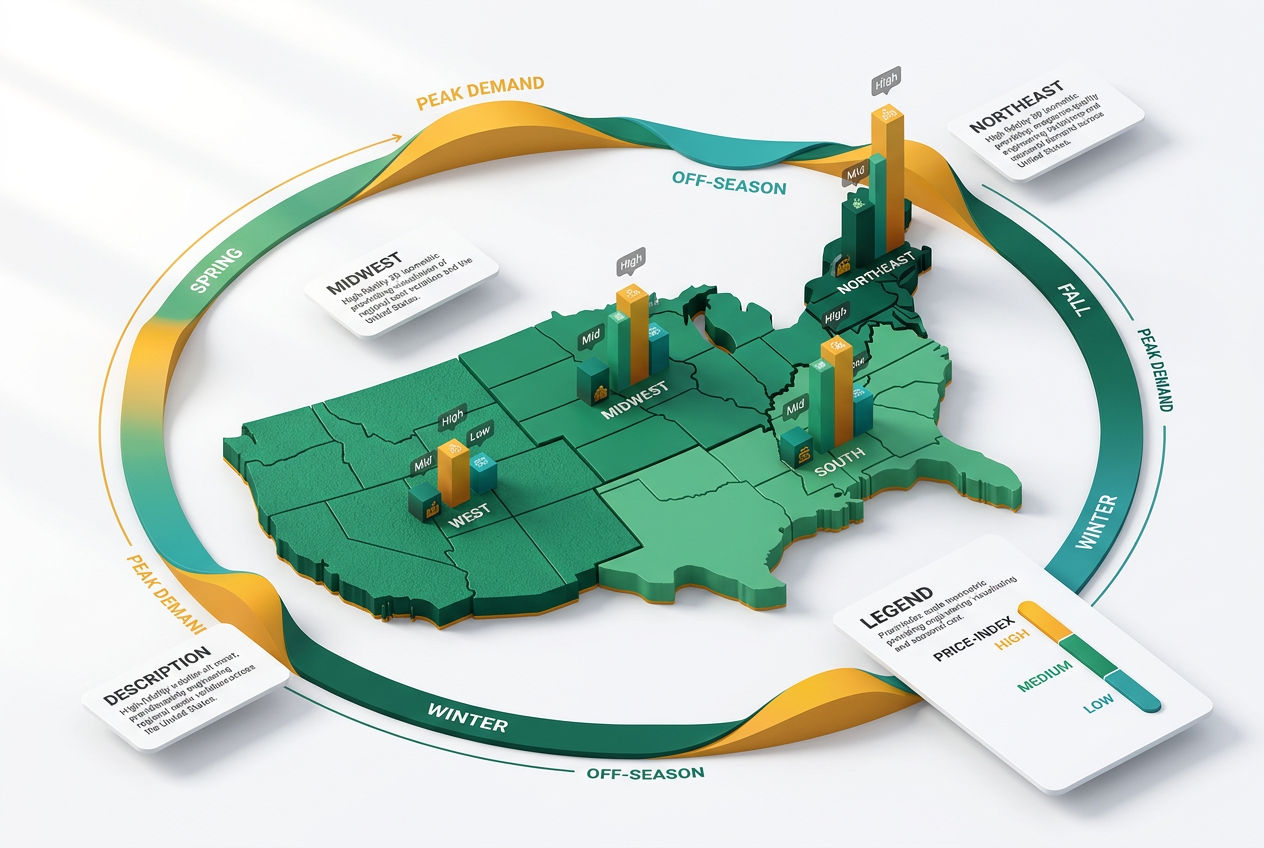
Memorial Day, July 4th, and Labor Day weekends frequently trigger surge pricing. If a vendor tells you they're "sold out," that's not a sales pitch — most regional fleets genuinely max out during holiday weekends.
Regional price variation is equally significant. According to PSAI regional market data, portable toilet rental prices in the Northeast and West Coast run 20–35% above the national average. The South and Midwest tend to be 10–15% below. Here's a rough breakdown:
| Region | Monthly Construction Rate | Notes |
|---|---|---|
| Northeast (NY, MA, CT) | $175–$300 | High labor, permit, and disposal costs |
| West Coast (CA, OR, WA) | $160–$275 | Cal/OSHA adds compliance overhead |
| Southeast (GA, FL, NC) | $110–$190 | Competitive market, lower labor costs |
| Midwest (IL, OH, MI) | $115–$195 | Moderate pricing, strong vendor competition |
| Mountain West (CO, UT) | $130–$220 | Remote site access drives delivery costs |
For insight into how regional sanitation businesses structure their service pricing, see our guide on how to run a septic business.
How to Save Money on Portable Toilet Rental
The cheapest porta potty rental isn't always the best value — but there's real money to save if you know where to look.
Bundle units and services. Vendors discount when you rent multiple units. Renting 5 units from one vendor typically costs 10–15% less per unit than renting 5 units from five vendors.
Avoid peak windows. Renting for a September outdoor event instead of a July one can save 15–20% on the same unit. If your event date is flexible, use that flexibility.
Negotiate service frequency. On long construction rentals, ask whether bi-weekly pump-out is sufficient for your crew size. Dropping from weekly to bi-weekly service on a 3-unit rental saves $600–$900 over a 3-month project.
Ask about off-season rates. Many vendors offer 10–15% discounts for rentals booked January through March. Even if your event is in May, locking in a contract in February at the off-season rate is often allowed.
Compare itemized quotes, not headline prices. A vendor quoting $90/day with delivery included may be cheaper than one quoting $75/day with a $150 delivery fee. Always normalize to total cost before comparing.
For more operational cost-cutting strategies used by professional sanitation companies, our porta potty business operations guide details how vendors structure their pricing — knowledge you can use when negotiating.
Related guides: grease trap services · septic pumping cost
Frequently Asked Questions
What is the average cost to rent a porta potty for a day?
The average porta potty rental cost for a single day is $75–$150 for a standard unit in 2026. That figure covers the unit, basic supplies (toilet paper and hand sanitizer), and one initial service. Delivery and pickup are billed separately and typically add $50–$200 depending on distance. ADA-accessible portable toilet rental runs $100–$200 per day, and luxury flushable units reach $175–$300. If you're pricing a portable restroom for a weekend event, ask vendors about 2–3 day package rates — these usually save 10–18% compared to multiplying the daily rate. According to PSAI market benchmarks, the national median for a basic single-day rental including delivery landed near $115–$125 in 2025, with 2026 pricing holding relatively flat. Always request an itemized quote before committing, because headline daily rates rarely include every fee you'll actually pay.
How much does it cost to rent a porta potty for a month?
Monthly porta potty rental for a construction site runs $125–$225 per unit in 2026. That monthly rate typically includes the unit itself plus one weekly pump-out visit — four service visits per month. Additional pump-outs cost $75–$150 each and are often needed in hot weather or for large crews. OSHA requires one toilet per 20 workers on job sites under 200 employees (29 CFR 1926.51), so a 40-person crew needs two units minimum. At $175/month per unit plus weekly servicing, a two-unit setup costs roughly $1,550–$1,750 per month all-in. California sites governed by Cal/OSHA Title 8, Section 1526 typically pay 15–30% above that figure. For projects lasting three months or longer, negotiate a contract rate — most vendors discount 8–12% for commitments of 90 days or more. See our porta potty business cost breakdown for more on how vendors structure long-term contracts.
How many porta potties do I need for 100 people?
For 100 guests at a standard 4-hour outdoor event, you need 2 standard porta potties. That follows the industry baseline of one unit per 50 guests. Adjust upward if alcohol is served: add 20%, which brings you to 3 units for a 100-person event with an open bar. If your event runs longer than 4 hours, add one unit per additional 2-hour block or schedule a mid-event pump-out. ADA compliance requires at least one accessible portable restroom — add 1 ADA unit regardless of total headcount. Events with predominantly female attendance should use a 1-per-40 ratio, meaning 3 units for 100 guests. Final tally for a 100-person, 5-hour outdoor event with alcohol and mixed attendance: 3 standard units plus 1 ADA unit. At $150 per unit for a weekend rental plus delivery, budget $700–$900 total. Our portable restroom planning guide includes unit calculators by event type.
What is the difference between a standard and luxury porta potty rental?
A standard porta potty costs $75–$150/day and provides a plastic enclosure, holding tank, toilet paper, and hand sanitizer — no running water, no flush, no climate control. A luxury portable toilet rental costs $175–$300/day and includes a fresh-water tank, foot-pump or electric flush, sink with running water, interior lighting, and a mirror. Some luxury units feature wood-grain paneling and tile floors. The right choice depends on your event's expectations: standard units suit construction sites and casual outdoor events; luxury units are appropriate for weddings, corporate functions, and VIP festival areas. Restroom trailers are a third category — towable units with generators, climate control, full flushing, and hotel-quality interiors, ranging from $500 to $3,500 per weekend depending on stall count. According to EPA guidance updated in 2024, standard units now predominantly use formaldehyde-free deodorizing chemicals, which affects tank capacity and pump-out frequency compared to older formulations.
Are there hidden fees in porta potty rental quotes?
Yes — hidden fees are common in portable restroom rental quotes and can add $135–$390 or more to your total. The most frequent add-ons include: delivery and pickup ($50–$200 based on distance), pump-out service fees ($75–$150 per visit beyond what's included), cleaning and restocking charges ($25–$75 per service), fuel surcharges ($10–$40 per trip), emergency or after-hours service premiums (25–50% above standard rates), and street placement permit fees ($50–$200 per unit in cities like New York or Chicago). Damage deposits or credit card holds of $200–$500 are also standard. The single best protection is requesting a fully itemized quote — not a per-day headline price — before signing any rental agreement. Ask specifically: "What is the total cost including delivery, all service visits, and pickup for my rental period?" Vendors who won't provide itemized quotes are a red flag. Our portable toilet cost comparison shows what a clean, transparent quote should look like.
How does porta potty rental cost compare across different regions?
Portable toilet rental costs vary 20–35% between the most expensive and least expensive U.S. regions. The Northeast — particularly New York, Massachusetts, and Connecticut — runs highest, with monthly construction rates of $175–$300 per unit due to high labor costs, strict permitting, and elevated waste disposal fees. The West Coast follows closely at $160–$275/month, driven largely by Cal/OSHA compliance requirements under Title 8, Section 1526. The Southeast (Georgia, Florida, North Carolina) is the most affordable major market at $110–$190/month, with strong vendor competition keeping prices down. The Midwest (Illinois, Ohio, Michigan) runs $115–$195/month. Mountain West markets like Colorado and Utah see $130–$220/month, where remote job site access inflates delivery costs significantly. For single-day event rentals, the same regional spread applies — a $100/day quote in Atlanta might cost $135–$140/day for the same unit in Boston. Always get quotes from local vendors rather than national brokers, who often mark up regional rates by 10–20%.
Sources
- OSHA Sanitation Standards: 29 CFR 1926.51 — osha.gov
- Cal/OSHA Portable Toilet Requirements: Title 8, Section 1526 — dir.ca.gov
- Portable Sanitation Association International (PSAI) — Industry pricing benchmarks and usage guidelines — psai.org
- EPA Guidance on Portable Sanitation Waste Treatment Chemicals (2024 update) — epa.gov
Was this article helpful?
Frequently Asked Questions
Recommended Resources
Find Septic Professionals Near You
Compare licensed, verified septic companies by area — top county markets and cities below, or browse all 50 states.
County markets
Popular cities
