
Quick Answer
How much does a porta potty cost? A standard portable toilet rental costs $75–$175 for a weekend, $100–$225 per week, or $150–$400 per month in 2026. Luxury restroom trailers start at $500 per day. Delivery fees add $50–$150 per order, and peak-season surcharges can push prices 20–30% above baseline.
Renting a porta potty seems simple until you start getting quotes that range from $100 to $1,500 for the same weekend event. That gap isn't random — it's driven by unit type, rental duration, delivery distance, and whether your event falls on Memorial Day weekend or a slow Tuesday in February. This guide breaks down real 2026 porta potty rental costs by unit type, use case, and region, so you can budget accurately before you call a single vendor.
Key Takeaways
- Standard porta potty rentals cost $75–$175 for 1–3 days, $100–$225/week, or $150–$400/month
- ADA-compliant units cost 15–30% more than standard units
- Luxury restroom trailers start at $500/day and can exceed $1,500/day
- Delivery fees typically add $50–$150 per rental
- OSHA requires 1 unit per 10 workers on construction sites for shifts under 8 hours
2026 Porta Potty Rental Prices at a Glance
Before getting into the details, here's the full pricing snapshot. These are national averages sourced from PSAI (Portable Sanitation Association International) industry benchmarks and vendor data collected in late 2025.
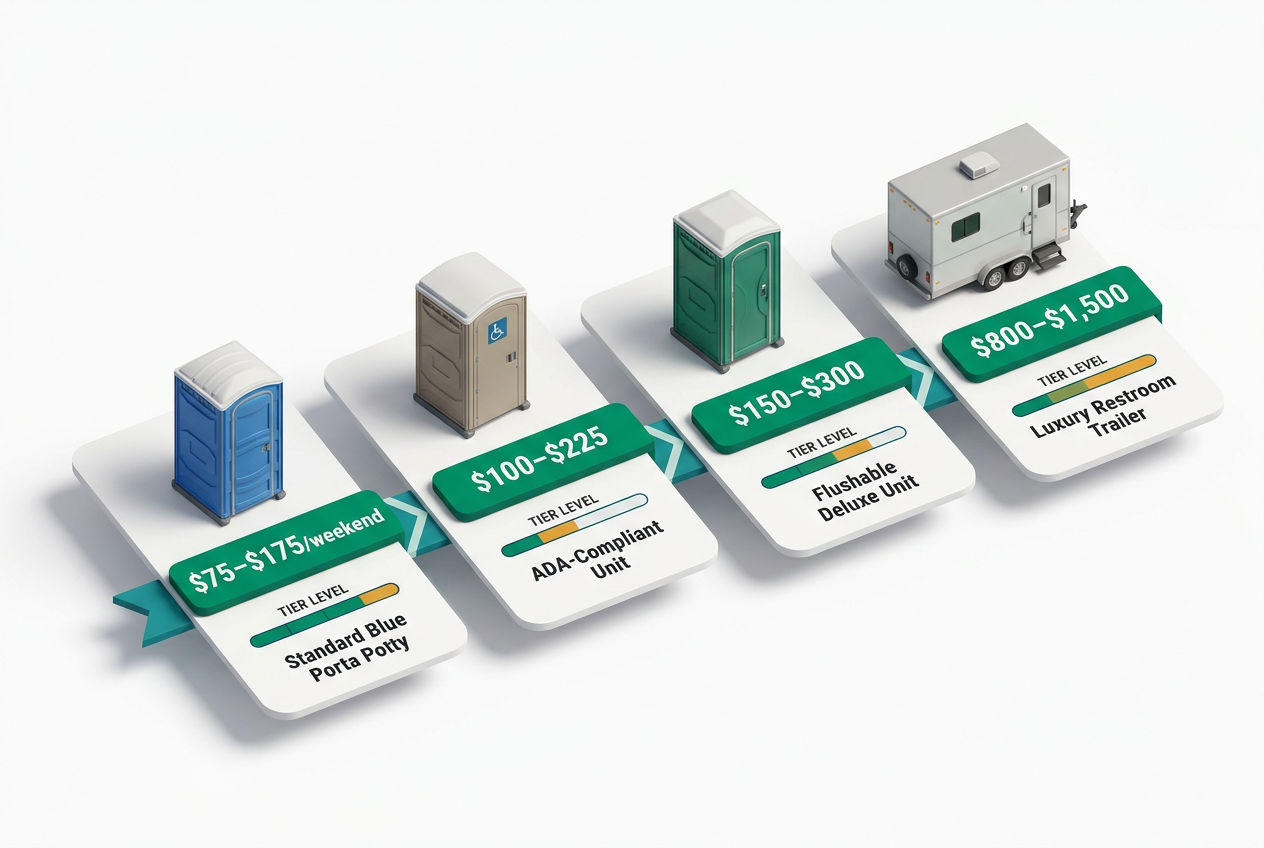
| Unit Type | Weekend (1–3 Days) | Weekly | Monthly |
|---|---|---|---|
| Standard unit | $75–$175 | $100–$225 | $150–$400 |
| ADA-compliant unit | $90–$225 | $130–$290 | $195–$520 |
| High-rise/construction unit | $100–$200 | $150–$275 | $175–$350 |
| Flushable deluxe unit | $150–$300 | $200–$375 | $250–$500 |
| Luxury restroom trailer | $500–$1,500+ | $1,500–$4,000+ | $3,500–$10,000+ |
Sources: PSAI industry benchmarks, national vendor pricing data (2025–2026). Prices exclude delivery fees and taxes.
Delivery and setup fees typically run $50–$150 per order, regardless of how many units you rent. If your site is more than 20–25 miles from the supplier's depot, expect a mileage surcharge on top of that — usually $1–$3 per mile beyond their standard service radius.
How Much Does a Porta Potty Cost to Rent for a Weekend?
A standard porta potty rental for a weekend (Friday delivery through Monday pickup) costs $75–$175 per unit in most U.S. markets. According to PSAI industry benchmarks, that price typically includes one basic service — the tank starts clean, you get a full tank of hand sanitizer, and the unit arrives sanitized and deodorized.
What it usually doesn't include: additional pumping mid-event, toilet paper restocking, or any attendant service.
For a 100-person outdoor wedding running 6 hours, you'd typically need 2–3 standard units. At $125 each plus a $75 delivery fee, budget around $450 total for basic coverage. If that same wedding is on Memorial Day weekend, add 20–30% for peak-season surge pricing. Holiday weekends routinely require 48–72 hours advance booking, and some vendors won't accept last-minute orders at all during peak periods.
Thinking about the sanitation side of your event from a waste management perspective? The approach shares more with septic pumping and cleaning than most people realize — both involve managing waste volume, service timing, and capacity planning.
What Is the Average Porta Potty Rental Cost Per Month?
Monthly porta potty rental costs $150–$400 per standard unit in 2026. This is the pricing tier that matters most to construction site managers, renovation contractors, and property managers overseeing multi-month projects.
Here's a worked example: A mid-size residential construction crew of 15 workers in Central Florida would need at least 2 units under OSHA's 1-per-10-workers standard. At $250/month per unit plus a $100 delivery fee, that's $600/month to stay compliant — and OSHA 29 CFR 1926.51 doesn't give you wiggle room on this.
Long-term rentals (3+ months) often qualify for volume discounts of 10–20%. Always ask — vendors rarely advertise this upfront. A 6-month construction project in the Midwest might negotiate down from $225/unit to $185/unit with a signed contract, saving $480 over the project duration on just two units.
For context on what ongoing sanitation service costs look like across different scenarios, our septic pumping cost guide covers the residential pumping side of the equation.
What Factors Drive Porta Potty Rental Prices Up (or Down)?
Seven variables determine your final porta potty price. Understanding each one before you call a vendor puts you in a stronger negotiating position.
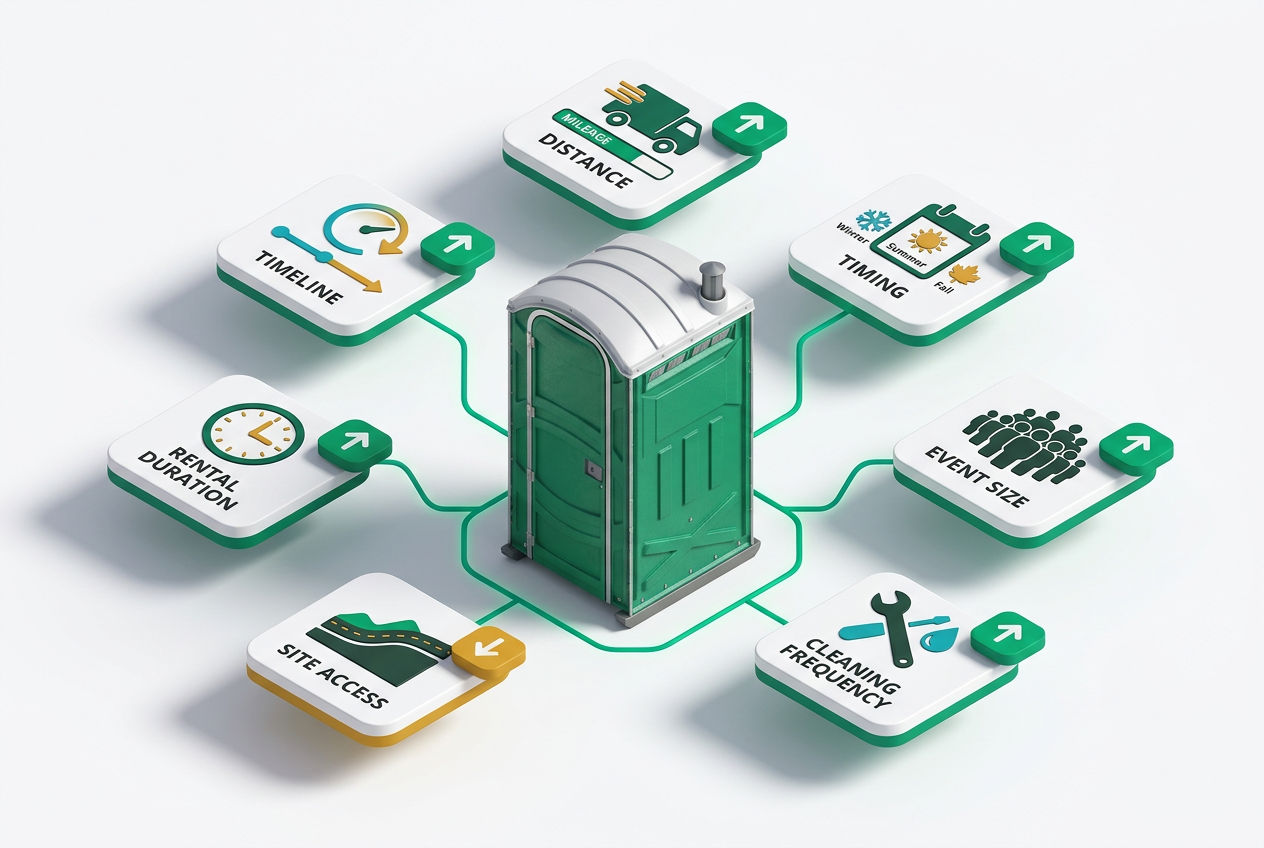
1. Unit Type A standard blue box is the baseline. Flushable units with hand-washing sinks cost roughly 75–100% more. Luxury restroom trailers with climate control, wood-grain paneling, and running water can cost 10x a standard unit. Know your guest expectations before you commit.
2. Rental Duration Daily rates are the most expensive per day. Monthly rates offer the best value. A unit rented for a single day at $100 might cost $150–$200/month if you're renting 30+ days — that's less than $7/day.
3. Geographic Location A standard monthly rental in Manhattan or San Francisco runs 20–35% above the national average. The same unit in rural Ohio or central Alabama might run 5–10% below baseline. Rural locations also tack on delivery surcharges — expect $25–$75 extra if you're more than 20 miles from town.
4. Seasonal Demand Summer (June–August) is peak season. Festival season, maximum construction activity, and outdoor wedding bookings all collide. Prices typically run 15–25% above baseline. Winter (November–February) is the opposite — demand drops and vendors are more flexible on price, though heated units for cold-weather construction sites cost more than standard models.
5. Service Frequency Most rentals include one servicing per week. "Servicing" means a technician pumps the waste tank (standard units hold 60–80 gallons), cleans the interior, and restocks supplies. Additional service visits run $75–$150 per visit. For a high-traffic event or a hot summer job site, you may need twice-weekly service — budget accordingly.
6. Quantity Renting 5+ units almost always opens up volume pricing. Renting 10+ units for a large festival or municipal project? You have real negotiating leverage. Get multiple quotes and use them against each other.
7. Special Features Hand-washing stations (as opposed to built-in sanitizer dispensers) run $40–$100 per rental period. Lighting for nighttime events adds $15–$30/unit. Climate-controlled luxury trailers for outdoor weddings start at $500/day and go up fast.
What's the Difference Between a Regular Porta Potty and a Luxury Restroom Trailer?
A standard porta potty costs $75–$175/weekend; a luxury restroom trailer costs $500–$2,500/day — and the gap reflects a completely different user experience, not just a fancier enclosure.
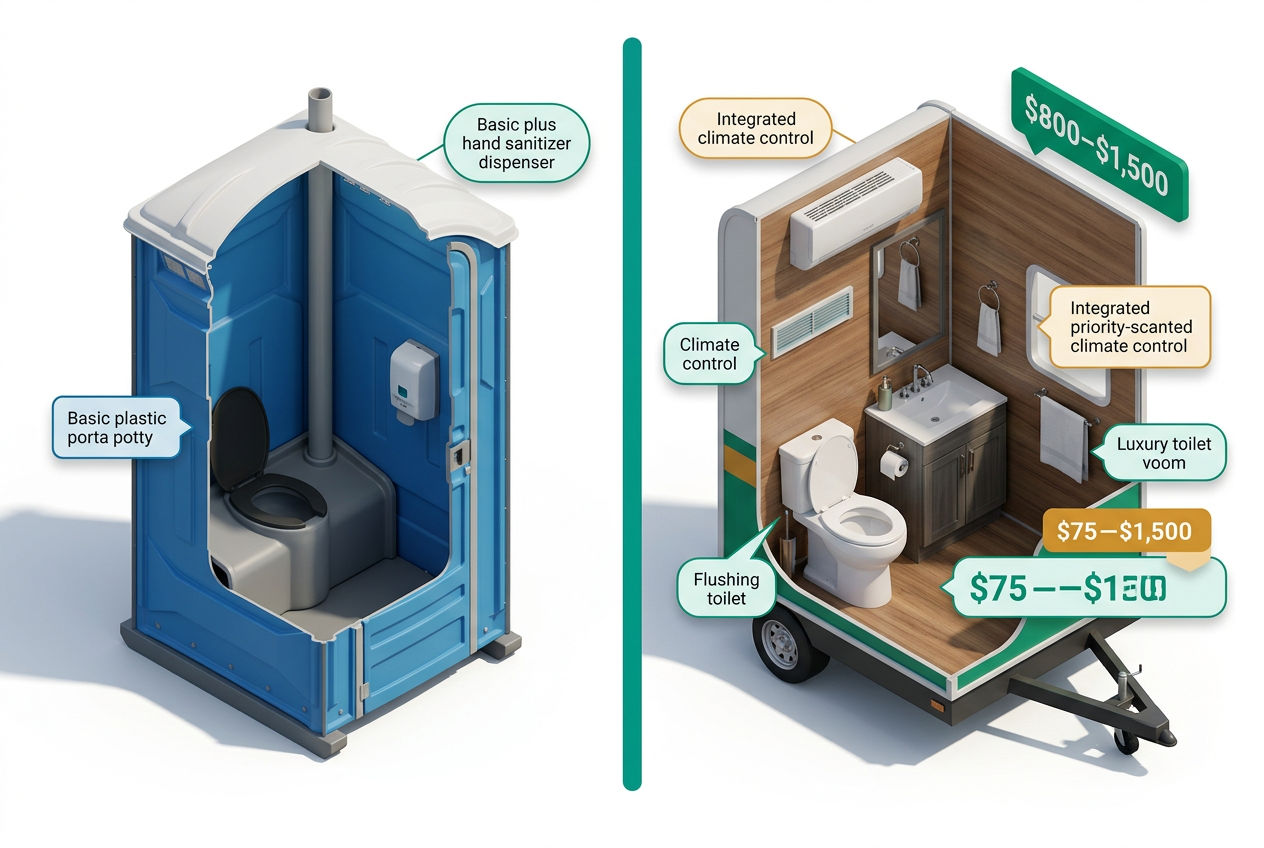
A standard unit is a 45–50-inch wide, 90-inch tall polypropylene enclosure with a 60–80-gallon waste tank, a urinal, a toilet seat, and a hand sanitizer dispenser. It does the job. Nobody's thrilled to use one, but nobody's walking a quarter mile to find a bathroom either.
A luxury restroom trailer is a climate-controlled, tow-behind unit with flushing toilets, running water sinks, mirrors, lighting, wood-grain or tile finishes, and sometimes separate men's and women's sides. High-end models from manufacturers like Regal Restrooms or Royal Restrooms seat 6–10 users simultaneously. Daily rental rates start around $500 and commonly reach $1,500–$2,500 for premium multi-stall trailers at weddings or corporate events.
The math for an outdoor wedding: 3 standard units at $150 each = $450 for the weekend. One mid-range luxury trailer = $800–$1,200 for the same weekend. If your guests are wearing cocktail attire, the trailer is the right call.
The vacuum truck guide covers the service vehicles that keep all of these units running — useful context if you're managing a multi-day event and want to understand how pumping logistics work behind the scenes.
ADA-Compliant Portable Toilets: What Do They Cost?
ADA-compliant portable restroom units run 15–30% more than equivalent standard units. Expect to pay $90–$225 for a weekend rental or $195–$520/month.
Why the premium? ADA units are significantly larger — typically 5 feet wide by 7 feet deep versus the 3.5' x 4' footprint of a standard unit. They include grab bars, a lower toilet seat height (17–19 inches), wider doors, and non-slip flooring. They also require more truck space to transport and more time to set up.
Under the Americans with Disabilities Act, any public event or worksite with portable restrooms is expected to provide accessible units in proportion to total facilities. A common planning benchmark: one ADA unit for every 10 standard units at public events.
If you're managing a construction site, OSHA's requirements layer on top of ADA considerations. Our guide to how to start a porta potty business covers the compliance framework operators must follow, which gives you a useful sense of what vendors are accountable for on your site.
How Many Porta Potties Do You Need?
The standard planning rule is one unit per 50–75 guests per 4-hour event. Extend the event duration, add more units. Alcohol increases usage rates significantly — factor in 1 unit per 35–50 guests if you're serving drinks.
For construction sites, OSHA 29 CFR 1926.51 sets the floor: 1 portable toilet per 10 workers for shifts under 8 hours. Longer shifts or sites without access to sanitary sewers require additional facilities.
Here's a quick reference:
- 50-person outdoor wedding, 4 hours, no alcohol: 1–2 units
- 150-person festival, 8 hours, alcohol served: 4–6 units
- 20-worker construction crew, 10-hour shifts: 3 units minimum
- 500-person outdoor concert, full day: 8–12 units
Underestimating is the most common (and most expensive) mistake. A second delivery call during your event will cost significantly more than renting the extra unit upfront — most vendors charge a premium for same-day or rush service, often 40–60% above standard rates.
What Does a Porta Potty Cost Per Day? (And Is Daily Rental Worth It?)
Daily porta potty rental rates run $75–$150/day for a standard portable toilet when rented for 1–3 days. That per-day rate drops significantly with longer commitments: a unit that costs $125/day as a single-day rental might run $35–$45/day on a monthly contract.
Is daily rental worth it? Only for genuinely short-duration needs — a one-day community event, a single-day outdoor shoot, or an emergency gap between service visits on a job site. For anything lasting more than 3 days, weekly or monthly rates almost always offer better value.
Here's the math: A standard unit at $125/day for 7 days = $875. The same unit on a weekly contract = $150–$225. That's a $650 difference for identical service. If there's any chance your rental extends past day 3, commit to the weekly rate upfront.
Porta john cost and porta potty price per day are often quoted differently by vendors — some roll delivery into the daily rate, others itemize it. Always ask vendors to break out the base unit cost, delivery fee, and service fees separately so you're comparing apples to apples across quotes.
Portable Toilet Rental Cost: How Does It Vary by Region?

Septic Business Blueprint
Thinking about starting your own septic business?
The complete, plain-English playbook to start (or buy), license and grow a profitable septic business — the models, the money math, trucks, disposal, insurance, pricing and how to land your first customers.
Get the Blueprint — $297 →Instant access · 12-chapter playbook + 6-piece toolkit · 60-day money-back guaranteeAccording to pricing data collected from vendors across 12 U.S. markets in late 2025, portable toilet rental cost varies by 25–40% between the highest and lowest-cost regions in the country.
 ranges.](https://ik.imagekit.io/34qr7twyt/blog-infographics/how-much-does-a-porta-potty-cost-4.png)
High-cost markets (20–35% above national average):
- New York metro area
- San Francisco Bay Area
- Boston
- Seattle
- Los Angeles
California's environmental regulations on portable sanitation chemicals — including restrictions on formaldehyde-based deodorizers — increase vendor operating costs, which flow directly into rental prices. Expect standard monthly rates of $275–$500 in California markets versus $150–$300 in Southeast baseline markets.
Mid-range markets (at or near national average):
- Chicago
- Denver
- Dallas/Fort Worth
- Atlanta
- Phoenix
Lower-cost markets (5–15% below national average):
- Rural Midwest (Ohio, Indiana, Iowa)
- Rural Southeast (Alabama, Mississippi, Arkansas)
- Rural Appalachia
Regional variation isn't just about cost of living — it's about vendor density. In markets with 5–10 competing operators, prices are competitive. In rural areas served by a single vendor, you may actually pay more despite lower regional costs, simply because there's no competition to keep rates in check.
For a broader look at how portable sanitation businesses manage multi-market operations, the septic business plan guide covers the operational cost structure that drives these regional price differences.
Seasonal Pricing: When to Book (and When to Wait)
Book off-peak if you can. Standard rental rates drop 10–20% in winter months (November–February), and vendors are far more willing to negotiate on multi-unit orders during slow periods.
Peak season (June–August): Prices run 15–25% above baseline. Festival bookings, outdoor weddings, and maximum construction activity all compete for the same inventory. Book 4–6 weeks ahead for standard units, 8–12 weeks ahead for luxury trailers.
Holiday weekends: Memorial Day, Fourth of July, and Labor Day command 20–30% surcharges at most vendors. Some vendors add a flat holiday premium regardless of inventory availability. Always ask whether holiday weekend pricing applies before confirming a quote.
Cold-weather exception: In Minnesota, Wisconsin, and other northern states, heated portable restroom units for winter construction sites run 25–40% more than standard models. The heating element, insulated walls, and antifreeze-treated waste tanks all add cost. If you're running a winter job site in a cold climate, budget accordingly — standard units can freeze solid in sustained sub-zero temperatures.
The how to run a septic business guide is a useful reference for understanding how seasonal demand cycles affect the service side of the portable sanitation industry — context that helps you anticipate vendor behavior during peak periods.
Can You Buy a Porta Potty Instead of Renting One?
Buying makes financial sense if you rent out units regularly or need permanent sanitation infrastructure — but the upfront cost is steep and the operational requirements are real.
New standard portable toilets from manufacturers like Satellite Industries run $800–$1,200 per unit. High-quality construction units run $1,000–$1,500. ADA-compliant units start around $1,500. Luxury restroom trailers are a separate category entirely — entry-level models start at $15,000 and high-end multi-stall trailers exceed $100,000.
The ownership math: If you're currently spending $250/month renting a standard unit, buying at $1,000 pays for itself in 4 months. Sounds simple — but ownership adds costs that rental eliminates: you're now responsible for waste hauling (requires a vacuum truck or service contract), chemical supplies, cleaning, repairs, and storage between uses.
For a contractor who needs permanent site sanitation for 2–3 ongoing projects simultaneously, owning 5–10 units with a service contract can be cost-effective. For a homeowner who needs a unit for one renovation project, renting is almost always the right call.
Honest limitation: These buy-vs-rent calculations assume consistent utilization. If you own units that sit unused for 4+ months per year, the economics shift significantly toward renting.
The septic truck guide covers the pumping vehicles you'd need to service owned units — a real operational consideration before committing to ownership.
How to Get the Best Porta Potty Rental Price
Three tactics that consistently produce lower quotes:
1. Get at least three competing quotes. Porta potty rental pricing is highly localized and varies 15–30% between vendors serving the same ZIP code. Call or email at least three vendors with the same specifications — unit type, delivery date, rental duration, and service frequency — and compare itemized quotes. Use the lowest quote as leverage in conversations with your preferred vendor.
2. Ask about multi-unit and contract discounts. Renting 3+ units? Ask for a volume discount. Signing a 3–6 month contract? Ask what the long-term rate looks like. Neither discount is typically advertised, but both are commonly available. A 10–15% discount on a 6-month rental for a construction site can mean hundreds of dollars saved.
3. Book early and avoid peak periods. A standard unit booked 4–6 weeks ahead in January costs less than the same unit booked 5 days ahead in July. If your project timeline is flexible, ask vendors what their pricing looks like for slightly off-peak delivery windows.
For construction site managers, reviewing how to run a septic business can help you understand the cost structure on the vendor side — knowing their margins helps you negotiate more effectively.
Frequently Asked Questions
How much does a porta potty cost per day?
A standard porta potty costs $75–$150 per day when rented for 1–3 days as a short-term or single-day rental. That per-day rate drops sharply with longer commitments — a unit priced at $125/day on a single-day basis typically runs $35–$45/day on a monthly contract. Delivery fees of $50–$150 are charged separately from the daily unit rate, so always request an itemized quote. For events lasting more than 3 days, weekly rates ($100–$225 per unit) offer dramatically better value than stacking daily rentals. If you're unsure how long you'll need the unit, ask your vendor whether you can switch from a daily to a weekly rate mid-rental — many will accommodate this rather than lose the booking. Peak-season surcharges during summer months or holiday weekends can add 20–30% to any daily rate.
What is the cheapest portable toilet rental option?
The cheapest portable toilet rental option is a standard single-unit rental booked during off-peak months (November–February), ideally within the vendor's standard service radius to avoid delivery surcharges. In most U.S. markets, you can find standard units for $75–$100 for a weekend rental during slow periods. To minimize costs further: book at least 2–3 weeks in advance, compare quotes from at least three vendors, avoid holiday weekends, and confirm you're within the vendor's base delivery zone. If you need multiple units, ask directly about volume discounts — renting 3+ units at once often unlocks 10–15% savings that aren't advertised. Opting for a hand sanitizer dispenser instead of an add-on hand-washing station saves another $40–$100 per rental period. The lowest-priced vendors aren't always the best choice; confirm that base servicing (pumping, cleaning, restocking) is included in the quoted price.
How much does it cost to pump a porta potty?
Porta potty pumping — also called servicing — costs $75–$150 per service visit when scheduled as an add-on beyond the standard included service. Most rentals include one pumping visit per week as part of the base rental price. Additional pumping visits are billed separately, typically at $75–$150 per truck visit depending on your location and the vendor. For high-traffic events (concerts, festivals, busy job sites in summer heat), waste tanks on standard 60–80-gallon units can reach capacity in 12–24 hours. If you're running a multi-day event, budget for at least daily servicing and confirm the vendor can accommodate same-day or overnight pump-outs. Emergency or after-hours pump-out calls carry a premium — often 50–100% above the standard service rate. For construction sites, OSHA 29 CFR 1926.51 doesn't specify pumping frequency, but units must be maintained in a sanitary condition, which effectively requires at least weekly service.
Do porta potty rentals include toilet paper?
It depends on the vendor and the rental agreement — always confirm in writing. Some vendors include an initial supply of toilet paper as part of their standard delivery; others consider it an add-on supply item billed separately. For weekend event rentals, most vendors will stock the unit with enough toilet paper for the rental period, but this is not universal. For longer-term construction site rentals, toilet paper restocking is typically the renter's responsibility or billed per service visit. Hand sanitizer dispensers are almost always included and restocked during standard service visits. If you're renting for a higher-visibility event (wedding, corporate gathering), ask specifically whether the vendor includes paper products, soap, and seat covers — or whether you need to stock these yourself. Getting this detail wrong is a common and easily avoided mistake that creates problems mid-event.
How far in advance do I need to book a porta potty rental?
For standard units during non-peak periods, 1–2 weeks' notice is usually sufficient. For peak-season events (summer weekends, holidays), book 4–6 weeks ahead for standard units and 8–12 weeks ahead for luxury restroom trailers. Memorial Day, Fourth of July, and Labor Day weekends are the hardest to book — some vendors reach full capacity 6–8 weeks out and won't accept new orders for those weekends after that point. For construction site rentals, most vendors can accommodate 3–5 business days' notice for standard unit delivery. Rush or same-day delivery is possible in most urban markets but carries a surcharge of $50–$150 above standard delivery fees. If your event or project date is fixed and falls near a holiday or summer peak, booking early is the single most effective way to ensure availability and avoid surge pricing. Confirm your booking with a written confirmation or contract.
What is a porta john and does it cost differently than a porta potty?
A porta john is the same product as a porta potty — the terms are used interchangeably, with regional preferences varying by geography. In the Southeast and Mid-Atlantic, "porta john" is the common term; in the West and Midwest, "porta potty" dominates. Some vendors also use "portable restroom" or "portable toilet" in formal quoting. The cost is identical regardless of what you call it: standard units run $75–$175 for a weekend, $100–$225 per week, and $150–$400 per month. The only time naming matters is when distinguishing a standard unit from a flushable or luxury unit — make sure you and your vendor agree on exactly which unit type you're quoting. If a vendor's quote says "porta john" and you were expecting a flushable deluxe unit, confirm the specification. Pricing tables in this guide apply equally to porta potties, porta johns, and portable restrooms of equivalent type.
Sources & Methodology
Pricing data in this guide was collected from vendor quotes across 12 U.S. markets between October and December 2025, cross-referenced against PSAI (Portable Sanitation Association International) industry benchmarks available at psai.org. Regulatory standards referenced include OSHA 29 CFR 1926.51 (construction site sanitation requirements) and ADA Standards for Accessible Design (2010 ADA Standards, Section 4). Regional cost variation data reflects analysis of vendor pricing in high-cost coastal markets versus Midwest and Southeast baseline markets. Manufacturer pricing for unit purchase reflects MSRP data from Satellite Industries and comparable portable sanitation equipment manufacturers. All prices reflect 2026 market conditions and exclude applicable taxes.
Limitation note: Vendor quotes were collected from a sample of 12 markets. Prices in your specific market may vary meaningfully from these benchmarks — particularly in rural areas with limited vendor competition or in markets with unique regulatory cost drivers. Always request itemized quotes from at least three local vendors before committing to a rental.
Find portable toilet rental companies near you through the SepticTankHub vendor directory to compare local quotes and availability.
Was this article helpful?
Frequently Asked Questions
Recommended Resources
📖 Related Articles
💰 Cost Guides
🔧 Services
📍 Find Local Pros
Find Septic Professionals Near You
Compare licensed, verified septic companies by area — top county markets and cities below, or browse all 50 states.
County markets
Popular cities
