
Quick Answer
A vacuum truck is a heavy-duty vehicle fitted with an industrial suction pump and a sealed storage tank that pulls liquid waste, sludge, and debris from septic tanks, grease traps, storm drains, and industrial sites. Tank sizes range from 1,000 to 6,000+ gallons, and most units generate 300–1,800 CFM of suction power to clear waste quickly and safely.
Key Takeaways
- Vacuum trucks (also called vac trucks or vacuum tankers) use industrial pumps rated 300–1,800 CFM to suction liquid waste from septic tanks, grease traps, and industrial sites.
- Tank capacities range from 1,000 gallons (residential septic work) to 6,000+ gallons (industrial applications).
- Hiring a vacuum truck service costs $150–$450 per hour; a standard residential septic pump-out runs $300–$600.
- Most vac truck drivers need a Class B CDL; hauling certain waste types requires a hazmat endorsement.
- Demand peaks in spring and fall — schedule routine septic service before those windows to avoid waiting weeks for an appointment.
What Does a Vacuum Truck Do?
A vacuum truck removes liquid waste and slurries that can't be moved by hand or conventional equipment. The pump creates a partial vacuum inside the holding tank — typically 16–28 inches of mercury (Hg) — which generates enough suction to pull material up through a hose from as far as 300 feet away horizontally or 25–30 feet below ground level.
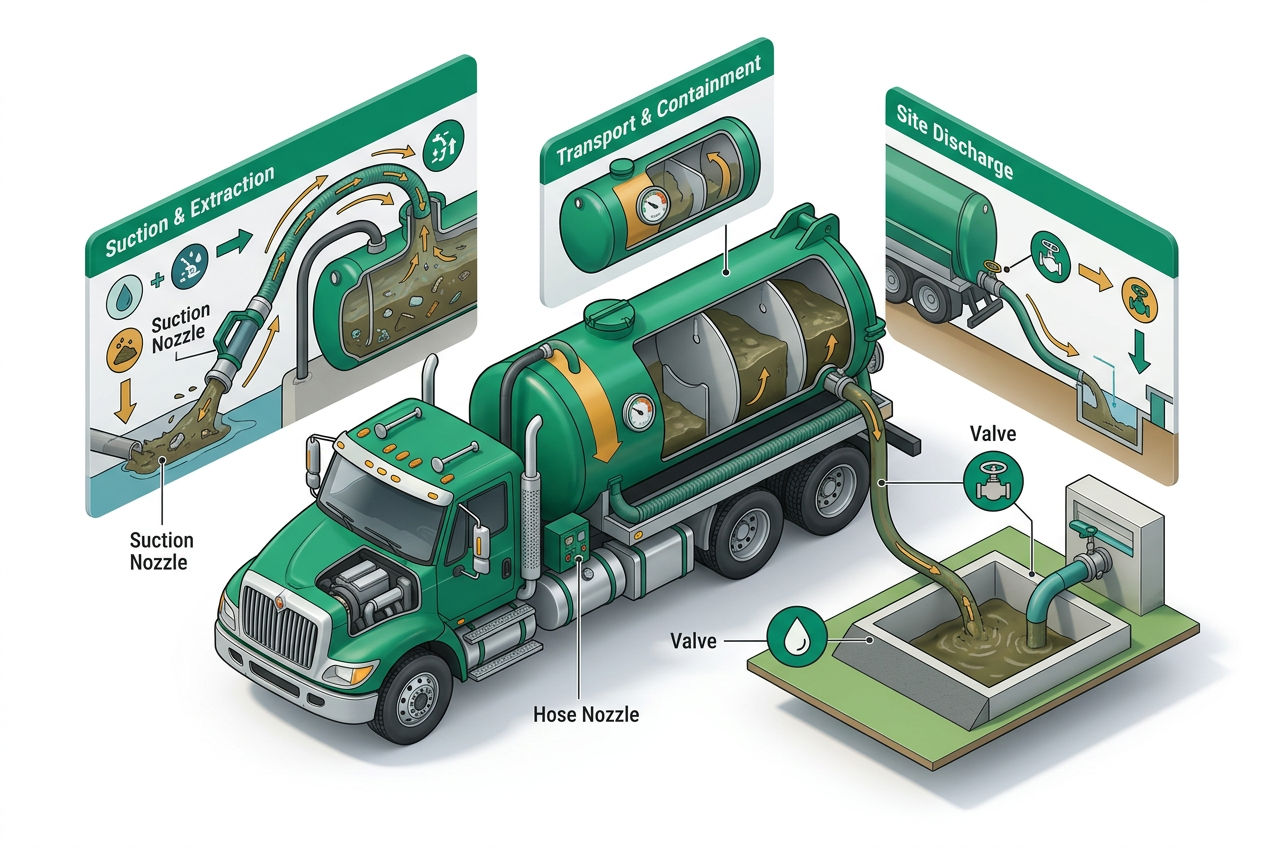
Picture this: a pumper truck backs down your driveway, drops a 4-inch suction hose into your septic tank's inlet baffle, and within 20–45 minutes, a 1,000-gallon tank is empty. The operator uses a sludge judge — a clear acrylic tube that measures sludge depth — to confirm all accumulated solids have been removed before pulling out. That's the process described by the EPA's SepticSmart program, which recommends routine pumping every 3–5 years for most households.
Beyond residential septic work, vacuum trucks handle:
- Grease trap pumping at restaurants and commercial kitchens
- Portable sanitation servicing (porta-potty vacuum trucks)
- Industrial spill cleanup and liquid waste removal at manufacturing plants
- Storm drain and catch basin cleaning in municipal settings
- Hydro excavation support — vac trucks carry away the slurry created by water-jet digging
- Oil and gas pit cleanout in the Southwest and Appalachian Basin
If you need grease trap pumping service or routine septic pumping and cleaning, a vacuum truck is the tool doing the heavy lifting.
How Does a Vacuum Truck Pump Work?
The heart of every vac truck is its pump system. Most units run one of three pump types: a positive displacement pump, a liquid ring pump, or a centrifugal blower. Positive displacement pumps are the workhorses of the septic world — they tolerate thick sludge, rags, and grit that would destroy a centrifugal unit.
The pump is power-take-off (PTO) driven, meaning it pulls power directly from the truck's diesel engine via a mechanical shaft. The driver engages the PTO from the cab, the pump spins up, and a valve opens on the suction hose. Air rushes into the sealed tank — well, not exactly. The pump removes air from the tank, creating a pressure differential. Atmospheric pressure on the outside of the hose then pushes liquid waste up and into the truck.
A relief valve prevents over-pressurization, and a float valve automatically shuts off suction when the tank reaches capacity. Operators monitor vacuum levels with a gauge on the rear control panel, keeping the system between 16 and 28 inches Hg for most residential jobs. Push past 28" Hg on a worn hose and you risk a blowout — not a situation you want in your front yard.
For a deeper look at the pumping process itself, our septic tank pumping guide walks through what happens from the time the truck arrives to when it leaves.
What Are the Types of Vacuum Trucks?
Not every vac truck is the same. Knowing the type helps you hire the right service for your job.
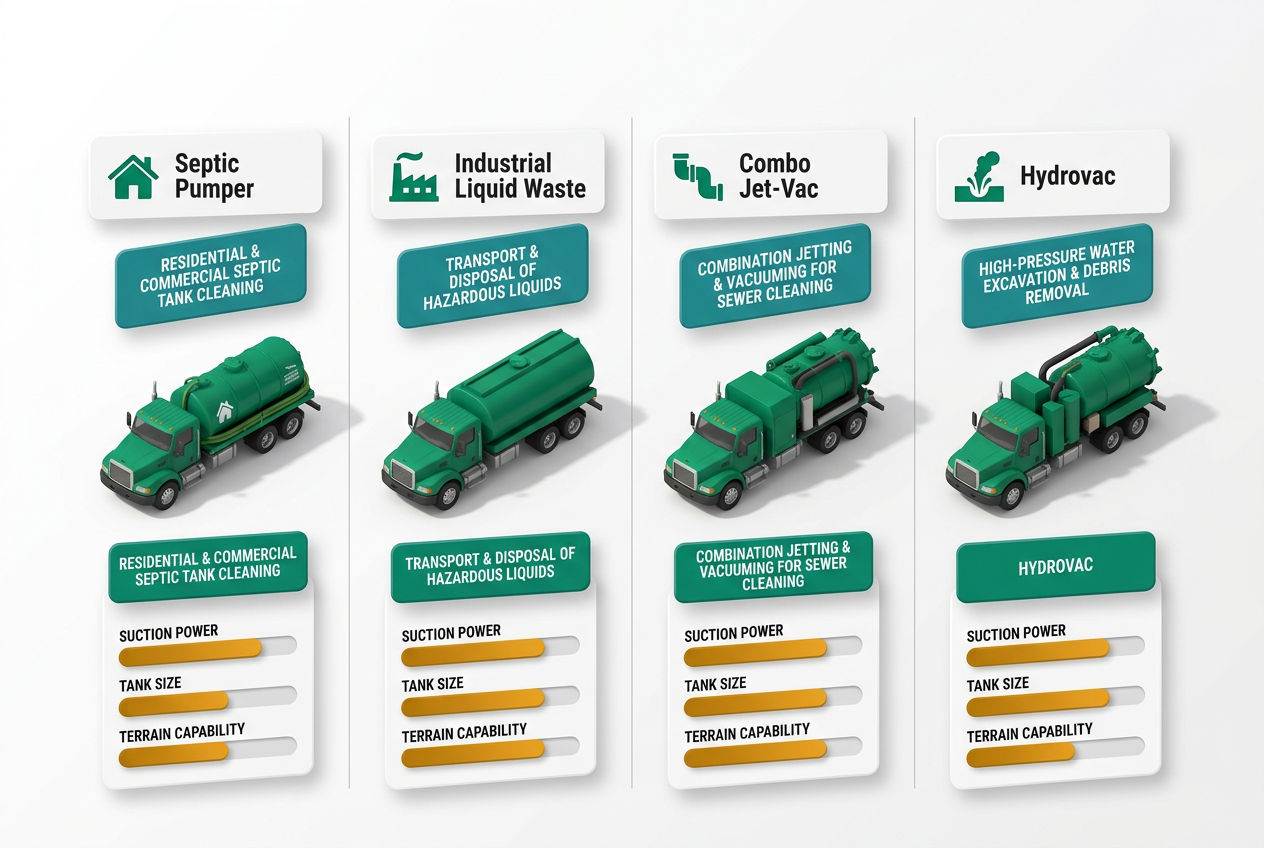
Septic Vacuum Truck (Pumper Truck) The most common type for residential use. Typically carries 1,500–3,500 gallons. Equipped with a single suction hose and a PTO-driven positive displacement pump. This is what shows up for your routine septic pump-out every 3–5 years.
Industrial Vacuum Truck Larger units, often 4,000–6,000+ gallons, built for hazardous or high-volume waste. Found at petrochemical plants, refineries, and large municipal projects. May carry a hazmat placards and require special disposal manifests.
Combination Sewer Truck (Combo Vac Truck) A combo unit pairs a high-pressure water jetter with a vacuum pump on the same chassis. The jetter blasts debris loose; the vacuum recovers it. Cities use combo vac trucks for sewer line maintenance and catch basin cleaning.
Hydrovac Truck (Hydro Excavation Truck) Often confused with a standard vac truck, a hydrovac truck uses pressurized water to break up soil or frozen ground, then vacuums the resulting slurry. It's a distinct machine designed for non-destructive digging around buried utilities. The vacuum component looks similar, but the water system makes it a different category entirely.
Portable Sanitation Vacuum Truck Lighter-duty units, typically 500–1,500 gallons, purpose-built for servicing porta-potties at construction sites, fairs, and concerts. They must handle a different waste chemistry than septic sludge and usually include a fresh-water supply tank for cleaning units on-site.
Wet/Dry Vacuum Truck Configured to handle both liquid and dry bulk material. Common in industrial settings where crews need to remove both standing water and dry debris like sand, fly ash, or grain dust.
Vacuum Truck Capacity and Specifications
| Type | Typical Tank Size | Pump Rating (CFM) | Vacuum Pressure | Best Use Case |
|---|---|---|---|---|
| Small Pumper | 1,000–1,500 gal | 300–600 CFM | 16–20" Hg | Residential septic tanks |
| Mid-Size Pumper | 2,500–3,500 gal | 600–1,000 CFM | 18–24" Hg | Commercial grease traps, multi-tank jobs |
| Industrial Vac Truck | 4,000–6,000+ gal | 1,000–1,800 CFM | 22–28" Hg | Hazmat, oil & gas, municipal |
| Combo Sewer Truck | 2,000–4,000 gal | 800–1,400 CFM | 20–26" Hg | Sewer jetting and recovery |
| Hydrovac Truck | 800–2,500 gal | 1,200–1,800 CFM | 24–28" Hg | Non-destructive digging |
Source: Manufacturer specifications from Imperial Industries, Ledwell, and Keith Huber; industry data compiled by SepticTankHub editorial team.
A mid-size 2,500-gallon pumper can typically empty a standard 1,000-gallon residential septic tank and still have 1,500 gallons of capacity remaining — useful if the operator needs to rinse the tank walls and re-vacuum. Most licensed pumpers dispose of waste at a municipal wastewater treatment plant or permitted septage receiving facility. Minnesota's MPCA, for example, requires operators to file a disposal manifest with the county after every service call.
How Much Does It Cost to Hire a Vacuum Truck?
Hiring a vacuum truck service costs $150–$450 per hour nationally, with the wide range driven by truck size, regional labor costs, and waste disposal fees.

For residential septic pumping, most homeowners pay $300–$600 for a standard pump-out of a 1,000-gallon tank. A 1,500-gallon tank runs $400–$750. Here's how location shifts those numbers:
- A 1,000-gallon tank in Central Florida runs $275–$375. Year-round demand and competition keep prices moderate.
- The same tank in rural Minnesota costs $350–$500. Longer drive times, seasonal access windows, and higher disposal fees push rates up.
- In New York or Connecticut, expect $450–$600 minimum due to strict state environmental regulations and higher operating costs.
Industrial vacuum truck services run $250–$450 per hour for the truck alone, often plus a mobilization fee of $150–$500 depending on distance. An oil field pit cleanout in West Texas might run $1,500–$3,000 for a half-day job.
For a full cost breakdown by tank size, job type, and region, see our septic pumping cost guide.
Buying a vacuum truck is a different conversation. New units price out at $150,000–$500,000+ depending on tank size, pump configuration, and chassis. A used vac truck in working condition costs $40,000–$200,000. The U.S. vacuum truck market is valued at approximately $1.2–1.5 billion annually and growing, driven partly by the EPA's estimate that 21 million+ U.S. households rely on septic systems. If you're thinking about starting a pumping business, our septic business startup guide has the full capital breakdown.
How Often Should a Septic Tank Be Pumped with a Vacuum Truck?

Septic Business Blueprint
Thinking about starting your own septic business?
The complete, plain-English playbook to start (or buy), license and grow a profitable septic business — the models, the money math, trucks, disposal, insurance, pricing and how to land your first customers.
Get the Blueprint — $297 →Instant access · 12-chapter playbook + 6-piece toolkit · 60-day money-back guaranteeThe EPA recommends pumping every 3–5 years for most households. That's a starting point, not a hard rule.
A 1,000-gallon tank serving a 2-person household can stretch to 5–7 years between pump-outs if the system is healthy and the household uses minimal water. Add a garbage disposal, and you're generating 50% more solids — now that same tank needs service every 2–3 years.
Here's a quick reference:
- 2-person household, 1,000-gallon tank: Pump every 5–7 years
- 4-person household, 1,000-gallon tank: Pump every 3–4 years
- 4-person household, 1,500-gallon tank: Pump every 4–5 years
- 6-person household, 1,000-gallon tank: Pump every 1.5–2 years
Signs your tank needs a vacuum truck sooner than scheduled: slow drains, gurgling pipes, sewage odor near the tank or drain field, and wet spots or abnormally green grass over the leach field. Don't wait for backup. A flooded drain field costs $3,000–$15,000 to repair or replace — see our drain field replacement cost guide for specifics.
For a complete pumping schedule based on your household size and tank specs, our how often to pump your septic tank guide covers every scenario.
Do You Need a CDL to Drive a Vacuum Truck?
Yes, in almost every case. Most vacuum trucks are Class 7 or Class 8 commercial vehicles over 26,001 lbs GVWR, which requires a Class B CDL under FMCSA regulations. Some smaller porta-potty service trucks fall below that threshold and require only a Class C license, but that's the exception.
Hauling hazardous waste — certain industrial solvents, petroleum-contaminated sludge — also requires a Hazmat endorsement on top of the CDL. The endorsement involves a TSA security threat assessment and a written exam on hazmat handling protocols.
State licensing adds another layer. Florida requires septic contractors to hold a Registered Septic Tank Contractor (RSTC) license through the Florida Department of Health. Texas delegates licensing to county-level Designated Representatives under TCEQ oversight. California requires a Sanitary System Contractor license through the Contractors State License Board. Operating without the right credentials exposes operators to fines and can void their liability insurance — check your state's specific septic regulations before hiring or operating.
Additionally, confined space entry is a real hazard in this industry. OSHA 29 CFR 1910.146 governs permit-required confined spaces — any time a worker descends into a septic tank or manhole to inspect or unclog an obstruction, that standard applies. Reputable vacuum truck companies train their crews on atmospheric monitoring and retrieval procedures.
Seasonal Demand and Regional Variations
Spring is the peak season for vacuum truck services, particularly in northern states. As the frost line recedes (reaching 42–60 inches in Minnesota, for example), buried tanks become accessible again and homeowners rush to schedule overdue pump-outs. Search volume for vacuum truck services jumps 15–25% between March and May nationally.
Fall is a secondary peak. Savvy homeowners pump their tanks before winter sets in — especially in the Northeast, where frozen ground can make emergency service calls a nightmare. If your tank is below the frost line, the tank itself rarely freezes. But the inlet pipe connecting your house to the tank? That's vulnerable. An uninsulated 4-inch ABS line running through a shallow trench is a $1,500–$2,500 emergency thaw-out waiting to happen. Our septic pipes freeze prevention guide covers the fix.
Regional industrial demand shifts the picture further:
- Texas, Oklahoma, New Mexico: Oil and gas production drives massive industrial vacuum truck demand for pit cleanouts and produced water hauling. These regions see year-round activity that dwarfs residential septic work.
- Florida and the Southeast: High water tables mean septic systems fail faster. Hurricane season creates emergency demand — a flooding yard and a backed-up tank during a tropical storm is a genuine health hazard. Year-round humidity keeps demand steady.
- Pacific Northwest: Heavy rainfall saturates drain fields faster than in arid regions. Oregon and Washington have stringent DEQ regulations requiring licensed contractors for any septage transport and disposal.
- Midwest Rural Belt: Vast rural populations with no municipal sewer access. Agricultural waste removal — including hog lagoon pumping in Iowa and Indiana — adds a dimension of demand that coastal states rarely see.
What Is the Difference Between a Vacuum Truck and a Hydrovac Truck?
A vacuum truck uses suction alone to pull liquid waste and slurry from a contained space. A hydrovac truck adds high-pressure water (up to 3,000 PSI) to break up material first, then vacuums the slurry. They're both "vac trucks" in casual conversation, but they're built for different jobs.
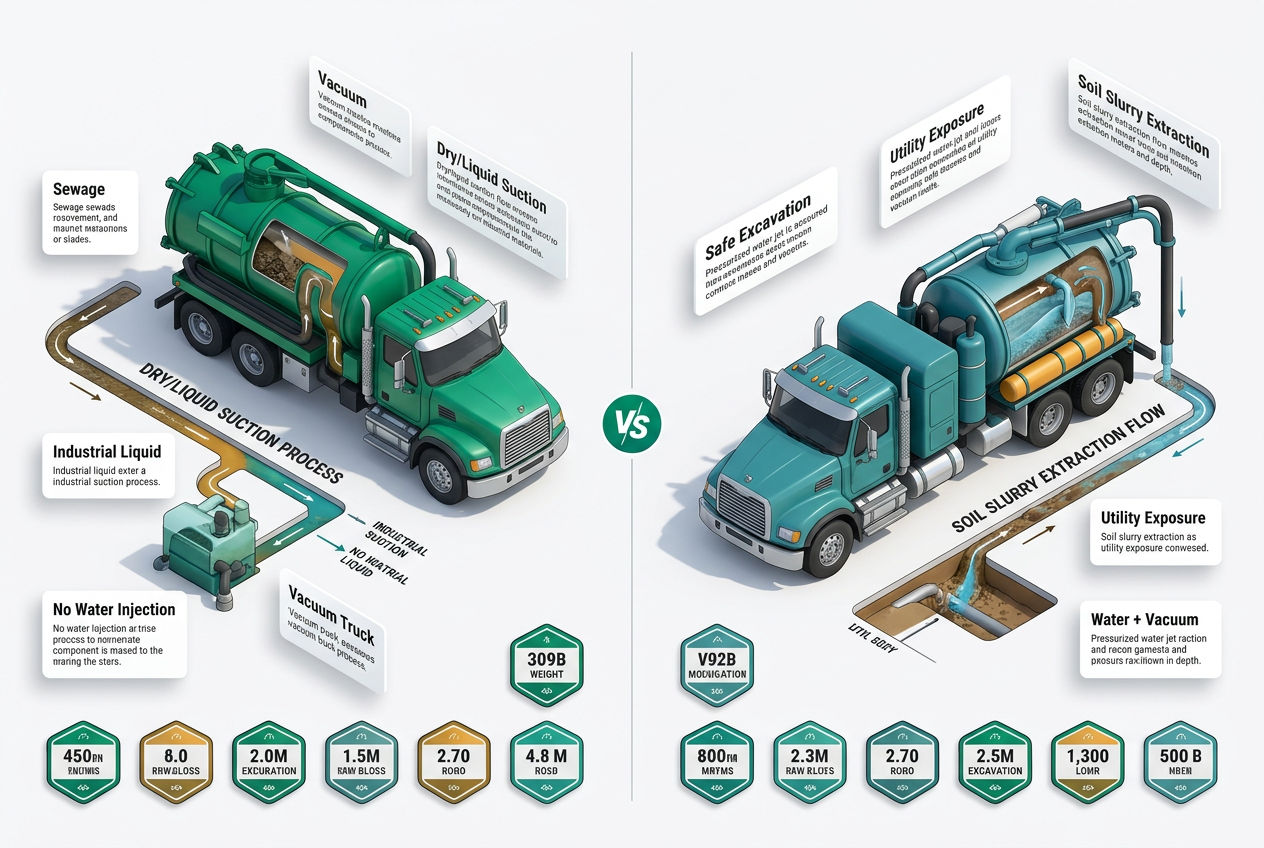
Use a standard vacuum truck for: septic pumping, grease trap service, liquid waste removal, porta-potty servicing, and catch basin cleaning.
Use a hydrovac truck for: exposing buried utilities without damaging them, digging in frozen ground, potholing for site surveys, and any excavation task where traditional digging equipment carries too much risk.
Hydrovac trucks cost more to operate and rent — expect to pay $300–$600 per hour versus $150–$450 for a standard vac truck. If a contractor recommends a hydrovac for a job that sounds like straight liquid removal, ask why. It may be justified, or it may be upselling.
When Should You Call a Vacuum Truck Service?
Routine scheduling is the best approach. But some situations demand an immediate call:
- Sewage backing up into tubs or toilets — call the same day. Your tank is either full or has a blockage. Every flush makes it worse.
- Sewage odor inside the house — could be a broken baffle or a full tank pushing gases back through drain traps.
- Wet, spongy ground over the drain field — the drain field may be receiving more liquid than it can handle because the tank is overdue for pumping.
- You're buying or selling a home — get the tank pumped and inspected before closing. Our septic inspection guide for home buyers explains what's at stake.
- After a major plumbing event — root intrusion, a crushed line, or a failed effluent filter (like a clogged Polylok PL-122 filter cartridge) can dump solids into the drain field. A pump-out combined with a camera inspection catches the damage early.
Service availability and pricing vary significantly by region. Find a vacuum truck or septic pumping service near you through the SepticTankHub directory.
How Vacuum Truck Businesses Operate
If you're a property owner, this section helps you understand what you're paying for. If you're considering entering the industry, our septic pumping business startup guide covers licensing, equipment, and startup capital.
A typical vacuum truck operator runs one to three trucks, each covering a service radius of 30–60 miles. Route density matters: a truck pumping 6–8 residential tanks per day in a suburban area generates more revenue per mile than one driving 45 minutes between rural jobs. Disposal fees at a municipal septage facility typically run $0.04–$0.12 per gallon, so a full 3,500-gallon load costs the operator $140–$420 to dump before they make a dime on the next job.
Fuel is the other major variable. A diesel pumper truck hauling a loaded 3,500-gallon tank gets 4–6 MPG. At current diesel prices, a 100-mile round trip burns $50–$100 in fuel alone. That's why rural service calls cost more — the math is straightforward.
Most successful vac truck businesses layer multiple revenue streams: residential septic pumping, commercial grease trap service, and municipal contracts. Grease trap clients pump on a strict schedule (monthly or quarterly in many jurisdictions), which creates predictable recurring revenue that residential septic work can't match. See our guide to grease trap pumping for what that side of the business looks like.
For those managing a growing operation, septic business software helps route trucks efficiently, automate service reminders, and manage disposal manifests digitally. The how to run a septic business pillar covers every operational detail.
Sources & Methodology
- U.S. Environmental Protection Agency — Septic Systems (epa.gov/septic): Pumping frequency recommendations, septic system household statistics, and liquid waste disposal regulations.
- FMCSA Commercial Driver's License Standards (fmcsa.dot.gov): CDL class requirements, hazmat endorsement process, and vehicle weight thresholds.
- OSHA Standard 29 CFR 1910.146 — Permit-Required Confined Spaces (osha.gov): Confined space entry requirements applicable to septic and manhole work.
- Minnesota Pollution Control Agency (pca.state.mn.us): Septage disposal manifest requirements and licensed pumper regulations — used as a representative example of state-level regulatory frameworks.
- Imperial Industries, Ledwell, and Keith Huber manufacturer specifications: Tank capacity, pump CFM ratings, and vacuum pressure ranges cited in the specifications table.
- Allied Market Research / Grand View Research: U.S. vacuum truck market size estimates ($1.2–$1.5 billion annually) used as industry context.
Was this article helpful?
Frequently Asked Questions
Recommended Resources
📖 Related Articles
- How Are Septic Tanks Pumped? The Complete Process
- Septic Business Startup Cost: 2026 Price Guide
- How Often Should You Pump Your Septic Tank?
- Freezing Pipes and Septic: How to Prevent Winter Damage
- Septic Inspection for Home Buyers: Complete Checklist
- Septic Pumping Business: The Complete Guide
- Grease Trap Pumping: The Complete Guide
- The Best Septic Business Software (Scheduling, Routing & Billing)
- How to Run a Septic Business: Operations, Pricing & Growth
💰 Cost Guides
Find Septic Professionals Near You
Compare licensed, verified septic companies by area — top county markets and cities below, or browse all 50 states.
County markets
Popular cities
