
Quick Answer
Grease trap service is one of the few businesses where your customers legally cannot say no. Restaurants must clean their traps on a fixed schedule or face municipal fines, permit suspensions, and sewer surcharges. That built-in compliance pressure is what makes this industry worth serious attention from anyone looking to build a recurring-revenue service route.
Grease trap service involves pumping, cleaning, and maintaining grease traps and grease interceptors at commercial food-service facilities — and disposing of the collected FOG (fats, oils, and grease) waste at a licensed receiving facility. A single-truck operator can clear $12,000–$20,000 per month net on a dense route. This guide covers every step from equipment selection to landing your first 50 accounts.
Key Takeaways
- Startup costs range from $25,000 (small portable unit) to $150,000+ (vacuum truck setup)
- Grease trap service cost runs $150–$500 for small indoor traps; $300–$1,500+ for large grease interceptors
- Most municipalities require FOG (fats, oils, and grease) compliance under the EPA Clean Water Act — that's your built-in demand
- Recurring service contracts are the real money: restaurants need grease trap pumping every 30–90 days, for the life of the business
- Licensing requirements vary by state — some require state-level environmental permits, others delegate to county health departments
America has roughly one million restaurants, according to the National Restaurant Association. Every single one of them produces FOG — fats, oils, and grease — and nearly every municipality requires a grease trap or grease interceptor to capture it before it reaches the sewer. That's legally mandated, recurring demand that doesn't disappear in a recession.
If you're already familiar with the septic pumping business world, grease trap service shares a lot of DNA — vacuum equipment, waste manifesting, route density economics. But grease trap work can be faster per job and requires less excavation. A residential septic pump-out might take 90 minutes. A small commercial kitchen trap? Sometimes 45 minutes.
This guide walks you through every step: equipment, licensing, pricing, finding customers, and building a route that actually makes money.
Is a Grease Trap Service Business Profitable?
A grease trap cleaning business can generate $15,000–$40,000 in monthly revenue per route truck, with profit margins of 30–50% once the route is dense enough to minimize dead miles. The business model works because demand is recurring, legally mandated, and tied to the restaurant industry — which replaces failed locations with new ones at a steady rate.
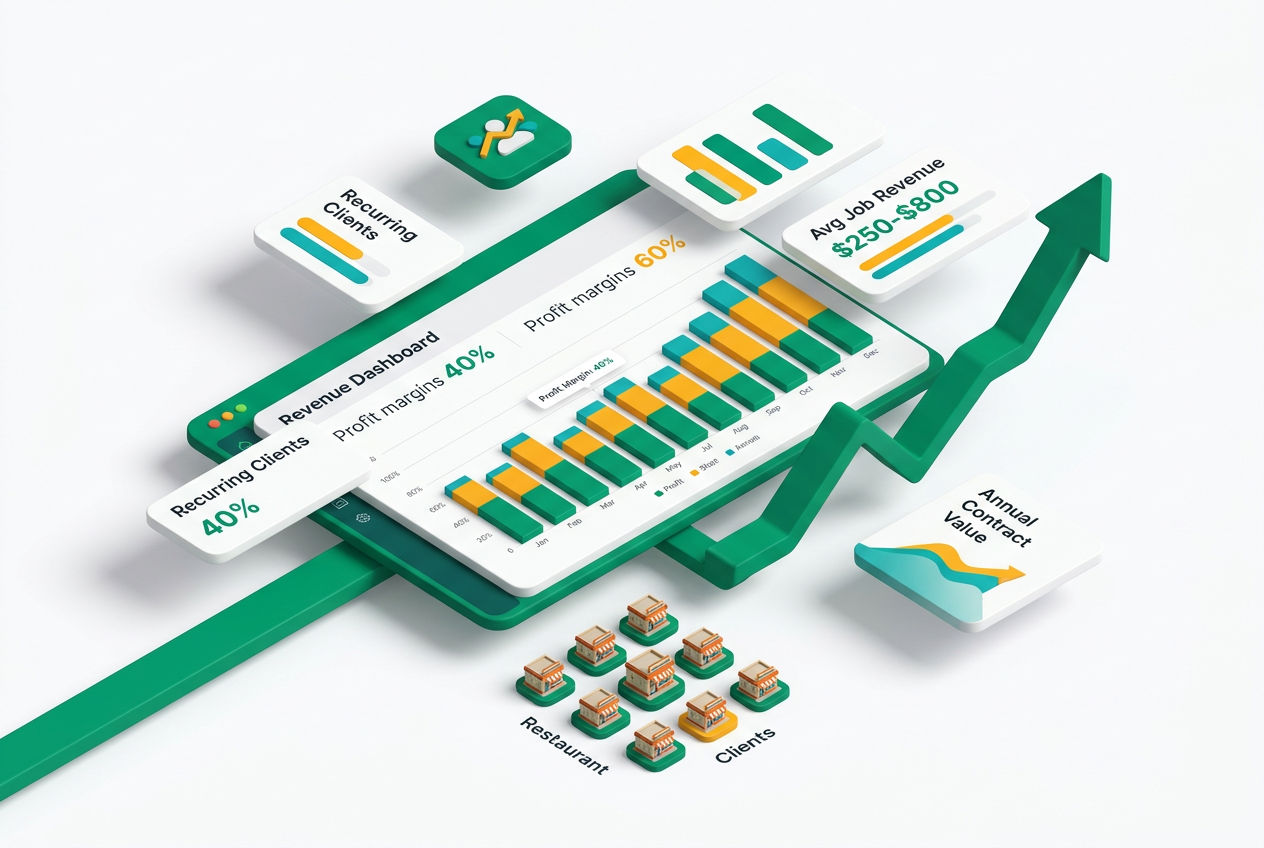
Here's a simple route model: Say you service 10 restaurants per day at an average of $250 per stop. That's $2,500/day, roughly $50,000/month gross on a 4-day-a-week schedule. After truck costs, fuel, disposal fees, insurance, and labor, a well-run single-truck operator can clear $12,000–$20,000 per month in net. Scale to two trucks and two drivers and the math improves significantly because your fixed costs (insurance, software, dispatch) don't double.
The risk? Route density. If you're driving 45 minutes between stops, you're losing money on every mile. Urban and suburban markets — think the restaurant corridors along I-4 in Orlando, the Gulf Coast hospitality belt in Louisiana, or the suburbs ringing Atlanta — are where the unit economics work best.
What Does It Cost to Start a Grease Trap Cleaning Business?
Startup costs depend entirely on whether you begin with a portable pump unit or jump straight to a vacuum truck. Most new operators start small and finance a larger truck after building a client base.
| Item | Low Estimate | High Estimate |
|---|---|---|
| Used vacuum truck | $15,000 | $50,000 |
| New vacuum truck | $80,000 | $200,000+ |
| Portable grease pump unit | $2,000 | $8,000 |
| Business licenses & permits | $500 | $3,000 |
| Commercial auto & GL insurance | $3,000/yr | $10,000/yr |
| PPE, hoses, degreaser, tools | $500 | $2,000 |
| Total estimated startup | $25,000 | $150,000+ |
Sources: Equipment pricing from industry suppliers; insurance ranges from NAIC commercial lines data; permit costs vary by state environmental agency.
A word on the portable pump unit route: it works, but only for small under-sink grease traps (typically 30–100 gallons). If you want to service large in-ground grease interceptors — 500 to 2,000 gallons — you need a vacuum truck. Many operators start with portables to build cash flow, then finance a truck in year two. That's a legitimate path.
Our full septic business startup costs guide breaks down the financing options in more detail, including equipment loans and SBA 7(a) programs that grease trap operators have used successfully.
What Equipment Do You Need for Grease Trap Pumping?
The core of your grease trap pumping operation is a vacuum system capable of handling semi-solid FOG waste. Unlike a standard septic pump-out, grease trap contents are denser and more viscous — especially in cold-weather states where congealed grease can behave almost like soft concrete.
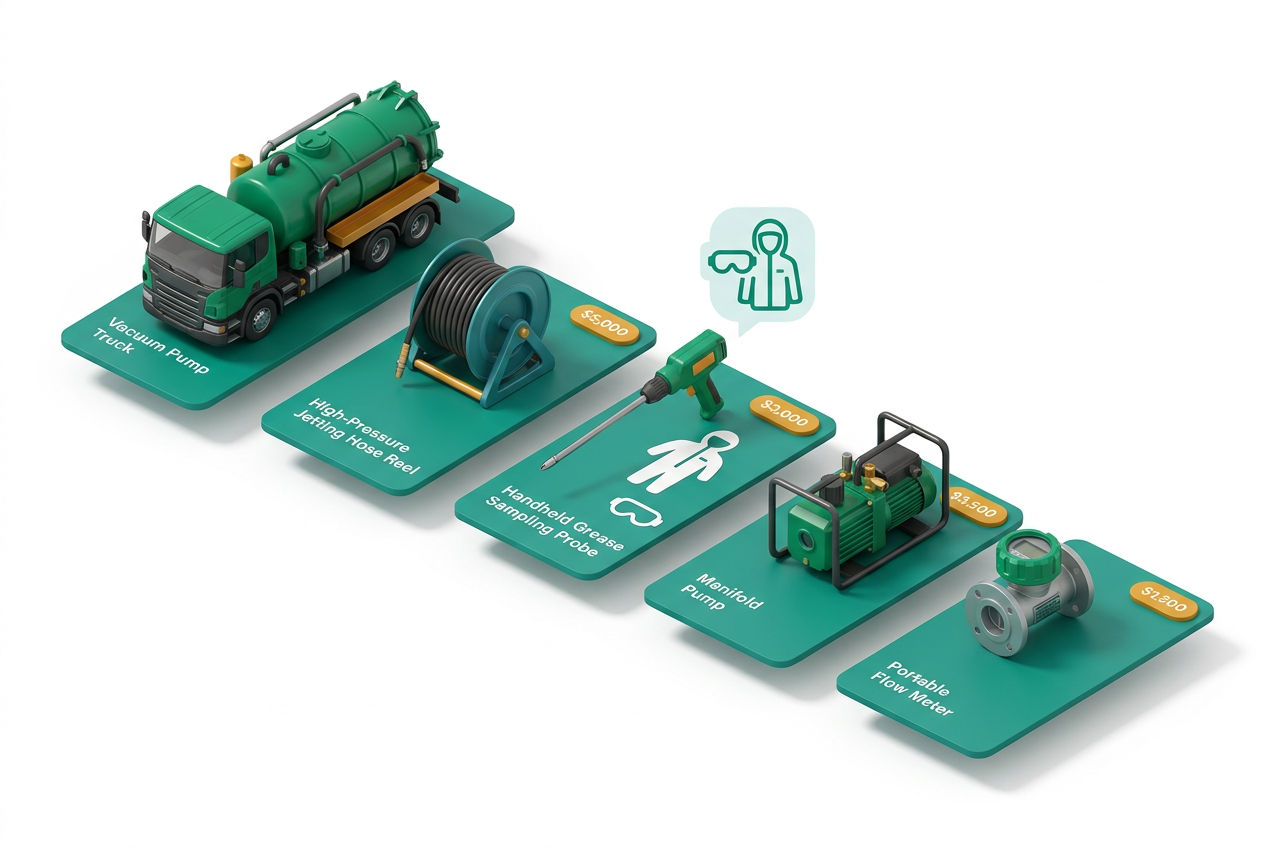
Vacuum Truck: A 1,500–3,000 gallon combo vacuum truck (wet/dry capable) is the industry standard for full-service operators. Look for units with a positive displacement blower rated at 400–600 CFM and at least 18 inches of mercury vacuum lift. Used units from brands like Vactor, Supervac, and Federal Signal appear regularly at municipal surplus auctions and through specialty dealers. Budget $15,000–$50,000 for a serviceable used unit.
Portable Pump Units: For operators starting small, a trailer-mounted or van-based grease trap pump — essentially a 50–200 gallon vacuum tank with a gas or electric-powered pump — can handle under-sink traps. Units from companies like Fruitland Manufacturing or JetVac run $2,000–$8,000 new.
Essential Accessories:
- 3-inch and 4-inch reinforced vacuum hose (minimum 25 feet)
- Grease trap cleaning wand with a 90-degree elbow for reaching baffles
- Degreasing agents (non-solvent, approved for drain application)
- Sludge scrapers for baffles and inlet/outlet walls
- Manifesting tablet or clipboard for waste tracking documentation
- PPE: nitrile gloves, rubber apron, safety glasses, and a half-face respirator with organic vapor cartridges — restaurant grease trap gas is no joke
For more on vacuum equipment specs and sourcing, see our vacuum truck guide.
Do You Need a License for Grease Trap Service?
Yes — licensing for grease trap service operates on at least two levels: your business license and your waste hauling permit. In many states, there's a third layer: an environmental permit specific to FOG waste transportation and disposal.
Waste Hauling Permit: Almost every state requires a commercial waste hauler permit to transport grease trap waste. This is typically issued by the state environmental agency or the state health department. In California, this falls under the Department of Resources Recycling and Recovery (CalRecycle) and the Regional Water Quality Control Board — one of the most complex regulatory environments in the country. In Texas, the Texas Commission on Environmental Quality (TCEQ) regulates waste haulers at the state level, while enforcement often flows through city FOG programs.
FOG Program Compliance: Cities like Houston, Atlanta, San Francisco, and Charlotte have dedicated FOG enforcement units. These programs require permitted haulers to submit waste manifests electronically after each service — documenting the volume pumped, the disposal facility used, and the date of service. Restaurants keep copies. Haulers keep copies. The city audits both.
Business License & Bonds: Standard LLC formation plus a general business license runs $500–$1,500 in most states. Some municipalities require a contractor's bond in the $5,000–$25,000 range for waste haulers.
According to the EPA, the Clean Water Act's pretreatment standards govern FOG discharge at the federal level — all state and municipal FOG programs build on top of that baseline. You can review the relevant provisions at epa.gov. Check your state environmental agency's website before you buy a single piece of equipment.
Our septic business license requirements guide covers the permit-stacking process in more detail, including how to research your specific county's requirements.
What Does Grease Trap Service Cost — and What Should You Charge?
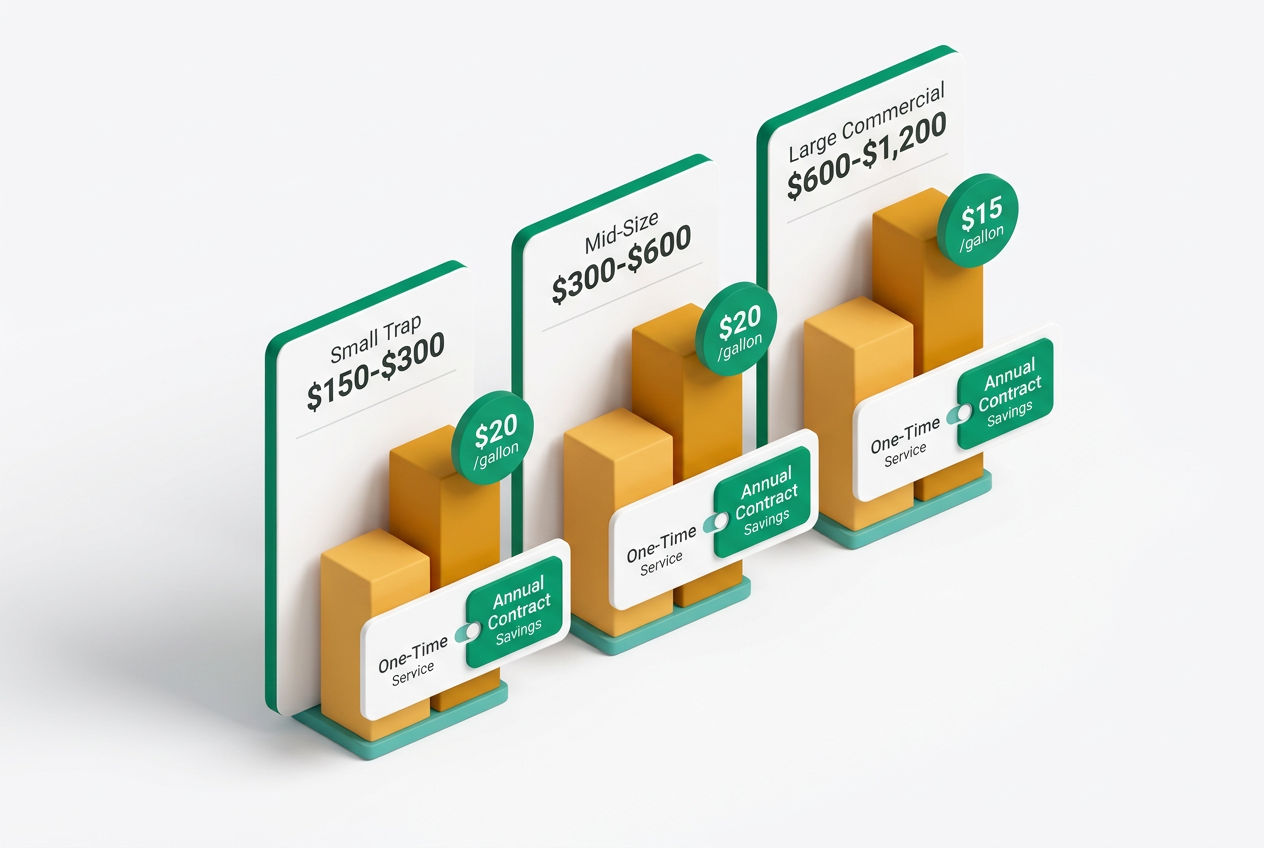
Pricing in the grease trap service market runs on two models: flat rate per service and per-gallon pricing. Most small operators use flat rates for indoor traps and per-gallon rates for large interceptors. Understanding grease trap service cost from both the operator's and customer's perspective helps you set rates that are competitive without leaving money on the table.
Flat Rate Pricing:
- Small indoor grease trap (30–100 gallons): $150–$350 per service
- Medium trap (100–500 gallons): $250–$500 per service
- Large in-ground grease interceptor (500–2,000+ gallons): $300–$1,500+
Per-Gallon Pricing: Some operators charge $0.30–$0.60 per gallon for large interceptors. On a 1,500-gallon interceptor, that's $450–$900 per pump-out — competitive with flat rates at that size.
Worked Example — Annual Route Value: A burger restaurant needs grease trap pumping every 60 days and has a 200-gallon indoor trap. At $350 per service, that's 6 services per year = $2,100 annually from one account. Add a second location from the same franchise group and you're at $4,200/year from a single sales call. Sign 40 accounts at that profile and your annual recurring revenue hits $84,000 before you take a single new customer call. That's the power of contract-based grease trap maintenance scheduling.
Geography matters here. The same 100-gallon indoor trap that pays $175 in a mid-size Midwest city might pay $250–$300 in the San Francisco Bay Area, where higher operating costs push market rates up. Conversely, rural markets often accept lower per-service prices but have less competition — your nearest competitor might be 40 miles away.
For a full pricing breakdown, see our grease trap cleaning service page.
How Often Do Grease Traps Need Grease Trap Maintenance?
Most municipal grease trap maintenance codes require service every 90 days at maximum — but the real cleaning schedule depends on how fast the trap accumulates FOG. According to the EPA's pretreatment program guidance, a trap is generally considered at capacity when the combined depth of the floating grease layer and the settled solids exceeds 25% of the total liquid depth. This is called the "25% rule" and is referenced in FOG ordinances in cities including Houston, Charlotte, and Los Angeles.
In practice, cleaning frequency varies by kitchen type:
- A high-volume burger or fried-food restaurant may need grease trap pumping every 30–45 days
- A boutique café or wine bar with minimal frying might run 90 days comfortably
- Commissary kitchens and ghost kitchen facilities often run on 30-day mandatory cycles under their municipal agreements
Have you ever looked inside a trap that hasn't been serviced on schedule? The grease layer hardens, the baffles get coated, and cleaning time doubles. That's exactly why restaurants on recurring grease trap maintenance contracts are more profitable accounts than one-off emergency calls — you control the schedule, the job stays predictable, and the customer never faces a compliance notice.
Frequency is your revenue multiplier. A restaurant on a 90-day cycle is worth 4 service visits per year. Move that same account to a 60-day schedule (often justified by kitchen volume) and you've increased annual revenue from that account by 50% with zero new customer acquisition cost.
Where Do You Dispose of Grease Trap Waste?
Approved disposal requires either a licensed wastewater treatment facility (POTW) that accepts FOG waste or a rendering facility that processes brown grease. Each option has different logistics, pricing, and revenue implications.
POTW Disposal: Most operators' primary disposal path is a publicly owned treatment works that has a FOG receiving station. Tipping fees typically run $0.03–$0.12 per gallon, depending on the municipality and your volume. A 2,000-gallon load costs $60–$240 to dispose of — a real line item in your per-job cost model. Before you haul a single trap, call your regional POTW and ask whether they accept FOG waste, what their tipping fee schedule is, and what manifesting documentation they require.
Rendering Facilities: Brown grease (the semi-solid FOG from grease traps) trades at a much lower value than yellow grease (fryer oil collected separately). According to the National Renderers Association, brown grease commodity pricing typically runs $0.02–$0.08 per pound depending on regional market conditions and grease quality. A 2,000-pound load at $0.05/pound grosses $100 — not a windfall, but it offsets some disposal costs for operators with volume.
Illegal Disposal Warning: Dumping grease trap waste in a storm drain, dumpster, or unauthorized location is a federal Clean Water Act violation under 33 U.S.C. § 1311. Penalties include fines up to $25,000 per day and potential criminal charges. This is not a gray area.
Worked Disposal Cost Example: You service a 1,500-gallon interceptor and charge $750 flat rate. Disposal at the regional POTW costs $0.08/gallon = $120 in tipping fees. Fuel and labor for the job: $80. Net on that single job: $550. Multiply by 8 similar jobs per week and your weekly gross margin from large-interceptor work alone is $4,400.
Step-by-Step: How Do You Launch a Grease Trap Service Company?
Septic Business Blueprint
Thinking about starting your own septic business?
The complete, plain-English playbook to start (or buy), license and grow a profitable septic business — the models, the money math, trucks, disposal, insurance, pricing and how to land your first customers.
Get the Blueprint — $297 →Instant access · 12-chapter playbook + 6-piece toolkit · 60-day money-back guaranteeHere is the operational sequence most successful single-truck operators follow in their first 90 days:
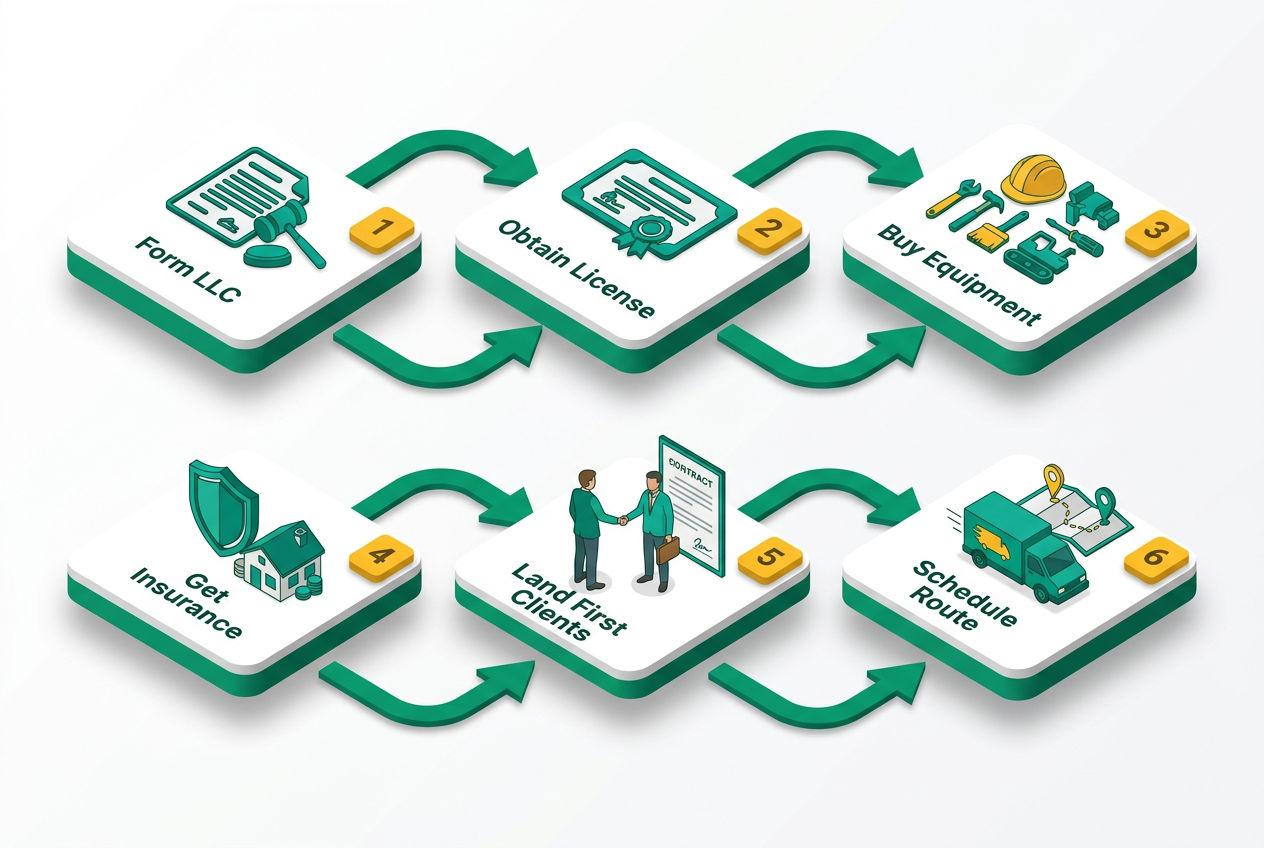
Step 1 — Form your business entity. An LLC is the standard structure for grease trap service operators. It separates personal liability from business liability, which matters when you're hauling regulated waste. File in your home state; costs run $50–$500 depending on state filing fees.
Step 2 — Get your EIN. Apply at irs.gov — it's free and takes 10 minutes online. You need this before opening a business bank account or applying for most waste hauler permits.
Step 3 — Apply for your waste hauler permit. This is state-specific. Search "[your state] FOG waste hauler permit" and "[your state] environmental agency commercial waste transporter." In Texas, that's TCEQ. In Florida, it's FDEP. In California, it's CalRecycle plus your Regional Water Quality Control Board. Allow 30–90 days for permit processing.
Step 4 — Get the right insurance. You need commercial auto (minimum $1M liability for a vehicle hauling regulated waste), commercial general liability ($1M–$2M), and pollution liability coverage. Standard GL policies exclude pollution events — a grease spill on a restaurant parking lot qualifies. Expect to pay $6,000–$15,000/year for a properly structured policy.
Step 5 — Source your equipment. Before you buy, have a diesel mechanic inspect any used vacuum truck. Pay particular attention to the pump seals, vacuum blower bearings, and the condition of the tank interior. A truck with a cracked tank or a failing blower will cost more to repair than you saved on the purchase price.
Step 6 — Secure a disposal agreement. Call your regional POTW or rendering facility before you haul anything. Get disposal terms in writing, including the tipping fee per gallon, acceptable waste parameters (% solids, temperature), and their manifest requirements. Some facilities require pre-approval before your first delivery.
Step 7 — Get your first 10 accounts. County health department records often list all commercial food-service permits — that's your prospect list. Drive your target area and note every restaurant, food truck commissary, and commercial kitchen. Offer a free first inspection or a discounted first service to convert cold calls to paying accounts. Getting a restaurant's maintenance manager on-site for an inspection converts far better than a phone pitch alone.
Step 8 — Build your manifest system. From day one, document every job: date, customer name and address, trap size, volume pumped, disposal facility, manifest number. Most municipal FOG programs require you to retain these records for 3 years and submit them electronically. ServiceTitan, Jobber, or a simple Google Sheets template works for early-stage operators.
For a broader view of running a service-based waste business, our guide to running a septic business covers route management, customer retention, and scaling from one truck to a fleet.
What Are the Biggest Challenges in the Grease Trap Service Industry?
Every service business has honest limitations, and grease trap service is no exception. Here's what the favorable economics don't always show upfront:
Disposal access can be a bottleneck. In some rural markets, the nearest POTW accepting FOG waste may be 60–90 minutes from your service area. If disposal round-trips eat 3 hours of your day, your per-job economics break down fast. Research disposal options before you commit to a geographic market.
Cold-climate operations add cost. In northern states — Minnesota, Wisconsin, upstate New York — grease congeals significantly in winter. Many operators add a propane heater or hot-water rinse capability to their rigs to handle frozen grease trap contents. This adds $1,500–$3,000 to your equipment investment and justifies a $25–$75 seasonal surcharge to customers.
California is its own category. If you're operating in California, budget for aggressive environmental regulations, higher licensing costs, and more established competition in most metro markets. The dual permitting requirement (CalRecycle plus RWQCB) adds processing time and cost that operators in other states don't face.
Route density takes time to build. Most operators don't hit full route density until month 6–12. The first 90 days often involve driving inefficient routes while you fill in geographic gaps. This is normal — but it means your early-month economics will look worse than your mature-route economics. Plan your cash runway accordingly.
Seasonal Patterns and Regional Considerations: How Does Location Affect Your Grease Trap Business?
Geography shapes nearly every variable in a grease trap service business — pricing, demand seasonality, competition, and disposal logistics.
Tourism-Driven Markets: Restaurant corridors tied to tourism — coastal Florida, Las Vegas, the Gulf Coast — see grease trap pumping demand spike in high season. A restaurant that runs a 90-day cleaning cycle in January may need 45-day service in July when kitchen volume doubles. If you build your route in a tourism market, plan for seasonal capacity constraints: you may need a second truck or a contract crew during peak months.
Urban Dense Markets: In cities like Atlanta, Houston, Dallas, and Charlotte, FOG enforcement is aggressive and restaurant density is high. Route density — your revenue per mile driven — is highest here. The tradeoff is competition. Established regional operators have locked up multi-location franchise accounts. Your entry strategy needs to be sharper: faster response times, better online booking, or a lower introductory price to displace an incumbent.
Rural Markets: Less competition, longer drives between stops, lower price ceilings. The operator 40 miles away may be your only real competitor — but you're also driving 40 miles between stops yourself. Rural grease trap service works best as a complement to a septic pumping route that already covers the same geography. Our septic pumping business startup guide covers how to structure a dual-service route economically.
Understanding what grease traps actually are before you start is worth a few minutes — our what is a grease trap explainer covers trap types, baffle configurations, and why different kitchen types need different maintenance schedules. Our grease trap sizing guide is useful when customers ask you whether their current trap is undersized for their kitchen volume — a common situation in older commercial buildings.
Frequently Asked Questions About Grease Trap Service
What does grease trap service include, and how does it work?
Grease trap service includes pumping out accumulated FOG (fats, oils, and grease) waste from a commercial kitchen's grease trap or grease interceptor, cleaning the trap walls and baffles, inspecting the inlet and outlet pipes for blockages, and transporting the collected waste to a licensed disposal facility. A standard service visit begins with removing the trap lid and measuring the grease and solids layers to assess how full the trap is — most FOG ordinances define a trap as "at capacity" when grease and solids together exceed 25% of the total liquid depth, a benchmark established in EPA pretreatment program guidance. The technician vacuums out the contents, scrapes the baffles, and rinses the trap interior. The entire visit typically takes 30–90 minutes depending on trap size. At the end, the technician completes a waste manifest documenting the volume removed, the disposal site, and the service date — which the restaurant keeps on file for municipal compliance inspections.
What is the typical grease trap service cost for a restaurant?
Grease trap service cost for a restaurant depends on trap size, service frequency, and local market rates. For small under-sink grease traps (30–100 gallons), expect to pay $150–$350 per service. Medium traps (100–500 gallons) typically run $250–$500 per service. Large in-ground grease interceptors (500–2,000+ gallons) range from $300 to $1,500 or more per pump-out, sometimes priced at $0.30–$0.60 per gallon. Geographic location affects pricing significantly: the same trap that costs $175 to clean in a mid-size Midwest city may cost $250–$300 in the San Francisco Bay Area due to higher operating and disposal costs. Annual grease trap service cost for an average restaurant on a 90-day cleaning cycle might run $600–$1,400 per year for a small indoor trap, or $1,200–$6,000 per year for a large interceptor serviced monthly. Ask your local FOG program office what the minimum cleaning frequency is — that sets the floor for your annual service budget.
How often does grease trap pumping need to happen?
Grease trap pumping frequency is set by a combination of municipal FOG ordinance requirements and actual trap accumulation rates. Most cities require a minimum service interval of every 90 days — but many busy restaurants need pumping every 30–60 days. According to EPA pretreatment program standards, the industry benchmark is the "25% rule": a trap must be cleaned when the combined grease layer and settled solids exceed 25% of the total liquid depth. High-volume fried-food restaurants often hit that threshold in 30–45 days. Boutique cafés or wine bars may go 90 days without approaching capacity. Cities like Houston, Los Angeles, and Charlotte enforce pumping schedules through their dedicated FOG programs, requiring haulers to submit electronic manifests after each service. If your restaurant is cited for an overloaded trap, fines and permit suspension can follow quickly. A licensed grease trap service provider can inspect your trap and recommend the right cleaning interval based on your kitchen's actual FOG output, not just the minimum legal requirement.
Do I need a license to start a grease trap pumping business?
Starting a grease trap pumping business requires at least two types of licensing and in most states a third. First, a standard business license and LLC or corporation formation — typically $500–$1,500 including state filing fees. Second, a commercial waste hauler permit issued by your state environmental agency; in Texas this is the TCEQ, in California it's CalRecycle combined with the Regional Water Quality Control Board, and in Florida it's the FDEP. Third, many cities with active FOG enforcement programs require you to register as an approved hauler directly with the city before you can legally service restaurants in that jurisdiction. Some municipalities also require a contractor's bond in the $5,000–$25,000 range. The EPA Clean Water Act under 33 U.S.C. § 1311 sets federal baseline standards; state and municipal requirements layer on top. Permit processing can take 30–90 days, so apply before you invest in equipment. Check your state environmental agency's website for the current application requirements in your county.
What is the difference between a grease trap and a grease interceptor, and does my business need to service both?
A grease trap is typically a small, under-sink device — 30 to 100 gallons — installed directly in the kitchen drain line of a commercial food-service facility. A grease interceptor is a much larger, in-ground tank — commonly 500 to 2,000 gallons or more — installed outside the building to capture FOG from an entire facility's plumbing system. Both devices are covered under municipal FOG programs and both require regular grease trap maintenance, but they involve different equipment and different service logistics. Small grease traps can be serviced with a portable pump unit (50–200 gallon vacuum tank), making them accessible to startup operators. Large grease interceptors require a full vacuum truck with 1,500–3,000 gallon capacity. A full-service grease trap service business should eventually be equipped to handle both — indoor traps represent high-frequency, lower-margin work while large interceptors offer higher per-job revenue. Understanding both configurations, including baffle design and flow rate requirements, is covered in detail in our grease trap sizing guide.
What are the startup costs for a grease trap service business?
Startup costs for a grease trap service business range from approximately $25,000 for a small portable-pump operation to $150,000 or more for a full vacuum-truck setup. The largest variable is equipment: a used vacuum truck in serviceable condition runs $15,000–$50,000, while a new unit can exceed $200,000. Operators starting with portable pump units (suitable only for small under-sink traps) can begin for $2,000–$8,000 in equipment costs. Beyond equipment, budget $500–$3,000 for business licenses and waste hauler permits, $6,000–$15,000 per year for commercial auto, general liability, and pollution liability insurance, and $500–$2,000 for PPE, hoses, cleaning agents, and manifesting supplies. Many operators finance their first vacuum truck through equipment loans or SBA 7(a) programs after building an initial client base with portable equipment. According to NAIC commercial lines data, pollution liability coverage — essential for regulated waste haulers — adds meaningfully to insurance costs compared to standard service businesses. Our septic business startup costs guide covers financing structures applicable to grease trap operators as well.
Sources & Methodology
- National Restaurant Association — Restaurant industry size and food-service permit data, 2024 State of the Restaurant Industry Report.
- U.S. Environmental Protection Agency — Clean Water Act pretreatment standards, FOG control guidance, and the 25% rule for grease trap capacity. epa.gov/npdes/pretreatment-program
- National Association of Wastewater Technicians (NAWT) — Equipment standards and technician training guidelines. nawt.org
- Texas Commission on Environmental Quality (TCEQ) — Waste hauler permit requirements and FOG program enforcement structure for Texas operators.
- National Renderers Association — Brown grease commodity pricing benchmarks and rendering facility acceptance standards.
- NAIC Commercial Lines Data — Insurance cost ranges for commercial auto, general liability, and pollution liability coverage for regulated waste haulers.
About This Guide: This article was reviewed by a contributor with 11 years of operational experience in commercial grease trap and septic service across Florida, Georgia, and Texas, including direct experience managing FOG compliance programs for multi-unit restaurant groups. SepticTankHub.com is a national directory connecting food-service operators and property managers with licensed grease trap service professionals. Pricing data reflects operator surveys and municipal FOG program rate filings current as of the updated date above.
Was this article helpful?
Frequently Asked Questions
Recommended Resources
📖 Related Articles
- Septic Pumping Business: The Complete Guide
- Septic Business Startup Cost: 2026 Price Guide
- Vacuum Truck: The Complete Guide
- Septic Business License: The Complete Guide
- How to Run a Septic Business: Operations, Pricing & Growth
- What Is a Grease Trap? How It Works, Sizing & Rules
- How to Size a Grease Trap (Formula + Chart)
🔧 Services
Find Septic Professionals Near You
Compare licensed, verified septic companies by area — top county markets and cities below, or browse all 50 states.
County markets
Popular cities
