
Quick Answer
Running a septic tank business means licensing a vacuum truck operation, hiring certified technicians, setting compliant disposal routes, and building recurring customer relationships — all while managing a capital-intensive asset that depreciates daily. The fastest path to profitability combines tight route density (6–8 jobs per day within a 30-mile radius), maintenance contracts that generate predictable monthly revenue, and upsell services like inspections and minor repairs that require no additional equipment investment.
Key Takeaways
- A single pumper truck can generate $150,000–$400,000 in annual revenue at 4–8 jobs per day
- Startup costs range from $50,000 (lean, used equipment) to $300,000+ (new truck, full setup)
- Most states require a licensed operator and a waste hauler permit — requirements vary significantly by state
- Profit margins run 25–45% for well-managed service operations
- Maintenance contracts are the most reliable way to smooth seasonal revenue dips and build recurring income
What Does It Actually Take to Run a Septic Tank Business?
Running a septic tank business means managing a licensed, insured field operation that pumps, hauls, and disposes of septage — the technical term for the sludge, scum, and liquid waste pulled from a tank. The work is more demanding than it looks from the outside, and the compliance burden is real.

You're coordinating a vacuum truck operation governed by state waste hauler permits, EPA disposal requirements, and OSHA confined space entry rules under 29 CFR 1910.146. Customers are often calling because something has already failed — a backed-up line, a gurgling drain, a yard that smells like a problem. Getting there fast, diagnosing accurately, and documenting the job properly is what separates operators who build referral businesses from those who stay stuck chasing new calls.
The core service is septic tank pumping. A vacuum truck pulls waste through a hose connected to the tank's access port. Technicians assess baffle condition, check the effluent filter (common models include the Polylok PL-122 and Zabel A1800), note scum and sludge depths using a sludge judge, and haul the load to an approved disposal facility. A residential job on a 1,000-gallon tank takes 1–3 hours from driveway to departure.
Pumping is just the entry point. The most profitable septic businesses add inspections, system assessments, minor repairs, and maintenance contracts on top. Each of those layers increases revenue per customer without requiring a second truck — and that's where sustainable margins are actually built.
How Much Does It Cost to Start a Septic Pumping Business?
Starting a septic pumping business costs between $50,000 and $300,000 depending on whether you buy used or new equipment and how aggressively you invest in your first year.
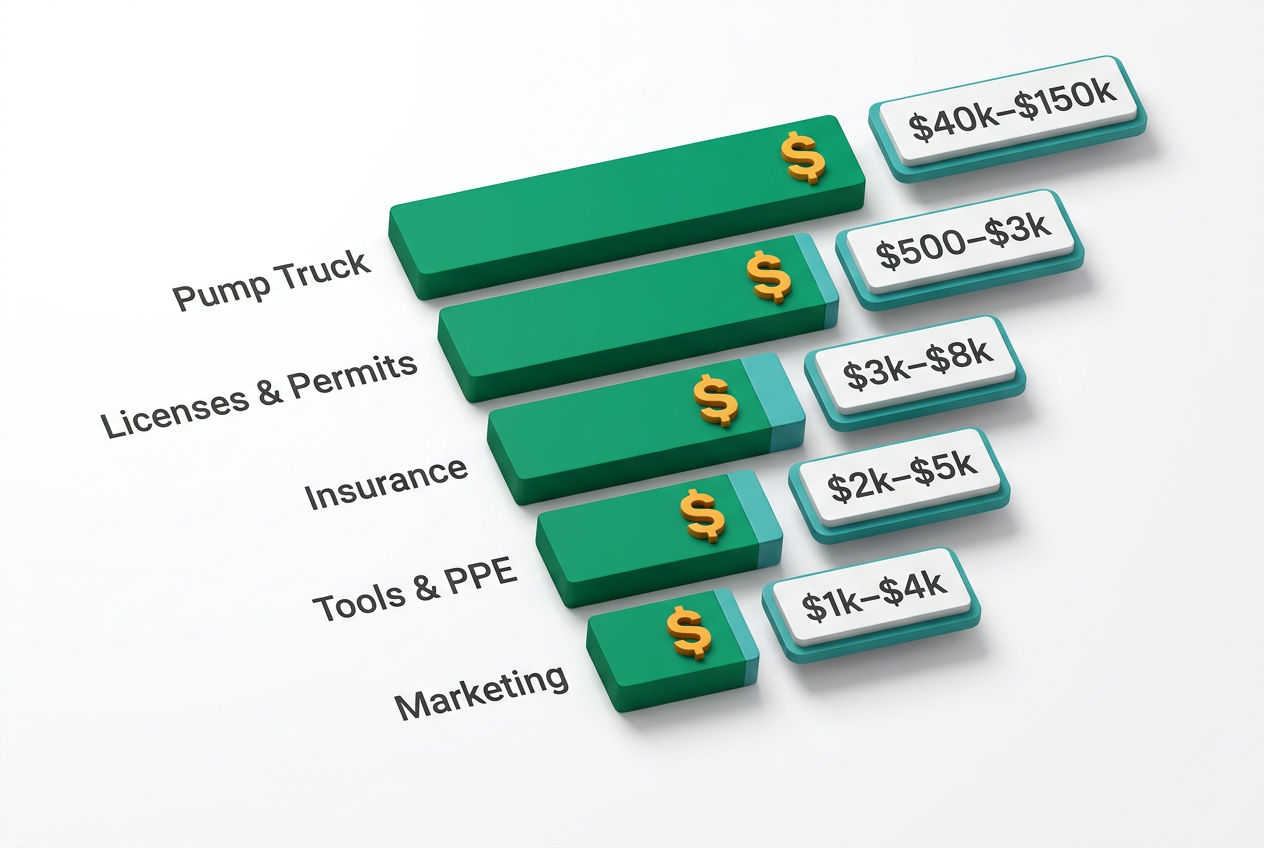
Here's what drives those numbers:
Vacuum/Pumper Truck This is your biggest expense. A used vacuum truck in working condition runs $15,000–$50,000. Expect higher maintenance costs and possible downtime. A new unit — think a Heil or Mack chassis with a 2,500–3,500 gallon tank — runs $80,000–$200,000+. For a detailed breakdown of truck options and configurations, see our septic pump truck cost guide and the full vacuum truck guide.
Licensing and Permitting Budget $500–$5,000+ depending on your state. Some states require only a business license and a waste hauler permit. Others — California, New York, Texas — require certified operator credentials with documented training hours and annual renewals.
Business Insurance General liability, commercial auto, and pollution liability together run $3,000–$8,000 per year for a small operation. Don't skip pollution liability. One spill during disposal can create an environmental claim that wipes out a year's profit.
Hand Tools and Safety Equipment Sludge judges, inspection cameras, PPE, hoses, and fittings add another $2,000–$8,000 to startup costs.
Working Capital Plan for three months of operating expenses before your first check clears. That's fuel, insurance payments, disposal fees, and your own salary if you're the sole operator.
For a full itemized breakdown, see our dedicated septic business startup costs guide.
Septic Business Startup Costs at a Glance
| Expense Category | Lean Setup | Full Setup |
|---|---|---|
| Used vacuum truck | $15,000–$50,000 | — |
| New vacuum truck | — | $80,000–$200,000+ |
| Licensing & permits | $500–$2,000 | $2,000–$5,000+ |
| Business insurance (year 1) | $3,000–$5,000 | $5,000–$8,000 |
| Tools & safety equipment | $2,000–$4,000 | $4,000–$8,000 |
| Working capital (3 months) | $10,000–$20,000 | $20,000–$40,000 |
Sources: NAWT industry surveys, EPA Onsite Wastewater Program, operator interviews. Costs are U.S. national estimates and vary by region.
Do You Need a License to Start a Septic Tank Company?
Yes — in virtually every state, some form of licensing or permitting is required to legally operate a septic tank company. The specifics vary dramatically.

Licensing operates at two levels: the business/contractor license and the operator certification. Most states require both.
- Texas delegates regulation to county-level Designated Representatives (authorized agents of the Texas Commission on Environmental Quality). Some counties require certified installers for pumping operations; others are less stringent.
- Florida requires all septic contractors to hold a Registered Septic Tank Contractor (RSTC) license through the Florida Department of Health before operating commercially.
- California requires Registered Environmental Health Specialists or certified pumpers under county jurisdiction, with disposal manifests filed for every load.
- New York mandates that septage haulers obtain a permit from the state Department of Environmental Conservation plus local county health department approval.
Beyond operator credentials, you'll need a waste hauler permit in almost every state. This permit authorizes you to transport septage from job site to disposal facility. Without it, you're operating illegally regardless of your other credentials.
Disposal itself is regulated separately. Treatment facilities — municipal wastewater plants, licensed land application sites — set their own tipping fees and require manifest documentation. Fees run $0.03–$0.10 per gallon depending on region, which means a full 3,000-gallon truck load costs $90–$300 just to dispose of.
The National Association of Wastewater Technicians (NAWT) offers the Certified Inspector of Onsite Sewage Systems (CIOSS) program, which is accepted as a qualifying credential in several states and is worth completing before you apply for operator certification in any jurisdiction.
For state-specific details, check our septic business license requirements guide and your state's health department regulations.
Is Starting a Septic Hauling Business Worth It Financially?
Before diving into pricing mechanics, it's worth asking whether a septic hauling business actually pencils out — and for most markets, the numbers work.
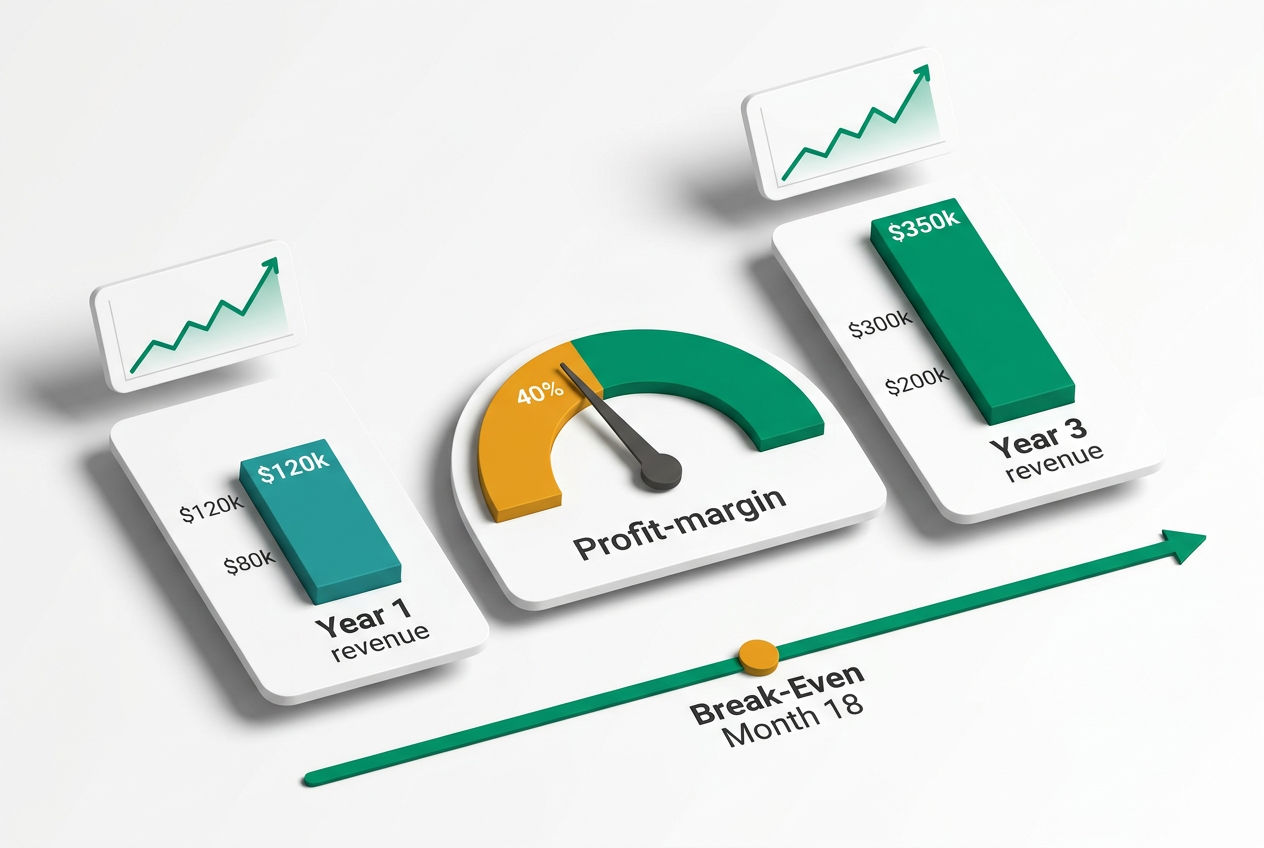
The combination of low customer churn, recurring service cycles, and inelastic demand creates a financial profile that's genuinely hard to replicate in other trades. Septic systems don't stop needing service because the stock market drops. The EPA's Onsite Wastewater Treatment Systems Manual estimates that the 3–5 year residential pump cycle generates a predictable base of demand regardless of economic conditions — demand that, unlike discretionary home improvement, is driven by public health necessity rather than consumer preference.
One honest limitation worth stating plainly: profit margins in the first 12–18 months are almost always compressed. You're paying down equipment debt, building route density, and absorbing the inefficiencies that come with any new operation. An owner-operator in central Tennessee who tracked his first-year numbers found that after truck payment ($1,850/month), insurance ($520/month), disposal fees, and fuel, his actual take-home on $180,000 in gross revenue was closer to $38,000 — a 21% net margin, not the 35–40% he'd projected. By year three, with 140 maintenance contract customers and a denser route, his net margin had climbed to 33%.
That trajectory is typical. Operators who expect 40% net margins in year one are usually disappointed. Operators who treat year one as a route-building investment and target 15–20% net tend to be better positioned for the long run. A septic hauling business with 200+ maintenance contract customers and tight route density can sustain margins well above the industry average of 25–45% for established operations.
How Do You Price Septic Tank Pumping Services?
Pricing a septic pumping job starts with your costs, not with what your competitor charges. A standard residential pump-out on a 1,000-gallon tank runs $300–$600 nationally. In dense suburban markets with short drive times, you can stay near the lower end and still profit well. Rural operations with long routes and higher fuel costs need to price at $400–$600 or more to protect margin.
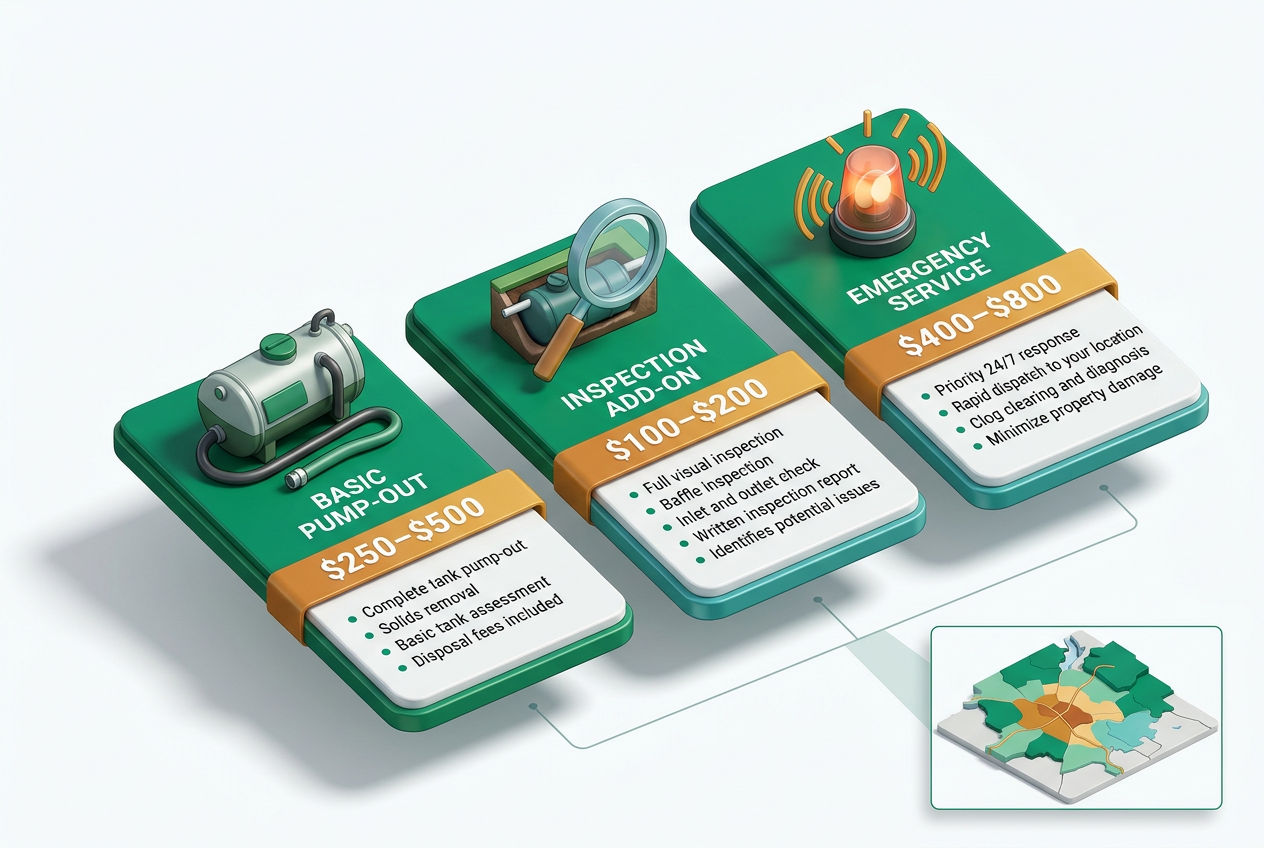
See our septic pumping cost guide for what customers in your market are already expecting to pay.
Build your floor price from the bottom up:
- Truck cost per hour — Divide annual truck expenses (payment, insurance, maintenance) by billable hours. A $100,000 truck paid over 5 years at $20,000/year, plus $8,000 insurance and $5,000 maintenance, costs roughly $33,000/year. At 1,500 billable hours, that's $22/hour.
- Labor — Technicians earn $18–$28/hour. Add payroll taxes and burden at 25–30% on top.
- Disposal fee — At $0.07/gallon average, a 1,000-gallon job costs $70 in tipping fees.
- Fuel — Budget $0.50–$1.00 per loaded mile.
- Overhead — Office costs, software, marketing, and admin typically add 15–20% to job cost.
Add those up and you'll find your true cost per job. Then price above it.
Worked example: Say your fully loaded cost per residential job — truck, labor, disposal, fuel, overhead — comes to $185. At a $375 service charge, your gross profit per job is $190, a 50.7% gross margin. Run 6 jobs per day, 5 days per week, for 45 working weeks, and that single truck generates $506,250 in annual revenue and roughly $255,000 in gross profit before owner compensation and debt service. This is why route density matters so much: adding a seventh job per day at the same cost structure adds $42,750 in annual revenue with almost no incremental overhead.
Commercial accounts — restaurants, mobile home parks, commercial buildings — run larger systems and require more frequent service. A 5,000-gallon commercial tank can generate $800–$2,500 per service call. These accounts are worth pursuing actively once you have residential routes established.
Inspection services add $150–$400 per call for a separate revenue stream that requires no additional truck. A visual inspection plus written report is a natural upsell during any pump-out. See our septic inspection cost guide to understand what the market supports.
Use the pricing calculator below to build your floor price from actual costs — enter your truck expenses, labor rate, disposal fee, and target margin to get a job price that protects your business.
How Much Do Septic Business Owners Make?
A single-truck septic operation running 4–8 residential jobs per day can generate $150,000–$400,000 in annual revenue at current market pricing. What the owner actually takes home depends on route density, service mix, and how efficiently they manage truck and labor costs.
For a realistic picture, consider a central Tennessee owner-operator running one truck, six days per week, averaging 5.5 jobs per day at $375 average ticket. That's roughly $760,000 in theoretical annual capacity — but accounting for weather delays, drive time, seasonal slowdowns (January and February are consistently the slowest months in most southern markets), and time spent on estimates and disposal runs, actual billable jobs come in around 1,200 per year. At $375 average, that's $450,000 gross.
After truck payment, insurance, fuel, disposal fees, and one part-time office staffer, net income before taxes lands at $110,000–$140,000 for the owner. That's a strong living — but it's not passive. It reflects an owner who still runs the truck, answers calls, and manages disposal logistics personally.
Multi-truck operations that have moved the owner off the truck and into a management role typically see higher gross revenue but similar owner net income until the third or fourth truck, when economies of scale on insurance, dispatch software, and disposal contracts start to compound.
For a deeper financial model, see our analysis of whether a septic business is profitable.
What Equipment Do You Need to Start a Septic Business?
The minimum equipment needed to start a legal septic service business is a licensed vacuum truck, basic hand tools, and the safety equipment required under OSHA 29 CFR 1910.146 for confined space entry operations.
 and essential tools: vacuum pump, hose reel, inspection camera, PPE kit, and locator wand.](https://ik.imagekit.io/34qr7twyt/blog-infographics/how-to-run-a-septic-business-6.png)
Here's the full equipment list broken into tiers:
Core Equipment (Required)
- Vacuum/pumper truck: 1,500–3,500 gallon capacity depending on market. Manufacturers like Heil Environmental, Imperial Industries, and Pik Rite are common in the industry. New units run $80,000–$200,000; used units $15,000–$50,000.
- Sludge judge: A clear calibrated tube used to measure scum and sludge layers before and after pumping. Essential for documenting job completion and assessing tank health. Cost: $50–$150.
- Hoses and fittings: 4-inch suction hose in 10-foot sections, plus couplings, elbows, and clean-out fittings. Budget $1,500–$3,000 for a complete hose kit.
- PPE: Nitrile gloves, rubber boots rated for chemical exposure, safety glasses, and a half-face respirator with organic vapor cartridges for enclosed-space work near tank openings.
- Confined space entry kit: Per OSHA 29 CFR 1910.146, a permit-required confined space entry kit including gas monitor, retrieval harness, tripod, and communication gear. Cost: $800–$2,500 for a basic kit.
Inspection and Upsell Equipment (Strongly Recommended)
- Inspection camera: A push-rod or crawler camera for line and baffle inspection. The RIDGID SeeSnake Compact2 is a common entry-level choice at $3,000–$5,000. These cameras pay for themselves quickly when inspection fees are added to every pump-out.
- Effluent filter tools: Wrenches and brushes sized for common filter housings including the Polylok PL-122 and Zabel A1800 — both frequently encountered on residential systems installed after 2000.
- Digital job forms: Tablet or phone-based forms that capture tank dimensions, baffle condition, sludge depth readings, and customer signature. Jobber ($49–$199/month) includes field forms that sync directly to invoicing.
Vehicle and Safety Support
- Traffic cones, safety vests, and wheel chocks for roadside and driveway jobs
- First aid kit with bloodborne pathogen supplies
- Spill containment kit: absorbent booms and a 5-gallon bucket of dry absorbent material for minor spills during connection and disconnection
A lean startup running one truck with used equipment and basic inspection tools can be field-ready for $25,000–$35,000 in equipment beyond the truck itself. New operators should budget for the lower end while building route density and paying down equipment debt. Spending $8,000 on a RIDGID camera before you have steady inspection volume is a capital allocation mistake — add upsell equipment as the service demand justifies it.
How Do You Build a Customer Base for a Septic Pumping Business?
Septic Business Blueprint
Thinking about starting your own septic business?
The complete, plain-English playbook to start (or buy), license and grow a profitable septic business — the models, the money math, trucks, disposal, insurance, pricing and how to land your first customers.
Get the Blueprint — $297 →Instant access · 12-chapter playbook + 6-piece toolkit · 60-day money-back guaranteeBuilding a customer base for a new septic service business means combining digital presence, referral relationships, and direct outreach — in that order of long-term leverage.

Google Business Profile First Your Google Business Profile (GBP) is the highest-leverage marketing asset in the first 90 days. Set your primary category to "Septic Tank Pumping" and add "Plumbing" as a secondary category. Upload photos of your truck, your team in proper PPE, and completed jobs where visible. Request reviews from every customer within 24 hours of service — a text link to your GBP review page converts at 15–20% when sent promptly. Most owner-operators see meaningful local search visibility within 60–90 days of an optimized GBP with 10+ reviews.
Real Estate Agent Referrals Real estate transactions require septic inspections in most states before closing. Agents need a reliable inspector who can turn around a written report in 24–48 hours and answer the phone when a deal is moving fast. A one-page flyer with your turnaround time commitment, your inspection fee, and your direct cell number will generate repeat business from agents once they trust your reliability. Bring it to two or three local brokerages and introduce yourself in person — this is a relationship business and email alone rarely breaks through.
Direct Mail to Older Subdivisions Homeowners in pre-1987 subdivisions are often overdue for service and may not have records of their last pump-out. A postcard campaign targeting homes in these zip codes runs $0.35–$0.50 per piece. On a 500-home mailing, expect 2–4% response (10–20 calls), with 7–15 converting to paid jobs. At $375 average, a $175 mailing investment can return $2,600–$5,600 in first-time jobs — plus recurring customers if you set reminders for their next service cycle.
Maintenance Contracts Once you have 50+ active customers, introduce an annual maintenance plan. A simple $149–$199/year contract that includes one pump-out, a basic inspection, and a reminder call before the service window due date converts well when offered at the point of first service. Customers who sign maintenance contracts churn at a fraction of the rate of one-time customers, and their routes become predictable — which makes scheduling and disposal planning significantly more efficient.
Commercial Outreach Restaurants, campgrounds, and mobile home parks need frequent, reliable service. A food service establishment with a 1,500-gallon grease trap may need monthly pumping — one commercial account can equal 12 residential jobs per year at higher per-call revenue. Cold outreach to food service managers with a simple one-page proposal (frequency schedule, response time guarantee, compliance documentation) works better than advertising for these accounts.
For more detail on marketing execution, see our septic business tips to grow guide.
How Do You Scale a Septic Tank Business Beyond One Truck?
Scaling past one truck requires that the business operate independently of the owner's physical presence. Most single-truck owner-operators hit a ceiling around $350,000–$450,000 in annual revenue because they're still running the truck, dispatching themselves, and handling customer calls between jobs.
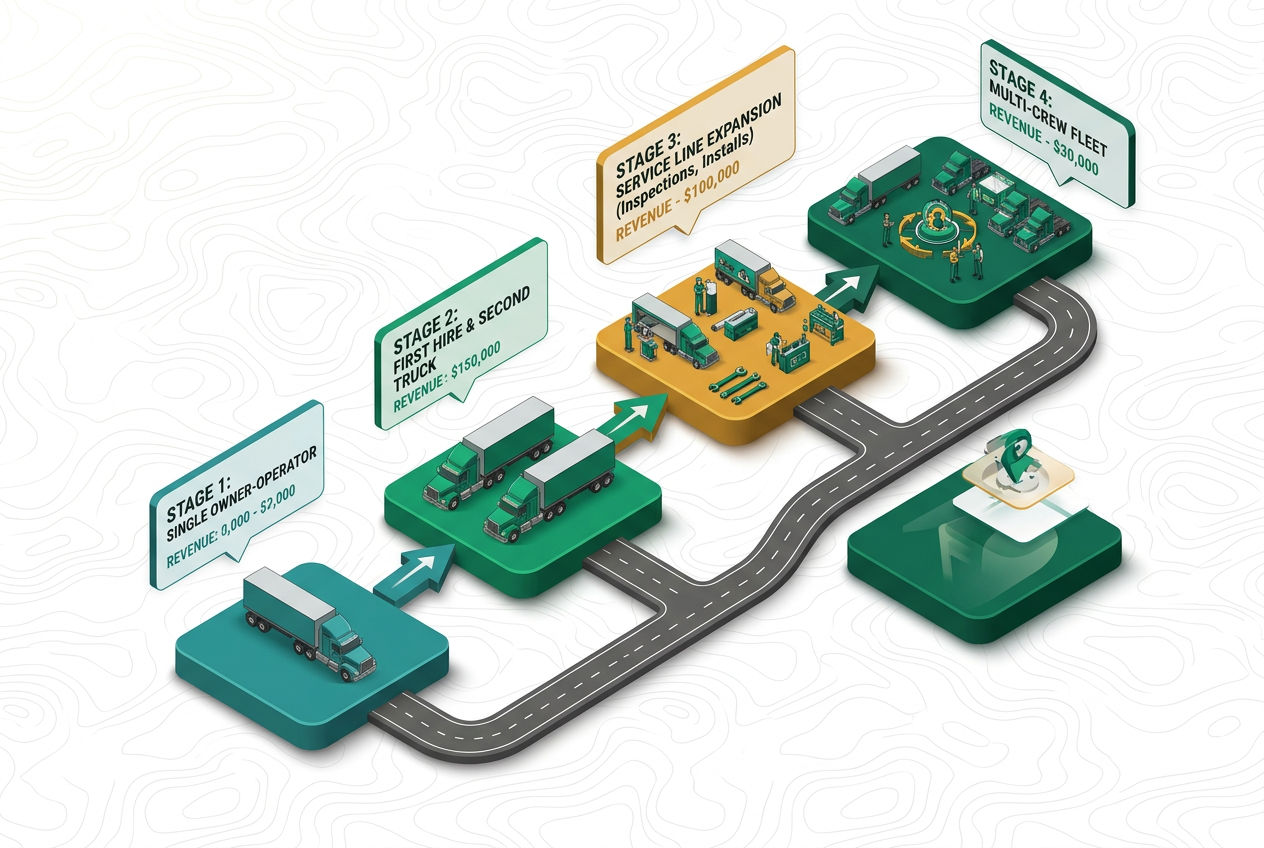
Breaking through that ceiling means building systems first, then adding capacity.
Add dispatch infrastructure before adding a truck. Jobber or ServiceTitan can handle scheduling, routing, invoicing, and customer reminders. Get those systems running on your first truck so that adding a second truck doesn't also mean adding chaos. Route4Me or the routing feature inside Jobber can sequence daily jobs to minimize drive time — a critical efficiency when you're managing two crews and paying two sets of labor hours.
Hire and train a lead technician before buying truck two. The person who will eventually run your second truck needs 6–12 months of supervised field experience before operating independently. Hiring ahead of the expansion is expensive in the short term but essential for service quality and compliance. A second truck with an undertrained operator generates callbacks, complaints, and potential regulatory exposure that costs more than the wages saved.
Lock in a disposal contract before you scale volume. Many municipal wastewater treatment facilities and licensed land application sites offer tiered tipping fee structures for high-volume haulers. Operators processing 50,000+ gallons per month can often negotiate $0.04–$0.05/gallon versus the $0.07–$0.10 walk-up rate. At that volume, a $0.03/gallon reduction saves $1,500/month — $18,000/year that flows directly to the bottom line.
Target commercial accounts for truck two revenue. A second truck running commercial routes — restaurants, mobile home parks, commercial facilities — is easier to schedule predictably than a residential expansion truck. Commercial customers have defined service intervals, generate larger per-call revenue, and don't require the same level of emergency response availability that residential customers expect.
Acquisition is faster than organic growth at the second or third truck stage. A retiring owner-operator with 150 maintenance contract customers and a serviceable truck can often be acquired for 0.5–1.0× annual revenue. That's an instant customer base, established routes, and often seller financing. For details on buying versus building, see our buying a septic business guide.
For adjacent expansion opportunities once your core routes are established, see our guide on how to start a grease trap business.
What Are the Biggest Risks in Running a Septic Service Business?
Every septic business faces a common set of operational and financial risks. Knowing them in advance doesn't eliminate them — but it helps you build systems that contain the damage when something goes wrong.
Equipment failure: A vacuum truck that goes down during peak season can cost $5,000–$25,000 in repair bills and $2,000–$10,000 in lost revenue while it's out of service. Operators who run preventive maintenance schedules — oil changes, pump seal inspection, valve checks every 500 operating hours — have significantly lower catastrophic failure rates than those who fix problems after they appear.
Regulatory non-compliance: A disposal manifest that doesn't match your load record, a missed permit renewal, or an unapproved disposal site can result in fines, permit suspension, or forced operational shutdown. California, in particular, has aggressive county-level enforcement with fines that can reach $10,000 per violation for manifest discrepancies. Keep a compliance calendar with renewal dates for every permit and credential in your operation.
Seasonal revenue gaps: January and February are the lowest-demand months in most U.S. markets. Operators without maintenance contract revenue streams often see monthly gross revenue drop 30–50% below summer peak. Maintenance contracts, commercial accounts with fixed service schedules, and advance booking programs that offer small discounts for scheduling pump-outs in January can meaningfully smooth this gap.
Septic repair liability: If a technician's assessment misses a failing drain field and the customer's system backs up two weeks later, you may face a dispute over whether your inspection was adequate. Clear scope-of-work documentation on every job — what was inspected, what was not, and what the customer was advised — is your primary protection. See our service pages on septic repair and drain field repair for how to structure those upsell conversations appropriately.
Related Guides in This Series
- Septic Truck: The Complete Guide
- 'Vacuum Truck: The Complete Guide'
- Porta Potty Rental Cost: 2026 Price Guide
- How Much Does a Porta Potty Cost: 2026 Price Guide
- How to Start a Porta-Potty Rental Business
- Septic Pump Truck: The Complete Guide
- How to Start a Grease-Trap Cleaning Business
- Septic Business Startup Cost: 2026 Price Guide
- 'Septic Business License: The Complete Guide'
- 'The Best Septic Business Software (Scheduling, Routing & Billing)'
- Septic Tank Business Tips: The Complete Guide
- Septic Pumping Business: The Complete Guide
- 'Septic Business Plan: The Complete Guide'
Frequently Asked Questions: How to Run a Septic Tank Business
How do you run a successful septic tank business?
A successful septic tank business runs on route density, recurring contracts, and operational consistency. Start by building your Google Business Profile and collecting reviews from every early customer. Set your service area tightly — 30 miles or less from your disposal facility — and fill that area with customers before expanding geographically. Add maintenance contracts as early as possible; operators with 100+ active contracts have significantly more predictable revenue than those running only on-call jobs. Track every customer's pump date and set automated reminders for their next service window. The businesses that grow reliably are the ones where customers never have to remember to call — because you call them first. Target a mix of 70% residential recurring and 30% commercial accounts by year three.
What are the septic service business startup costs?
Startup costs for a septic service business range from $50,000 to $300,000+ depending on equipment choices. The vacuum truck is the dominant cost: used units run $15,000–$50,000, while a new Heil or Imperial Industries truck with a 2,500–3,500 gallon tank runs $80,000–$200,000. Add $500–$5,000 for state licensing and waste hauler permits, $3,000–$8,000 for year-one insurance (including pollution liability), $2,000–$8,000 for hand tools and safety equipment, and three months of operating capital. Most lean startups with used equipment and minimal staffing can reach operational status for $60,000–$90,000 all in. Budget for higher maintenance costs on used equipment and assume two to three months before cash flow from jobs covers all monthly obligations.
How much do septic business owners make?
Owner-operators running a single septic pumping truck typically earn $75,000–$150,000 per year in owner compensation once the business is past its first 18 months. The range is wide because route density and service mix matter enormously. An operator with 200 maintenance contract customers and a commercial account roster running alongside residential service will approach the upper end. An operator still building routes with no recurring contracts will be at the lower end. The EPA reports that 21 million U.S. homes use private septic systems — a base that creates consistent demand. Multi-truck owners with two to four trucks and an office manager often earn $120,000–$250,000 from their businesses without running a truck themselves, though this level typically takes five or more years to build.
Do you need a license to run a septic tank company?
Yes — every state requires some form of licensing or permitting to operate a septic tank company legally. Requirements vary significantly. Florida requires a Registered Septic Tank Contractor (RSTC) license through the Florida Department of Health. New York requires a septage hauler permit from the state Department of Environmental Conservation plus local county health department approval. Texas operates through county-level Designated Representatives authorized by the TCEQ. California requires certified pumpers under county jurisdiction with disposal manifests for every load. In addition to operator credentials, virtually every state requires a waste hauler permit authorizing you to transport septage. The NAWT CIOSS certification is worth completing before you apply for state credentials — it's accepted as a qualifying credential in multiple states and demonstrates professional competence to inspectors and customers alike.
What equipment do you need to start a septic hauling business?
The core equipment list for a septic hauling business starts with a vacuum truck (1,500–3,500 gallon capacity), sludge judge, suction hoses and fittings, personal protective equipment including chemical-rated boots and half-face respirator, and an OSHA-compliant confined space entry kit per 29 CFR 1910.146 requirements. That kit must include a calibrated gas monitor, retrieval harness, tripod, and communication equipment. Beyond the essentials, an inspection camera — the RIDGID SeeSnake Compact2 is a common entry-level choice — allows you to charge $150–$400 for inspection upsells on every pump-out. Field management software like Jobber handles scheduling, invoicing, and customer reminders from a phone or tablet. A lean startup can be field-ready for $25,000–$35,000 in equipment beyond the truck, with inspection and upsell tools added as service volume justifies the investment.
What are the best marketing strategies for a new septic business?
The highest-return marketing strategies for a new septic business are Google Business Profile optimization, real estate agent referral development, and direct mail to older subdivisions — in roughly that priority order. Set your GBP primary category to "Septic Tank Pumping," add truck and job photos, and request a review text within 24 hours of every completed service. For real estate referrals, deliver a one-page flyer with your inspection turnaround time and direct cell number to two or three local brokerages — agents who need a fast, reliable inspector for closing deadlines become repeat referral sources quickly. For direct mail, target pre-1987 subdivisions where homeowners are statistically overdue for service: a 500-piece postcard campaign at $0.35–$0.50 per piece typically returns 10–20 calls and 7–15 paid jobs at current response rates.
Sources & Methodology
This guide draws on the following primary sources, supplemented by interviews with active septic service operators across Tennessee, Florida, Ohio, and Washington State. Operators interviewed include sole proprietors in their first three years and multi-truck owners with five or more years of operation; names are withheld at their request but business details — truck count, years operating, service area — were verified against state licensing records where available.
- U.S. Environmental Protection Agency — Onsite Wastewater Treatment Systems Manual (EPA/625/R-00/008). Available at: epa.gov/sites/production/files/2015-06/documents/2004_07_07_septic_septic_2002_osdm.pdf. Accessed May 2025.
- National Association of Wastewater Technicians (NAWT) — Industry statistics and CIOSS certification program overview. Available at: nawt.org. Accessed May 2025.
- Occupational Safety and Health Administration — OSHA Standard 29 CFR 1910.146: Permit-Required Confined Spaces. Available at: osha.gov/laws-regs/regulations/standardnumber/1910/1910.146. Accessed May 2025.
- Florida Department of Health — Registered Septic Tank Contractor (RSTC) licensing requirements. Available at: floridahealth.gov. Accessed May 2025.
- Texas Commission on Environmental Quality (TCEQ) — Authorized Agent and Designated Representative program for on-site sewage facilities. Available at: tceq.texas.gov. Accessed May 2025.
- New York State Department of Environmental Conservation — Septage hauler permit requirements. Available at: dec.ny.gov. Accessed May 2025.
- California Environmental Health Association — Pumper certification and county jurisdiction model guidance. Accessed May 2025.
- Heil Environmental — Vacuum truck product specifications for 2,500–3,500 gallon units. Available at: heil.com. Accessed May 2025.
- Jobber Software — Pricing and features for field service management. Available at: getjobber.com. Accessed May 2025.
- EPA — National estimate of 21 million homes on private septic systems. Available at: epa.gov/septic. Accessed May 2025.
For a complete business planning framework, see our septic business plan guide. For ongoing service frequency guidance to share with customers, see how often to pump a septic tank.
Was this article helpful?
Frequently Asked Questions
Recommended Resources
📖 Related Articles
- Septic Pump Truck: The Complete Guide
- Vacuum Truck: The Complete Guide
- Septic Business Startup Cost: 2026 Price Guide
- Septic Business License: The Complete Guide
- Is a Septic Business Profitable? Real Owner Salary & Margins
- Septic Tank Business Tips: The Complete Guide
- Buying a Septic Business: What to Look For and What to Pay
- How to Start a Grease-Trap Cleaning Business
- Septic Business Plan: The Complete Guide
- How Often Should You Pump Your Septic Tank?
💰 Cost Guides
🔧 Services
Find Septic Professionals Near You
Compare licensed, verified septic companies by area — top county markets and cities below, or browse all 50 states.
County markets
Popular cities
