
Quick Answer
A septic pump truck — also called a vacuum truck, septic tank pumping truck, septic pumper truck, or honey wagon — is the specialized vehicle that removes accumulated waste from your septic tank. Most residential trucks carry between 2,500 and 3,500 gallons, run vacuum systems rated at 300–600 CFM, and can complete a standard pump-out in 20–45 minutes. Hiring one for a routine service call costs $300–$600 for most homeowners.
Key Takeaways
- Most residential septic pump trucks carry 2,500–3,500 gallons and use 3- or 4-inch suction hoses to extract waste.
- A standard pump-out costs $300–$600 nationally; larger tanks or difficult-access properties push that to $800–$1,200.
- The EPA recommends pumping every 3–5 years for a typical household.
- Drivers often need a CDL — federal rules require one for vehicles with a GVWR over 26,001 lbs, and most loaded septic trucks exceed that threshold.
- Waste hauled off by the truck goes to municipal wastewater treatment plants, approved septage receiving facilities, or permitted land-application sites — not a ditch somewhere.
How Does a Septic Pump Truck Work?
A septic pump truck works by using a power take-off (PTO) driven vacuum pump to create negative pressure inside a sealed tank mounted on the truck chassis. That vacuum — reaching up to 27 inches of mercury (Hg) — pulls liquid and solid waste through a 3- or 4-inch suction hose inserted into your tank's manhole opening. The technician guides the hose down into the tank, the pump runs, and everything in that tank — sludge layer, scum layer, and liquid effluent — gets sucked up and into the truck's holding tank.
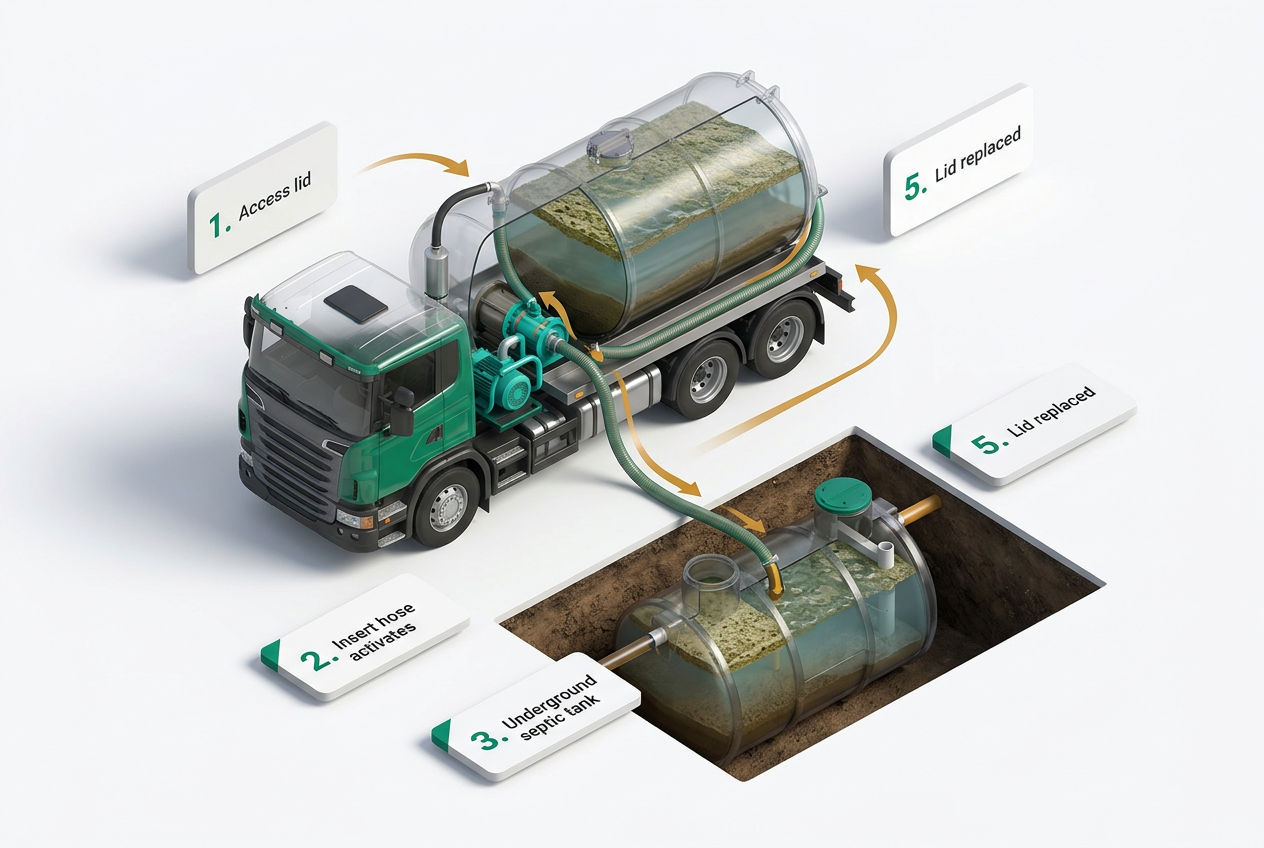
Standard trucks carry 100–200 feet of suction hose on a reel, so a tank buried 40 feet from the road isn't a problem. One that's 220 feet away? That's where pricing and access conversations start.
The holding tank itself is baffled internally. Those baffle walls prevent the liquid load from sloshing hard during transit — which matters a lot when you're hauling 2,500 gallons of septage down a county highway. Most trucks also carry a primary shutoff / float valve that automatically closes when the tank nears capacity. A sight glass lets the driver monitor fill level. These aren't optional features — they're what prevent an overflow disaster on the road.
For more detail on how septic systems work and why pumping is necessary, that background helps you understand exactly what the truck is removing.
What Are the Specs of a Septic Pump Truck? Capacity, Components & Chassis
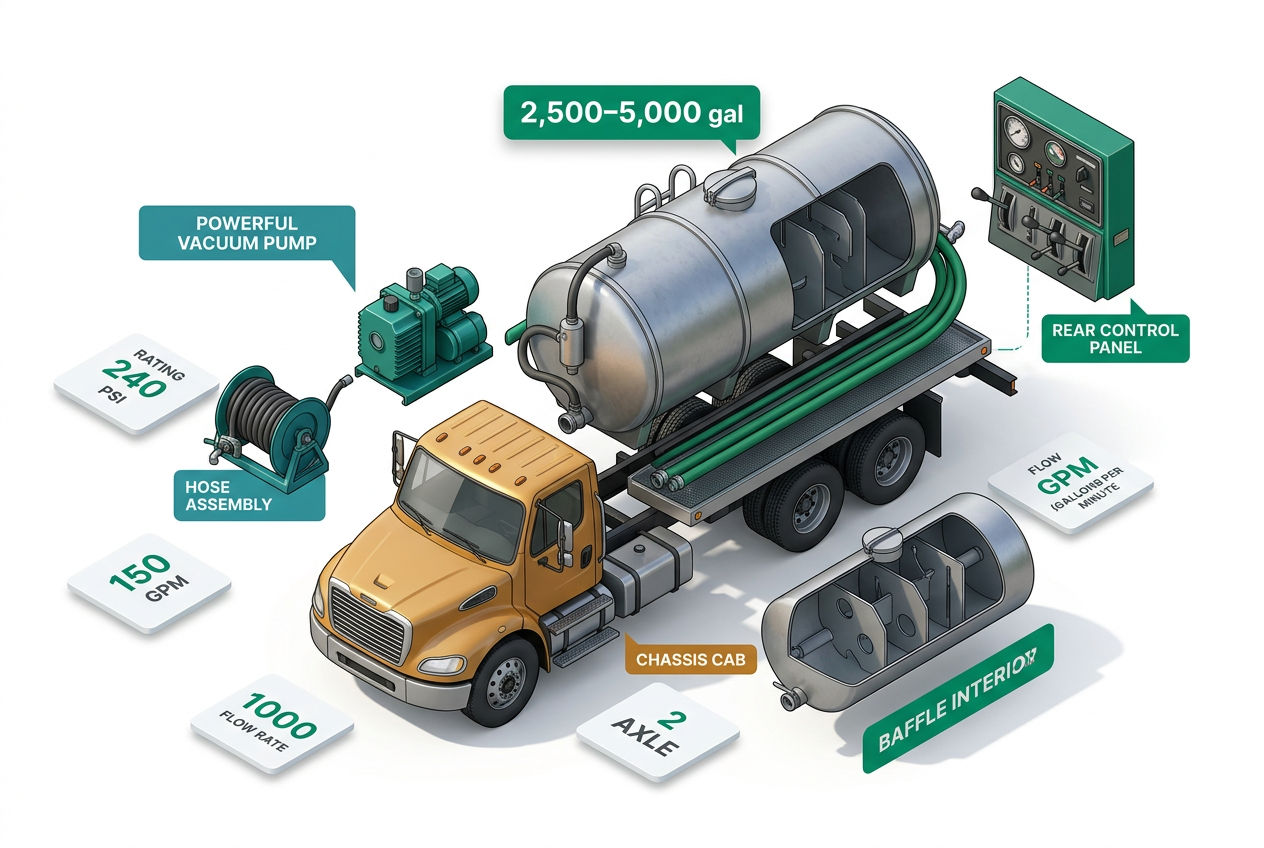
Here's what a typical septic vacuum truck is actually built from:
Tank Capacity
Residential service trucks usually run 2,500–3,500 gallon tanks. Smaller trucks (1,000–2,000 gallons) appear in tight-access situations or with newer operators watching startup costs. Commercial and industrial vacuum trucks can carry 6,000–8,000+ gallons, mostly used for large commercial systems, lift stations, or municipal septage.
Context matters: the average residential septic tank holds 1,000–1,500 gallons. A 2,500-gallon truck can handle multiple stops before needing to unload — usually 4–8 service calls per day depending on drive time and tank sizes.
Vacuum System
The heart of the truck is its vacuum pump system — either a rotary vane pump or a rotary lobe (blower) pump. Rotary lobe units move more volume (higher CFM) and handle solids better. Rotary vane pumps are quieter and common on smaller trucks.
CFM ratings typically fall between 300 and 600 CFM for standard residential trucks. Higher CFM means faster pump-outs, which matters when you're squeezing eight stops into a workday.
Chassis
Most septic pump trucks are built on Class 6–8 truck chassis: Ford F-750, International HV, Peterbilt 348, Kenworth T370, and Freightliner M2 are all common platforms. The chassis choice affects payload capacity, fuel economy, maneuverability in tight driveways, and maintenance cost.
Other Key Components
- Suction hose reel — holds 100–200 feet of 3- or 4-inch hose
- Discharge/pressure system — for cleaning tank walls or pumping back into an aerobic system
- Manway opening — where waste enters the truck tank
- PTO system — transfers engine power to the vacuum pump
- DOT-compliant lighting and placarding — required for road travel with waste loads
Septic Pump Truck Specs at a Glance
| Spec | Typical Range | Notes |
|---|---|---|
| Tank capacity | 1,000–8,000 gal | 2,500–3,500 gal most common for residential |
| Vacuum pump output | 300–600 CFM | Rotary vane or rotary lobe |
| Max vacuum pressure | Up to 27 in Hg | Higher = faster extraction |
| Suction hose diameter | 3 in or 4 in | 4 in faster; 3 in more maneuverable |
| Hose reel length | 100–200 ft | Longer reach = more flexible access |
| Chassis class | Class 6–8 | Ford F-750, Peterbilt 348, Kenworth T370 common |
Source: Industry specifications from NAWT (National Association of Wastewater Technicians) member equipment data and manufacturer published specs.
How Much Does Septic Pump Truck Service Cost in 2026?
A standard residential pump-out for a 1,000-gallon tank costs $300–$600 nationally in 2026, with most companies charging $275–$400 in lower cost-of-living regions. Larger tanks, difficult access, and high-cost markets push that higher.

Here's what that looks like in real numbers:
A 1,000-gallon tank in Central Florida runs $275–$375. That same tank in rural Minnesota costs $350–$500 — longer drive times, shorter operating season, and higher disposal fees at receiving facilities. In Massachusetts, where Title 5 regulations require detailed inspections alongside pump-outs, you might pay $400–$700 for the combined service.
Worked example: Say you own a 1,500-gallon tank in suburban Ohio, pumped on a 4-year cycle. The base rate is $425. Access is straightforward — risers installed, tank within 60 feet of the driveway. Total invoice: $425. Now add a garbage disposal you've run daily for three years. The pumper pulls out a sludge layer 18 inches deep instead of the usual 10. Surcharge for heavy solids: $75. New total: $500. That's still within range — but skip two more cycles and you're looking at a possible baffle repair or drain field rescue call that starts at $1,500.
If your tank hasn't been pumped in 15 years and is packed with hardened sludge, add a surcharge — some operators charge $50–$150 extra for severely neglected tanks. Tanks over 1,500 gallons, or systems with difficult access (buried lids, no risers, steep terrain), regularly run $800–$1,200.
For a full breakdown by region and tank size, see the septic pumping cost guide.
How Often Should You Have Your Septic Tank Pumped?
According to the EPA's Homeowner's Guide to Septic Systems, the standard recommendation is pumping every 3–5 years for a typical household. That guidance applies to a 1,000-gallon tank serving a family of four under normal usage conditions.
Usage patterns change the math significantly. Add a garbage disposal and drop that interval to every 2–3 years — disposals push far more solids into the tank than the bacterial ecosystem can break down. A 1,500-gallon tank serving two people can safely stretch to 5–7 years between pump-outs. A 750-gallon tank (common in older homes and cabins) serving four people needs service every 2 years.
Some states don't leave this to homeowner discretion. Parts of Arizona, certain counties in Washington and Minnesota, and many Massachusetts municipalities require pumping every 3–5 years by law, with licensed pumpers filing disposal manifests after every service. According to the Minnesota Pollution Control Agency (MPCA), that documentation must be submitted to the county after each service call — making compliance trackable at the local government level.
Check how often to pump your septic tank for a full household-size chart.
What Happens to the Waste After the Septic Truck Picks It Up?
After the truck leaves your property, the septage — a mix of sludge, scum, and liquid effluent — goes to one of three places:
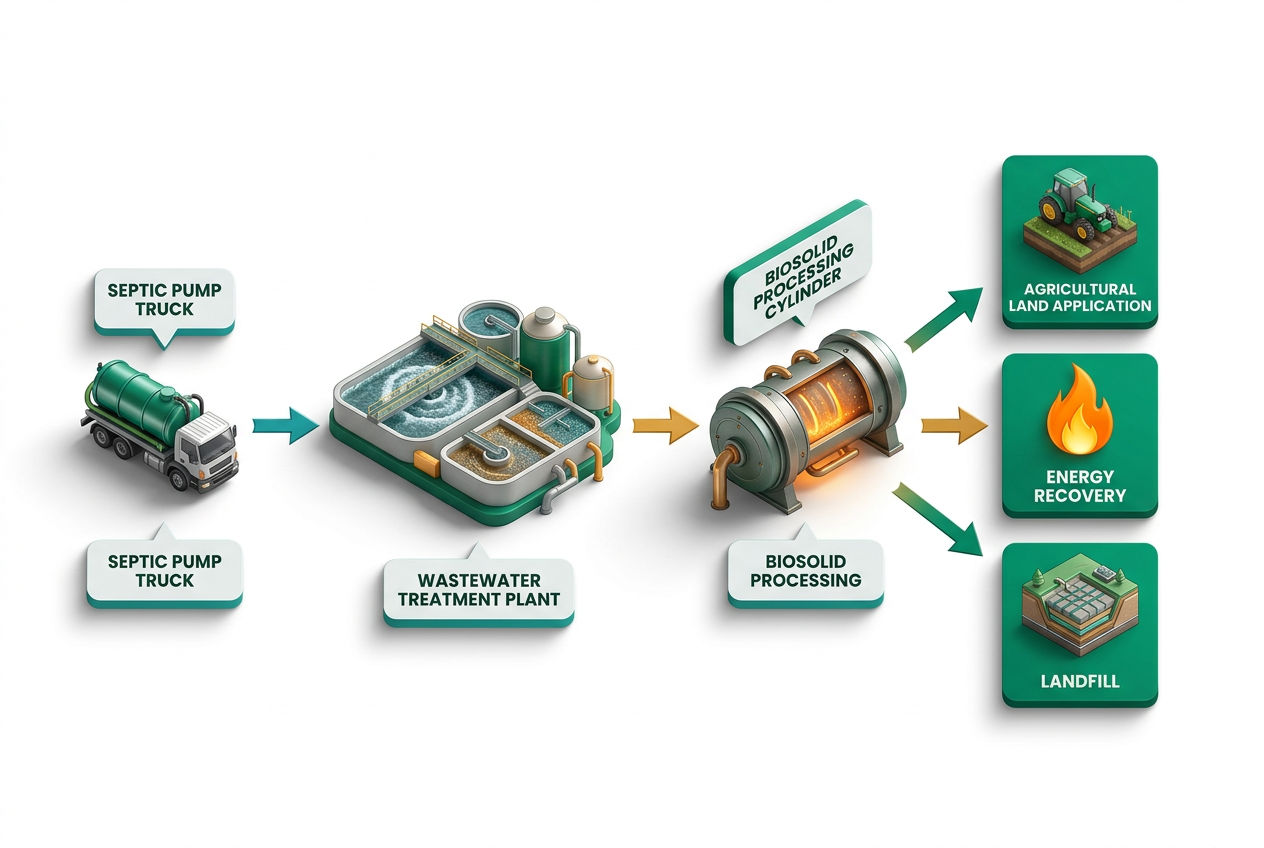
- Municipal wastewater treatment plant — the most common destination, where septage is processed alongside municipal sewage
- Approved septage receiving facility — dedicated processing sites in areas where treatment plants don't accept truck waste
- Permitted land-application sites — septage is applied to agricultural fields as fertilizer under strict EPA and state regulations (40 CFR Part 503 governs this process, setting pathogen reduction and vector attraction requirements)
What it doesn't do: go into a ditch, a pond, or someone's field without permits. Illegal dumping of septage is a federal violation, and licensed operators face serious consequences. NAWT-certified pumpers are trained specifically on legal disposal chains.
The truck driver typically maintains a manifest for each load — documenting the source address, volume hauled, and disposal destination. In many states, that manifest is filed with the county health department.
Do You Need a CDL to Drive a Septic Truck?
Yes, in most cases. Federal FMCSA regulations require a Commercial Driver's License (CDL) for any vehicle with a gross vehicle weight rating (GVWR) over 26,001 lbs. A fully loaded 3,000-gallon septic truck — add the chassis weight, the tank, the hoses, and the waste — easily clears that threshold.
A Class B CDL covers most septic trucks. If the truck has a trailer (less common), Class A applies. Some states add endorsements for liquid tank vehicles (the "N" endorsement), and many require a waste hauler permit on top of CDL requirements.
State licensing for the pumping business is separate from the CDL. Florida requires contractors to hold a Registered Septic Tank Contractor (RSTC) license through the Department of Health. Texas delegates contractor licensing to county-level Designated Representatives.
Researching septic business license requirements before launching is non-negotiable.
How Much Does a Septic Pump Truck Cost to Buy?

Septic Business Blueprint
Thinking about starting your own septic business?
The complete, plain-English playbook to start (or buy), license and grow a profitable septic business — the models, the money math, trucks, disposal, insurance, pricing and how to land your first customers.
Get the Blueprint — $297 →Instant access · 12-chapter playbook + 6-piece toolkit · 60-day money-back guaranteeBuying a septic pump truck is a significant capital investment — and one of the largest startup costs for a new pumping business.
New trucks from an upfitter like Transcourt, Lely, or GFL Environmental's equipment division run $80,000–$180,000 depending on tank size, chassis, and vacuum system specs. A turn-key 3,000-gallon unit on a Peterbilt 348 chassis with a rotary lobe pump typically lands between $120,000 and $150,000 from a major upfitter.
Used trucks bring that entry point down considerably. A 10-year-old septic pumper truck with 150,000 miles and a recently rebuilt pump can be sourced for $30,000–$65,000 on platforms like IronPlanet or Purple Wave. Condition varies wildly — tank integrity, pump hours, and hose condition are the three inspection priorities.
Financing is available through equipment lenders like Crest Capital and Balboa Capital, with terms typically running 48–72 months on commercial equipment. Expect to put 10–20% down.
Operating costs add up fast. Diesel, insurance (commercial truck plus pollution liability), pump maintenance, and disposal fees combine to run $8,000–$15,000 per month for a single-truck operation, depending on volume and geography. The rotary lobe pump rebuild — needed every 5–8 years of heavy use — runs $5,000–$12,000 on its own.
For a full cost breakdown, see septic business startup costs.
Limitation note: Equipment prices shift with steel costs, supply chain conditions, and regional dealer markup. The figures above reflect 2025–2026 market conditions but should be verified with at least two upfitter quotes before making a purchase decision.
What Should You Expect During a Septic Tank Pump-Out?
The technician arrives, locates your tank access lid (or installs a temporary riser if none exists), and inserts the suction hose. The pump runs for 20–45 minutes depending on tank size and sludge volume. A properly equipped operator uses a sludge judge — a clear tube that shows layer depths — to measure sludge and scum before and sometimes after pumping. That measurement tells you how fast your tank fills relative to household use.
During the pump-out, a good technician will:
- Check inlet and outlet baffles for damage or deterioration
- Note the condition of the tank walls and lid
- Confirm effluent color and consistency (gray water vs. heavily contaminated)
- Provide a written service report documenting what was pumped and what was observed
Ask for that report if the technician doesn't offer it automatically. It's your record for insurance, real estate transactions, and future service scheduling. According to NAWT's technician certification standards, a proper service visit includes a basic condition assessment — not just a pump-and-go.
For a detailed walkthrough of the full appointment, see what to expect during a septic tank pump-out.
When Is the Best Time of Year to Schedule a Septic Pump-Out?
Fall is the single best scheduling window for most homeowners in freeze-prone climates. Pumping in September or October removes accumulated solids before the ground freezes and before holiday gatherings add peak load to the system. In Minnesota and other northern states, frost penetrates 42–60 inches deep by midwinter — making tank access genuinely difficult and sometimes impossible without specialized equipment.
Spring is the second-best option if you missed fall — ground thaw makes access easy again, and pumping before summer lawn irrigation season protects the drain field from hydraulic overload.
What to avoid: scheduling in July or August when pumpers are at peak demand and appointment windows stretch 2–3 weeks out in many markets. Summer heat also accelerates odor during the service call.
Emergency winter pump-outs — when a tank fails in January — are possible but cost more. Expect a $100–$300 premium for winter access in frozen-ground states, plus potential surcharges if the lid requires excavation through frost.
For more on cold-weather service logistics, see septic tank pumping in winter.
How Do You Find a Qualified Septic Pumping Service Near You?
Not every truck operating in your county carries the same qualifications. Here's what to look for when hiring:
Certifications: NAWT (National Association of Wastewater Technicians) and NOWRA (National Onsite Wastewater Recycling Association) both offer technician certification programs. A certified pumper has passed coursework on system evaluation, legal disposal, and safety — not just driving a truck.
State licensing: Verify the contractor holds your state's required license. Florida's RSTC license, Texas's county-level authorization, and similar credentials are public record — ask for the license number and verify it.
Disposal documentation: Ask where your waste goes. A legitimate operator can name the receiving facility and has a manifest process in place. Reluctance to answer is a red flag.
Reviews and tenure: A company that's been operating in your county for 10+ years has an established disposal relationship and a local reputation to protect. Newer operators aren't automatically worse, but tenure matters.
Use the SepticTankHub directory to find licensed, reviewed pumpers in your area — and cross-reference with your county health department's approved hauler list.
For broader guidance on evaluating service quality, see how to run a septic business — written for operators, but useful for homeowners who want to understand what a professional operation looks like from the inside.
Frequently Asked Questions About Septic Pump Trucks
How long does a septic pump-out take?
A standard residential septic pump-out takes 20–45 minutes from hose insertion to completion for a typical 1,000–1,500 gallon tank. Tanks that haven't been serviced in many years — where sludge has hardened or accumulated to unusual depth — can take 60–90 minutes because the operator may need to break up compacted solids with water pressure before extraction. Large commercial tanks (3,000+ gallons) routinely take 60–90 minutes regardless of condition. The clock starts when the technician opens the tank lid, not when the truck arrives. Drive time, lid location, and hose setup add 10–15 minutes on either end of the actual pumping. If a technician completes a 1,500-gallon pump-out in under 10 minutes, that's a sign the tank wasn't fully evacuated — a proper pump-out should leave the tank nearly dry.
What is a septic pumper truck, and how is it different from a regular vacuum truck?
A septic pumper truck is a vacuum truck specifically configured for residential and commercial septic waste extraction. While the terms are often used interchangeably, a dedicated septic pumper truck typically features a smaller tank (2,500–3,500 gallons), longer suction hose reels (100–200 feet), and a vacuum system tuned for mixed liquid and solid waste rather than pure liquids. General-purpose industrial vacuum trucks may carry larger tanks (5,000–10,000 gallons) and are built more for bulk liquid transfer, hydro-excavation, or industrial spill recovery. For homeowners, the distinction rarely matters — what you're hiring is the service, not the specific equipment classification. For operators choosing equipment, a purpose-built septic pumper truck is more cost-effective at residential scale than an oversized industrial vac unit that's difficult to maneuver in suburban driveways.
How do I know when my septic tank needs pumping?
Your septic tank needs pumping when sludge and scum layers together occupy more than one-third of the tank's liquid capacity — typically measured with a sludge judge tool. Practical warning signs include slow drains throughout the house (not isolated to one fixture), gurgling sounds in the plumbing, sewage odors near the drain field or tank lid, and unusually green or wet grass directly over the drain field. None of these are definitive on their own, but two or more together warrant an immediate service call. The most reliable approach is to follow the EPA's 3–5 year pumping schedule so you never reach the warning-sign stage. A technician who performs a proper inspection at each pump-out will tell you how quickly your tank is filling and whether your current schedule needs adjustment based on actual sludge accumulation rates.
What size septic pump truck do I need for my property?
As a homeowner, you don't choose the truck size — the pumping company sends whatever unit matches their service route and equipment fleet. What matters is that the truck's tank capacity is at least as large as your septic tank, which it almost always will be. A standard 2,500-gallon residential septic vacuum truck can fully evacuate a 1,500-gallon tank in a single pull. If you're an operator or property manager asking this for business planning purposes: residential routes are typically served by 2,500–3,500 gallon units; commercial or municipal accounts with large tanks or lift stations require 5,000–8,000 gallon trucks. The access constraint matters more than tank size for most residential properties — a smaller truck may be preferable on properties with narrow driveways, low-hanging tree limbs, or soft ground that won't support a fully loaded Class 8 chassis.
Is septic tank pumping tax deductible?
Septic pump-out costs are generally not deductible for personal residences — the IRS treats routine home maintenance as a personal expense. However, there are two situations where deductibility applies. First, if the property is a rental, septic pumping is a legitimate Schedule E maintenance expense. Second, if you operate a business from a home office, a proportional share of septic maintenance costs may be deductible under the home office deduction rules. A septic system repair — distinct from routine pumping — may qualify as a medical deduction if a physician documents that the system failure created a health hazard, though this is a narrow and rarely applied provision. Always consult a tax professional for your specific situation. Keep service invoices regardless — they're useful documentation for real estate transactions, insurance claims, and any future disputes about system maintenance history.
How much does a septic pump truck cost per hour to hire?
Most residential septic companies don't quote by the hour — they charge a flat rate per pump-out based on tank size and access conditions. That flat rate typically runs $300–$600 for a standard residential job. When hourly pricing does appear, it's usually for non-standard work: excavating a buried lid, jetting drain lines, or performing an inspection beyond the scope of a routine pump-out. In those cases, expect $150–$250 per hour for equipment and labor, separate from the base pump-out fee. Commercial accounts — lift station cleaning, grease trap service, or large-volume industrial jobs — are more commonly quoted hourly or by volume (per gallon). If a residential pumper quotes you an hourly rate for a standard pump-out with no explanation of why, ask for a flat-rate alternative or get a second quote from another licensed operator in your area.
Sources & Methodology
- U.S. Environmental Protection Agency — Homeowner's Guide to Septic Systems (EPA 832-B-02-005): pumping frequency recommendations and septage land-application regulations (40 CFR Part 503)
- Federal Motor Carrier Safety Administration (FMCSA) — CDL weight thresholds and commercial vehicle classification requirements
- National Association of Wastewater Technicians (NAWT) — technician certification standards and member equipment specification data
- Minnesota Pollution Control Agency (MPCA) — septage manifest and disposal reporting requirements for licensed haulers
- Massachusetts Title 5 regulations (310 CMR 15.000) — inspection and pumping requirements for septic systems in Massachusetts
- IronPlanet and Purple Wave — used equipment market pricing for septic pump trucks, sourced from active listings 2024–2025
- Regional pricing data — compiled from publicly listed service rates and direct operator interviews across Florida, Minnesota, Ohio, and Massachusetts markets. Costs vary by market; readers should obtain at least two local quotes before scheduling service.
Was this article helpful?
Frequently Asked Questions
Recommended Resources
📖 Related Articles
- What Is a Septic System? How It Works (Visual Guide)
- How Often Should You Pump Your Septic Tank?
- Septic Business License: The Complete Guide
- Septic Business Startup Cost: 2026 Price Guide
- What to Expect When Getting Your Septic Tank Pumped
- Should You Pump Your Septic Tank Before Winter?
- How to Run a Septic Business: Operations, Pricing & Growth
💰 Cost Guides
Find Septic Professionals Near You
Compare licensed, verified septic companies by area — top county markets and cities below, or browse all 50 states.
County markets
Popular cities
