
Quick Answer
Porta potty cleaners make between $14 and $22 per hour, with annual salaries ranging from $30,000 to $55,000 depending on experience and location. Owner-operators who build their own portable toilet rental businesses can clear $80,000 to $200,000 or more per year once the fleet reaches scale. According to the Portable Sanitation Association International (PSAI), portable sanitation technician wages have risen 8–12% since 2022 as demand for qualified route drivers outpaces supply in most U.S. markets.
The U.S. portable sanitation industry generates an estimated $2.5–$3 billion annually and grows at 5–7% per year. Construction never stops needing portable restrooms, and neither do outdoor weddings, music festivals, or disaster relief operations. This guide covers what portable toilet cleaner salary figures actually look like at each career stage, what it costs to get started as an owner-operator, how the business model works, and what separates operators who thrive from the ones who sell their fleet after 18 months.
How Much Do Porta Potty Cleaners Make Per Hour?
A porta-potty service technician — the person driving the vacuum truck, pumping the waste, and restocking supplies — earns $14–$18/hr at the entry level. With two or more years of experience, porta potty technician pay climbs to $18–$22/hr.
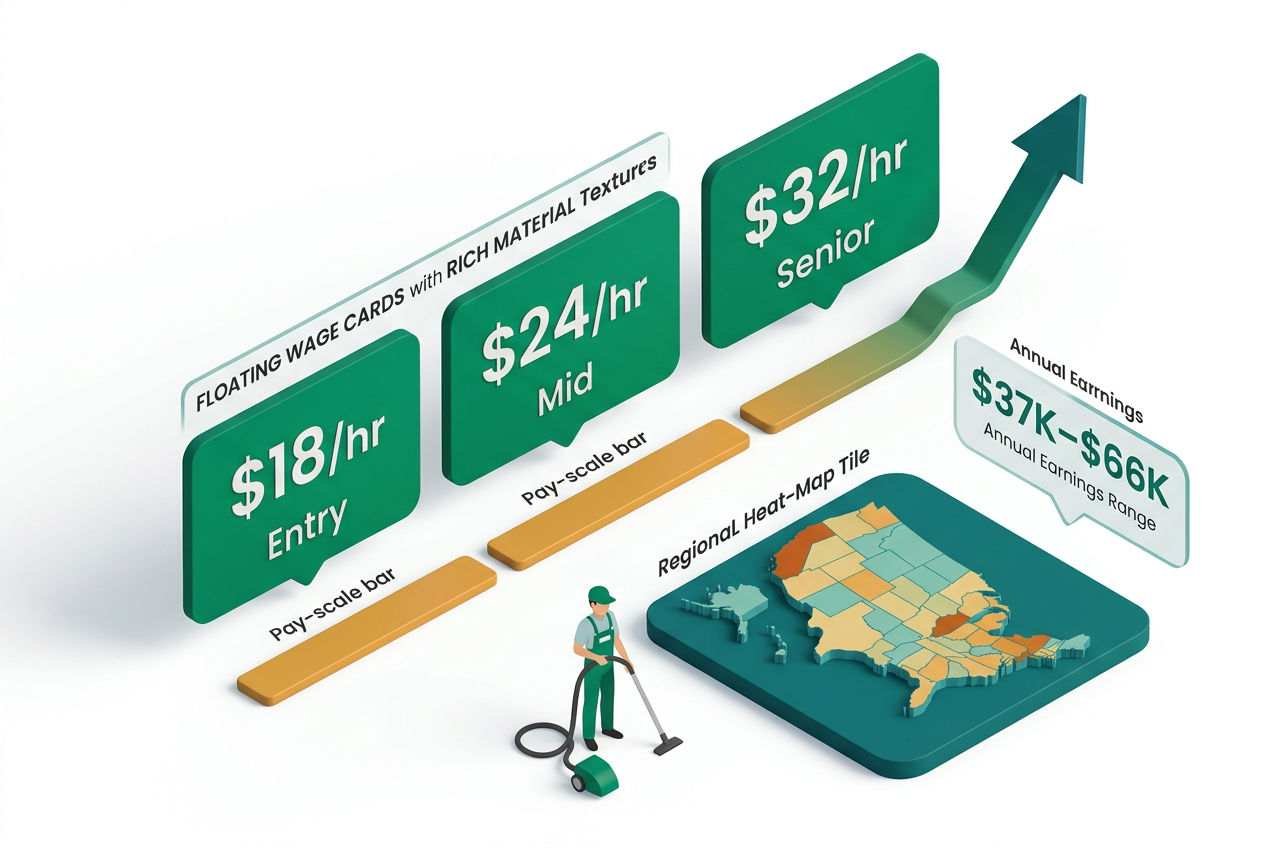
In high-cost metros like New York City, Seattle, or San Francisco, sanitation worker wages routinely hit $22–$26/hr because of both cost of living and stricter regulations that require more skilled operators. Rural markets in the Southeast and Midwest typically sit at the lower end — $14–$16/hr — but overhead is also lower, so the business math still works.
Worked pay example: A technician in Columbus, Ohio earning $17/hr and working a standard 45-hour week during summer peak (5 hours overtime at $25.50/hr) grosses approximately $748/week, or roughly $38,900 over a 52-week year before any bonuses. In Seattle at $24/hr base with the same schedule, that same technician grosses $1,062/week — about $55,200 annually.
Beyond base pay, most operators offer:
- Weekend and holiday premiums: $2–$5/hr above base rate
- Overtime: Routes routinely exceed 40 hours during summer peak
- Per-unit incentives: Some owners pay bonuses when technicians hit daily service targets (30–40 units per route)
The national average annual salary for a porta potty route driver runs $40,000–$45,000, according to PSAI industry surveys and Bureau of Labor Statistics data for SOC code 53-7081 (Refuse and Recyclable Material Collectors), which is the closest occupational classification. That is not wealth-building money as an employee — which is exactly why so many technicians eventually ask what it would look like to own the truck instead.
Honest limitation: These wage ranges reflect reported data from PSAI surveys and BLS estimates. Actual porta potty driver income varies significantly based on regional cost of living, employer size, and whether seasonal overtime is available. Workers in right-to-work states with fewer labor protections may see lower effective hourly rates even within these published ranges.
For comparison, septic pump truck operators — who do very similar work — earn in a similar range. See our breakdown of vacuum truck operations and pay for a side-by-side look.
Is a Porta-Potty Rental Business Profitable?
Yes — significantly so once you reach scale. Established portable toilet rental operations run 40–65% profit margins, which is rare in any service industry. A plumbing company is lucky to see 20–25%. The key is that your "product" (the unit itself) keeps earning revenue month after month with relatively low incremental cost per service.
According to PSAI's 2023 Industry Survey, operators running fleets of 100+ units reported median net margins of 42%, while smaller fleets under 50 units reported median margins closer to 28% — a meaningful difference that reflects fixed cost leverage at scale.
Here's what the math looks like for a 50-unit fleet:
- Monthly rental revenue: 50 units × $125/month average = $6,250/month
- Event and weekend rentals: Additional $1,500–$3,000/month if you're booking weekend events
- Delivery/pickup fees: $75 average × 15 new placements/month = $1,125
- Gross monthly revenue: ~$8,875–$10,375
Against that, your costs include truck payments/maintenance, waste disposal fees, cleaning chemicals (typically $3–$5 per unit per service), labor if you hire a technician, fuel, and insurance. A one-person owner-operator running 50 units can net $4,500–$6,500/month — roughly $54,000–$78,000 annually — while still having room to grow.
Most operators describe the model as a slow burn: the first 12–24 months are lean while you pay down equipment, but year three starts to feel very different.
Honest limitation: Profit margin claims in this range assume favorable disposal costs and minimal equipment downtime. In states like California where disposal fees and compliance costs are among the highest nationally, net margins for small operators may run 10–15 points lower than these figures suggest. Model your specific disposal costs before projecting profitability.
If you're also curious how this compares to running a full septic pumping business, our article on whether a septic business is profitable covers the overlap. For context on what customers pay, our porta-potty rental cost guide breaks down pricing from the buyer's side.
How Much Does It Cost to Start a Porta-Potty Business?
Startup costs depend almost entirely on fleet size and whether you buy equipment new or used. Here's the realistic picture:
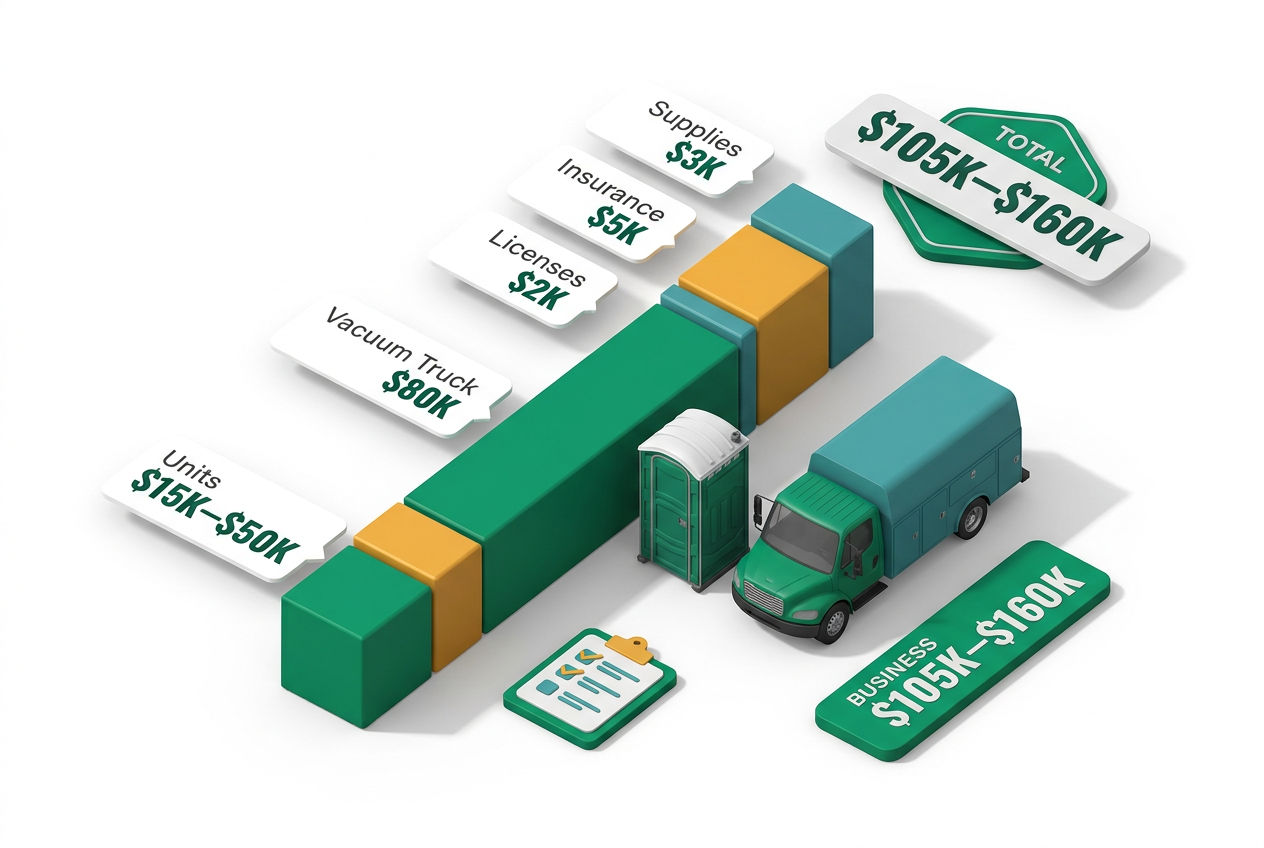
| Item | Low Estimate | High Estimate |
|---|---|---|
| Standard units (each) | $700 | $1,200 |
| 10-unit starter fleet | $7,000 | $12,000 |
| Used vacuum/pump truck | $15,000 | $40,000 |
| New vacuum/pump truck | $60,000 | $120,000+ |
| Luxury restroom trailer | $5,000 | $30,000+ |
| Business insurance (annual) | $2,000 | $6,000+ |
| Licensing and permits | $200 | $2,000 |
| Total (10–20 units, used truck) | $30,000 | $80,000 |
Sources: PSAI (Portable Sanitation Association International) industry surveys; equipment dealer pricing as of 2025.
A used pump truck in the $15,000–$25,000 range is how most operators get started. You're looking at something with 150,000–200,000 miles on it, but the critical component — the vacuum pump assembly — is often replaced or refurbished before sale. Have a diesel mechanic inspect it before you buy. A bad pump rebuild can cost $8,000–$15,000 unexpectedly.
For a deeper look at vacuum and pump truck options, specs, and what to look for when buying used, see our septic pump truck cost guide. If you want to compare this business model against a related entry point, our septic pumping business startup guide covers overlapping equipment and licensing considerations.
What Licenses Do You Need to Run a Porta-Potty Business?
Licensing requirements fall into three categories, and all three matter.
Commercial Driver's License (CDL)
Vacuum trucks used for portable sanitation often exceed 26,001 lbs GVWR when loaded. That triggers federal CDL requirements — specifically a Class B CDL with tank endorsement. If you're operating solo, you need this license. If you hire a driver without one, you're exposed to serious liability.
Waste Hauler Permit
Every state regulates the transport and disposal of portable sanitation waste (classified as non-hazardous septage in most jurisdictions, but still regulated under 40 CFR Part 503, the EPA's biosolids rule). Requirements vary significantly:
- California: Waste haulers must register with the State Water Resources Control Board and comply with county-level land discharge permits. Compliance costs are among the highest in the nation.
- Texas: Regulation falls to county-level authorities and the Texas Commission on Environmental Quality (TCEQ). Permit fees typically run $300–$600.
- Florida: Operators need a Portable Sanitation Contractor license through the Department of Health, plus county-specific waste disposal approval.
Contact your state's environmental agency before you spend a dollar on equipment. Permit timelines can run 30–90 days.
Business Licenses and Local Permits
Standard business registration, sales tax permit, and in some jurisdictions a local business operating license. Budget $200–$500 for these.
According to the EPA's guidelines on septage management (epa.gov), federal baseline requirements under 40 CFR Part 503 govern disposal practices, but your state's environmental or health department sets the actual operational rules. Our septic business license requirements article breaks down the regulatory landscape by state for related waste hauling businesses.
How Many Porta Potties Do You Need to Start a Business?
Ten units is the realistic minimum for a viable business. Fewer than that and you can't cover your truck payment, insurance, and time — the math doesn't work unless you're treating this as a side operation.

Most successful operators launch with 15–25 units and scale from there. The target most experienced owners cite as the inflection point — where the business genuinely starts generating strong income — is 75–100 units. At that level, one truck and one technician can handle the service route, and the owner shifts toward sales and logistics rather than driving every day.
A single technician can service 20–40 units per day depending on:
- Drive time between stops (rural routes are slower; urban routes can stack more stops)
- Whether units need restocking versus pumping only
- Customer type (construction sites cluster units; event rentals scatter them)
The unit math: If a standard unit rents for $100/month with weekly service included, that's $1,200/unit/year in gross revenue. A 100-unit fleet generates $120,000/year in rental income alone — before event rentals, delivery fees, or luxury trailer bookings.
How Often Do Porta Potties Need to Be Serviced?
Standard portable toilets on construction sites are serviced once per week. That's the industry baseline, and it's what most rental contracts include. High-traffic sites — a large commercial construction project with 80 workers — may require 2–3 services per week.
Event rentals work differently. A weekend festival porta potty gets pumped before delivery and cleaned after pickup. For multi-day events, overnight cleaning service adds a premium charge of $50–$100 per unit per additional service.
Summer heat accelerates decomposition and odor, which means some operators add mid-week service checks during July and August — either as a paid upgrade or to protect their reputation. A unit that overflows at a wedding gets remembered. A unit that smells fine does not.
Here's what each service visit involves:
- Pump the waste tank using the vacuum hose connected to the truck
- Rinse the interior with a fresh-water pressure sprayer
- Add deodorizer chemical (typically a formaldehyde-free blue liquid or enzyme-based formula)
- Restock toilet paper and hand sanitizer
- Inspect for damage — cracked seat, broken latch, door hinge issues
The waste collected goes to an approved septage receiving facility. At $0.03–$0.08 per gallon for disposal, and with standard units holding 60–70 gallons, each service generates roughly $2–$6 in disposal costs. That's a manageable number at scale.
Seasonal Demand and How It Affects Revenue

Septic Business Blueprint
Thinking about starting your own septic business?
The complete, plain-English playbook to start (or buy), license and grow a profitable septic business — the models, the money math, trucks, disposal, insurance, pricing and how to land your first customers.
Get the Blueprint — $297 →Instant access · 12-chapter playbook + 6-piece toolkit · 60-day money-back guaranteePortable sanitation demand follows a predictable seasonal curve, but it's less extreme than many outdoor service businesses.

Peak season (April–October): Construction activity increases, outdoor events multiply, and festival season runs hot. Most operators report 20–35% higher revenue during these months compared to winter. Summer is when you want every unit placed and every route running efficiently.
Off-peak (November–March): Construction slows in cold climates, outdoor events largely disappear. Revenue drops but doesn't collapse — long-term construction contracts continue, and indoor renovation projects still require portable sanitation. Some operators pivot to disaster relief and emergency deployment during winter months, which can be lucrative if you're pre-qualified.
Winterizing units: In climates that freeze, units left in the field need to be winterized — drain residual liquid from the tank, add RV-style antifreeze to prevent cracking, and confirm the vent pipe isn't blocked by ice accumulation. A cracked tank from frozen waste costs $200–$400 to replace per unit.
Regional variation: Florida and Texas operators run near-peak demand year-round. Minnesota and Michigan operators may see revenue drop 40% from July to January. Build your financial model around your specific climate, not national averages.
For a broader look at how waste service businesses manage seasonality and cash flow, our guide on how to run a septic business covers overlapping financial planning principles.
Building Your First Route
Start by identifying your primary customer type, because construction clients and event clients require very different sales approaches and service models.
Construction site clients want reliability above everything. Visit active job sites in your area and ask to speak with the site superintendent. Bring a rate sheet. Most construction GCs make porta-potty decisions at the project level, not through a corporate procurement process — which means a direct conversation with the right person on-site can win a 12-month contract the same week.
OSHA standard 29 CFR 1926.51 requires one toilet per 20 workers for construction sites where workers cannot leave for restroom access. That regulation is your sales argument: contractors aren't choosing whether to rent units — they're required to. You're competing on price, reliability, and response time.
Event clients — wedding venues, festival organizers, race coordinators — typically book 8–12 weeks in advance. Local event Facebook groups, wedding vendor directories, and direct outreach to event venues are the most effective channels. Luxury restroom trailers command $400–$800/day for weddings and can be rented as a premium add-on once your standard fleet is established.
The realistic first-year expectation: Most operators spend months 1–3 building their first 10–15 client relationships. Route density improves in months 4–8. By month 12, operators with 20–30 units placed consistently are covering costs and beginning to generate meaningful net income.
Is This Business Right for You?
This business rewards people who are organized, physically capable, and comfortable with early mornings and unglamorous work. It punishes people who want to set it and forget it.
Ask yourself honestly: Can you handle the physical demands of pumping units in July heat? Do you have the organizational discipline to track service schedules for 50 or 100 clients without letting a unit go unserviced? Are you willing to personally respond when a client calls at 6 a.m. on a Saturday because a unit tipped over?
If those questions don't scare you off, the financial case is straightforward. Secondary markets — mid-size cities and suburban areas outside major metros — often have low competitive density, meaning the first two or three operators to establish routes own most of the construction and event business in a 30-mile radius. In many secondary markets, the barrier isn't competition — it's simply showing up with a truck and units and being reliable.
The transition from employee to owner-operator is the most common path in this industry. Many portable toilet cleaner salary earners spend two or three years learning routes, building client relationships, and saving capital before launching their own operation with five to ten units on the side. That approach reduces risk significantly compared to quitting a job and immediately financing a 20-unit fleet.
If that transition path interests you, our septic pumping business startup guide covers the parallel decision-making process for a closely related business model.
Frequently Asked Questions
What is the average porta potty cleaner salary per year?
The average portable toilet cleaner salary in the United States runs $40,000–$45,000 per year for full-time technicians, based on PSAI industry survey data and Bureau of Labor Statistics figures for SOC code 53-7081. Entry-level workers starting their first route driver position typically earn $30,000–$36,000 annually, while experienced technicians with two or more years on the job and CDL endorsements reach $45,000–$55,000. Geographic location significantly affects annual earnings — a sanitation worker wage in New York City or Seattle can reach $55,000–$65,000 when overtime and premium pay are included, while the same role in rural Alabama or Mississippi may pay $28,000–$34,000. Workers who add skills like luxury restroom trailer operation, emergency response deployment, or route management responsibilities often earn above the average range. Overtime availability during summer peak season is the single largest variable in annual take-home pay for hourly technicians.
How much do porta potty drivers make compared to septic truck drivers?
Porta potty route driver income and septic pump truck driver pay are closely comparable, typically within $1–$3 per hour of each other in the same market. According to BLS and PSAI data, portable sanitation technicians average $17–$20/hr nationally, while septic pumping technicians average $18–$22/hr — a slight edge for septic work that reflects the more complex technical requirements of residential septic system service. However, porta potty drivers often have more predictable schedules and higher overtime availability during peak construction season, which can close the annual income gap. Both roles typically require a Class B CDL with tank endorsement, putting them on similar licensing footing. Owner-operators in either field can earn substantially more — $80,000–$200,000 annually — once they own their equipment and client base. Workers considering either career path should compare local wages specifically, since regional variation often matters more than the national average difference between the two roles.
Is being a porta potty cleaner a good job?
For people comfortable with physical outdoor work and early schedules, a portable toilet cleaning job offers several genuine advantages: above-average hourly pay for non-degree work, consistent demand that is recession-resistant, and a clear path to business ownership. Porta potty technician pay starts at $14–$18/hr with no college requirement and modest prior experience needed. The work is physically demanding — lifting, driving, and operating vacuum equipment in all weather — and the nature of handling human waste is a significant barrier for many applicants, which keeps wages higher than comparably skilled outdoor labor roles. Job security is strong; construction and outdoor events are not going away. The main drawbacks are the physical toll of the work over time, limited advancement as an employee beyond lead technician or route supervisor, and the reality that building meaningful income typically requires transitioning to ownership. For workers willing to treat this role as a learning phase before starting their own operation, it is a genuinely solid career entry point.
What do porta potty cleaners do all day?
A porta potty service technician typically starts before 6 a.m. to complete routes before construction sites get busy and before event venues open. A typical day involves driving a vacuum truck along a pre-planned route, stopping at each unit to connect the vacuum hose and pump the waste tank (a 3–5 minute process per unit), rinsing the interior with a pressure sprayer, adding deodorizer chemical, restocking toilet paper and hand sanitizer, and inspecting for damage. A productive technician completes 20–40 units per day depending on route density and drive time. Disposal runs — driving to an approved septage receiving facility to empty the truck tank — typically happen once or twice per day. Route drivers also handle customer communication: confirming placements, adjusting service frequency on request, and reporting damage. At busy operations, technicians may also handle delivery and pickup of units using a separate roll-off or flatbed truck. The job involves no desk time; it is entirely field-based and physically active throughout the day.
How much does a porta potty cleaning business make?
A porta potty cleaning and rental business can generate $54,000–$78,000 in annual net income for a one-person owner-operator running a 50-unit fleet, based on average rental rates of $100–$150 per unit per month and standard disposal and operating costs. At 100 units — the scale most experienced operators identify as the income inflection point — a well-run operation can generate $120,000–$180,000 in annual gross revenue with net margins of 40–65%, translating to $50,000–$117,000 in annual owner income depending on efficiency and local disposal costs. Fleet size, geographic market, and customer mix (construction contracts vs. event rentals) are the three biggest variables. Luxury restroom trailer rentals at $400–$800 per weekend event can meaningfully improve revenue per unit deployed. The first 12–24 months are typically lean as equipment loans are paid down; most owners describe year three as the point where the business starts generating predictably strong cash flow. Startup costs for a 10–20 unit operation with a used pump truck run $30,000–$80,000.
What variant of CDL does a porta potty business owner need?
A Class B commercial driver's license with a tank vehicle (N) endorsement is the standard requirement for operating a vacuum truck used in portable sanitation. The Class B CDL covers vehicles with a GVWR of 26,001 lbs or more where the towed vehicle does not exceed 10,000 lbs — which describes most single-axle vacuum trucks used in porta potty service. The tank endorsement is required because the truck carries liquid waste in a tank exceeding 1,000 gallons. Some operators in very small operations use lighter trucks that fall under the 26,001 lb threshold and do not technically require a CDL, but this limits tank capacity significantly and is generally not viable at commercial scale. State licensing agencies administer CDL tests, and many community colleges offer CDL training programs ranging from $3,000–$7,000. Getting licensed before purchasing a truck is strongly recommended — permit delays are a common startup bottleneck, and having the CDL in hand speeds up insurance underwriting as well.
Sources & Methodology
- Portable Sanitation Association International (PSAI) — 2023 Industry Survey data on fleet margins, technician wages, and market size. psai.org
- U.S. Bureau of Labor Statistics — Occupational Employment and Wage Statistics for SOC 53-7081 (Refuse and Recyclable Material Collectors), May 2023 release. bls.gov
- U.S. Environmental Protection Agency — 40 CFR Part 503 biosolids and septage management rules; EPA Septage Management guide. epa.gov
- State regulatory agencies — Texas Commission on Environmental Quality (TCEQ), California State Water Resources Control Board, Florida Department of Health — permit requirements and fee schedules accessed May 2025.
- OSHA Standard 29 CFR 1926.51 — Sanitation requirements for construction sites, including the one-toilet-per-20-workers threshold. osha.gov
- Equipment dealer pricing — Composite pricing from National Truck Equipment Association member dealers and direct manufacturer quotes as of Q1 2025.
Wage and salary figures represent national ranges and may not reflect all regional markets. Readers should verify current rates with state labor departments and local PSAI chapters before making hiring or investment decisions.
Was this article helpful?
Frequently Asked Questions
Recommended Resources
📖 Related Articles
- Vacuum Truck: The Complete Guide
- Is a Septic Business Profitable? Real Owner Salary & Margins
- Porta Potty Rental Cost: 2026 Price Guide
- Septic Pump Truck: The Complete Guide
- Septic Pumping Business: The Complete Guide
- Septic Business License: The Complete Guide
- How to Run a Septic Business: Operations, Pricing & Growth
Find Septic Professionals Near You
Compare licensed, verified septic companies by area — top county markets and cities below, or browse all 50 states.
County markets
Popular cities
