
Quick Answer
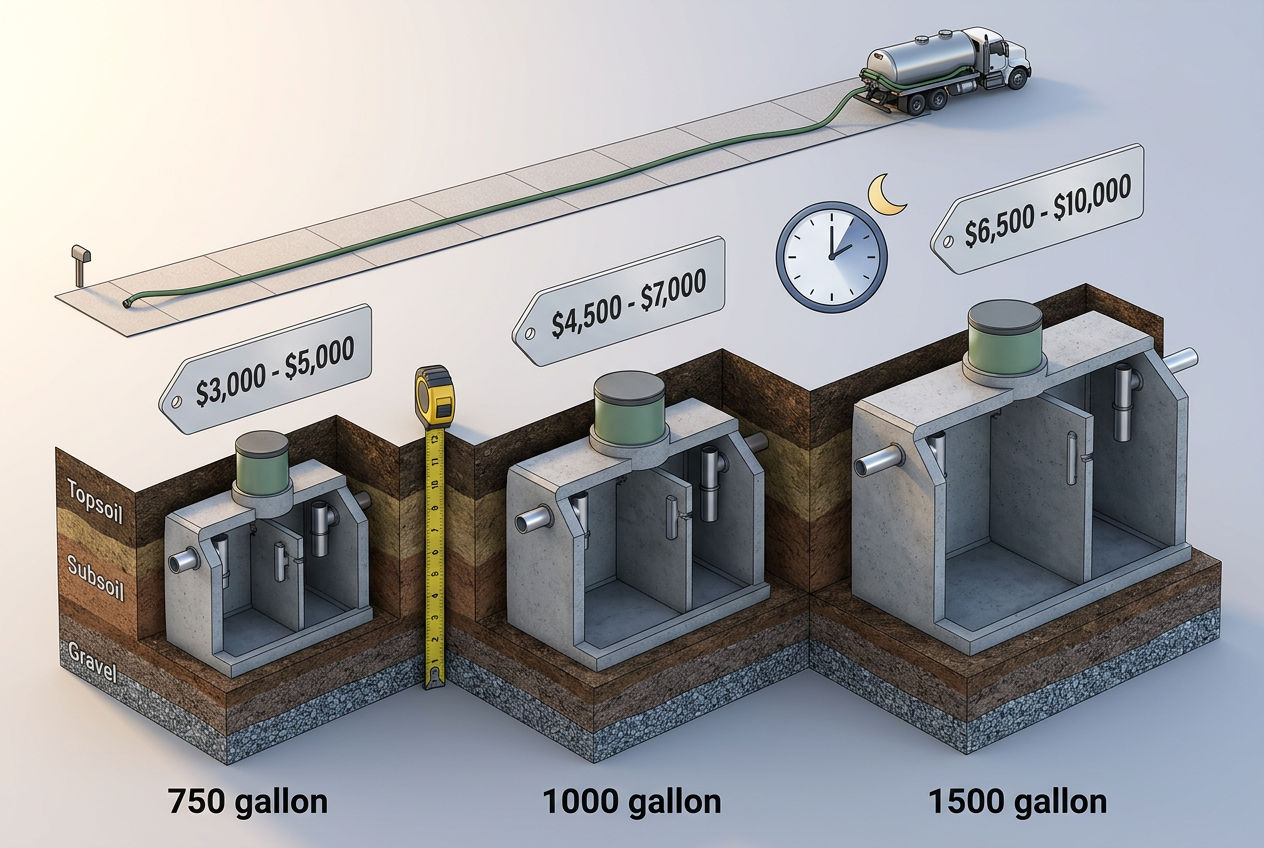
A septic tank pump out is the routine removal of sludge, scum, and wastewater from your septic tank using a commercial vacuum truck. Most homeowners pay $300-$600 per pump out, the job takes 30-60 minutes, and it should happen every 3-5 years to prevent backups and drain field damage.
Key Takeaways
- A septic tank pump out costs $300-$600 for most residential tanks in 2026
- The process takes 30-60 minutes — a vacuum truck removes all solids and liquid
- Schedule a pump out every 3-5 years based on household size and tank capacity
- Skipping pump outs leads to $3,000-$15,000 in drain field repairs
- Emergency pump outs cost $150-$300 more than scheduled appointments
If you've searched "septic tank pump out" wondering what it actually involves, you're not alone. Over 21 million U.S. homes depend on septic systems, and routine pump outs are the single most important thing you can do to protect yours. A neglected tank doesn't just back up into your house — it sends solids into your drain field, causing failures that cost 10 to 50 times more than the pump out you skipped.
Whether you're a first-time septic owner or just overdue for service, this guide covers everything: what happens during a pump out, what it costs, how often you need one, and how to avoid overpaying.
Find a licensed septic pumping company in your area on SepticTankHub.com
What Is a Septic Tank Pump Out?
A septic tank pump out is a maintenance service where a licensed technician uses a vacuum truck to remove all contents from your septic tank — sludge on the bottom, scum floating on top, and the liquid effluent in between. The truck's PTO-driven pump generates 15-27 inches of mercury suction through a 4-inch hose inserted through the tank's access port.
You might also hear this called "septic pumping," "septic tank emptying," or "septic cleanout." These terms all describe the same service. Regional terminology varies — "pump out" is especially common in the Southeast and Mid-Atlantic states, while "emptying" is more common in the Northeast and Midwest. Regardless of what your local company calls it, the process is identical.
The waste (called septage) is hauled to an approved treatment facility or municipal wastewater plant. Licensed haulers carry state permits and must document every load with transport manifests.
Key Insight: Some companies advertise "partial pumping" at a lower price, removing only liquid while leaving sludge behind. This is a waste of money. A proper pump out removes everything — sludge, scum, and liquid — so the technician can inspect the tank bottom and baffles.
For a deeper dive into the mechanical process, see our guide on how septic tanks are pumped.

How Much Does a Septic Tank Pump Out Cost?
The average septic tank pump out costs $300-$600 for a standard residential tank in 2026. Your actual price depends on tank size, location, accessibility, and whether you're booking routine or emergency service.
| Tank Size | Avg Pump Out Cost | Typical Homes |
|---|---|---|
| 750 gallons | $250-$350 | 1-2 bedroom |
| 1,000 gallons | $350-$425 | 3 bedroom |
| 1,250 gallons | $375-$475 | 3-4 bedroom |
| 1,500 gallons | $400-$550 | 4-5 bedroom |
| 2,000 gallons | $500-$700 | 5+ bedroom / multi-family |
| 2,500+ gallons | $600-$900 | Commercial / large homes |
Source: SepticTankHub.com aggregated pricing data from 4,200+ septic companies, 2026
Several factors push your cost higher. Tanks buried more than 12 inches deep add $50-$150 for digging access. Properties with long driveways or limited truck access can add $50-$100 because the truck needs extra hose runs. Emergency pump outs on weekends or after hours typically cost $150-$300 more than a scheduled weekday appointment.
For a complete regional cost breakdown, check our septic pumping cost guide and our article on how much it costs to pump a septic tank.
Pro Tip: Installing septic tank risers ($150-$300 one-time cost) brings the access lid to ground level. This eliminates digging fees on every future pump out — most homeowners recoup the investment within two service visits.
What Happens During a Septic Tank Pump Out?
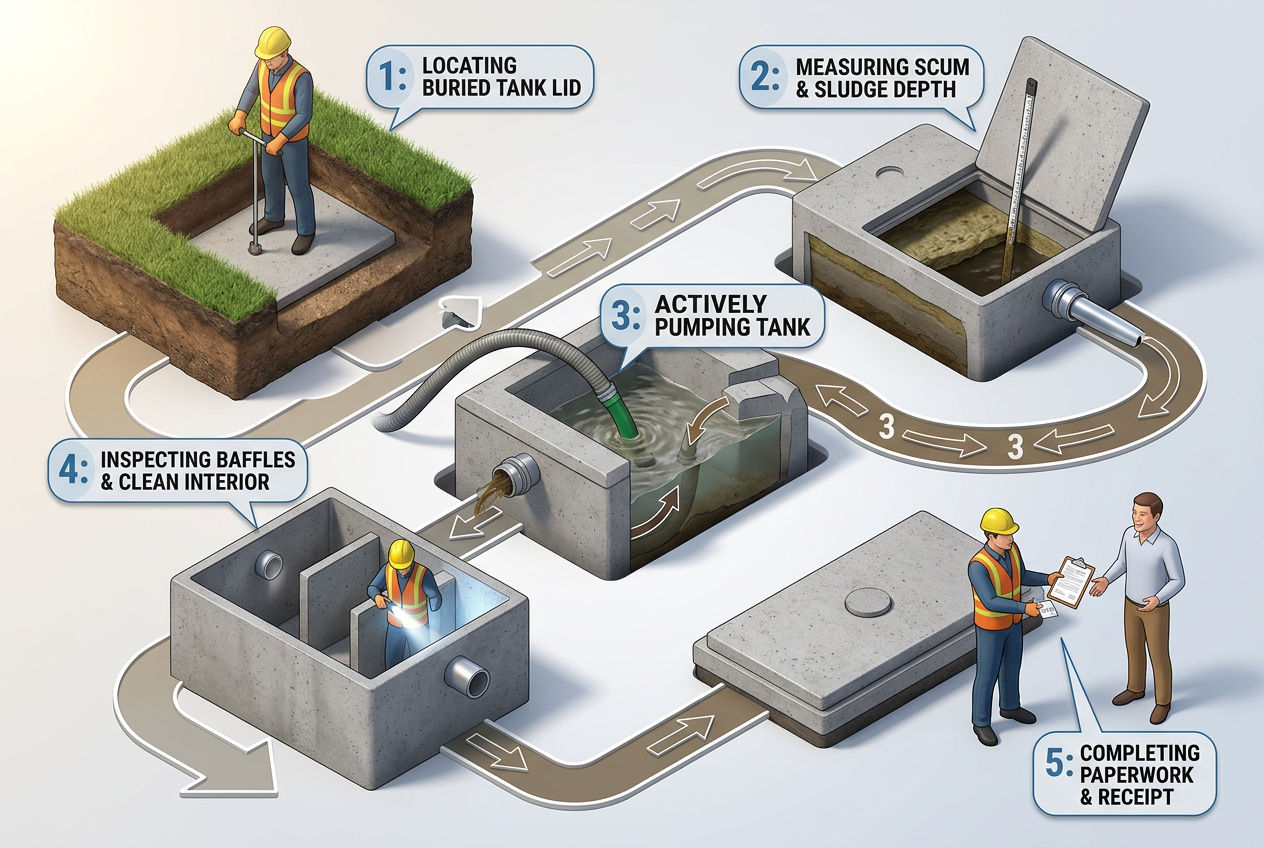
Understanding the step-by-step process helps you know what's normal and what's a red flag. Here's exactly what a professional pump out looks like:
Step 1: Locate and access the tank. The technician finds your tank using property records, a soil probe, or a radio transmitter. If you don't have risers, they'll dig down to expose the lid. Knowing your tank's location saves time and money — see our guide on how to find your septic tank lid.
Step 2: Open the lid and assess contents. Before pumping, the technician checks sludge depth and scum thickness using a measuring stick called a sludge judge. This tells them how full the tank is and whether the pumping interval is appropriate.
Step 3: Insert the vacuum hose and pump. A 4-inch hose goes into the tank and the vacuum pump engages. The truck pulls liquid first, then breaks up and removes the heavier sludge layer. A good operator uses a back-flush technique — spraying liquid back into the tank to loosen compacted sludge and ensure complete removal.
Step 4: Inspect baffles and tank walls. With the tank empty, the technician checks the inlet and outlet baffles for damage, looks for cracks in the tank walls, and verifies the effluent filter (if installed) is clean. This 5-minute visual inspection catches problems early.
Step 5: Close up and document. The technician replaces the lid, backfills any soil, and provides you with a service receipt showing the date, volume removed, and any issues noted. Keep this receipt — you'll need it when selling your home or if a problem arises later.
The whole process takes 30-60 minutes for a standard residential tank. For a first-timer's perspective, read what to expect when getting your septic tank pumped.
Free download
Free: the Septic Fridge Card — what to flush, what never to.
The Do / Don’t card the whole family can see, plus the Survival Kit: emergency flowchart, warning-sign decoder and pump-schedule card. One printable PDF.
How Often Do You Need a Septic Tank Pump Out?
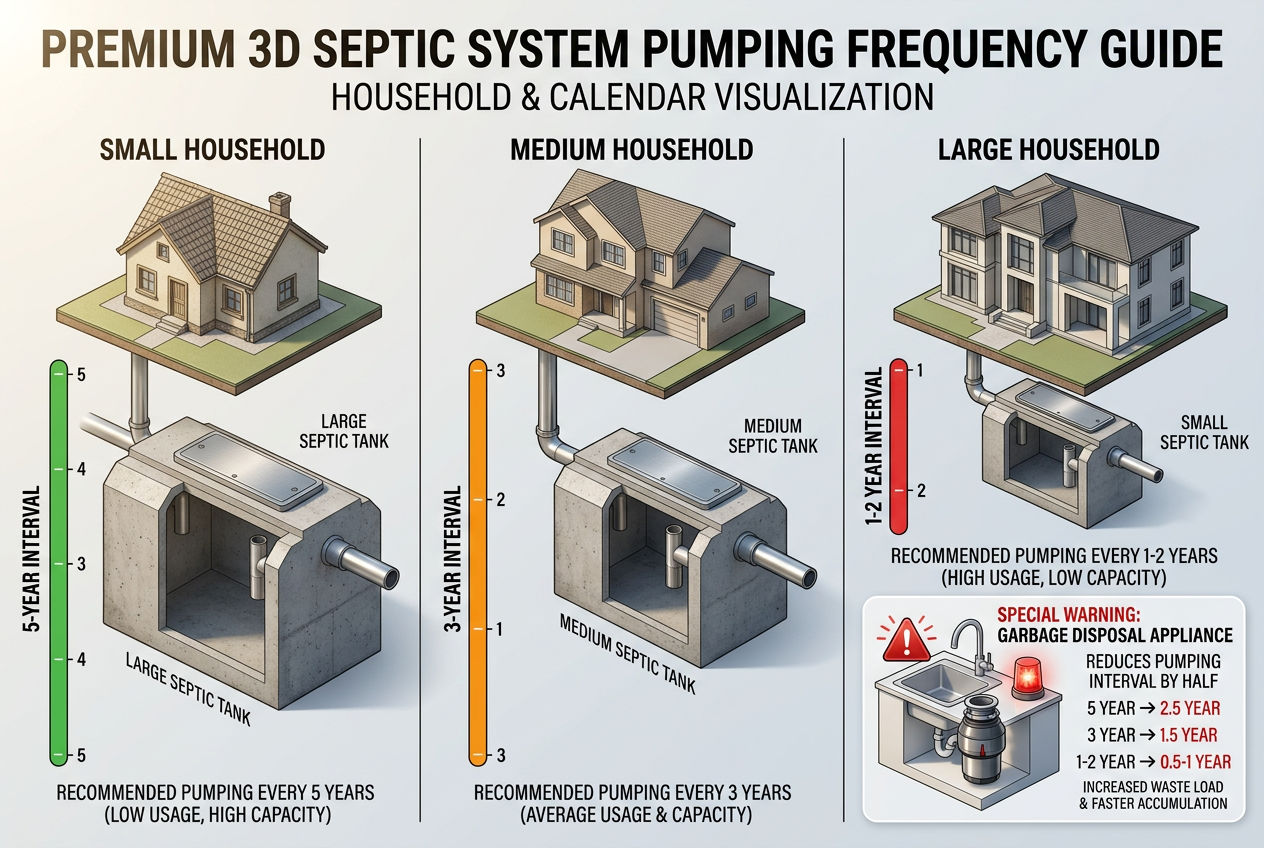
The standard recommendation is every 3-5 years, but your actual frequency depends on four variables: tank size, household size, water usage, and what goes down the drain.
| Household Size | 750-Gallon Tank | 1,000-Gallon Tank | 1,500-Gallon Tank |
|---|---|---|---|
| 1-2 people | Every 4-5 years | Every 5-6 years | Every 7-8 years |
| 3-4 people | Every 2-3 years | Every 3-4 years | Every 4-5 years |
| 5-6 people | Every 1-2 years | Every 2-3 years | Every 3-4 years |
| 7+ people | Annually | Every 1-2 years | Every 2-3 years |
Source: EPA Homeowner's Guide to Septic Systems, adapted with updated household data
Garbage disposals cut your interval by roughly 50% because they add undigestible food solids directly to the tank. High-efficiency toilets and washing machines extend the interval by reducing overall water volume entering the system.
The most reliable method is measuring sludge depth annually. When the combined sludge and scum layers fill one-third of the tank's total depth, it's time to pump. Your county health department may also mandate specific intervals — check local regulations.
For a detailed frequency calculator based on your exact setup, see how often you should pump your septic tank.
Common Mistake: Waiting until you see warning signs — slow drains, gurgling toilets, sewage odors — before scheduling a pump out. By the time symptoms appear, sludge has already reached your outlet baffle and may be flowing into the drain field. Pump on a schedule, not on symptoms.
What Are the Warning Signs You Need a Pump Out Now?
Sometimes you can't wait for your next scheduled pump out. These signs mean your tank is at or past capacity and needs immediate attention:
Slow drains throughout the house. One slow drain is usually a clog. When every sink, shower, and toilet drains slowly at the same time, the septic tank is full and can't accept more wastewater. This is different from a single fixture issue — see our slow drains and septic guide for diagnosis help.
Sewage odors near the tank or drain field. Hydrogen sulfide gas escaping through saturated soil or a full tank vent means the system is overwhelmed. This isn't just unpleasant — it's a health hazard.
Standing water or soggy patches over the drain field. When a full tank pushes solids into the drain field, the soil becomes clogged and can't absorb effluent. Water surfaces instead of draining. This is a sign of potential drain field failure.
Sewage backup into the house. This is the emergency scenario — wastewater coming up through basement floor drains, tubs, or toilets. Call for an emergency pump out immediately. Don't use any water in the house until the tank is pumped.
Unusually green grass over the tank area. A lush green strip over your septic tank while the rest of your lawn is dormant suggests the tank is leaking nutrient-rich effluent into the surrounding soil.
For the complete list with photos, see our guide on signs your septic tank needs pumping.
Quick Fact: According to the EPA, septic system failure is the third most common source of groundwater contamination in the United States. Regular pump outs are not just about convenience — they protect your drinking water.
How to Save Money on Your Septic Tank Pump Out
Septic pump outs are unavoidable, but there are proven ways to reduce what you pay over time.
Schedule during off-peak months. Spring and fall are the busiest seasons for septic companies. Booking in winter or mid-summer can save you 10-15% because trucks have open schedules and companies offer discounts to fill routes.
Get multiple quotes. Pricing varies significantly between companies in the same area. Call at least three septic services and ask for their all-in price including any digging fees. Our pumping cost comparison by state gives you regional benchmarks so you know what's reasonable.
Install risers if you don't have them. As mentioned above, risers eliminate the $50-$150 digging charge on every pump out. Over the life of your system, this saves hundreds or thousands of dollars.
Protect your system between pump outs. Spreading laundry loads across the week instead of doing multiple loads on one day reduces hydraulic overload. Avoiding flushing non-biodegradable items keeps sludge accumulation in check. A well-maintained system goes longer between pump outs, saving you money. For a full list of best practices, check out our septic tank maintenance guide.
Don't fall for additives marketing. Products claiming to eliminate the need for pump outs are false. No additive replaces mechanical removal of accumulated solids. Some actually harm your system — the EPA and most state health departments explicitly advise against them.
Pro Tip: Ask your pumping company about multi-year contracts or neighborhood group rates. Some companies offer 10-20% off when they service multiple homes on the same street in a single trip — the reduced drive time makes it worthwhile for everyone.
What Happens If You Skip a Septic Tank Pump Out?
Skipping pump outs doesn't save money — it guarantees expensive repairs. Here's the cascade of failures that occurs when a tank goes unpumped:
Year 1-2 past due: Sludge and scum layers grow thicker. Effluent quality drops as the tank's settling capacity decreases. No visible symptoms yet, but the biomat layer in your drain field starts thickening.
Year 3-4 past due: Sludge reaches the outlet baffle. Solids begin flowing into the drain field distribution pipes. You may notice occasional slow drains. Drain field soil starts clogging — this damage is partially reversible at this stage with pumping and rest.
Year 5+ past due: The drain field is saturated with solids. Standing water appears on the surface. Sewage backs up into the house. At this point, you're looking at drain field replacement ($5,000-$20,000) or a full system repair ($3,000-$15,000).
A $300-$600 pump out every few years versus a $10,000+ drain field replacement is one of the clearest returns on investment in home maintenance.
Common Mistake: Assuming your tank is fine because you "haven't had any problems." Septic systems fail silently for years. By the time you see symptoms, the damage is already done. Stick to a schedule.

Sources & Methodology
EPA — How to Care for Your Septic System — Federal guidelines on pumping frequency, maintenance best practices, and additive warnings
EPA — Homeowner's Guide to Septic Systems — Overview of system types, pumping schedules, and failure prevention for residential owners
University of Minnesota Extension — Septic System Pumping — Research-backed pumping frequency tables by household and tank size
National Environmental Health Association — Septage Management — Professional standards for septage handling, transport, and disposal
SepticTankHub.com Internal Data — Aggregated pricing from 4,200+ listed septic service companies across all 50 states
Was this article helpful?
Frequently Asked Questions
Recommended Resources
📖 Related Articles
- How Often Should You Pump Your Septic Tank?
- How Are Septic Tanks Pumped? The Complete Process
- 8 Signs Your Septic Tank Needs to Be Pumped
- What to Expect When Getting Your Septic Tank Pumped
- Septic Tank Emptying: What It Means, Cost & How Often (2026)
- How to Find Your Septic Tank Lid (And What to Do If It's Buried)
- The Complete Septic Tank Maintenance Guide
- What Is a Septic System? How It Works (Visual Guide)
- Septic Tank Full After Just Pumped: Why and What to Do
💰 Cost Guides
🔧 Services
Find Septic Professionals Near You
Compare licensed, verified septic companies by area — top county markets and cities below, or browse all 50 states.
County markets
Popular cities
