
Quick Answer
Septic tank emptying is the process of removing accumulated sludge and scum from your septic tank using a vacuum truck. Most homeowners pay $300-$600 per emptying and need the service every 3 to 5 years, depending on tank size and household size.
Key Takeaways
- Septic tank emptying and pumping are the same service — the term varies by region
- Average cost is $300-$600 for a standard residential tank in 2026
- The EPA recommends emptying every 3-5 years for most households
- Skipping emptying leads to drain field failure — a $5,000-$20,000+ repair
- A licensed hauler with a vacuum truck is legally required in most states
If you've searched for "septic tank emptying" and found yourself wondering whether it's different from septic tank pumping — you're not alone. Thousands of homeowners ask this every month, and the answer is simple: they're the same thing.
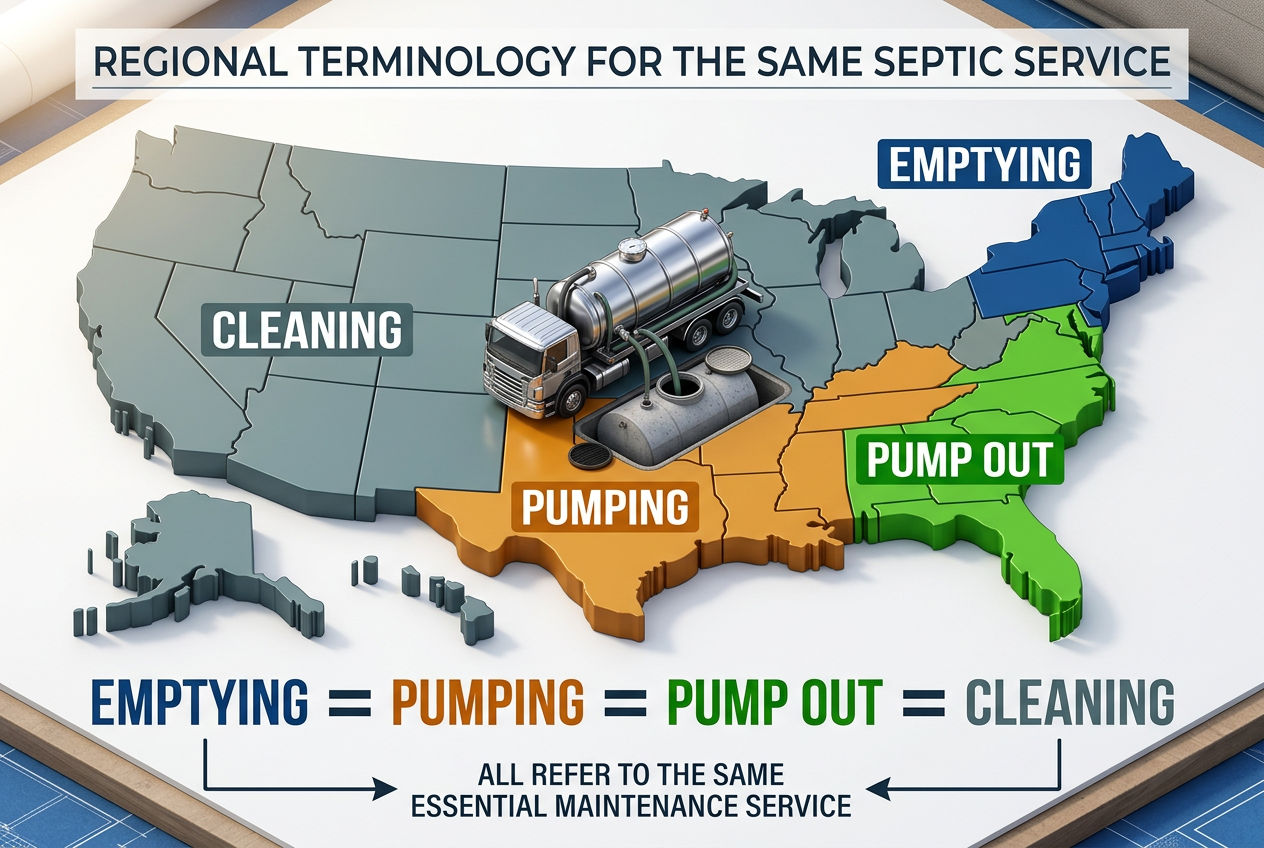
Different parts of the country use different words. Some regions say emptying. Others say pumping, cleaning, or pump-out. The service is identical: a licensed hauler drives a vacuum truck to your property, opens your tank, and removes the accumulated waste inside.
This guide covers what happens during a septic tank emptying, what it costs, how often you need it, and the warning signs that mean you're overdue. If your tank hasn't been emptied in more than five years, you're likely already past due.
Find a licensed septic pumping company in your area on SepticTankHub.com.
What Exactly Happens During Septic Tank Emptying?
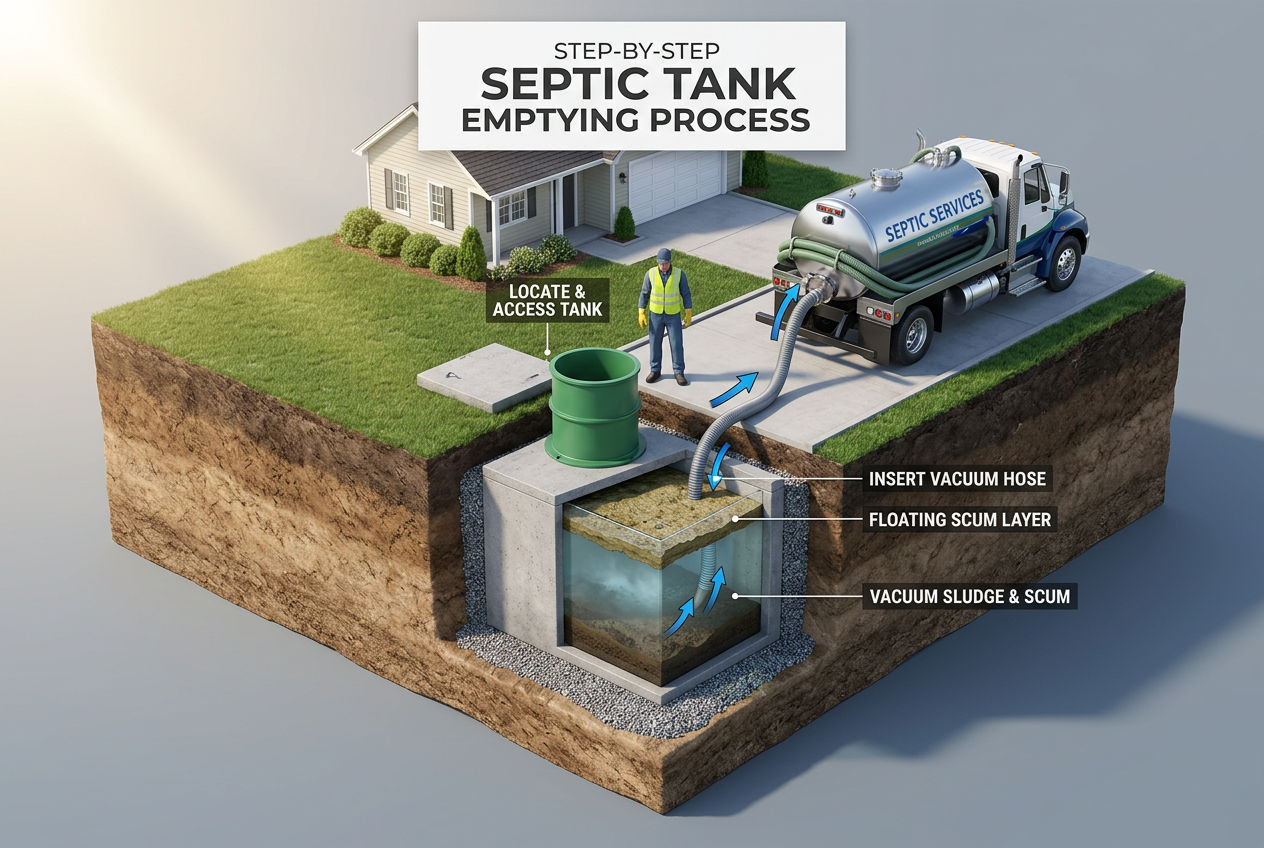
Septic tank emptying takes 30-60 minutes for a standard residential tank. A vacuum truck connects a large-diameter hose to your tank's access port and extracts the contents under suction.
Here's the step-by-step process your septic hauler follows:
1. Locate and expose the tank lid. If your tank has risers installed, the lid is at ground level. If not, the hauler may need to dig down 6-18 inches to reach buried lids — some charge $50-$100 extra for this.
2. Open the access port and inspect. The hauler checks the scum layer (floating fats and grease on top) and the sludge layer (settled solids on the bottom). These two layers tell them how overdue your tank is.
3. Vacuum extraction. The truck's pump creates suction that pulls liquid, scum, and sludge through the hose into the holding tank on the truck. The operator agitates the sludge layer with the hose to break up compacted material on the bottom.
4. Baffle inspection. While the tank is empty, a good hauler checks the inlet and outlet baffles. Baffles direct flow inside the tank and prevent scum from escaping to the drain field. Damaged baffles are the most common cause of premature drain field failure.
5. Document and dispose. The hauler records the volume extracted and transports it to a licensed wastewater treatment facility. In most states, they're required to file a disposal manifest with the county.
For a deeper look at the mechanical process, read our full guide on how septic tanks are pumped.
Pro Tip: Ask your hauler to measure the sludge depth before emptying and give you the reading. If sludge was above 30% of tank capacity, you're emptying too infrequently. If it was below 15%, you might be able to stretch your interval and save money.
How Much Does Septic Tank Emptying Cost?
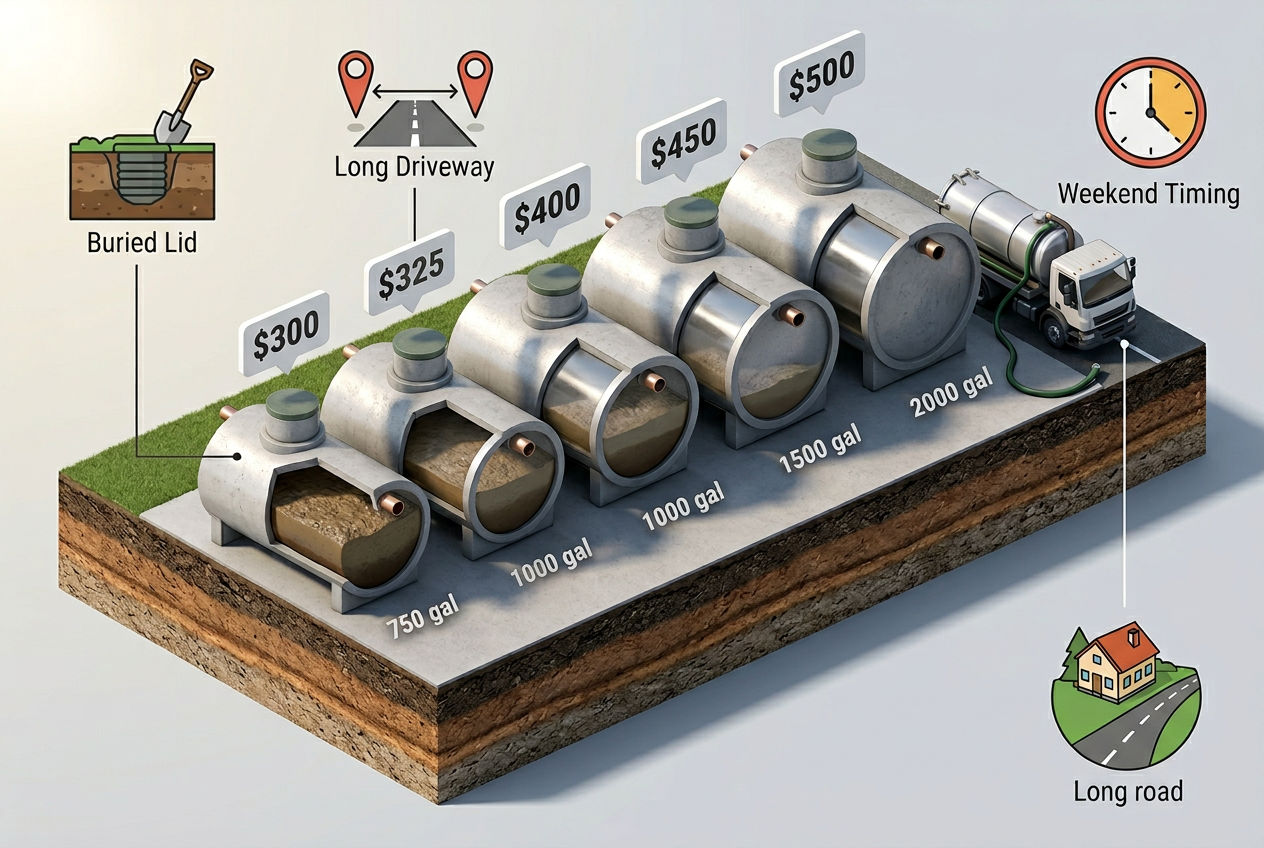
The average septic tank emptying costs $300-$600 nationwide in 2026. Your final price depends on tank size, location, and accessibility.
| Tank Size | Average Emptying Cost | Typical Homes |
|---|---|---|
| 750 gallons | $250-$350 | 1-2 bedroom |
| 1,000 gallons | $350-$425 | 3 bedroom (most common) |
| 1,250 gallons | $400-$500 | 3-4 bedroom |
| 1,500 gallons | $450-$550 | 4-5 bedroom |
| 2,000 gallons | $550-$700 | 5+ bedroom or high-use |
Source: National averages compiled from contractor pricing data via HomeAdvisor and Angi, 2025-2026.
Several factors push the price up or down:
Buried lids add $50-$100 per visit if the hauler has to dig. Installing septic tank risers ($150-$300 one time) eliminates this charge permanently.
Drive distance matters. Rural properties 30+ minutes from the hauler's base often see a $50-$100 surcharge. Companies in suburban areas with clustered customers charge less per stop.
Emergency or weekend service adds $50-$150 to the base price. Scheduling a routine emptying on a weekday during business hours is always the cheapest option.
Tank condition affects time on-site. A severely overdue tank with compacted sludge takes longer to empty and may require extra agitation, adding labor charges.
For a complete cost breakdown by region and state, see our septic pumping cost guide and the state-by-state pricing comparison.
Free download
Free: the Septic Fridge Card — what to flush, what never to.
The Do / Don’t card the whole family can see, plus the Survival Kit: emergency flowchart, warning-sign decoder and pump-schedule card. One printable PDF.
Is Septic Tank Emptying the Same as Pumping?
Yes — septic tank emptying and septic tank pumping are identical services. The terminology varies by region, but the process, equipment, and result are the same.
Here's how the terms break down geographically:
| Term | Common Regions | Search Volume |
|---|---|---|
| Septic tank emptying | Northeast, Midwest, UK/Australia | 19,000/month |
| Septic tank pumping | South, West, Central US | 14,000/month |
| Septic tank pump out | Southeast, Mid-Atlantic | 9,000/month |
| Septic tank cleaning | Mixed — all regions | 6,000/month |
Source: Ahrefs keyword data, March 2026.
When you call a septic company and ask for "emptying" or "pumping," you'll get the same truck, the same hose, and the same result. The only practical difference is the word you use when calling.
Some homeowners assume "cleaning" is a more thorough service than "pumping" or "emptying." It's not. All three terms describe the same vacuum extraction of sludge and scum. No standard septic service includes pressure washing or scrubbing the tank interior — and you don't want that, because it disrupts the healthy bacteria colony that breaks down waste.
Common Mistake: Don't pay extra for a "deep clean" or "sanitizing" service on your septic tank. Some companies upsell these services for $100-$200 extra, but they provide no benefit and can actually harm your system by killing the bacteria that process waste. Standard emptying is all you need.
How Often Should You Empty Your Septic Tank?
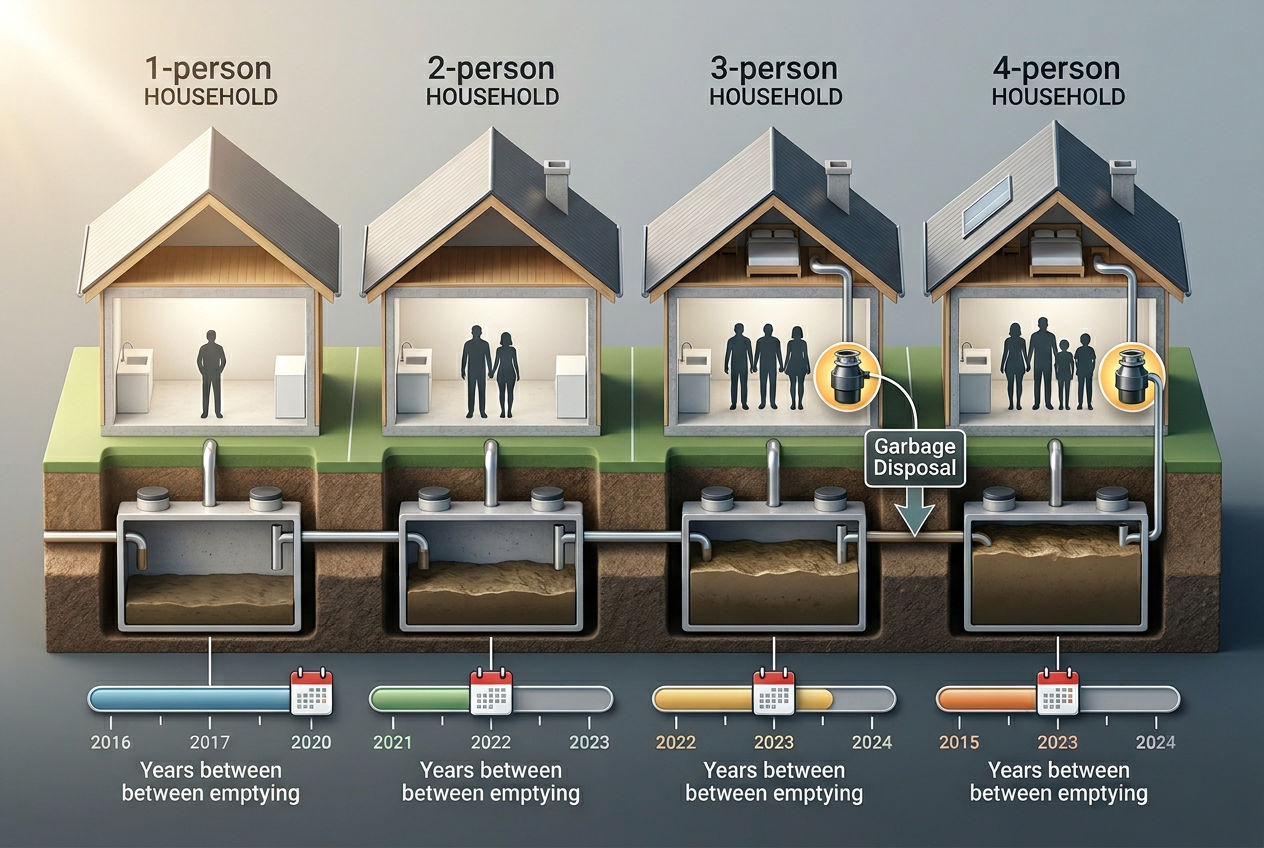
The EPA recommends septic tank emptying every 3 to 5 years for the average household. Your exact schedule depends on two variables: tank size and the number of people in your home.
| Household Size | 750 gal | 1,000 gal | 1,250 gal | 1,500 gal |
|---|---|---|---|---|
| 1 person | 9.4 years | 12.4 years | 15.6 years | 18.9 years |
| 2 people | 4.2 years | 5.9 years | 7.5 years | 9.1 years |
| 3 people | 2.6 years | 3.7 years | 4.8 years | 5.9 years |
| 4 people | 1.8 years | 2.6 years | 3.4 years | 4.2 years |
| 5 people | 1.3 years | 2.0 years | 2.6 years | 3.3 years |
Source: EPA — A Homeowner's Guide to Septic Systems, adjusted for 2026 usage patterns.
A garbage disposal changes everything. The EPA estimates disposals increase the solid waste entering your tank by up to 50%, which means you should cut the intervals in the table above roughly in half.
Other factors that shorten your emptying interval:
- Water softener discharge into the septic system (adds 40-70 gallons of brine per regeneration)
- Frequent entertaining or guests (temporary household size increase)
- Older tank with reduced effective volume (inlet/outlet baffles may restrict usable space)
For the complete frequency guide with a household-specific calculator, see how often you should pump your septic tank.
Key Insight: The single most expensive mistake septic owners make isn't choosing the wrong hauler or overpaying per service — it's waiting too long between emptying visits. Late-1990s EPA literature estimated that 10-20% of septic systems were failing at any given time, and the leading cause is deferred maintenance. A $400 emptying every 3 years protects you from a $15,000+ drain field replacement.
What Are the Signs Your Septic Tank Needs Emptying?
Don't wait for symptoms. By the time you notice problems, the damage to your drain field may already be underway. That said, here are the warning signs that your tank is overdue:
Slow drains throughout the house. If multiple fixtures drain slowly at the same time — not just one sink — the issue is likely a full septic tank, not a single pipe clog. One slow drain is plumbing. Multiple slow drains is septic.
Sewage odors near the tank or drain field. When the tank is too full, gases can't vent properly and escape through ground-level seams. If you smell sulfur or sewage in your yard, especially near the tank location, emptying is overdue.
Standing water or soggy patches over the drain field. This is the most serious warning sign. It means solids have escaped your tank and are clogging the drain field soil. You need immediate emptying plus a drain field inspection.
Gurgling sounds in toilets or drains. Air trapped in the system because the tank is too full to vent correctly creates gurgling noises. Read more about what septic tank gurgling means.
Sewage backup into the house. This is the final stage — the system has nowhere left to send waste. If raw sewage backs up through floor drains, tubs, or toilets, call for emergency emptying immediately.
For the full diagnostic list, read our guide to 8 signs your septic tank needs pumping.
Pro Tip: Set a calendar reminder for your next emptying date based on the frequency table above. The best time to schedule is mid-spring or early fall — you'll avoid the summer rush when most homeowners remember their septic system exists, and you'll dodge winter access issues in cold climates.
What Happens If You Never Empty Your Septic Tank?
A septic tank that's never emptied will eventually fail, and the failure cascade is expensive.
Here's the progression:
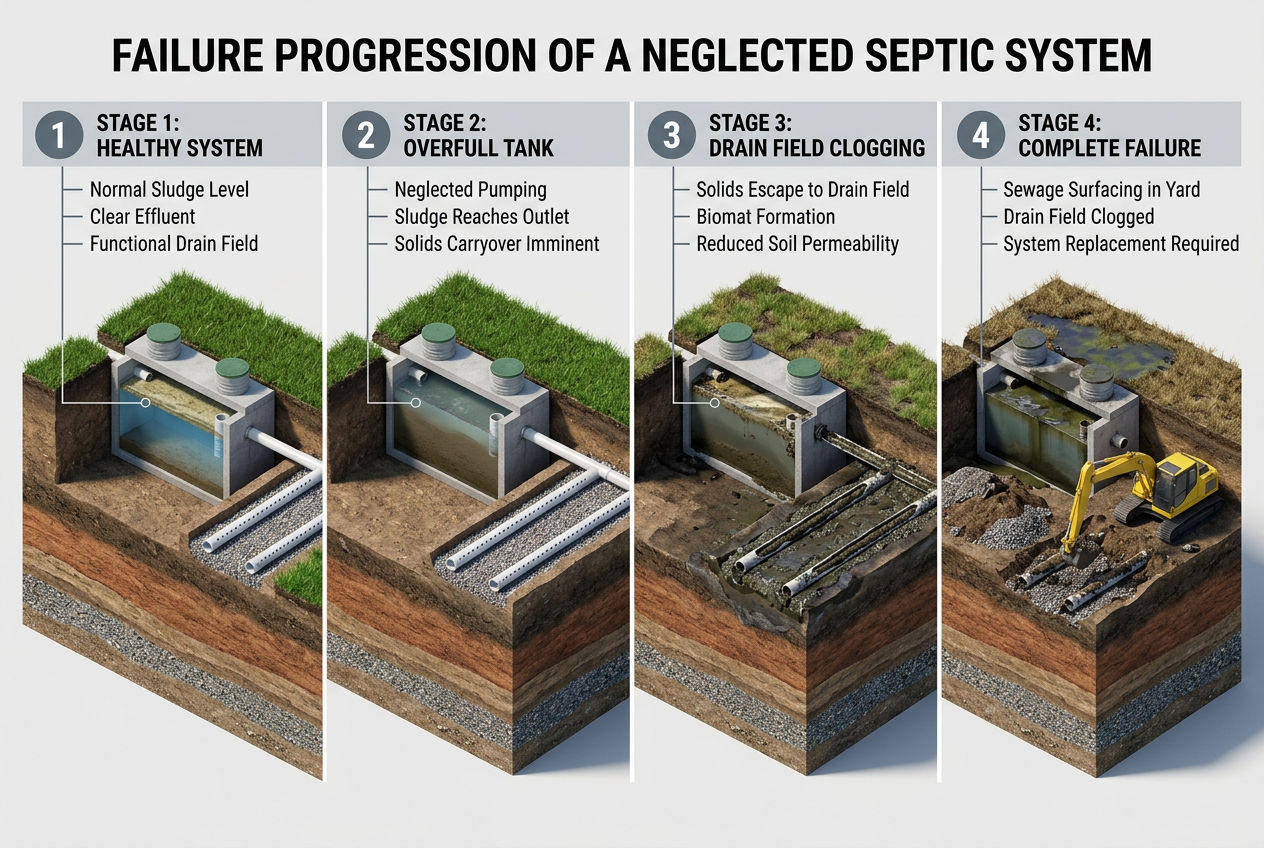
Years 1-3: Sludge and scum build up inside the tank. The system works normally because there's still enough liquid volume for settling and bacterial breakdown.
Years 3-6: Sludge reaches 30-50% of tank capacity. Settling efficiency drops. Small particles of suspended solids begin escaping through the outlet into the drain field lines.
Years 5-8: Solids clog the perforations in drain field pipes. The soil around the pipes develops a biomat — a bacterial layer that reduces absorption. Drains slow down. Odors appear.
Years 7-12: The drain field fails. Effluent can no longer percolate into the soil. Sewage surfaces in the yard or backs up into the house. The drain field is destroyed and must be replaced.
The cost comparison tells the story:
| Scenario | 30-Year Cost |
|---|---|
| Regular emptying every 3 years | $4,000-$6,000 |
| Skipped emptying → drain field replacement at year 10 | $15,000-$30,000 |
| Skipped emptying → full system replacement at year 12 | $25,000-$50,000 |
The math is clear: emptying your septic tank is the cheapest thing you'll ever do for your home's wastewater system.
For details on what repair and replacement costs look like, see our septic repair cost guide.
How Do You Prepare for a Septic Tank Emptying?
Preparing for your emptying appointment takes about 15 minutes and saves time (and money) when the hauler arrives.
Know where your tank is. If you don't know the location, your county health department should have an as-built drawing on file. You can also follow our guide to finding your septic tank lid.
Clear the area. Move vehicles, patio furniture, garden decorations, or anything blocking the path from the driveway to the tank. The hauler needs to run a heavy hose from the truck to the access lid — a clear path makes the job faster.
Expose the lids if buried. If your tank doesn't have risers, dig down to the access lids before the hauler arrives. This can save $50-$100 that some companies charge for digging. Mark the location with a flag or stake so you can find it easily next time.
Note any problems. If you've noticed slow drains, odors, or wet spots, tell the hauler when they arrive. They can check for specific issues while the tank is open and give you an honest assessment before the problem gets worse.
Keep records. After the service, save the receipt with the date, company, cost, volume extracted, and any notes from the hauler. This history is essential for calibrating your emptying schedule and is required during home sales in most states.
For ongoing maintenance between emptying visits, see our septic tank maintenance guide.
Why Does Your Septic Tank Fill Up Again After Emptying?
This is the most common question homeowners ask after their first emptying. You just paid $400 to have your tank emptied, and within a week it looks full again. Is something wrong?
No — that's exactly how a septic tank is supposed to work.
Your septic tank is designed to be full of liquid at all times. When the hauler empties it, the tank refills with water from your household use within 2-3 days. This is normal. The liquid level should sit at the bottom of the outlet pipe — that's the operating level.
What the emptying removed was the sludge (settled solids on the bottom) and scum (floating grease and fats on top). The tank refills with relatively clean water, and over the next few years, new sludge and scum slowly accumulate again.
If your tank is full of solids again within weeks or months of emptying, something else is wrong. Common causes include a failing drain field that's pushing water back into the tank, a plumbing leak sending excess water into the system, or a malfunctioning baffle that isn't directing flow properly.
Read more about this phenomenon in our guide: septic tank full after pumping — why and what to do.
Key Insight: A septic tank that appears "full" of clear liquid immediately after emptying is working correctly. A tank that's full of sludge or sewage shortly after emptying has a separate problem that emptying alone won't fix — you'll need a professional inspection to diagnose it.
Sources & Methodology
EPA — A Homeowner's Guide to Septic Systems — Federal guidelines on septic system maintenance, emptying frequency by household size, and system failure prevention.
HomeAdvisor — Septic Tank Pumping Cost — National cost data aggregated from verified contractor pricing across all 50 states.
National Onsite Wastewater Recycling Association (NOWRA) — Industry standards for onsite wastewater system servicing, waste hauler certification, and disposal regulations.
Angi — Septic System Costs — Regional pricing data and homeowner-reported costs for septic emptying and pumping services.
Was this article helpful?
Frequently Asked Questions
Recommended Resources
📖 Related Articles
- How Often Should You Pump Your Septic Tank?
- How Are Septic Tanks Pumped? The Complete Process
- 8 Signs Your Septic Tank Needs to Be Pumped
- The Complete Septic Tank Maintenance Guide
- What Is a Septic System? How It Works (Visual Guide)
- Septic Tank Full After Just Pumped: Why and What to Do
- How to Find Your Septic Tank Lid (And What to Do If It's Buried)
💰 Cost Guides
🔧 Services
Find Septic Professionals Near You
Compare licensed, verified septic companies by area — top county markets and cities below, or browse all 50 states.
County markets
Popular cities
