
Quick Answer
Septic system repair costs range from $200 for a simple baffle fix to $15,000+ for drain field replacement. The type of repair, your system's age, and whether you catch the problem early determine whether you're looking at a minor bill or a major excavation project.
Key Takeaways
- Most septic repairs cost $500-$5,000 — drain field work is the expensive outlier at $5,000-$20,000
- Baffle replacement ($150-$500) is the #1 most common repair and prevents drain field damage
- About 20% of repairs are DIY-friendly — the rest need a licensed contractor
- Never enter a septic tank — toxic gases can cause unconsciousness in seconds
- Early detection through regular inspections saves thousands in repair costs
Your septic system is underground, out of sight, and easy to ignore — until something goes wrong. When it does, most homeowners have no idea whether they're looking at a $200 fix or a $15,000 problem.
This guide breaks down every common septic system repair by type, cost, and difficulty level. You'll learn which issues you can handle yourself, which ones absolutely require a licensed contractor, and how to avoid the repair mistakes that turn small problems into catastrophic failures.
If your system is showing symptoms right now — slow drains, odors, wet spots, or alarms — skip ahead to the symptoms section to identify your likely repair.
Find a licensed septic repair company in your area on SepticTankHub.com.
What Are the Most Common Septic System Repairs?
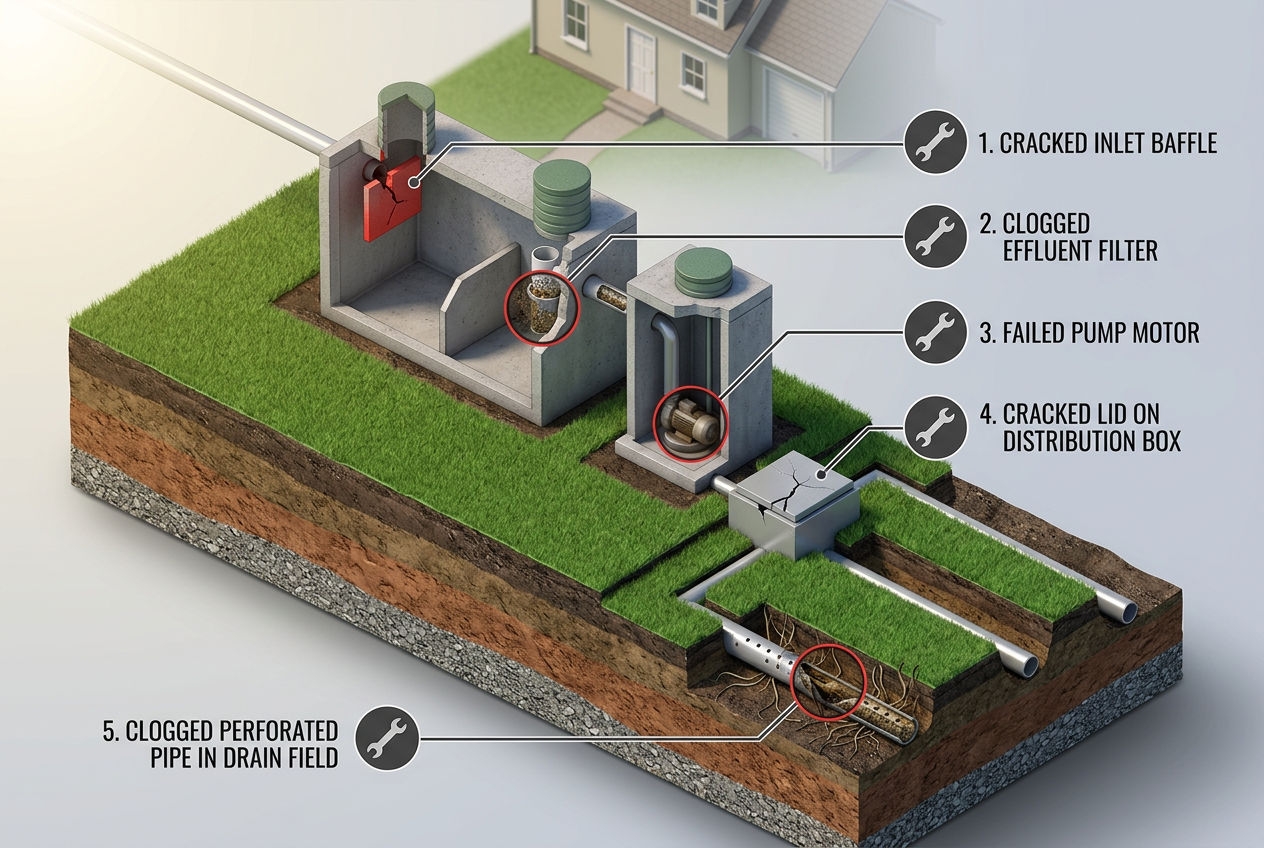
Most septic system problems fall into five categories. Here's what breaks, how often, and what it costs to fix.
| Repair Type | Cost Range | Frequency | DIY Possible? |
|---|---|---|---|
| Baffle replacement | $150-$500 | Very common | No — requires tank access |
| Effluent filter replacement | $30-$80 | Common | Yes — surface accessible |
| Pipe repair (inlet/outlet) | $500-$2,500 | Common | Rarely — usually buried |
| Pump replacement (aerobic/lift) | $500-$1,200 | Moderate | No — electrical + confined space |
| Distribution box repair | $500-$1,500 | Moderate | No — buried component |
| Drain field repair (jetting/aeration) | $2,000-$10,000 | Less common | No — specialized equipment |
| Tank crack/structural repair | $1,500-$5,000 | Rare | No — excavation required |
| Full drain field replacement | $5,000-$20,000 | Rare | No — permits + excavation |
Source: National repair cost data compiled from contractor pricing via SepticTankHub.com, HomeAdvisor, and Angi, 2025-2026.
Baffles are the most frequently repaired component. These internal walls direct wastewater flow inside your tank, preventing scum from escaping to the drain field. Concrete baffles corrode over time due to hydrogen sulfide gas exposure. When they fail, solids flow freely into the drain field — causing thousands in secondary damage. Learn more in our septic tank baffle repair guide.
Effluent filters are the easiest and cheapest repair. These cartridge filters sit in the outlet tee and catch solids before they reach the drain field. They need cleaning every 1-3 years and replacing every 5-10 years. A homeowner with basic tools can do this in 15 minutes.
Pipe repairs vary wildly in cost depending on depth and accessibility. A cracked inlet pipe 2 feet underground costs $500-$800. A collapsed outlet pipe running to the drain field at 4+ feet deep can cost $2,000-$2,500 including excavation and backfill.
Pro Tip: Ask your pumper to inspect baffles during every routine emptying — it takes them 30 seconds while the tank is open and costs nothing extra. Catching a cracked baffle early prevents $5,000+ in drain field damage that would otherwise go undetected until the field fails.
How Much Does Septic Repair Cost? (Quick Overview)
The total cost of a septic system repair depends on three factors: what's broken, how accessible it is, and how much secondary damage has occurred.
Component cost is the baseline — the price of the part itself. A replacement baffle is $50-$100. A new effluent pump is $200-$500. A new distribution box is $200-$600.
Labor and excavation are where costs escalate. Any repair below 2 feet of soil requires an excavator ($200-$500/hour including operator). A 4-foot excavation to reach a distribution box can add $1,000-$2,000 in digging and backfill costs alone.
Secondary damage is the expensive surprise. If a broken baffle sent solids into your drain field for months before you noticed, you're not just replacing a $100 baffle — you're also repairing a drain field that may have $5,000-$10,000 in damage.
For complete cost breakdowns, see our septic repair cost guide and drain field replacement cost guide.
Common Mistake: Don't ignore a septic alarm or slow drains hoping the problem will resolve itself. Septic problems never get better on their own — they only get more expensive. A $500 repair caught early becomes a $5,000+ repair after six months of delay. Every week you wait, solids continue damaging your drain field.
Free download
Free: the Septic Fridge Card — what to flush, what never to.
The Do / Don’t card the whole family can see, plus the Survival Kit: emergency flowchart, warning-sign decoder and pump-schedule card. One printable PDF.
Which Septic Repairs Can You Do Yourself?
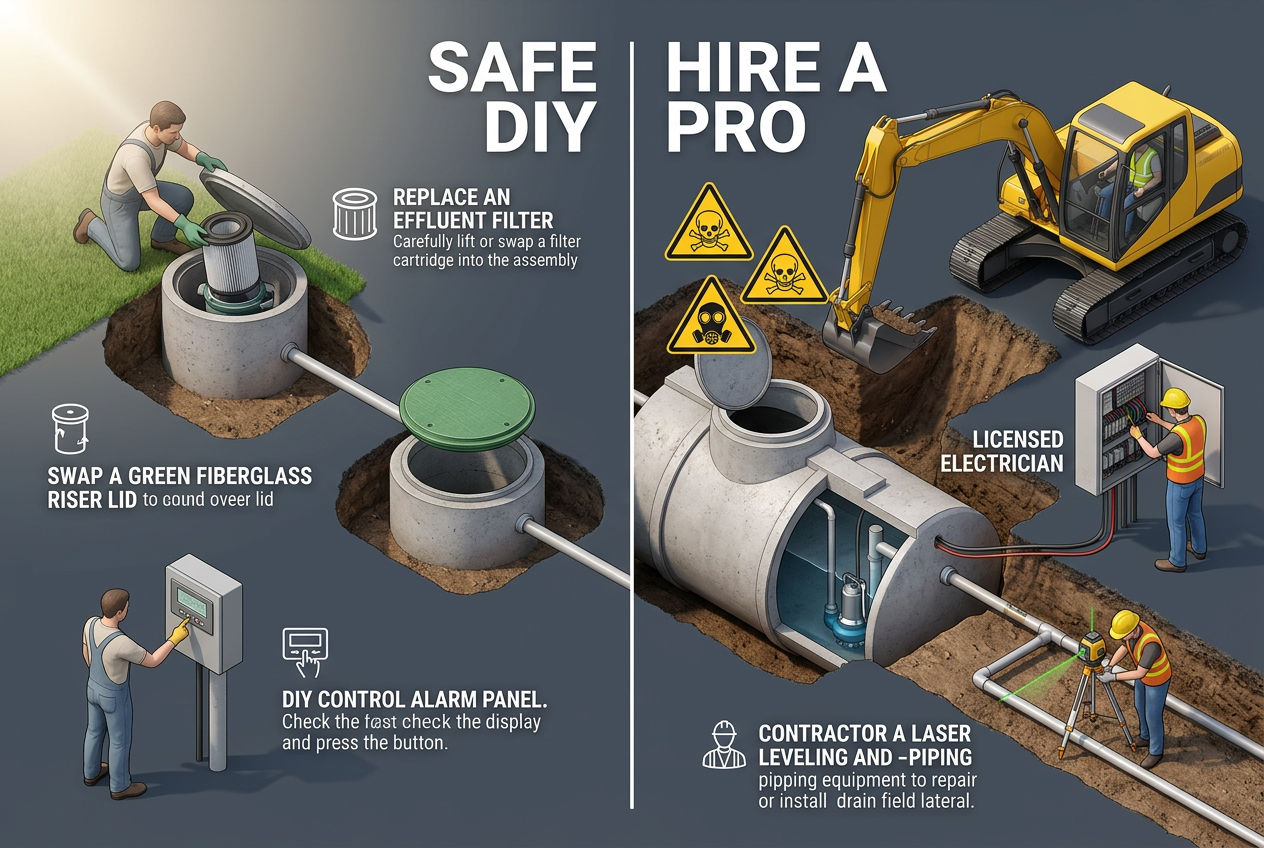
About 20% of septic repairs are DIY-friendly for a homeowner with basic tools and some mechanical confidence. The rest require a licensed contractor due to safety risks, permit requirements, or specialized equipment.
DIY-Safe Repairs
Effluent filter cleaning and replacement ($0-$80). The filter cartridge pulls straight out of the outlet tee — usually accessible from the surface through a riser. Rinse it with a garden hose, or replace it if the mesh is damaged. Do this every 1-3 years.
Riser lid replacement ($20-$50). Cracked or broken riser lids are a surface-level swap. Remove the old lid, clean the rim, set the new one. Takes 10 minutes.
Septic alarm reset ($0). If your septic alarm is going off, the first step is checking whether it's a genuine high-water alarm or a tripped circuit. Reset the breaker and check the float switch. If it trips again, call a professional.
Minor surface pipe repairs ($50-$200). If a visible pipe fitting above ground is leaking, you can replace it with standard PVC fittings from a hardware store. Only applies to exposed, accessible pipes — not buried lines.
Always Hire a Professional For
Anything below grade. If the repair requires digging more than 12 inches, hire a contractor with excavation equipment. Disturbing septic lines incorrectly can collapse pipes and cause bigger problems.
Any tank entry. Septic tanks contain methane, hydrogen sulfide, and other toxic gases that can cause unconsciousness within seconds. People die in septic tanks every year. Never open a tank and lean in — even to retrieve a dropped tool.
Drain field work of any kind. Drain field repairs require understanding soil percolation, pipe grade, and distribution patterns. Incorrect repairs can destroy a functioning field. This work also typically requires a county permit.
Pump replacement. Effluent pumps and aerator motors involve electrical connections in wet, confined spaces. This is a licensed electrician and septic contractor job.
For the full DIY breakdown with step-by-step instructions, read our guide to repairing your septic system.
How Do You Diagnose Which Repair You Need?
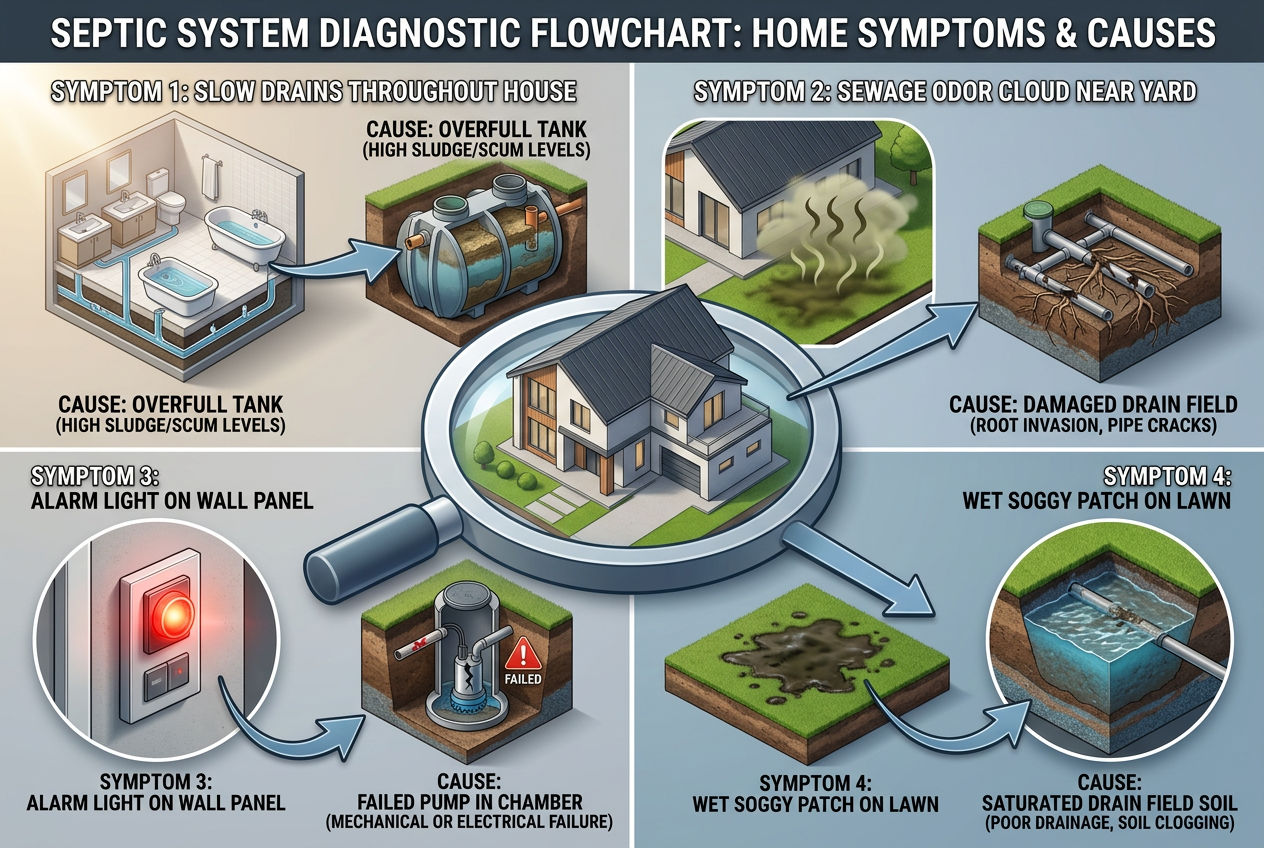
Septic problems produce specific symptoms. Match your symptoms to the likely repair:
| Symptom | Likely Cause | Repair Needed | Cost Range |
|---|---|---|---|
| All drains slow throughout house | Full tank or clogged outlet | Emptying + possible baffle repair | $350-$600 |
| Sewage odor near tank | Damaged lid, failed riser seal, or venting issue | Lid/seal replacement | $50-$300 |
| Sewage odor near drain field | Drain field overload or failure | Drain field inspection + repair | $500-$10,000 |
| Gurgling toilets | Full tank or blocked vent | Emptying, vent clearing | $350-$800 |
| Wet spots over drain field | Drain field failure | Drain field repair/replacement | $2,000-$20,000 |
| Alarm going off | High water level in pump chamber | Pump repair/replacement | $500-$1,200 |
| Sewage backup in house | Full tank, pipe blockage, or field failure | Emergency — call immediately | $350-$5,000+ |
| Green stripe over drain field | Mild overload (nutrients feeding grass) | Monitor + adjust water usage | $0-$500 |
If you're experiencing multiple symptoms simultaneously, the problem is likely more severe and may involve drain field damage.
The fastest way to get a definitive diagnosis is a professional septic inspection. An inspector uses cameras, dye tests, and probing to pinpoint the exact failure point. Inspection costs $300-$500 but saves you from guessing wrong and spending money on the wrong repair.
Key Insight: About 60% of septic "repair" calls are actually just overdue pump-outs. Before assuming you need an expensive fix, check when your tank was last emptied. If it's been more than 3-5 years, start there. A $400 emptying often solves the symptoms without any repair work. See our guide on how often to pump your septic tank.
When Should You Repair vs. Replace Your Septic System?
This is the most expensive decision you'll make with a failing septic system. The answer depends on what's failed, the age of your system, and the condition of the remaining components.
Repair makes sense when:
- One specific component has failed (single baffle, single pipe section, one pump)
- The tank is structurally sound (no wall cracks, no settling)
- The drain field is still functioning (drains are slow but no surface sewage)
- The system is less than 20 years old
- Total repair cost is under 30% of full replacement cost
Replacement makes sense when:
- Multiple components have failed simultaneously
- The tank has structural damage (cracked walls, collapsed roof, severe settling)
- The drain field is permanently saturated and unresponsive to repair treatments
- The system is 25+ years old with concrete components showing advanced corrosion
- Repair costs would exceed 50% of full replacement cost
- Your household has grown significantly and the system is undersized
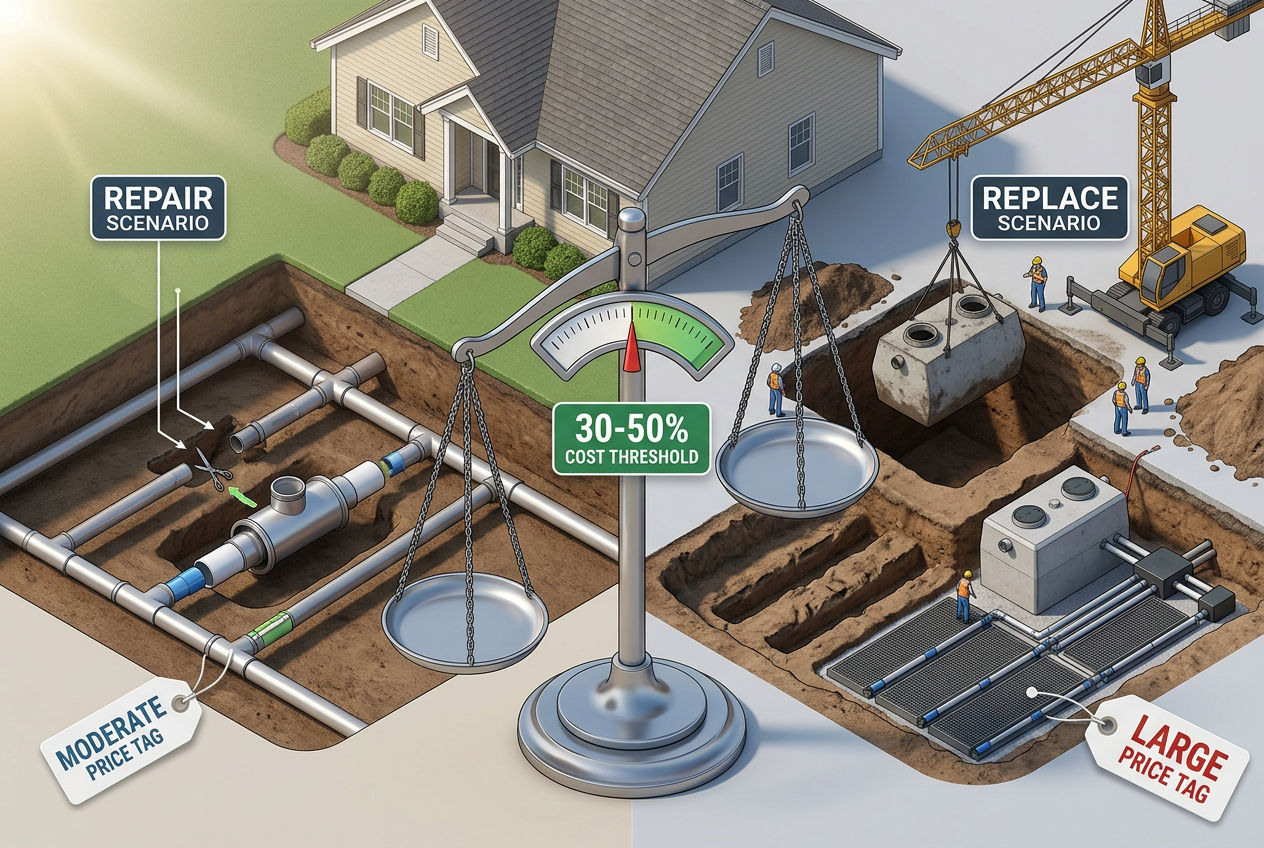
The 30/50 rule: If the repair costs less than 30% of a full replacement, repair. If it exceeds 50%, replace. Between 30-50%, consider the system's age and remaining lifespan.
A standard septic system replacement costs $15,000-$30,000 including tank, drain field, piping, permits, and labor. Alternative systems (mound, aerobic, sand filter) can reach $30,000-$50,000.
What Are the Biggest Septic Repair Mistakes?
These mistakes turn routine repairs into financial disasters:
Mistake #1: Using chemical drain cleaners. Products containing bleach, lye, or sulfuric acid kill the bacteria in your septic tank that break down waste. One bottle of drain cleaner can disrupt your bacterial balance for weeks. If you have a clog, use a plumber's snake — never chemical cleaners.
Mistake #2: Ignoring the first symptoms. Slow drains and occasional odors are the early warning system. Homeowners who wait for sewage backup or standing water are dealing with 5-10x more expensive repairs because the drain field has been absorbing damage for months.
Mistake #3: Hiring an unlicensed "handyman" for septic work. Septic repair requires specific knowledge of soil science, grading, and local health codes. An unlicensed repair that fails can void your system's permit, making you liable for the entire replacement cost plus fines.
Mistake #4: Not pulling a permit when required. Most jurisdictions require permits for any repair involving the drain field, distribution box, or tank replacement. Unpermitted work discovered during a home inspection can kill a sale and trigger mandatory corrective action.
Mistake #5: Repairing the wrong component. Without a professional diagnosis, homeowners sometimes replace a pump when the real problem is a clogged outlet pipe, or repair a drain field when the tank itself is the issue. A $300-$500 inspection that identifies the actual problem saves thousands in misdirected repair costs.
Pro Tip: Before approving any repair over $1,000, get a second opinion from an independent septic inspector — not the contractor proposing the repair. Some companies recommend drain field replacement when jetting or aeration could restore the field at 20% of the cost. An unbiased inspector has no financial incentive to oversell.
How Do You Prevent Expensive Septic Repairs?
The best repair is the one you never need. Most septic failures are preventable with three basic practices:
Empty your tank on schedule. The EPA recommends every 3-5 years depending on household size and tank capacity. This single habit prevents the #1 cause of drain field failure — solids escaping a neglected tank. Our pumping frequency guide helps you find your exact schedule.
Fix problems when they're small. A cracked baffle costs $150-$500 to replace. The drain field damage caused by that cracked baffle costs $5,000-$20,000 to repair. Every component failure in your tank becomes a drain field problem if left unaddressed.
Reduce hydraulic load. Spread laundry across the week instead of marathon wash days. Fix running toilets immediately — a single running toilet can send 200+ gallons per day into your septic system, overwhelming the drain field's absorption capacity.
Find a licensed septic service company near you to set up a regular service schedule.
Sources & Methodology
EPA — A Homeowner's Guide to Septic Systems — Federal guidelines on septic system maintenance, failure prevention, and homeowner responsibilities.
HomeAdvisor — Septic System Repair Cost — National repair cost data aggregated from verified contractor pricing across all 50 states.
National Onsite Wastewater Recycling Association (NOWRA) — Industry standards for onsite wastewater system repair, contractor certification, and best practices.
Angi — Septic System Repair Costs — Regional pricing data and homeowner-reported costs for septic system repairs.
University of Minnesota Extension — Septic System Owner's Guide — Research-backed guidance on system maintenance, repair diagnostics, and failure prevention.
Was this article helpful?
Frequently Asked Questions
Recommended Resources
📖 Related Articles
- How to Repair a Septic System: DIY vs Professional
- Septic System Backing Up? Causes & Emergency Steps
- Why Does My Septic System Smell? Causes & Fixes
- Signs Your Drain Field Is Failing (And What to Do)
- How to Fix a Saturated Drain Field
- Septic Tank Baffle Repair & Replacement: Costs, Signs of Failure, and DIY vs Pro
- Septic Tank Gurgling Sounds: Causes and Fixes
- What Happens During a Septic Inspection?
- Septic Tank Alarm Going Off? What It Means and What to Do
- How Often Should You Pump Your Septic Tank?
💰 Cost Guides
🔧 Services
Find Septic Professionals Near You
Compare licensed, verified septic companies by area — top county markets and cities below, or browse all 50 states.
County markets
Popular cities
