
Quick Answer
A lagoon septic system is an engineered, open-air wastewater pond that treats effluent naturally — through sunlight, wind, algae, and microbial activity — rather than routing it through a drain field or leach field. Lagoon systems are most common in rural Midwest and Southern states and typically cost 30–50% less to install than conventional systems.
Key Takeaways
- Residential sewage lagoons cost $3,000–$12,000 to install, compared to $10,000–$25,000 for conventional systems
- Typical size for a single-family home is 50×50 to 100×100 feet, 3–5 feet deep
- Lagoons are commonly permitted in Missouri, Kansas, Oklahoma, Arkansas, Nebraska, and Iowa — and restricted or banned in most Northeast states
- Setback requirements typically mandate 50–100 feet from your home and 100–200 feet from any well
- With proper maintenance, a lagoon can last 20–40 years — sometimes longer
How Does a Septic Lagoon Work?
A septic lagoon — sometimes called a sewage lagoon, septic pond, or wastewater lagoon — treats household wastewater in a shallow, open pond rather than underground. Wastewater flows from your home into the lagoon, where a combination of sunlight, oxygen, algae, and naturally occurring bacteria breaks down organic matter over days or weeks before the treated water evaporates or slowly percolates into the soil.
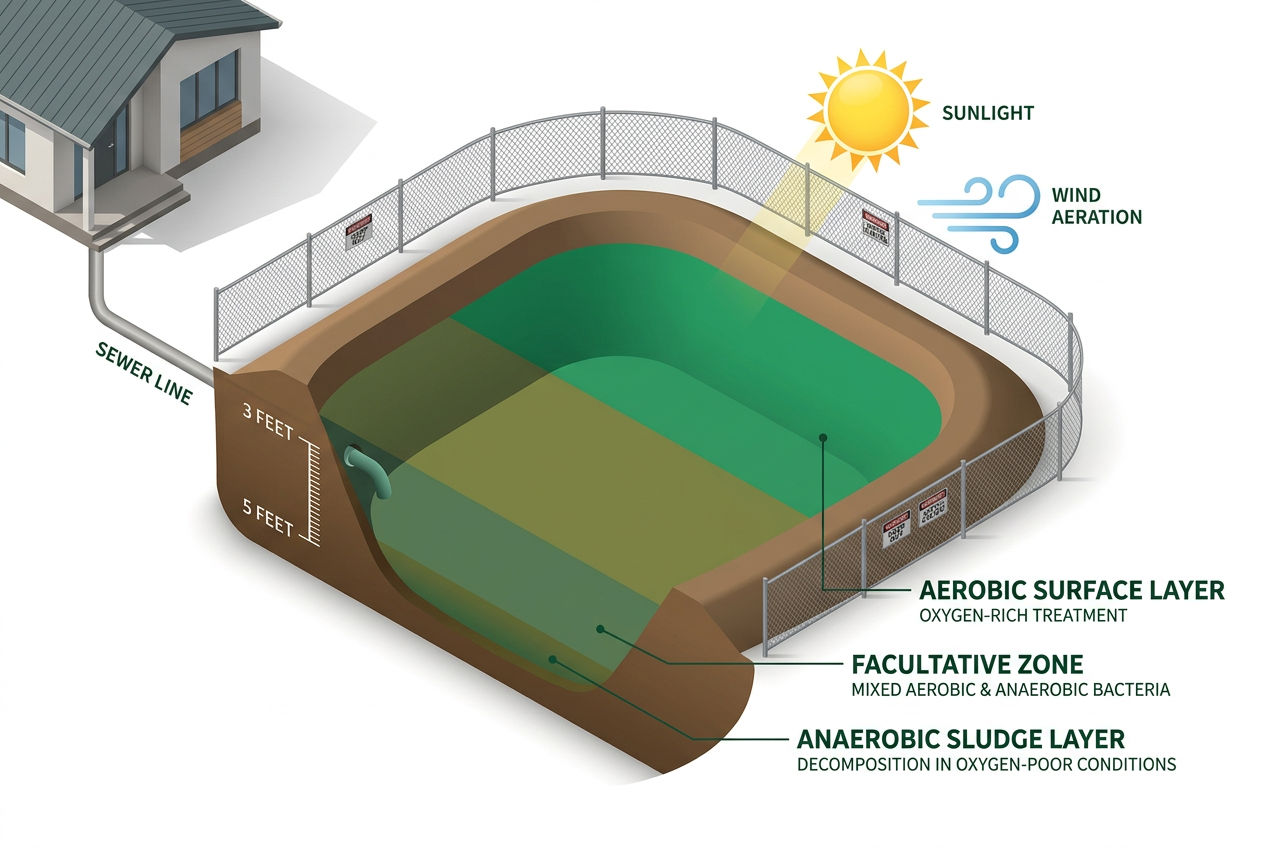
Most residential setups use a two-stage process. First, solids settle in a small septic tank or primary chamber. Then the liquid effluent flows into the lagoon for secondary biological treatment. Without that primary settling stage, solids would overwhelm the lagoon quickly. Lagoons also come up often in DIY septic system research for rural land precisely because the design is simpler than most alternatives — though the same two-stage principle still applies.
The Three Types of Septic Lagoons
Not all lagoons work the same way. There are three main types, and the right one depends on your climate, land size, and local regulations.
Anaerobic lagoon: These are deep (8–15 feet) and designed for high-strength waste. Bacteria work without oxygen. They're more common in agricultural settings than residential ones, and they produce more odor.
Aerobic lagoon: Shallower (1–2 feet) and oxygen-dependent. Sunlight and wind oxygenate the water, supporting aerobic bacterial activity. Sometimes called an oxidation pond in engineering literature, this design offers cleaner treatment but requires more land surface area.
Facultative lagoon: The most common residential type. These mid-depth ponds (3–6 feet) support both aerobic activity near the surface and anaerobic decomposition at the bottom. The top layer handles sunlight and oxygen while the bottom layer handles settled sludge — a naturally self-regulating process that county health departments typically prefer for residential use. For most homeowners on large rural lots, a facultative lagoon is what a county health department will approve.
The EPA recognizes lagoons as a viable decentralized wastewater treatment technology under its septic guidance program.
Lagoon vs. Septic Tank: What's the Difference?
A conventional septic system uses a buried tank to separate solids from liquids, then disperses treated effluent through a drain field — typically 300–1,000 feet of perforated pipe in gravel trenches underground. A lagoon system eliminates the drain field entirely and replaces it with an open pond.
Here's a practical comparison:
| Feature | Lagoon System | Conventional Septic |
|---|---|---|
| Installation cost | $3,000–$12,000 | $10,000–$25,000 |
| Land required | 1+ acre typical | 0.5–1 acre typical |
| Underground components | Minimal | Tank + drain field trenches |
| Maintenance frequency | Sludge pump every 5–15 yrs | Tank pump every 3–5 yrs |
| Odor risk | Moderate (outdoor) | Low (underground) |
| Permitted in Northeast | Rarely | Yes |
| Lifespan | 20–40+ years | 20–30 years (drain field) |
Sources: EPA Septic Systems Program; University of Missouri Extension; NOWRA (National Onsite Wastewater Recycling Association)
The biggest trade-off is visibility and land requirement. A drain field is buried and invisible. A lagoon — whether you call it a septic pond, waste lagoon, or oxidation pond — sits in your backyard. That matters less on a 5-acre rural property in Kansas than on a 1-acre suburban lot in Connecticut — which is partly why regulations skew so differently by region.
If you're comparing total project costs across system types of septic systems, lagoons frequently win on upfront price where soil conditions rule out a conventional drain field anyway.
How Much Does a Lagoon Septic System Cost to Install?
A residential lagoon septic system costs $3,000–$12,000 to install, with most homeowners landing between $5,000–$8,000. That's significantly less than the $10,000–$25,000 range for a conventional system with a drain field.
Here's what drives the number up or down:
Excavation and earthwork is the biggest line item — typically $1,500–$5,000 depending on soil type, slope, and how much material needs to be moved. Sandy soil is cheaper to excavate than rocky clay.
Liner costs vary by local code. Some counties require a synthetic liner (20–40 mil HDPE or similar) to prevent groundwater contamination — add $800–$3,000. Others allow unlined clay-bottom lagoons.
Permits and engineering fees typically run $500–$2,000. Your county health department will usually require a site evaluation, perc test, and stamped plans. See our perc test guide for what to expect during that process.
Primary treatment tank (if required separately): $800–$2,500.
A homeowner in rural Missouri with 3 acres, moderate clay soil, and a 3-bedroom home — where the county requires a liner and a 1,000-gallon primary settling tank before the lagoon — can expect a total installed cost around $7,200. The same project in Nebraska with sandier soil and no liner requirement might come in at $4,800. The difference comes down almost entirely to liner requirements and soil excavation difficulty, not the lagoon itself.
For a detailed breakdown across system types, check the septic installation cost guide.
DIY Septic Blueprint
Thinking about building it yourself?
The complete, plain-English plan to size, permit and install your own septic system — designed for homeowners, not contractors. Skip the $15,000–$25,000 quotes and do it right the first time.
Get the DIY Blueprint — $67 →Instant download · 8 modules + 3 bonus guides · 60-day money-back guaranteeAre Septic Lagoons Legal in Your State?
Regulations vary so dramatically by region that a lagoon system that's standard practice in rural Missouri is often flat-out illegal in New Jersey. Before you commit to a design, check your state and county rules first — the gap between permitted and prohibited can mean the difference between a $6,000 project and a complete redesign.
States where residential lagoons are commonly permitted: Missouri, Kansas, Oklahoma, Arkansas, Nebraska, Iowa, South Dakota, North Dakota, Montana, Wyoming, Mississippi, and parts of Texas and Louisiana. Missouri in particular has thousands of permitted residential lagoons — the University of Missouri Extension has published detailed lagoon design guides for decades.
States where lagoons are restricted or prohibited for new residential installations: Most of the Northeast (New York, New Jersey, Connecticut, Massachusetts, Maryland), the Pacific Coast (California, Oregon, Washington), and Florida. High population density, environmental sensitivity, and stricter groundwater protection rules typically drive these bans.
Setback requirements vary considerably by jurisdiction, but common minimums include:
- 50–100 feet from your dwelling
- 25–50 feet from property lines
- 100–200 feet from wells, streams, or other water sources
- 25–50 feet from roads
Your state health department is the starting point. For state-specific rules, see our septic system regulations by state pages — we have individual guides for Missouri, Kansas, Arkansas, and 47 other states. Even where lagoons are generally permitted, individual county health departments often add their own rules. Always confirm at the county level, not just the state level. This is covered in detail in our septic system permit requirements guide.
How Do You Maintain a Septic Lagoon?
A properly sized residential lagoon genuinely requires less hands-on attention than a conventional drain field — but skip maintenance long enough and you'll face expensive dredging or a full system failure.
Sludge removal is the primary maintenance task. Over years of use, settled solids accumulate on the lagoon floor. Most residential lagoons need desludging every 5–15 years, depending on household size and lagoon volume. The job typically runs $300–$1,000, depending on the contractor and sludge volume. This is similar to septic tank pumping, but involves different equipment. See how much septic pumping costs for regional pricing context.
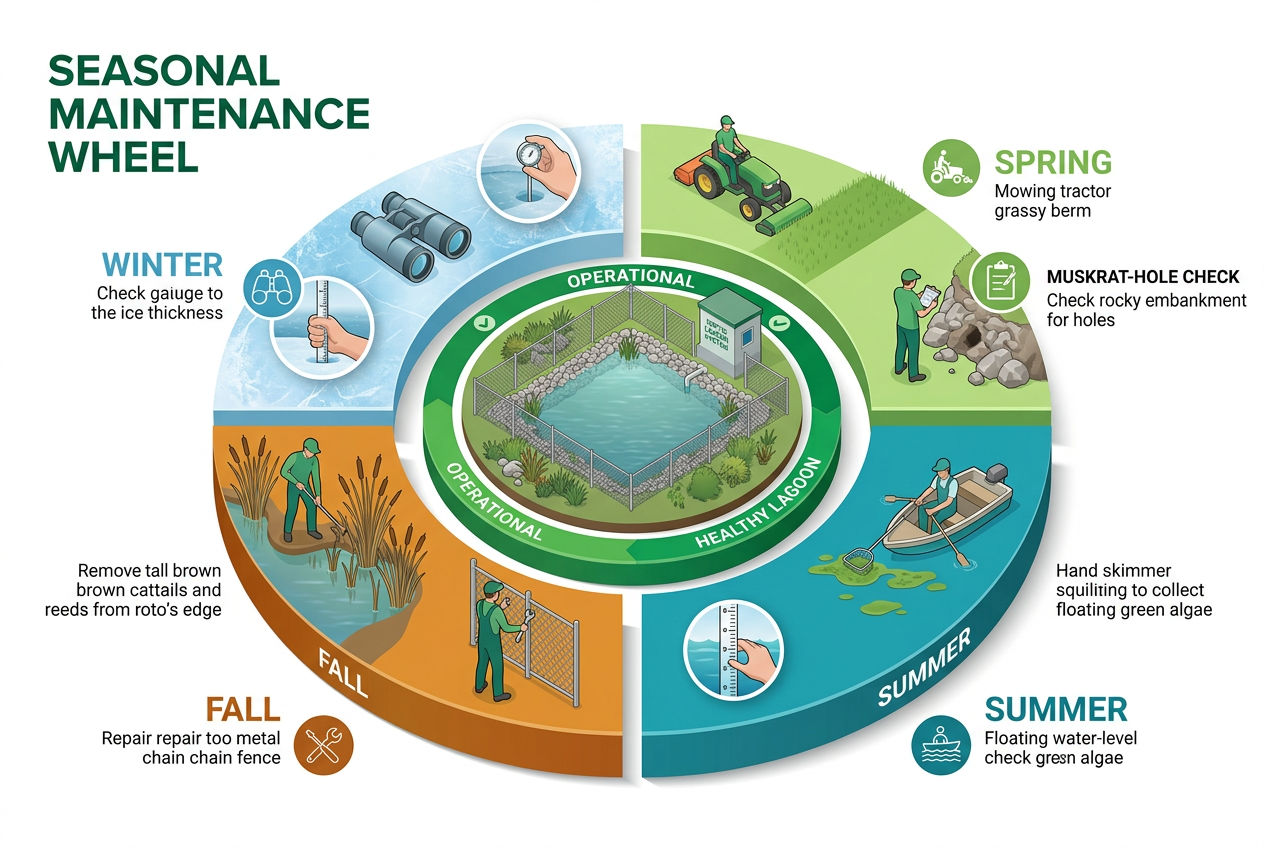
Vegetation management matters more than most people expect. Overgrown emergent weeds (cattails, reeds) along the lagoon edges reduce oxygen transfer and harbor pests. Plan on cutting back vegetation 2–4 times per year.
Inspect the berm and liner annually for erosion, cracking, or animal damage. Muskrats and beavers can burrow into earthen berms — a serious structural problem if left unaddressed.
Test effluent quality if your permit requires it. Some counties require periodic water quality testing to verify the lagoon is treating waste adequately before any discharge.
Seasonal Maintenance Calendar
Spring: Check the berm for frost heave or erosion from snowmelt. Look for signs of overflow or high water levels. Spring is also peak installation season if you're planning a new system.
Summer: Expect algae blooms — this is normal and actually indicates healthy biological activity. Surface algae performs photosynthesis that oxygenates the water. Monitor odor; a healthy lagoon smells earthy, not like raw sewage. If neighbors complain, that usually signals a pH or loading problem.
Fall: Best time for sludge removal — biological activity is still active enough to help process loosened material before winter. Schedule your inspection and any pumping before the ground freezes.
Winter: In states like Nebraska, Iowa, or Montana, ice cover forms on the lagoon surface. This is expected. The system slows dramatically but doesn't stop. Biological treatment drops to 20–30% efficiency under ice. Don't stress it — the lagoon has volume to buffer the reduced treatment rate until spring.
Do Septic Lagoons Smell?
A healthy lagoon smells earthy or faintly organic — not like raw sewage. If yours smells like a sewer, something is wrong.
The most common causes of lagoon odor problems:
Overloading: Too much waste entering the system relative to lagoon volume. This can happen after adding household members, a guest surge, or connecting laundry to the system without accounting for the added load.
pH imbalance: Optimal bacterial activity happens at pH 6.5–8.5. Detergents, bleach, and other household chemicals can throw off the balance. Some lagoon owners add agricultural lime (calcium carbonate) to adjust pH — typically 20–50 lbs per surface acre when needed.
Anaerobic turnover: Occasionally, bottom sediment gets disturbed — by heavy rain, wind, or a desludging operation — and the anaerobic material mixes into the upper water column. The odor is temporary but strong. It usually clears within a few days as aerobic conditions reestablish.
Surface crust: A dead or cracked surface crust prevents proper oxygen exchange. Warm-weather aeration (even dragging a rope across the surface) can help break it up.
For neighbors living 200+ feet away, a well-maintained lagoon is rarely noticeable. For neighbors closer than 100 feet, it can be an issue during hot summer months — another reason setback requirements exist.
How Long Does a Septic Lagoon Last?
A properly constructed and maintained residential sewage lagoon lasts 20–40 years, and many systems installed in the 1970s and 1980s are still functioning today with proper care.
Lifespan depends heavily on three factors:
Liner integrity is often the limiting factor in modern systems. A 20-mil HDPE liner has a design life of 20–30 years; a 40-mil liner can exceed 40 years. Unlined clay-bottom lagoons can last indefinitely if the clay layer remains intact, but they're increasingly rare in new construction due to groundwater protection requirements.
Berm condition determines structural integrity. An eroded or compromised berm can cause a lagoon to fail suddenly rather than gradually. Annual berm inspections and prompt repair of animal damage extend system life significantly.
Loading history — how much waste has entered the system relative to its design capacity — affects sludge accumulation rate. A lagoon sized for a 3-bedroom home that consistently houses 6–8 people will accumulate sludge faster and require more frequent desludging.
Systems from the 1980s with original liners are approaching the end of their design life. If you're buying a rural property with an existing lagoon, ask for the installation date and maintenance records before closing. A septic inspection that includes lagoon condition assessment is worth the cost.
For comparison, conventional drain fields typically last 20–30 years before the soil absorption capacity fails — at which point drain field replacement runs $5,000–$20,000. A lagoon that needs liner replacement at year 25 might cost $3,000–$8,000 for new liner material, far less than a full drain field rebuild.
Is a Lagoon System Right for You?
A residential lagoon makes practical sense under a specific set of conditions. It's not a universal solution.
Good candidates for a lagoon system:
- Rural properties with 1+ acres and adequate setback distance from wells, streams, and property lines
- Locations where soil conditions (heavy clay, shallow bedrock, high water table) rule out a conventional drain field
- Homeowners in states where lagoons are permitted and the county health department has an established approval process
- Budget-constrained projects where the $5,000–$8,000 lagoon cost is significantly more manageable than a $15,000–$20,000 engineered alternative
Poor candidates:
- Properties under 1 acre or with tight setback constraints
- Any location in the Northeast, Pacific Coast, or Florida where permits are unavailable
- Homeowners with close neighbors sensitive to occasional odor
- Properties where a future sale to suburban buyers might be complicated by a visible waste lagoon
If your soil or site fails the conditions for a conventional system but a lagoon isn't permitted, alternative septic systems like mound systems, sand filter systems, or engineered septic systems may be the path forward. Each comes at a higher cost but works on sites where lagoons and conventional drain fields both fail. See how long drain fields last if you're weighing a lagoon against repairing an existing conventional system. Whichever direction your site points, septic professionals near you can evaluate the soil and quote each option side by side.
Sources & Methodology
Cost data was compiled from contractor pricing surveys, county health department fee schedules, and homeowner project reports across Missouri, Kansas, Nebraska, Arkansas, and Oklahoma collected between 2022 and 2025. Ranges reflect variation in soil conditions, liner requirements, and regional labor costs. Single-state averages are not representative of national pricing.
Technical specifications (lagoon types, depth ranges, treatment efficiency, winter performance data) draw from:
- U.S. Environmental Protection Agency. Septic Systems Overview. epa.gov/septic
- University of Missouri Extension. Lagoon Systems for Wastewater Treatment. Multiple publications, 1990–2023.
- NOWRA (National Onsite Wastewater Recycling Association). Decentralized Wastewater Treatment Technology Fact Sheets.
- NAWT (National Association of Wastewater Technicians). Residential Lagoon Maintenance Guidelines.
- U.S. EPA. Constructed Wetlands and Waste Stabilization Ponds: A Handbook for Decision Makers. EPA/625/R-95/003.
Regulatory information reflects state health department guidance current as of publication. Regulations change; verify current requirements with your county health department before beginning any project.
Free download
Not ready for the Blueprint? Start free.
Grab the free DIY Septic Planning Kit — the permit-first checklist, perc-test cheat sheet, and sizing tables that keep your build from getting red-tagged.
Was this article helpful?
Frequently Asked Questions
Recommended Resources
📖 Related Articles
- What Is a Septic System? How It Works (Visual Guide)
- Types of Septic Systems: Complete Comparison Guide
- Perc Test (Percolation Test): What It Is & How It Works
- Septic System Permit Cost & State Requirements (2026 Guide)
- What Happens During a Septic Inspection?
- Alternative Septic Systems: Options When a Standard System Won't Work
- Mound Septic System: $10K–$25K Cost & How It Works (2026)
- Sand Filter Septic Systems: How They Work & What They Cost
- Engineered Septic System Cost: $12K–$30K+ (2026)
- How Long Do Drain Fields Last? Lifespan Guide
💰 Cost Guides
🔧 Services
Find Septic Professionals Near You
Compare licensed, verified septic companies by area — top county markets and cities below, or browse all 50 states.
County markets
Popular cities
