
Quick Answer
1970s septic tank design relied on precast concrete tanks, pipe-and-gravel drain fields, and early PVC laterals — a significant step up from 1950s steel tanks and 1960s Orangeburg pipe, but still undersized and largely single-compartment by modern standards. Systems from the 1950s through 1980s each reflect the materials, regulations, and construction shortcuts of their era, and each decade produces distinct failure patterns that show up in inspections today.
You bought an older home. The inspection report flagged the septic system. Or maybe the county sent a notice about compliance. Now you're trying to figure out what you actually have buried in your backyard — and whether it's going to cost you $800 or $28,000 to fix. Some owners even start pricing a DIY septic replacement at this point — but you can't budget anything until you know what's actually down there.
The septic system under a home built in 1965 or 1972 or 1981 was constructed with different materials, different sizing standards, and different regulatory oversight than what contractors install today. Different failure modes follow. And in many cases, different legal standing under current code.
This guide breaks down old septic system designs by decade — what materials were standard, what sizing was typical, and what specific failure patterns those systems produce for homeowners dealing with them right now.
Key Takeaways
- Septic systems built before 1980 were largely unregulated and often undersized by modern standards
- Steel tanks from the 1950s–1960s have a lifespan of just 15–25 years — most are long past due for replacement
- Cinder block septic tanks are no longer permitted in most U.S. jurisdictions and are considered high-failure-risk
- Old single-compartment tanks treat waste less effectively than modern two-compartment designs
- A 50-year-old septic system may still be "grandfathered" under local code, but that doesn't mean it's safe or functional
- If you don't know what type of system you have, a professional septic inspection is the essential first step
Before the 1950s: Cesspools and the Wild West of Wastewater
Before tackling the decade-by-decade breakdown, you need to understand what existed before modern septic systems.
A cesspool isn't a septic tank. It's a buried pit — sometimes lined with cinder blocks or stone, sometimes just a hole in the ground — that collects both solids and liquids. There's no separation, no treatment, no drain field. Liquid seeps out through the gaps in the walls or the bottom. Solids pile up until the pit fills. Then you either pump it, dig a new one, or wait for problems.
Millions of American homes built before 1955 still have cesspools. Some are still in active use. To understand the difference between a cesspool and a true septic system, the cesspool vs. septic tank guide covers the key distinctions in detail.
If your home is pre-1955, there's a real chance what's buried in your yard is a cesspool, not a septic tank — regardless of what any previous owner told you.
What Did 1950s Septic Systems Actually Look Like?
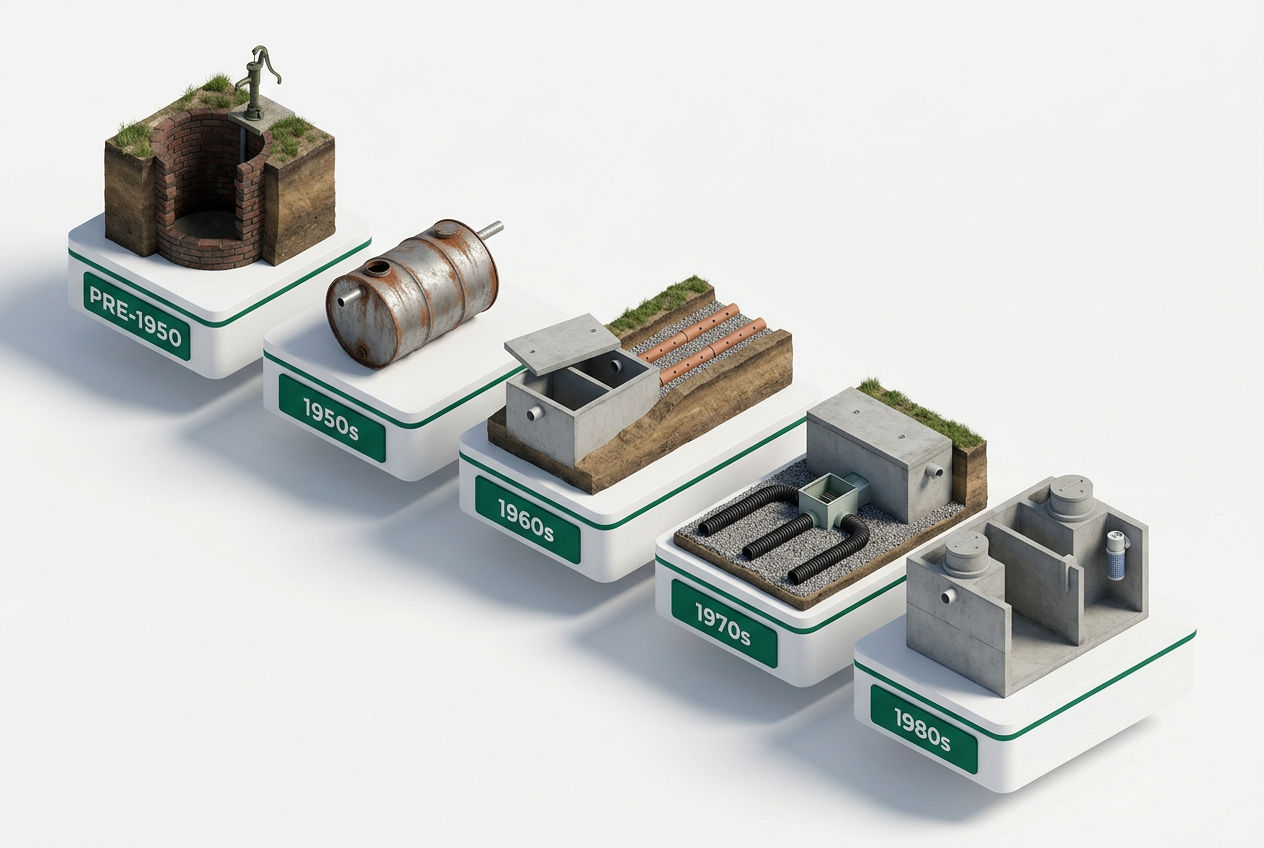
The Materials and Construction of 1950s Systems
The 1950s were the postwar suburban boom. Millions of homes went up fast, especially in newly developed subdivisions outside major cities. Septic systems were an afterthought — if they were thought about at all.
Tank materials: Steel tanks dominated the 1950s. Prefabricated metal septic tanks were easy to manufacture and transport. Some homeowners and contractors used poured-in-place concrete. Others built tanks out of cinder blocks or concrete blocks mortared together — the original cinder block septic tank design that still haunts homeowners today.
Tank size: Typical 1950s tanks held 500–750 gallons. A modern 3-bedroom home requires a minimum of 1,000–1,500 gallons in most states. Those old tanks were undersized from day one — a 500-gallon tank serving a family of four receives roughly twice the daily hydraulic load it was designed to handle.
Drain fields: Many 1950s properties didn't have a true leach field at all. Instead, they used a seepage pit (also called a dry well) — a single large pit filled with gravel where liquid waste simply percolated into the surrounding soil. Others used basic clay tile pipe laid in gravel trenches, but the design was rarely engineered or tested. For more on how a drain field is supposed to work, that guide covers the basics.
Regulations: There essentially were none. Pre-1960s, most U.S. counties had no septic regulations. No permit required. No percolation test. No setback requirements from wells, property lines, or water sources. A contractor — or the homeowner himself — could dig a hole, drop in a steel tank, run some pipe, and call it done.
1950s System Failure Modes You'll See Today
Steel tanks from the 1950s have a maximum lifespan of 15–25 years. If yours hasn't been replaced, it hasn't just failed — it's likely collapsed. Corroded steel tanks cave in under soil pressure, creating sinkholes in your yard and potentially allowing raw sewage to contaminate groundwater.
Cinder block tanks fare only slightly better. The mortar joints between blocks deteriorate over 20–40 years, allowing groundwater infiltration and effluent leakage. These tanks were no longer permitted in most jurisdictions decades ago, but plenty remain in service.
What Did 1960s Septic Tank Design Look Like — and What Fails First?
By the early 1960s, precast concrete tanks began replacing steel as the dominant material. Precast tanks were manufactured off-site and craned or trucked into position — a significant improvement over site-built block tanks and corroding steel.
Tank size: 750–1,000 gallons became typical. Still single-compartment in nearly all cases.
Pipe materials: Clay tile pipe and Orangeburg pipe were both common in the drain field. Orangeburg — a pressed-fiber pipe made from wood pulp and pitch — was cheap and easy to cut. According to the National Association of Home Inspectors, Orangeburg was designed with a 50-year lifespan, which means virtually every Orangeburg pipe installation from the 1960s is now past its end-of-life. It collapses into an oval shape, restricts flow, and eventually disintegrates entirely.
Drain field design: Pipe-and-gravel trench systems became more common, but design standards varied wildly by county and contractor. A distribution box (D-box) was sometimes used to split effluent flow between multiple lateral lines — a critical component that homeowners still find failing in older systems today. Understanding how long drain fields last gives useful context for evaluating whether a 1960s field is worth repairing.
Regulations: Some states began adopting sanitary codes in the mid-to-late 1960s. Percolation tests started appearing as a requirement in certain jurisdictions, but enforcement was spotty. If you dig into old county records, you'll often find 1960s systems that were permitted but never inspected.
1960s System Problems Today
The concrete tank structure itself may still be intact — well-built precast concrete can last 40–80+ years. But the inlet and outlet baffles inside that tank are a different story.
Original baffles from the 1960s were often made of concrete or metal. Both deteriorate. Concrete baffles crack and crumble. Metal baffles corrode. Without functioning baffles, solids escape the tank and clog the drain field. A common repair: replacing failed original baffles with Polylok PL-122 tees — a plastic baffle fitting that costs $200–600 installed and eliminates the corrosion problem entirely.
Clay tile pipe holds up longer than Orangeburg — 50–60+ years structurally — but the joints between sections separate over time, allowing root intrusion from nearby trees.
Free download
Planning your own septic system?
Grab the free DIY Septic Planning Kit — the permit-first checklist, perc-test cheat sheet, and sizing tables that keep your build from getting red-tagged.
What Made 1970s Septic Tank Design Different From Earlier Systems?
The 1970s produced the most variation in design quality of any decade covered here — systems that ranged from surprisingly solid to completely illegal by modern standards. More homes from this era are still on original septic systems than from any other period, which makes understanding 1970s septic tank design especially relevant for today's buyers and owners.
The Clean Water Act changed everything. Passed in 1972, it triggered a cascade of state-level regulation that forced counties to start taking wastewater seriously. According to the EPA, the 1972 Act's Section 208 provisions explicitly addressed non-point-source pollution including septic system effluent. By the mid-1970s, most states required permits and percolation tests for new septic installations. The 1977 amendments tightened enforcement further.
Tank design: Precast concrete became the near-universal standard for 1970s septic tank design. Tank sizes settled around 1,000 gallons for a typical 3-bedroom home. Single-compartment tanks were still the norm, though some contractors began building two-compartment designs in response to emerging state codes. To understand how a septic system is supposed to function with modern two-compartment tanks, that overview covers the full process.
Pipe materials: PVC pipe started replacing clay tile and Orangeburg in drain fields during this decade. Early 1970s systems often used clay tile; late 1970s systems increasingly used PVC. This is a critical distinction when evaluating an old system — a 1978 installation with PVC laterals is in substantially better shape than a 1971 system with clay tile.
Drain field design: Pipe-and-gravel trench systems with a distribution box were standard. Setback requirements from wells and property lines were now appearing in most state codes, though the specific distances varied significantly by jurisdiction.
How Did Regional Soil and Climate Shape 1970s Septic Tank Design?
Geography mattered — a lot — in how 1970s septic tank design was actually executed in the field.
In New England, frost depths of 4–6 feet required tanks and pipes buried deeper than in the South, which protected those systems from some surface-level disturbances but created access challenges for maintenance. Massachusetts and Connecticut both had active state sanitary codes by the early 1970s. Massachusetts Title 5, which requires a septic inspection at point of sale, has since forced thousands of 1970s systems into compliance upgrades.
In Florida and coastal Southeast states, high water tables made traditional pipe-and-gravel systems problematic from the start. Many 1970s-era Florida systems used seepage pits or shallow drain fields that failed quickly in sandy, high-water-table soils — a core reason the Florida Department of Health has become aggressive about mandating system upgrades in coastal counties.
In the rural Midwest, clay-heavy soils that barely passed a perc test were routinely approved for conventional drain fields. According to the University of Minnesota Extension, clay soils with percolation rates slower than 60 minutes per inch should not receive standard gravity drain fields — yet many 1970s Midwest systems were installed in exactly these conditions. Those clay soils never absorbed effluent efficiently, and many 1970s Midwest drain fields were effectively failing within 10–15 years of installation.
What Fails First in 1970s Septic Systems?
Here's a worked example that shows how this plays out in practice: A 1,000-gallon precast concrete tank installed in 1975 is pumped for the first time in 2024. The inspector finds the concrete inlet baffle crumbled entirely — solids have been passing directly into the distribution box for an unknown period. The D-box shows heavy sludge accumulation. Two of four lateral lines are blocked. Replacing the baffle costs $350. Rehabilitating the two blocked laterals with hydro-jetting costs $800. If jetting fails, replacing the drain field runs $8,000–15,000 depending on site conditions and local labor rates — a cost range confirmed by the Texas Commission on Environmental Quality's published guidance on conventional system replacement.
The concrete tank body itself is fine. The baffles failed around year 20–30, as they almost always do. Original concrete baffles in 1970s tanks typically fail within 20–30 years. Replacement with Polylok PL-122 tees at the first pump-out — even proactively — is the single highest-value maintenance action on any 1970s system.
The drain field story is more variable. A 1975 PVC-lateral system in loamy New England soil that has been pumped every 3 years may still be functional. A 1972 clay-tile system in Florida clay soil that was never pumped is almost certainly failed. The signs of drain field failure guide covers what to look for before you spend money on an inspection.
What Changed in 1980s Septic System Design?
By the 1980s, state-level regulation had matured enough to produce genuinely better systems in most jurisdictions.
Tank design: Two-compartment concrete tanks became increasingly common as state codes began requiring them. The second compartment provides a second settling stage, significantly reducing the solids load on the drain field. Some states, including New Jersey and New York, required two-compartment tanks by code for new installations after the mid-1980s.
Pipe materials: Schedule 40 PVC pipe was near-universal by the early 1980s. The unreliable materials of earlier decades — Orangeburg, clay tile, corrugated metal — were effectively gone from new construction.
Drain field design: Engineered designs with soil testing became standard rather than exceptional. Many states adopted minimum setback distances of 50–100 feet from wells and surface water. Distribution boxes were required components in most state codes.
Inspection and permitting: By the mid-1980s, most counties required a permit, a percolation test, and a final inspection before covering a new system. This created a paper trail that makes 1980s systems far easier to research than their predecessors.
1980s System Limitations Today
An 1980s system built to code is the most likely of the pre-modern systems to still be functional. But "functional" has limits. According to the EPA's Onsite Wastewater Treatment Systems Manual, even a well-maintained conventional drain field has a design lifespan of 20–30 years under normal loading — meaning most 1980s drain fields are at or past their designed service life regardless of how well the tank was maintained.
The honest limitation here: a drain field that appears functional on visual inspection may still be in a slow-failure mode where biomat accumulation gradually reduces capacity over years. Camera inspection of laterals is the only way to assess this definitively.
What Does "Grandfathered" Actually Mean for an Old Septic System?
"Grandfathered" is one of the most misunderstood terms in the septic world. Homeowners hear it and assume it means their system is approved, legal, and doesn't need to be touched.
That's not what it means.
Grandfathering means a system that was legal when installed doesn't have to immediately comply with current regulations simply because the regulations changed. It does not mean:
- The system is safe to use
- The system meets current performance standards
- You're protected from enforcement action if the system fails
- You can expand or modify the system under the old rules
Most states attach conditions to grandfathered status. In Massachusetts, under Title 5, a grandfathered system loses its protected status and must be upgraded when the property is sold, when the building is expanded, or when the system fails inspection. Florida has similar triggers. Texas Commission on Environmental Quality rules require any failed system — regardless of age or grandfathered status — to be repaired or replaced to current standards.
The practical implication: a grandfathered 1965 steel tank that is still technically "permitted" offers no protection if it collapses and contaminates a neighbor's well.
How Do You Figure Out What Type of Old Septic System You Have?
This is the question that actually drives most people to this article — not the history, but the practical problem of identifying an unknown system on a property they just bought or are about to buy.

Start with the county health department. Most counties that issued septic permits after the mid-1960s kept records. Call the environmental health or sanitarian's office and ask for the septic permit file for your address. For systems installed before 1965, records may not exist — this is a real limitation in many rural counties that didn't require permits until state-level regulations forced the issue.
Check the as-built drawing. If a permit file exists, it often contains an as-built diagram showing tank location, tank size, drain field dimensions, and materials used. This single document can tell you everything you need to know about what type of system you have.
Use probe rods if no records exist. A septic contractor or inspector can use a thin metal rod to probe the yard and locate tank edges and distribution box locations. Combined with visual clues — depressions in the yard, unusually green grass over the drain field in dry weather, old cleanout risers — probing can identify system components without excavation.
Schedule a camera inspection. For drain field condition, a lateral line camera inspection ($300–600 nationally for a standard system) is the most definitive tool available. It shows pipe condition, collapse, root intrusion, and biomat buildup directly. The how often to pump your septic tank guide covers what a full service visit should include.
If you truly have no records and no visible surface indicators, a professional septic inspection with probing and camera work is the only way to get a reliable answer. The cost ($300–600) is a fraction of what a failed drain field costs to replace.
Should You Repair or Replace an Old Septic System?
This is the question that actually matters after you've identified what you have. The answer depends on which component has failed and how old the overall system is.
Repair makes sense when:
- Only the baffles have failed in an otherwise intact tank (cost: $200–600 for Polylok PL-122 tee replacement)
- The distribution box is cracked or offset but the laterals are clear (cost: $300–900 for D-box replacement)
- One lateral line is blocked but others are functional and the tank is well-maintained (cost: $500–1,500 for hydro-jetting or partial field repair)
- The tank is structurally sound precast concrete from the 1970s or later
Replacement makes more sense when:
- The tank is a 1950s steel tank or cinder block construction — full replacement is almost always the right call
- Multiple drain field laterals are failed or collapsed
- The system is undersized (500–750 gallons) for current household occupancy
- You're seeing surface breakout of effluent, which triggers mandatory repair requirements in virtually every state
- The septic tank replacement cost calculation shows repair costs approaching 50%+ of full replacement
One thing every old system requires: more frequent pumping than a newer one. According to the EPA's standard recommendation — every 3–5 years for a 1,000-gallon tank — most old systems have been severely under-maintained. For 1960s-era 750-gallon tanks serving average households, a 2–3 year pumping interval is more appropriate. The septic pumping cost guide covers what to expect to pay in your region. And whichever route you take, find a local septic contractor who has worked on systems from your home's era — these failure patterns are second nature to them.
Sources & Methodology
This article draws on the following sources:
- U.S. Environmental Protection Agency — Onsite Wastewater Treatment Systems Manual (EPA/625/R-00/008), the primary federal reference for septic system design standards, lifespan estimates, and pumping frequency recommendations.
- University of Minnesota Extension — Soil percolation rate guidance and clay soil septic system failure data, used for the Midwest regional section.
- National Association of Home Inspectors (NAHI) — Orangeburg pipe lifespan and failure mode documentation.
- Texas Commission on Environmental Quality (TCEQ) — Published guidance on conventional septic system replacement costs and regulatory requirements for failed systems.
- Massachusetts Title 5 (310 CMR 15.000) — Point-of-sale inspection requirements and grandfathered system upgrade triggers, cited for the New England regional section.
Decade-specific construction details reflect publicly available county permit records, contractor documentation, and published building history research. Cost ranges reflect national averages as of 2024–2025 and will vary by region and site conditions.
Was this article helpful?
Frequently Asked Questions
Recommended Resources
📖 Related Articles
- Cesspool vs Septic Tank: Differences & What Replaces a Cesspool
- What Is a Drain Field? (And How Does It Work?)
- Septic System Permit Cost & State Requirements (2026 Guide)
- How Long Do Drain Fields Last? Lifespan Guide
- What Is a Septic System? How It Works (Visual Guide)
- Signs Your Drain Field Is Failing (And What to Do)
- How Often Should You Pump Your Septic Tank?
- Septic Tank Replacement Cost 2026: $5,000–$15,000 (Full Breakdown)
💰 Cost Guides
🔧 Services
Find Septic Professionals Near You
Compare licensed, verified septic companies by area — top county markets and cities below, or browse all 50 states.
County markets
Popular cities
