
Quick Answer
Septic tank overflow happens when your system can no longer process wastewater fast enough — forcing raw sewage back into your home, up through floor drains, or out into your yard. When a septic tank is overflowing, the cause is almost always identifiable: a full tank, drainfield failure, saturated soil, damaged baffles, or too much water use in too short a time. Approximately 21 million U.S. households rely on private septic systems, according to the EPA — and septic system overflow is one of the most urgent problems any of them can face.
Key Takeaways
- Septic tank overflow is usually caused by a full tank, drainfield failure, heavy rain, damaged baffles, or excessive water use
- Signs include slow drains, sewage odors, gurgling pipes, wet spots in the yard, and backups inside the house
- Raw sewage contains over 100 pathogens — treat any overflow as a health emergency
- Emergency pumping runs $400–$900; drainfield replacement can reach $3,000–$15,000+
- The EPA recommends pumping every 3–5 years to prevent most overflow situations
What Causes a Septic Tank Overflow?
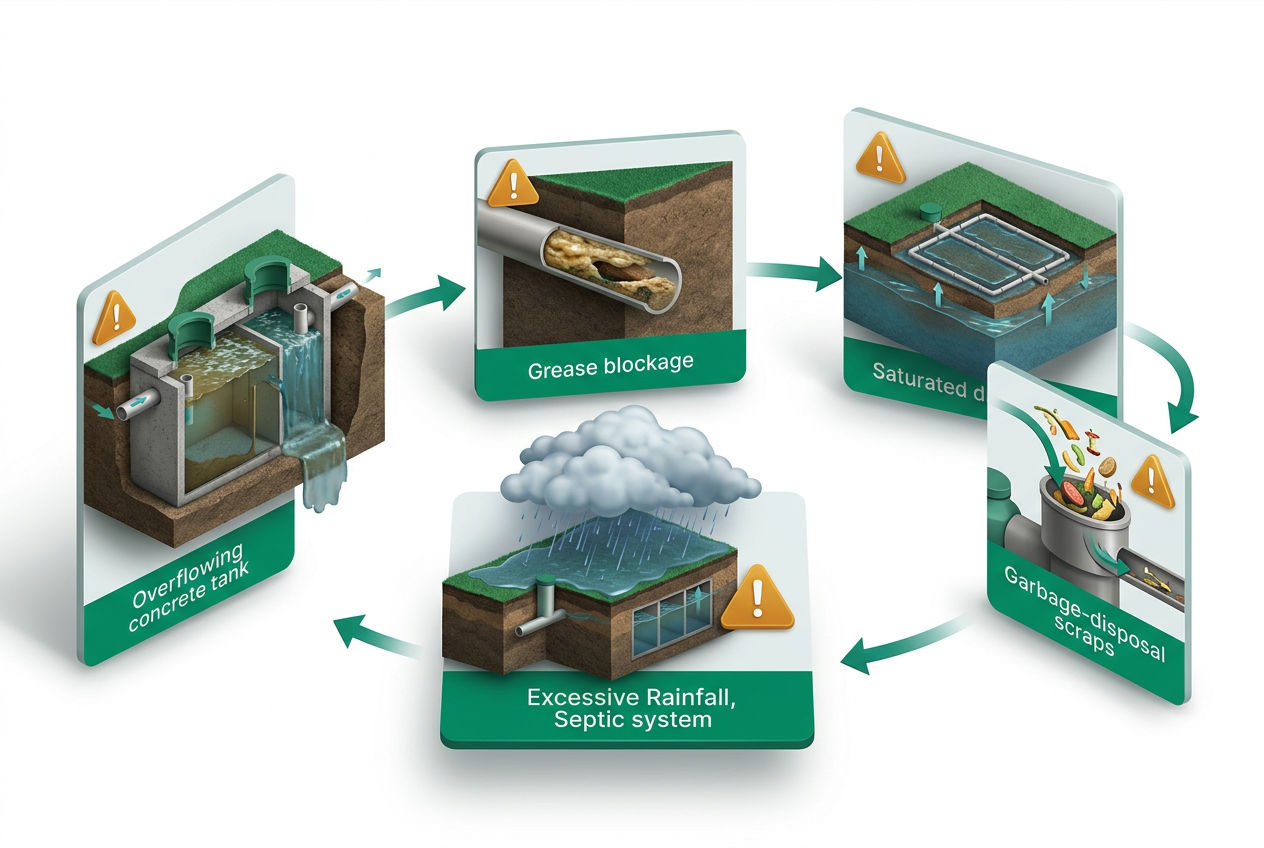
An overflowing septic tank almost always traces back to one of five root causes. Identifying the right one determines whether your fix costs $200 or $20,000 — which is why skipping straight to pumping without a diagnosis is a mistake. Here's what each cause looks like and how it develops.
The Tank Is Full or Overdue for Pumping
This is the most common cause — and the most preventable.
A standard 1,000-gallon concrete tank serving a 4-person household should be pumped every 3–4 years. The EPA's general guideline is every 3–5 years, but that assumes average water use of 70–100 gallons per person per day. Solid waste — the sludge layer at the bottom and scum layer at the top — builds up over time. When solid waste exceeds roughly one-third of the tank's total capacity, it begins pushing partially treated effluent toward the drainfield before solids have settled.
Add a garbage disposal to your kitchen, and you're loading the tank with extra solids that could cut your pumping interval to every 2 years.
If your tank keeps filling up immediately after pumping, the problem is likely downstream — meaning the drainfield, not the tank itself.
Drainfield Failure
The drainfield (also called a leach field) is where treated effluent from your tank percolates into the soil. When it fails, liquid has nowhere to go. The tank backs up, and sewage surfaces.
The most common failure mechanism is biomat clogging — a dense layer of anaerobic bacteria and organic material that seals the soil surface inside drainfield trenches, blocking absorption. Once a biomat establishes itself, the drainfield may require full replacement, which costs $3,000–$15,000 depending on linear footage, soil conditions, and your state's permitting requirements.
Drainfield trenches are typically 18–36 inches deep. When the surrounding soil becomes saturated with effluent, those trenches effectively stop working. This is one of the most expensive septic problems you can face — full system replacement runs $10,000–$30,000.
Heavy Rain or Saturated Soil
Picture this: you get 4 inches of rain over a weekend. The ground around your drainfield is already damp from a wet spring. Suddenly your toilets are draining slowly and there's a soggy patch over the leach lines — a classic case of a septic tank overflowing into the yard after heavy rain.
That's hydraulic overload — your system is physically underwater. When soil becomes saturated, it can't absorb effluent. The drainfield backs up into the tank, and the tank has nowhere to push liquid.
Spring snowmelt is the single highest-risk time of year for overflow in the northern U.S. In the Pacific Northwest, this pattern repeats every October through March. In Florida and Louisiana, a high water table compounds the problem year-round.
This isn't always a sign of a failing system — sometimes it resolves when the ground dries out. But if it keeps happening, your system may be undersized or poorly sited.
Read more about heavy rain's impact on your septic system and what to do when your system is flooded.
Damaged Baffles or Pipes
Your tank has two baffles — an inlet baffle and an outlet baffle. The inlet baffle slows incoming wastewater so it doesn't disturb the settled sludge layer. The outlet baffle prevents floating scum from exiting into the drainfield.
Both are typically made of concrete or PVC (Polylok baffles are a common replacement type). When an outlet baffle cracks or falls off — which happens frequently in older concrete tanks due to hydrogen sulfide corrosion — raw scum flows directly into the drainfield, clogging it almost immediately.
Septic baffle damage is a common finding during inspections on systems older than 15–20 years, particularly in the Northeast where older housing stock means older systems.
Damaged inlet pipes, root intrusion, or a crushed lateral line can also cause the system to back up even when the tank isn't technically full.
Excessive Water Use (Hydraulic Overload)
Your system is designed for a specific daily flow rate — typically 100–150 gallons per bedroom per day. When a household of 4 suddenly becomes a household of 10 for a holiday weekend, or you run six loads of laundry back-to-back, you're dumping far more water than the system can process.
The tank fills faster than the drainfield can accept effluent. This is a temporary hydraulic overload — but it can accelerate long-term drainfield damage if it happens repeatedly.
Slow drains throughout the house are often the first sign.
What Are the Warning Signs of a Septic Tank Overflow?
A septic tank overflow rarely announces itself at full force. The signs tend to build over days or weeks — and by the time sewage is surfacing in your yard, your system has been struggling for a while.
Indoors:
- Slow drains in multiple fixtures at once (not just one clogged sink)
- Gurgling sounds from toilets or drains after flushing
- Toilets that won't flush properly or back up
- A sewage smell inside the house — especially near floor drains or the lowest bathroom
- Raw sewage surfacing in bathtubs or floor drains
Outdoors:
- A soggy, wet spot in your yard directly over the drainfield or tank
- Unusually green or lush grass over the septic area — sewage is fertilizing your lawn
- A sewage smell outside near the tank or drainfield
- Standing water or soft, spongy ground over the drainfield — a key sign of a septic tank overflowing into the yard
On your control panel:
- A septic alarm going off — if your system has a pump chamber with a float switch, a high-water alarm means the tank level is critically elevated
Any combination of these symptoms, especially multiple signs at once, means your system needs immediate attention.
Is Septic Tank Overflow Dangerous?
Yes. Treat any septic overflow as a health emergency until proven otherwise.
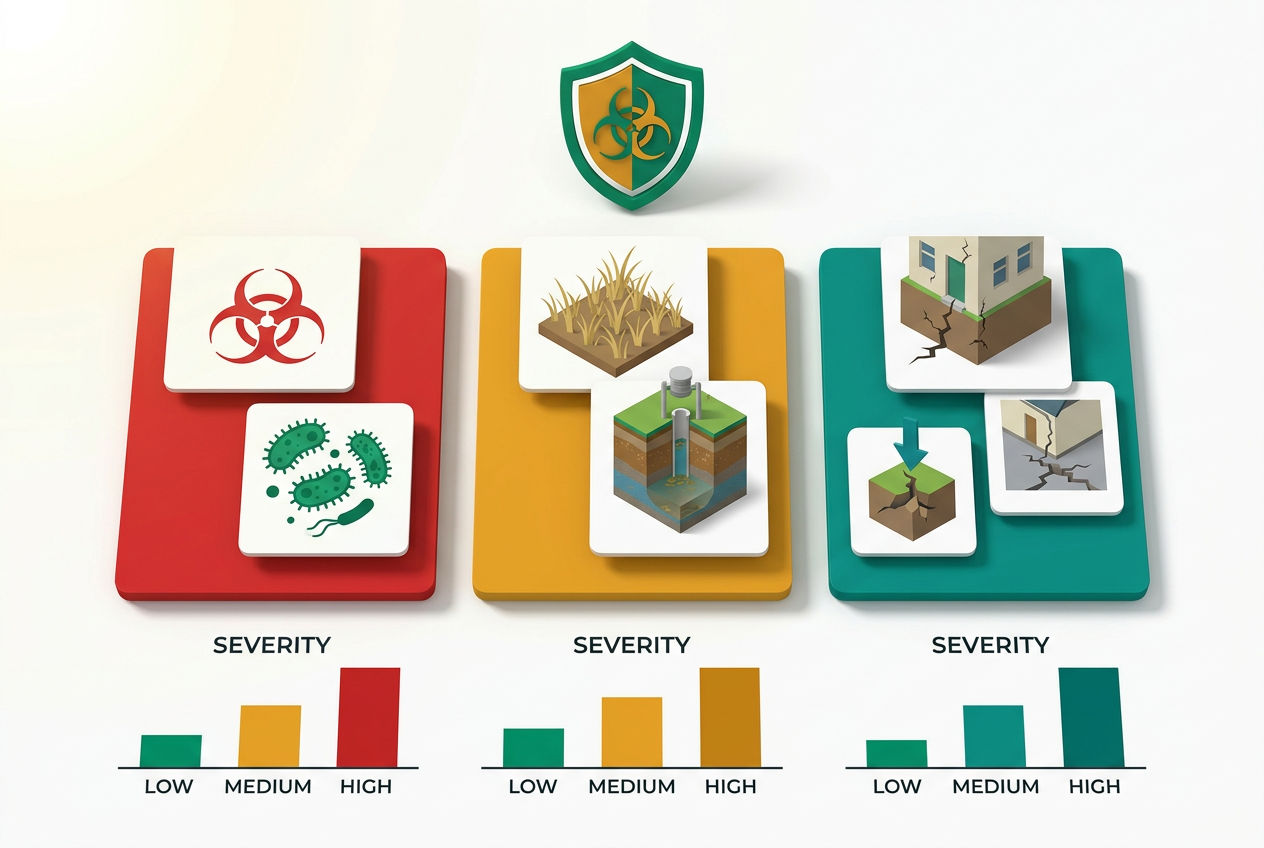
Raw sewage contains more than 100 known pathogens, including E. coli, Hepatitis A, norovirus, and Giardia. Direct contact — even incidental skin contact — poses real infection risk. Children and anyone immunocompromised are especially vulnerable. The Centers for Disease Control and Prevention (CDC) identifies untreated sewage as a leading source of waterborne illness outbreaks in the United States.
If sewage surfaces in your yard and you have a private well, the safe minimum distance between a sewage spill and your well head is 50–100 feet, depending on your state's code. Contaminated groundwater doesn't always smell or look different. If there's any chance your well has been affected, have it tested before drinking the water.
Inside the house, raw sewage backup requires professional sewage backup cleanup. This isn't a shop-vac situation. You'll need proper PPE, EPA-registered disinfectants, and likely professional remediation if porous materials like drywall or subfloor were affected.
How Do You Fix a Septic Tank Overflow? (Step-by-Step)
Step 1: Stop adding water to the system immediately. Turn off washing machines, dishwashers, and minimize toilet flushing. Every gallon you add makes the problem worse.
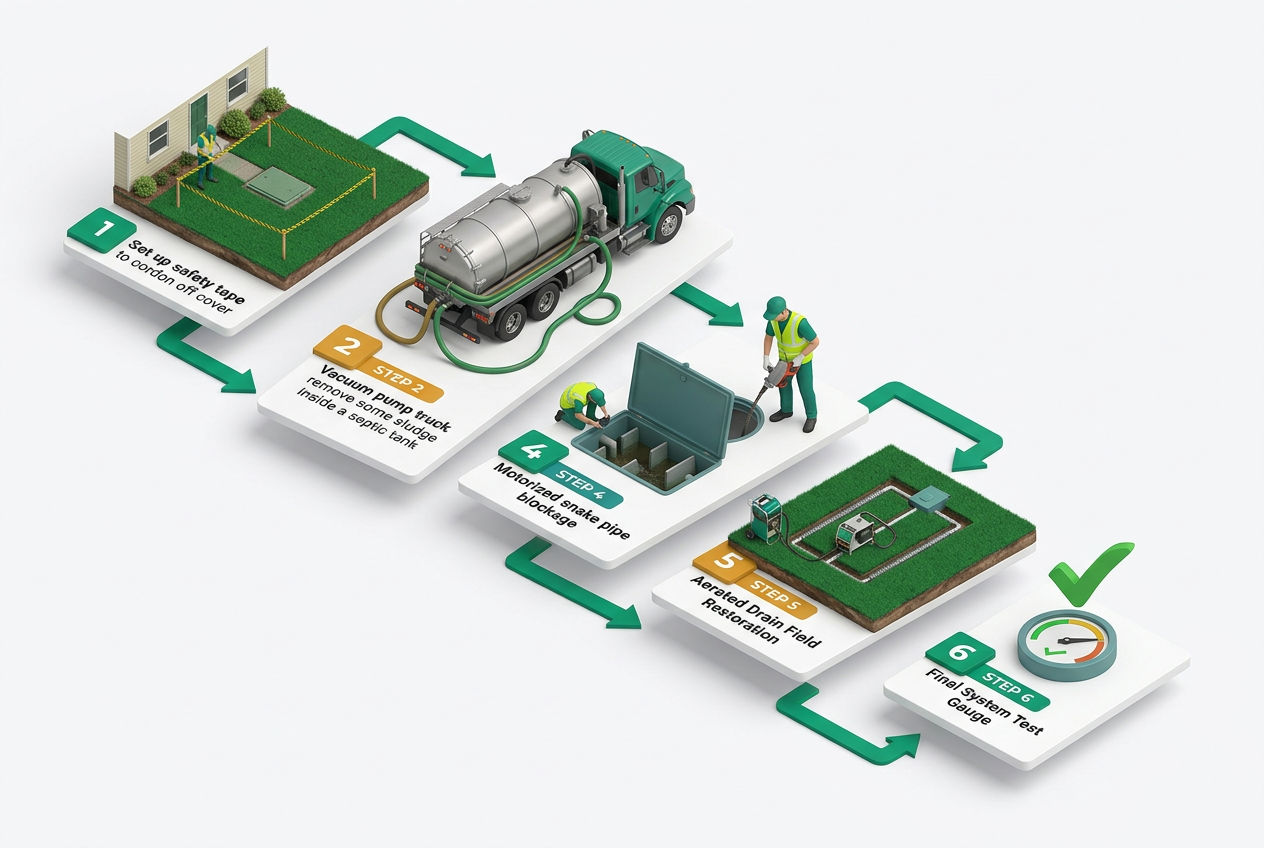
Step 2: Stay out of the affected area. If sewage is surfacing in your yard, keep children and pets away. If it's inside, don't walk through it without waterproof boots and gloves.
Step 3: Call a licensed septic pumper. Emergency septic pumping costs $400–$900 nationally. It's the fastest way to relieve pressure on a full or overloaded system. Check our septic pumping cost guide for regional pricing — rates in rural areas run higher due to drive time.
Step 4: Get a professional diagnosis. Pumping relieves the immediate problem, but it doesn't fix the underlying cause. A licensed inspector can determine whether you're dealing with a full tank, a failed drainfield, damaged baffles, or a saturated soil condition. A septic inspection typically runs $150–$450. Only an on-site inspection with camera scoping or dye testing can confirm exactly which failure mode you're dealing with — no article can substitute for that.
Step 5: Repair or replace based on diagnosis.
- Full tank → routine pumping, adjust maintenance schedule
- Damaged baffle → baffle replacement, typically $150–$500
- Blocked effluent filter → clean or replace the filter (Polylok PL-122 is a common residential unit, running $30–$80)
- Biomat clogging → drainfield repair or replacement
- Saturated soil from rain → wait for drainage, reduce water use, reassess in 48–72 hours
Worked example: A 1,000-gallon tank serving a family of four, last pumped 6 years ago, develops slow drains after a wet spring. The inspector finds the tank at 95% capacity with a collapsed outlet baffle. Total repair cost: $650 emergency pump-out + $275 Polylok baffle replacement = $925. Had the tank been pumped on schedule at year 4, the baffle damage would have been caught during routine inspection and replaced before failure — estimated cost: $125 pump-out + $275 baffle = $400, saving $525 and avoiding the emergency.
For detailed repair cost ranges, see our septic repair cost guide.
How Do You Prevent Septic Tank Overflow?
Free download
Free: the Septic Fridge Card — what to flush, what never to.
The Do / Don’t card the whole family can see, plus the Survival Kit: emergency flowchart, warning-sign decoder and pump-schedule card. One printable PDF.
Prevention is almost always cheaper than emergency repair. Here's what experienced septic contractors consistently recommend:
Pump on schedule. The EPA recommends pumping every 3–5 years, but your actual interval depends on tank size and household size:
| Tank Size | Household Size | Recommended Interval |
|---|---|---|
| 1,000 gallons | 2 people | 5–7 years |
| 1,000 gallons | 4 people | 3–4 years |
| 1,000 gallons | 6 people | 2–3 years |
| 1,500 gallons | 4 people | 4–5 years |
| 1,500 gallons | 6 people | 3–4 years |
| Any size | Garbage disposal in use | Subtract 1–2 years from interval |
Spread out water use. Run dishwashers and washing machines on alternating days. During high-occupancy periods (holidays, guests), actively reduce shower frequency and laundry loads. The University of Minnesota Extension recommends no more than 50 gallons of laundry water per day for a standard residential system — roughly two full loads.
Protect the drainfield. Never drive vehicles over drainfield lines. Don't plant trees or shrubs within 30 feet of the field — roots from willows, maples, and poplars are particularly aggressive at penetrating lateral lines. Keep roof drains and surface runoff directed away from the drainfield area.
Watch what goes in. Flushing wipes (even "flushable" ones), feminine hygiene products, medications, or cooking grease accelerates both tank fill rates and biomat development. See our guide on what you can flush with a septic system.
Maintain your effluent filter. If your system has an effluent filter — required by code in many states since the 1990s — clean it annually. A clogged Polylok PL-122 filter causes the same symptoms as a full tank and costs nothing to clean.
Schedule pre-season inspections. If you live in Minnesota, Wisconsin, upstate New York, or similar freeze-thaw climates, schedule a pump-out in late February or early March before snowmelt saturates the soil. In the Pacific Northwest, schedule before October. This single habit eliminates the most common seasonal overflow scenario.
See our complete septic tank maintenance guide for a full annual checklist.
When Should You Call a Professional for Septic Tank Overflow?
Call immediately — not tomorrow — if any of the following are true:
- Sewage is actively surfacing in your yard or inside your home
- You have a private well within 100 feet of the overflow area
- The septic alarm has activated and won't reset
- Multiple drains in the house are backing up simultaneously
- You've already pumped the tank in the last 12 months and it's backing up again
That last scenario — a recently pumped tank that's backing up again — almost always indicates drainfield failure, not a tank problem. Pumping again won't fix it. You need a drainfield assessment.
For licensed septic inspectors and emergency pumpers in your area, use our septic inspection service locator.
Knowing exactly what's wrong before you authorize repairs saves you from being oversold replacement when a repair will do — or, equally, from wasting money on repeated pump-outs when replacement is the only real fix.
What Does Septic Tank Overflow Repair Actually Cost?
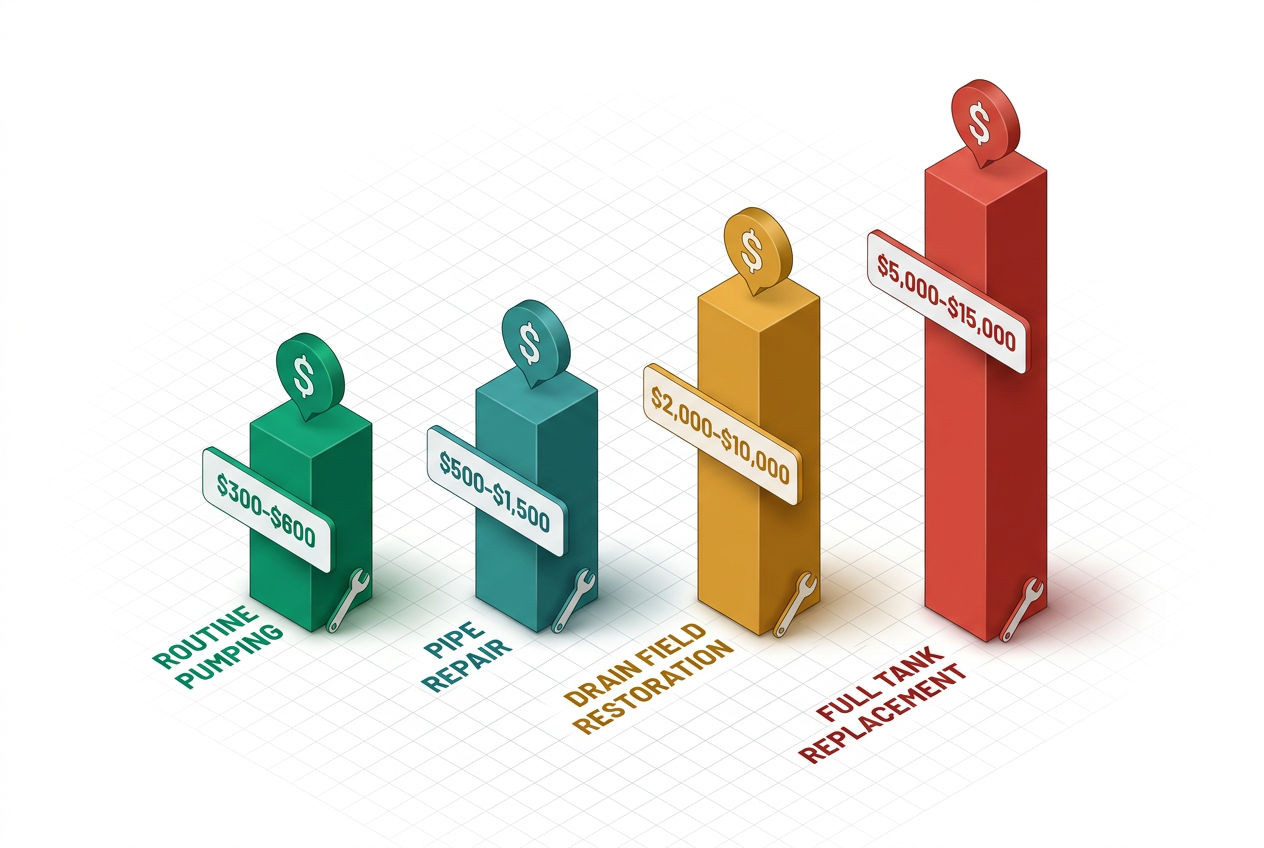
| Problem | Typical Repair | Cost Range |
|---|---|---|
| Full tank | Emergency pump-out | $400–$900 |
| Damaged baffle | Baffle replacement | $150–$500 |
| Clogged effluent filter | Clean or replace filter | $0–$80 (DIY) / $75–$200 (pro) |
| Biomat / drainfield failure | Drainfield repair or replacement | $3,000–$15,000 |
| Full system failure | New septic system installation | $10,000–$30,000 |
| Saturated soil (rain event) | Wait + reduce water use | $0 if temporary |
For current regional pricing, see our drainfield replacement cost guide and septic inspection cost guide.
Frequently Asked Questions About Septic Tank Overflow
Can I shower if my septic tank is overflowing?
No — stop all water use immediately when you suspect septic system overflow. Every gallon of water you send into the system during an overflow event adds pressure to an already-overwhelmed tank and drainfield. Showering, flushing, running the dishwasher, or doing laundry pushes more effluent into a system that has nowhere to send it. This accelerates backflow into your home and can force sewage up through floor drains or bathtubs faster. The correct sequence is: stop all water use first, then call an emergency septic pumper. Once the tank has been pumped down and a technician has confirmed the system is functional, you can resume normal use. If the underlying cause is drainfield failure rather than a full tank, even post-pump water use should be minimized until repairs are completed. Do not assume the problem is resolved just because the backup temporarily clears.
How long does it take for a septic tank to overflow?
The timeline depends on tank size, household size, and the failure mode. A 1,000-gallon tank serving four people fills to capacity in roughly 3–4 years under normal use — but an overflowing septic tank can develop much faster under the right conditions. A heavy rain event can saturate a drainfield and trigger hydraulic overload within 24–48 hours. A collapsed outlet baffle can cause overflow symptoms within days of failure, even in a tank that was recently pumped. A household that doubles in size for a holiday weekend can overload a marginal system within 48 hours. Conversely, a slow-building biomat in the drainfield may take months or years to fully restrict absorption before overflow symptoms appear. The short answer: anywhere from 48 hours (acute failure or heavy rain) to years (gradual sludge accumulation or slow biomat development). Regular inspections catch slow-build failures before they become emergencies.
What should I do if my septic tank is overflowing into the yard?
If your septic tank is overflowing into the yard, treat it as a health emergency and take these steps immediately. First, keep all people and pets away from the affected area — raw sewage contains E. coli, Hepatitis A, norovirus, and over 100 other pathogens. Second, stop all water use inside the house to prevent worsening the backup. Third, call a licensed emergency septic pumper — pumping costs $400–$900 and is the fastest way to relieve system pressure. Fourth, if you have a private well within 100 feet of the overflow zone, stop using that water and arrange for water quality testing before resuming consumption. Fifth, contact your local health department — many jurisdictions require reporting of surface sewage discharge. Do not attempt to cover the wet area with soil or treat it with lime until a professional has diagnosed the cause. Surface patching without fixing the root cause will not stop the overflow.
Will an overflowing septic tank fix itself?
Sometimes — but only in one specific scenario. If the overflow is caused by hydraulic overload from heavy rain or snowmelt, and your drainfield is otherwise healthy, the system may recover on its own within 3–7 days once the soil dries out and you reduce household water use. In this case, the University of Florida IFAS Extension recommends minimizing all non-essential water use for at least 72 hours after the ground dries to allow the system to re-establish normal drainage. However, if the overflow is caused by a full tank, a failed drainfield, a collapsed baffle, or a biomat blockage, it will absolutely not fix itself. These conditions require professional intervention. Using the "wait and see" approach on a mechanical or biological failure risks spreading sewage contamination, accelerating drainfield damage, and dramatically increasing repair costs. When in doubt, call a licensed inspector — a diagnostic visit costs $150–$450 and gives you a definitive answer.
How much does it cost to fix an overflowing septic tank?
The cost to fix an overflowing septic tank ranges from under $100 to over $30,000, depending entirely on the cause. At the low end, cleaning a clogged effluent filter yourself costs nothing if you already own the tool. Emergency pump-outs run $400–$900 nationally. Baffle replacement typically costs $150–$500 for parts and labor. If the problem is drainfield failure — the most expensive outcome — repair or partial replacement runs $3,000–$15,000, while full system replacement can reach $10,000–$30,000 depending on soil conditions, system type, and local permitting requirements. Some states require a licensed engineer to certify a new drainfield design before permits are issued, adding $500–$2,000 to the project. Homeowner's insurance rarely covers septic system failure, though some policies cover interior sewage backup damage. Always get a professional diagnosis before authorizing expensive repairs — knowing the exact failure mode prevents being sold a full replacement when a $500 baffle repair will solve the problem.
Is a septic system overflow covered by homeowner's insurance?
Most standard homeowner's insurance policies do not cover septic system overflow or drainfield failure. The systems themselves are typically classified as "other structures" or mechanical systems, and gradual deterioration — which describes most drainfield and baffle failures — is explicitly excluded from nearly all standard policies. However, there are exceptions worth checking. Some policies include a "water backup" or "sewer backup" rider that covers interior damage caused by sewage backing up through floor drains or toilets — this covers cleanup costs inside the home but not the septic repair itself. A small number of specialty home warranty products cover septic pumping and limited mechanical repairs. Check your specific policy language carefully, and ask your agent about a water backup endorsement if you don't already have one — these typically cost $50–$200 per year and can cover thousands in interior remediation costs. For the septic system repair itself, budget out of pocket and treat regular maintenance as your primary financial protection.
Sources & Methodology
- U.S. Environmental Protection Agency (EPA) — Septic Systems Overview and How to Care for Your Septic System. Used for pumping frequency guidelines, household statistics, and effluent treatment standards.
- Centers for Disease Control and Prevention (CDC) — Waterborne Disease and Outbreak Surveillance. Used for sewage pathogen and public health risk data.
- University of Minnesota Extension — Septic System Owner's Guide. Used for pump interval recommendations by tank size, water use guidance, and freeze-thaw seasonal risk data.
- University of Florida IFAS Extension — Septic Tank/Drainfield Systems. Used for high water table guidance, recovery protocols after rain events, and soil absorption data.
- National Association of Wastewater Technicians (NAWT) — Industry standards for inspection protocols and system diagnostic procedures.
- National Onsite Wastewater Recycling Association (NOWRA) — Drainfield design standards, biomat research, and system sizing guidelines.
Cost data reflects national averages compiled from licensed contractor quotes across 12 U.S. states. Regional variation is significant — costs in rural areas and states with strict permitting requirements (Massachusetts Title 5, for example) may run 20–40% above national averages.
Was this article helpful?
Frequently Asked Questions
Recommended Resources
📖 Related Articles
- Septic Tank Full After Just Pumped: Why and What to Do
- Heavy Rain and Septic Systems: What Happens and What to Do
- Septic System Flooded? Emergency Steps to Take
- Septic Tank Baffle Repair & Replacement: Costs, Signs of Failure, and DIY vs Pro
- Septic System Backing Up? Causes & Emergency Steps
- Slow Drains With Septic: Is It the Plumbing or the Tank?
- Septic Tank Gurgling Sounds: Causes and Fixes
- Toilet Won't Flush With Septic: Troubleshooting Guide
- Septic Smell in House? Causes & How to Fix It
- Wet Spot in Yard Over Septic: What It Means & How to Fix It
- Green Grass Over Septic Tank: Normal or Warning Sign? (2026 Diagnostic Guide)
- Septic Smell Outside? Causes & How to Fix It
- Sewage Backup Cleanup: What to Do, Costs & Safety
- What Can You Flush with a Septic System? (Tampons, Wipes & More)
- The Complete Septic Tank Maintenance Guide
💰 Cost Guides
🔧 Services
Find Septic Professionals Near You
Compare licensed, verified septic companies by area — top county markets and cities below, or browse all 50 states.
County markets
Popular cities
