
Quick Answer
An IBC tote septic tank cannot legally or structurally replace a permitted septic system in any U.S. state. Standard 275–330 gallon totes fall far short of the 1,000-gallon minimum required by most state codes, are not engineered for below-grade soil pressure, and will be rejected by every county health department that inspects them. The result is a system that fails within 2–10 years, exposes you to fines up to $20,000, and can contaminate your drinking water.
An IBC tote septic tank sounds like a genius workaround — a $200 used container from a farm supply auction, buried in the backyard, plumbed in over a weekend. Skip the contractor. Skip the permit. Save $8,000. Here's the reality: it almost never works, and the consequences of getting it wrong range from a five-figure fine to a contaminated well to a collapsed tank under your driveway. This article breaks down exactly why — with real numbers — and points you toward legitimate alternatives that can actually save you money.
Key Takeaways
- Standard IBC totes hold 275 or 330 gallons — most state codes require a minimum 1,000-gallon tank, meaning you'd need 3–4 totes just to meet volume requirements.
- IBC totes are engineered for above-ground liquid storage, not underground burial. Soil pressure at 3-foot depth can exceed 300–500 lbs per square foot — beyond their design tolerance.
- All 50 states require permits for septic installation. Unpermitted systems carry fines from $500 to $20,000+.
- Underground lifespan of an IBC tote is estimated at 2–10 years versus 20–40 years for a manufactured septic tank.
- Legitimate budget alternatives — including plastic polyethylene tanks, chamber systems, and USDA Rural Development loan programs — exist and are worth exploring.
Can You Use an IBC Tote as a Septic Tank?
Technically, you can bury one. Practically and legally, you shouldn't.
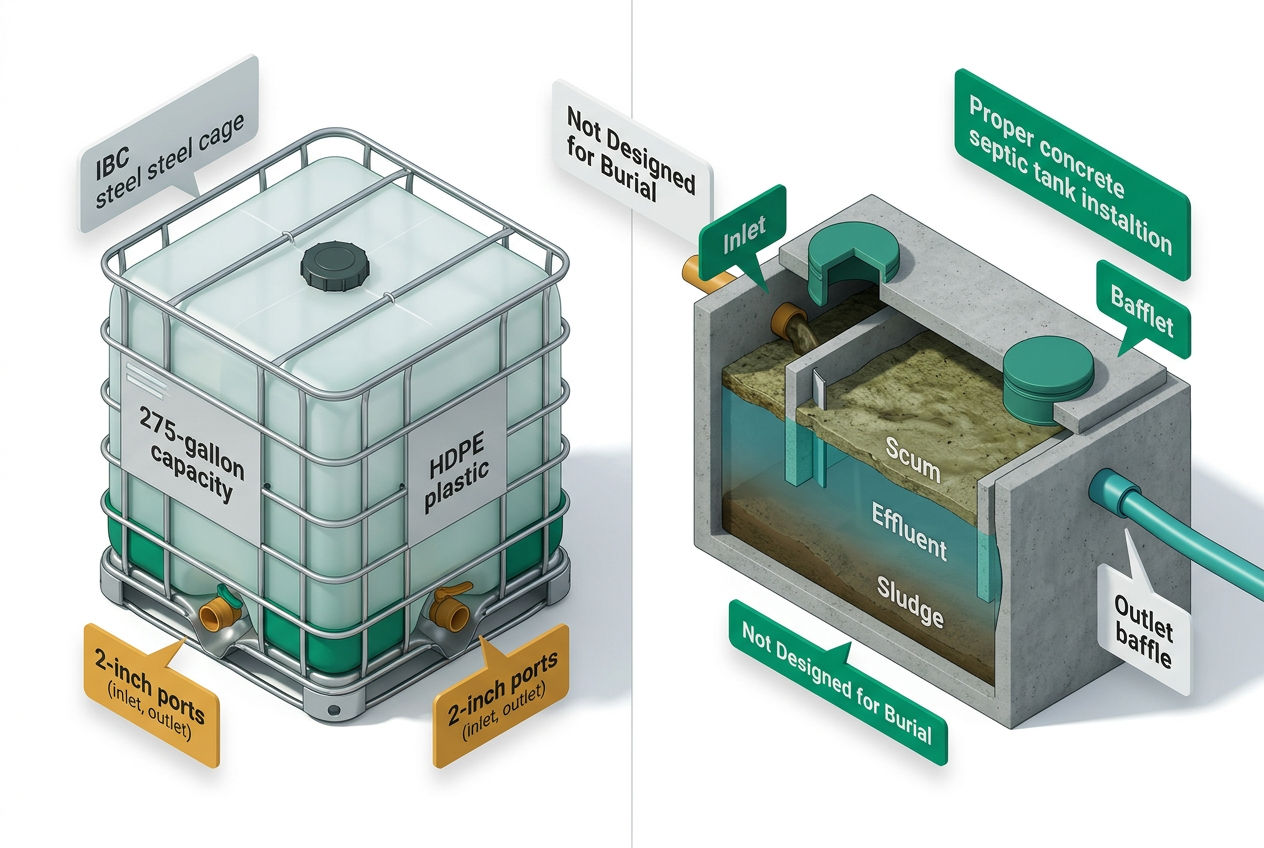
An IBC tote septic tank fails on three separate fronts: capacity, structural integrity, and code compliance. A standard 275-gallon or 330-gallon intermediate bulk container simply wasn't designed to hold sewage underground, and no amount of DIY ingenuity changes the physics or the permit requirements.
According to the EPA, a septic system is a subsurface wastewater treatment structure requiring proper sizing, soil evaluation, and installation to protect public health and groundwater. An IBC tote checks none of those boxes as a permanent solution.
That said, there's a narrow legitimate use case we'll cover — but it's narrower than most people hope.
Is It Legal to Build Your Own Septic Tank?
Every single U.S. state has septic permitting requirements. Not most states — all of them.
What varies is enforcement. Rural counties in parts of Appalachia or the Great Plains may have historically looked the other way, but that's changing fast as groundwater contamination cases pile up and state health departments increase oversight.
To install any septic system, you generally need:
- A percolation test (perc test) to confirm your soil can absorb effluent
- A site plan approved by your county health department
- A permit before any excavation begins
- An inspection before backfilling the tank
Building without a permit isn't just a fine risk. It's a property title problem. Picture this: you're selling your home three years later, and the buyer's inspector pulls the permit history. An unpermitted septic system — especially a homemade one — can kill a sale outright or force you to retrofit a compliant system at full cost before closing.
Fines for unpermitted installation range from $500 in rural counties to $20,000+ in states like New York, Oregon, and Massachusetts, where enforcement is aggressive. Massachusetts Title 5 regulations (310 CMR 15.000) explicitly govern tank materials, capacity minimums, and installation standards. An IBC container septic tank doesn't come close to qualifying under that framework — or any comparable state code.
For a full breakdown of what permits actually involve, see our guide to septic system permit requirements.
How Many IBC Totes Would You Actually Need?
Most state health codes require a minimum 1,000-gallon septic tank for a standard 2–3 bedroom home. Some states set the floor at 1,250 gallons for a 3-bedroom.
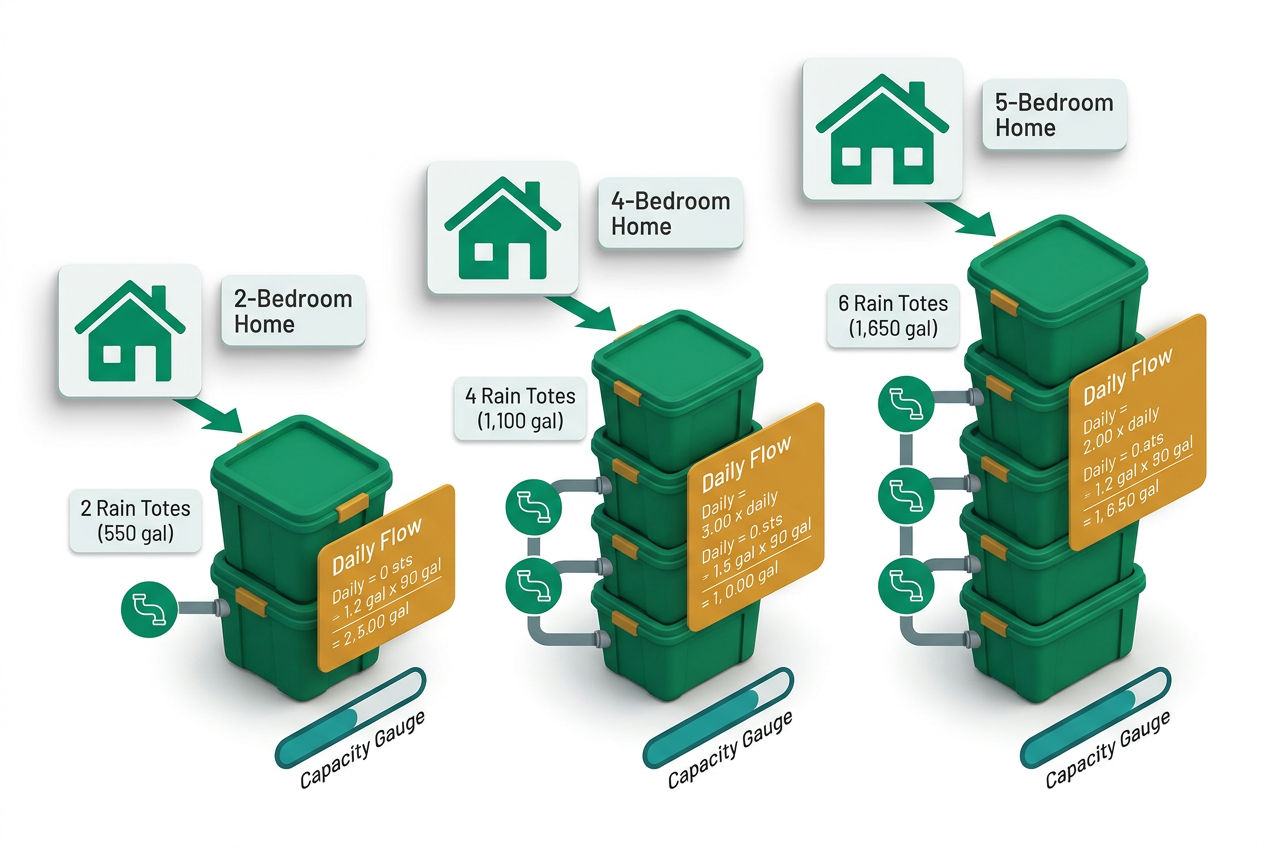
The most common IBC tote sizes are 275 gallons and 330 gallons. Run the numbers:
- At 275 gallons: you need 4 totes to reach 1,100 gallons minimum
- At 330 gallons: you need 4 totes to reach 1,320 gallons
Here's a worked example. Take a family of four in a 3-bedroom home in Tennessee, where the state minimum is 1,000 gallons. According to the National Association of Wastewater Technicians (NAWT), average household wastewater generation runs 50–100 gallons per person per day. That family generates 200–400 gallons daily. To achieve the 24–48 hours of retention time that anaerobic bacteria need to break down solids before effluent exits to the drain field, the tank must hold a minimum of 400–800 gallons of daily flow plus accumulated sludge — hence why 1,000 gallons is the regulatory floor, not a suggestion.
To reach that with a DIY IBC tote septic system, you'd need at minimum four 275-gallon totes linked in series. Each connection point requires a sealed inlet baffle, an outlet baffle, and an effluent filter. The excavation alone for four linked containers — roughly 12 feet by 4 feet each — runs $800–$1,500. Add plumbing fittings, sealant, and labor and you're at $1,500–$3,000 before the totes even go in the ground. The "savings" shrink fast.
A real septic tank isn't just a container — it has inlet and outlet baffles, a scum layer zone, a liquid effluent zone, and a sludge zone at the bottom. Linking four IBC totes together to create that kind of functional system with proper baffle walls, sealed connections, and effluent filtration is not a weekend project. The engineering compounds quickly.
For help thinking through proper sizing, our septic tank size chart walks through capacity calculations by household size and bedroom count.
What Are the Structural Dangers of a Homemade IBC Tote Septic Tank?
This is the section most DIY articles skip.
IBC totes are engineered for surface storage and transport of liquids — not below-grade burial. The difference matters enormously. When you bury a tank at even 3 feet of depth, the surrounding soil exerts 300–500 lbs of pressure per square foot on the tank walls and lid. Purpose-built polyethylene septic tanks — like those manufactured by Infiltrator Water Technologies — are rotationally molded from high-density polyethylene specifically rated for that below-grade load. Their wall thickness and rib geometry are engineered for it.
An IBC tote's thin-wall HDPE container (inside the steel cage) was not designed for this. The steel cage adds some rigidity, but it will corrode underground. Once the cage rusts through — which starts within 2–5 years in moist soil — the plastic container has no structural support. Tank collapse becomes a real possibility. A collapsed tank means sewage backing up into your home or surfacing in your yard.
Expected underground lifespan of an IBC tote: 2–10 years, depending on soil moisture, chemical exposure from prior contents, and whether the steel cage corrodes. A manufactured concrete septic tank lasts 40+ years. A purpose-built polyethylene tank lasts 20–30 years. The long-term math doesn't favor the tote.
There's another regional hazard worth addressing directly. In Florida and the Gulf Coast, the water table in many areas sits just 12–24 inches below grade. A lightweight IBC tote — even when full of liquid — can experience buoyancy forces that literally push it upward out of the ground. This is called flotation, and it's why manufactured concrete tanks are preferred in high-water-table areas: their weight keeps them in place. Our guide to high water table septic systems covers this in more detail.
In northern climates — think Minnesota, Montana, or upstate New York — thin plastic walls offer almost no insulation against frost. A concrete tank buried below the frost line (42–60 inches in Minnesota) stays functional through winter. An IBC tote buried shallow enough for DIY installation is vulnerable to freeze-related cracking and frost heave.
One honest limitation worth stating: if you've already buried an IBC tote and it's been in the ground less than two years with no visible problems, the short-term risk may feel theoretical. It isn't — but the failure mode is gradual until it's suddenly catastrophic. Cage corrosion isn't visible from the surface, and by the time effluent surfaces in your yard, you're already facing remediation costs that dwarf what a compliant tank would have cost upfront.
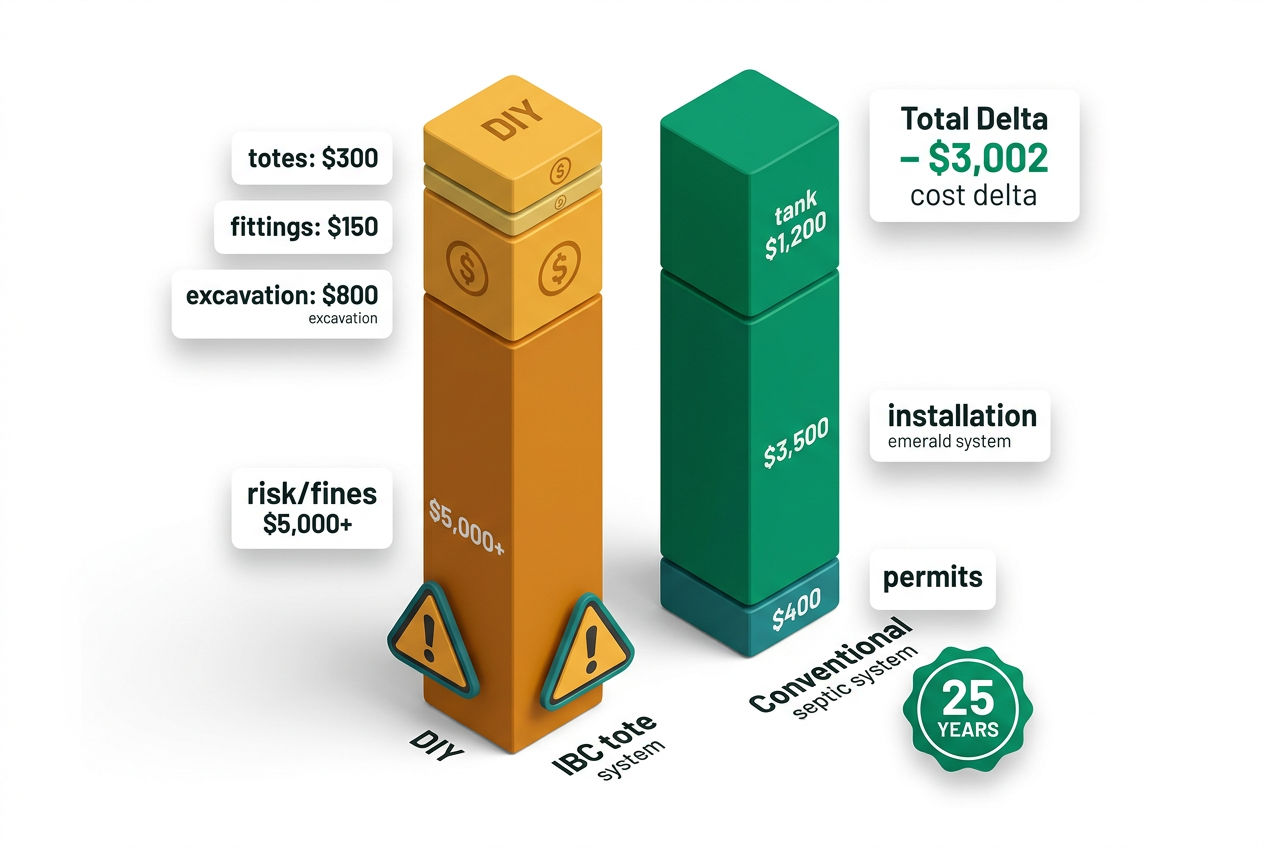
IBC Tote vs. Conventional Septic Tank: Real Cost Comparison
| IBC Tote (DIY) | Plastic Poly Tank | Concrete Tank | |
|---|---|---|---|
| Purchase Cost | $100–$400 (used) | $500–$2,000 | $700–$2,000 |
| Full Install Cost | $500–$2,000+ | $3,000–$7,000 | $4,000–$10,000 |
| Permit Approval | Almost never | Yes | Yes |
| Expected Lifespan | 2–10 years | 20–30 years | 30–40+ years |
| Code Compliant | No | Yes | Yes |
| Flotation Risk | High | Low–Medium | Very Low |
Sources: EPA Septic Systems Program; Infiltrator Water Technologies product specifications; National Association of Wastewater Technicians (NAWT) cost survey data
The upfront savings on the tote itself disappear when you account for replacement every few years, fine exposure, and potential groundwater contamination liability. A $300 tote that lasts 5 years and earns a $5,000 fine costs more than a $1,500 polyethylene tank that lasts 25 years with a valid permit.
Compare this to legitimate budget options in our cheapest septic system guide.
Is There Any Legitimate Use Case for an IBC Tote in a Wastewater System?
DIY Septic Blueprint
Thinking about building it yourself?
The complete, plain-English plan to size, permit and install your own septic system — designed for homeowners, not contractors. Skip the $15,000–$25,000 quotes and do it right the first time.
Get the DIY Blueprint — $67 →Instant download · 8 modules + 3 bonus guides · 60-day money-back guaranteeYes — but it's specific.
In some jurisdictions, an IBC tote may be acceptable as a temporary holding tank for construction site use or for an off-grid greywater-only system in states that permit separate greywater recycling. A holding tank is not a septic system — it simply collects waste and must be pumped regularly rather than discharging to a leach field.
If you're building an off-grid homestead and want to manage greywater only (sink, shower, laundry — not toilet waste), some western states including Montana, Idaho, and New Mexico have specific provisions that may allow simpler containment or surface disposal under certain conditions. But you still need to check with your county health department before assuming any of this applies to your property.
This limited use case is worth investigating. But it's a far cry from a full septic replacement. For real off-grid wastewater solutions, our off-grid septic system guide covers composting toilets, aerobic treatment units, and engineered alternatives that can actually get permitted.
What Are the Real Alternatives If You Can't Afford a Standard Septic System?
Septic installation costs are genuinely steep — full system installation typically runs $3,000–$15,000 depending on soil conditions, system type, and local labor rates, according to NAWT survey data. That's a real barrier. But there are legitimate ways to reduce that number.
1. Plastic polyethylene tanks A rotationally molded poly tank from a manufacturer like Infiltrator Water Technologies or Norwesco runs $500–$2,000 and is engineered for below-grade installation. It's code-compliant, permit-eligible, and lasts 20–30 years. This is the closest legitimate alternative to what people are trying to accomplish with a DIY IBC tote septic system.
2. Chamber leach field systems Infiltrator chamber systems replace traditional gravel drain fields with plastic chambers, reducing excavation and material costs significantly. According to Infiltrator's published specifications, chamber systems can reduce drain field footprint by up to 50% compared to gravel systems — which directly reduces installation cost.
3. Owner-assisted installation Some counties allow homeowners to perform portions of the installation themselves — particularly excavation — while a licensed contractor handles the tank placement and inspection sign-off. This hybrid approach can cut $1,000–$3,000 from labor costs legally. Our DIY septic system guide explains where this is permitted and what it actually involves.
4. USDA Rural Development loans and grants The USDA Section 504 Home Repair program (rd.usda.gov) provides loans and grants specifically for rural homeowners who need to repair or replace failing sanitation systems. Grants up to $10,000 are available for qualifying low-income homeowners over age 62. This program is underutilized and genuinely worth a phone call to your local USDA Rural Development office.
5. Aerobic treatment units (ATUs) In areas with poor soil percolation, an ATU combined with a smaller drain field can be less expensive than a conventional system requiring extensive drain field engineering. They require more maintenance but are fully permitted solutions.
See our full septic installation cost guide for a complete breakdown by system type and region.
What Happens If Your Homemade Septic System Fails?
According to late-1990s EPA literature, 10–20% of U.S. septic systems are failing at any given time — and those are mostly permitted, manufactured systems. A homemade IBC tote septic tank pushes that failure probability dramatically higher.
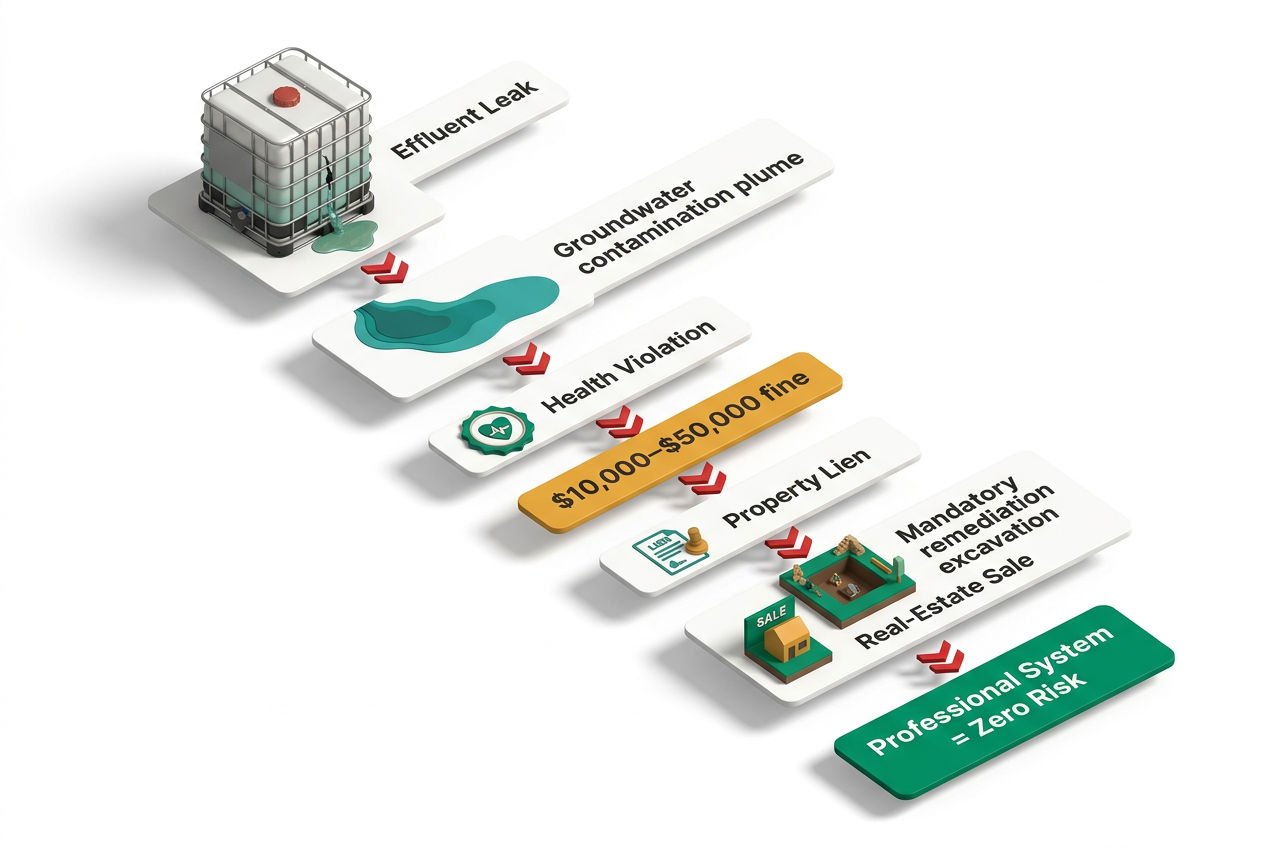
When an unpermitted homemade system fails, the consequences stack:
- Health department enforcement action: Most states require remediation within 30–90 days of a documented failure. You pay for the compliant replacement system plus the fine.
- Groundwater contamination liability: If your failing system contaminates a neighbor's well, you face civil liability under state environmental tort law. Remediation costs for a contaminated well can run $10,000–$50,000+.
- Property title issues: An unpermitted system discovered during a title search or home inspection triggers mandatory disclosure requirements in most states. In some states — including California and Massachusetts — you cannot legally transfer title with a known failing septic system without remediation.
- Mortgage and insurance complications: Lenders increasingly require septic certification at closing. An unpermitted system can cause a mortgage denial or require expensive escrow holdbacks.
Our guide to illegal septic system consequences covers what enforcement typically looks like and what remediation actually costs.
If you're in a situation where a previous owner installed something questionable, talk to a licensed professional before assuming the worst. Our septic installation service directory can connect you with licensed contractors in your area who handle both new installations and remediation of problem systems.
For a comprehensive look at plastic tank options that are code-compliant, see our plastic septic tank guide.
Frequently Asked Questions
Can I use a 275-gallon IBC tote as a septic tank for a tiny house or cabin?
A 275-gallon IBC tote cannot legally serve as a septic tank for any residential structure in any U.S. state, including tiny houses and seasonal cabins. The minimum tank capacity required by most state health codes is 1,000 gallons for a 1–2 bedroom dwelling — meaning a single 275-gallon IBC tote meets only 27.5% of the minimum volume requirement. Even for a composting toilet setup where only greywater enters the tank, most jurisdictions still require a properly permitted greywater system rather than a buried IBC container. The structural problem compounds the legal one: a 275-gallon tote buried under even 2 feet of soil experiences lateral pressure its thin-wall HDPE was never rated for. For a tiny house or cabin on a budget, a 500–1,000 gallon rotationally molded polyethylene holding tank combined with a county-permitted pump-out schedule is the closest legitimate alternative that won't result in enforcement action or tank failure within a few years. Check your county health department for minimum capacity rules — they vary by state and bedroom count.
How long does an IBC tote last underground?
An IBC tote buried underground has an estimated lifespan of 2–10 years, compared to 20–30 years for a purpose-built polyethylene septic tank and 40+ years for a concrete tank. The failure timeline depends on three factors: soil moisture content, chemical residue from the tote's previous contents, and the corrosion rate of the steel cage. In consistently moist soil — which describes most areas where a septic tank would be buried — the galvanized steel outer cage begins oxidizing within 2–5 years. Once the cage loses structural integrity, the thin-wall HDPE inner container is left unsupported against soil pressure that can exceed 300–500 lbs per square foot at a 3-foot burial depth. The container then deforms or collapses, causing sewage backup into the home or surfacing in the yard. Prior chemical contents accelerate HDPE degradation — a tote that previously held agricultural chemicals or industrial solvents may degrade faster than one used for food-grade liquids. There is no field-reliable way to inspect cage corrosion without excavating, which means the failure typically appears suddenly rather than with warning.
What is the difference between an IBC tote holding tank and a septic tank?
An IBC tote used as a holding tank and a septic tank serve fundamentally different functions, and conflating them is a common and costly mistake. A holding tank simply collects wastewater and must be pumped out regularly — it performs no treatment. A septic tank is a treatment vessel: anaerobic bacteria break down solids over a 24–48 hour retention period, separating scum, effluent, and sludge before treated liquid exits to a drain field. An IBC tote might be acceptable in some jurisdictions as a temporary holding tank for construction sites or greywater-only systems — but only if it meets local capacity minimums and is permitted as a holding tank, not a septic system. Using it as a holding tank still requires regular pump-outs, typically every 1–3 months for a full household, adding $150–$400 per service call to your ongoing costs. As a permanent wastewater solution, a holding tank of any kind — IBC tote or otherwise — is more expensive over time than a properly installed septic system with a drain field.
Does a homemade IBC tote septic system affect my homeowner's insurance?
Yes, a homemade IBC tote septic system can void coverage or create significant gaps in your homeowner's insurance policy. Most homeowner's policies exclude damage caused by unpermitted structures or systems. If a DIY IBC tote septic system fails and sewage backs up into your home, causing water damage to floors, walls, and substructure, your insurer may deny the claim on the grounds that the system was unpermitted and non-code-compliant. The exclusion language varies by policy, but phrases like "failure to comply with local ordinances" or "pre-existing conditions caused by unpermitted work" are common grounds for denial. Beyond coverage gaps, if your system contaminates a neighbor's well or property, your liability coverage may not apply to damages arising from a known code violation you installed intentionally. Before assuming your policy covers you, call your insurer and ask directly whether unpermitted sanitation systems affect your coverage. The answer will likely prompt you to reconsider the IBC tote approach entirely.
Are there IBC tote septic system designs that are code-compliant?
No DIY IBC tote septic system design is code-compliant as a permanent residential septic system in any U.S. jurisdiction. This isn't a gap in the regulations that a clever design can bridge — it's a deliberate policy outcome. Septic tank materials, wall thickness, structural ratings, baffle configurations, and inlet/outlet specifications are defined in state and county health codes with specific reference to manufactured products that have been tested and certified for below-grade installation. An IBC container, regardless of how it's configured or reinforced, has not been certified for this use. Some homeowners attempt to reinforce totes with concrete encasements or additional bracing, but this doesn't achieve permit approval — it just adds cost to a non-compliant system. The one partial exception: in states with specific greywater reuse provisions (Montana, New Mexico, and parts of Idaho), a permitted greywater recycling system using a contained vessel may be possible, but this applies only to non-blackwater (no toilet waste) streams and requires explicit county approval. If code compliance is your goal, a rotationally molded polyethylene tank rated for below-grade use is the budget-friendly starting point.
Sources & Methodology
- U.S. Environmental Protection Agency (EPA) — Septic Systems Program: epa.gov/septic. Referenced for septic system definition, failure rate statistics, and groundwater protection standards.
- Massachusetts Title 5 Regulations (310 CMR 15.000): Official regulation governing septic system installation in Massachusetts, including tank material and capacity requirements.
- National Association of Wastewater Technicians (NAWT): nawt.org. Referenced for cost survey data and household wastewater generation figures.
- Infiltrator Water Technologies: infiltratorwater.com. Referenced for polyethylene tank specifications, below-grade load ratings, and chamber leach field system data.
- USDA Rural Development Section 504 Home Repair Program: rd.usda.gov. Referenced for loan and grant program details for rural homeowners.
Cost figures reflect national ranges as of 2025 and will vary by region, soil conditions, and local labor markets. Regulatory requirements cited reflect general state-level patterns; always verify current requirements with your county health department before any installation.
Free download
Not ready for the Blueprint? Start free.
Grab the free DIY Septic Planning Kit — the permit-first checklist, perc-test cheat sheet, and sizing tables that keep your build from getting red-tagged.
Was this article helpful?
Frequently Asked Questions
Recommended Resources
📖 Related Articles
- Septic System Permit Cost & State Requirements (2026 Guide)
- Septic Tank Sizes & Dimensions Chart (by Bedrooms)
- High Water Table and Septic Systems: What You Need to Know
- What Is the Cheapest Septic System? (Ranked by Total Cost)
- Off-Grid Septic Systems: Legal Options That Actually Work
- DIY Septic System: How to Build Your Own (Step-by-Step)
- Bought a House With an Illegal Septic System? Your Options
- Plastic Septic Tanks: Sizes, Prices, Pros & Cons
🔧 Services
Find Septic Professionals Near You
Compare licensed, verified septic companies by area — top county markets and cities below, or browse all 50 states.
County markets
Popular cities
