
How much does drain field replacement cost in 2026? Get real cost ranges, line-item breakdowns, system comparisons, and regional pricing. Plan your budget now.
Quick Answer
Drain field replacement cost ranges from $5,000 to $20,000 for a conventional system in 2026, with a national average of $10,000–$12,000. Alternative systems — mound, drip irrigation, and aerobic treatment units — push costs to $15,000–$30,000+. Soil conditions, lot size, local regulations, and system type are the biggest variables.
📊 Key Takeaways
- Most homeowners pay $8,000–$15,000 for a conventional drain field replacement
- Mound systems cost $15,000–$30,000+ due to engineered fill requirements
- Soil conditions and local permit requirements are the two biggest cost drivers
- Septic installation costs have risen 15–25% since 2020 due to labor and material inflation
- Fall is typically the best time to schedule a non-emergency replacement — shorter wait times, better contractor availability
Your drain field — also called a leach field — is the underground network of perforated pipes or chambers that receives partially treated wastewater from your septic tank. Effluent flows from the tank through a distribution box, then spreads across 100–300+ linear feet of trenches, where soil microbes break down remaining contaminants.
Most drain fields last 15–30 years with proper maintenance, according to the EPA. But several things accelerate failure:
💡 Pro Tip: Not sure if your field has actually failed? Check out our guide to signs your drain field is failing before you commit to a full replacement quote.
A conventional drain field replacement costs $5,000–$20,000 in 2026, with most projects landing between $8,000 and $15,000. The national average sits around $10,000–$12,000. That range is wide because three-bedroom homes in sandy Florida soil and three-bedroom homes in rocky Massachusetts terrain are fundamentally different projects.
Here's a realistic scenario: a 3-bedroom home in the Midwest with decent percolation, moderate labor rates, and straightforward access typically runs $9,000–$12,000 all-in. That same scope in a New England county with Title 5 regulations, rocky ledge, and a 6-month construction season? You're looking at $15,000–$22,000.
⚠️ Warning: Septic installation costs have risen 15–25% since 2020 due to labor shortages and material cost increases. A project that cost $9,000 in 2021 is closer to $11,000–$12,000 today. Budget accordingly.
Most contractors quote a lump-sum number, but that number is really 7–9 separate cost centers bundled together. Breaking them apart helps you evaluate quotes intelligently and spot what's been left out.
| Line Item | Typical Cost Range |
|---|---|
| Perc test / soil evaluation | $250 – $1,000 |
| System design / engineering | $500 – $2,500 |
| Permits & inspections | $200 – $1,500 |
| Excavation & soil removal | $1,500 – $5,000 |
| Pipe, gravel, or chamber materials | $1,500 – $4,000 |
| Distribution box replacement | $150 – $500 |
| Labor (installation) | $2,000 – $6,000 |
| Landscaping restoration | $500 – $3,000 |
| Old field removal / abandonment | $500 – $2,000 |
Source: National installer pricing data compiled from NOWRA member contractors and regional health department permit records, 2025–2026.
Perc test / soil evaluation: Before any new drain field gets designed, your county health department or a licensed engineer must run a percolation test to measure how quickly your soil absorbs water. In North Carolina, state code requires a licensed soil scientist or engineer for this step, adding $1,000–$2,500 to the project before a single trench gets dug.
Distribution box replacement: Most contractors replace the D-box while the system is already open. At $150–$500, skipping this and having it fail two years later is a false economy. Ask your contractor whether D-box replacement is included. Learn more about how these components work in our septic distribution box guide.
Landscaping restoration: Excavation for a 900 sq ft drain field tears up your yard. Grading, topsoil, seeding, and sod replacement add $500–$3,000 to the total. Some quotes don't include this. Ask specifically.
For trench-style conventional systems, drain field replacement runs $25–$60 per linear foot of installed trench. The wide range comes down to soil conditions, trench depth, and local labor rates.
A 3-bedroom home typically needs 100–300 linear feet of drain field, depending on your state's design flow requirements (most states use approximately 120 gallons per day per bedroom as a baseline). At $40/ft average, a 200-linear-foot system runs about $8,000 in materials and labor — before permits, perc testing, or site restoration.
⚠️ Warning: Rocky or clay-heavy soils drive up excavation time dramatically. When a trenching machine hits ledge rock, hand excavation can push the per-foot cost past $80–$100 in extreme cases.
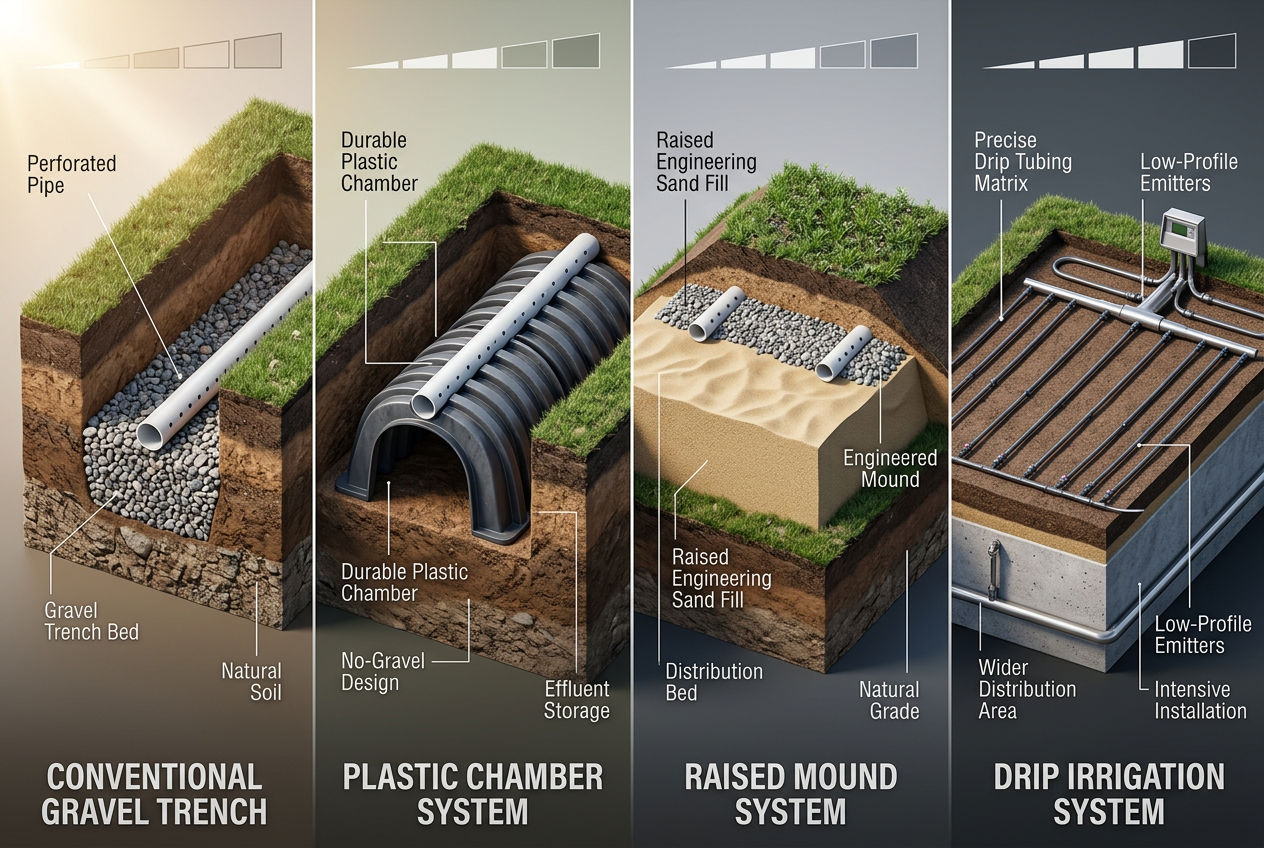
Not every property can support a conventional gravel-and-pipe system. High water tables, poor soil percolation, and small lot sizes push homeowners toward engineered alternatives — all of which cost more.
| System Type | Cost Range | Best For |
|---|---|---|
| Conventional gravel & pipe | $5,000 – $15,000 | Good soil, adequate space |
| Chamber system (e.g., Infiltrator IM-540) | $7,000 – $18,000 | Moderate soil, faster install |
| Mound system | $15,000 – $30,000+ | High water table, poor perc |
| Drip distribution / ATU | $15,000 – $25,000+ | Tight lots, sloped terrain |
| Sand filter system | $10,000 – $20,000 | Poor soil, environmentally sensitive areas |
Source: NOWRA installer network pricing benchmarks, 2025–2026; EPA Septic Systems guidance.
Chamber systems (Infiltrator Water Technologies makes the industry-standard IM-540 and Arc 36 chambers) have largely replaced gravel-and-pipe in many markets. They install faster, don't require aggregate delivery, and their open-bottom design provides solid long-term performance in moderate soils.
Mound systems require importing engineered fill material — typically clean sand — to elevate the drain field above the natural water table or limiting soil layer. The cost of trucking in 20–40 cubic yards of approved sand, plus a more complex distribution network, is what drives costs to $15,000–$30,000+. See our full breakdown of mound septic systems for more detail.
Aerobic treatment units (ATUs) combined with drip irrigation represent the high end of the market. Systems using components from manufacturers like Orenco Systems include a multi-stage treatment tank, an aerator compressor (similar in function to a Hiblow HP-80), and a pressurized drip network. They produce significantly cleaner effluent but require quarterly maintenance contracts. For the full cost picture, read our aerobic septic system cost guide.
Soil conditions are the single biggest variable. Sandy, well-draining soils pass perc tests easily and support conventional systems. Dense clay or soil with a seasonal high water table above 24 inches typically requires an engineered alternative — immediately doubling your project cost. Learn how soil type affects drain field depth and design.
System size scales with bedroom count and state-mandated daily flow rates:
More square footage means more trench, more pipe or chambers, and more excavation.
A backhoe needs roughly 10 feet of clearance. Fences, retaining walls, large trees, or a drain field tucked behind an addition add hours of hand work — and hours translate directly into dollars.
Permit requirements vary dramatically by county and state. In Massachusetts, Title 5 regulations require a licensed septic engineer to design the system, submit stamped drawings, and oversee installation — adding $2,000–$4,000 in professional fees before a shovel hits the ground. In rural Texas counties with minimal oversight, that same administrative layer might cost $300–$500 total.
Old field abandonment is often required by local health codes. Proper decommissioning — crushing or filling old chambers, cutting pipes, documenting closure with the county — typically runs $500–$2,000 and is rarely included in base quotes unless you ask.
Geography moves the needle more than most homeowners realize:
Northeast (New England, Mid-Atlantic): Budget 15–30% above the national average. Rocky glacial soils, strict state regulations (Massachusetts Title 5, Connecticut PA 490), high labor costs, and a compressed construction season all push costs up. A conventional system that costs $10,000 in Ohio often runs $14,000–$18,000 in Connecticut.
Southeast: Near or slightly below the national average in most markets. Sandy coastal soils excavate easily. But high water tables throughout Florida and coastal Georgia mean mound systems are far more common than conventional ones — and mound system costs push totals to $15,000–$25,000 even in low-labor-cost markets. Florida requires all septic contractors to hold a Registered Septic Tank Contractor (RSTC) license through the Department of Health.
Midwest: Tracks close to the national average. Clay-heavy soils in Illinois, Indiana, and Ohio slow excavation and can require alternative system designs. Hard winters mean a shorter installation season — roughly April through November in Minnesota.
Southwest / Mountain West: Add 10–30% for hard, rocky terrain, high-altitude complications, and remote-area travel surcharges. Water scarcity regulations in Arizona and New Mexico increasingly mandate low-flow alternative systems that cost more upfront.
Pacific Northwest: Washington and Oregon add 10–25% above average. High rainfall, elevated seasonal water tables, and strict environmental protections near Puget Sound and coastal watersheds frequently require advanced treatment systems. Washington State delegates permitting to county environmental health departments, and requirements vary significantly from King County to rural Ferry County.
This is the question you actually need answered before calling contractors.
💡 Pro Tip: Our how to fix a saturated drain field guide covers several repair approaches, including rest-and-rotate systems and aerobic bioremediation.
✅ Key Takeaway: A licensed inspector charging $300–$700 for a comprehensive septic inspection can tell you which situation you're in before you spend $12,000. That's almost always money well spent.
Mostly no — but the details matter.
Standard homeowners policies cover sudden, accidental damage (a backhoe operator accidentally destroys your drain field during a utility project, for example). They almost never cover gradual failure from normal wear, age, or neglect, which describes 95% of drain field replacements.
Some insurers offer optional septic system riders or service line coverage endorsements that can cover part of the replacement cost. These typically run $30–$80/year and cap coverage at $5,000–$10,000. Worth checking with your agent before your field fails.
💡 Pro Tip: Our full article on homeowners insurance and septic systems explains exactly what's covered, what's excluded, and how to file a claim if you do have a legitimate case.
This is not optional. Drain field quotes for the same scope regularly vary by $3,000–$5,000. Choosing the right septic service company takes an hour and can save you a car payment.
Spring and summer are peak season. Contractors are booked out 4–8 weeks and have no incentive to negotiate. Fall — September through November — brings shorter wait times and more competitive pricing. Emergency winter replacements in northern states carry 20–30% premiums for frozen-ground excavation.
If a contractor defaults to a mound system quote, ask whether a chamber system or drip distribution system might meet code with a lower total cost. In some cases, engineering a slightly larger conventional field is cheaper than a mound.
Some contractors handle permitting and engineering in-house at lower margins than if you hired a separate engineer. Ask whether those fees are bundled before hiring an independent designer.
The USDA Rural Development program (rd.usda.gov) offers Section 504 loans and grants for septic repair and replacement for qualifying rural low-income homeowners. Some states have additional low-interest loan programs through their environmental quality or health departments. Septic system financing options vary widely by state — ask your county health department what programs are active in your area.
For non-emergency replacements, fall (September–November) is the sweet spot. The ground is workable, contractors are transitioning out of peak season, and you have time to get the project done before winter ground freeze in northern states. Aim to have permits pulled by mid-September for an October installation.
⚠️ Warning: If you're in a true emergency — sewage backing into the house, surface breakout in the yard — don't wait for the calendar. Call immediately. Sewage surfacing on your property is a public health violation in most jurisdictions, not just an inconvenience.
Licensing requirements for septic contractors vary by state. Florida's RSTC license, Massachusetts' Title 5 installer certification, and Washington State's On-Site System Installer endorsement are examples of state-specific credentials. Always verify current licensure with your state's health or environmental department before signing a contract.
✅ Pro Tip: For a curated list of licensed septic professionals in your area, use the SepticTankHub contractor directory to request quotes from vetted local installers.
Cost data in this article was compiled from NOWRA (National Onsite Wastewater Recycling Association) member contractor pricing surveys, regional health department permit fee schedules, and homeowner-reported project costs collected 2024–2025, adjusted for 2026 labor and material conditions.
EPA Septic Systems Program (epa.gov/septic) — Referenced for leach field lifespan guidance, system design flow rates, and the statistic that approximately 20% of U.S. homes (21 million+) rely on septic systems.
USDA Rural Development (rd.usda.gov) — Referenced for Section 504 rural homeowner assistance programs applicable to septic repair and replacement.
NOWRA (nowra.org) — Industry association data on installer pricing benchmarks and system type market share.
State health department regulations — Massachusetts Title 5, Florida RSTC licensing, Washington State On-Site System Installer endorsements referenced for regional permitting context.
Compare top-rated companies in your area. Get free, no-obligation quotes from verified providers.
Was this article helpful?
Connect with licensed, verified septic companies in your area.
Get estimates from licensed, verified companies in your area. No obligation.
⚡ Average response time: under 2 hours