
Quick Answer
The right septic tank maintenance products can mean the difference between a system that runs quietly for decades and a $7,000 drain field replacement you didn't see coming. About 21 million U.S. households rely on septic systems, according to the EPA — and most of them never think about maintenance until something goes wrong. These products won't replace professional service. But used correctly, they extend the life of your system, reduce odors, and may push your pumping schedule from every three years to every four or five.
Key Takeaways
- Bacterial treatments with 1 billion+ CFUs per dose are the most widely used septic maintenance products — look for enzyme types including protease, lipase, amylase, and cellulase on the label
- No additive eliminates the need for pumping — a 1,000-gallon tank serving four people still needs pump-outs every 3–5 years
- Chemical drain cleaners (including Drano) kill the beneficial bacteria your system depends on
- Effluent filters like the Polylok PL-122 are mechanical products that protect your drain field more reliably than any additive
- Cold-climate households need bacterial products with cold-tolerant strains — standard bacteria become dormant below 50°F
Do Septic Tank Treatment Products Actually Work?
Bacterial additives do introduce beneficial microbes into your tank, but peer-reviewed research tells a nuanced story. A University of Arkansas extension study found that bacterial additives did not meaningfully reduce sludge accumulation compared to untreated control tanks over a two-year period. The EPA's position is direct: biological additives are not necessary for a properly functioning septic system and do not eliminate the need for pumping.
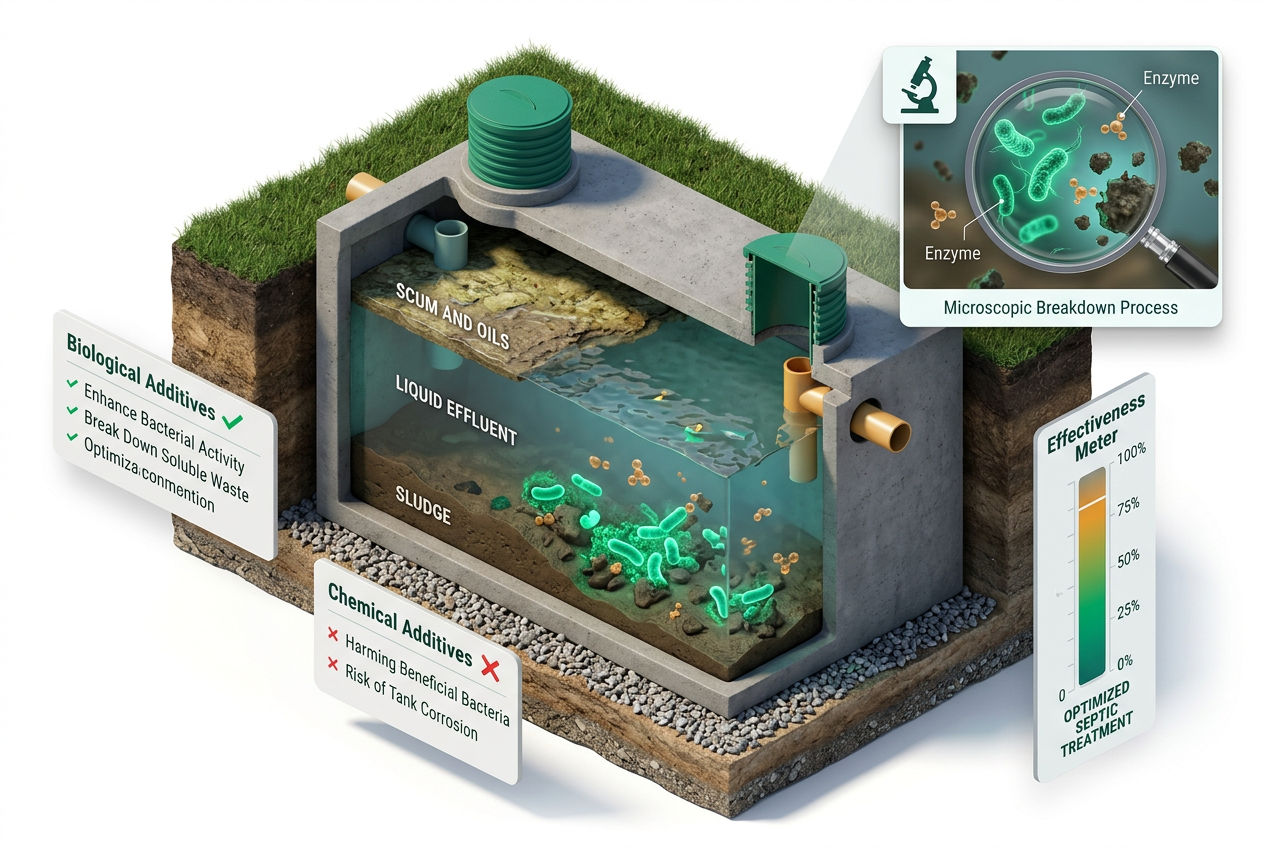
So why recommend them at all? Because most real-world septic systems aren't operating under ideal conditions. If your household regularly uses antibacterial soaps, bleach-based cleaners, or garbage disposal waste, your tank's native bacterial population takes a hit. In those cases, a monthly bacterial treatment acts as a corrective measure — restoring microbial balance after chemical disruption. The bacteria need help getting back to working levels, the same way your gut needs time to recover after a round of antibiotics wipes out the good microbes alongside the bad.
For a deeper look at the science, see our article on whether septic additives actually work.
What Are the Best Septic Tank Maintenance Products to Buy?
The best category of septic tank maintenance products for most homeowners is a biological septic treatment — specifically one that combines live bacteria with multiple enzyme types. Here's what to look for on any label before you buy.
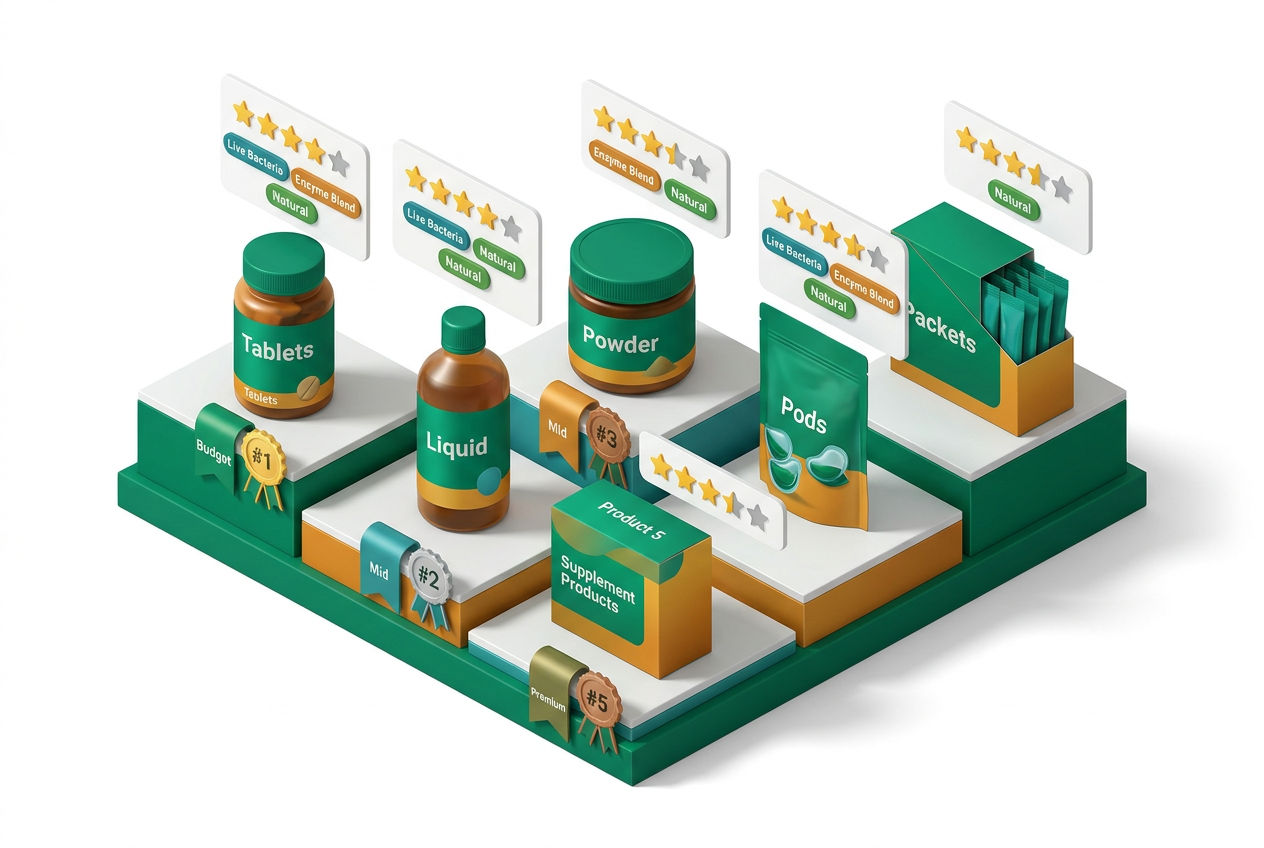
Bacterial Additives (Monthly Septic Treatment)
What they are: Packets, pods, or dissolvable tablets containing live bacterial cultures. The bacteria produce enzymes that break down solid waste in your tank.
What to look for:
- CFU count: At least 1 billion colony-forming units per dose. Some premium products deliver 5–10 billion CFUs. Higher counts matter most after a pump-out, when the tank needs to re-establish its bacterial population from scratch.
- Enzyme types: A quality product lists at least four enzyme types — protease (proteins), lipase (fats and grease), amylase (starches), and cellulase (paper and plant fiber). Single-enzyme products are less effective.
- Tank size compatibility: Most monthly treatments are formulated for tanks between 1,000 and 1,500 gallons. If you have a larger system — say, a 2,000-gallon tank on a rural property — you'll need to double-dose or choose a professional-grade product.
Top products in this category:
Rid-X is the brand most homeowners recognize. A single-dose packet contains approximately 9.8 billion CFUs and four enzyme types. At around $10–$13 per month of treatment, it's the budget benchmark. The EPA-registered formulation is a reasonable starting point. For a thorough breakdown, read our Rid-X septic review.
Septifix takes a different approach — compressed effervescent tablets that release bacteria and oxygen as they dissolve. Each tablet claims 10 billion CFUs across 14 bacterial strains. At roughly $25–$30 for a three-month supply, the per-treatment cost is higher, but users report strong odor control. See our Rid-X vs. Septifix comparison for a side-by-side breakdown.
Green Gobbler Septic Saver comes in convenient monthly pods and uses a blend of aerobic and anaerobic bacteria — useful for households with aerobic septic systems that need treatment beyond standard products. Priced around $20–$25 for a six-month supply.
How to use: Flush one dose down the toilet on the same day each month. After a pump-out, use a double dose to jump-start bacterial colonization. Time-to-activation is typically 24–72 hours before bacteria establish meaningful colonies.
Septic Tank Shock Treatment
Sometimes a monthly treatment isn't enough. If your tank has been ignored for years, or you've just moved into a home with no maintenance history, a shock treatment makes more sense than a standard monthly dose.
Shock treatments contain concentrated bacterial cultures — often 50–100 billion CFUs — along with surfactants that help break up grease accumulation along baffle walls and at the inlet tee. Products like BioTab for Septics or Roebic K-57 Septic System Opener are designed for exactly this scenario.
Real-world example: You buy a house with a 1,250-gallon concrete tank. Records show the last pump-out was six years ago. Before you can establish a monthly routine, you need to address existing sludge overload. A shock treatment buys you time — but it's not a substitute for scheduling a pump-out. Get the tank serviced, then start monthly maintenance afterward.
If your system is already showing signs of drain field failure, no product in this category will reverse the damage.
Enzyme-Based Septic Cleaners
Enzyme-based products differ from bacterial treatments in an important way: they contain stabilized enzymes without live bacteria. They work faster (enzymes act immediately; bacteria take hours to days to reproduce), but they don't self-sustain. Once the enzymes break down, the effect stops.
These products shine in a specific scenario: clearing slow drains caused by grease buildup in the pipe between your house and the tank. Products like Bio-Clean or RootX's enzyme companion work on the inlet side of the system without harming the bacterial colony in the tank.
Avoid using standard enzyme drain cleaners — especially those containing surfactants or solvents — anywhere near your septic system unless the label specifically says "septic safe." Better yet, check our guide to septic-safe drain cleaners before you buy anything for your drains.
Are Mechanical Maintenance Products Worth the Investment?
Mechanical products deliver more consistent, measurable protection than any biological additive — and most homeowners skip them entirely. That's a mistake worth correcting before the next pump-out visit.
Effluent filters are the single most impactful mechanical product for drain field protection. The Polylok PL-122 is the industry standard — a cylindrical mesh filter that installs at the outlet baffle of your tank and captures suspended solids before they enter the distribution box and leach laterals. Without a filter, fine particles exit with the effluent and progressively clog your drain field lines.
A Polylok PL-122 costs around $30–$60 installed by a plumber during a pump-out. Compare that to drain field replacement costs of $3,000–$15,000 and the investment calculates itself. If your tank doesn't have one, ask your pumper to install one at the next service visit.
Riser lids aren't a treatment product, but they belong in any honest list of maintenance products. Installing concrete or polyethylene risers to bring your tank access lids to grade level costs $200–$600 one-time — and saves $50–$150 in excavation fees every time your tank needs service. Our septic tank risers guide covers installation options in detail.
Septic Maintenance Product Comparison
| Product Type | Avg. Monthly Cost | Best For | Tank Size | Limitation |
|---|---|---|---|---|
| Bacterial additive (Rid-X) | $10–$13 | Routine maintenance | 1,000–1,500 gal | Won't fix failing system |
| Septifix tablets | $8–$10 | Odor control + bacteria | 1,000–2,000 gal | Higher upfront cost |
| Shock treatment (Roebic K-57) | $15–$20 one-time | Neglected systems | 1,000–1,500 gal | Not a pump-out substitute |
| Enzyme cleaner (Bio-Clean) | $12–$18 | Slow inlet drains | Any | No sustained colony |
| Effluent filter (Polylok PL-122) | ~$4/mo amortized | Drain field protection | All sizes | Requires pro installation |
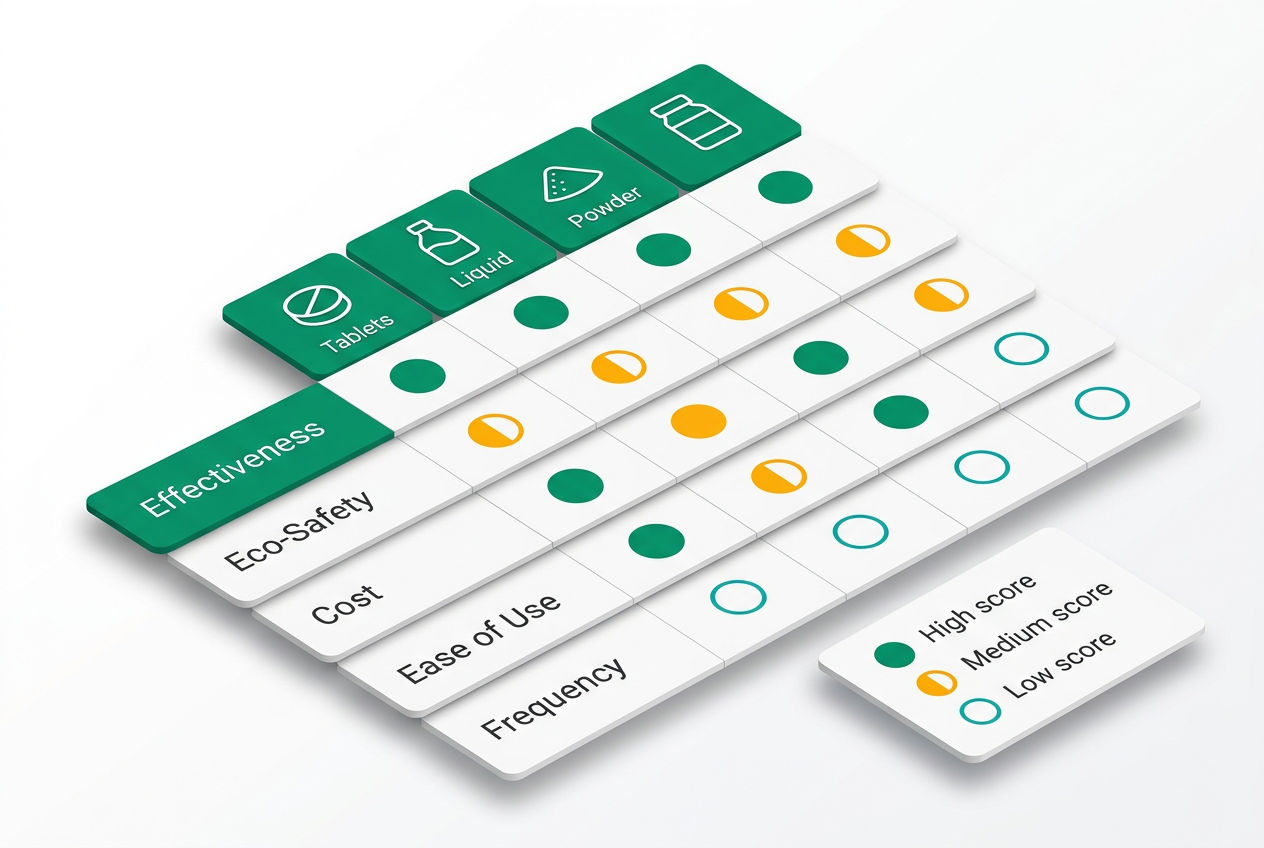
Sources: Product manufacturer specifications; EPA septic system guidelines (epa.gov/septic); NOWRA maintenance standards (nowra.org)
How Often Should You Treat Your Septic Tank?
For standard bacterial additives, once per month is the recommended frequency for most households. That said, frequency should scale with system load:
- 2-person household, 1,000-gallon tank: Monthly treatment is often sufficient. Consider quarterly if you're vigilant about what enters the system.
- 4-person household, 1,250-gallon tank: Monthly treatment is the baseline. Add a double dose in summer when guest traffic spikes.
- 6+ person household or short-term rental property: Monthly treatment plus a shock dose at the start of peak season. These systems need more frequent professional inspection too.
After a professional pump-out, always add a double dose immediately. Your tank's bacterial population has been removed along with the sludge — it needs to re-establish from zero, and a single standard dose isn't enough to seed a tank that size quickly. See our breakdown of septic pumping costs if you're budgeting for your next service visit.
What Should You Never Put in a Septic Tank?
Free download
Free: the Septic Fridge Card — what to flush, what never to.
The Do / Don’t card the whole family can see, plus the Survival Kit: emergency flowchart, warning-sign decoder and pump-schedule card. One printable PDF.
Some products actively harm your system — and they're worth knowing by name, not just category.
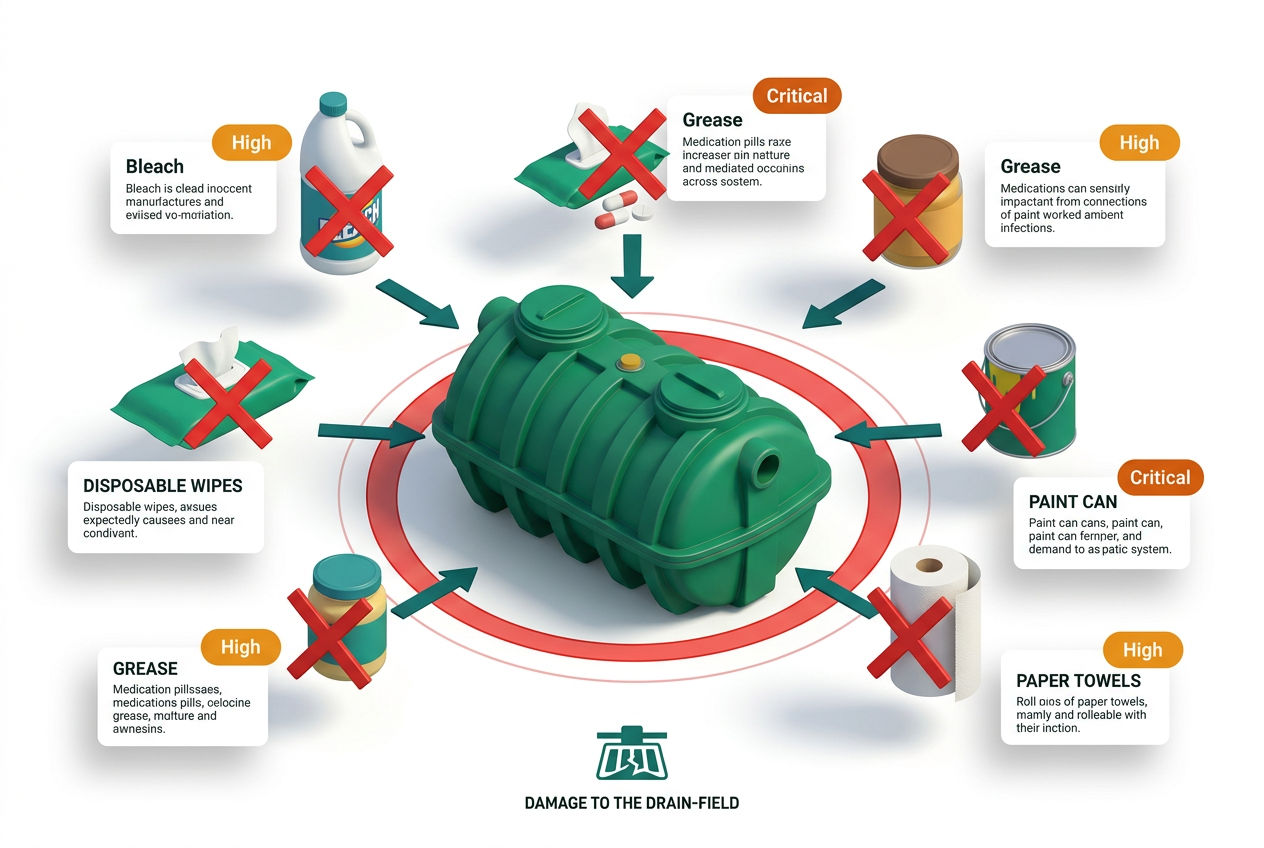
Chemical drain cleaners top the list. Products containing sodium hydroxide (lye) or sulfuric acid will sterilize your tank's bacterial colony within hours of contact. A single application of standard Drano can set back your microbial population by weeks. Read our full breakdown of why Drano is dangerous for septic systems before reaching for it on a slow drain.
Antibacterial soaps and bleach in large quantities do cumulative damage. Occasional use won't collapse your system, but households that run bleach loads daily or use antibacterial hand soap at every sink should compensate with more frequent bacterial treatments.
Garbage disposals push the limits of any septic system. Food solids increase the organic load significantly — some studies suggest disposal use can increase required pump-out frequency by 50%. If you have one installed, read our guide to garbage disposals and septic systems before your next pump-out conversation.
Wet wipes — even those labeled "flushable" — do not break down in septic tanks. They accumulate at the inlet baffle and cause blockages that no additive can address.
Which Best Septic Tank Additives Are Safe for the Environment?
Environmental safety is a legitimate concern — and it's more nuanced than "natural = safe."
Most bacterial additives on the market use strains of Bacillus bacteria — naturally occurring soil bacteria that are non-pathogenic and biodegradable. From a regulatory standpoint, these are generally considered environmentally benign. The Florida Department of Environmental Protection and Washington State Department of Health both publish approved product lists that screen for harmful chemical ingredients; checking your state's equivalent list is the most reliable way to verify a product before purchase.
The products to scrutinize are those containing surfactants, solvents, or chemical oxidizers — marketed as "septic openers" or "drain activators." These can disrupt the bacterial balance in your tank and introduce compounds into your soil absorption system that persist in groundwater. Enzyme-only products without chemical carriers are generally safer for drain field soil.
For a full breakdown of which products carry independent environmental certification, see our septic-safe products guide.
Seasonal Considerations for Septic Maintenance Products
Do Septic Tank Products Work Differently in Winter?
Yes — bacterial activity drops significantly as temperatures fall, and standard septic additives perform poorly in cold climates without the right bacterial strains.
Winter: Soil temperatures below 50°F cause most standard Bacillus strains to go dormant. For cold-climate households — particularly in northern states with extended freezing seasons — look for products specifically labeled with psychrophilic or cold-tolerant strains. These bacteria remain metabolically active near 35°F, maintaining waste breakdown through the coldest months. Standard products used in Minnesota or Maine winters may deliver close to zero benefit from November through March. See our guide to preventing septic pipes from freezing for additional cold-weather protection steps.
Summer: Heat accelerates bacterial activity — which sounds beneficial but creates its own management challenge. Higher temperatures increase the rate of anaerobic decomposition, which can spike hydrogen sulfide production and cause septic odors to become noticeable at the surface or inside the home. If you notice odors in summer, adding an aerobic bacterial supplement (one containing oxygen-releasing compounds like Septifix) can help shift the microbial balance.
Spring: After a cold winter, your tank's bacterial population may be suppressed even if you used cold-tolerant products. A shock treatment in early spring — before peak household load resumes — is a practical reset.
Vacation properties: Tanks that sit unused for months face a different problem: the bacterial colony starves without organic input. Add a shock treatment when reopening the property, and wait 48–72 hours before running full household loads to allow the population to re-establish. Aerobic septic systems require additional attention here — see our aerobic septic system maintenance guide for protocol details.
When Should You Call a Professional Instead of Using Products?
Septic tank maintenance products handle routine upkeep. They don't handle structural failure, drain field saturation, or pump malfunctions — and using products as a substitute for professional service in these situations delays necessary repairs and typically makes them more expensive.
Call a licensed septic professional, not a product, when you observe:
- Wet spots or lush grass patches over the drain field — these indicate effluent surfacing, which means the drain field is saturated or failing
- Sewage odors inside the home — this points to a venting problem, a full tank, or a broken baffle, none of which products address
- Gurgling sounds in multiple drains simultaneously — systemic drainage issues upstream of the tank itself
- Sewage backup — any backup warrants immediate professional inspection, not a shock treatment
- Tank hasn't been pumped in more than five years — no additive restores function to a tank operating at capacity
Our septic pumping and cleaning service connects you with licensed professionals in your area for inspection and pump-out scheduling. For a complete overview of when products stop being sufficient, see our septic tank maintenance guide.
Products are one layer of a maintenance strategy. Routine professional pump-outs, mechanical protection (effluent filter), and avoiding system-damaging household products are the other layers. For a complete overview, see our septic effluent filter guide.
Frequently Asked Questions About Septic Tank Maintenance Products
What are the best septic tank additives for a neglected system?
The best septic tank additives for a neglected system are concentrated shock treatments rather than standard monthly doses. Products like Roebic K-57 Septic System Opener or BioTab for Septics contain 50–100 billion CFUs per dose — significantly more than the 9–10 billion CFUs in routine maintenance products like Rid-X. These high-concentration formulas also include surfactants that help break up hardened grease deposits along baffle walls and inlet tees. For a tank that hasn't been pumped in six or more years, a shock treatment buys time but isn't a substitute for professional service. The correct sequence is: schedule a pump-out first, then apply a double dose of bacterial additive immediately after pumping to re-seed the tank, then transition to monthly maintenance. Using shock treatments without pumping on a severely overloaded tank will not prevent eventual drain field damage. Start with the pump-out, then choose your ongoing septic treatment products from there.
Are septic treatment products safe to use every month?
Yes — monthly use of bacterial septic treatment products is safe for your tank, your pipes, and your drain field when you choose biological formulations based on Bacillus bacteria and natural enzymes. Products containing only live bacteria cultures and enzyme blends (protease, lipase, amylase, cellulase) introduce nothing harmful to your system — these are naturally occurring soil microbes that biodegrade completely. What you should avoid using monthly are products containing chemical oxidizers, solvents, or surfactants marketed as drain openers or system "restorers." These can disrupt your tank's microbial balance and introduce persistent compounds into your drain field soil. States like Washington and Florida publish approved septic additive lists through their environmental departments — cross-referencing your product against those lists before purchase is the most reliable safety check available. Biological septic maintenance products used as directed on a monthly basis have no documented negative effects on properly functioning systems.
How do septic tank maintenance products work in cold weather?
Most standard septic tank maintenance products become significantly less effective in cold weather because the bacterial strains they contain — typically mesophilic Bacillus species — go dormant below 50°F. In northern climates where soil temperatures drop into the 30s from November through March, a standard monthly treatment may deliver minimal benefit for four to five months of the year. The solution is to choose products specifically formulated with psychrophilic or cold-tolerant bacterial strains, which remain metabolically active near 35°F. These cold-weather bacterial additives maintain waste breakdown activity through freezing conditions that would suppress standard strains entirely. Look for the terms "cold-tolerant," "psychrophilic," or "works in cold temperatures" on the product label. If you've been using a standard product through cold winters without knowing this, a shock treatment in early spring — once soil temperatures rise above 50°F — helps re-establish the bacterial population before peak household demand resumes.
What is the difference between septic tank additives and septic treatment products?
"Septic tank additives" and "septic treatment products" are often used interchangeably, but there's a useful distinction worth understanding before you shop. Septic tank additives typically refers to biological products — live bacteria cultures and enzyme blends — that supplement or restore the microbial population inside your tank. These include monthly maintenance packets like Rid-X and shock treatments like Roebic K-57. Septic treatment products is a broader category that includes biological additives but also covers mechanical maintenance items like effluent filters (Polylok PL-122), enzyme-only drain treatments for inlet pipes (Bio-Clean), and system-specific treatments for aerobic septic units. For most homeowners, the important practical difference is this: biological additives address what's happening inside your tank at the microbial level, while mechanical products like effluent filters address what exits your tank and enters your drain field. A complete maintenance approach uses both categories together, not one as a substitute for the other.
Do the best septic tank products eliminate the need for pumping?
No septic tank product — regardless of CFU count, enzyme variety, or marketing claims — eliminates the need for regular pump-outs. This is a documented regulatory position: the EPA explicitly states that biological additives are not necessary for a properly functioning septic system and do not replace pumping. The reason is physical rather than biological. Even the most active bacterial colony cannot fully mineralize all solid waste. Inorganic materials — grit, non-biodegradable solids, excess inorganic compounds — accumulate in the tank regardless of microbial activity. Over time, this accumulation reduces effective tank volume and pushes solids into the effluent stream. A 1,000-gallon tank serving a four-person household typically requires pump-out every three to five years under good maintenance conditions. The benefit of consistent use of septic maintenance products isn't eliminating pump-outs — it's potentially extending the interval between them and reducing the organic load your pumper has to remove each visit.
Which septic tank maintenance products work best for aerobic systems?
Aerobic septic systems require different maintenance products than conventional anaerobic tanks because they use oxygen injection to accelerate waste breakdown rather than relying solely on anaerobic bacterial digestion. For aerobic units, choose bacterial additives that contain aerobic bacterial strains — those that thrive in oxygenated environments — rather than standard anaerobic-only formulations. Green Gobbler Septic Saver is one of the more accessible products that explicitly includes both aerobic and anaerobic strains, making it compatible with aerobic treatment units. Avoid products that are labeled only for "conventional septic tanks," as these may introduce bacterial strains that compete poorly with the aerobic environment your system maintains. Beyond bacterial additives, aerobic systems require regular inspection of the air compressor or aerator component — a mechanical failure that no additive can compensate for. Check our aerobic septic system maintenance guide for a full protocol. In regulated states, verify that any additive you choose appears on the approved product list before adding it to an aerobic unit.
Sources & Methodology
-
U.S. Environmental Protection Agency — Septic Systems Overview (epa.gov/septic): Used for statistics on U.S. household septic system prevalence (21 million households), EPA position on biological additives, and general regulatory framework. Accessed January 2026.
-
University of Arkansas Cooperative Extension — Septic System Additives Research: Used for the two-year controlled study finding that bacterial additives did not meaningfully reduce sludge accumulation compared to untreated control tanks. Published findings cited for the "Do Products Actually Work?" section.
-
National Onsite Wastewater Recycling Association (NOWRA) (nowra.org): Used for maintenance frequency standards and professional service recommendations referenced in the comparison table and frequency section.
-
Florida Department of Environmental Protection — Approved Septic Additives List: Used for state-level regulatory context in the environmental safety section. Florida DEP maintains a current list of reviewed septic products.
-
Washington State Department of Health — On-Site Sewage Systems: Used for state restriction context on septic additives. Washington maintains specific guidance on additive use in on-site sewage systems.
Was this article helpful?
Frequently Asked Questions
Recommended Resources
📖 Related Articles
- How Often Should You Pump Your Septic Tank?
- Do Septic Tank Additives Actually Work? (The Science)
- Rid-X for Septic Tanks: Does It Help or Hurt?
- Signs Your Drain Field Is Failing (And What to Do)
- The Best Septic-Safe Drain Cleaners (and What to Never Pour In)
- How to Install Septic Tank Risers (and Why You Should)
- How Often Should You Service Your Septic System?
- Can You Use Drano with a Septic System?
- Can You Use a Garbage Disposal with a Septic System?
- Septic-Safe Products: What to Use (and What to Avoid)
- Freezing Pipes and Septic: How to Prevent Winter Damage
- Aerobic Septic System Maintenance: The Complete Guide
- The Complete Septic Tank Maintenance Guide
- Septic Effluent Filters: Do You Need One?
💰 Cost Guides
🔧 Services
Find Septic Professionals Near You
Compare licensed, verified septic companies by area — top county markets and cities below, or browse all 50 states.
County markets
Popular cities
